
• 検索結果がありません。

Questions and Common Ground Building: Cross-Cultural Perspectives of Japanese and American English

N/A
N/A
Protected

Academic year: 2021

シェア "Questions and Common Ground Building: Cross-Cultural Perspectives of Japanese and American English"

Copied!
19
0
0

読み込み中.... (全文を見る)

全文

(1)

Questions and Common Ground Building:

Cross-Cultural Perspectives of Japanese and American English

Kishiko Ueno

Key words: questions, Japanese, American English, common ground, information- al/affi liational imperatives

1. Introduction

Numerous studies have been made to reveal how and in what style Ameri- can

1

and Japanese speakers communicate with each other in order to achieve mutual understanding. Th e studies so far have obtained fruitful results show- ing the contrast between American and Japanese speakers on issues such as their preferred conversational styles (Mizutani 1983; Maynard 1997). Th e current study will analyze the use of questions in American English and Japa- nese conversation as an attempt to disclose how American and Japanese speak- ers establish mutual understanding. Moreover, the use of questions will be explicated by drawing upon the notion of “common ground,” i.e., “mutual knowledge, shared by social associates” (Enfi eld and Levinson 2006: 23) since this approach is thought to succeed based on the assumption that a question is one of numerous conversational devices that contribute to building mutual knowledge.

Th e motivation for this study to examine questions in conversation origi- nates in an initial impression I formed from looking at the conversational data contained in the Mr. O Corpus.

2

Th at is to say, in Japanese conversation, as the interaction proceeds, the distinction becomes blurred with regard to whom the utterance in question belongs, and vital information is buried in the conversational fl ow, while in English conversation the agent of the utter- ance in question is always obvious and the information off ered is well ordered.

A closer examination suggested that these diff erences rest largely on the diff er- Studies in English and American Literature, No. 45, March 2010

©2010 by the Engish Literary Society of Japan Women’s University

(2)

ing patterns of question asking. Because a large part of the bilateral interac- tional process depends on question-answer exchanges (Maynard 1997: 209), discerning diff erences in the use of questions may result in shedding new light on the contrastive features of Japanese and English communication.

Th us, this study aims to (1) investigate how English and Japanese speakers engage themselves in participant roles and use questions in conversation, and (2) illustrate how the use of questions is related to the feature of conversa- tional development. Finally, the result of the analysis is explained in terms of the notion of common ground building.

Because of the purposes of the study, both quantitative and qualitative analyses will be conducted. Th e former discloses the distribution of questions, and the latter denotes the distinctive features of question-asking and conver- sational development associated with the use of questions.

2. Background of the study

2.1. Common ground and informational/affi liational imperatives

According to Enfi eld (2006), the term “common ground” includes two levels of meaning: the cultural and personal levels. At the cultural level, the term common ground encompasses a common language and common cul- tural resources for participants to adopt culturally relevant participant roles (Enfi eld and Levinson 2006: 20), which rest largely on cultural co-member- ship. At the personal level, common ground refers to knowledge that is openly shared by participants in their current interaction, i.e., what has been described as physical and linguistic co-presence. Th us, it can be said that in the course of interaction participants incessantly exploit common ground at the cultural level, and produce common ground at the personal level.

Another key notion for this study is the “informational and affi liational

imperatives.” According to Enfi eld (2006), the act of common ground build-

ing is closely interlinked with these imperatives. Th e informational imperative

requires individuals to cooperate with their interlocutors in maintaining a

common referential understanding. Second, the affi liational imperative re-

quires interlocutors to maintain a common degree of interpersonal affi liation,

proper to the status of the relationship. Of special signifi cance is the fact that

cultures diff er with respect to the determination of relationship intensity, and

(3)

in the practices by which such intensity is maintained (Enfi eld 2006: 413). It would be reasonable, therefore, to assume that there are diff erences between English and Japanese speakers in their ways of handling the informational and affi liational imperatives.

2.2. Studies of questions

2.2.1. Studies of English questions

Questions have been studied by a number of scholars with diff erent inter- ests. Speech act theorists have classifi ed questioning as a type of directive, which is an attempt by the speaker to make the audience react verbally (Austin 1962). Conversation analysts are interested in the sequence of questions and answers, as well as how they operate in the structure of conversation (Sacks et al. 1974). Anthropological linguists explore how each speech community develops its own norms for how questions are used (Gumperz 1982). And interactional sociolinguists have studied intercultural diff erences in question- asking (Tannen 1984). Of particular signifi cance to this study are issues raised as to the interactional and conversational eff ects of questions. Th at is, ques- tions other-select the occupant of the next turn and determine the sequential relevance of a next move (Sack et al. 1974); consequently, a large part of the conversational process is contingent on the use of questions. Moreover, due to the functions of gathering information, showing interest, and encouraging the addressee to participate in talk, questions create a momentary involvement in a topic (Tannen 1984).

2.2.2. Studies of Japanese questions

A number of studies have been made to examine Japanese questions in terms of their forms, functions, and modality. Th e National Institute for Japa- nese Language (1960), for example, presented a taxonomy of interrogative postpositions according to their functional types. As for the functions and modality of individual interrogative postpositions, productive studies have been presented by Nitta (1992), Adachi (1999), and others.

In contrast to considerable attention given to the forms, functions, and

modality of questions, only a few attempts have so far been made to investi-

gate how questions are used in conversation. Sakakura (1954), one of a lim-

(4)

ited number of studies referring to the use of questions, used a play scenario as data and pointed out that more than half of the lines of the scenario expect completion by the addressee. He argued that a large part of so-called “declara- tives” in the data are inclined to the category of interrogatives, since they are addressed to the other with the intention of soliciting a response. Kurosaki (1991), based on the investigation of the use of questions in conversation, claimed that half of the questions in the data requested confi rmation. He also concluded that questions are likely to be designed to elicit affi rmative answers, thus ensuring harmony between speakers.

3. Data

Th e data for this study consist of ten American English and ten Japanese conversations contained in the Mr. O Corpus. Th e participants in each con- versation are two close female friends. Th e English participants are students studying in colleges in Tokyo, ranging in age from 20 to 22. Th e Japanese participants are college students living in Tokyo, ranging in age from 20 to 22.

Th ey are all native speakers of their language. Th e participants were asked to talk freely in pairs about things that have surprised them in their everyday life and they spent approximately fi ve minutes engaged in dyadic conversation.

Th e current study used the fi rst fi ve-minute conversation in each pair. Th e total length of the data is 50 minutes for both English and Japanese conversa- tions.

4. Defi nition of questions

Th is study attempts to fi nd a defi nition of questions acceptable to both

languages, considering their forms and functions in context. Th us, questions

in the current study are defi ned as utterances that meet both of the following

conditions: (1) they have a form generally categorized as questions or rising

intonation at the end, and (2) they trigger another utterance as a reply from

the interlocutor. As for English, included in the form of questions are subject-

auxiliary inversion, “wh” questions, and declaratives with rising intonation

and interrogative tags. Moreover, expressions indicating the speaker’s doubt

such as “I guess . . .” are included inasmuch as they elicit an utterance from

the other. As for Japanese, included in the form of questions are declaratives

(5)

with rising intonation, “wh” questions, and utterances that have postpositions listed in Th e National Institute for Japanese Language (1960). Th e listed items are postpositions such as ka, no, ne, yone, kana, kashira, deshoo, jan, and janai(ka).

5. Results and analysis

5.1. Frequencies and functions of questions

Using the above defi nition, 105 questions in the English conversations and 260 questions in the Japanese conversations were identifi ed. To reveal how these questions function in their conversational context, the analysis begins by classifying them according to the following four functional types: (1) eliciting information, (2) eliciting confi rmation, (3) eliciting a new topic, and (4) clarifying information. Defi nitions and examples of the functional categories are provided below.

(1) Eliciting information:

Th is type is a question that is asked to elicit new information. Th ere are three kinds of informational questions, depending on the type of information that the questioner seeks. Th e types of information are (1) yes/no information, (2) “wh” information, and (3) alternative choice from two or more possible answers suggested by the questioner. Th e following are examples of questions by which the questioner seeks a yes/no answer.

( i ) A: It was a big bumblebee too, it just like sat down, and I’m like,

“Ow!”

B: It stung you?

A: Yeah.

(ii) A: obakeyashiki hait-ta?

3

haunted house enter-PAST

“Did (you) enter the haunted house?”

B: hait-ta, byooin no yatsu.

enter-PAST hospital GEN one

“Yes, (I) entered the one like a hospital.”

(2) Eliciting confi rmation:

Th is is a question that is asked to elicit the other’s confi rmation of the

(6)

proposition provided by the questioner. Nitta (1992: 152) calls this type of question a “pseudo-question” inasmuch as it is not used to request informa- tion, but rather to elicit confi rmation about the proposition that the ques- tioner has presented. In English, questions eliciting confi rmation are mainly realized by tag questions, negative questions, declaratives with rising intona- tion, and expressions such as “I wonder.” In Japanese, they are realized by the attachment of postpositions such as yone, janai, jan, or deshoo.

(iii) A: It’s like she’s just like sort of leaving, [right?

B: [Yeah, yeah.

(iv) A: demo, zenzen kizuite nai wake ja nai yone but utterly notice NEG case COP NEG FP

“But it is not likely that (she) doesn’t realize at all, right?”

B: soo da yone.

so COP FP

“Th at’s right.”

(3) Eliciting a new topic

Th is is a question that is asked to elicit a new topic from the other. Th e use of this type of questions makes a topic boundary.

( v ) A: Do you have a surprising story to share with me today?

B: Oh, okay.

(vi) A: Nanka ari masu ka?

something have ADD HON Q

“Do (you) have something (to talk about)?”

B: ee, konomae, konomae, Fujikyuu ni it-ta no ne well lately lately Fujikyuu to go-PAST FP FP

“Well, (I) went to Fujikyuu the other day.”

(4) Clarifying information:

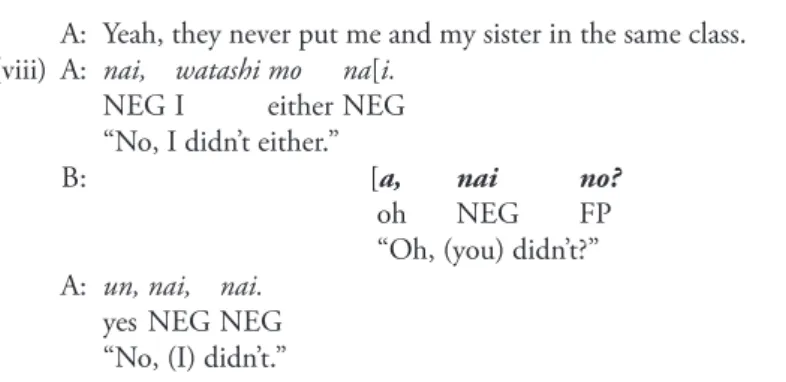
Th is is a question by which the speaker asks for information to clarify the other’s prior utterance. Th e speaker is checking the accuracy of what is newly received, and sometimes conveying slight unexpectedness.

( vii ) A: And during like, junior high and everything, they always try and separate twins.

B: Oh, do they?

(7)

A: Yeah, they never put me and my sister in the same class.

(viii) A: nai, watashi mo na[i.

NEG I either NEG

“No, I didn’t either.”

B: [a, nai no?

oh NEG FP

“Oh, (you) didn’t?”

A: un, nai, nai.

yes NEG NEG

“No, (I) didn’t.”

Table 1 below shows the frequency of question occurrence according to their functional type.

Table 1. Functional types and frequency of questions in English and Japanese con- versation (EN: 50 min., JP: 50 min.)

Functional types Raw count (Percentage)

English Japanese

Eliciting information

Yes/no information 20 (19.0)

46 (43.8)

66 (25.4)

86 (33.1)

“Wh” information 15 (14.3) 19 (7.3) Alternative choice 11 (10.5) 1 (0.4)

Eliciting confi rmation 28 (26.7) 142 (54.6)

Eliciting a new topic 16 (15.2) 23 (8.8)

Clarifying information 15 (14.3) 9 (3.5)

Total 105 (100.0) 260 (100.0)

Th e notable points that the data in Table 1 show are as follows. (1) In a 50–

minute conversation, 105 questions occurred in English conversation, and

260 questions in Japanese conversation; questions in Japanese conversation

occurred 2.47 times more frequently than those in English conversation. (2)

Th e question type that occupied the greatest part in English conversation was

question eliciting information (43.8%), while that in Japanese conversation

was questions eliciting confi rmation (54.6%). (3) Th ere is a tendency for

English speakers to use questions that pursue or clarify information, as shown

in the relatively higher rates of questions which seek “wh” information and

(8)

alternative choice, as well as clarifi cation questions. (4) Th ere is a tendency for Japanese speakers to ask for a yes/no answer when using information ques- tions, while primarily asking for the other’s confi rmation.

What do these diff erences mean? In the following, English and Japanese examples of typical patterns are presented in order. Th e data are analyzed fo- cusing on (1) how the speakers defi ne their participant roles and use ques- tions, and (2) how the use of questions contributes to conversational develop- ment.

5.2. Questions in English conversation

Th e qualitative examination of English data discloses a tendency that one partner is engaged in narrating a story about her surprising experience, while the other listens as well as supports the elaboration of the story by asking ques- tions aimed at making the informational content more explicit or detailed.

Th us, questions operate as a device that is mainly used by the topic recipient to garner further information from the topic provider. Th ese fi ndings corre- spond with the results of the quantitative analysis showing questions to elicit information accounting for 43.8% of the overall occurrence of questions.

Now we will show an example. In Excerpt 1, the topic provider E1 begins to talk about her experience of when she was shocked at the news of her sister’s pregnancy.

[Excerpt 1]

01 E1: I was surprised when my sister told me she was pregnant.

02 E2: Yeah, I was actually thinking of that because you told me, t — told me earlier, and that, I was thinking, and I bet that was a shocker for Sarah.

03 E1: Yeah, well, the reason it was so shocking is because she called me on my cell phone, and I had just gotten out of my friends play, and then, I don’t remember what I was doing, but anyway, she called me, and it was both my sisters and they just told me like, ‘Sarah, uhh . . . we have something to tell you’, and I was like, ‘What?’ and she’s like,

‘Oh, Hannah has like a bun in the oven’ or something, and I was

like, ‘What?!’ {laugh}

(9)

04 E2: [Uh-huh.

05 E1: [And then, I was in the middle of this like huge crowd of people, and I was like, ‘Are you kidding?, like, what are you talking about?’, and then, I was very surprised. {laugh}

06 E1: And then I told my [friends, I was like ‘Hold on a second, my sister’s having a baby!’ {laugh}

07 E2: [Uh-huh.

08 E1: And then her boyfriend thought I was weird or something. {laugh}

09→E2: Your friend’s boyfriend or your sister’s? =

10 E1: =My friend’s [boyfriend.

11 E2: [Uh-huh . . .

[yeah.

12 E1: [Yeah.

13 E1: And the way they told my [parents was on Valentine’s day . . . well, my sister, my parents, my sister and her . . . that — at that point boyfriend were like, ‘Um, we have something to tell everyone, uhh . . . Hannah’s pregnant’.

14 E2: [Uh-huh.

15 E2: {laugh} Wow.

16 E1: And it was the worst Valentine’s Day surprise ever.

17→E2: What did your parents do?

18 E1: Uh . . . my dad was just . . . didn’t say anything, he was just like, {laugh} completely silent.

19 E1: And my mom was like, ‘Well, what are you going to do about it?’

In Excerpt 1, two questions are presented by the topic recipient E2 (lines 09

and 17). Th e clarifi cation question in line 09 is asked to obtain an accurate

understanding of the proposition being provided by E1. In line 17, right after

E1 concludes her story (line 16), a “wh” question is asked to gain information

about E1’s parents’ reaction when they heard that their daughter was preg-

nant. Th is question prompts E1 to talk further, by which E2 successfully ac-

quires further information. Although it is implied by E2’s utterance in line 02

that a certain part of this story has already been shared by E1 and E2, who are

close friends, E2 is persistently engaged in a role of listening and supporting

(10)

the elaboration of E1’s story by asking questions. E1, on the other hand, is engaged in a role of providing information. Consequently, through the inter- active process of E1’s providing information and E2’s question asking, mutu- ally shared knowledge is built and amplifi ed.

Th e tendency illustrated in Excerpt 1 is not unique, but rather it is perva- sively observed in English data. Let us show another example. In Excerpt 2, E3 broaches her topic: she is surprised to know that some of the athletic clubs at Japanese colleges make a rule of not drinking water during practice.

[Excerpt 2]

02 E3: In when they have like clubs in Japan at schools . . . like you know they do the whole senpai-kohai [thing.

03 E4: [Uh-huh.

04 E3: And they make these rules.

05 E3: So my, one of my girlfriends at college is in a club, like . . . on . . . with our . . . the like the Japanese campus . . . she’s on the cheer club.

06 E4: Yeah.

07 E3: And, they make these rules where like you can’t do things or you have to do things, which is, you know xxx, we kind of do that kind of stuff [in the States.

08 E4: [Yeah.

09 E3: But they don’t let them drink water.

4
10 E3: At least the cheergirl, she can drink like this Gatoraid stuff , but my friend who is on the track team; nothing.

11 E4: Na [ . . .

12 E3: [Th ey go to practice right after school, like th[ree.

13→E4: [How long is practice?

14 E3: She said it was like four hours long.

15 E3: Th ey have to run all the relays, they do all their practices, you know, and [the . . .

16→E4: [And they don’t drink in between?

17 E3: No, the . . . the little kids weren’t allowed to . . . not the little kids,

(11)

but like the . . . you know the freshmen, the sophomores weren’t allowed to drink anything.

Excerpt 2 exhibits a pattern of conversational process and question asking similar to that seen in Excerpt 1 — one participant plays a role of narrating a story and the other listens and asks questions. Two questions which occurred in Excerpt 2 (lines 13 and 16) are asked by the topic recipient, E4, and they contribute to producing a further stage of E3’s story. Th e “wh” question (line 13) elicits detailed information (lines 14 and 15). Th e eliciting confi rmation question (line 16) suggests a reasonable consequence guessed from what E3 has told so far. E3 replies to it in the negative and commits herself to adding further information (line 17). Consequently, E3 is engaged in the role of the information provider, and E4 the information recipient as well as elicitor throughout.

As illustrated in the two examples above, in the setting where two close friends are asked to talk freely about surprising experiences, English speakers spontaneously defi ne their participant role as a topic provider or a topic re- cipient, and these roles continue for as long as the topic itself is sustained. Th e questions mainly function as a device for the topic recipient to gain addi- tional information, and to make information provided by the other more ex- plicit and detailed.

It is worth mentioning that the results of our English data showing that question asking serves to clarify and expand on information have much in common with previous studies (Yamada 1997: 6, Maynard 1997) which claim that the goal of American communication is to make messages negotiated between individuals explicit. It could be inferred that questions are one of a number of devices used in negotiations conducted for the purpose of attaining a communicative goal, namely, to make messages explicit.

5.3. Questions in Japanese conversation

Th e quantitative analysis showed notable diff erences in the distribution of

questions between the English and Japanese data. As mentioned earlier, in

Japanese conversation the overall frequency of questions is 2.47 times higher

than that in English conversation. Th e higher frequency is largely attributed

(12)

to the confi rmation questions, which comprised 54.6% of the overall occur- rence of questions.

Th e qualitative analysis revealed that these diff erences are the outcome of Japanese speakers’ diff ering ways of defi ning participant roles and of using questions. Unlike English conversation, in which one of the pair spontane- ously assumes the role of narrating a story and questions are mainly used in such a way that the topic recipient elicits further information, in Japanese conversation neither the topic provider nor recipient has such an intense at- tachment to their respective participant roles as do the English speakers. In- stead, Japanese speakers tend to blur the boundary between the topic provider and recipient through the use of questions from both sides. To put it more precisely, the topic provider narrates using questions to elicit a response from the other, while the topic recipient extends her involvement in the progression of the story by eliciting further information as well as adding something to the story, which then calls for the topic provider’s confi rmation.

Now let us present an example. At this point, in Excerpt 3, J1 begins to talk about a dying crow she found on the way to college.

[Excerpt 3]

01 J1: gakko kuru toki ni

“When coming to college.”

02 J2: un “Yeah.”

03→J1: mejiro doori aru jan?

“Th ere runs Mejiro street, right?”

04 J2: un un un un

“Yeah yeah yeah yeah.”

05 J1: futsuu ni aruiteta no

“I was walking as usual.”

06 J2: un “Yeah.”

07 J1: soshitara karasu no nakigoe ga shita no ne

“Th en I heard a cry of a crow.”

(13)

08 J1: shitara shita ni ite karasu ga de hikkuri kaettete

“And then there was a crow on the ground and it lay down on its back.”

09→J2: ee, hikkuri kaetteta no?

“Oh, did it lie down on its back?”

10 J1: de shinisoo datta no

“And it was going to die.”

11 J2: hee “Indeed.”

12→J1: de, nande daroo, mushi ga shinisoonano to chigatte karasu tte okkii desho?

“And, how to say, diff erntly from a bug being dying, a crow is big, isn’t it?”

13 J2: un un un un

“Yeah, yeah, yeah, yeah.”

14→J1: de, makkuro jan?

“And it is really black, isn’t it?”

15 J2: un “Yeah.”

16 J1: un, sugoi ne, nan daro, karasu gurai okkii to kekkoo

“Well, really, how to say, being as big as a crow, defi nitely . . .”

17→J2: bibiru yone?

“We get cold feet, don’t we?”

18 J1: nandaro, un, ningen poi to wa iwanai kedo, doobutsu tte kanji datta

“How to say, well, I don’t say it was like a human being, but it was like an animal.”

Note that in line 3, J1 broaches her topic using a confi rmation question and gains J2’s affi rmative response (line 04). It is about the public fact (“Th ere runs Mejiro street”) that J1 asks for J2’s confi rmation. It would be alternatively pos- sible for J1 to lead in the topic without using a confi rmation question, just like

“Gakko ni kuru toki ni Meijiro doori wo aruite itara (When I came to college,

I was walking along Mejiro street).” If it had been presented like that, how-

(14)

ever, a defi nite response like “un un un un (yeah, yeah, yeah, yeah)” would not have been elicited from the other. Th erefore, this confi rmation question, which can be interpreted either as an attempt to call J2’s attention to what J1 is beginning to talk about, or else to avoid beginning narration without regard for J2, causes the eff ect that shared context is created so that J2 is promoted to be involved in the progression of the story J1 is narrating.

After line 08, four questions occurred (lines 09, 12, 14, and 17). Th e clari- fi cation question used by J2 (line 09) conveys her slightly surprised feelings when receiving J1’s prior utterance, and is followed by J1’s continuation of her narrating. Th e two confi rmation questions in lines 12 and 14 are used by the topic provider, J1, where she tries to illustrate how terrible the dying crow was, and the two questions result in eliciting an affi rmative response from the other (lines 13 and 15). Th us, these confi rmation questions function as a device for J1 to make it possible to relate a story on the one hand, and elicit J2’s response at times on the other hand. Finally, in line 17, J2 uses a confi rmation question to say “bibiru yone? (We get cold feet, don’t we?).” Th is question conveys a consequential assessment that the topic provider, J1, is expected to have been going to present. It is thought that J2’s substitution for J1 to make a conse- quential remark is triggered by J1’s way of narrating the story, that is, narrating with questions that allow space for the other to be involved in and develop the story. Th us, the two speakers bi-directionally co-create a story and do not show very intense attachment to distinctive roles as a topic provider or recipi- ent.

Th is type of interaction and question asking was distinctively and perva- sively observed within our Japanese data. Let us look at another example.

In Excerpt 4, J3 begins to talk about her experience of going to a haunted house at Fujikyuu, an amusement park. Just after raising her topic, J3 asks a yes/no questions (line 03).

[Excerpt 4]

01 J3: ee, kono mae {laugh} Fujikyu ni itta no ne

“Well, I went to Fujikyu before.”

02 J4: un

“Yeah.”

(15)

03→J3: {laugh} kono mae Fujikyu itta toki ni, Fujikyu itta ko, itta?

“When I went to Fujikyu the other day, have you ever been there?”

04 J4: itta, itta “Yeah, yeah.”

05 J3: nanka, kono mae, itta no

“Well, I went there the other day.”

06 J3: de, kono mae itta toki ni, o, obakeyashiki haitta koto nakute

“And when I went there the other day, I had not had an experience of entering a haunted house.”

07→J3: obakeyashiki ni haitte, saisho saa, shashin toru tokoro ga aru jan?

“And I entered a haunted house, and then there is a place where we take a photo, isn’t there?”

08 J4: a, ja, chi, chigatta kamo shirenai

“Oh, maybe it is diff erent (from the one I went to).”

09 J3: hontoo ni sa, iroiro sa, heya ga atte sa, choo bikkuri shite

“Really, there are various rooms, and I was really surprised.”

10→J4: hito dete kita?

“Did a fi gure appear?”

11 J3: dete kita “Appeared.”

12 J3: okkake ra, nanka, soko made ja nai kedo, okkake rare tari shitete {laugh}

“Run after, like, not that much, but I was run after.”

13 J3: soo, bikkuri shita

“Yeah, I was surprised.”

14→J4: obakeyashiki kei bikkuri suru ne?

“All kinds of haunted houses are surprising, aren’t they?”

15 J3: soo da ne “Th at’s right.”

In the same way as in Excerpt 3, the topic provider in the current example uses

a question in leading in the topic. In line 03, J3, who has just started her story,

(16)

changes her orientation and moves into asking a question to fi nd out whether or not J4 has been to Fujikyuu, and she gains J4’s positive response (04). In line 07, J3 uses a confi rmation question when narrowing the story into her experience of going to a haunted house.

Following on, the topic recipient J4 asks a question to obtain further infor- mation about the haunted house being talked about (line 10). Finally, in line 14, J4, who originally was the topic recipient, concludes the story calling for J3’s confi rmation saying “obakeyashikikei bikkuri suru ne (All kinds of haunted houses are surprising, aren’t they?),” and obtains J3’s positive response.

Th e questions that occurred in Excerpt 4 are interpreted similarly as those in Excerpt 3. Th e former two questions asked by J3 facilitate J4’s involvement in the current story J3 is telling. J4 supports the development of the story by eliciting further information, and fi nally is led to substituting for J3 to make a concluding remark.

What the two examples above show is that it is typical for questions in Japanese conversation to occur from both sides, unlike English questions, which tend to occur in the phase where the topic provider goes through her story telling and in turn the recipient supports the expansion of the informa- tional content. Th e question types most frequently used by Japanese speakers are, as the data in Table 1 showed, confi rmation questions, and they are fol- lowed by information questions that seek a yes/no answer. In particular, ques- tions to elicit confi rmation are productively used throughout the conversa- tional process in order to off er propositional content conveying expectation of the other’s accordance. Th is leads to creation of shared context and allows the other space to add something to the story being narrated. Th e frequent use of confi rmation questions would not be impossible to explain as no more than a

“fashion of speaking.” However, it cannot be ignored that relating with confi r- mation questions results in eliciting some verbal response from the other and can aff ect how the speakers play participant roles in conversation as well as how the story develops, as discussed above.

6. Questions and common ground building

According to Enfi eld (2006), individuals being engaged in interaction in-

cessantly exploit common ground, i.e., mutual knowledge. At the same time,

(17)

they are inclined to satisfy the informational and affi liational imperatives.

Th at is, in the course of conversation, participants cooperate with their part- ners in maintaining a common referential understanding, while maintaining a common degree of interpersonal affi liation proper to the status of the rela- tionship. Now, the results of the analysis are explicated in terms of the criteria suggested by Enfi eld (2006).

As for the English pairs, the informational imperative is satisfi ed through the integration of narrating a story on one side and supporting the elaboration of the story on the other. Th e latter is realized by question-asking, whereby the mutual knowledge is made more comprehensive. On the assumption that neither the informational nor affi liational is primary or secondary (Enfi eld 2006: 399), the satisfaction of the affi liational imperative is understood to be attained by subordinating the bilateral contribution to the production of mu- tual knowledge. Th us, in English conversations, the fulfi llment of the infor- mational and affi liational imperatives can be conveyed by the two sides’

jointly building common ground that contains suffi cient and elaborated in- formation.

On the other hand, the way in which Japanese participants meet the infor- mational imperative is through narrating a story on one side and expanding involvement in the story being narrated on the other. Questions are mutually used throughout by both sides so that a common ground is bi-directionally created that constitutes an accordant context. Devoting themselves to the process of common ground building inevitably leads the participants to fulfi ll the affi liational imperative as well.

Th e realization of diff ering types of common ground building observed in English and Japanese data can be attributed to the cultural common ground shared by pairs of close female friends who speak a common language. It is thought that the diff erences in the act of common ground building between English and Japanese speakers are the outcome to diff ering cultural common ground, namely diff ering cultural resources that make the speakers play cul- turally relevant participant roles.

7. Conclusion

Th is study has illustrated diff ering ways in which English and Japanese

(18)

speakers build common ground through using questions. Yet the remit of the analysis is limited to the data using participants who are close female friends, so it is important to note that the results do not imply that Japanese speakers are never interested in acquiring explicit information, or that English speakers are never interested in creating an accordant context. We still have a long way to go before we arrive at a disclosure of pragmatics of questions in English and Japanese conversation.

Notes

1 In this study, “English,” “American(s),” and “American English” are used to refer to American English or American English speakers.

2 Th e “Mr. O Corpus” was collected in Tokyo in 2004, under the project “Empiri- cal and theoretical studies on culture, interaction, and languages in Asia,” (Grant-in aide for scientifi c research, directed by Sachiko Ide). It consists of conversations, nar- ratives, and talk during a goal-oriented joint task in English, Korean, Chinese, and Japanese.

3 Transcription conventions are as follows: ADD HON=addressee honorifi c;

COP=copula; FP=fi nal particle; GEN=genitive; NEG=negation; PAST=past;

Q=question marker.

4 “—” indicates an omission of a middle part.

References

Adachi, T. 1999. Nihongo gimonbun ni okeru handan no shosoo [Epistemic aspects of in- terrogatives]. Tokyo: Kuroshio.

Austin, J. L. 1962. How to do things with words. Cambridge, MA: Harvard University Press.

Enfi eld, N. J. 2006. Social consequences of common ground. In N. J. Enfi eld and S. C. Levinson (Eds.), Roots of human sociality. New York: Berg. 399–430.

Enfi eld, N. J. and S. C. Levinson. 2006. Introduction: Human sociality as a new inter- disciplinary fi eld. In N. J. Enfi eld and S. C. Levinson (Eds.), Roots of human social- ity. New York: Berg. 1–38.

Gumperz, J. J. 1982. Discourse strategies. Cambridge, U.K.: Cambridge University Press.

Kurosaki, Y. 1991. Danwa sinkoojoo no toikake hyoogen no unyoo to kinoo: Hyoogo- ken Takino hoogen ni tsuite [Th e use and functions of questions in discourse: On Takino dialect of Hyoogo Prefecture]. Gengo hyoogen kenkyuu [Studies of linguistic expressions]. 29–39.

Maynard, S. K. 1997. Japanese communication: Language and thought in context. Hono-

(19)

lulu, HI: University of Hawaii Press.

Mizutani, N. 1983. Aizuchi to ootoo [Backchannel and response]. In O. Mizutani (Ed.), Hanashi kotoba no hyoogen [Expressions of spoken language]. Tokyo: Chikuma.

Nitta, Y. 1992. Nihongo no modaritii to ninshoo [Modality and person of Japanese].

Tokyo: Hituji Syobo.

Sacks, H., et al. 1974. A simplest systematics for the organization of turn-taking for conversation. Language 50(4). 696–735.

Sakakura, A. 1954. Taiwa: gikyoku no kotoba [Dialogue: Language in a play]. Kokugo kokubun [Th e Japanese language and literature]. 23–11.

Tannen, D. 1984. Conversational style. New Jersey: Ablex.

Th e National Institute for Japanese Language. 1960. Hanashi kotoba no bunkei (1) [Forms of colloquial language (1)]. Tokyo: Shuuei.

Yamada, H. 1997. Diff erent games, diff erent rules: why Americans and Japanese mis-

understand each other. New York: Oxford University Press.

Table 1 below shows the frequency of question occurrence according to  their functional type.

参照

関連したドキュメント

Due to Kondratiev [12], one of the appropriate functional spaces for the boundary value problems of the type (1.4) are the weighted Sobolev space V β l,2.. Such spaces can be defined

The hypothesis of Hawkins & Hattori 2006 does not predict the failure of the successive cyclic wh-movement like 13; the [uFoc*] feature in the left periphery of an embedded

knowledge and production of two types of Japanese VVCs, this paper examines the use of syntactic VVCs and lexical VVCs by English, Chinese, and Korean native speakers with

Amount of Remuneration, etc. The Company does not pay to Directors who concurrently serve as Executive Officer the remuneration paid to Directors. Therefore, “Number of Persons”

In case of any differences between the English and Japanese version, the English version shall

In case of any differences between the English and Japanese version, the English version shall

In case of any differences between the English and Japanese version, the English version shall

In case of any differences between the English and Japanese version, the English version shall