Methodology of biomechanical evaluation of laterality in ski‑jumping take‑off
著者 YAMAMOTO Keizo
雑誌名 北翔大学生涯スポーツ学部研究紀要
巻 3
ページ 1‑11
発行年 2012
URL http://doi.org/10.24794/00000208
北翔大学生涯スポーツ学部研究紀要 第3号 2012
ski-jumping take-off
Keizo YAMAMOTO
北翔大学生涯スポーツ学部研究紀要 第3号
Bulletin of Hokusho University School of Lifelong Sport No. 3 平成24年3月 March,2012
Methodology of biomechanical evaluation of laterality in ski-jumping take-off
Keizo YAMAMOTO
抄 録
スキージャンプ競技の一連の動作は,主に助走,踏切,飛行および着地の4局面に分類される。
この中で着地動作を除くと,ジャンパーの姿勢や動作は左右対称であることが力学的・空気力 学的に望ましい。しかし,スキージャンプに関する研究の多くは,左右対称であることを前提 条件として分析されており,左右差に関してはほとんど言及されていない。そこで,本研究の 目的は,空中姿勢を形づくる上で重要なテイクオフ動作の力学的な左右差を評価する手法を提 案することとした。被験者は女子スキージャンパー1名とし,実験室内でシミュレーション・テ イクオフ動作を7試技課した。動作分析では,光学式動作分析装置と床反力計を用いて,テイ クオフ動作中の両脚の股・膝および足関節の関節モーメントを計測した。下肢三関節の屈伸ま たは底背屈モーメントとパワーから力学的左右差を評価した。左右差の程度を定量化するため に,対称性指数を用いた。分析結果から,右脚の床反力が大きく,下肢三関節モーメントもす べて右脚の方が有意に大きいことが示された。対称性指数による左右差の程度評価では,特に膝・
足関節に大きな差が確認され,左右差の定量化の有用性が示された。本手法により,関節毎に 左右差を定量化でき,今後のトレーニング方針に有用なデータを得られることが示された。
Abstract
The purpose of this study was to propose the biomechanical method to evaluate the laterality of take-off motion. One skilled woman ski jumper with right foot preference, participated in this research. Seven simulation take-offs were analyzed using a 6-camera VICON system and two force platforms in a laboratory. Reflective markers were placed bilaterally on acromion, elbow lateral epicondyle, styloid process of radius, one third on the line between the anterior superior iliac spine and the femur greater trochanter, knee and ankle joint lateral aspect and forefoot. From the VICON raw data, the center of gravity,
School of Lifelong Sport, Department of Sport Education 生涯スポーツ学部 スポーツ教育学科
キーワード:ski-jumping, take-off, laterality, joint moment, symmetry index
Introduction
The series of motions of ski jumping is classifiable into four phases of approach, take-off, flight, and landing. Except for the motion on landing, what is desirable from kinetics and aerodynamics perspectives is that the motion or the posture of a jumper be balanced symmetrically. An asymmetric posture, if taken in the air, is disadvantageous from an aerodynamics perspective. Therefore, it is highly probable that it would degrade the performance in competition if a force were applied in an asymmetric posture during the take-off motion, which is the initial state leading to the next flight posture. However, because it is reported that even a relatively slow motion such as able-bodied walking includes differences in the right and the left in terms of kinetics (Sadeghi, 2000; Vagenas and Hoshizaki, 1992; Herzog et al., 1989), such a motion that requires a sudden posture change like the take-off of ski jumping is
vulnerable to retention of its symmetry when a force must be applied.
Nevertheless, many studies made of the biomechanics of take-off motions have examined the sagittal plane only. Practically none has stated the fact that there exists a laterality (Janura et al., 1999; Virmavirta and Komi, 1993ab). For example, in a report by Virmavirta et al. (2000, 2001abc), who measured the plantar pressure for each posture taken from the approach to the landing, the foot pressure of both feet was measured. Nonetheless, that study specifically emphasized analysis for the front-back direction only while comparing the pressure values of the toe and heel parts of foot with no comments added on the laterality. No report has described analysis of the laterality for the take-off motion from a kinetics perspective, even in the review made by Schwameder (2008) for biomechanics studies related to ski jumping.
Athletes and coaches recognize that the posture and motion taken during the joint moments and power of hip, knee and ankle joints were calculated. Paired t-tests were performed to determine significant differences (p<0.05) between right and left limb value. The symmetry index was also obtained due to quantify the degree of the laterality.
There were some significant differences between right and left value. In variables showing of the significant differences, the right side showed alwaysgreater value than the left side.
Significant differences between right and left are shown in all variables except for the hip joint power. The symmetry index of knee and ankle joint were particularly big. From these results, the main cause of the laterality of this subject might be regarded as the moment of the knee and ankle joint. The technique proposed in this study could evaluate the asymmetry of a joint moment during simulation take-off movement quantitatively.
3
competition are asymmetric in terms of right and left based on the knowledge obtained from the actual motions they experience and associated video image p i c t u r e s . R e g r e t t a b l y , t h e r e i s n o established method to evaluate the laterality quantitatively. Under such circumstances, the objective of this study was to propose the method to detect the kinetic differences between the right and left limbs during the take-off motion, and quantify them.
Method
The subject was a well-skilled female ski jumper (22 years old, 1.55 m tall, 53 kg). We explained the aim of our research work to the subject and secured her cooperation. To determine laterality from a physical perspective, the thigh length of both her lower limbs (the distance between the greater trochanter and the lateral epicondyle of thighbones), the shank length (between the head of fibula and the lateral malleolus), and the lower limb length (between the anterior superior iliac spine (ASIS) and the medial malleolus) were measured with the assistance of a physiotherapist. Measurements were made for every 5 mm length. Special directions were given to avoid inadvertent pressure on any soft tissues during measurements.
To analyze the motions, the subject was required to wear tights that fitted well to her body, and to perform seven simulated take-
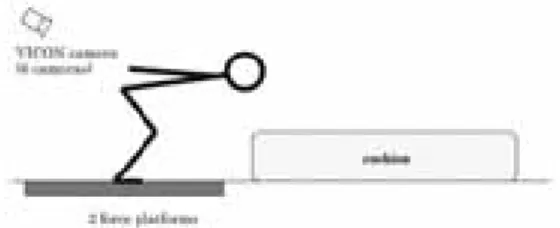
off motion with bare feet. The simulation take-off motion is one training subject that a ski jumper normally makes, which consists of a series of motions from the in- run posture taken at the approach initially, with subsequent stretching the body in an attempt to jump while moving to the next flight posture. In general, an athlete who jumps would be expected to be supported from underneath by an assistant. However, in the experiment, an optical motion capturing system was used to analyze the motions, all people except for the subject herself were away from the measurement area. The subject was directed to land on the cushion placed in her forward direction to lessen the possible collision impact. For motion analysis, the motion capturing system (Vicon; Oxford Metrics Ltd.) and two force platforms (BP6001200; AMTI, Inc.) were used (Figure 1). The reflective markers of 14 mm diameter were placed at 15 locations on the body based on the method described by Ishiguro et al. (2006), such as on the acromion of both right and left scapula bones (at the center of each acromion), the hip joint (at the 1/3 distance from the greater trochanter on the line drawn between the center of the greater trochanter and the ASIS), the knee joint (the lateral epicondyle of thighbones), the ankle joint (ankle joint malleolar), and the head of the fifth metatarsal bone, and also further on the right-hand-side posterior superior iliac spine to use it as a dummy marker. The sampling frequency was set
at 120 Hz. The subject was directed not to place both her feet on one force platform at one time.
In the analyses, the central point of the three lower limb joints were calculated based on three-dimensional coordinate data obtained with the reflective markers.
The center point of the hip joints were estimated at the 18%-interpolated point on the line drawn between both sides’hip joint markers. The center point of the knee joints and ankle joints was set at the point moved from the markers of each knee joint, ankle joint and the head of the fifth metatarsal bone toward inside the body by 1/2ML in length for each joint (between the medial epicondyle and lateral epicondyle of thighbones and the medial malleolus and lateral malleolus) in the direction of the normal line passing through those three marker points. To calculate the body’s center of gravity (COG), the whole body was divided into seven segments, which included the upper part of the body (the head, the trunk and both upper limbs), both thighs, both shanks, and both feet, giving each segment of those the COG location as well as the mass ratio of each segment to
the subject’s weight (Table 1) calculating their weighted average as a result. Using the reaction force from the floor and the motion data available, the vertical component of the floor reaction force (Fvertical), the moment and the power of extension- flexion and of plantar-dorsal flexion of the three lower limb joints was calculated (Winter, 1990). The low pass filter of 6 Hz cutoff frequency was applied to every waveform.
From the time series data thus obtained, the maximum values of Fvertical, the moment and the power of the three lower limb joints were acquired. In addition, the mean value and standard deviation of the seven trial motions were obtained. Paired t-test analyses with P<0.05 were also performed to evaluate significant differences between right and left limbs. Furthermore, to quantify the level of the laterality, the Symmetry Index (SI), as expressed in the following eq. (1) was computed (Robinson et al., 1987).
(1) Fig.1 Experimental system
Table 1 Anthropometric data segment Segment weight
/ Total body
Center of Mass / Segment length (distal) Head-Arm-Trunk 0.67 0.70
Thigh 0.10 0.51
Shank 0.05 0.51
Foot 0.015 0.50
5
In that equation, XR and XL respectively represent the measured values at the right lower limb and at the left lower limb. When SI is zero (0), no right-and-left difference exists; if it is positive, the measured value at the right lower limb is larger than the other.
To evaluate this proposed method, the total mechanical work of the three lower limb joints (Wj) was compared with the mechanical energy increase of the COG (ΔE), both of which were calculated from the data taken during the take-off motion. The Wj was obtained by taking the integral by time about the power of the three joints of the lower limbs consumed during the take- off motion (eq. (2)). The ΔE was calculated by the sum of the potential and the kinetic energy (translation and rotation) increase (eq. (3)).
(2)
(3)
Therein, Phip, Pknee, and Panklerespectively stand for the power [W] accomplished each at the hip joints, the knee joints and the ankle joints of both lower limbs, m signifies the subject’s mass [kg], g denotes the acceleration of gravity [m/s2], Δh stands for the maximum displacement of the vertical coordinate of the COG (COGv) [m]
and v represents the velocity of COG at the highest point of COGv [m/s], I and ω stand for the rotational moment of inertia [kgm2] and the rotational velocity of segments [rad/
s], respectively. In this study, the rotational energy was assumed to be zero because no segments were rotated at the highest point of COGv.
Results
The physical measurement values of the subject were 360 mm of the right thigh length, 355 mm of its left, 315 mm of the right shank, 310 mm of its left, 775 mm of the right lower limb, and 770 mm of its left.
Figure 2-4 presents an example of the
Fvertical values obtained from the in-run
posture to the end of the take-off motion, COGv, and the moment of and the power of the three lower limb joints. The mean of the maximum displacement of COGv ( Δ h) were 0.59 (S.D. 0.02) m, and the velocity of COG at the highest point of COGv (v) was 2.2 (0.6) m/s. Examination of the Fvertical
curve revealed that the associated values of the right lower limb were larger for all trial motions during the static posture taken at the approach of ski jumping. Furthermore, results show that the maximum value during the take-off motion was larger for the right limb than for another limb (Fig.
2). This trend was common to all the trial motions and the statistical significance was observed (P<0.001).
Regarding the moment of each joint, when its value is positive, the joint moment
of extension or plantar flexion is ongoing;
when its value is negative, the moment of flexion or dorsal flexion is ongoing. In the take-off moiton, all the hip-, knee- and ankle joints constantly performed the joint moment of extension and plantar flexion from when the motion started until when the associated lower limb took off the floor (Fig. 3). The maximum value of the joint moment showed higher values for the right lower limb for every joint and for every trial motion. There were the statistical significances (P<0.001).
The power of each joint constantly showed a positive value until the lower limbs took off the floor, and showed that Fig.2 Vertical component of floor reaction
force (Fvertical) and vertical coordinate of COG (COGv) during the take-off motion.
The solid lines represent the Fvertical
and the dotted line represents the COGv
Fig.3 Joint moments of the lower limbs (an example data)
Fig.4 Joint power of the lower limbs (an example data)
7
the extension muscle group or the plantar flexion muscle group of each joint caused a concentric contraction (Fig. 4). As far as the maximum value of the power is concerned, the higher value in knee and ankle joints was recognized for the right lower limb for every trial. However, its value in hip joint was higher for the left-hand-side for the two trials out of the seven of them. Statistically, a significant difference was recognized for knee and ankle joints (P<0.001).
Table 2 presents the mean value and the standard deviation based on the maximum values of the moment and the power of each associated joint in addition to the
Fvertical for all the trials. The P-value for
the t-tests and the SI were also listed in Table 2. Regarding SI, its values were the largest for the moment and the power of the knee joints, the mean values (S.D.) were, respectively, 26.5 (8.5) % and 32.7 (13.1) %.
The second largest values were for the ankle joint, which were, respectively, 22.8 (1.6) % and 29.5 (3.0) %.
Table 3 presents the total mechanical work of the three joints at both lower
limbs during the take-off motion (Wj), the mechanical energy increase of the COG (Δ E) and their ratio (Wj/ ΔE). In this table, both values of Wj and ΔE mostly agree;
their ratio is within 0.77-0.82.
Discussion
Examining the physical measurement of the subject, there was little physical difference in her thigh length and shank length with respect to right and left.
Regarding the location of the reflection markers used to analyze the ski jumper’s motions, the marker for the ASIS might be hidden behind the subject’s because Table2 Means of take-off variables
XL XR p value SI
FRF (%BW) Fvertical 97.4±1.0 104.6±1.5 <0.001 7.1±1.4
Joint moment (Nm)
Hip 61.0±3.1 66.3±3.0 <0.001 8.4±2.5
Knee 33.3±1.4 43.6±2.9 <0.001 26.5±8.5
Ankle 49.6±1.6 62.3±2.0 <0.001 22.8±1.6
Power (W)
Hip 345.9±25.9 360.9±15.6 =0.124 4.4±6.6
Knee 241.3±35.5 334.0±30.8 <0.001 32.7±13.1
Ankle 439.0±22.8 590.7±23.7 <0.001 29.5±3.0
(mean±S.D., n=7) Table 3 Mechanical work of the joints of
lower limbs (Wj) and the increase of mechanical energy (ΔE ) and the ratio Wj/ ΔE
trial Wj (J) ΔE (J) Wj /ΔE
1 291.2 378.3 0.77
2 295.0 369.1 0.80
3 282.5 364.8 0.77
4 280.5 357.5 0.78
5 303.3 370.8 0.82
6 292.1 368.6 0.79
7 282.5 369.1 0.77
the jumper takes a crouching posture with his or her hip joints bent during the approaching phase. For this reason, the Plug-In-Gait (VICON) or the Helen Hayes marker set (Kadaba et al., 1990) that needs the markers on the ASISs were not practicable in this work. Instead, the marker set which did not require such markers was applied in this study. Thereby, all markers were photographed successfully during the motion, even when the subject took the approaching posture. The marker set applied in this study assumed the head, the trunk part of the body and the upper limbs as one segment so that it is good to use to analyze such jumper’s actions with a small motion of head or upper limbs accompanied like the take-off motion.
In the approaching phase, the Fvertical values and moment values of the right lower limb have larger values than those of the left, so that the COG position of the subject tends to shift rightward when she takes the approaching posture. This rightward shift of the COG might degrade the sliding performance of the skis. point of view of the aerodynamic, an asymmetric posture would be disadvantageous. This is certainly one item that should be considered for improvement.
In the take-off phase, the Fvertical values and the moment values of the right lower limb are also higher than those of the left. That indicates that the take-off force was being applied asymmetrically as well. Especially
the SI values of the moment and power of the knee and ankle joints are large, which tells that the main cause of the laterality as recognized for the floor reaction force results from motions of these two joints.
The cause of the laterality in the take- off phase was regarded as the COG shift in the approach phase. Such a COG shift increased the load to support her entire weight using the right hand lower limb, thereby necessitating more joint moment to use during the action. From the fact that the subject showed no laterality physically, the laterality might be resulted from her muscle activities made during the series of motions. Sadeghi et al. (2000) reported that, the laterality noticed in the lower limbs during able-bodied walking, there would exist a functional difference between the right and left limbs. Bearing this fact in mind, the ski jumper would require a highly technical motion control ability with a large and symmetric take-off force in a short period during the take-off action.
Comparison of the largest values of the lower limb joint moment among the associated joints shows that all the moments created by all the three lower limb joints were equally required during the take-off motion. Especially, the moment of the hip joint was large, which indicates that the activity by the hip joint extension muscle group is important for the take off motion.
Moreover, results show that because a ski jumper must change his or her posture
9
within a very short period, the angular velocity of the joint increases, based on which the associated power value becomes larger, too. According to the report from Virmavirta et al. (2009), based on analyses of the take-off motion image pictures, a positive correlation is recognized between the hip joint extension angular velocity and the competition factors of athletes.
Moreover, it is important for athletes to perform upper body motions associated with the hip joint extension efficiently from an aerodynamics perspective.
The SI values to use as an index to evaluate the right and left symmetry are obtainable from the difference value divided by the associated mean value. Because the SI value is useful to quantify the level of laterality, it is used as an index to know how efficient the training would be to correct the laterality (Robinson et al., 1987).
This index has the following characteristics.
1) It takes the value of zero (0) when there exists no laterality. 2) From sign of the value, you can know which leg is dominant over the other. If the sign is positive, then the right leg is dominant, and if negative, the left leg. 3) Even if the difference value in the numerator does not vary, the mean value of the denominator varies. Therefore, the SI value varies accordingly. In other words, even if the difference value remains unchanged, the SI value would be estimated as small for competitive athletics requiring a strong leg muscle force.
The total mechanical work Wj nearly agreed with the mechanical energy increase ΔE. The proposal method was reasonably sufficient. Furthermore, the fact that the ratio of those two, Wj/ ΔE, falls between 0.77 and 0.82 shows that most of the mechanical energy increase created by the take-off motion results from activities produced by the three joints of the lower limbs. Considering the fact that the value of Wj is smaller than that of ΔE, the total mechanical work might be underestimated.
Because the marker set applied to this study did not analyze the motion of head and upper limbs. Regarding all the points explained above, the method introduced herein is useful for quantitative analyses of the laterality.
Conflict of interest
There is no conflict of interest for the authors of the manuscript entitled.
Acknowledgements
The authors would like to thank Prof.
Yoshihiro Ehara (Dept. of Prosthetics, Orthotics and Assistive Technologies, Niigata University of Health and Welfare) for advising the procedure of the analysis;
Mr. Takahiro Ogawa (Ski Associate of Japan) for helpful discussions. This work was supported by KAKENHI (22700620, Grant-in-Aid for Young Scientists (B) ).
Refferences
1)Golomer, E. and Féry, Y. A., 2001.
Unilateral jump behavior in young professional female ballet dancers.
International Journal of Neuroscience 110, 1-7.
2)Golomer, E., Keller, J., Féry, Y. A. and Testa, M., 2004. Unipodal performance and leg muscle mass in jumping skills among ballet dancers. Perceptual and motor skills 98 (2), 415-418.
3)Herzog, W., Nigg, B., Read, J. and Olsson E., 1989. Asymmetries in ground reaction force patterns in normal human gait. Medicine and Science in Sports and Exercise 21 (1), 110-114.
4)Iwata, S., Miyoshi, E., 2005. The relationship between movements and left-right differences in the flight phase during ski-jumping.The annual report of physical education Bulletin 35, 75-79 [in Japanese with English abstract].
5)Ishiguro, K., Kurokawa, Y., Ehara, Y.
and Abe, K., 2006. Kinetic analysis of stumbling gait in laboratory condition.
Niigata journal of health and welfare 6, 95-101
6)Sadeghi, H., Allard, P., Prince, F. and Labelle, H., 2000. Symmetry and limb dominance in able-bodied gait: a review.
Gait and Posture 12, 34-45.
7)Janura, M., Lehnert, M., Elfmark, M.
and Vaverka, F., 1999. A comparison of the take-off and transition phase of the
ski jumping between the group of the ski jumpers and the competitors in Nordic combined. Gymnica 29 (2), 7-13.
8)Kadaba, M. P., Ramakrishnan, H. K. and Wootten, M. E., 1990. Measurement of lower extremity kinematics during level walking. Journal of orthopaedic research 8, 383-392.
9)Robinson, R. O., Herzog, W. and Nigg, B.
M., 1987. Use of force platform variables to quantify the effects of chiropractic manipulation on gait symmetry. Journal of Manipulative Physiological Therapeutics 10, 172-176.
10)Stephens, T. M., Lawson, B. R. and Reiser, R. F., 2005. Bilateral asymmetries in max effort single-leg vertical jumps.
Biomedical sciences instrumentation 41, 317-322.
11)Schwameder, H., 2008. Biomechanics research in ski jumping, 1991-2006. Sports Biomechanics 7(1), 114-136.
12)Vagenas, G. and Hoshizaki, B., 1992.
A multivariable analysis of lower extremity kinematic asymmetry in running. International Journal of Sport Biomechanics 8, 11-29.
13)Virmavirta, M. and Komi, P. V., 1993a.
Measurement of take-off forces in ski jumping Part I. Scandinavian Journal of medicine & science in sports 3, 229-236.
14)Virmavirta, M. and Komi, P. V., 1993b.
Measurement of take-off forces in ski jumping Part II. Scandinavian Journal of medicine & science in sports 3, 237-243
11
15)Virmavirta, M. and Komi, P. V., 2000.
Plantar pressure during ski jumping take- off. Journal of applied biomechanics 16, 320-326.
16)Virmavirta, M., Perttunen, J. and Komi, P. V., 2001a. EMG activities and plantar pressures during ski jumping take-off on three different sized hills. Journal of Electromyography and Kinesiology 11, 141-147.
17)Virmavirta, M. and Komi, P. V., 2001b.
Plantar pressure and EMG activity of simulated and actual ski jumping take- off. Scandinavian Journal of Medicine and Science in Sports 11, 310-314.
18)Virmavirta, M. and Komi, P. V., 2001c.
Ski jumping boots limit effective take-off in ski jumping. Journal of Sports Sciences 19, 961-968.
19)Virmavirta, M., Isolehte, J., Komi, P. V., Schwameder, H., Pigozzi, F. and Massazza, G., 2009. Take-off analysis of the Olympic ski jumping competition (HS- 106m). Journal of Biomechanics 42, 1095- 1101.
20)Winter, D. A., 1990. Biomechanics and motor control of human movement 3rd ed., John Wiley and Sons, New York