研究報告
- The Language “Noticing” Hypothesis – Towards Effective Teaching Methods in Japan
Kolawole Waziri OLAGBOYEGA**
Abstract
This paper is a contribution to a continued exploration of what Language “Noticing” Hypothesis has to offer the language teachers and learners in Japan. The paper explores the hypothesis and examines the effectiveness of the method in an EFL context such as Japan. Debates on language teaching methods tend to fall into oppositional views. Since the early ages of English Language Teaching in Japan, yakudoku (grammar-translation) method has been the “vogue”. The method, on the other hand, has been criticized in the last 20 years for failing to produce learners with high level of proficiency in English. The criticism often leads to a demand for more emphasis on “output” or “communicative language teaching” (CLT). Reviewing the previous research on input and output, some scholars suggest that output is necessary for language acquisition (e.g. Swain’s ‘Output Hypothesis’) while some claim that language acquisition occurs only through input (e.g. Krashen’s ‘Input Hypothesis’). However, some recent approaches try to link input with output in a dynamic mechanism of second language acquisition by adapting the factors of ‘noticing’, which is theorised as
‘Noticing Hypothesis’ by R. Schmidt. The factors are also related to ‘implicit teaching’ and ‘explicit teaching’ in language classrooms. This paper outlines Schmidt’s hypothesis about noticing and explores how the hypothesis could be adapted to the real teaching contexts. The paper concludes that input/output and implicity/explicity should not be discussed as opposites but should be seen as complementary teaching approaches.
.
1. Introduction: What is “Noticing” Hypothesis?
Due to the advent of cognitive psychology and Chomsky’s innatistic propositions, more theories in the late 1980s started paying attention to human’s internal system of understanding and learning languages, known as cognitive linguistics(1)(2). The idea of ‘attention’,
‘awareness’ or ‘noticing’ in second language acquisition emerged in this period. The most famous proponent of the notion is Richard Schmidt. His ‘Noticing Hypothesis’
originates from a case study of a Japanese learner of English (given the pseudonym “Wes”) and his own
Received August 5, 2013
** Dr. Kolawole Waziri Olagboyega is an Associate Professor of English Language and Applied Linguistics at the Graduate School of Global Communication and Language of Akita International University. He also teaches (part-time) in the Graduate School of the Faculty of Engineering and Resource Science of Akita University, Japan.
experience in learning Portuguese in Brazil(3). In the first study, Schmidt(4) found that “Wes” had acquired very good fluency but had not sufficiently learned morphological or syntactic accuracy. He suggested that the learner did not develop much morphology and grammar primarily because he may have lacked the aptitude to do so, and he therefore relied exclusively on implicit learning through interaction alone, with little attention to form and structure(5). On the other hand, from their experiences in learning Portuguese, Schmidt & Frota(6) found that new items were acquired when the learner (given the pseudonym “R”, referring to Richard Schmidt himself) consciously noticed them in his journal. Based on the findings in his studies and cognitive psychology, Schmidt proposed that “intake is what learners consciously notice”(7).
2. “Noticing Hypothesis” and its impact on SLA Schmidt(8) provides a clear definition of ‘noticing’ in second language acquisition. He first introduces the term
‘consciousness’ as a broader category of human’s cognitive system and divides it into three subcategories:
consciousness as awareness, consciousness as intention, and consciousness as knowledge. In addition, consciousness as awareness consists of three levels: perception, noticing, and understanding. The term ‘noticing’ refers to “focal awareness” in his definition, and at this level one can pay attention to a certain stimuli as a “private experience” and
“report it verbally”(9). Though noticing does not result in acquisition by itself, it greatly facilitates learning and acquisition. On the basis of this explanation, the claim of Noticing Hypothesis has been briefly summarised as “the only linguistic elements in the input that learners can acquire are those elements that they notice”(10) or “nothing is learned unless it has been ‘noticed’”(11).
The notion of ‘noticing’ can be embedded into this process as follows: Second language acquisition is generally described as the process of building the
‘interlanguage’. Interlanguage is a learner’s knowledge of the target language internalised through receiving input and integrating intake. For example, if a learner is given a sentence with an ‘–ed’ past form such as “I played tennis last Sunday” as input. When the learner notices the rule: “- ed has to be added to the verb in talking about an event that happened in the past”, this knowledge becomes intake. This means that noticing facilitates input to be an “intake” as in the Figure 1 below.
Figure 1: The process of input becoming intake through noticing. (Partly adapted from Izumi(12))
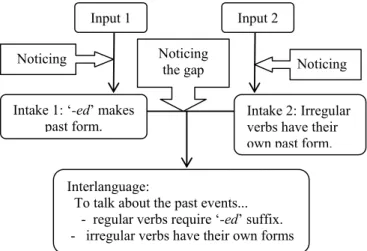
However, not all verbs require ‘-ed’ suffix for their past form; irregular verbs have their own forms. This rule is comprehended as a new intake and integrated with the previous one through ‘noticing the gap’ (Figure 2). The learner at this phase establishes more general rule in his/her mental language system.
Figure 2: Noticing the gap to build interlanguage.
One notable impact of the hypothesis was that it challenged Krashen’s proposition that language learning was an unconscious process. Thus, the hypothesis has led to the development of teaching methods that emphasize learner’s consciousness(13)(14). Some of the methods are to be discussed in the next section. Another point to note is that “noticing” happens in both input and output. Izumi(15) suggests that input can be most beneficial when a learner notices the integration of form, meaning and function and also that output facilitates “noticing” and “noticing the gap”. He outlines the dynamic relationship between input, output and noticing as Figure 3.
Figure 3: The relationship between input, output and noticing. (Adapted from Izumi(16))
Intake: ‘-ed’ makes past form.
Noticing of ‘-ed’ and its function
Input: I played tennis last Sunday.
Tom watched TV yesterday.
Mary cleaned her room two days ago.
Intake 1: ‘-ed’ makes past form.
Interlanguage:
To talk about the past events...
- regular verbs require ‘-ed’ suffix.
- irregular verbs have their own forms Noticing
the gap Input 1
Noticing
Input 2
Noticing Intake 2: Irregular verbs have their own past form.
Input
Intake
Interlanguage
Output Noticing
Noticing the gap
Access
Facilitating
‘noticing’
Facilitating
‘noticing the gap’
Automatizing
Moreover, noticing can occur in both implicit teaching and explicit teaching. In the case of learning past forms, the learner may notice the ‘-ed’ form and its function by him/herself or implicitly when exposed to many examples of the same structure. When the teacher explicitly shows the rule before he/she gives examples, the learner would pay attention to the target form.
Consequently, Noticing Hypothesis has stimulated the effective collaboration of input and output or of implicit teaching and explicit teaching.
As stated above, this language teaching hypothesis was a response to Krashen’s “comprehensible input hypotheses”(17). To do justice to this paper, let us consider Krashen’s arguments.
3. “Comprehensible Input”
Stephen Krashen’s “Monitor Model” is the best known model of second language acquisition influenced by Noam Chomski’s innatist theory of first language acquisition(18). There are five basic hypotheses in this model: the Acquisition-Learning Hypothesis, the Monitor Hypothesis, the Natural Order Hypothesis, the Comprehensible Input Hypothesis, and the Affective Filter Hypothesis.
The Comprehensible Input Hypothesis, one of the five hypotheses above, is based on the principle that language acquisition occurs when one is exposed to language almost all of which is comprehensible. Learners learn a new language when they receive input that is just a little more difficult than what they can easily understand. Krashen defines a learner’s current state of knowledge as “i” and the next stage as “1” thereby arriving at the formula “i+1”(19). In support of Krashen’s hypotheses, Paul Nation(20) asserts that there should be no more than one unknown word in every fifty running words. In other words, there should be more than ninety-eight percent familiar words in the text so that meaning-focused input will occur. If more than five percent of the running words are unfamiliar, then it is no longer likely to be meaning-focused learning because so much of the learner’s attention has to be given to language features(21). Thus, the basic principle of the Comprehensible Input Hypothesis is that students may understand most, but
not at all the words they listen to or read. It is the language teacher’s responsibility to provide the students with the appropriate opportunities for comprehensible input both inside and outside of the classroom.
4. Classroom Activities for Comprehensible Input In second language acquisition, there are two types of learning; form-focused learning and meaning-focused learning. In Japan, in traditional educational approaches such as grammar-translation method (yakudoku), the focus has been more on form than on meaning, which has often been severely criticized for not having succeeded in producing successful learners who can communicate in English language fluently with other “expert users”(22) of English. Recently, communicative language teaching (CLT) has gained more advocates(23), and at the same time, importance of meaning-focused learning has been more emphasized. On the other hand, how and what kind of activities should be implemented in language learning classrooms should be different depending on the ‘learners’
characteristics’ and the ‘learning conditions’(24). Here are four examples of activities for comprehensive input which focus more on meaning than on form; appropriate for intermediate English learners in high schools in Japan.
4.1. Word definition
One of the traditional ways of learning new words in EFL classes is directly translating the words of the target language (TL: English) into the learner’s first language (L1:
Nihongo) and vice versa. However, the focus in this process is mainly on form. After the learners have understood the meaning of the new words both in the TL and in their L1, the teacher then provides the definition of the words in the TL. The definition should be given in the words that are comprehensible to the learners. Then learners think of the meanings of the new words in the TL. For example, if
‘refrigerator’ is a new word, the learners understand it as
‘reizouko’ in Japanese. Then the teacher provides the definition: ‘a metal container with a door in which food and drink are kept cold so that it stays fresh.’ The word
‘container’ may be unknown to the students; however, they
can guess the entire meaning that the definition is trying to convey, and connect it to the target word. In order to create a situation where students communicate with each other, pair work or group work will also be helpful.
4.2. Cloze test
A cloze test, which was first described by W. L. Taylor in 1953, can be used for a comprehensible input activity. In this activity, basically every nth word is missing from the text and the learners fill in the blanks with the best possible word for each blank. To complete this activity, the learners have to read words and phrases around the blanks, and they may guess the appropriate word from the context or from their recognition of the part of speech that should be written in the blanks. To have the students engage in a meaningful activity, language items in the text should not be too difficult; so, the text of a new chapter in the textbook may not be appropriate for this activity. If a teacher thinks it is hard for the students to guess the word that should be in the blank, he or she can give the first letter of the word or give some alternatives so that the students can do the activity with more ease. In addition, by shifting the position of blanks, the same text can be used repeatedly.
4.3. Questions and answers
Asking students questions about the contents of a text that they have just read is one of the familiar activities traditionally observed in language classrooms. However, teachers should be aware of whether they are focusing on meaning or on form. If a question is focusing on meaning, the language used in the question should be comprehensible to the student. If the students’ responses are grammatically incorrect, it should be acceptable as long as the students understand what the teacher asks and the responses were meaningful.
4.4. Extensive reading
Graded readers, in which simplified language is used, may be used for extensive reading as additional reading activities. Reading a great deal of texts enhances the students’ vocabulary, and one of the benefits of simplified
readers is that students encounter a reasonable number of new words. On the other hand, there can be some problems with implementing graded readers. The language used in them may not be authentic; it may be difficult to find graded readers with enough volumes that meet the interests of all the students; and it may be too expensive for some schools to buy certain number of books so that all the students can enjoy the benefits of reading extensively.
Providing students with comprehensible input can be a key to successful language acquisition. In addition, classroom English is also very important and language teachers should be careful about the following in their classes. First, vocabulary used in class need to be controlled. There should not be too many unknown words for the students. Paraphrasing should be useful when the teacher feels that the students are having difficulty in understanding the lesson. Second, it is helpful to use visual aids such as pictures, videos, realia and so on. Visual images can be of great help for students to understand the target language. Third, paralinguistic features including change of stress, gesture, and facial expressions are also important. These paralinguistic features are equally essential in normal day-to-day communication. Fourth, providing students with the relevant kind of schemata can help them understand the context of what they are going to learn. Having relevant background knowledge facilitates students’ understanding of the content of the input they hear, read, watch or listen to.
4.5.Designing a Language Curriculum
Although comprehensible input or meaning-focused input is an important factor, it is not the only factor that leads second language learners to successful second language acquisition. Input should be followed by output (as observed above). In learning English as a foreign language (such as is the case in Japan), where English is not used by learners on a daily basis, comprehensible or meaning-focused input activities as well as other kinds of activities (such as the “output” activities described above) should be practiced. In terms of designing a vocabulary course, I. S. P. Nation(25) suggests that the following four
strands should be considered in a balanced fashion:
meaning-focused input, meaning-focused output, language- focused learning, and fluency development.
For comprehensible input, Nation and Macalister(26) maintain that learners should learn the language through message-focused listening and reading (meaning-focused input) in which the students are already familiar with around 98 percent of the vocabulary. Examples of activities for this strand are extensive reading and listening to lectures. Second, as for meaning-focused output, learners should be encouraged to produce meaningful words through speaking and writing. Examples of activities for this strand are taking part in conversation and writing about what has just been read. Third, as for language-focused learning, deliberate attention to vocabulary and other language features are needed, although too much attention to form is not desirable. Examples of activities for this strand are vocabulary exercises and intensive reading. And fourth, as for fluency development, learners should be fluent in using what they already know in each of the four skills of listening, speaking, reading, and writing. Examples of activities for this strand are speed reading with easy texts and repeated listening/reading. All of these four strands should be well balanced in a second language acquisition (SLA) curriculum.
It is important to ensure that the learners receive a large amount of comprehensible input. On the other hand, no matter how much input learners are given, the Affective Filter might become a “psychological block”(27) and prevents the input from accessing the learners’
consciousness. In order to lower the Affective Filter, teachers need to encourage learning environments in which learners feel at ease and are ready to receive comprehensible input. To make this situation happen, teachers first need to understand that all learners have different metalinguistic abilities, different learning styles, and different motivation toward language learning.
Teachers also need to understand that all learners are in different learning language conditions, including the amount of time they are exposed to the target language in their daily lives and what discourse types they are exposed
to. As for English language learners in Japanese high schools, the opportunities of exposure to English language in their daily lives are often extremely limited. It is the teacher’s responsibility to understand each learner’s characteristics and needs in language learning, and try to lower the learners’ affective filter as well as to provide the learners with both quantitative and qualitative input.
5. Implications for English language teaching in Japan
A teaching method significantly developed by Noticing Hypothesis is ‘focus on form’ instruction or ‘form-focused’
instruction. It can be defined as the “inversion in which simultaneous attention is brought to both meaning and how that meaning is encoded”(28). Here we look at another example of this type of method applied in an English teaching context. Suppose this is a typical English classroom at a Japanese senior high school: 35 EFL students all of whom are Japanese and use Japanese as their first language, intermediate-level, and using a MEXT- approved textbook. In this lesson, the students are to learn the structures of “It takes/costs... to do~” to talk about how long it takes and how much it costs to do something.
At the beginning of the lesson, the teacher briefly explains the structures to students by telling them about the best place he has ever visited. Next, the students are asked to think of the best places they have ever visited or where many tourists visit in their area. They are, then, required to write a paragraph in English to describe their travelling or the place they would recommend someone to visit. The teacher reads the students’ work and picks up errors to be corrected which are commonly made amongst the students.
For example, some students may miss “–s” in “takes” and
“costs”, and some might say “It costed each of us 500 yen to enter the museum” in writing about their school trip of the previous year.
The explicit introduction of the target grammar as the input will help the students to notice the key structure “It takes/costs... to do~”. When they work on the writing activity as output, the students would be paying attention to both the form and contents of their work by themselves because they know that the paragraph is expected to be as
correct and meaningful as possible. When the teacher talks about common errors, the students again could notice some points in the key structure. They would notice the correct verb form in the present tense after the subject “it” and learn that the past form of “cost” is also “cost”. In this teaching procedure, not only input and output but also
‘focus on meaning’ and ‘focus on form’ are embedded through noticing. ‘Focus on form’ teaching is, thus, to actively help learners to be aware of the key form through the meaning-focused or content-based instruction.
‘Corrective feedback’ is also a method based on Noticing Hypothesis. It can be implicit or explicit and enables a learner to check and notice his/her interlanguage.
Let us see some examples in Saville-Troike(29). When a learner says “I can’t assist class.” meaning “I can’t attend class.”, the teacher may respond “You can’t what?”
meaning “You’ve got the wrong word. Try again.” This method is referred to as ‘confirmation check’. Another common form of feedback is ‘recasting’. When a learner says “John goed to town yesterday.” the teacher may respond “Oh, John WENT shopping. Did you go with him?”
by paraphrasing the learner’s utterance and emphasizing the correct form. Again the important function of giving feedback is that a learner can consciously review his/her knowledge of the target language and revise it if necessary.
Various types of corrective feedback in the classroom are explained by Lightbown & Spada(30).
6. Conclusion
This paper has shown that Noticing Hypothesis effectively facilitates second language learning and contributes to the link between input and output and between implicit teaching and explicit teaching. Although those factors are often portrayed as oppositional - that one is more important than the other. We have also reviewed Krashen’s “comprehensible input” and found it extremely indispensible to second language acquisition. Our discussions conclude that both input and output and both implicity and explicity are equally important in teaching second languages and that they should not be debated as antagonistic methods but complementary ones.
It is probably true that yakudoku method has put too much focus on providing input and the input exclusively focuses on form and is divorced from meaning or function.
However, this does not mean giving input is less effective than giving output. It is essential for an effective and efficient teacher of English language to integrate various teaching approaches, methods and techniques. This approach will benefit more English language learners in Japan – after all, these are learners with individual differences; learners with different learning characteristics and learners with different learning conditions.
References
(1) Fotos, S. (2001): Cognitive approaches to grammar instruction. In M. Celce-Murcia (Ed.), Teaching English as a Second or Foreign Language (3rd edition) Boston, MA:
Heinle, Cengage Learning. pp. 267-283.
(2) Matsumura, M. (2009): Eigo-kyoiku wo shiru 58 no kagi [58 key issues of English language education]. Tokyo:
Taishukan-shoten. p.75.
(3) Schmidt, R. (2010): Attention, awareness, and
individual differences in language learning. In W.M. Chan, S. Chi, K.N. Cin, J. Istanto, M. Nagami, J.W. Ser, T.
Suthiwan, & I. Walker, Proceedings of Classic 2010, Singapore, December 2-4 Singapore: National University of Singapore, Centre for Language Studies. pp. 721-737.
(4) Schmidt, R.W. (1983): Interaction, acculturation and the acquisition of communicative competence: A case study of an adult. In N. Wolfson & E. Judd (Eds.),
Sociolinguistics and Language Acquisition Rowley, MA:
Newbury House. pp. 137-174.
(5) Ibid., pp. 170-173.
(6) Schmidt, R.W. & Frota, S.N. (1986): Developing basic conversational ability in a second language: A case study of an adult learner of Portuguese. In R.R. Day (Ed.), Talking to Learn: Conversation in second language acquisition Rowley, MA: Newbury House. pp. 237-326.
(7) Schmidt, R.W. (1990): The role of consciousness in second language acquisition. Applied Linguistics, Vol. 11, No. 2, pp. 129-158.
(8) Ibid., p. 130.
(9) Ibid., p. 132.
(10) VanPatten, B. & Benati, A.G. (2010): Key Terms in Second Language Acquisition. London: Continuum International Publishing. pp. 42-48.
(11) Lightbown, P.M. & Spada, N. (2013): How Languages are Learned (4th ed.). Oxford, UK: Oxford University Press. pp. 60-78.
(12) Izumi, S. (2009): Naiyo-jushi no input to output wo toshita focus on form no shido [‘Focus on form’ instruction through content-based input and output]. In The English Teachers’ Magazine, Vol. 57, No. 12. Tokyo: Taishukan- shoten. p. 28.
(13) Fotos, S. (2001): Cognitive approaches to grammar instruction. In M. Celce-Murcia (Ed.), Teaching English as a Second or Foreign Language (3rd edition) Boston, MA:
Heinle, Cengage Learning. p. 273.
(14) Matsumura, M. (2009): Eigo-kyoiku wo shiru 58 no kagi [58 key issues of English language education]. Tokyo:
Taishukan-shoten. p.36.
(15) Izumi, S. (2009): Naiyo-jushi no input to output wo toshita focus on form no shido [‘Focus on form’ instruction through content-based input and output]. In The English Teachers’ Magazine, Vol. 57, No. 12. Tokyo: Taishukan- shoten. pp.28-30
(16) Ibid., p.29.
(17) Krashen, S. (1985): The Input Hypothesis: Issues and implications. New York: Longman. pp. 12-38.
(18)Lightbown, P.M. & Spada, N. (2013): How Languages are Learned (4th ed.). Oxford, UK: Oxford University Press. pp. 45-58.
(19) Gass, S. M., & Selinker, S. (2008): Second language acquisition: An introductory course. New York: Routledge.
pp. 54-63.
(20) Nation, I.S.P. (2007): ‘The four strands’. Innovation in Language Learning and Teaching Vol.1, No.1. pp.1-12.
(21) Nation, I. S. P. (2001): Learning Vocabulary in Another Language. Cambridge: Cambridge University Press. pp. 16-28.
(22) Kirkpatrick, A. (2007): World Englishes: Implications for international communication and English language
teaching. Cambridge: Cambridge University Press. pp. 48- 52.
(23) Olagboyega, K.W. (2012): The Communicative Approach to Language Teaching: Some Strengths and Weaknesses. In The Scientific and Technical Journal, Faculty of Engineering and Resource Science, Akita University, Japan. Vol. 33, pp. 17-23.
(24) Lightbown, P.M. & Spada, N. (2013): How Languages are Learned (4th ed.). Oxford, UK: Oxford University Press.
pp. 48-68.
(25) Nation, I.S.P. (2007): ‘The four strands’. Innovation in Language Learning and Teaching Vol. 1, No.1. pp.1-12.
(26) Nation, I.S.P. and J. Macalister (2010): Language Curriculum Design. New York: Routledge. pp. 10-22.
(27) Cook, V. (1993): Linguistics and second language acquisition. New York: Palgrave. pp. 23-28.
(28) VanPatten, B. & Benati, A.G. (2010): Key Terms in Second Language Acquisition. London: Continuum International Publishing. pp. 14-19.
(29) Saville-Troike, M. (2006): Introducing Second Language Acquisition. Cambridge, UK: Cambridge University Press. pp. 34-44.
(30) Lightbown, P. M., & Spada, N. (2013): How languages are learned. Oxford: Oxford University Press. pp. 62-66.