• 検索結果がありません。

An Analysis of Communicative Language Teaching in Japan

N/A
N/A
Protected

Academic year: 2021

シェア "An Analysis of Communicative Language Teaching in Japan"

Copied!
16
0
0

読み込み中.... (全文を見る)

全文

(1)

An Analysis of Communicative Language Teaching in Japan

Francine Chloe G. RAMIREZ

Abstract 

  With the changing times, cultures, and technologies, it is a grinding task to create the ideal teaching method for teaching English as a foreign or second language. Throughout the decades, methods have been pitted against each other as they vie for their place at the top of the teaching curriculum. The Communicative Language Teaching method is one of these. This study explores the eff ects of the CLT method to Japanese learners of English, focusing on some of the advantages and disadvantages of the method in a more Japan-classroom-centred manner.

Research about CLT in Japan from diff erent researchers were also reviewed.

Keywords:  Communicative Language Teaching, motivation, L2, second language teaching

Introduction

   The rapid advancement of globalization in society has given rise to the importance of universal communicative skills of a country’s citizens when it comes to performance progress.

With the political power the West has in various aspects of society; i.e., business, science, art, media, education, and language, to name a few, it is no surprise that English language education continues to be emphasized and prioritized in several non-native English speaking countries.

Japan is one of them.

   Japan’s government has continuously made strides to improve its citizens’ English abilities by enforcing new and/or revised programs in the education department. Established in 2001, the Japanese Ministry of Education, Culture, Sports, Science, and Technology was created, merging the Ministry of Education, Science Sports and Culture, and the Science and Technology Agency (MEXT, N.A.). The goal of the Education Policy Bureau of MEXT is to promote lifelong learning for coexistence. By fostering human resources who support education, MEXT continuously widens its reach by promoting learning in local communities, as well as advancing educational reform to fi t the times (MEXTb, N.A.).

THE TSURU UNIVERSITY GRADUATE SCHOOL REVIEW,

No.25(March, 2021)

(2)

MEXT and Its Recent Developments

   Every ten years or so, MEXT revises the country’s general Courses of Study in order to ensure fixed quality standards across the nation (MEXTe, NA). This hasn’t been fully implemented exactly every ten years, as will be shown in the later examples. With the implementation of the Revised Basic Act on Education (enacted December 2006 ), MEXT officially put a new national English curriculum into effect, from 2011 in public elementary schools, from 2012 in junior high schools, and from 2013 in high schools (MEXTc, 2006).

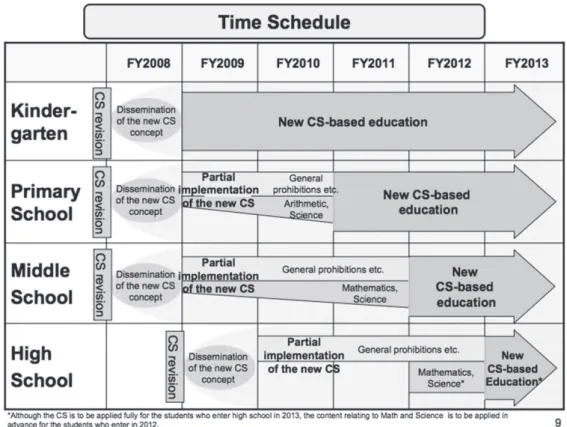
This reform was done in order to promote thinking capacity and decisiveness, to raise moral education, and to improve the public school teachers’ attitude towards English education. Figure 1 shows the time schedule of the implementation of the revised course of study, emphasizing how each level of education possesses its own scheme. This gradual execution, from the dissemination of the concept, to the partial implementation, to the full eff ectuation of the reform can also be seen in the future endeavors MEXT will arrange, which will be discussed further on.

Figure 1: Time Schedule for the Revisions of the Courses of Study for Elementary and Secondary Schools (adapted from MEXT, NA).

   Aside from this, 2014 saw MEXT endeavor to enhance English education incrementally

by requiring the English learning course at a younger age (lower secondary school) (MEXTd,

(3)

2014). Come the year 2020, Japan would have offi cially fully implemented the government’s English Education Reform Plan corresponding to globalization. The English Education Reform Plan will require third and fourth graders to engage in English Language activities one to two times a week in order to nurture the foundations of English education. From fi fth to sixth grade, students will be asked to attend English Language Modules three times a week. As the students advance in grade level, the English language learning diffi culty is set to increase as well. Once again, the progressive yet consistent change was the chosen course of action to fully realize the reform.

  In the university level, the national syllabus for English teaching was revised to reform university entrance examinations so that more prominence would be placed on developing oral communication skills and promoting the use of communicative language teaching (Iwamoto, 2017). The government’s plan to introduce private-sector English language tests was a sizeable remodeling of the university entrance examinations then; thence, this emendation was met with much concern (Asahi Shimbun, 2019). Even with the apprehensions and complications alluding to this change, students have been made to review for these separate, private English tests that were to be part of their university entrance exams. To the surprise of most, the government administered a last minute about-turn on the 1

st

of November, 2019, when MEXT Minister Koichi Haguida declared the postponement of the use of private English tests in college entrance exams as they are still “fundamentally re-examining” the reform (Chiwaki, et. al, 2019). This has stirred high school students all over Japan, particularly second year high school students, considering they have been “forced” to review and take these examinations already (Shiotsuki, et.al, 2019).

   A high school student from Miyazaki was quoted by The Mainichi remarking, “I made the application because I was pressured to, because I was told I needed to do the test as part of my college entrance exams. I don't want them to confuse me anymore” (Shiotsuki, et.al, 2019).

Another student from Osaka Prefecture said in the same article, “I've already paid the fee for taking the Eiken test next spring. Unless they (the government) decide what to do fast, I won't know which direction to take my study plan.”

   This sudden change of mind MEXT manifested defi nitely agitated some of the high school students; to wit, the learners directly aff ected by the initial implementation in the fi rst place. On the other side of the account, people have hailed the government’s move to postpone the reform.

A private high school student from Tokyo who was calling for the review stated, “Even my high school was falling behind trying to get ready for the new system because there were too many things that hadn't been fi nalized. The postponement is a good thing, because I was very anxious” (Shiotsuki, et.al, 2019). Satoshi Hagiwara, chairman of the National Association of Upper Secondary School Principals, released a statement saying, “I want a fundamental review to resolve problems, such as dissolving economic and regional gaps among test-takers and securing fairness and integrity.”

   With all these new reforms and enforcements, it is important to refl ect and analyze on the

eff ects, both positive and negative, of the genesis of communicative language teaching in Japan,

(4)

as well as why CLT still is the preferred teaching method over the Grammar Translation Method in Japan.

On Communicative Language Teaching and its Advantages 

  Communicative Language Teaching is quite unique as a teaching approach as it has had an immense impact on second language learning, particularly in English. Essentially, CLT can be defined as the social engagement of language learners with the goal of developing their communicative competence (Hymes, 1971). Savignon describes communicative competence as

“the ability of classroom language learners to interact with other speakers” (2007, p.209). This social interaction goes above and beyond advancing the learners’ abilities to recite dialogues or memorize grammar points. Instead, communicative competence encourages students to ask questions, clarify information, negotiate meaning, and ultimately, take risks (Savignon, 2007).

  Both Savignon (2007) and Li (1998) agree that the best-known explanation for communicative competence was identifi ed by Canale and Swain in the 1980s. Before the advent of Communicative Language Teaching, what rocked the boat of language learning was audio- lingualism. The audio-lingual method, which has already been discredited, focused mainly on sentence level structure. In Canale and Swain’s framework of communicative competence, they identifi ed four dimensions; namely, grammatical competence, sociolinguistic competence, strategic competence, and discourse competence (Savignon, 2007; Li, 1998). Various researchers have added on to and reformed Canale and Swain’s defi nitions, but fundamentally, their theory still stands to this day.

  To further break communicative competence down, competence can be described as the quality or state of having suffi cient knowledge, judgment, skill, or strength (as for a particular duty or in a particular respect). With reference to linguistics, competence is the knowledge that enables a person to speak and understand a language (Merriam Webster Dictionary). In the context of communicative language teaching, competence does not equate to “native-like.”

Language data has undermined the importance of context, as context is needed for the learner to construct his or her own variation to determine meaning.

  Another unique factor of CLT is its fl exibility and variability when it comes to methods of engaging learners. Bhatia (1997) suggests that although conformity can serve as a gatekeeper, variations in academic discourse are still underestimated. One, then, has to remember that language and communication exceed lexis and syntax: there is a sociocultural context to be examined in the equation as well. Related to this, Li (1998) carries on to state that in Communicative Language Teaching, meaning is central. Thus, Li suggests that because learners have their individual interests, needs, and goals, this then should be exhibited in the context of instructional design.

  In this way, communicative language teaching highlights the importance of communication,

concentrates on making the second language relevant to the learner by giving meaningful tasks

(5)

in realistic situations, and endeavors to create a comfortable and relaxed climate for the learners (Li, 1998).

  The next sections will integrate CLT in the context of Japan by citing researchers with both quantitative and qualitative studies on the matter. The results of the explorations may diff er and unfavorable results may occur (as with any method), but predominantly, there appears to be a positive tendency towards Communicative Language Teaching.

Communicative Language Teaching in Japan

1. Taguchi on Motivation

Several researchers have tackled Communicative Language Teaching since its advent in Japan. Taguchi (2013), for one, focused on the relationship of the students’ attitude and motivations towards English language learning. In the research, two methodologies were used.

Firstly, a sample of 1534 Japanese native speakers from eight diff erent universities and colleges were tasked to answer a questionnaire about their background and on their attitudes and motivations towards English learning.

   The results of this first method showed that Japanese learners could “readily imagine a situation where they are speaking English with foreigners and themselves as individuals who are able to speak English” (Taguchi, 2013, p.175). A stark contrast to that in the same results includes the finding that “Japanese learners have difficulty in imagining themselves living abroad and having a discussion in English and themselves using English in their future career, in other words, as someone using English for study and work purposes.” The former result, Taguchi detected, seemed to correspond to the concept of the personally agreeable self, while the latter correlated to the professionally successful self.

   Adding to this, the results of the questionnaires also showed how although the participants held a generally positive attitude to learning English, a general consensus appeared as most agreed that learning English in Japan was not the best way to develop learners’ L2 competence.

The reason behind this, according to the participants, was the over-emphasis on grammar- translation rather than actual communication. The participants found grammar-translation boring; i.e., not motivational in any aspect.

  The second part of the study involved qualitative data in the form of semi-structured interviews with 20 university students from various backgrounds, ages, and academic statuses.

Three latent variables arose in the analysis; namely, the ideal L2 self, attitudes towards learning

English, and criterion measures. For the ideal L2 self, the qualitative data showed that Japanese

university students learning English did not desire to learn the language for academic or

vocational reasons. Rather, these university students used English for its personally agreeable

aspects. Unfortunately, with the current climate of globalization, it is “indispensible” for the

students to increase their motivation for studying English, as there is still the professional

advantage of knowing a second language present to this day (Taguchi, 2013, p.180).

(6)

  The second latent variable involves attitudes towards learning English. This second variable is not detached from the fi rst. Attitudes towards learning English are strongly linked to the ideal L2 self. Taguchi observed that contrary to the generalization that English class is found to be uninteresting to students, the Japanese students who participated in the interview stated that gaining more information about the world stimulated the students’ appeal for learning English. With the assemblage of positive comments and responses to CLT, it is then compelling to understand why the move from Grammar-Translation to CLT was such an applauded one predominantly, especially to the students involved. The main disapproval on the Grammar- Translation Method centered on the focus on English grammar rather than communication skills. As specifi ed by Taguchi, “Japanese students often believe that focusing on a knowledge of grammar hinders, rather than helps, the development of their communicative skills” (2013, p.181).

   The third latent variable relates to the criterion measures. In the study, it was revealed that although the university students expressed great interest in learning the English language, this is not directly proportional to the amount of eff ort given to learning the language. This could be associated to the learners’ feared self, where the students fail to actualize the ideal L2 selves they hope to achieve. By possessing and enhancing their personally agreeable English-speaking selves rather than their professionally successful selves, Japanese learners of English are less likely to develop a feared self.

  Overall, Taguchi’s research proved that Communicative Language Teaching is positively evaluated by Japanese students. Because this method of teaching focuses on speaking and general communicative skills, CLT meets the expectations and needs of these students. The grammar-translation method, on the other hand, does not. At least, this is so in the eyes of the students themselves.

2. Nishida on Elementary EFL Learners

Also focusing on motivation, Nishida (2013) specifies her research by using the self- determination theory (SDT). Nishida states that SDT focuses on extrinsic and intrinsic motivation. Intrinsic motivation involves the enjoyment a learner attains by linking one’s rewards to the self. Extrinsic motivation involves, as determined by its name, extrinsic cues such as rewards and punishments (Nishida, 2013). By combining both quantitative and qualitative data, Nishida was able to examine how intrinsic motivation worked in English learning students in Japan, as well as how the pattern of their three psychological needs; i.e., autonomy, competence, and relatedness, adapted to new situations and tasks. She conducted two studies, the fi rst being a musical project, and the second being more show-and-tell in essence.

   Longitudinal in nature, the fi rst study spans half a year, with a culminating group project.

The project was given to fi fth grade Japanese students studying at Satsuki Elementary School

(pseudonymous) in Osaka, Japan. The students, grouped in four 5

th

grade classes, were given

a musical script, including eight dialogues scenes and four English songs, which they had to

perform at the end of the project. The learners had to learn the entire script, even though each

(7)

class was given two of the eight dialogues each. An imaginative and playful story, the script told the tale of the rise, fall, and redemption of a lion pack in Africa. The pack sees its king’s death, followed by an invasion of hyenas. In the story’s denouement, the lion pack is vindicated by the dead king’s son’s leadership as they face a fi nal battle that would prove successful for the lions.

A total of twelve hours of English lessons and six hours of movement lessons were needed to prepare for the performance (Nishida, 2013). 116 students participated in the project.

   The outcome of the program was a successful one, with students who had “higher perceived competency and autonomy” also increase in intrinsic motivation after the musical (Nishida, 2013, p.102). The success of the project was not just found in the communicative task- based features of the project, but also in the attitudes and actions of the teachers throughout the project. During the fi rst few days of practice, the teachers would focus on modeling repetitions and scaffolding. In the process of doing so, they also gave students positive feedback, supporting the students throughout the process. As the days passed, the teachers would no longer need to fully support the students in their learners’ endeavors, only assisting them from time to time. Nishida beautifully affirms that “scaffolding was gradually lifted as students learned to perform independently” (Nishida, 2013, p.102).

  Nishida’s second study involved 5

th

graders from Sakura Elementary School. For this project, Nishida was tasked to create a project for the students in order to link social studies with English. Since little time was given for the project compared to the previous program (seven lessons in a span of three months), the project given to the students was smaller in scale, but just as interacting and important. To combine English and social sciences, the students were asked the importance of an interdependent world. In the process, the learners had to seek information on products, whether they were made in Japan or elsewhere, and then show-and-tell their explanations.

  Nishida used the questionnaire as a tool to measure interest in language, once again resulting with positive feedback. After the task, students’ perceived competence increased in the post-test measures, and a signifi cant change was found in the boys of the class. This is because historically, boys are perceived to have lower motivation than girls. With the integration of social studies and English, the boys’ attitudes in the program changed significantly for the better.

   This change was the overall goal of the teachers in conducting this project. The teachers wanted their students to become more confi dent in their conversational skills, and be able to

“say what they wished to say” (Nishida, 2013, p.103). With the success of this project, another program of the same kind was conducted on a larger scale with 6

th

graders from the same university. The program also posited positive feedback from teachers, students, and parents alike.

3. Tanaka and Hiromori on Educational Intervention

Related to Nishida’s study on self-determination theory is Tanaka and Hiromori’s research

on enhancing intrinsic motivation of L2 learners. In their study, Tanaka and Hiromori focused

(8)

on examining the Group Presentation Activity to see whether this enhances intrinsic motivation in Japanese EFL university students (2007). The second goal of the research was to determine whether the psychological needs of the students aff ected their motivational development. These goals were actualized by using the Group Presentation Activity as a method, as this system has been proven to stimulate the three psychological needs simultaneously (Tanaka and Hiromori, 2007).

   With 78 second-year university students taking the English language course participating, the study was conducted once a week for 90 minutes each. The activities went on for fi ve weeks.

Before and after the activities, the students were asked to answer a questionnaire regarding their language learning motivation.

   The results showed remarkable changes in their answers. The Group Presentation Activity

“had a significant positive effect on students’ intrinsic motivation” (Tanaka, and Hiromori, 2007, p.60). Aside from these positive results, there were also some complications that arose when focusing on individual diff erences. The study revealed that the psychological needs of the students varied, depending on the student’s initial motivational profi les. In other words, students with low motivational profi les were greatly aided by the activity, while students with medium to high motivational profi les needed more incrementally. Thus, the study suggests that in order to fully and properly enhance each student’s motivational profi les, teachers have to diff erentiate their strategies depending on their students’ level.

4. Aubrey on the L2 Motivational Self System

There appears a stark difference between English language learning in the pre-tertiary level and the university level. In junior high school and high school, it seems as though English is learned in order to pass exams and get into a good university. (Aubrey, 2014). English in university tells an entirely divergent narrative. Once students enter the university level, Japanese universities arrogate the notion of “English for communication” (Aubrey, 2014, p.154). In his study on English at the university level, Aubrey analyzed the situation of a private university in Hyogo Prefecture, a university that received the Global 30 Plus grant in 2012. After receiving the grant, the university reformed much of their English language curriculum, most specifi cally its Intensive English Program (IEP). The IEP is a yearlong course requiring students to meet three days a week. The competitive program is initiated on the second semester of the students’

fi rst year. The goal of the IEP was to emphasize communicative performance and develop the students’ communicative language skills.

   With a total of 202 Japanese university students from diff erent departments participating, the research was conducted through asking the students to rate their English profi ciency at the start and the end of the semester, more specifi cally, the fi rst week and the eleventh week.

   By analyzing the scales of the students at the start and towards the end of the semester,

Aubrey determined that the attitudes of the university students under the Intensive English

Program towards the communicative approach was enthusiastic, and that the students who

participated in the research increased in both “motivated learning behavior and ought-to L2

(9)

self” (2014, p.167).

   What set Aubrey’s research apart was the fi nding that after just one semester of the two- semester intensive course, the students under the program expressed a connection between the classroom environment and their future self-concepts. This is so because as the classes progressed, the activities conducted during the lessons “became more personally relevant for [the] learners’ futures” (Aubrey, 2014, p.168).

5. Nakayama, et. al on Study Abroad

Nakayama, Pek, Tan, Taguchi, and Fukushima posed an interesting research topic about learning English in a short-term study abroad setting (2013). 90 university students participated in a two-week study abroad program in Malaysia, where the Communicative Language Teaching approach was commonly used for English learning classrooms. These students came from varied background, but most of whom came from the Faculty of Pharmaceutical Sciences.

These university students were sent to the Perak Campus of Universiti Tunku Abdul Rahmun (UTAR) in suburban Malaysia from the 1st to the 16

th

of September 2012. Since CLT is carried out in a theoretically student-centered atmosphere where students learn grammar, discourse, and pragmatics, it is also important to understand the concept of CLT to achieve its goals. These concepts include “self-confi dence, learning models, skills-based learning/teaching, interactions, autonomous learning, and functional social interaction activities” (Nakayama, et.al, 2013).

   The objective of the research was to determine whether CLT changed participants’ learning attitudes, and whether the CLT method improved English language proficiency. To obtain a better grasp of what such a short term study abroad program entails, the summary of the program events can be found in Figure 2.

   In order to analyze the two-week study abroad program, the researchers used three methodologies: a questionnaire on the study abroad program, a self-evaluation questionnaire for the students who participated, as well as interviews from the teachers themselves. To answer the two research questions, the results of the study and analysis concluded that there was a change in the learners’ attitudes towards learning English. This data can be found in all three variables.

As for the improvement in language profi ciency, the results of the students’ surveys compared with the teachers’ interviews differed somewhat. For both the instructors and students, there was a signifi cant positive change in the listening and speaking skills of the participants. The instructors, on the other hand, did not note any significant improvement in the participants’

reading and writing skills, contrary to what the students thought.

   Nakayama, Pek, Tan, Taguchi, and Fukushima’s study thus suggests that the CLT based

short-term study abroad program did indeed improve students’ oral skills. With reading and

writing, however, more research must be conducted, as the data gathered was confl icting.

(10)
(11)

Figure 2: Class schedule summary of the two-week study abroad program in Malaysia (adapted from Nakayama, et.al, 2013).

Issues that May Manifest in Communicative Language Teaching

   Even with the positive effects and acknowledgements in the use of Communicative Language Teaching as a method, it is unavoidable for issues to arise. These issues include, but are not limited to, cultural diff erences and practicality. Each nation has its own cultural vantage points, and even inside these countries, subcultures transpire. This would mean that although communicative language teaching seems to be an ideally “perfect” method, when practiced in reality, the procedure may be quite laborious and more convoluted than fi rst imagined.

1. Cultural diff erences

In Japanese culture, silence is valued, even cultivated (Lebra, 2004). Silence can be seen as a type of communication, as it not only sends a message, but also induces self-address and reflexivity. The concept of the Japanese self is very important when understanding the signifi cance of silence in this frame of reference. Ikuma Dan (as cited in Lebra, 2004) describes the notion of silence in the Japanese self like “ma” in traditional Japanese music:

“’Ma’ is the term for the interval between sounds in Japanese music and is not to be confused with the rest in Western music. In Western music, the beat is all important and determines the rhythm, while the rest is subsidiary to the beat and merely emphasizes it. IN Japanese music, however, it is the interval which determines rhythm, while the beat is subsidiary and serves to enhance the interval.”

  In the four social zones, Lebra indicates that silence plays varying roles. In omote, silence conveys s positive message, as speaking may actually hurt the feelings of others. In uchi, it is said that silence can communicate intimacy. In ura and soto, silence indicates a lack of civility.

This signifies the negative connotation silence may play in this social zone. With all these

diff erent meanings of silence administered in assorted situations, Lebra suggests that silence has

an inner integrity in the Japanese self.

(12)

  When dealing with English learners, it is consequential to interpret the actions, such as silence, of the students culture-specifically. Nakane conducted three case studies in order to explain how the silence displayed by Japanese students is perceived by the Japanese students, the Australian lecturers, and the local Australian students (2005). The researcher indicated that because the Japanese students in the study were not used to voluntary participation, the patterns of turn-taking of the Japanese learners diff ered from the Australian students. This could also concern timing differences. The Australian students seemed to overlap while talking to the teacher, but the Japanese students would pause for what seemed to be “too long for the lecturer to wait for the student’s response” (Nakane, 2005,p.85). Another possibility Nakane poses for the use of silence in Japanese students is as a face-saving strategy. When the Japanese student in Nakane’s research did not understand the teacher’s question, which she admitted to, she remained silent.

   From the perspective of the Australian students and lecturers, it was diffi cult for them to analyze what the silences of the Japanese students meant, as culturally, silence in Australia may be interpreted diff erently. Nakane concludes with stating how important it it to understand how language profi ciency and culture-specifi c communication are interconnected. By grasping this relationship, one can better discern the chinks and uncertainties of silence in cross-cultural communication.

2. Practicality

It is very diffi cult to resolve the issue of practicality, since most universities would require students to pass an English Language Test in order for them to be eligible to study abroad. In East Asian countries like South Korea, English language learning is traditionally grammar- focused (Li, 1998). This tradition can also be seen in Japan. With the rise of globalization, focus has gradually shifted to Communicative Language Teaching, although the methods for eff ectuation appear to be imperfect.

  Another issue of practicality revolves around the suitability for non-native teachers to teach

in a CLT environment. Medgyes contradicts some of the points of Communicative Language

Teaching for non-native teachers by stating how too much burden has already been put on the

non-native teacher (1986). Aside from understanding the needs of the group, the non-native

teacher would also have to take into account that the group is made of individuals with unique

aspirations, motives, and needs, all this while also tackling the non-native teachers’ struggles

with their own language deficiencies. Medgyes also argues that Communicative Language

Teaching is for the privileged few: those who “have fewer lessons to teach, with brighter

students, in smaller groups” (1986.p.111).

(13)

Communicative Language Teachingʼs Saving Graces

   In this research, both positive and negative views of Communicative Language Teaching were discussed. Although the method is not perfect, the preference towards it, especially amongst Japanese learners, is high. The advantages of CLT have already been discussed throughout the paper, but the researcher seeks to encapsulate, some and not all, these into one summary:

1. For English learning especially, the CLT method recognizes the cultural references of the learners, making sure that the evaluation of communicative competence is appropriate.

2. Since its focus is on communication, learners are able express themselves more easily through this method.

3. There seems to be suffi cient proof that from the learners’ point of view, CLT learning is much more motivational than the Grammar-Translation Method.

4. Language policies have a significant effect on education. In Japan, the teaching and language policies have change to better fi t globalization schemes, and the CLT method was deemed the appropriate reform to English language education in Japan.

5. With variability being permitted in the CLT method, sociocultural contexts of language use can be used, making it easier for the learners to relate to English.

6. Emphasizing on holistic learning, the CLT approach allows learners to be tested not only on their written or reading skills, but in speaking, listening, and other creative communicative measures as well.

Implications and Suggestions

  The researcher suggests that these advantages and positive points of the Communicative Language Teaching method should not be pit against the Grammar-Translation Method. The researcher acknowledges the benefits as well as the flaws of both teaching techniques and also takes into account the diff erent learning styles of language learners. With these in mind, understanding which method to use seems to be a matter of subjectivity; i.e., a situation-specifi c matter that varies depending on the learning environment.

   The CLT method then implies that it is not only the job of the teachers, but also of the education administrators, curriculum developers, textbook creators, to name a few, to see which formula would best fi t their learners. This research also implies that the broad generalizations of CLT can be seen as myths, as the system does not just equal group work, or oral work, or getting rid of teacher status. Lastly, I believe the study was able to indicate that CLT, at its core, already contains the potential to address ethnocentricity, acknowledge language learning’s social characteristic, promote culture-sensitivity, and provide holistic development.

  In order to improve English language teaching, the researcher suggests the move from

(14)

what Holliday calls weak CLT to strong CLT (1994). Strong CLT contains the elements for adaptability more than its weak counterpart. Weak CLT resembles more the traditional approach to language teaching. This means that in the latter method, learners are provided structures with function, and then asked to practice these language items through a communicative activity.

The strong version, conversely, focuses on language in discourse. Holliday states that there is no requirement to have to always work in groups or pairs. In reality, “as long as the individual students are communicating with rich text and producing useful hypotheses about the language, what they are doing is communicative” (Holliday, 1994, p.172). Collaborative work is not solely for the purpose of communicating with each other, but also for the purpose of helping one another solve language problems together.

   Another suggestion posed by the researcher is the development of more local materials for the learners. By doing so, the gap in the sociocultural dimension may lessen, or better yet, close.

   Lastly, the researcher suggests that in order to gradually and incrementally implement the CLT method in classrooms still using traditionalist approaches, it is essential to adapt, rather than fully adopt abruptly, the CLT method to what the students are used to. This would mean that CLT will co-exist with the traditional, just as in the anthropological evolution of the human species: the co-existence of Homo sapiens and Homo erectus.

References: 

Asahi Shimbun, (2019). Concerns linger over English tests for university admission system. In The Asahi Shimbun. Retrieved from

http://www.asahi.com/ajw/articles/AJ201907300023.html

Aubrey, S. (2014). Development of the L2 Motivational Self System: English at a University in Japan | JALT Publications. [online] Jalt-publications.org. From

https://jalt-publications.org/jj/articles/4168-development-l2-motivational-self-system- english-university-japan

Bhatia, V. (1997). The power and politics of genre. In World Englishes 16, pp.259-371.

Chiwaki, K., Narita, Y., &Takeuchi, N. (2019). Japan's college applicants concerned about new test portions' subjectivity. In The Mainichi. Retrieved from

https://mainichi.jp/english/articles/20191109/p2a/00m/0na/008000c

Competence. In The Merriam-Webster.com Dictionary. Retrieved from https://www.merriam-webster.com/dictionary/competence

Holliday, A. (1994). Part C: Appropriate methodology design. In Appropriate methodology and

(15)

social context. Cambridge: Cambridge University Press.

Hymes, D.H. (1979). On communicative competence. In C.J. Brumfi t & K. Johnson (Eds.), The communicative approach to language teaching (pp.5-26). Oxford: Oxford University Press.

Iwamoto, N. (2017). L2 Learners’ Attitudes toward Communicative Language Teaching at One Japanese University. In Toyo University. Retrieved from

https://www.toyo.ac.jp/uploaded/attachment/111182.pdf

Li, D. (1998). “It’s always more difficult than you plan and imagine”: Teachers’ perceived difficulties in introducing the communicative approach in South Korea. In TESOL Quarterly. Pp.677-703.

Lebra, T.S. (2004). The inner, refl exive self: interiority and exteriority in contingency. In The Japanese self in cultural logic. pp.177-223. USA: University of Hawai’i Press.

MEXT. (N.A.). Chronology of the Ministry of Education, Culture, Sports, Science and Technology (MEXT). In Ministry of Education, Culture, Sports, Science and Technology. Retrieved from http://www.mext.go.jp/en/about/mext/index.htm.

MEXTb. (N.A.). Overview of the Ministry of Education, Culture, Sports, Science and Technology.

In Ministry of Education, Culture, Sports, Science and Technology. Retrieved from

http://www.mext.go.jp/en/about/pablication/__icsFiles/afieldfile/2019/03/13/1374478_001.

pdf.

MEXTc. (2006). The Revisions of the Courses of Study for Elementary and Secondary Schools.

In Ministry of Education, Culture, Sports, Science and Technology. Retrieved from http://www.mext.go.jp/en/policy/education/elsec/title02/detail02/__icsFiles/afieldfi le/2011/03/28/1303755_001.pdf.

MEXTd. (2014). English Education Reform Plan corresponding to Globalization. In Ministry of Education, Culture, Sports, Science and Technology. Retrieved from

http://www.mext.go.jp/en/news/topics/detail/__icsFiles/afi eldfi le/2014/01/23/1343591_1.pdf.

MEXTe. (NA). Improvement of Academic Abilities (Courses of Study) . In Ministry of Education, Culture, Sports, Science and Technology. Retrieved from

https://www.mext.go.jp/en/policy/education/elsec/title02/detail02/1373859.htm

Nakayama, T., Pek, H.C., Tan, S.K., Taguchi, S., & Fukushima, L. (2013). Learning English as

an international language: Study abroad in a multilingual society. In Josei International

(16)

review, 18,pp.61-85.

Nishida, R. (2013). A comprehensive summary of empirical studies of motivation among Japanese elementary school EFL learners. In Language Learning Motivation in Japan. pp.

93-109. Bristol: Multilingual Matters.

Taguchi, T. (2013). Motivation, attitudes and selves in the Japanese context: A mixed methods approach. In Language learning motivation in Japan. Pp.169-188. Bristol: Multilingual Matters.

Savignon, S.J. (2007). Beyond communicative language teaching: What’s ahead? In Journal of Pragmatics, 39(1), pp.207-220.

Shiotsuki, Y., Nakayama, A. ,Kumamoto, Y., Narita, Y., Yoshikawa, Y. (2019). 2nd-yr high schoolers feel biggest blow from gov't about-face on private English exams. In The Mainichi.

Retrieved from

https://mainichi.jp/english/articles/20191102/p2a/00m/0na/009000c

Received:October 28, 2020

Revision received:November 04, 2020

Accepted:November 18, 2020

Figure 1: Time Schedule for the Revisions of the Courses of Study for Elementary and  Secondary Schools (adapted from MEXT, NA).

参照

関連したドキュメント

During the implementation stage, we explored appropriate creative pedagogy in foreign language classrooms We conducted practical lectures using the creative teaching method

Comparing the present participants to the English native speakers advanced-level Japanese-language learners in Uzawa’s study 2000, the Chinese students’ knowledge of kanji was not

Keywords: Online, Japanese language teacher training, Overseas Japanese language education institutions, In-service teachers, Analysis of

【Details of the study】Surveys were conducted for a wide range of interviewees, including doctors, Japanese students, foreign students studying abroad in Japan, stakeholders of

Our aim was not to come up with something that could tell us something about the possibilities to learn about fractions with different denominators in Swedish and Hong

In solving equations in which the unknown was represented by a letter, students explicitly explored the concept of equation and used two solving methods.. The analysis of

Among other languages spoken in the country, there are Vedda, an indigenous language, Tamil, another official language, a few Creoles and English. However, in recent years, Vedda,