奈良教育大学学術リポジトリNEAR
Seifert Fibered Slopes and Boundary Slopes on Small Hyperbolic Knots
著者 ICHIHARA Kazuhiro, MOTEGI Kimihiko, SONG Hyun‑Jong
journal or
publication title
奈良教育大学紀要. 自然科学
volume 57
number 2
page range 21‑25
year 2008‑10‑31
URL http://hdl.handle.net/10105/713
1. Introduction
Let K be a knot in S
3with the exterior E(K); the complement of an open tubular neighborhood of K in S
3. On the boundary ∂ E(K) of E(K), let γ be a slope, i.e.
the isotopy class of an essential unoriented simple closed curve. Then, by K(γ ), we denote the 3-manifold obtained by Dehn surgery on K along γ; that is, K( γ ) is constructed by attaching a solid torus to E(K) so that a representative of γ bounds a disk in the attached solid torus.
We call a slope γ a boundary slope if γ is repre- sented by a boundary of an essential (i.e. incompress- ible and boundary-incompressible) surface in E(K).
We say that a knot K is small if there is no closed incompressible surface except for a boundary parallel torus in the exterior E(K).
For small knots, we have the following as an implicit corollary of Theorem 2.0.3 in the paper
(6), see also the paper
(13).
Theorem. Let K be a small hyperbolic knot in S
3and γ a boundary slope of K. Then the result K(γ ) of γ -surgery on K can be neither a lens space nor a
Seifert fiber space with finite fundamental group.
Along the same line with the proof of this theo- rem, we have:
Proposition 1. Let K be a small hyperbolic knot in S
3and γ a boundary slope of K. If K(γ ) is a Seifert fiber space with infinite fundamental group, then K is fibered and γ is the slope of the fiber, i.e. the preferred longitude of K.
The purpose in this note is to show an existence of such hyperbolic knots.
Theorem 2. There are infinitely many small, fibered hyperbolic knots K in S
3with longitudinal, boundary slope γ for each of which K( γ ) is a Seifert fiber space.
This result is motivated by also works of Teragaito in the papers
(18),(19).Acknowledgments: The first author is supported in part by Grant-in-Aid for Young Scientists (B) (No.
18740038), and the second author is supported in part by Grant-in-Aid for Scientific Research (No.17540097), Bull. Nara Univ. Educ., Vol. 57, No.2 (Nat. ) , 2008
Seifert Fibered Slopes and Boundary Slopes on Small Hyperbolic Knots
Kazuhiro ICHIHARA, Kimihiko MOTEGI * and Hyun-Jong SONG
†(Department of Mathematics Education, Nara University of Education, Nara 630 −8528, Japan)
(Received May 7, 2008)
Abstract
Let K be a small hyperbolic knot in the 3-sphere S
3and γ a boundary slope of K. Then it is known by the cyclic surgery theorem that the result K( γ ) of γ-surgery on K can be neither a lens space nor a Seifert fiber space with finite fundamental group. In this note, we show an existence of a small hyperbolic knot K in S
3such that K(γ ) is a Seifert fiber space with infinite fundamental group for a boundary slope of K. (AMS Subject Classification: 57M25.)
*Nihon University,
†Pukyong National University Key Words : Dehn surgery, hyperbolic knot, Seifert
fiber space, boundary slope
The Ministry of Education, Culture, Sports, Science and Technology, Japan.
2. Proofs
Proof of Proposition 1. It follows immediately from Theorem 2.0.3 in the paper
(6)and Corollary 8.19 in the paper
(8). Since K is a small knot and K( γ ) is irreducible by VI.13.Example in the book
(12), referring to the possi- bilities of the conclusion of Theorem 2.0.3 in the paper
(6), we see that K( γ ) is a Haken manifold or E(K) fibers over S
1with fiber a planar surface having bound- ary slope γ. In the former case, VI.13.Example in the book
(12)shows that H
1(K(γ )) is infinite and K(γ ) is a sur- face bundle over S
1and hence, γ is a longitudinal slope. Then Corollary 8.19 in the paper
(8)shows that K is a fibered knot in S
3with fiber slope γ. In the latter case, K(γ ) contains a non-separating 2-sphere, in par- ticular it is reducible, a contradiction. This completes a
proof of Proposition 1. [Q.E.D.]
Proof of Theorem 2. We use the construction given in the paper
(17)with a slight modification. Let k∪t
1∪t
2∪t
3be the four component link given by Figure 1; each component is a trivial knot in S
3.
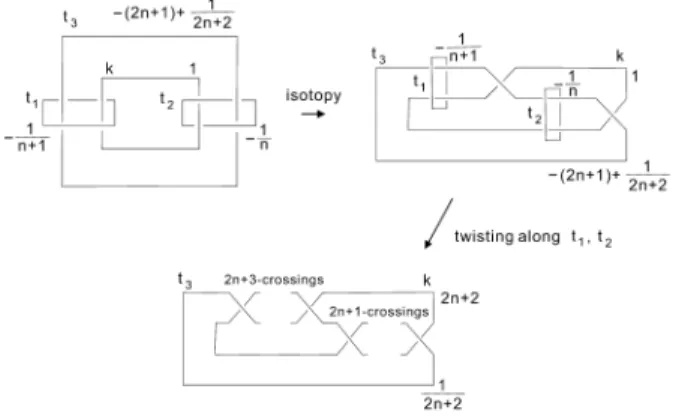
Figure 1: Surgery description of K
nLet K
nbe a knot obtained from k by performing
− , − and −(2n+1)+ -surgeries on t
1, t
2and t
3, respectively.
Lemma 3. The knot K
nis lying in S
3and K
n(0) is a manifold obtained from S
3by performing 1, − ,
− and − (2n+1) + -surgery on k, t
1, t
2and t
3,
respectively.
Proof. After − -surgery on t
1(i.e., n+1-twist along t
1) and − -surgery on t
2(i.e., n-twist along t
2), k
∪t
3become a 2-bridge link in (new) S
3with their link- ing number (n+1) −n=1 and new framings 2n+2 and on k and t
3, respectively (Figure 2).
Then after −(2n+2)-twist along t
3, we obtain a knot K
nin S
3with the framing (2n +2) −1
2× (2n +2) =0.
[Q.E.D.]
We shall say that a Seifert fiber space is of type S
2(n
1, n
2, n
3) if it has a Seifert fibration over S
2with three exceptional fibers of indices n
1, n
2and n
3(n
i≥ 2).
Lemma 4. The resulting 3-manifold K
n(0) (n ≠0, −1,
−2) is a small Seifert fiber space of type S
2( | 2n +1 | ,
| 2n +3 | , | (2n +1)(2n +3) | ).
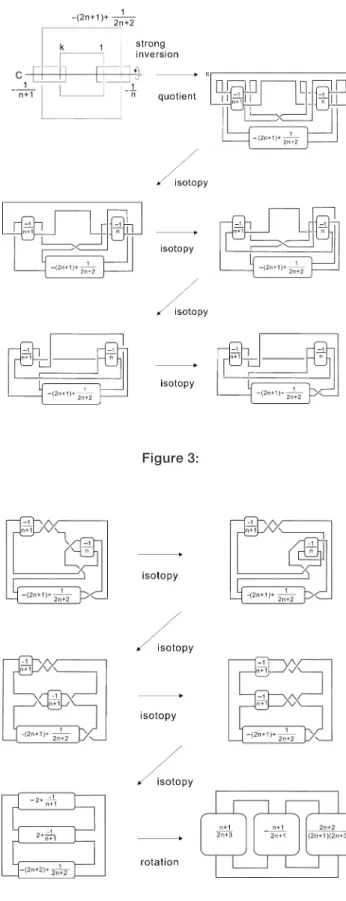
Proof. To prove this we take the quotient by the strong inversion of S
3as shown in Figure 3. Then we obtain a branch knot c ′ which is the image of the axis C. The Montesinos trick developed in the paper
(16)(also see the paper
(4)) shows that r
i-surgery on t
iin the upstairs corresponds to r
iuntangle surgery in the downstairs, i.e., a replacement of 1/0-untangle by r
i- untangle. Please remark that we are adopting Bleiler's convention in the paper
(5)on the parametrization of rational tangles. These untangle surgeries convert the knot c ′ into a link c (Figure 3).
We follow the sequence of isotopies in Figures 3 and 4. Finally we obtain a Montesinos link M( ,
− , ). Since K
n(0) is a double branched
cover of S
3branched over the Montesinos link M( ,
− , ), K
n(0) is a Seifert fiber space of type
S
2( | 2n+1 | , | 2n+3 | , | (2n+1)(2n+3) | ). [Q.E.D.]
Since K
n(0) is a Seifert fiber space, it follows from Proposition 1 that K
nis a fibered knot in S
3.
It is easy to see that K
nis a trivial knot if n=0, −1 or −2. Except for these values, we have:
2n+2 (2n+1)(2n+3) n+1
2n+1
n+1 2n+3 2n+2
(2n+1)(2n+3) n+1
2n+1
n+1 2n+3
1 2n+2
1 n
1 n+1
1 2n+2 1
n
1 n+1 1
2n+2 1
n 1 n+1
Kazuhiro Ichihara
・Kimihiko Motegi
・Hyun-Jong Song 22
Figure 2: Modification of the surgery description
Lemma 5. The knot K
nis hyperbolic if n ≠0, −1,
−2.
Proof. Note that the 2-bridge link given in Figure 2 is a
(2, p)-torus link if and only if n=0, −1, −2. In fact,
the 2-bridge link is a Hopf link when n =0, −1, −2.
Hence by the result in the paper
(14)it is a hyperbolic link if n≠0, −1, −2. Since | 2n+2 | > 1 if n≠−1, it follows from Theorem 1 in the paper
(1)(see also Theorem 1.2 in the paper
(3)) that K
nis a hyperbolic knot.
See also Corollary A.2 in the paper
(10), Theorem 1.2 in the paper
(15)and Theorem 1.1 in the paper
(2). [Q.E.D.]
Let us show that the knot K
nis a small knot.
Lemma 6. Each hyperbolic knot K
n(n≠0, −1, −2) is a small knot.
Proof. As we observed in the proof of Lemma 3, the knot K
nis obtained from a component k of a two-bridge link L([−2n−1, 2n+3])=k ∪t
3by twisting along the other component t
3, see Figure 2.
Note that L([ −2n −1, 2n +3]) is isotopic to L([ − 2n −3, 2n +1]), and isotopic to the mirror image of L([2n+1, −2n−3]) by their symmetries.
Now assume for a contradiction that K
n(n≠0, −1,
−2) is not small. Then there is a closed essential sur- face F in E(K
n). Since there is no closed essential sur- face in a two-bridge link exterior by Theorem 1 and its Remarks (1) in the paper
(11)F intersects the dual t
*3of t
3in E(K
n). We may isotope F so that F ∩ N(t
*3) consists of meridian disks of N(t
*3) and the number of such disks is minimal. Put S = F∩E(K
n∪t
*3), which is a properly embedded essential surface in E(K
n∪t
*3)=E(k ∪t
3).
Then a component of ∂ S has a slope ( ≠ ) on
∂ N(t
3). If S is meridionally compressible, i.e., there is a
disk D⊂S
3such that D∩S=∂ D is essential in S and D meets K
ntransversely in one point, then apply merid- ional surgeries until it is meridionally incompressible.
It is easy to check that meridional surgeries preserve essentiality of surfaces. Thus we obtain an essential, meridionally incompressible surface S in the 2-bridge link exterior E(k ∪ t
3) satisfying property ( * ):
(i) ∂ S ∩∂ N(k) =0 / or ∂ S ∩∂ N(k) has slope , and
(ii) ∂ S∩∂ N(t
3) has slope .
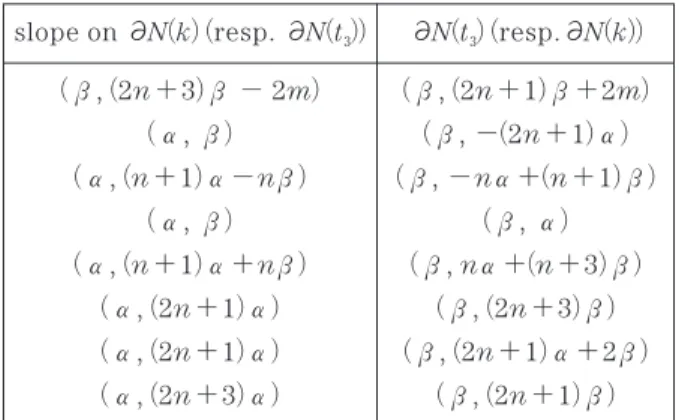
Now we apply a classification of such surfaces in a 2-bridge link exterior due to the result in the paper
(9)by Goda, Hayashi and Song, which is based on the paper
(7). For adaptation of their setting, if 2n+1 > 0 (i.e., −2n
−1 < 0), then we once take the mirror image L([2n+1,
1 2n+2
1 0
1 0 1 2n+2