Master thesis
Experimental Study on the Dynamics of a Dual-Species Bose-Einstein Condensate with
Tunable Interactions
Supervisor: Associate Prof. Shin Inouye
Department of Applied Physics School of Engineering
The University of Tokyo
37-126537 Alto OSADA
Submitted in February, 2014
ABSTRACT
Since the first realization of a dilute gas multi-component Bose Einstein Condensate (BEC), non-equilibrium properties of the gas have been investi- gated extensively, showing great success in unveiling the nature of solitons, various spin textures, vortex rings, etc.. Until recently, however, important ingredient in cold-atom experiments was not incorporated in these studies:
manipulation of interaction strength using Feshbach resonance.
Our experimental setup of
41K and
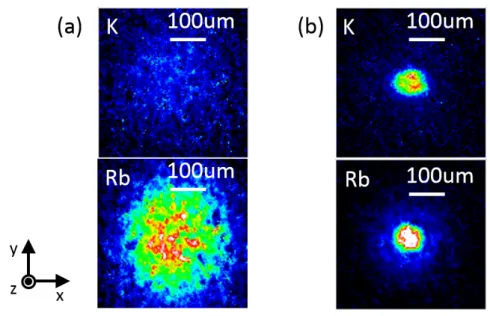
87Rb allows us to investigate the superfluid-superfluid interaction quantitatively with tunable interaction and to compare results to that of coupled Gross-Pitaevskii (GP) equations. As an example, we examined the modulation instability of a strongly interact- ing dual BEC, by observing the time-evolution of a dual BEC using non- destructive imaging method. The spatial profile of the dual BEC in an elon- gated trap showed a characteristic pattern, and the change in the length scale was studied as a function of the interspecies scattering length, and compared with the results from the coupled Gross-Pitaevskii equations. The observed size of spatial structures (22(4) µm at a
KRb= 80.8 a
B) agreed well with the theoretical prediction of 23 µm.
.
ACKNOWLEDGMENTS
本論文は東京大学大学院工学系研究科物理工学専攻における
2013
年度の 修士論文として執筆されたものです。本論文の執筆に際してお世話になった、あるいは助力をいただいた方々へのお礼の言葉をここに述べさせていただきた いと思います。
指導教官である井上慎准教授には、学部
4
年次より3
年間お世話になり ました。学部4
年のころより私の素朴な質問にも親切に答えてくださり、ミー ティングやその他の機会を通して沢山のことを学ばせていただきました。特に 物理現象をなるべく平素な言葉で述べる姿勢、プレゼンテーションの際に聴衆 の興味を引くためのテクニックなど非常に参考になるものが多く、今後の研究 生活の基盤をなすもっとも大きな構成要素といっても過言でない事柄を多く学 ぶことができました。また、研究以外でも社会生活を営む上での作法や態度な ども勉強をさせていただきました。たいへん世間知らずな私の性質でむしろご 迷惑をお掛けすることも多々あり、私が問題を起こすたびにフォローをしてい ただき、私を諭してくださったことにはいくら感謝をしてもしきれません。ま だまだ世間知らずが治ったとは言えない私ですが、今後も先生のお言葉を活か し、一角の人物となれるよう精進を怠らず邁進していく所存です。助教である小林淳氏には学部
4
年次ではULE cavity
を用いた光源の作成 で、修士課程進学後はミーティングやその他の機会でお世話になりました。と くに氏の豊富な経験からの助言は実験の方法や考察の随所随所で大変参考にな り、修士2年次からの私単独での実験において、もっともたくさん助言をいた だいた方の一人です。本論文4
章で述べたTOF
シークエンスの改善の折や5
章 でのデータ解析において助言をいただいたことが特に印象に残っております。また実験データや現象・物理の本質の理解に対して非常に積極的で、かつデー
iv
タの妥当性に関して厳しくもあった氏の姿勢はぜひ見習いたく思います。また、
実験中手が空くときにはよく他愛のない雑談等に付き合っていただきました。
ありがとうございました。
現在博士
3
年次の加藤宏平氏とは私が修士課程に進学してからかれこれ2
年間、E1
グループの実験装置を共有してきました。初めの1
年は氏とともに 極低温極性分子の生成を目指した研究を行い、氏の指導の下実験装置に関する 様々なことをはじめ電子デバイスやオプティクスの基礎的な扱い方から物品の 発注の仕方まで一通りのことを学びました。修士2
年に進級して実験テーマが 別になったのちも私が投じるトンチンカンな質問にも真面目な議論にも根気強 く答えてくださり、大変感謝しております。私の大雑把な性格とは対照的に念 入りに実験を行う氏の姿勢は印象が深く、確認を怠ったことによるミスを犯す たびに氏の慎重さを手本とし、改善の努力をしてきました。お手を煩わせるこ とも多々あったとは思いますが、大変お世話になりました。昨年井上研で修士論文を出された上原城児氏はアルカリ原子の光会合を テーマにされ、
E1
グループの装置も用いて実験が行われていたのを覚えてい ます。氏の実験テーマ、実験結果は当時E1
グループに配属されて全容を把握 しきれず、ようやく分子生成の話もつかみかけていた私には興味深くみえまし た。氏の夜遅くまで作業に取り組む姿に、私も頑張らねばと自分を奮い立たせ ていました。昨年度卒業論文を井上研究室で執筆し、現在は情報理工学系研究科の数 理情報第
5
研究室に所属している鈴木皓博氏は、上原城児氏やその他の研究室 メンバーと協力してずっとひたむきに作業をこなしておりました。試行錯誤を し、結果を残そうとしていた氏の姿が非常に心に残っています。これに並行し てまったく分野の違う研究科を目指し、しっかり合格をもぎ取った氏の行動力 にも驚きましたが、氏が修士課程に進学したのちに井上研に顔を出されたとき に元気そうな顔を見せてくださり、私としても他愛もない話ができて大変楽し く、非常に励みになりました。現在修士
1
年次の早川悠介氏とは彼が修士課程で井上研に配属され、E1
グループの実験に本格的に携わってから1
年にも満たない期間の付き合いです が、氏には実験上非常に多くの面で助けられました。とくにFringe Cleaning
の実行やカメラのデータ取得に関する問題点に関してはプログラミング言語にv
慣れ親しんだ彼の助力なしには成しえなかったと考えられます。また、Rb
のZeeman
シフトの計算もPhase Contrast Imaging
には不可欠のものでした。現 在は加藤宏平氏とともに分子生成の実験及びEfimov
状態に関連した物理の研 究を精力的に行っており、修士1
年次ということで就職活動も始まっているよ うで大変でしょうが、ご健闘をお祈りしています。同じく現在修士
1
年次の荻野敦氏は私が修士1
年の時に学部4
年生として 井上研に配属され、以来現在までの2
年弱を主にE2
グループにおいて過ごし てこられました。氏が学部4
年次の時の研究テーマが私の学部4
年次のそれと 共通点が多くあったため当時はお手伝いをすることもありましたが、いまや小 林淳助教の指導のもとでE2
グループの実験装置をコントロールしつつ、基礎 定数の恒常性検証という問題に立ち向かう頼もしいメンバーとなっています。夜遅くまで残って根気強く実験する氏の姿を見かけるたび自分の身が引き締ま る思いでいました。氏も早川悠介氏とともに就職活動に身を投じることになり ます。なにかと大変なこともあるかとは思いますが、氏にとって良い結果とな ることを祈ります。
学部
4
年生として井上研究室に配属され、その後修士課程では物性研究 所小林研に所属している現修士1
年の大久保弘樹氏は氏の卒業研究において荻 野敦氏とともに研究に励んでおられました。修士課程に進んでからも輪講でお 会いした際に近況をお聞きすることができ、大変嬉しく思いました。氏の卒業 研究は荻野敦氏と同じく冷却分子を用いた基礎定数の恒常性の検証でしたが、発表なども非常にわかりやすく、勉強をさせていただきました。氏のますます のご活躍を期待しております。
現在学部
4
年生として井上研に配属され、卒業研究をされている赤羽健二 氏、小野貴晃氏は小林淳氏の指導の下に着実に研究を進める姿が印象に残りま した。特に両氏がお互いによく相談し、理解しあって分担して作業をこなす様 子や、作業中積極的に質問をしてくださる点にはある種の頼もしさを感じまし た。彼らの抱える技術的問題に対して私のアドバイスは的外れなことも多かっ たと思いますが、少しでも彼らにとって利する部分があれば幸いに思います。両氏ともに修士課程進学後には別の研究室へと巣立っていくことになりますが、
井上研で学んだことを糧に羽ばたいて行かれることを期待しております。
論文紹介セミナーでは実験、理論問わず冷却原子の研究を行っている研究
vi
室の学生とスタッフが一堂に会して週ごとの論文を持ち回りで紹介しました。
論文紹介に参加された中でも理学系研究科上田研の遠藤晋平氏、理化学研究所 肥山研に所属されている作道直幸氏は理論家の観点から選ばれた論文の紹介と 実験的な興味の両方をカバーした内容を常に提供してくださり、理解しきれな いところはありつつも非常に興味深く新鮮に聞くことができました。とくにビ リアル展開の物理的な意味と重要性や、フェルミ粒子のユニタリー極限に関す る作道直幸氏の説明は明快で、いまだに記憶に残っております。また理学系研 究科五神研の冷却原子実験チームの堀越宗一助教は多様な実験を理解し、また 知らないことに対する理解に貪欲でありました。同チームの学生である五神研 所属の池町拓也氏、小芦研所属の伊藤亜紀氏は積極的に質問をして自らの理解 を進めようとする姿に大変刺激を受けました。また小芦研の市田昌己氏はこの セミナーを通してご自身の知識を増やそうとされていて、見習いたい態度だと 感じました。
私は
2013
年1
月より統合物質科学リーダー養成プログラム(Materials
Education program for the future leaders in Research, Industry, and Tech-
nology
、MERIT
)に2014
年3
月まで所属させていただいております。MERIT
プログラムにおいては多彩なコースワーク、特別講義等を享受する機会をいた だき非常に勉強させていただいたことに加え、奨励金の支給は私の生活の支え となりました。MERIT
プログラムにおいて副指導教員を担当していただいた中 村泰信教授には四半期に一度の進捗報告の際には近しいとはいえ異分野の私の 話を興味を持って聞いていただき、また中村研究室の学生、スタッフの方々と の交流をさせていただいたりと貴重な体験をさせていただきました。とくに私 の博士課程進学後に指導教員を担当していただく宇佐見康二准教授には初めて 中村研にお伺いした際に新しく赴任されるとご紹介いただき、それがきっかけ で学会でお話を聞かせていただくなどして博士課程から異分野へ飛び込み、宇 佐見准教授の下で新たな分野について学ぼうという決心をしました。現在の私 の進路を決めるうえで中村教授、宇佐見准教授と出会うことができたことは非 常に大きな影響を持っており、このような機会に恵まれたのはひとえにMERIT
プログラムの副指導教員制の恩恵であると強く感じています。博士課程進学後 はほとんど一からのスタートにはなりますが、私の選択とご縁はきっと私の今 後にとってかけがえのないものになると信じ、日々精進していく所存です。vii
上記以外にも、私の家族をはじめとして学生およびスタッフの居室にい た様々な研究室の方々、物理工学専攻の教務関係の方々、6
号館工作室や9
号館 事務の方々、教養学部時代からの友人、MERIT
を通じて知り合った友人、数え 切れないほど様々な方の助けを得て修士課程2
年間を過ごすことができました。この修士論文が完成をみることができたのは上記のすべての方々の助力あって こそのものです。最後に改めて心からの感謝の意を表し、この謝辞の結びとし たいと思います。
2014
年2
月 長田 有登Contents
1 INTRODUCTION 1
1.1 Historical Overviews . . . . 1
1.1.1 Laser Cooling and Trapping of Neutral Atoms . . . . 1
1.1.2 Realization of Bose-Einstein Condensation(1995) . . . . 4
1.1.3 Experiments Using BEC . . . . 6
1.1.4 Experiments on Superfluid Helium . . . . 7
1.2 Two-component Bose-Einstein Condensates . . . . 8
1.2.1 Experiments on Two-component BECs . . . . 8
1.2.2 Another Application: Ultracold Molecules . . . . 10
1.3 Contents of This Thesis . . . . 12
2 THEORETICAL DESCRIPTION OF A DUAL-SPECIES BEC 13 2.1 Single-Component BEC . . . . 13
2.1.1 Gross-Pitaevskii Equation . . . . 13
2.1.2 The Transition temperature and The Condensate Fraction . 17 2.2 Two-Component BEC . . . . 18
2.2.1 Coupled Gross-Pitaevskii Equations . . . . 18
2.2.2 Tuning the Scattering Length by Feshbach Resonance . . . 24
3 EXPERIMENTAL SETUP 27 3.1 Toward In-situ, Nondestructive Observation of a Dual BEC . . 27
3.1.1 Phase Contrast Imaging . . . . 27
3.1.2 Elongated dual BEC in an Optical Dipole Trap . . . . 28
3.1.3 Gravitational Sag and Magnetic Field Gradient . . . . 29
x CONTENTS
3.2 Interaction Between Electromagnetic Field and an Atom . . . 30
3.2.1 Density Matrix and Optical Bloch Equations . . . . 30
3.2.2 Refractive Index and Phase Shift . . . . 32
3.3 Phase Contrast Imaging . . . . 34
3.3.1 Schematics of the Phase Contrast Imaging . . . . 34
3.3.2 Probe Lasers for Phase Contrast Imaging . . . . 37
3.3.3 Generating Pulse Trains for Probe Lights . . . . 43
3.4 Setup of Optical Dipole Traps . . . . 45
3.4.1 Light Shift . . . . 46
3.4.2 Experimental Sequences . . . . 47
3.4.3 Crossed ODT and Optical Lattice . . . . 48
3.4.4 Gravitational Sag and 809 nm ODT . . . . 51
3.4.5 Setup for Generating Elongated BECs . . . . 52
3.5 Gravitational Sag and Magnetic Field Gradient . . . . 56
3.5.1 Gravitational Sag in the Horizontal Direction . . . . 56
3.5.2 Effect of Magnetic Field Gradient on the Potential Minimum 57 4 IN-SITU OBSERVATION OF A DUAL BEC 61 4.1 Creation of an Elongated Dual BEC in an ODT . . . . 62
4.1.1 Time-of-Flight Measurement . . . . 62
4.1.2 Elongated Dual BEC in a New Crossed ODT . . . . 64
4.2 In-Situ Observation of a Dual BEC . . . . 65
4.2.1 Probe lasers for PCI and Phase Plate . . . . 65
4.2.2 Phase Contrast Imaging of a Dual BEC . . . . 69
4.3 Spatially Overlapped Dual BEC in 809 nm ODT . . . . 72
4.3.1 Cancellation of Relative Gravitational Sag in 809 nm ODT 72 4.3.2 Static Nature of Dual BEC . . . . 72
4.3.3 Tuning the Relative Position of Two BECs by Magnetic Field Gradient . . . . 79
4.3.4 Dynamical Motion of an Immiscible Dual BEC . . . . 80
4.4 The Glitch in Time-of-Flight Imaging . . . . 84
CONTENTS xi 5 OBSERVATION OF MODULATION INSTABILITY WITH A DUAL
BEC 89
5.1 Theoretical Description of the Modulation Instability . . . . . 91 5.2 Preparation of a New Optical Trap of an 809 nm ODT . . . . . 98 5.2.1 New Shape of an 809 nm Optical Dipole Trap . . . . 99 5.2.2 Radial Trapping Frequency of the New Optical Dipole Trap 100 5.2.3 Loading a dual BEC into the New Optical Dipole Trap . . . 104 5.3 Experimental Observation of the Modulation Instability . . . . 106
5.3.1 Experimental Conditions for Observing the Modulation In- stability . . . 106 5.3.2 Experimental Sequence for Observing Modulation Instability 107 5.3.3 Results at a
KRb= 80.8 a
B. . . 108 5.3.4 Results at a
KRb= 81.5 a
B. . . 114 5.3.5 Summary of the Results . . . 119
6 SUMMARY AND CONCLUSIONS 123
A ALKALI D-LINE DATA 127
A.1 Properties of
87Rb D2 Line . . . 127 A.2 Properties of
41K D2 Line . . . 128
B FRINGE CLEANING 131
C DISCRETE FOURIER TRANSFORMATION 135
C.1 Discrete Fourier Transformation . . . 136
C.2 Sampling Theorem and Aliasing . . . 137
C.3 Analysis of Experimentally Obtained Data . . . 138
D MEASUREMENT OF THREE-BODY LOSS COEFFICIENT 141
E NUMERICAL SOLUTION OF COUPLED GP EQUATIONS 147
F C++ PROGRAM FOR ANALYZING THE IMAGE 151
List of Figures
1.1 Schematic representation of a Magneto-optical trap (MOT). . . 3
1.2 False-color surface plots of the velocity distributions of atomic clouds for various temperatures[11] . . . . 5
2.1 Schematic plot of a Thomas-Fermi density profile . . . . 16
2.2 Schematic plots of Thomas-Fermi density profiles of dual BECs with variable interactions . . . . 20
2.3 Schematic representation of scattering potentials . . . . 23
2.4 Schematic representation of an avoided crossing between atomic and molecular states . . . . 23
2.5 Theoretically calculated value of the interspecies scattering length a
RbK. . . . 26
2.6 Theoretically calculated value of interspecies scattering length a
RbK. . . . 26
3.1 Schematic representation of the phase contrast imaging . . . . 34
3.2 Side imaging system . . . . 36
3.3 Top imaging system . . . . 36
3.4 Calculation of Zeeman shifts for K D2 line . . . . 40
3.5 Calculation of Zeeman shifts for Rb D2 line . . . . 41
3.6 Preparation of probe lasers for PCI . . . . 42
3.7 Instruments for TTL pulse train generation . . . . 44
3.8 Configuration of ODT (A) and (P) . . . . 49
3.9 Configuration of optical lattice beams . . . . 50
xiv LIST OF FIGURES
3.10 Modified evaporation sequence . . . . 53
3.11 Crossed dipole trap with ODT (P) and (B) . . . . 54
3.12 Calculation of potential surface by crossed dipole trap with ODT (P) and (B) . . . . 55
3.13 Illustration of a tilted optical dipole trap and a plot of relative position . . . . 56
3.14 Illustration of the configuration of compensation coils and its magnetic field/field gradient . . . . 59
4.1 Time sequence of TOF and absorption imaging . . . . 63
4.2 Absorption image of thermal clouds and dual BEC . . . . 65
4.3 Optical path of probe beam before the glass cell . . . . 66
4.4 Optical path of probe beam after the glass cell . . . . 66
4.5 Picture of optical path of probe beam after the glass cell . . . . 67
4.6 Schematic representation of focused Gaussian beam through a lens . . . . 68
4.7 Schematics of imaging sequence of PCI . . . . 70
4.8 Observation of dual BEC generated in 1 µm ODT by PCI . . . 71
4.9 Time sequence of loading atoms into 809 nm ODT . . . . 73
4.10 Two BECs in (a) an 1 µm ODT and (b) the 809 nm ODT . . . . 74
4.11 Cancellation of relative gravitational sag . . . . 74
4.12 Observation of phase separation with dual BEC in 809 nm ODT by absorption imaging. . . . 75
4.13 Miscible dual BEC observed by PCI . . . . 76
4.14 Immiscible dual BEC observed by PCI . . . . 77
4.15 Tuning the relative position in horizontal direction . . . . 79
4.16 Dynamical transition from a metastable configuration to the stable configuration . . . . 81
4.17 Time sequence of the loading into an 809 nm ODT . . . . 82
4.18 Dynamical motion of a dual BEC undergoing the sudden change
of the interspecies scattering length. . . . 83
LIST OF FIGURES xv 4.19 Typical images obtained with TOF measurement written in
Section 4.1 . . . . 85
4.20 Modified TOF sequence . . . . 87
4.21 Comparison between dual BECs produced by the former and the modified TOF sequence . . . . 88
5.1 Optical path of the tight 809 nm optical trap . . . . 97
5.2 TOF measurement of rubidium BEC in (a) the former 809 nm trap and (b) the new one . . . 101
5.3 Measurement of the trapping frequency with a laser power of 84.6 mW . . . 102
5.4 Measurement of the lifetime with a laser power of 84.6 mW . 102 5.5 Measurement of the trapping frequency with a laser power of 27.4 mW . . . 103
5.6 Measurement of the lifetime with a laser power of 27.4 mW . 103 5.7 TOF measurement of a dual BEC in the new 809 nm trap . . . 104
5.8 Calculated values of k
maxversus a
KRb. . . 105
5.9 Calculated values of G
maxversus a
KRb. . . 105
5.10 Hall probe measurement of magnetic field sweep . . . 107
5.11 Typical images of time evolution at a
KRb= 80.8 a
B. . . 109
5.12 Spectrum obtained at a
KRb= 78.5a
B. . . 110
5.13 Subtracted signals of two atomic species and Fourier transfor- mation of them(a
KRb= 80.8 a
B) . . . 111
5.14 Spectrum obtained at a
KRb= 80.8 a
B. . . . 113
5.15 Typical images of time evolution at a
KRb= 81.5 a
B. . . 115
5.16 Subtracted signals of two atomic species and Fourier transfor- mation of them(a
KRb= 81.5 a
B) . . . 116
5.17 Subtracted signals and fittings on them . . . 117
5.18 Spectrum obtained at a
KRb= 81.5 a
B. . . . 118
5.19 Spatial pattern imprinting on the BEC . . . 119
A.1 Level structures of Rb and K D2 line . . . 129
xvi LIST OF FIGURES B.1 Processed images of a dual BEC with variable number of ref-
erence images. . . 134 C.1 Data points and sinusoidal wave fitting to them. . . 138 C.2 Data processing of images to obtain Fourier spectrum. . . 139 D.1 Measurement of three-body loss coefficient in thermal mix-
ture of K and Rb . . . 145 D.2 In-situ observation of dual BEC with time interval 200 ms. . . 146 E.1 Numerically calculated Thomas-Fermi profiles of dual BECs
with various interactions. . . 150
Chapter 1
INTRODUCTION
1.1 Historical Overviews
Before proceeding to the introduction of a two-component BEC and stud- ies on it, we will review the history of atomic physics and lasers. The in- ventions closely related to atomic physics are introduced step by step, from lasers to a MOT. At the end of the section we mention the realization of a single-species BEC and give a brief review on experiments of superfluid he- liums, which are studies on the superfluid lasting from the beginning of the 20th century. We will describe experiments and perspectives on a dual BEC in the next Section, 1.2.
1.1.1 Laser Cooling and Trapping of Neutral Atoms
It was more than 50 years ago when the first amplification of electro- magnetic wave was realized by A. L. Schawlow and C. H. Townes[2]. This novel technique, the laser oscillation, is so ubiquitous that it is used very commonly in various region of scientific research and in our daily life, e.g., optical writing and readout of the information to data disks, laser pointers we use, and revolutionary fast optical communication.
By now the laser is a powerful tool to investigate the phenomena ap-
pearing in the nature. Since the laser light has spatial and temporal coher-
ence, light field with some specific frequency and wavevector can be applied to a matter. This enables not only the detailed spectroscopy of the atomic, molecular levels and the elementary excitations in solid-state materials, but also the coherent control of them. In practice, for spectroscopic purpose we apply laser pulses to target matters and measure the frequency-dependence of absorption or fluorescence with a high resolution. Simultaneously, this means that we can address elementary excitations in a selective manner, or if the transition dipole moment and laser intensity are known, we can shine a π/2-pulse to prepare the superposed state of the ground and the excited state. Besides, of course the light-matter interaction is not limited only to the context of excitation, but can expose an influence on the ground state without any excitations by making use of a off-resonant laser. Such control and spectroscopy are successfully realized in atomic gas systems be- cause of an atom’s relatively simple electronic structure and its discrete en- ergy levels. There have been experiments which investigate various physical phenomena and quantities by utilizing these properties such as the Sagnac effect[3], the measurement of the physical constants ¯ h/m[4] and the gravita- tional acceleration[5].
In order to provide an overview of how an atom interacts with light field, we introduce two forces acting on an atom. The first one comes from the absorption. When an atom absorbs a photon, momentum conservation says that it is kicked in the direction of photon. After a while the atom emits a photon in a random direction (spontaneous emission) and it experiences a kick in a random direction. For the absorbed photon has always the same momentum (wavevector) and emitted one has its direction at random, the net momentum that an atom acquires is (the number of absorbed photons)
× (the momentum of a single photon) and thus an atom feels the net force acting in a direction of the wavevector of photon. This net force is called the radiation pressure.
The second way of interaction is due to the refractive index of a single
atom. In this case an atom does not absorb photons, but it bends them to
Figure 1.1: Schematics representation of a Magneto-optical trap (MOT), which consists of six red-detuned lasers and a pair of coils in the anti- Helmholtz configuration.
feel the net force, this time from the gradient of light intensity. As described in detail in Chapter 3, this interaction is derived by regarding an atom as an electric dipole whose orientation follows the direction of electromagnetic wave (electric dipole approximation). This force is essentially different from the radiation pressure and called the dipole force.
Above, two types of forces acting on an atom by light have been intro-
duced. The important fact is that the radiation pressure is dissipative while
the dipole force is conservative. Proper use of dissipative force can reduce
the total energy of, or cool, the ensemble. For the atomic gases, this scheme
works very well because they can be put in a highly isolated environment.
The most commonly used instrument is a vacuum chamber with gas pres- sure on the order of 10
−9to 10
−11Torr. Thus the cooling of matter by optical forces has been developed successively for atomic gases and the technique of Zeeman slowing[6], optical molasses[7] and magneto-optical trap[8] were realized. Optical molasses is based on the radiation pressure combined with the Doppler effect. This is realized by counterpropagating two beams in three directions, whose frequencies are slightly lower than the atomic reso- nance.
Magneto-optical trap (MOT) is constructed by just putting a pair of coils in the anti-Helmholtz configuration in addition to optical molasses. Atoms in MOT is dramatically cooled below 1 mK from room temperature. The dipole force is also frequently used as an optical dipole trap (ODT). ODT is a very common technique comparable to the magnetic trap. The advantage of using ODT is that this can trap any spin states and enables us to inves- tigate properties of atoms in the magnetically-untrappable hyperfine states.
In addition, by counterpropagating two beams and letting them interfere to form optical lattice, we can study interaction of atoms and periodic potential as a matter-wave gratings, or a lattice potential in which atoms mimics the particles in condensed matter systems.
1.1.2 Realization of Bose-Einstein Condensation(1995)
Magneto-optical trap can cool an atomic ensemble below 1 mK. Even if
Sisyphus cooling works to lower the temperature down to µK regime, the
phase space density ˜ n = nλ
3dBis several orders of magnitude smaller than 1,
while the atomic gas undergoes the Bose-Einstein condensation (BEC) tran-
sition with phase space density ˜ n ∼ 1. In order to achieve lower temper-
ature and higher spatial density, evaporative cooling was used. Roughly
speaking, this technique throw relatively hot atoms away and then remain-
ing atoms are thermally redistributed to get cold. In 1995, researchers cooled
Figure 1.2: False-color surface plots of the velocity distributions of atomic clouds for various temperatures, each corresponds to the one of 400 nK, 200 nK and 50 nK from left to right.[11].
atoms down to about 100 nK, especially the ones belong to Bose statistics,
and had found that they condensed into the quantum ground state of the
trapping potential: the BEC was first realized by E. Cornell, C. Wieman,
and Wolfgang Ketterle’s group [9, 10]. In short, BEC phase is described as
the one that most atoms occupy the quantum ground state of the trapping
potential, sharing the same phase factor e
iSon the wavefunctions. There-
fore, there exists coherence among atoms and consequently BEC exhibits
rich properties which cannot be observed in ”hot” (or, thermal) atomic en-
sembles such as a superfluidity, an interference pattern formed by two sepa-
rate BECs[16](Note that the interference pattern appears also in thermal(not
BEC) but sufficiently cold atomic ensembles[17], though they observed an
interference of two thermal clouds separated from initially a single thermal
cloud), the formation of a vortex lattice[15] and so on.
1.1.3 Experiments Using BEC
Once a BEC is realized, it became not only an aim but also a tool to inves- tigate many things that had never seen. For example, the matter-wave inter- ferometry allowed us to examine the ”phase shift” experienced by atoms. If the acquired phase shifts differs from one BEC to another, interference fringe shifts by some amount of phase and we can measure the relative phase shift.
From this and due to its high fringe contrast, various phenomena can be ob- served, or some physical quantities have been precisely measured e.g., the Stark shifts of the energy levels[13] and the constant ¯ h/m[12].
On the other hand, ultracold atomic collisions were also of interest, such as the Feshbach resonance which was predicted in 1964 by the nuclear physi- cist Hermann Feshbach[69, 70]. For atomic physics experiment it is often re- ferred to as the phenomenon that the coupling between free state and bound state enhances the scattering amplitude and the scattering length varies due to this. Due to different magnetic susceptibilities of these two states (chan- nels), energy levels of two states degenerate at some magnetic field and this results in a divergence of s-wave scattering length at that magnetic field and this resonant behavior is one of the consequences of Feshbach reso- nance. This had not been observed until it was observed in a BEC of
23Na [14]. Around the resonance, the coupling can be tuned so that the scattering length can also varied by changing a value of magnetic field.
This technique is now commonly used in experiments of ultracold atoms.
For example, by trapping a BEC in a two-dimensional optical lattice and tun- ing the scattering length at a very large positive value, Tonks-Girardeau gas was studied[18]. By tuning scattering length from a large positive value to a large negative value for the Fermi degenerate atomic cloud, a smooth transi- tion from BEC regime to BCS regime was observed(BCS-BEC crossover)[19].
These experiments can be included in the attempts of so-called ”quantum
simulator”, originally dictated by R. P. Feynman. Note that we can tune the
scattering length, namely the mean-field energy at will, and we can prepare
and tune the hight of lattice potential by optical lattice technique. These facts
supports the idea of quantum simulator. The first, impressive experiment appeared in Ref. [20]. In this experiment the superfluid-to-Mott-insulator transition of a degenerate Bose gas in an optical lattice was observed and opened up a new way in atomic physics.
1.1.4 Experiments on Superfluid Helium
At this point, it has some importance to review experiments on the super- fluidity using liquid helium and the relation to gaseous BEC experiments.
Helium consists of two isotopes,
4He (99.999863%, boson) and
3He (0.000137%, fermion). It is very famous that
4He was first liquefied at about 4.23 K in 1908 by Heike Kamerlingh Onnes, who discovered the superconductivity in mer- cury three years later. Later in 1930’s, researchers discovered and confirmed that liquid helium-4 below 2.17 K does not behave as a classical fluid[34]. P.
Kapitza used a term ”superfluid” to refer to non-classical properties[37] and F. London suggested that superfluidity of helium originates in the behav- ior as a macroscopic liquid matter wave. Nowadays it has become almost a common sense among researchers that superfluidity of helium-4 is related to Bose-Einstein condensation. The hydrodynamic and excitation properties of superfluid are well studied with superfluid helium-4.
Helium-4 is a bosonic species and can realize macroscopic occupation of the ground state. For fermionic helium-3, this phenomenon does not occur in principle. However, in 1970’s researchers found that helium-3 became superfluid below a few mK[35, 36], which was three orders of magnitude lower temperature than that of helium-4. This was thought to be simply because fermionic helium-3 must form a pair to be a boson. Striking fact was that this pair of atoms had nonzero angular spin ( S = 1 ), which could not be explained by Bardeen-Cooper-Schrieffer(BCS) theory. A. J. Leggett explained this mystery by considering an attractive interaction due to the spin fluctuation and won the Nobel prize in 2003.
In spite of these experimental successes, informations about BEC had not
been uncovered until the experimental realization of gaseous BEC of alkali atoms. In a gaseous BEC, almost pure condensate with condensate fraction of almost 100 per cent( for liquid superfluid helium-4, condensate fraction is thought to be less than 10 per cent ) can be prepared. For its purity and outstanding controllability, the properties of BEC and superfluidity from the entirely new approach has become possible.
Furthermore, using different spin states or atomic species we can eas- ily investigate the superfluid-superfluid interaction with very pure conden- sates. This is difficult with helium-3, though it has spin-1, because of low- solubility of at most ∼ 15 per cent in
4He and the phase separation tak- ing place between them when the concentration is higher than ∼ 15 per cent[38, 39] at low temperature below 0.4 K. Therefore atomic physics ex- periment can offer the powerful tool to study the interaction and dynami- cal behavior of superfluid mixture. In the next section, we introduce two- component BEC experiments in detail.
1.2 Two-component Bose-Einstein Condensates
1.2.1 Experiments on Two-component BECs
As described above, investigations on a single-species atomic gas or a BEC have been successful in many aspects and are now still the cutting-edge of today’s physics, for example, a transport phenomena in 1D-disordered lattice potentials across the fluid-insulator transition[22], an artificial gauge field for neutral particles[23, 24, 25], and so on.
On the other hand, a few years later from the first realization of a gaseous
BEC, a two-component BEC(or a dual BEC) was generated for the first time
by mixing two hyperfine states of rubidium atoms[31] and subsequently of
sodium atoms[32]. This mixture of BECs is called a spinor BEC and it en-
abled us to succeed in measurement of the relative phase between a binary
component mixture of condensates by an interferometric method[33], and in
observing a decay phenomenon of dark solitons into vortex rings[63]. An- other impressive experiment with a two-component BEC is the one by C.
Hamner et al. [89] that observed the soliton train formation in the presence of superfluid-superfluid counterflow. They also used a spin mixture of
87Rb which is only very weakly immiscible.
An experimental study on the mixture of BECs using different atomic species was first done by S. Papp et al. [67]. In this experiment two differ- ent atomic species,
85Rb and
87Rb are sympathetically cooled to realize the simultaneous condensation of both atomic species. The important point is that since the intra-species scattering length of
85Rb is a large negative value with no magnetic field bias, they had to tune the scattering length of
85Rb by the intra-species Feshbach resonance. In other words, they can tune the ratio between intra- and interspecies scattering lengths at will by making use of the Feshbach resonance, so that their dual BEC is suitable for studies on spa- tial separation and all other phenomena where the ratio of scattering length is crucial. Actually, they investigated the droplet formation during the evap- orative cooling with widely tunable interaction regime and observed an im- plication of the presence of the modulation instability in this process. This result is supported by the theoretical analysis of this experiment by S. Ronen et al. [68].
There are also intensive theoretical studies with a dual BEC such as on the modulation instability[1], the Rayleigh-Taylor instability[55, 56], the genera- tion of dark-bright solitons[57]. As can be seen with all these studies, and as written above, a dual BEC is a system in which rich dynamical phenomena are potentially available. This is why many researchers are paying attention to the experiment using dual BEC, and the experimental investigation and understanding of quantum non-equilibrium nature of the superfluid mix- ture are expected.
In this thesis, we study on a dual BEC of
41K and
87Rb. By using dual-
species BEC, we can enjoy a few merits compared to a spinor BEC. First, we
use a dual-species BEC, both in the magnetic sublevel | F = 1, m
F= 1 >
so that the atoms cannot exchange their spins with each other and thus the two-body inelastic collision is inhibited. For a spinor BEC, in spite of hav- ing an ability to study the spin-spin interaction, it suffers from the two-body inelastic loss due to the spin exchanging. This results into a relatively short lifetime of about 100 ms[27]. On the other hand, As we observed in Chap- ter 4, our dual BEC of
41K and
87Rb survives for more than 800 ms, which provides a great advantage for the investigation of various phenomena in a dual BEC.
Second, a dual-species BEC can make use of an intra- or inter-species Fes- hbach resonance relatively easily. Although a Feshbach resonances is used also in a spinor BEC with two hyperfine states | F = 2, m
F= − 1 > and
| F = 1, m
F= 1 > [28], their use as an adjuster of the scattering length is limited, for its width is ∆B = 3 mG and requires the precise control of the magnetic field. For
41K and
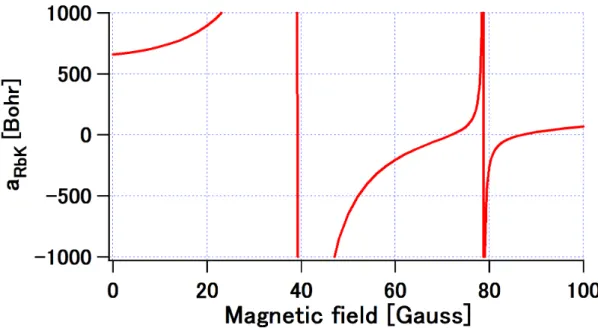
87Rb, a Feshbach resonance with the width of 1.2 G is available at 78.67 G and this is suitable for tuning the scattering length at an arbitrary value.
Third, different energy structures of the two atomic species are beneficial in that if we apply a 780 nm-laser to excite or transfer Rb to another state, the laser does nothing to K atoms and all the same in the opposite way.
Therefore we can access only one of the two species by an optical means and this works well also for microwave transitions.
1.2.2 Another Application: Ultracold Molecules
By the way, we would like to mention to another application of a dual BEC.
There are growing interest in atomic gases as a quantum simulator, espe-
cially the one can not only mimic systems exhibiting the many-body effect
in the ”beyond-mean-field” regime as in the condensed matter physics, but
also investigate a parameter region which is not available with bulk materi-
als. However, there is a problem: electrons in solid state materials interact
with other electrons or ions mainly by Coulomb interaction proportional to
1/r, where r is the distance between particles. But we have a BEC of neutral atomic gas: they interact by short range Van der Waals interaction propor- tional to 1/r
6and this is negligible for the most dilute atomic gases and BECs
1.
Therefore ultracold particles which have long range interaction are needed.
One of the candidate for this is the heteronuclear alkali-alkali dimers which have long range electric dipole-dipole interaction proportional to 1/r
3. For instance the proposal on supersolid[43] is based on the long-range, dipole- dipole interaction between particles in an optical lattice. Promising method to create this ultracold polar molecules is to cool down two species of atoms simultaneously and succeedingly convert them into heteronuclear molecules adiabatically via the magneto-association using a Feshbach resonance. For homonuclear molecules this method has been successfully done and the molecular BEC is realized[26], although this does not have a permanent dipole.
For heteronuclear case the most successful experiment on the ultracold molecule is the one demonstrated by JILA’s group, which uses fermionic
40
K and bosonic
87Rb to generate fermionic molecules
40K
87Rb[29]. Re- cently, this group observed the phase oscillation due to the dipole-dipole interaction[30]. There have also been a few attempts aiming at ultracold het- eronuclear bosonic molecules
85Rb
133Cs[45],
87Rb
133Cs[46],
23Na
87Rb[44],
88
Sr
87Rb[100] and so on. For the sake of efficient generation of ultracold bosonic molecules it is also important to understand the static nature of dual BEC and let the spatial overlap as large as possible.
1Researchers have developed method for producing BECs of atomic species with large magnetic dipole moments such as52Cr[40]( 6µB),164Dy[41]( 10 µB), and168Er[42]( 7 µB).
However, in lattice experiments their dipole-dipole interactions are said to be still small.
1.3 Contents of This Thesis
Currently there are two types of experiments running on our apparatus:
one is aiming at creating ultracold molecules and the other is the study on non-equilibrium properties of a superfluid-superfluid mixture, which is the main contents of this thesis. Our purpose is an experimental study on the dynamics of a dual BEC with tunable interaction strength using
41K and
87
Rb, both bosonic species. Below we shall briefly summarize the contents of this thesis.
To say our achievement first, we examined dynamical properties of a dual-species BEC and especially we succeeded in the observation of spatial patterns formed by the presence of the modulation instability, which occurs when an immiscible dual BEC is initially overlapped. For this observation, three things were needed to be realized: the generation of BECs spatially elongated in one direction, the complete overlap of two species of BECs in an optical trap, and the in-situ, successive observation of a dual-species atomic cloud. In order to implement these three, we prepared a pseudo- one-dimensional optical trap for elongated BECs, made use of an 809 nm optical trap and a pair of coils for overlapping two BECs, and prepared the setup of the phase contrast imaging for each atomic species which enabled the nondestructive observation of two atomic species in a single experimen- tal run. Furthermore, we compared obtained results to the theoretical pre- diction by coupled Gross-Pitaevskii equations, so that it was confirmed that the observed spatial pattern originated in the modulation instability.
The quantitative analysis of the modulation instability using different
atomic species was done for the first time. The achievements in this thesis
imply the strong possibility of a
41K-
87Rb dual BEC as a tool for investigating
non-equilibrium properties of a superfluid-superfluid mixture in a quanti-
tative manner. This can tackle to other dynamical phenomena such as the
vortices and dark/bright solitons, for example.
Chapter 2
THEORETICAL DESCRIPTION OF A DUAL-SPECIES BEC
In this chapter we introduce coupled Gross-Pitaevskii equations which explain the properties of a dual BEC very well and briefly discuss the proper- ties derived from them. In particular, miscible / immiscible(phase-separate) transition, which is the most characteristic phenomenon in a dual BEC, is discussed in detail for the static case.
2.1 Single-Component BEC
Before we mention the coupled equations describing a spatially coex- isting dual BEC, Gross-Pitaevskii equation for a single-component BEC is introduced. Coupled ones are easily derived by analogy with the single- component one.
2.1.1 Gross-Pitaevskii Equation
First we introduce a Gross-Pitaevskii equation for a single atomic species
in a single state, which has its mass m and the scattering length a. The
derivation is based on the variational method as in the Ref.[51]. In BEC
phase, all atoms in an ensemble share the same quantum ground state wave-
function ψ ( r ) . For an ultracold atomic gas in an isotropic harmonic trap V ( r ) = mω
2r
2/2, the ground state is the lowest energy level among equidis- tantly aligned energy levels and the wavefunction is given as
ψ
0( r ) = 1 4π
( mω π ¯ h
)
14exp
[ − mω 2¯ h r
2] ,
where ¯ h is the Planck constant divided by 2π. Note that this wavefunction is the one for non-interacting particles and actually the ground state wave- function is not like this due to the finite interaction between atoms. Let this actual ground state be denoted by ψ ( r ) . The energy E of a BEC can be writ- ten as the sum of the kinetic energy, the potential energy and the interaction energy, which is
E =
∫ (
¯ h
22m |∇ ψ |
2+ V ( r ) | ψ |
2+ g 2 | ψ |
4) dr,
where the coefficient g is an energy density of interaction between atoms.
Now the wavefunction squared have a unit of spatial density: ψ ( r ) = √ n ( r ) e
iS, where n is the spatial density and S the phase. Energy density g can be ex- pressed by the s-wave scattering length of atoms, that is,
g = 4π¯ h
2
a m .
One would notice that we already assume a contact interaction for the two- body collision and applied the mean-field approximation. We can readily take the functional derivative of the functional E [ ψ ( r )] to get the Euler equa- tion
[
− ¯ h
2∇
22m + V ( r ) + g | ψ ( r ) |
2]
ψ ( r ) = µψ ( r ) .
Here the chemical potential µ which has a unit of an energy is introduced.
This constant must be determined by the normalization condition N =
∫ | ψ ( r ) |
2dr.
This condition says nothing but that the spatial density is integrated to give the total number of atoms N. This differential equation is referred to as the time-independent Gross-Pitaevskii equation, the most fundamental one for a single-component BEC.
One may notice that the Gross-Pitaevskii equation has a form very sim- ilar to the time-independent Schr ¨odinger equation excepting the nonlinear, interparticle interaction term g | ψ ( r ) |
2. If the time evolution is under consid- eration, the Gross-Pitaevskii equation should take the time-dependent form with the chemical potential µ being replaced by an operator i¯ h∂/∂t (actu- ally this procedure is a restoration) just as we can do in obtaining the time- dependent Schr ¨odinger equation:
i¯ h ∂
∂t ψ ( r, t ) . = [
− h ¯
2∇
22m + V ( r ) + g | ψ ( r ) |
2]
ψ ( r, t ) .
Third nonlinear term g | ψ ( r ) |
2on the left hand side makes it difficult to solve this equation analytically, however, there exists a powerful approxi- mation called the Thomas-Fermi approximation, which neglects the kinetic energy term − ¯ h
2∇
2/2m with respect to the interaction (mean-field) term g | ψ ( r ) |
2. This yields a quite simple form
µ = V ( r ) + gn ( r ) and together with the condition N = ∫
n ( r ) dr, the density and the chem- ical potential can be determined self-consistently for the given number of atoms. It is obvious that since µ is a constant, the spatial density of a BEC obeys to the form of the trapping potential V ( r ) , for example, when we ap- ply an optical dipole trap, the central region of the trapping potential can be regarded as a parabolic curve so that the density profile of a BEC is also a parabola. The boundary of a condensate with the Thomas-Fermi approach is estimated by setting n ( r ) = 0, namely,
n ( r ) = µ − V ( r )
g = 0.
Figure 2.1: Schematic plot of a Thomas-Fermi density profile. For compari- son, a Gaussian profile f ( x ) = A exp ( − x
2/2σ
2) with σ = R/2 is shown in the same region. Both of them are normalized by their peak densities.
For an isotropic harmonic trap V ( r ) =
12mω
2r
2we can easily calculate the boundary R as
R =
√ 2µ m ω
2which is often referred to as a Thomas-Fermi radius. Schematic represen-
tation of a density profile calculated by Thomas-Fermi approximation is
shown by a red line in the Fig. 2.1. In this figure a Gaussian profile is also
shown for the sake of the comparison between interacting (Thomas-Fermi)
and non-interacting (Gaussian) case. As depicted in these two profiles, the
distribution in the vicinity of the central region becomes broader due to the
interparticle repulsion than that of the non-interacting one. From above for-
mula the boundary size of a condensate depends on the interaction strength
through the chemical potential µ and the trapping frequency of the harmonic
trap we apply to. More concretely, the larger the trapping frequency, the
smaller the size of the condensate; the larger the interparticle interaction,
the larger the area that atoms spread over, in order to avoid excess increase of the interaction energy. For the anisotropic potential, one would easily derive
R
i=
√ 2µ
mω
2i(2.1)
for three directions i = x, y, z.
2.1.2 The Transition temperature and The Condensate Frac- tion
Statistical physics gives a clear explanation of how a BEC emerges, and we are not to explain the detail here, rather we only refer to some results.
Informations are found in Ref.[51]. According to this Ref.[51], the BEC tran- sition temperature T
cand the condensate fraction N
0/N of trapped parti- cles(bosons) in a harmonic trap are written as
k
BT
c= h ¯ ωN ¯
13
[ ζ ( 3 )]
13= 0.94¯ h ω ¯ N
13, (2.2) N
0N = 1 − ( T
T
c)
3,
here k
Bis the Boltzmann constant, ¯ ω the geometric average of the trapping frequencies, N
0the number of atoms in the ground state and ζ ( x ) the Rie- mann zeta function.
To have an intuitive understanding of the expression of critical tempera-
ture, it will be of great help to consider the density of states in a trap. Discrete
energy levels of a particle in a harmonic potential are written as ¯ hω ( j + 1/2 )
with integer j = 0, 1, 2, · · · . Therefore the interval of neighboring energy
levels is ¯ hω and larger trapping frequency ω makes the energy interval get
larger. For equal number of atoms, condensation occurs when the thermal
energy k
BT gets comparable to the energy interval, so that the large (small)
trapping frequency results in the high (low) critical temperature. Indeed the
number of atoms also plays an important role in the respect of phase space
density and the correct formula is given as the equation (2.2).
2.2 Two-Component BEC
2.2.1 Coupled Gross-Pitaevskii Equations
Now we can deal with a dual BEC by directly extending the method for a single-component BEC. The energy functional of two BECs is the direct sum of the energy functional of each component and an additional, inter- component interaction term, that is,
E =
∫ (
i=
∑
1,2[ h ¯
22m
i( ∇ ψ
i)
2+ V
i( r ) | ψ
i|
2+ g
i2 | ψ
i|
4]
+ g
12| ψ
1|
2| ψ
2|
2)
dr.
The indices i = 1, 2 represent the components 1 and 2, and g
12is the in- tercomponent coupling coefficient, which is expressed using an intercom- ponent scattering length a
12and a reduced mass m
12= m
1m
2/ ( m
1+ m
2) as
g
12= 2π¯ h
2
a
12m
12.
All we have to do is again taking functional derivatives of this energy functional with respect to ψ
1and ψ
2. Resulting Euler equations have the form similar to that of the single-component one, except for the term origi- nates in the intercomponent coupling term g
12| ψ
1|
2| ψ
2|
2:
[
− ¯ h
2∇
22m
1+ V
1( r ) + g
1| ψ
1( r ) |
2+ g
12| ψ
2( r ) |
2]
ψ
1( r ) = µ
1ψ
1( r ) , (2.3) [
− ¯ h
2∇
22m
2+ V
2( r ) + g
2| ψ
2( r ) |
2+ g
12| ψ
1( r ) |
2]
ψ
2( r ) = µ
2ψ
2( r ) . (2.4)
In this case the constraints are N
1= ∫
| ψ
1( r ) |
2dr and N
2= ∫
| ψ
2( r ) |
2dr. Im-
portant properties of the dual BEC are derived by this pair of equations. The
time-dependent form of this pair of equations can be written down again by
restoring the chemical potentials by i¯ h∂/∂t:
i¯ h ∂
∂t ψ
1( r ) = [
− h ¯
2∇
22m
1+ V
1( r ) + g
1| ψ
1( r ) |
2+ g
12| ψ
2( r ) |
2]
ψ
1( r ) , (2.5)
i¯ h ∂
∂ t ψ
2( r ) = [
− h ¯
2∇
22m
2+ V
2( r ) + g
2| ψ
2( r ) |
2+ g
12| ψ
1( r ) |
2]
ψ
2( r ) . (2.6)
Throughout this chapter we deal with time-independent Gross-Pitaevskii equations and time-dependent ones are considered in Chapter 5 for analyz- ing the linear stability of a dual BEC.
First of all, Gross-Pitaevskii equations can be simplified by the Thomas- Fermi approximation, again neglecting kinetic energy terms − h ¯
2∇
2/2m
1and − ¯ h
2∇
2/2m
2. This yields a pair of algebraic equations g
1n
1( r ) + g
12n
2( r ) = µ
1− V
1( r ) , g
2n
2( r ) + g
12n
1( r ) = µ
2− V
2( r ) . and their solutions are found to be
n
1= g
2( µ
1− V
1) − g
12( µ
2− V
2)
g
1g
2− g
212, (2.7)
n
2= g
1( µ
2− V
2) − g
12( µ
1− V
1)
g
1g
2− g
212. (2.8)
These expressions of density distributions imply that there are two phases for the mixture of dual BEC depending on the values of intra-/inter-species scattering lengths a
1, a
2and a
12. One is a miscible phase, which is character- ized by an inequality g
212< g
1g
2. In this phase two BECs can coexist in the same region in a trap and their density distributions satisfy formulae (2.7) and (2.8). As it is obvious from these formulae, the existence of one compo- nent have an influence on the density distribution of the other component and vice versa.
Another is an immiscible phase characterized by g
212> g
1g
2. For this
parameter region, denominators of (2.7) and (2.8) are negative. Since the
density distributions are always positive or zero, µ
1( µ
2) gets large at some
Figure 2.2: Schematic plots of Thomas-Fermi density profiles of dual BECs
with variable interactions. For (a) a
KRb= 50 a
B, a dual BEC is miscible and
when (b) a
KRb= 230 a
B> 74 a
Bit is in an immiscible regime.
position and µ
2( µ
1) becomes small in order to keep n
2( n
1) positive. How- ever, in order to let n
2be positive, n
1becomes very small or zero due to large µ
1and small µ
2. In other words, two components cannot coexist at the same position and phase separation occurs in the parameter region g
212> g
1g
2. In contrast to the miscible phase, the bulk regions of phase-separated BECs does not have influence on each other.
Actual density profiles of a dual BEC can be calculated by a numerical manner as it is summarized in Appendix. E. In short, numerical solutions can be obtained by minimizing the energy functional without kinetic en- ergy terms (Thomas-Fermi approximation) with respect to the density pro- files. Since our system of K and Rb can be regarded to have constant intra- species scattering lengths a
K= 60 a
Band a
Rb= 100 a
B, the free parameter is only the interspecies scattering length a
KRbother than the trapping po- tential, which is fixed in the calculation. The immiscible phase emerges in the region g
2KRb> g
Kg
Rb, which is rewritten in terms of scattering length as a
KRb> 74 a
Bwith parameters given above, and in the Fig. 2.2 (a) and (b) a miscibility at a
KRb= 50 a
Band an immiscibility at a
KRb= 200 a
Bare clearly realized, respectively. More detailed informations are placed in Appendix.
E.
Moreover, an immiscible dual BEC system has interfaces between the components, which are absent from the miscible one. BEC-BEC interface physics has been intensively investigated theoretically[52, 53, 54]. Accord- ing to these literature, properties of BECs at interfaces such as penetration depths λ
∗iand surface tensions σ
ichange whether the intercomponent scat- tering length is small (∆
∗ def= g
12/ √ g
1
g
2− 1 ≪ 1) or large (∆
∗≫ 1). The former case is referred to as the weak separation and the latter as the strong separation. The difference of these two regimes is as follows[52]:
λ
i=
ξ1+ξ2 2√
∆∗
![Figure 1.2: False-color surface plots of the velocity distributions of atomic clouds for various temperatures, each corresponds to the one of 400 nK, 200 nK and 50 nK from left to right.[11].](https://thumb-ap.123doks.com/thumbv2/123deta/7263772.2404663/25.892.191.704.179.518/figure-false-surface-velocity-distributions-various-temperatures-corresponds.webp)