社団法人 電子情報通信学会
THE INSTITUTE OF ELECTRONICS,
INFORMATION AND COMMUNICATION ENGINEERS
信学技報
TECHNICAL REPORT OF IEICE.
平均多項式カーネルと動画像認識およびブレ インマシンインタフェースへ の応用
レラトーレ イサ
†廣橋 義寛
†伊藤 栄祐
†加藤 毅
†† 群馬大学理工学部, 〒 376–8515 群馬県桐生市天神町 1–5–1 E-mail: † [email protected]
あらまし
コンピュータビジョンやブレ インマシンインタフェース (BMI) における識別タスクは,バイオメトリックや 認知訓練において重要な応用がある.しかし,他の識別タスクと異なり,データ表現を決定するために,近年のアプロー チは各例題をベクトルの形式とは異なるものを用いていた.本論文では,ベクトル系列のための新しいカーネル,平均 多項式カーネルを提案する.近年の研究では,各例題を線形部分空間で近似して,グラスマン多様体上の元として扱っ ている.提案するカーネルはより一般的な形式でデータを表し,かつ,高速に計算できる.顔画像認識と BMI データ認 識の実験を通して,提案カーネルはグラスマン多様体による方法より優れていることをしめす.
キーワード
カーネル法,サポートベクトルマシン,グラスマン距離,グラスマンカーネル,顔認識,ブレ インマシン インターフェース,ベクトル列
Mean Polynomial Kernel and Its Application to Classification for Video and Brain Macine Interface
Raissa T. RELATOR
†, Yoshihiro HIROHASHI
†, Eisuke ITO
†, and Tsuyoshi KATO
†† School of Science and Technology, Gunma University Tenjin-cho 1–5–1, Kiryu-shi, Gunma, 376–8515 Japan E-mail: † [email protected]
1. Introduction
コンピュータビ ジョン やブレ イン マシン イン ターフェー ス
(BMI)
におけるパターン認識の研究では,データをいかに表現するかが,重要となる.動画や
BMI
のデータに関しては,これま での多くの研究において低次元部分空間で表現されてきた[1]
〜[9]
.動画認識においては,各フレームの画像をベクトルであら わすと,動画はベクトルの列で表すことができる(
図1a)
.BMI
データの場合,頭部に設置した複数のセンサーからEEG
信号が 時系列となって得られ(
図1b)
,その信号は視覚的刺激や運動に ひき起こる神経活動をとらえる[8], [9]
.EEG
データも各フレー ムでセンサーの個数分のベクトルとあらわされ,よってデータ 全体ではベクトル列となる.データの適切な表現の選択はパターン認識において最も重要な 事項である.特に
SVM
やカーネル法を使用するにあたって,ベ クトルでの表現は最も簡単で最もよく用いられてきた.しかし , 時系列データのように固定長のベクトルでは表しにくいデータ も出現し,近年,それらに対する新たな表現方法の追及が行われてきた
[5], [10]
〜[17], [?]
〜[23]
.新たなデータ表現方法の中で最 も成功しているものはカーネルによる表現であり,グラフ[10]
〜[15]
,文字列[16]
〜[18]
,部分空間[5], [19]
〜[23]
によるパターン 認識に用いられている.本論文では,ベクトル系列のデータ表現に注目する.ベクト ル系列のデータ表現として,多くの研究で低次元の線形部分空 間で近似する方法が採られてきた
[1]
〜[7], [21]
.それらの中でもHamm & Lee [2]
の研究が最も成功している.Hamm & Lee [2]
は,グラスマン多様体
(Grassmann manifold)
,すなわち,特定 の次元を持つ部分空間の集合上で方法論を展開している.Hamm
& Lee
のアプローチには一つの短所がある.ベクトル系列に彼らの方法を適用するとなると,部分空間への近似を伴うことに なり,その際に情報の損失が生じる.さらに,主部分空間を求め るに固有値分解が必要となり,系列の長さと次元数によっては無 視しがたい計算時間の増大を招く.
本論文では,データ表現の生じる情報損失をなるだけ少ない新 しいカーネル関数を提案する.グラスマン多様体による方法では 重い計算を伴う線形部分空間への変換を行うのではなく,提案す
AFz
Cz FCz
Fz Fpz
C2 C4 C6 T8 T10 C1
C3 C5 T7 T9
FC2 FC4 FC6 FT8 FT10 FC1
FC5 FC3 FT9 FT7
F2
F3 F1 F4 F6
F7 F5 F8
F9 F10
AF7 AF8
AF3 AF4
Fp1 Fp2
CP1 CPz CP2
CP3 CP4 CP6
TP8 TP10 TP9 TP7 CP5
Pz P3 P1 P7 P5
P2 P9
P4 P6 P8
P10 POz
Oz PO4 PO8 PO7 PO3
O1 O2
Iz Nz
図2 Sample position map of sensors for EEG.
るカーネルではベクトルの集合から直接カーネルを計算する.こ のため高速に計算可能である.加えて,提案法とグラスマン射影 カーネル
(Grassmann projection kernel)
との関係を議論する.実験では,動画の識別と
BMI
のためのEEG
データの識別にお いて,提案法とグラスマン多様体を使った方法とを比較する.2. グラスマンカーネル
本節では,従来のグラスマンカーネル
[2], [21], [24]
を紹介する.グラスマン多様体はある特定の次元
m
を持つ線形部分空間の 集合を指す.グラスマン多様体上にはいくつかの計量やカーネル が考えられている[1], [2], [4]
〜[7], [21], [24]
.特に,本研究では次 のカーネルに興味がある:Definition 2.1. 2つの部分空間に対して,それぞれの正規直 交基底をUx および Uyの列で与えるとする.これら2つの部 分空間間に対して,グラスマン射影カーネルは
k
PROJ(U
x,
Uy) =
‚‚UTxUy‚‚2F
,
と定義される.ただしk·kF はフロビニアスノルム
(Frobenius norm)
を表す.グラスマンビ ネコーシーカーネル(Grassmann Binet-Cauchy kernel)
はk
BC(U
x,
Uy) = (det
UTxUy)
2= det
UTxUyUTyUx.
と定義される.
さらに,グラスマン多様体上でのカーネルをグラスマンカー ネルと呼ぶ.グラスマンカーネルをベクトル系列に使うには,ま ず,ベクトル系列における各ベクトルを点の集合とみて,点の集 合から主部分空間の正規直交基底を求める必要がある
(
図3)
.グ ラスマンカーネルは,条件によっては主部分空間を得るのに多 大な計算を要してしまう.3. 平均多項式カーネル
本節では,新しいカーネル,平均多項式カーネル
(mean poly- nomial kernel)
を提案する.このカーネルは部分空間を介さず に計算できる.2つのベクトル列
X
=
{xi}`i=1および
Y
=
{yj}`10を考える.ただし ,xi
,
yj ∈Rd である.このようなタイプ の データに対するカーネルを定義するために,ベクトル列の集合 に対して記法S
=
˘{zi}ni=1|
n
∈Nand
∀i
∈Nn,
zi∈Rd¯を 用 い る こ と に す る .た だし ,N は 自 然 数 の 集 合 で あ り,
Nn
=
{i ∈ N|i < = n}
と 定義する.集合S上の カーネル として,次のカーネルを提案する:Definition 3.1. カーネル
k
q:
S×S→Rをk
q(X ,
Y) =1
``
0 X`i=1
`0
X
j=1
˙xi
,
yj¸q,
のように定義する.ただし,X
,
Y∈Sまた,q
∈Nとする.こ のk
qをq
次平均多項式カーネルと呼ぶ.2
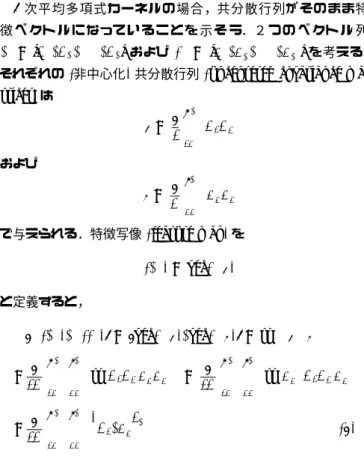
次平均多項式カーネルの場合,共分散行列が そのまま特 徴 ベ クト ル に なって い る こ と を 示 そ う.2 つ の ベ クト ル 列 X= [x
1,
x2,
· · ·,
x`]
および Y= [y
1,
y2,
· · ·,
y`0]
を考える.それぞれの
(
非中心化)
共分散行列(uncentered covariance ma- trices)
はΣx
= 1
`
X` i=1xixTi
および
Σy
= 1
`
0`0
X
j=1
yjyTj
で与えられる.特徴写像
(feature map)
を φ(X) = vec(Σx)
と定義すると,
hφ(X),φ(Y
)
i=
hvec(Σ
x), vec(Σ
y)
i= tr
` ΣxΣy´
= 1
``
0 X` i=1`0
X
j=1
tr
`xixTiyjyjT´
= 1
``
0 X` i=1`0
X
j=1
tr
`yjTxixTiyj´
= 1
``
0 X`i=1
`0
X
j=1
˙xi
,
yj¸2. (1)
を得る.したがって,共分散行列間のユークリッド 内積はまさに
2
次平均多項式になっており,非中心化共分散行列に含まれるす べての情報がカーネルの値に含まれることになる.¯
xおよびy
¯
をそれぞれXおよびY 内のベクトルの平均ベク トルとし ,カーネルの定義をk ¯
q(X,
Y) = 1
``
0 X`i=1
`0
X
j=1
˙xi−x,
¯
yj−y¯
¸q, (2)
と変更すると,このカーネルは
q = 2
のとき,中心化共分散行(a) Video sequence data. (b) EEG signals.
図1 Examples of data modeled as vector sequences. (a) For video sequences, each im- age frame extracted is represented as a vector of pixel intensity values. The vector sequence are usually concatenated to represent the vector set input. (b) For BCI, EEG signals are recorded over a certain time interval using several channels or sen- sors. Each vector in the sequence corresponds to a channel used in the procedure, and vector entry represents an instantaneous signal intensity.
Vector sequences Data points Data
arrangement PCA Grassmann
kernel
Kernel matrix
Principal subspaces
Mean polynomial kernel
Vector sequences Data points Data
arrangement
Kernel matrix
(a)Flow for Grassmann kernels. (b)Flow for Mean Polynomial kernel.
図3 Flow of methodology for computing values for Grassmann kernels and the mean poly- nomial kernel. Grassmann kernels are defined on a Grassmann manifold which is a set of linear subspaces. When employing these kernels, each vector sequence, represented by a set of data points on space, is approximated by a principal subspace obtained via PCA. However, this poses a threat of some degree of information loss, and is more likely to consume more time due to eigendecomposition. The proposed kernel, on the other hand, can be directly applied to compute the kernel value between the sets of data points. It can avoid information loss while being more time efficient.
列の内積になる.
一般に,
q
次平均多項式カーネルは,すべてのq
次モーメント を特徴ベクトルとして含む.現に,Pq
=
{p∈(N
∪ {0})d|pT1= q}
とおき
x
h,iをxiの第h
要素とすると,q
次モーメントφ
p(X) = 1
`
sq!
p
1!
· · ·p
d!
X` i=1Yd h=1
x
ph,ih.
を列挙することによって得られる特徴写像φ(X) = [φp
(X)]
p∈Pqは次の等式を満たす:
k
q(X,
Y) =
hφ(X),φ(Y)
i. (3)
導出は付録1.
に掲載した.特徴写像が存在するので,平均多項 式カーネルは半正定値であることが保証された.平均多項式カー ネルの中心化版の場合,q
次中心化モーメントの集合が特徴写像 になることを同様にして示すことができる(
付録3.)
.4. グラスマン射影カーネルとの理論的な比較
本節では,平均多項式カーネルとグラスマン射影カーネルの
理論的な比較を行う.ベクトル系列の識別を行うには,グラスマ ンカーネルは主部分空間のカーネルとして用いられる.2つの ベクトル系列X,Yに対して,主部分空間の基底を求めるため に,2つの共分散行列,ΣxおよびΣyの固有値分解が必要とな る.なぜなら,
m
次元主部分空間の基底は共分散行列のm
個の 最も主要な固有ベクトルからなるからである.ΣxおよびΣyのm
個の最もmajor
な固有ベクトルを列に持つにd
×m
正規直 交行列をUx およびUyとする.さらにΣ0x
:=
UxUTxおよび
Σ0y
:=
UyUTyとおく.これらは非中心化共分散行列の
m
個の主要な固有値を1
に置き換え,残りの固有値を0
に置き換えたものに等しい.グ ラスマン射影カーネルと,Σ0xおよびΣ0yには次の等式が成り立 つことを示すことができるk
PROJ(U
x,
Uy) =
˙vec(Σ
0x), vec(Σ
0y)
¸. (4)
導出は付録
2.
に掲載した.MP PROJ BC GDMSM−CD GDMSM−SD 0.7
0.72 0.74 0.76 0.78 0.8 0.82 0.84 0.86 0.88
0.9 Accuracy
AUC F−measure
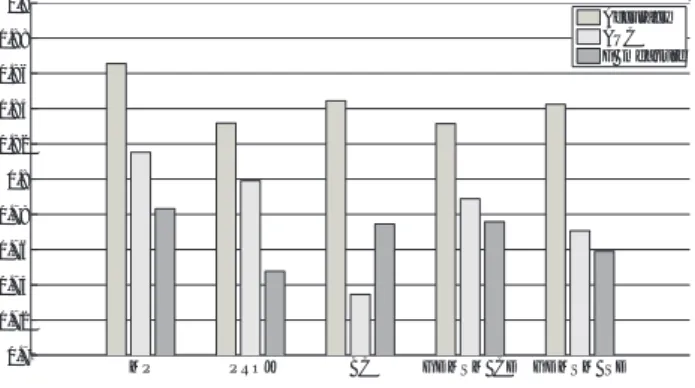
図 4 Average performance of all methods for the face member- ship authentication task. The bar plot represents the average accuracy, average AUC, and average F-measure values com- puted.
(1)
と(4)
を比較すると,2次平均多項式カーネルは非中心化 共分散行列に含まれるすべての情報を保持しているのに対し,グ ラスマン射影カーネルは主部分空間における各次元の情報を喪 失し,補空間の情報を捨てていることがわかる.平均多項式カー ネルの中心化版(2)
でも同様な議論が可能である.さらに,計算コストに関しても,グラスマン射影カーネル,グ ラスマンビネコーシーカーネルともに主部分空間の基底を求める のに時間を要してしまうが,提案カーネルにはその必要がない.
5. 実 験 結 果
本節では,提案カーネルの有効性を示すために,2つの識別問 題,動画認識,
EEG
データ認識を用いる.従来法であるグラス マンカーネル,およびグラスマン距離を用いた相互部分空間法(Grassmann Distance Mutual Subspace method, GD-MSM)
と定量的比較を行う.5. 1 動 画 認 識
顔認識の重要な応用として顔画像による認証がある.認証タス クは,ある未知の人物が メンバーであるか否かを判定するもの で,建物や事務所へのアクセス,計算機のログ イン,携帯端末の ロック解除,オンラインサービスの開始,制御システムへのアク セスに応用できる.認証タスクは2クラス識別問題である.ここ では動画から抽出した画像系列から認証を行うことを考える.動 画データは
MOBIO
データセット[25]
を用いた.MOBIO
デー タセットは152
人の動画データを含み,各被験者は12
セッショ ンに分かれており,そのうち6
セッションがPhase 1
,残りがPhase 2
となっている.各セッションには21
個の動画データがある.各動画データから
25
フレームを取りだし,一つの例題と した.各フレームにOpenCV
の顔検出器を使って切り出した顔 画像をグレースケール化し,25
×25
画素にリサイズしたものか ら625
次元のベクトル系列を得た.25
人中,10
人をランダムに 選び メンバーとし ,残り15
人を非メンバーとした.2つの方法を試した.一つはカーネルの値を計算し,
SVM
を 用いるもの.もうひとつはGD-MSM
である.一つ目の方法では,グラスマン射影カーネル
(PROJ)
,グラスマンビネコーシーカー ネル(BC)
,そして,提案手法である平均多項式カーネル(MP)
の3種類を試した.GD-MSM
では,8個の計量[2], [5]
を試した:平均距離
(average distance)
,ビネコーシー計量(Binet-Cauchy metric)
,測地線距離(Geodesic distance)
,最大相関(maximum correlation)
,最小相関(minimum correlation)
,フロベニアス ノル ムに 基づ くプ ロ クラ ステ ス距離(Frobenius norm based Procrustes distance)
,2-
ノルムに基づくプロクラステス距離(2- norm based Procrustes distance)
,射影計量.GD-MSM
に関し ては,クラスごとに一つの辞書を用意する方法(GDMSM-CD)
と,人物ごとに一つの辞書を用意する方法(GDMSM-SD)
の2 つを試した.6-fold
交差確認法で性能を評価した.カーネルのパラメータとしては,提案カーネルにおける次数
q
は,1
から5
まで試した.グラスマンカーネルで用いる部分空間 の次元数m
は1
から10
まで試した.SVM
の正則化パラメータ はC = 10
0, 10
1, 10
2, 10
3, 10
4, 10
5 を試した.訓練用データセッ ト内でさらに3-fold
交差確認を行って(q, C)
および(m, C)
を 決定した.GDMSM
ではm
の値を決めなくてはならないが,こ の値も訓練用データセット内で3-fold
交差確認を行って決めた.性能の定量評価のために
ROC
カーブ下の面積(Area under the ROC curve, AUC)
,正解率(Accuracy)
,F
値(F-measure)
を 用いた.図
4
は各手法のAUC
,F
値を示している.提案カーネルがAUC,
正解率,F
値いずれをとっても最もよい性能を得た.一 方,2番目に高いAUC
を得たのがビネコーシーカーネル,2 番目に高い正解率を得たのが射影カーネル,2番目に高いF
値 を得たのがGDMSM-CD
であった.なお,図4
でしめしている 正解率は8個の計量を用いたの中で最も性能が良かったものを 示している.なお,8個の計量を用いたの中で最も性能が良かっ た計量は最大相関であった.よって,提案カーネルは,グラスマ ンカーネルよりも,また,GDMSM
でどの計量を使ったときよ りも,優れていることがわかる.5. 2 EEG 信号識別
ブレ イン マシン イン ターフェースのコン ペティション
BCI competition III-IVa dataset [8]
のデータを使って,MP, PROJ,
BC, GDMSM-CD
およびGDMSM-SD
の性能比較を行った.そのデータは
118
個の電極チャンネルを使って,5人(aa, al, av, aw, and ay)
の被験者に右手を動かす,もし くは右足を動か すという運動想起をさせて計測したものである.各EEG
信号 は3.5
秒間1,000 Hz
のサンプリング率で得たものであるが,こ れを100 Hz
にダウンサンプリングし,10Hz
から35Hz
の周波 数のみフィルタリングした.各被験者に右手を動かす試行を140
回,右足を動かす試行を140
回させており,合計280
回の試行 のデータがある.パラメータの設定は,前述の動画認識と同様に 行った.図
5
に平均性能を示す.提案カーネルがAUC,
正解率,F
値 いずれも最も高かった.つぎに性能がよかったものはグラスマ ン射影カーネルであった.GD-MSM
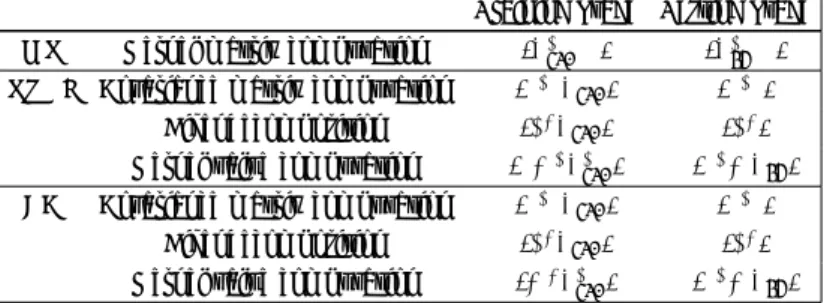
でつかった8個の距離の中 で最も性能が良かったものは最大相関であった.したがって,動表1 Time complexity comparison of the kernels.
Training Stage Testing Stage MP Kernel matrix computation O(n2tra`d) O(n2sv`d) PROJ Covariance matrix computation O(d2`ntra) O(d2`)
Eigendecomposition O(k3ntra) O(k3) Kernel value computation O(dm2n2tra) O(d2mnsv) BC Covariance matrix computation O(d2`ntra) O(d2`)
Eigendecomposition O(k3ntra) O(k3) Kernel value computation O(m3n2tra) O(d2mnsv)
MP PROJ BC GDMSM−CD GDMSM−SD
0.5 0.55 0.6 0.65 0.7 0.75 0.8 0.85
0.9 Accuracy
AUC F−measure
図5 Average performance of all methods for the EEG signal task classification. The bar plot represents the average accuracy, average AUC, and average F-measure values computed.
画認識,
EEG
データ識別の2つのタスクいずれの場合も,提案 カーネルはグラスマンカーネルより識別性能が良く,どの計量を使った
GDMSM
よりも高精度に識別できることが確認された.5. 3 計算時間の比較
提案カーネルとグラスマンカーネルの計算時間を比較する.
n
traを訓練用データ数とする.
n
svをサポートベクトルの個数とする.簡単のため,各ベクトル列の長さを
`
とする.k = min(`, d)
と おく.各手法のそれぞれのステップにかかる計算量を表1
に示 す.この表より,提案カーネルはグラスマンカーネルと比べて性 能が良いのみならず,計算も高速であることがわかる.6. 結 論
本論文ではベクトル列のためのカーネル,平均多項式カーネ ルを提案した.関連手法として,グラスマン射影カーネルとの理 論的な関係性を示した.提案カーネルの有効性は顔画像系列お よび,運動想起
EEG
データを使った2クラス識別実験から確認 された.計算時間に関してもグラスマンカーネルより優れてい ることを示した.Acknowledgments
The work of RR is supported by the Ministry of Educa- tion, Culture, Sports, Science and Technology of Japan. TK is supported by MEXT KAKENHI Grant number 23500373.
文 献
[1] K. Fukui and O. Yamaguchi, “Face recognition using multi-
viewpoint pattern for robot vision,” Proc. Int. Symp.
Robotics Research, pp.192–201, 2003.
[2] J. Hamm and D. Lee, “Grassmann dicriminant analysis:
a unifying view on subspace-based learning,” Proc. ICML, pp.376–383, 2008.
[3] T.K. Kim, J. Kittler, and R. Cipolla, “Discriminative learn- ing and recognition of images set classes using canonical cor- relations,” IEEE Trans. Pattern Anal. Mach. Intell., vol.29, pp.1005–1018, 2007.
[4] H. Sakano and N. Mukawa, “Kernel mutual subspace method for robust facial image recognition,” Proc. Int. Conf. on Knowledge-Based Intell. Eng. Sys. And App. Tech, pp.245–
248, 2000.
[5] R. Shigenaka, B. Raytchev, T. Tamaki, and K. Kaneda, “Face sequence recognition using Grassmann distances and Grass- mann kernels,” Proc. IJCNN, pp.2630–2636, 2012.
[6] L. Wolf and A. Shashua, “Learning over sets using kernel principal angles,” J. Mach. Learn. Res., vol.4, pp.913–931, 2003.
[7] O. Yamaguchi, K. Fukui, and K. Maeda, “Face recognition using temporal image sequence,” Proc. Int. Conf. Automatic Face and Gesture Recognition, pp.318–323, 1998.
[8] B. Blankertz, K. M¨uller, D. Krusienki, G. Schalk, J. Wol- paw, A. Schl¨ogl, G. Pfurtscheller, J. Mill´an, M. Schr¨oder, and N. Birbaumer, “The BCI competition III: Validating al- ternative approaches to actual BCI problems,” IEEE Trans.
Neural Sys. Rehab. Eng., vol.14, no.2, pp.153–159, 2006.
[9] J. M¨uller-Gerking, G. Pfurtscheller, and H. Flyvbjerg, “De- signing optimal spatial filters for single-trial EEG classifica- tion in movement task,” Clinical Neurophysiology, vol.110, no.5, pp.787–798, 1999.
[10] H. Kashima, K. Tsuda, and A. Inokuchi, “Kernels for graphs,” Kernels and Bioinformatics, Cambridge, MA, USA, pp.155–170, MIT Press, 2004.
[11] R. Kondor and J. Lafferty, “Diffusion kernels on graphs and other discrete input spaces,” Proc. 19th ICML, pp.315–322, July 08-12, 2002.
[12] T. Kuboya, K. Hirata, and K. Aoiki-Kinoshita, “An efficient unordered tree kernel and its application to glycan classifica- tion,” Proc. PAKDD, pp.184–195, 2008.
[13] M. Neumann, N. Patricia, R. Garnett, and K. Kersting, “Effi- cient graph kernels by randomization,” Proc. ECML/PKDD, pp.378–393, 2012.
[14] Q. Shi, J. Petterson, G. Dror, J. Langford, A. Smola, and S. Vishwanathan, “Hash kernels for structured data,” J.
Mach. Learn. Res., vol.10, pp.2615–2637, 2009.
[15] S. Vishwanathan, N. Schraudolph, R. Kondor, and K. Borg- wardt, “Graph kernels,” J. Mach. Learn. Res., vol.11, pp.1201–1242, 2010.
[16] C. Leslie, E. Eskin, and W. Noble, “The spectrum kernel:
A string kernel for SVM protein classification,” Proc. of the Pacific Symposium on Biocomputing, pp.564–575, 2002.
[17] H. Lodhi, C. Saunders, J. Shawe-Taylor, N. Cristianini, and C. Watkins, “Text classification using string kernels,” J.
Mach. Learn. Res., vol.2, pp.419–444, 2002.
[18] S. Qiu, T. Lane, and L. Buturovic, “A randomized string ker- nel and its application to RNA interference,” Proc. AAAI, pp.627–632, 2007.
[19] F. Desobry, M. Davy, and W. Fitzgerald, “A class of kernels for sets of vectors,” Proc. 13th ESANN, 2005.
[20] K. Grauman and T. Darrell, “The pyramid match kernel:
Discriminative classification with sets of image features,”
Proc. IEEE ICCV, Beijing, China, October 2005.
[21] J. Hamm and D. Lee, “Extended Grassmann kernels for subspace-based learning,” Proc. NIPS, 2009.
[22] T.K. Kim, J. Kittler, and R. Cippolla, “Discriminative learn- ing and recognition of image set classes using canonical corre- lations,” IEEE Trans. Pattern Anal. Mach. Intell., pp.1005–
1018, 2007.
[23] R. Kondor and T. Jebara, “A kernel between sets of vectors,”
Proc. 20th ICML, August 2003.
[24] S. Vishwanathan and A. Smola, “Binet-cauchy kernels,”
Proc. NIPS, 2004.
[25] C. McCool, S. Marcel, A. Hadid, M. Piettikainen, P. Matejka, J. Cernocky, N. Poh, J. Kittler, A. Larcher, C. Levy, D. Ma- trouf, J.F. Bonastre, P. Tresadern, and T. Cootes, “Bi-modal person recognition on a mobile phone: Using mobile phone data,” Proc. IEEE ICME Workshop on Hot Topics in Mobile Multimedia, 2012.
付 録
1. Derivation of Equation
(3)
A mapping function of mean polynomial kernel is
φ(X) =
"
1
`
sq!
p
1!
· · ·p
d!
X` i=1Yd h=1
x
ph,ih#
,
where
p∈(
N∪ {0
})
qsuch that
pT1= q.
Proof:Let x
h,iand y
h,ibe the (h, i)th entries in
Xand
Y, respectively.
Let d be the number of rows in
Xand
Y,
k
q(X,
Y) = 1
``
0 Xi,j
˙xi
,
yj¸q= 1
``
0 Xi,j
Xd
h=1
x
h,iy
h,j!q
.
Using the multinomial theorem, we get
k
q(X,
Y) = 1
``
0 Xi,j
X
p
q!
p
1!
· · ·p
d!
Ydh=1
x
ph,ihy
h,jph=
Xp
1
`
sq!
p
1!
· · ·p
d!
X` i=1Yd
h=1
x
ph,ih!
×
1
`
0 sq!
p
1!
· · ·p
d!
`0
X
j=1
Yd
h=1
y
h,jph!
=
˙φ(X ), φ(Y )
¸,
where
p∈(N
∪ {0})qsuch that
pT1= q.
2. Derivation of Equation
(4)
Suppose the transformed covariance matrices are given by
Σ0x=
UxΛxUTx=
UxUTxand
Σ0y=
UyΛyUTy=
UyUTy, ob- tained via eigendecomposition of the covariance matrices
Σxand
Σy, and setting the major eigenvalues to one and the
minor eigenvalues to zero. Then we can write
k
PROJ`Ux
,
Uy´
=
‚‚UTxUy‚‚2
F
= tr
`UTxUyUTyUx
´
= tr
`UxUTxUyUTy
´
= tr
` Σ0xΣ0y´
=
˙vec
`Σ0x
´
, vec
` Σ0y´¸
.
This concludes the derivation of equation (4).
3. Explicit Representation of Features
In Section 3., we have shown that the features of the mean polynomial kernel can be represented explicitly. Features of the centered mean polynomial kernel are represented by the qth central moments:
φ ¯
p(X) = 1
`
sq!
p
1!
· · ·p
d!
X`i=1
Yd
h=1
`
x
h,i−x ¯
h´ph