Discussion of Search Strategy for Multi-objective Genetic Algorithm with Consideration of Accuracy and Broadness of
Pareto Optimal Solutions
Tomoyuki Hiroyasu1, Masashi Nishioka2, Mitsunori Miki3, Hisatake Yokouchi1
1 Faculty of Life and Medical Sciences, Doshisha University, 1-3 Tatara Miyakodani Kyotanabe, Kyoto, Japan [email protected], [email protected],
2 Graduate School of Engineering, Doshisha University [email protected]
3 Faculty of Science and Engineering, Doshisha University [email protected]
Abstract. In multi-objective optimization, it is important that the ob- tained solutions are high quality regarding accuracy, uniform distribu- tion, and broadness. Of these qualities, we focused on accuracy and broadness of the solutions and proposed a search strategy. Since it is difficult to improve both convergence and broadness of the solutions at the same time in a multi-objective GA search, we considered to converge the solutions first and then broaden them in the proposed search strategy by dividing the search into two search stages. The first stage is to improve convergence of the solutions, and a reference point specified by a decision maker is adopted in this search. In the second stage, the solutions are broadened using the Distributed Cooperation Scheme. From the results of the numerical experiment, we found that the proposed search strategy is capable of deriving broader solutions than conventional multi-objective GA with equivalent accuracy.
1 Introduction
In the field of multi-objective optimization, the purpose is to find Pareto optimal solutions. To achieve this, many multi-objective genetic algorithms (MOGAs) have been developed [1, 2, 3, 4, 5]. Of the many methodologies reported to date, NSGA-II [4] and SPEA2 [5] are known to show good performance.
When searching for Pareto optimal solutions, it is important that the ob- tained solutions have high quality with regard to accuracy, uniform distribution, and broadness. Accuracy is how close the obtained solutions are to the true Pareto front, and uniform distribution is how evenly located the solutions are without concentrating in certain areas. Broadness is how widespread the solu- tions are and is decided by the solutions located at the edge of the Pareto front, which are optimal solutions of each objective.
Many MOGAs have mechanisms to improve accuracy and uniform distribu- tion of the solutions. However, only mechanisms to store the obtained broadness of the solutions are available, with few capable of improving it. Therefore, it is difficult to improve broadness during the search, and solutions with insufficient broadness may be obtained in the case of problems with large and complex ob- jective spaces. In addition, it is difficult to verify whether the obtained Pareto front is broad or not.
With this background, Okuda et al. proposed the Distributed Cooperation Scheme [6], which utilizes single-objective GA (SOGA) along with MOGA so that not only non-dominated solutions but optimal solutions of each objective are also searched. It was confirmed that the Distributed Cooperation Scheme is capable of deriving broader solutions than conventional MOGAs. However, pre- liminary experiments have also indicated that the convergence speed is reduced because the solutions are broadened from the beginning of the search.
To improve convergence or broadness of the solutions in a MOGA search, there have been a number of studies of crossover methods, such as neighbor- hood crossover of NCGA [7] and similarity-based mating scheme [8]. Although the purpose of our research is to improve the accuracy and broadness of the solutions, it is difficult to simultaneously improve both qualities. Therefore, we propose a search strategy composed of two search stages that separately improve convergence and broadness. The first stage in the proposed search strategy is to improve convergence of the solutions, and the second is to improve the broadness of the solutions. A reference point [9] specified by a decision maker is adopted in the first stage to accelerate convergence speed of the search. In the second stage, a Distributed Cooperation Scheme is utilized to search for optimal solutions of each objective and broaden the solutions.
2 Search Strategy for Multi-objective Genetic Algorithm with Consideration of Accuracy and Broadness
The proposed search strategy consists of two search stages as shown in Fig. 1. The first stage is a search to improve convergence, and the second is for broadness.
The order of the search is set this way, as the final solutions obtained must be comparable in accuracy to conventional MOGAs and also be broad. Especially, in cases where the search time is limited, it becomes important to ensure the accuracy of the solutions first.
2.1 Convergence Search
In the convergence search, the preference of a decision maker is adopted in forms of a reference point [9]. This reference point can be located in both feasible or infeasible regions. Conventional MOGAs base their search on the dominance relationship of the solutions, but the proposed search method bases its search on the distance information. That is, solutions closer to the reference point are
f1(x) f2(x)
1st Stage: Convergence Search 2nd Stage: Broadening Search
f1(x) f2(x)
Switch Search Method
Fig. 1.Concept of Proposed Search Strategy
f2(x)
f1(x) f2(x)
f1(x) Reference Point (a) Rank-based (b) Reference Point-based
Fig. 2.Concept of Reference Point-based Search
prioritized in the search, which leads to convergence of the solutions around the reference point. The concept of this search is illustrated in Fig. 2.
The proposed search method is based on the conventional MOGA, and the distance information is utilized in the selection criterion of mating selection. The mating selection method is described below, and the archive size here isN.
Step 1: Sort archive solutions in ascending order of the Euclidean distance from the reference point.
Step 2: Add top N2 solutions to the search population.
Step 3: Select remaining solutions by tournament selection based on their rank.
If multiple solutions with same rank exist, select solution with smallest Eu- clidean distance.
N
2 solutions close to the reference point are copied to the search population in Step 2, because these solutions are not guaranteed to be selected using methods such as tournament selection. Copying these solutions to the search population should result in improvement of convergence. In addition, both rank and Eu- clidean distance are considered in the tournament selection at Step 3, which allows selection of non-dominated solutions close to the reference point, and the search is directed toward the reference point while preserving diversity.
2.2 Broadening Search
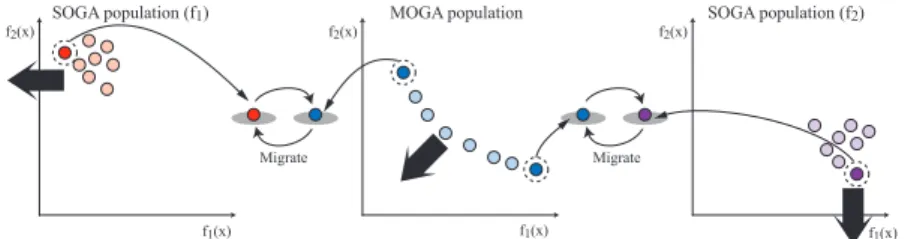
The Distributed Cooperation Scheme of Okuda et al. [6] is adopted in the broad- ening search. The search population is divided into subpopulations that search using MOGA and SOGA in the Distributed Cooperation Scheme. Henceforth,
the subpopulations searched with MOGA and SOGA are called the MOGA population and SOGA population, respectively. When there are k objectives, the search population is divided intok+ 1 subpopulations: one MOGA popula- tion andkSOGA populations. The concept of this scheme is illustrated in Fig.
3. As this is a scheme, any MOGA or SOGA methodology can be adopted. In this study, SPEA2 [5] and DGA [10] were adopted as the MOGA and SOGA populations, respectively.
SOGA population Migrate
Migrate
f2(x) SOGA
population
MOGA population
f1(x)
Fig. 3.Concept of Distributed Cooperation Scheme
MOGA and SOGA populations search in a parallel manner in the Distributed Cooperation Scheme, and best solutions from each population are exchanged every interval generations; this interval was set to 25 generations in this study.
The best solution of the fi SOGA population is the solution with the best fi
objective value. On the other hand, best solutions of the MOGA population are non-dominated solutions with best objective value for each objective, andk solutions exist in ak-objective problem. Migration of solutions in a two-objective problem is shown in Fig. 4.
Migrate SOGA population (f1) f2(x)
f1(x)
SOGA population (f2) f2(x)
f1(x) f1(x)
f2(x)
MOGA population
Migrate
Fig. 4.Concept of Migration in Distributed Cooperation Scheme
The algorithm of the Distributed Cooperation Scheme with population size ofN in thek-objective problem is shown below.
Step 1: Randomly generateN individuals.
Step 2: Divide the individuals into MOGA andkSOGA populations with k+1N individuals in each.
Step 3: Search for non-dominated solutions in the MOGA population and op- timal solutions of each objective in SOGA populations.
Step 4: Collect solutions from all populations and update archive.
Step 5: Exchange best solutions between MOGA and SOGA populations every interval generations.
Step 6: End if terminate criterion is met, else go back to Step 3.
2.3 Search Strategy
In the proposed search strategy, the convergence search described in section 2.1 is conducted, followed by the broadening search described in section 2.2. When to switch the search stage becomes important in this case. It is preferable that the search be switched when the solutions are at nominal convergence. Therefore, we adopt a convergence indicator in switching the search stage.
The indicator utilized in MRMOGA [11] was adopted as a convergence in- dicator. It is an average ratio of non-dominated solutions in the archive that is dominated by the derived solutions over several generations. This ratio will be high when the search is advancing and low when converged. In detail, when non-dominated solutions of the archive at theith generation isP Fknown(i), the ratio ofP Fknown(i) that is dominated (dominatedi) can be calculated. Based on the average ratio over g generations, it can be determined that the search has converged if criterion (1) is met.
∑k
i=1
dominatedi
g ≤ϵ (1)
With MRMOGA, the value ofϵ= 0.05. We usedϵ= 0.05 for two-objective problems andϵ= 0.025 for three-objective problems. Moreover, the period ofg generations is set to be the same as the migration interval in section 2.2, which was 25 generations. The process of the search strategy for ak-objective problem is shown below.
Step 1: Initialize the archive.
Step 2: Conduct convergence search as described in section 2.1.
Step 3: Check criterion (1) everyggenerations. Go to Step 4 if criterion (1) is met, else go back to Step 2.
Step 4: Divide solutions stored in archive intok+ 1 populations.
Step 5: Conduct broadening search as described in section 2.2.
Step 6: End if terminate criterion is met, else go to Step 5.
3 Numerical Experiment
A numerical experiment was performed to verify the effectiveness of the pro- posed search strategy by comparison with SPEA2. The MOGA methodology of the proposed search strategy is SPEA2, and DGA was adopted as the SOGA
population. The test problems used in this experiment were KUR and multi- objective knapsack problems. KUR is a two-objective continuous problem with 100 design variables [12]. KP500-2 (i.e., 2 objectives, 500 items), KP750-2, and KP750-3 [3] were selected as multi-objective knapsack problems. Lamarckian re- pair [13] was adopted as a repair method for the knapsack problems, and the items to be removed were selected randomly.
Many metrics are available to evaluate the obtained solutions, and we adopted inverted generational distance (IGD) [14], hypervolume (HV) [15], and spread [8]: IGD is the average distance from each solution of the Pareto optimal front to the closest obtained solution, and is a metric of accuracy and broadness; HV is a metric of overall performance; and spread, calculated as the sum of differences between maximum and minimum values of each objective within the obtained Pareto front, is a metric of broadness. The Pareto optimal front must be known to calculate IGD, but is unknown for KUR, KP750-2, and KP750-3 problems.
Therefore, we obtained near Pareto optimal solutions beforehand using a much greater population size and generations, which were used in the calculations.
For both the proposed search strategy and SPEA2, population size is set to 120 and the maximum generations is 1000. Therefore, the number of eval- uations is the same for both methods. In addition, 2 point crossover is utilzed with crossover rate of 1.0, and the mutation rate is 1/Chromosome Length. The parameters specific to the DGA used in the proposed search strategy are as fol- lows: sub population size is 10, tournament selection with tournament size of 4, migration rate is 0.5, and migration interval is 5. The topology of migration is random ring.
In the proposed search strategy, a reference point must be set for each prob- lem, and is set at (−1000,−400) for KUR, (30000,30000) for KP500-2 and KP750-2, and (30000,30000,30000) for KP750-3. These reference points were set in the area close to the center of the expected Pareto front. Further experi- ments on the placement of the reference points are needed in the future studies.
3.1 Results
Search results of KUR and KP750-2 by the proposed search strategy and SPEA2 in 30 trials are shown in Figs. 5 and 6.
-500 -400 -300 -200 -100 0 100
-1100 -1000 -900 -800 -700 -600 -500
f2(x)
f1(x) -500 -400 -300 -200 -100 0 100
-1100 -1000 -900 -800 -700 -600 -500
f2(x)
f1(x)
(a) Search Strategy (b) SPEA2
Fig. 5.Search Results of KUR (30 Trials)
(a) Search Strategy (b) SPEA2 23000
24000 25000 26000 27000 28000 29000 30000
23000 24000 25000 26000 27000 28000 29000 30000 f2(x)
f1(x) 23000
24000 25000 26000 27000 28000 29000 30000
23000 24000 25000 26000 27000 28000 29000 30000 f2(x)
f1(x)
Fig. 6.Search Results of KP750-2 (30 Trials)
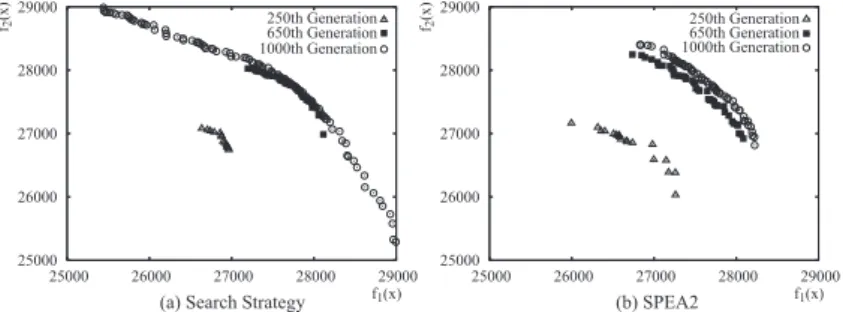
The search results shown in Figs. 5 and 6 indicate that the proposed model obtained broader solutions than SPEA2. Broader solutions provide more infor- mation of the shape of the Pareto front, which is important especially in problems such as KUR and KP750-2 where the optimal front is unknown. In addition, the solution set of a single run for KP750-2 is shown in Fig. 7. With the search strategy, the search was switched from convergence search to broadening search at the 650th generation as shown in Fig. 7(a).
25000 26000 27000 28000 29000
25000 26000 27000 28000 29000 250th Generation 1000th Generation 650th Generation f2(x)
f1(x) 25000 26000 27000 28000 29000
25000 26000 27000 28000 29000 250th Generation 1000th Generation650th Generation f2(x)
f1(x)
(a) Search Strategy (b) SPEA2
Fig. 7.Solution Set at Each Generation in a Single Run (KP750-2)
Fig. 7(a) shows that the search strategy is successful in first converging and then broadening solutions, as the broadness of the converged solutions improved after switching to the broadening search. On the other hand, solutions of SPEA2 shown in Fig. 7(b) are not broadened much as the search progresses. Similar results were also observed in other problems.
Second, the mean values and standard deviation of IGD, spread, and HV values are shown in Tables 1 to 3. For IGD in Table 1, the obtained solutions were closer to the Pareto optimal front when the value was close to 0. On the other hand, solutions with greater values of spread and HV are better.
From the mean values of IGD in Table 1, it can be seen that the proposed model is equivalent to or better than SPEA2. Therefore, the proposed model is comparable to SPEA2 with regard to accuracy. In addition, IGD also indicates how close the obtained solutions are to the optimal front regarding broadness.
Table 1.Inverted Generational Distance
KUR KP500-2 KP750-2 KP750-3 Search Strategy: mean 0.08343 0.01498 0.01767 0.03443 SD 0.04859 0.00159 0.00236 0.00233 SPEA2: mean 0.13593 0.02966 0.03086 0.04949 SD 0.01889 0.00198 0.00195 0.00287
Table 2.Spread
KUR KP500-2 KP750-2 KP750-3 Search Strategy: mean 516.22 6271.06 8952.60 6271.06 SD 193.42 355.85 648.39 1455.15 SPEA2: mean 243.62 2545.80 3122.00 2519.06 SD 23.04 264.68 295.57 282.89
Therefore, the obtained solutions of SPEA2 are not sufficiently broad. The spread values shown in Table 2 also indicate that the proposed model obtained broader solutions. Therefore, the approach to broaden solutions after converging the search is capable of obtaining broad solutions. Mean HV values shown in Table 3 also show better results for the search strategy. Next, the transition of mean IGD values and mean spread values of KUR and KP750-2 are shown in Figs. 8 and 9, respectively, to verify whether the targeted search is achieved.
The mean IGD values in Fig. 8 are better when the obtained solutions are close to the true Pareto front and broad. With the search strategy, the search was switched at means of 835 and 543 generations for KUR and KP750-2, respec- tively. As shown in Fig. 8, IGD values of the search strategy improved greatly after the search was switched. In addition, the spread values of the search strat- egy in Fig. 9 also improved after the search was switched. These results confirmed that the solutions converged and then broadened in the search strategy, and that the targeted search was achieved.
These results indicated that the proposed search strategy is effective for main- taining accuracy comparable to conventional MOGAs and deriving broader solu- tions. However, the variance of the performance by the proposed search strategy was greater than that of SPEA2. In some trials, the search was switched from
Table 3.Hypervolume
KUR KP500-2 KP750-2 KP750-3 Search Strategy: mean 2.635E+05 3.919E+08 8.461E+08 2.408E+13
SD 18832.6 1.652E+06 4.546E+06 5.425E+11 SPEA2: mean 2.550E+05 3.705E+08 8.013E+08 2.263E+13 SD 7563.9 1.445E+06 3.555E+06 1.233E+11
0.01 0.1 1
0 200 400 600 800 1000
IGD
Generations Search Strategy
SPEA2
better
(a) KUR
0.01 0.1 1
0 200 400 600 800 1000
IGD
Generations Search Strategy
SPEA2
(b) KP750-2
better
Fig. 8.Transition of Mean IGD Values
0 100 200 300 400 500 600 700
0 200 400 600 800 1000
Spread
Generations Search Strategy
SPEA2
better
(a) KUR
0 2000 4000 6000 8000 10000
0 200 400 600 800 1000
Spread
Generations Search Strategy
SPEA2
better
(b) KP750-2
Fig. 9.Transition of Mean Spread Values
the first to the second stage late in the search, because it took many genera- tions to reach nominal convergence. This resulted in insufficient broadness of the solutions. Therefore, further studies to determine how to switch the search are required.
4 Conclusions
In this paper, we focused on the accuracy and broadness of the solutions and proposed a search strategy for MOGAs. As it is difficult to improve both con- vergence and broadness of the solutions at the same time in a MOGA search, we considered converging the solutions first and then broadening them in the pro- posed search strategy. To accomplish this, the search is divided into two search stages. The first stage improves the convergence of the solutions, and a reference point specified by a decision maker is adopted for this purpose. In the second stage, the solutions are broadened using the Distributed Cooperation Scheme.
The results of numerical experiments indicated that the proposed search strategy can derive broader solutions compared to conventional MOGA with comparable accuracy. In future studies, a mechanism to judge when to switch the search stage must be determined, as it is now controlled by a parameter, and performance of the search strategy is dependent on this issue.
References
[1] D. E. Goldberg.Genetic Algorithms in search, optimization and machine learning.
Addison-Wesly, 1989.
[2] C. M. Fonseca and P. J. Fleming. Genetic algorithms for multiobjective opti- mization: Formulation, discussion and generalization. InProceedings of the 5th international coference on genetic algorithms, pp. 416–423, 1993.
[3] E. Zitzler and L. Thiele. Multiobjective Evolutionary Algorithms: A Comparative Case Study and the Strength Pareto Approach.IEEE Transactions on Evolution- ary Computation, Vol. 3, No. 4, pp. 257–271, 1999.
[4] K. Deb, S. Agarwal, A. Pratap, and T. Meyarivan. A Fast Elitist Non-Dominated Sorting Genetic Algorithm for Multi-Objective Optimization: NSGA-II. InKan- GAL report 200001, Indian Institute of Technology, Kanpur, India, 2000.
[5] E. Zitzler, M. Laumanns, and L. Thiele. SPEA2: Improving the Performance of the Strength Pareto Evolutionary Algorithm. InTechnical Report 103, Computer Engineering and Communication Networks Lab (TIK), Swiss Federal Institute of Technology (ETH) Zurich, 2001.
[6] Tamaki Okuda, Tomoyuki Hiroyasu, Mitsunori Miki, and Shinya Watanabe. DC- MOGA: Distributed Cooperation model of Multi-Objective Genetic Algorithm. In Advances in Nature-Inspired Computation: The PPSN VII Workshops, pp. 25–26, 2002.
[7] Shinya Watanabe, Tomoyuki Hiroyasu, and Mitsunori Miki. NCGA : Neigh- borhood Cultivation Genetic Algorithm for Multi-Objective Optimization Prob- lems. InProceedings of the Genetic and Evolutionary Computation Conference (GECCO’2002), pp. 458–465, 2002.
[8] H. Ishibuchi and Y. Shibata. Mating Scheme for Controlling the Diversity- Convergence Balance for Multiobjective Optimization. InProc. of 2004 Genetic and Evolutionary Computation Conference, pp. 1259–1271, 2004.
[9] Kalyanmoy Deb and J. Sundar. Reference Point Based Multi-Objective Opti- mization Using Evolutionary Algorithms. InGECCO ’06: Proceedings of the 8th annual conference on Genetic and evolutionary computation, pp. 635–642, 2006.
[10] R. Tanese. Distributed Genetic Algorithms. In Proc. 3rd ICGA, pp. 434–439, 1989.
[11] Antonio Lopez Jaimes and Carlos A. Coello Coello. MRMOGA: Parallel Evolu- tionary Multiobjective Optimization using Multiple Resolutions. Inin 2005 IEEE Congress on Evolutionary Computation (CEC’2005), pp. 2294–2301, 2005.
[12] Frank Kursawe. A Variant of Evolution Strategies for Vector Optimization. In Parallel Problem Solving from Nature. 1st Workshop, PPSN I, pp. 193–197, 1991.
[13] H. Ishibuchi, S. Kaige, and K. Narukawa. Comparison between Lamarckian and Baldwinian Repair on Multiobjective 0/1 Knapsack Problems. In Proc. of the 3rd International Conference on Evolutionary Multi-Criterion Optimization, pp.
370–385, 2005.
[14] H. Sato, H. Aguirre, and K. Tanaka. Local Dominance Using Polar Coordinates to Enhance Multi-objective Evolutionary Algorithms. InProc. 2004 IEEE Congress on Evolutionary Computation, pp. 188–195, 2004.
[15] J. Knowles, L. Thiele, and E. Zitzler. A Tutorial on the Performance Assessment of Stochastic Multiobjective Optimizers. InTIK Report 214, Computer Engineering and Networks Laboratory (TIK), ETH Zurich, 2006.