• 検索結果がありません。

- 78 - IEEE Workshop on Nonlinear Circuit NetworksDecember 9-10, 2011

N/A
N/A
Protected

Academic year: 2021

シェア "- 78 - IEEE Workshop on Nonlinear Circuit NetworksDecember 9-10, 2011"

Copied!
3
0
0

読み込み中.... (全文を見る)

全文

(1)

Synchronization Phenomenon in Four Chains of Coupled Oscillators

Kosuke Matsumura, Takahiro Nagai, Yoko Uwate and Yoshifumi Nishio Dept. Electrical and Electronic Eng, Tokushima University, Tokushima 770-8506, JAPAN

Email: { kosuke, nagataka, uwate, nishio } @ee.tokushima-u.ac.jp

Abstract— In this study, we investigate a synchronization phe- nomenon from a circuit network which is composed of two kinds of oscillator chains. They are one-dimensional arrays of weakly coupled van der Pol oscillators. From computer simulations, we observe relatively interesting unexpected synchronization phenomenon.

I. I ntroduction

Synchronization phenomena are very basic phenomena.

Also, the important phenomena observed everywhere in na- tures. For example, vibration of a pendulum, firefly lumi- nescence, gate patterns of four-leg animals, two frogs using voice religiously, periodic swinging of candle flames, and so on. Therefore, coupled oscillators are good models to investigate such interesting synchronization phenomena. Many researchers have proposed di ff erent coupled oscillatory net- works and have discovered many interesting synchronization phenomena [1]-[8]. The research group of the authors is also working on coupled oscillatory networks. Especially, we have been interested in coupled oscillators whose connections cause some kinds of frustrations [9]-[12].

In this study, we investigate a circuit network which is composed of two kinds of oscillator chains. They are one- dimensional arrays of weakly coupled van der Pol oscillators.

In this network, we couple the oscillators at bottom four oscillators in the chains to constrain them to produce in-phase synchronizations. While we couple the oscillators at the top four oscillators in the chains to produce anti-phase synchro- nizations. Middle oscillators in the chains are not coupled with the other chains. We observe relatively interesting unexpected synchronization phenomenon from computer simulations.

II. C ircuit M odel

Figure 1 shows the our proposed circuit model. Each oscillator-chain consists of n van der Pol oscillators weakly coupled by resistors r. In the figure, bottom four oscillators are coupled by relatively strong resistors R i , while the top four oscillators are coupled by also relatively strong resistors R a via inductors. Middle oscillators are not coupled with os- cillators located in the horizontal direction but weakly coupled vertically.

The coupling structure on the bottom or in vertical couplings (by R i or r) tends to make the oscillators to synchronize in in-phase. While the coupling structure on the top (by R a via inductor) tends to make the oscillators to synchronize in anti- phase.

Fig. 1. Circuit model for the case of n oscillator-chains.

We define the bottom four oscillators as Osc 11 , Osc 12 , Osc 13 and Osc 14 from the left, those on the kth row from the bottom as Osc k1 , Osc k2 , Osc k3 and Osc k4 , and the top four oscillators as Osc n1 , Osc n2 , Osc n3 and Osc n4 .

First, we assume that the vi characteristics of the nonlinear resistor in each oscillator is given by the following third order polynomial equation.

i R

k j

= − g 1 v k j + g 3 v k j 3

(1) where g 1 , g 3 > 0, k = 1 , 2 , ..., n, and j = 1 , 2 , 3 , 4.

By using the following variables and parameters:

t = √

LC τ, v k j =

g 1

g 3

x k j , i k j =

g 1 C g 3 L y k j ,

- 78 -

IEEE Workshop on Nonlinear Circuit Networks

December 9-10, 2011

(2)

ε = 1 g 1

L

C , α i = 1 R i

L

C , α a = R a

L

C , β = 1 r

L

C , the normalized circuit equations are given as follows:

(1) Top oscillators:

 







 











˙

x n1 = ε (1 − x n1 2 )x n1 − (y n1a + y n1b ) + β (x n1x (n − 1)1 )

˙

y n1a = 0 . 5 { x n1 − α a (y n1a + y n2b ) }

˙

y n1b = 0 . 5 x n1

˙

x n2 = ε (1 − x n2 2 )x n2 − (y n2a + y n2b ) + β (x n2x (n − 1)2 )

˙

y n2a = 0 . 5 { x n2 − α a (y n2a + y n3b ) }

˙

y n2b = 0 . 5 { x n2 − α a (y n1a + y n2b ) }

˙

x n3 = ε (1 − x n3 2 )x n3 − (y n3a + y n3b ) + β (x n3x (n − 1)3 )

˙

y n3a = 0 . 5 { x n3 − α a (y n3a + y n4b ) }

˙

y n3b = 0 . 5 { x n3 − α a (y n2a + y n3b ) }

˙

x n4 = ε (1 − x n4 2 )x n4 − (y n4a + y n4b ) + β (x n4x (n 1)4 )

˙

y n4a = 0 . 5 x n4

˙

y n4b = 0 . 5 { x n4 − α a (y n3a + y n4b ) }

(2) (2) Middle oscillators (k = 2 , 3 , · · · , n − 1) :

 













˙

x k1 = ε (1 − x k1 2 )x k1y k1 + β (x (k + 1)1 − 2x k1 + x (k − 1)1 )

˙ y k1 = x k1

˙

x k2 = ε (1 − x k2 2 )x k2y k2 + β (x (k + 1)2 − 2x k2 + x (k − 1)2 )

˙ y k2 = x k2

˙

x k3 = ε (1 − x k3 2 )x k3y k3 + β (x (k + 1)3 − 2x k3 + x (k − 1)3 )

˙ y k3 = x k3

˙

x k4 = ε (1 − x k4 2 )x k4y k4 + β (x (k + 1)4 − 2x k4 + x (k 1)4 )

˙ y k4 = x k4

(3) (3) Bottom oscillators:

 





 









˙

x 11 = ε (1 − x 11 2 )x 11 − y 11 + β (x 21 − x 11 ) − α i (x 11 − x 12 )

˙ y 11 = x 11

˙

x 12 = ε (1 − x 12 2 )x 12 − y 12 + β (x 22 − x 12 )

+ α i (x 11 − 2x 12 + x 13 )

˙ y 12 = x 12

˙

x 13 = ε (1 − x 13 2 )x 13 − y 13 + β (x 23 − x 13 )

+ α i (x 12 − 2x 13 + x 14 )

˙ y 13 = x 13

˙

x 14 = ε (1 − x 14 2 )x 14y 14 + β (x 24x 14 ) − α i (x 14x 13 )

˙ y 14 = x 14

(4) where x k j corresponds to the voltage across the capacitor and y k j , y n ja , y n jb are the currents through the inductors of Osc k j .

III. S ynchronization P henomena

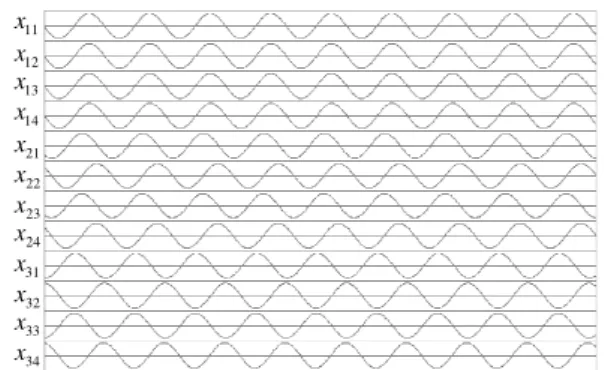
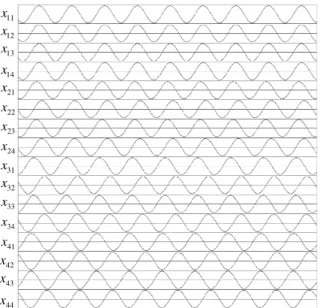
Figures 2 and 3 show the computer simulation results for the case of n = 3. Also, figures 4 and 5 show results for the case of n = 4. The circuit equations (2)-(4) are calculated by using the fourth-order Runge-Kutta method with the step size h = 0 . 005. The circuit parameters are chosen as ε = 0 . 10, α i = α a = 0 . 5, and β = 0 . 02.

As we expected, the bottom four oscillators (Osc 11 , Osc 12 , Osc 13 and Osc 14 ) are synchronized in in-phase and the top four oscillators (Osc 31 , Osc 32 , Osc 33 and Osc 34 ) are synchronized in anti-phase.

x

11

x

12

x

13

x

14

x

22

x

32

x

21

x

31

x

23

x

24

x

33

x

34

Fig. 2. Computer simulation results (time waveform) for n = 3.

x

11

x

31

x

11

x

11

x

11

x

34

x

33

x

32

x

11

x

21

x

11

x

11

x

11

x

24

x

23

x

22

x

11

x

11

x

11

x

11

x

11

x

14

x

13

x

12

Fig. 3. Computer simulation results (phase shift) for n = 3.

However, we observe unexpected synchronization phe- nomenon between the oscillators in each chain. Because the oscillators in each chain are coupled by r vertically, we expected that the middle four oscillators (Osc 21 , Osc 22 , Osc 23 , Osc 24 ,) are quasi-synchronization. And, the top four oscillators (Osc 31 , Osc 32 , Osc 33 and Osc 34 ) are which phase di ff erence is around 90[deg . ]. Also, we can observe from Figs. 2 and 3 that the oscillators in the middle row (Osc 21 , Osc 22 , Osc 23

and Osc 24 ) have some amount of phase shift to the first row, and those in the top row (Osc 31 , Osc 32 , Osc 33 and Osc 34 ) show larger phase shift.

IV. C onclusions

In this study, we have observed a synchronization phe- nomenon from a circuit network which is composed of two kinds of oscillator chains. Their edges were coupled to con- strain their phase states to generate a frustration. By computer simulations, we could observe interesting unexpected synchro- nization phenomenon.

The results in this study would be a good model of various natural and artificial systems. For example, stone-paved square of an old town (e.g. we observed one in Evora, Portugal) starts from one edge of the square to line up stones in a regular way like in-phase. However, sometimes the other edge of the square has a di ff erent constraint like anti-phase. In that case, frustrations occur somewhere in the square and they are not

- 79 -

(3)

x

11

x

12

x

13

x

14

x

22

x

32

x

21

x

31

x

23

x

24

x

33

x

3434

x

x

42

x

41

x

43

x

44

Fig. 4. Computer simulation results (time waveform) for n = 4.

x

11

x

41

x

11

x

11

x

11

x

44

x

43

x

42

x

11

x

31

x

11

x

11

x

11

x

34

x

33

x

32

x

11

x

21

x

11

x

11

x

11

x

24

x

23

x

22

x

11

x

11

x

11

x

11

x

11

x

14

x

13

x

12

Fig. 5. Computer simulation results (phase shift) for n = 4.

compensated at one or some particular points but over a wide area of the square. That is one example of synchronization phenomena observed from oscillator networks with frustration.

R eferences

[1] T. Endo and S. Mori, “Mode analysis of a multimode ladder oscillator,”

IEEE Trans. Circuits Syst., vol. 23, pp. 100-113, Feb. 1976.

[2] T. Endo and S. Mori, “Mode analysis of two-dimensional low-pass multimode oscillator,” IEEE Trans. Circuits Syst., vol. 23, pp. 517-530, Sep. 1976.

[3] T. Endo and S. Mori, “Mode analysis of a ring of a large number of mutually coupled van der Pol oscillators,” IEEE Trans. Circuits Syst., vol. 25, no. 1, pp. 7-18, Jan. 1978.

[4] Y. Nishio and S. Mori, “Mutually coupled oscillators with an extremely large number of steady states,” Proc. ISCAS’92, vol. 2, pp. 819-822, May 1992.

[5] S. Moro, Y. Nishio and S. Mori, “Synchronization phenomena in oscil- lators coupled by one resistor,” IEICE Trans. Fundamentals, vol. E78-A, no. 2, pp. 244-253, Feb. 1995.

[6] W. Wei, W. Zhou and T. Chen, “Cluster synchronization of linearly coupled complex networks under pinning control,” IEEE Trans. Circuits Syst. I, vol. 56, no. 4, pp. 829-839, Apr. 2009.

[7] Y. Uwate, Y. Nishio and R. Stoop, “Synchronization in three coupled van der Pol oscillators with different coupling strength,” Proc. NCSP’10, pp. 109-112, Mar. 2010.

[8] J. Lu, G. Chen and M. Bernardo, “On some recent advances in synchro- nization and control of complex networks,” Proc. ISCAS’10, pp. 3773- 3776, May 2010.

[9] Y. Setou, Y. Nishio and A. Ushida, “Synchronization phenomena in many oscillators coupled by resistors as a ring,” Proc. APCCAS’94, pp. 570- 575, Dec. 1994.

[10] Y. Setou, Y. Nishio and A. Ushida, “Synchronization phenomena in resistively coupled oscillators with different frequencies,” IEICE Trans.

Fundamentals, vol. E79-A, no. 10, pp. 1575-1580, Oct. 1996.

[11] Y. Uwate, Y. Nishio and R. Stoop, “Synchronization in two polygonal oscillatory networks sharing a branch,” Proc. NDES’10, pp. 62-65, May 2010.

[12] Y. Uwate and Y. Nishio, “Synchronizing Coupled Oscillators in Polygo- nal Networks with Frustration,” Proc. ISCAS’11, pp. 745-748, May 2011.

- 80 -

Figure 1 shows the our proposed circuit model. Each oscillator-chain consists of n van der Pol oscillators weakly coupled by resistors r
Fig. 2. Computer simulation results (time waveform) for n = 3.
Fig. 4. Computer simulation results (time waveform) for n = 4.

参照

関連したドキュメント

We reduce the dynamical three-dimensional problem for a prismatic shell to the two-dimensional one, prove the existence and unique- ness of the solution of the corresponding

[11] Karsai J., On the asymptotic behaviour of solution of second order linear differential equations with small damping, Acta Math. 61

On the other hand, from physical arguments, it is expected that asymptotically in time the concentration approach certain values of the minimizers of the function f appearing in

Furthermore, the upper semicontinuity of the global attractor for a singularly perturbed phase-field model is proved in [12] (see also [11] for a logarithmic nonlinearity) for two

In the present work, resuming from part of [9], we investigate a methodology based on the characteristic equation, which seems particularly practical for the scalar prototype

In the second section, we study the continuity of the functions f p (for the definition of this function see the abstract) when (X, f ) is a dynamical system in which X is a

In this paper, based on the concept of rough variable proposed by Liu 14, we discuss a simplest game, namely, the game in which the number of players is two and rough payoffs which

In Section 3 we generalize to several complex variables a result which is due to Schi¤er in the one-dimensional case: the degree of a holomorphic map between two annuli is bounded by