Neural Network Having Artificial Neurotransmitter
Kazuki NAGAO
1Shinsaburo KITTAKA
1Yoko UWATE
1Yoshifumi NISHIO
1(
1Tokushima University)
1. Introduction
Neural Network (NN) and Deep Learning are made to imitate the human nervous system. There are the follow- ing three substances constituting the human neural circuit.
First, there are many nerve cells (neuron) in the human brain, and information is passed on next neurons through the connection, and we can judge things. Second, synapse connects to neurons and becomes junction for communi- cating information. Third, neurotransmitter is substances generated from synapse. It excites and suppresses neurons.
It has a role to promote learning. Now, neuron and synapse are used in NN and Deep Learning. However, neurotrans- mitter is not used in NN and Deep Learning.
In this study, we propose new systems of feed forward Neural Network (FFNN) having artificial neurotransmit- ter. We use characteristic of acetylcholine among neuro- transmitter. Acetylcholine has been reported to be related to diseases and memory. We use this system and improve learning accuracy more than basic system.
2. Proposed method
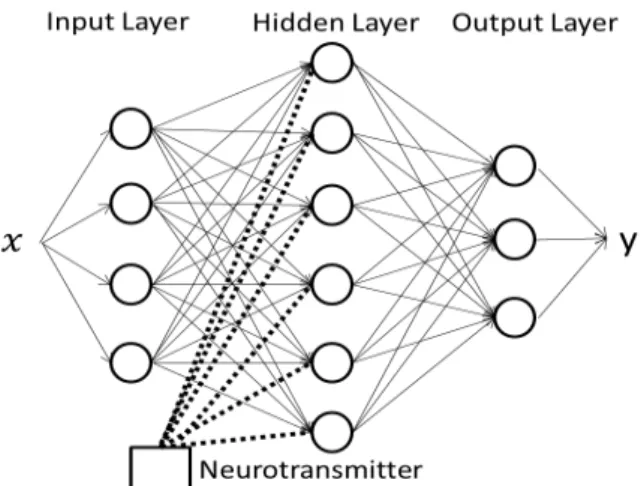
We used artificial characteristics of acetylcholine for the middle layer of FFNN. Proposed system that is used in this study is shown in Fig. 1.
Figure 1: Schematic diagram of new system about FFNN.
(a) pattern1. (b) pattern2.
Figure 2: Two patterns which artificial characteristics of acetylcholine.
Characteristics of acetylcholine are not fully understood yet. We use two reported characteristics of acetylcholine in this study. First, the amount of acetylcholine secretion varies in a daily life. Second, the amount of secretion re- covers by having breakfast, lunch and dinner. For using these characteristics, we made two patterns which artificial characteristics of acetylcholine (Fig. 2). Pattern 1 shows that the amount of secretion decreases curvilinearly at each learnning loop. Pattern 2 shows that the amount of secre- tion decreases linearly at each learnning loop.
h
ij(t + 1) = f {∑
w
ij(t)x(t) − θ (t) }
(1) Equation (1) shows the propagating equation of the con- ventional neuron system at hidden layer. It does not have the acetylcholine’s system. x is input data. w is connection weight. θ is threshold. h is output value.
h
ij(t + 1) = f {∑
w
ij(t)(x(t) + χ) − θ (t) }
(2) Equation (2) shows the propagating equation of the neu- ron having the acetylcholine’s system at hidden layer.
And Eqs. (1) and (2) using sigmoid function Eq. (3) for activation function.
f (a) = 1
1 + e
−a(3)
3. Simulation result
We define as the learning loops = 50000. We use Iris data set and define as the number of learning data sets = 150. The number of neurons in each layer is 4, 10 and 3.
Table 1 shows error rate for conventional system and pro- posed systems.
Table 1: Error rate.
error basic 0.05139 pattern1 0.00023 pattern2 0.00023
From Table 1, the learning accuracy is improved in pro- posed systems over conventional system. Error rate of pat- tern 1 and 2 are same.
4. Conclusion
We can approach human neural circuits more than con- ventional FFNN system by the proposed method. And we can improve learning accuracy. We understand that it is good to use artificial characteristics of acetylcholine for FFNN.
In the future, we will discover new patterns about char- acteristics of acetylcholine. And we further deeply examine how to use acetylcholine in NN.
平成