• 検索結果がありません。

Simultaneous Determination of Raltegravir, Dolutegravir, Elvitegravir, and Bictegravir in Human Plasma Using High-performance Liquid

N/A
N/A
Protected

Academic year: 2021

シェア "Simultaneous Determination of Raltegravir, Dolutegravir, Elvitegravir, and Bictegravir in Human Plasma Using High-performance Liquid "

Copied!
12
0
0

読み込み中.... (全文を見る)

全文

(1)

Simultaneous Determination of Raltegravir, Dolutegravir, Elvitegravir, and Bictegravir in Human Plasma Using High-performance Liquid

Chromatography-tandem Mass Spectrometry

Junichi M

ASUDA*1, 2)

and Yasuhisa K

ATO2)

Abstract : In this study, a highly sensitive method to simultaneously quantify the integrase strand transfer inhibitors (INSTIs) raltegravir, dolutegravir, elvitegravir, and bictegravir, which are recommended drugs in the HIV treatment guidelines, was established using liquid chromatography–tandem mass spectrometry (LC-MS/MS) . Raltegravir-d

3

was used as the internal standard substance. The plasma samples were deproteinized with methanol and analyzed by LC-MS/MS. Chromatographic separation was performed using the gradient method with a mobile phase A

(20 mmol/l ammonium formate - water) and mobile phase B (20 mmol/l ammo- nium formate - methanol) . In addition, an InertSustain C18 column (3 µm, 100 2.1 mm) , a flow rate of 0.45 ml/min, and a measurement time of 10 minutes were used. The calibration curve showed linearity (r

2

> 0.9904) within the range of 0.5- 1,250 ng/ml, and the limit of quantification was 0.5 ng/ml for all drugs. The mean intra- and inter-day accuracy was 99.6% 7.2% and 101.0% 5.0%, respectively, and the coefficient of variation (CV) was ≤ 18.5% and ≤ 10.3%, respectively. This method enables the highly sensitive simultaneous analysis of INSTIs and is useful for confirming the efficacy and safety of drugs in clinical practice.

Key words : integrase strand transfer inhibitors, LC-MS/MS, human plasma concen- trations, simultaneous determination, therapeutic drug monitoring

Introduction

 The life expectancy of HIV-infected patients has been greatly improved by antiretroviral therapy (ART) , which is a combination of several anti-HIV drugs

1)

. The United States Department of Health & Human Services guidelines recommend a regimen that includes a combination of integrase strand transfer inhibitors (INSTIs) and nucleoside reverse transcriptase inhibitors (NRTIs) as the initial therapy for treatment-naïve patients

2)

. The INSTIs that have been approved by the Food and Drug Administration (FDA) and Japan are raltegravir (RAL) , dolutegravir (DTG) , elvitegravir (EVG) , and bictegravir (BIC) .

 RAL is the worldʼs first INSTI. Importantly, RAL is not metabolized by cytochrome P450 Original

1)

Department of Pharmacy, National Center for Global Health and Medicine, 1-21-1, Toyama, Shinjuku-ku, Tokyo 162- 8655, Japan.

2)

Department of Clinical Pharmacy, Division of Drug Information Analytics, Showa University School of Pharmacy

To whom corresponding should be addressed.

(2)

(CYP) and is primarily metabolized through glucuronic acid conjugation mediated by uridine diphosphate (UDP) glucuronosyltransferase (UGT) 1A1. Therefore, only a few drug-drug inter- actions have been reported for RAL

3)

. Drug interactions affect not only anti-HIV drugs, but they also affect concomitant drugs. Because there are minimal drug-drug interactions with RAL, it is a useful agent when a patient is taking a concomitant drug. The comparable efficacy of DTG and RAL was demonstrated in a randomized controlled trial (Phase Ⅲ) that included a group treated with 2 NRTIs and RAL

4)

. DTG is primarily a substrate for UGTs, whereas only a small amount is metabolized by CYPs. Significantly, HIV has not yet developed resistance to DTG, which can be administered orally at a dose of 50 mg twice daily to patients who are resistant to other integrase inhibitors

5)

. The two types of EVG that have been approved for use as a combination drug therapy are elvitegravir/cobicistat/tenofovir disoproxil fumarate/emtricitabine

(EVG/COBI/TDF/FTC)

6)

and elvitegravir/cobicistat/tenofovir alafenamide/emtricitabine (EVG/

COBI/TAF/FTC)

7)

, with a recommended dose of one tablet a day. COBI, a component of these combination therapies, is a potent CYP3A4 inhibitor and acts as a pharmacokinetic (PK)

enhancer of EVG (booster) . Therefore, if concomitant drugs are metabolized by CYP, their metabolism is inhibited by COBI. For this reason, it is essential to consider drug-drug interac- tions when prescribing these drugs. RAL, DTG, and BIC can be taken with or without meals, but EVG must be taken with or directly after a meal. BIC was recently approved in Japan in March 2019 as part of the BIC/TAF/FTC regimen. The non-inferiority of the antiviral effect of the BIC group compared with the DTG group was demonstrated in a controlled trial (GS- US-380-1490) that included HIV-infected treatment-naïve patients

8)

. Similar to DTG, BIC has a high genetic barrier to the development of resistance and can be an option for patients with poor adherence. Because BIC is a substrate for CYP3A and UGT1A1, it is contraindicated in combination with an enzyme inducer of drug metabolism, such as rifampicin and antiepileptics

9)

. At present, BIC is not widely used in Japanese patients, so it is necessary to determine its effi- cacy and potential side effects.

 The therapeutic effects and tolerability of INSTIs are superior to other antiretrovirals, and INSTIs are administered to patients in clinical practice to both treatment-naïve and treatment- experienced HIV patients. Maintaining adherence is important to attain the therapeutic effect of anti-HIV drugs. However, the plasma drug concentration can vary depending on individual patient differences and drug interactions. Therefore, therapeutic drug monitoring (TDM) of anti- HIV drugs is useful to manage their therapeutic effect and safety

10, 11)

.

 Currently, INSTIs are measured alone or simultaneously with other anti-HIV drugs using liquid chromatography–tandem mass spectrometry (LC-MS/MS) . Bennetto et al. measured DTG in small plasma samples (20 µl) and applied this method to pediatric clinical trials

12)

. Prathipati et al. developed an LC-MS/MS method for the quantification of BIC in human plasma and reported its application in intracellular uptake studies

13)

. In a PK and TDM study, Aouri et al.

simultaneously measured EVG together with a rilpivirine (RPV) of non-nucleoside analogue

reverse transcriptase inhibitor (NNRTI)

14)

. Barceló et al. simultaneously measured EVG and

COBI and reported population PK analyses and drug-drug interactions for EVG and COBI

15)

.

(3)

Fayet et al. reported the simultaneous measurements of four different classes of HIV drugs : darunavir (DRV) , etravirine (ETR) , maraviroc (MVC) , and RAL

16)

. Yamada et al. reported the quantification of abacavir (ABC) , tenofovir (TFV) , DRV, and RAL in human plasma and saliva

17)

.

 The simultaneous measurement of anti-HIV drugs in human plasma, including multiple INSTIs, has been achieved by using LC-MS/MS. Tsuchiya et al. measured RAL, EVG, and DTG in plasma and cerebrospinal fluid (CSF)

18)

. Penchala et al. measured plasma DTG and EVG

19)

. Simiele et al. simultaneously measured plasma levels of 18 anti-HIV drugs, including RAL, EVG, and DTG

20)

. These reported methods have a limit of quantification of ≥ 5 ng/ml and a measure- ment range of 5-4,000 ng/ml. To date, there are no highly sensitive methods to measure the plasma concentration of the four INSTIs recommended by the current HIV treatment guidelines in the same measurement system. Here, we report the development of a method that allows the simultaneous quantification of RAL, DTG, EVG, and BIC in human plasma using LC-MS/

MS. This method has been validated and applied to the analysis of plasma samples from HIV- infected patients.

Materials and methods Chemicals and reagents

 RAL, DTG, EVG, BIC, and RAL-d

3

were purchased from Toronto Research Chemicals

(North York, ON, Canada) . Methanol (MeOH) , ultrapure water, acetonitrile, and ammonium formate were purchased from FUJIFILM Wako Pure Chemical Corporation (Osaka, Japan) . Fresh frozen plasma (FFP-LR120) was purchased from NISSEKI (Tokyo, Japan) .

Preparation of the calibration curve and quality control standards

 RAL, EVG, and BIC stock solutions were prepared in a 50% MeOH solution (MeOH-water 50 : 50, v/v) at 1.0 mg/ml. The DTG stock solution was prepared in 50% MeOH at 0.5 mg/

ml. The internal standard (IS) RAL-d

3

was prepared in 100% MeOH at 1.0 mg/ml. The RAL, EVG, DTG, and BIC working solutions were diluted with 50% MeOH to 10,000 ng/ml, and the IS was diluted with 100% MeOH to 1,000 ng/ml.

 The standard solutions for the calibration curve were 0.5, 5, 20, 50, 250, 500, and 1,250 ng/ml, using human plasma as the matrix. Solutions of 0.5 ng/ml (lower limit of quantification quality control [QC], LLQC) , 1.0 ng/ml (low QC, LQC) , 100 ng/ml (mid QC, MQC) , and 1,000 ng/

ml (high QC, HQC) of human plasma were prepared as QC samples. The calibration standards and QC samples were stored at − 30℃.

Clinical samples

 Clinical samples were obtained from six patients with an HIV-1 infection who were receiving

ART, including RAL, DTG, EVG, and BIC at the AIDS Clinical Center, National Center for

Global Health and Medicine. The plasma samples were collected in heparin blood collection

tubes and subsequently centrifuged at 3,000 g for 10 minutes ; the obtained plasma was stored

(4)

at − 80℃. This study was approved by the ethics committee of the National Center for Global Health and Medicine (NCGM-A-003058-02) , and each patient provided their informed consent.

Sample preparation

 In this analysis method, a CLAM-2000 (Shimadzu, Kyoto, Japan) was used for the prepara- tion of precipitated proteins, which were prepared at 9℃ with fully automated sampling. First, 150 µl of the plasma samples were dispensed into a vial and set in CLAM. In CLAM, 20 µl of MeOH was added to the filter, and the filter was activated. After activation of the filter, 30 µl of the plasma sample was added, then 100 µl of MeOH and 10 µl of the IS were added.

The plasma sample was stirred at 1,900 rpm (15 g) for 60 s, filtered for 90 s, and 5 µl of the prepared sample was injected for LC-MS/MS analysis. Clinical samples were diluted 10-fold with blank human plasma to obtain drug concentrations within the linear range of the assay.

LC-MS/MS analysis

 Chromatographic separation was performed using the Nexera System (Shimadzu, Kyoto, Japan) , which was prepared with a reversed-phase InertSustain C18, 3 µm, 100 2.1 mm column (GL Sci- ence, Tokyo) . The temperature of the autosampler and column oven was kept at 7℃ and 40℃, respectively. The mobile phase for separation used a gradient method and consisted of a mobile phase A (20 mmol/l ammonium formate - water) and mobile phase B (20 mmol/l ammonium formate - methanol) . A flow rate of 0.45 ml/min was used. Mobile phase B started at 30%

and increased linearly to 100% in 0-6 minutes. Mobile phase B was maintained at 100%

for 6-8 minutes and then returned to 30% and re-equilibrated in 8-10 minutes. Electrospray ionization (ESI) was performed using an LC-MS/MS-8040 (Shimadzu, Kyoto, Japan) in positive Multiple Reaction Monitoring mode. The probe voltage was set to + 1.5 kV, the desolvation line temperature was set to 250℃, the block heater temperature was set to 400℃, and liquid nitrogen (purity > 99.99%) was used in the nebulizer gas (3.0 l/min) and drying gas (15.0 l/

min) . The mass transitions were m/z 445.2 → 109.0 for RAL, m/z 420.1 → 277.1 for DTG, m/

z 448.1 → 344.1 for EVG, 450.0 → 289.1 for BIC, and m/z 448.0 → 364.15 for RAL-d

3

. Collision energies were : RAL, 19 V ; DTG, 27 V ; EVG, 34 V ; BIC, 23 V ; and IS, 19 V. The analytical data were processed using LabSolutions LCMS software (Shimadzu, Kyoto, Japan) .

Method validation

 The selectivity, linearity, LLOQ, precision, carryover, dilution integrity, and stability of the analy-

sis methods were validated in accordance with the Guideline on Bioanalytical Method Validation

in Pharmaceutical Development

21)

. Calibration curves (CC) were generated using blank human

plasma, a zero standard, and seven samples for the CC within the range of 0.5-1,250 ng/ml. CC

were created by plotting the peak area ratio (drug peak area/IS peak area) against each analyte

concentration, using a linear regression model weighted with 1/x

2

. The precision and accuracy of

the analysis method were evaluated through the iterative analysis of the QC samples (LLQC,

LQC, MQC, and HQC) . The QC concentration was calculated from the CC. Five replicates of

(5)

each QC sample were prepared, and the intra- and inter-day precision (coefficient of variation

(CV) %) and accuracy were calculated. To ensure the concentration of the analyzed substance was within the quantification limit of the calibration curve, plasma samples were prepared by spiking with each analyte at 10,000 ng/ml. The dilution control sample was diluted 10-fold with blank plasma, and five repeat analyses were performed. The sample handling stability was based on QC samples at two different concentrations (1 and 1,000 ng/ml) . Short-term stability was measured using samples stored at 9℃ for 3 days, whereas long-term stability tests used samples stored at −30℃ for 30 days. Freeze-thaw stability was measured in samples subjected to three freeze-thaw cycles prior to analysis. Benchtop stability was measured at room temperature

(22℃) for 4 h.

Results

LC-MS/MS Chromatograms

 Interference peaks with the blank plasma were not observed in the retention times of the four INSTIs or IS. The LLOQ and blank chromatogram were shown in Figure 1. Using the chromatography conditions described above, the retention times for RAL, DTG, EVG, BIC, and IS were 3.52, 3.81, 5.36, 3.82, and 3.52 min, respectively.

Fig. 1.   Typical multi-reaction monitoring chromatograms for raltegravir, dolutegravir, elvitegravir, bictegravir, and raltegravir-d

3

(IS) : (A) standards at LLOQ (0.5 ng/ml each) for plasma ; (B)

blank plasma sample. IS, internal standard ; LLOQ, lower limit of quantification.

(6)

Validation : Linearity, Precision, Accuracy, and Recovery

 The standard curves of the four INSTIs were analyzed with weighted (1/x

2

) least-square linear regression. The correlation coefficient ( r

2

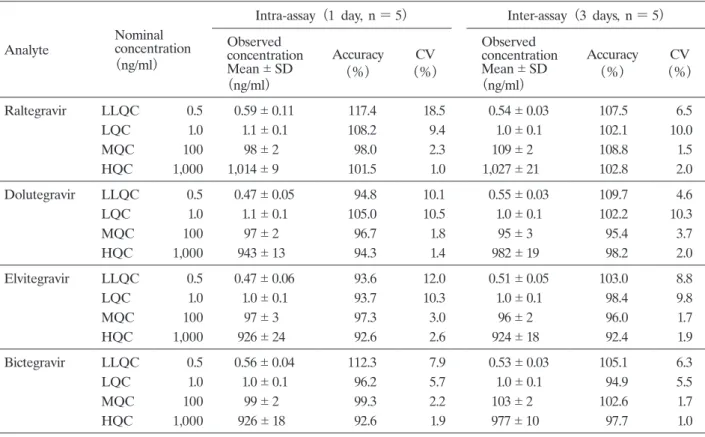
) of the calibration curve for all drugs within the range of 0.5-1,250 ng/ml was ≥ 0.9904 (Table 1) . In addition, the accuracy of the calibration curve was 89.2%-111.7%, CV was 0.5%-7.3%, and the LLOQ was 0.5 ng/ml for all drugs. The intra- and inter-day accuracy and CV of the four INSTI plasma samples were shown in Table 2. The mean intra-day accuracy was 99.6% 7.2%, and the precision (CV) was ≤ 18.5% . The mean inter-day accuracy was 101.0% 5.0% , and the precision (CV) was ≤ 10.3%. The carryover measurement using blank human plasma (n = 5) after measurement of the maximum concentration sample

(1,250 ng/ml) did not detect any of the four drugs. The mean accuracy of the 10-fold diluted

Table 1.  Summary of calibration curve standards (n = 3)

Analyte Nominal

concentration

(ng/ml)

Observed concentration Mean SD (ng/ml)

Accuracy

(%) CV

(%) r

2

Raltegravir 0.5 0.50 0.004 99.7 0.7 0.9969

5 5.2 0.3 104.2 5.1

20 21 0.5 102.8 2.6

50 52 0.9 103.5 1.8

250 226 1 90.4 0.5

500 501 8 100.1 1.6

1,250 1,281 23 102.5 1.8

Dolutegravir 0.5 0.49 0.002 98.9 0.5 0.9937

5 5.3 0.4 106.6 7.0

20 21 0.2 105.2 1.0

50 54 0.4 107.4 0.8

250 254 8 101.4 3.3

500 469 19 94.0 4.0

1,250 1,128 64 90.2 5.7

Elvitegravir 0.5 0.50 0.01 99.4 1.2 0.9904

5 5.2 0.4 103.9 7.3

20 22 0.3 111.7 1.4

50 56 0.7 111.7 1.3

250 233 9 93.0 4.0

500 468 20 93.6 4.2

1,250 1,140 54 91.2 4.8

Bictegravir 0.5 0.05 0.01 99.3 1.4 0.9912

5 5.4 0.4 107.7 7.3

20 22 0.4 110.7 1.8

50 54 0.7 108.9 1.3

250 223 6 89.2 2.7

500 482 18 96.3 3.7

1,250 1,169 37 93.6 3.2

SD ; standard deviation, CV ; coefficient of variation.

(7)

plasma samples (n = 5) for each drug were 102.6%-107.5%, and the CV were 1.1%-2.3 %. The stability data for the plasma samples under various conditions were shown in Table 3. The mean accuracy was within 85% -115%, and the precision (CV) was < 15% in all of the stability samples tested after three freeze-thaw cycles, 4 h at room temperature (22℃) , 30 days at ­30℃, and 72 h at 9℃. The mean recovery rate of RAL, DTG, EVG, and BIC in HQC was 105.5%, 86.2%, 74.7%, and 72.2%, respectively. The matrix effect (ME) CV for each drug was 2.6% (RAL) , 1.9% (DTG) , 6.5% (EVG) , and 1.0% (BIC) , and was less than 15% for all drugs (Table 4) .

Application of the Method in Clinical Samples

 The developed analysis method was used to determine the INSTI concentrations in clinical samples. The patient profiles and respective drugs were shown in Table 5. The clinical samples were collected from six patients treated with ART, including RAL, DTG, EVG, and BIC. All clinical samples were analyzed without any issues.

Discussion

 In this study, a method was developed for the simultaneous quantification of four INSTIs, which are recommended in HIV treatment guidelines. The resolution of the four INSTIs achieved by high-performance liquid chromatography (HPLC) was well maintained by the Inert- Sustain C18 column. Reversed-phase chromatography columns (C18 columns) have been widely

Table 2.  Summary of intra- and inter-run precision and accuracy

Analyte Nominal

concentration

(ng/ml)

Intra-assay (1 day, n = 5) Inter-assay (3 days, n = 5)

Observed concentration Mean SD

(ng/ml)

Accuracy

(%) CV

(%)

Observed concentration Mean SD

(ng/ml)

Accuracy

(%) CV

(%)

Raltegravir LLQC 0.5 0.59 0.11 117.4 18.5 0.54 0.03 107.5 6.5

LQC 1.0 1.1 0.1 108.2 9.4 1.0 0.1 102.1 10.0

MQC 100 98 2 98.0 2.3 109 2 108.8 1.5

HQC 1,000 1,014 9 101.5 1.0 1,027 21 102.8 2.0

Dolutegravir LLQC 0.5 0.47 0.05 94.8 10.1 0.55 0.03 109.7 4.6

LQC 1.0 1.1 0.1 105.0 10.5 1.0 0.1 102.2 10.3

MQC 100 97 2 96.7 1.8 95 3 95.4 3.7

HQC 1,000 943 13 94.3 1.4 982 19 98.2 2.0

Elvitegravir LLQC 0.5 0.47 0.06 93.6 12.0 0.51 0.05 103.0 8.8

LQC 1.0 1.0 0.1 93.7 10.3 1.0 0.1 98.4 9.8

MQC 100 97 3 97.3 3.0 96 2 96.0 1.7

HQC 1,000 926 24 92.6 2.6 924 18 92.4 1.9

Bictegravir LLQC 0.5 0.56 0.04 112.3 7.9 0.53 0.03 105.1 6.3

LQC 1.0 1.0 0.1 96.2 5.7 1.0 0.1 94.9 5.5

MQC 100 99 2 99.3 2.2 103 2 102.6 1.7

HQC 1,000 926 18 92.6 1.9 977 10 97.7 1.0

(8)

used in previous reports of anti-HIV drug chromatographic separation

12-20)

. The quantification limit of the simultaneous measurement of multiple anti-HIV drugs, including INSTIs in human plasma using LC-MS/MS, has been reported to be 5 ng/ml or more. Tsuchiya, et al. measured RAL, EVG, and DTG in human plasma and CSF, and the measurement range was 5-1,500 ng/

Table 3.  Stability studies of quality control samples

Stability Analyte QC Level Mean SD

(ng/ml) Accuracy

(%)

CV

(%)

Freeze-thaw

(three cycles)

n = 3

Raltegravir LQC 0.9 0.1 87.7 10.6

HQC 1,086 7 108.6 0.9

Dolutegravir LQC 1.0 0.03 94.5 2.8

HQC 914 14 91.4 1.5

Elvitegravir LQC 1.0 0.04 97.6 4.2

HQC 987 10 98.7 1.1

Bictegravir LQC 1.0 0.04 101.6 4.0

HQC 878 6 87.8 0.7

Benchtop

(4 h)

n = 3

Raltegravir LQC 1.0 0.1 102.1 8.8

HQC 971 16 97.1 1.7

Dolutegravir LQC 1.0 0.1 96.8 5.3

HQC 872 22 87.2 2.5

Elvitegravir LQC 1.0 0.1 95.6 5.1

HQC 874 9 87.4 1.0

Bictegravir LQC 1.0 0.1 96.2 12.7

HQC 1,055 15 105.5 1.4

Long-term

(30 days at −30℃)

n = 5

Raltegravir LQC 1.0 0.1 96.3 12.3

HQC 916 7 91.6 0.8

Dolutegravir LQC 0.9 0.1 85.7 14.9

HQC 1,026 38 102.6 3.7

Elvitegravir LQC 1.0 0.1 94.6 14.1

HQC 992 30 99.2 3.1

Bictegravir LQC 0.9 0.1 89.5 8.8

HQC 961 4 96.1 0.5

Processed sample

(72 h at 9℃)

n = 5

Raltegravir LQC 1.1 0.1 108.2 9.4

HQC 1,081 12 108.1 1.1

Dolutegravir LQC 1.1 0.1 105.0 10.5

HQC 910 12 91.0 1.3

Elvitegravir LQC 0.9 0.1 93.7 10.3

HQC 984 12 98.4 1.2

Bictegravir LQC 1.0 0.1 96.3 5.7

HQC 871 9 87.1 1.1

(9)

ml in plasma and 1-200 ng/ml in CSF

18)

. Penchala, et al. measured cobicistat (COBI) , DTG, and EVG in HIV-negative volunteers with a range of 10-4,000 ng/ml

19)

. Simiele, et al. measured 18 anti-HIV agents, including RAL, EVG, and DTG, and reported concentrations ranging from 7.8- 703 ng/ml

20)

. INSTIs inhibit enzyme activity by chelating two metal ions present at the center of integrase

22)

. Therefore, it is possible to detect INSTIs with high sensitivity by using a metal-free column to remove the influence of the inner wall of the column hardware and adsorption to the filter metal. The simultaneous measurement of INSTIs described above use a reversed-phase chromatography column (C18) , but it is not a metal-free column. The selection of a metal-free column is one of the reasons for the high sensitivity of the method used in this study. Another factor was the use of methanol instead of acetonitrile in the deproteinization process. For the deproteinization in the INSTI assay described above, Penchala et al. used tert–butyl methyl ether

(TBME)

19)

, whereas the other studies used acetonitrile. Acetonitrile is generally more efficient at deproteinization than methanol. Since the solubility of the four INSTIs was higher in metha- nol than in acetonitrile, the choice of methanol for deproteinization was considered to be one of the reasons that contributed to the high sensitivity. The preparation of samples for measuring the plasma concentration of the drug with LC-MS/MS requires a lot of time and effort. In this study, deproteinization was performed using a fully automated sample preparation apparatus, which reduces the risk of measurement variations and operation errors due to the operatorʼs

Table 4.  Recovery (RE) and matrix effect (ME) (n = 6)

Compounds QC

Level

Concentration

(ng/ml) RE (%)

Mean SD

MF (%)

Mean SD

(%) CV

Raltegravir HQC 1,000 105.5 43.1 105.0 2.7 2.6

Dolutegravir HQC 1,000 86.2 19.5 136.7 2.6 1.9

Elvitegravir HQC 1,000 74.7 7.0 149.0 9.6 6.5

Bictegravir HQC 1,000 72.2 14.6 121.8 1.3 1.0

Table 5.  Plasma concentrations of raltegravir, dolutegravir, elvitegravir, and bictegravir in six patients Patient

No ART Analyte Dose

(mg) Time after

dose (h) Concentration

(ng/ml) HIV Viral load

(copies/ml)

Count CD4

(cells/mm

3

1 DTG/TAF/FTC Dolutegravir 50, QD 20 8,710 23 574

2 EVG/COBI/TAF/FTC Elvitegravir 150, QD 18 1,688 106 479

3 DTG/ABC/3TC Dolutegravir 50, QD 23 3,365 700 954

4 RAL/ABC/3TC Raltegravir 400, BID 12 847 42 826

5 BIC/TAF/FTC Bictegravir 50, QD 24 8,139 182 554

6 BIC/TAF/FTC Bictegravir 50, QD 19 7,353 71 593

3TC ; lamivudine, ABC ; abacavir, ART ; antiretroviral therapy, BIC ; bictegravir, BID ; bis in die (twice daily) ,

COBI ; cobicistat, DTG ; dolutegravir, EVG ; elvitegravir, FTC ; emtricitabine, QD ; quaque die (once daily) ,

TAF ; tenofovir alafenamide

(10)

procedure. Measurement of illegal drugs and metabolites using CLAM, a fully automated sample preparation method

23)

, has been reported, but it has not yet been applied to anti-HIV drugs. The fully automatic pretreatment equipment is useful from the viewpoint of avoiding the risk of exposure to HIV infections of the measurer. The measurement range of the four INSTIs in the developed method was 0.5-1,250 ng/ml, and the selection of an appropriate column and pretreatment likely contributed to its high sensitivity.

 The developed analysis method was used to determine the INSTI concentrations in six clinical patients treated with ART, including RAL, DTG, EVG, and BIC. By measuring the patientʼs plasma drug concentration, it was possible to confirm the therapeutic effect and adherence and avoid potential side effects. Patient No. 1 had mild insomnia. The steady-state trough level of DTG at 50 mg once daily in adult HIV-infected patients is about 1.11 µg/ml

5)

. It has been reported that high plasma concentrations of DTG are associated with adverse reactions in the central nervous system (CNS)

24)

. The plasma concentration of DTG in this patient was high

(8,710 ng/ml) and led to the assumption that the insomnia was an adverse reaction of DTG.

Patient No. 2 received EVG/COBI/TAF/FTC on an empty stomach, and the level of HIV RNA was determined to be 106 copies/ml. Taking EVG on an empty stomach reduces the AUC by 26%-46%

7)

. The plasma concentration of the drug was measured, and a drug resistance test was performed to confirm the absorption of EVG. The package insert states that the trough level of EVG is 0.29 µg/ml

7)

. The plasma concentration of EVG was maintained at 1,688 ng/ml, and no drug-resistant mutations were detected. The HIV RNA blips were repeatedly detected in Patients No. 3 and 4, and therefore, the plasma concentrations were measured to check the adherence and therapeutic effect (the package insert states that the trough level of RAL is 63 ng/ml)

3)

. After completing tuberculosis treatment with rifampicin, Patient No. 5 switched from DTG (twice daily) /TDF/FTC to BIC/TAF/FTC. The plasma concentration of BIC was mea- sured to determine the effect of the drug interactions caused by rifampicin. Treatment of Patient No. 6 with EVG/c/TAF/FTC failed to reduce the levels of HIV RNA from 70 to 400 copies/ml.

Therefore, the regimen for Patient No. 6 was changed to BIC/TAF/FTC, and the drug plasma concentration was measured to determine the therapeutic effect. Although the plasma concentra- tions of the drug for Patients No. 5 and 6 were higher than the value of the trough concentra- tion (2,610 ng/ml) stated in the package insert

9)

, there were no adverse reactions.

 Assays to simultaneously measure the four INSTIs, including BIC, have not yet been reported.

INSTIs are the recommended anti-HIV agent in current HIV treatment guidelines, and therefore, the simultaneous measurement of four INSTIs in a single assay system is applicable to many patients. Especially because the new INSTI BIC is being prescribed more often in Japan.

Therefore, the simultaneous determination of anti-HIV drugs, including BIC, will be important for many patients in the future.

 We developed a method to simultaneously quantify RAL, DTG, EVG, and BIC, which used

simple sample processing and a highly sensitive LC-MS/MS analysis. This method is suitable

for confirming the efficacy and safety of drugs in clinical practice by monitoring their plasma

concentrations in HIV-infected patients.

(11)

Acknowledgments

 We thank the staff of the Department of Pharmacy, National Center for Global Health and Medicine, and the AIDS Clinical Center for their helpful support. We would also like to thank Shimadzu Corporation. This study was funded by the Japan Agency for Medical Research and Development and a grant from the National Center for Global Health and Medicine. The grant/award number for the Japan Agency for Medical Research and Development Grant is JP19fk0410028. The grant/award number for the National Center for Global Health and Medicine Grant is H30-1022.

Conflict of interest disclosure

 The authors have no conflict of interest to declare.

References

1) Antiretroviral Therapy Cohort Collaboration. Survival of HIV-positive patients starting antiretroviral therapy between 1996 and 2013: a collaborative analysis of cohort studies. Lancet HIV. 2017;4:e349-e356.

2) AIDSinfo. Panel on Antiretroviral Guidelines for Adults and Adolescents. Guidelines for the use of antiretroviral agents in adults and adolescents with HIV. Department of Health and Human Services. (accessed 2019 Dec 27)

Available from: https://aidsinfo.nih.gov/contentfiles/lvguidelines/adultandadolescentgl.pdf

3) Merck Sharp & Dohme Corp. ISENTRESS (raltegravir) Tablets, for oral use. United States Prescribing Information. 2007. (accessed 2019 Dec 27) Available from: https://www.accessdata.fda.gov/drugsatfda_docs/

label/2007/022145lbl.pdf

4) Raffi F, Jaeger H, Quiros-Roldan E, et al. Once-daily dolutegravir versus twice-daily raltegravir in antiretroviral- naive adults with HIV-1 infection (SPRING-2 study) : 96 week results from a randomised, double-blind, non- inferiority trial. Lancet Infect Dis. 2013;13:927-935.

5) ViiV Healthcare. TIVICAY (dolutegravir) tablets, for oral use. United States Prescribing Information. 2013.

(accessed 2019 Dec 27) Available from: https://www.accessdata.fda.gov/drugsatfda_docs/label/2013/204790lbl.pdf 6) Gilead Sciences Inc. STRIBILD (elvitegravir, cobicistat, emtricitabine, and tenofovir disoproxil fumarate) tablets,

for oral use. United States Prescribing Information. 2012. (accessed 2019 Dec 27) Available from: https://www.

accessdata.fda.gov/drugsatfda_docs/label/2012/203100s000lbl.pdf

7) Gilead Sciences Inc. GENVOYA (elvitegravir, cobicistat, emtricitabine, and tenofovir alafenamide) tablets, for oral use. United States Prescribing Information. 2015. (accessed 2019 Dec 27) Available from: https://www.accessdata.

fda.gov/drugsatfda_docs/label/2015/207561s000lbl.pdf

8) Sax PE, Pozniak A, Montes ML, et al. Coformulated bictegravir, emtricitabine, and tenofovir alafenamide versus dolutegravir with emtricitabine and tenofovir alafenamide, for initial treatment of HIV-1 infection (GS- US-380-1490) : a randomised, double-blind, multicentre, phase 3, non-inferiority trial. Lancet. 2017;390:2073-2082.

9) Gilead Sciences Inc. BIKTARVY (bictegravir, emtricitabine, and tenofovir alafenamide) tablets, for oral use.

United States Prescribing Information. 2018. (accessed 2019 Dec 27) Available from: https://www.accessdata.fda.gov/

drugsatfda_docs/label/2018/210251s000lbl.pdf

10) Pretorius E, Klinker H, Rosenkranz B. The role of therapeutic drug monitoring in the management of patients with human immunodeficiency virus infection. Ther Drug Monit. 2011;33:265-274.

11) Kredo T, Van der Walt JS, Siegfried N, et al. Therapeutic drug monitoring of antiretrovirals for people with HIV.

Cochrane database Syst Rev. 2009; (3) :CD007268.

12) Bennetto-Hood C, Tabolt G, Savina P, et al. A sensitive HPLC-MS/MS method for the determination of dolutegra- vir in human plasma. J Chromatogr B Analyt Technol Biomed Life Sci. 2014;945-946:225-232.

13) Prathipati PK, Mandal S, Destache CJ. Development and validation of LC-MS/MS method for quantification of

(12)

bictegravir in human plasma and its application to an intracellular uptake study. Biomed Chromatogr. 2019;33:1-7.

14) Aouri M, Calmy A, Hirschel B, et al. A validated assay by liquid chromatography-tandem mass spectrometry for the simultaneous quantification of elvitegravir and rilpivirine in HIV positive patients. J Mass Spectrom. 2013;

48:616-625.

15) Barcelo C, Gaspar F, Aouri M, et al. Population pharmacokinetic analysis of elvitegravir and cobicistat in HIV- 1-infected individuals. J Antimicrob Chemother. 2016;71:1933-1942.

16) Fayet A, Beguin A, Zanolari B, et al. A LC-tandem MS assay for the simultaneous measurement of new antiret- roviral agents: Raltegravir, maraviroc, darunavir, and etravirine. J Chromatogr B Analyt Technol Biomed Life Sci.

2009;877:1057-1069.

17) Yamada E, Takagi R, Sudo K, et al. Determination of abacavir, tenofovir, darunavir, and raltegravir in human plasma and saliva using liquid chromatography coupled with tandem mass spectrometry. J Pharm Biomed Anal.

2015;114:390-397.

18) Tsuchiya K, Ohuchi M, Yamane N, et al. High-performance liquid chromatography-tandem mass spectrometry for simultaneous determination of raltegravir, dolutegravir and elvitegravir concentrations in human plasma and cere- brospinal fluid samples. Biomed Chromatogr. 2018;32:3-5.

19) Penchala SD, Fawcett S, Else L, et al. The development and application of a novel LC-MS/MS method for the measurement of Dolutegravir, Elvitegravir and Cobicistat in human plasma. J Chromatogr B Analyt Technol Biomed Life Sci. 2016;1027:174-180.

20) Simiele M, Ariaudo A, De Nicolo A, et al. UPLC-MS/MS method for the simultaneous quantification of three new antiretroviral drugs, dolutegravir, elvitegravir and rilpivirine, and other thirteen antiretroviral agents plus cobici- stat and ritonavir boosters in human plasma. J Pharm Biomed Anal. 2017;138:223-230.

21) Ministry of Health, Labour and Welfare. Guideline on Bioanalytical Method Validation in Pharmaceutical Develop- ment. 2013. (accessed 2019 Dec 27) Available from: http://www.nihs.go.jp/drug/BMV/250913_BMV-GL_E.pdf 22) Pommier Y, Johnson AA, Marchand C. Integrase inhibitors to treat HIV/AIDS. Nat Rev Drug Discov. 2005;4:236-

248.

23) Robin T, Barnes A, Dulaurent S, et al. Fully automated sample preparation procedure to measure drugs of abuse in plasma by liquid chromatography tandem mass spectrometry. Anal Bioanal Chem. 2018;410:5071-5083.

24) Yagura H, Watanabe D, Nakauchi T, et al. Conference on Retroviruses and Opportunistic Infections 2017. Effect of dolutegravir plasma concentration on central nervous system side effects. (accessed 2019 Dec 27) Available from:

http://www.croiconference.org/sites/default/files/posters-2017/426_Yagura.pdf

[The publication of this paper was given a priority date]

Fig. 1.    Typical multi-reaction monitoring chromatograms for raltegravir, dolutegravir, elvitegravir,  bictegravir, and raltegravir-d 3  (IS) :  (A)  standards at LLOQ  (0.5 ng/ml each)  for plasma ;  (B)
Table 1.  Summary of calibration curve standards  (n = 3)
Table 2.  Summary of intra- and inter-run precision and accuracy
Table 3.  Stability studies of quality control samples
+2

参照

関連したドキュメント

The re- sults presented in Table 3, showing that total lipase activity (measured in the absence of 1 M NaCl) was similar to HL activity (measured in the presence of 1 M NaCl) in

Abstract Aims: The purpose of this study was to develop high-sensitivity analytical methods for the determination of lansoprazole and 5-hydroxy lansoprazole, glibenclamide and

Methods: Angiopoietin-like protein-3 (ANGPTL3), LPL activity, HTGL activity, remnant lipoproteins (RLP-C & RLP-TG), small dense LDL-Cholesterol (sd LDL-C) were measured in

In this study, a rapid, sensitive and selective LC-MS/MS method using deuterated 1-OHP-glucuronide as an internal standard and an effective pretreatment method for urine samples

Accordingly, our results showed that kahweol acetate and cafestol inhibited the proliferation and migration of both ACHN and Caki-1 cells, with their synergistic effects apparent

All of the above data showed that bufogenin having the 3β-hydroxy-5β-structure is enzymatically metabolized to the inactive metabolite having the 3α-hydroxy-5β-structure (Nambara

Histologic appearance varies markedly from area to area in the same case, varying from vascular granulation tissue heavily in filtrated with both plasma cells and lymphocytes to

established ELISA, liquid chromatography tandem mass spectrometry (LC-MS/MS), and an automated high-throughput mass spectrometry (HT-MS/MS) system (RapidFire) to identify