• 検索結果がありません。

Current Situation of Education in Japan on Comparative Law/ Foreign Countries' Laws

N/A
N/A
Protected

Academic year: 2021

シェア "Current Situation of Education in Japan on Comparative Law/ Foreign Countries' Laws"

Copied!
17
0
0

読み込み中.... (全文を見る)

全文

(1)

著者 Asano Noriyuki journal or

publication title

Kansai University review of law and politics

volume 39

page range 79‑93

year 2018‑03

URL http://hdl.handle.net/10112/13257

(2)

Current Situation of Education in Japan on Comparative Law/

Foreign Countries’ Laws

1)

Noriyuki ASANO*

Introduction

1. What is taught in Comparative Law classes?

2. Education in Japan on Comparative Law and foreign countries’ laws 2-1: Classes on Comparative Law

2-2: Classes on Comparative Constitutional Law 2-3: Classes on Foreign Legal Systems 3. Contents of Classes on Comparative Law Conclusion: Some findings

Introduction

The aim of this paper is to review the current situation of education at the undergraduate level in Japan on Comparative Law and foreign countries’ laws. In Japan, not all graduates from a law department will practice Law

2)

. This means that education at the undergraduate level has an important role in Japanese legal education. In order to evaluate Comparative Law education in Japan, it is necessary to find out the current state of such education at the undergraduate level.

This paper consists of three parts. First, I will briefly review Comparative Law education by focusing on the contents of its textbooks. Then, I will present the data on Comparative Law and Foreign Law education at the undergraduate level in Japan

3)

. This

* Professor, Faculty of Policy Studies

1) This paper is based on a presentation titled “Comparative Law or Laws of Foreign Countries?: Lectures on Comparative Law in Japan” at the “Conferences on Comparative Law in Asia” (27 & 28 September, 2017, held at the Faculty of Law, National University of Singapore). I appreciate to Asian Law Institute of the National University of Singapore, Centre for Asian Legal Studies of the National University of Singapore, and the International Academy of Comparative Law.

2) The graduates who will practice law mainly proceed to a so-called “Law School,” the professional graduate school for practicing law.

3) In Japan, legal education is offered at undergraduate and postgraduate levels. With regard to the postgraduate level, two types of schools are established. One is the so-called “Graduate School of Law”

(Hogaku Kenkyuka, in Japanese), which is mainly for research studies. The other is the so-called “Law

School” (Hoka Daigakuin), which is for practice. The numbers of students who enroll at such graduate schools

are limited. The reason why I focus on the undergraduate level is in studying the impact of Comparative Law

(3)

data is based on the titles of classes relating to Comparative Law and on the statistics of Law departments

4)

. To inform of the current situation, I shall analyze the data above mentioned. Then, I will review the syllabi of several lectures on Comparative Law to understand Comparative Law education in Japan.

1. What is taught in Comparative Law classes?

In Japanese universities, and possibly in other countries’ universities, the contents of education are based on the discretion of teachers. Thus, even if the titles of classes are identical, the contents will vary. This may be the same in the case of Comparative Law classes. However, there are some contents that should be common to all classes of Comparative Law.

One of the ways to review the contents of Comparative Law education is to examine the contents of books on Comparative Law.

Currently, many books on Comparative Law are published. Some of them are collected works by several authors, and some are written by a single author.

Husa’s (2015) work is a new introductory book on Comparative Law

5)

. As the author mentions, this book is rather focused on legal culture; Husa has called the volume a “New Introduction.” This book consists of two parts. The first part mainly describes the methodology of Comparative Law. In particular, the meaning and method of comparisons are described in detail. The second part is devoted to “macro-comparison.” In chapter 9, the author discusses the basic blocks of comparison, such as the Common Law, Continental Law, and Mixed Legal Systems. Then, the author discusses macro-constructs or groupings. Next, the author describes the evolution of Law while pointing out the macro-comparisons. Then, in the last chapter, the author discusses grouping or classification. In this chapter, after describing the criteria, the author discusses some groupings. Finally, the author stresses the importance of a pluralist approach in Comparative Law.

One of most famous Japanese books on Comparative Law is Lectures on Comparative Law (Hikaku-ho Kogi), by Prof. Masao Ooki

6)

. This book consists of seven chapters.

Chapters one to four are mainly on the general and theoretical spheres of Comparative Law. Chapter two concerns the development of thoughts on Comparative Law, and chapter three concerns the nature of Comparative Law, such as its concepts, purpose, and functions. Then, the methodology of Comparative Law is discussed in chapter four. After

education, the number of students should not be ignored.

4) With regard to data on the capacity of every faculty, see Obunsha (2017).

5) Another one may be Siems, M. (2014). This book is also a new comprehensive introductory book, and Husa mentions the differences between these two books (Husa, 2014, p.4).

6) Prof. Ooki is professor emeritus of Sophia University, Japan. Another of his famous works in Comparative

Law is his translation of Zweigert and Kötz (1971).

(4)

such theoretical debates, chapter five concerns Legal Circles (Rechtskreisen). In this chapter, factors for categorizing into legal circles are dealt with. The next chapter, chapter six, deals with legal codes. In this chapter, the author discusses the historical background and process of codification, the characteristics of legal codes, etc. As examples of civil codes, the German BGB, the Civil Code of the Soviet Union, and Anglo-American Law are covered. In the last chapter, the role and status of legal professions, which are treated as creators of legal order, are compared.

The other example of a book written by a single Japanese author is Comparative Law (Hikaku-ho), by Prof. Tadashi Takizawa. Prof. Takizawa is a specialist in French Law, but this textbook introduces several aspects of comparative legal study. His book consists of three parts. The first part concerns the “basic theory of comparative law,” the second part concerns the “current situation of the world’s several legal systems,” and the third part concerns “changes in several of the world’s legal systems.” In the first part, the concept and effects of Comparative Law, the methodology of Comparative Law, and the history of Comparative Law are discussed. In the second part, the author focuses on the theory of legal systems and its categorization. First, the concepts of a legal system are introduced, followed by categorization in terms of legal norms (legal techniques, source of Law, etc.) and legal institutions (legal professionals, courts). In this part, Japanese Law is also described from the point of view of Comparative Law. The last part focuses on changes to laws as a result of interactions between foreign laws. Consequently, in this part, the author discusses the reception of Law, the integration of laws, and so on.

Orücü and Nelken’s work (2007) is one example of a well-known book on Comparative Law. This volume consists of 19 chapters by 17 authors. The contents are divided into three parts: “Comparative Law at a Cross-roads,”

7)

“New Directions for Comparative Law,”

8)

and “New Territories for Comparative Law.”

9)

As mentioned in the preface, this book is different from “traditional” introductory volumes on Comparative

7) In this part, two chapters are included: “Comparative Law and Comparative Legal Studies,” by David Nelken, and “Developing Comparative Law,” by Esin Orücü.

8) In this part, seven chapters are included: “Globalisation and Comparative Law,” by William Twining;

“Com-paring,” by H. Patrick Glenn; “Defining and Using the Concept of Legal Culture,” by David Nelken;

“Is It So Bad to be Different? Comparative Law and the Appreciation of Diversity,” by Roger Cotterrell, “The Economic Approach: Competition between Legal Systems,” by Anthony Ogus; “A General View of ‘Legal Families’ and of ‘Mixing Systems’,” by Esin Orücü; and “Beyond Europe,” by Werner Menski.

9) In this part, ten chapters are included: “Convergence of Private Law in Europe: Towards a New Ius Commune?” by Jan M. Smits; “Comparative Family Law: Moving with the Times?” by Masha Antokolskaia;

“Comparative Commercial Law: Rules or Context?” by Nicholas HD Foster; “Administrative Law in a Comparative Perspective,” by John Bell; “Comparative Law in a Constitutional Context,” by Andrew Harding and Peter Leyland; “Comparative Law for International Criminal Justice,” by Paul Roberts; “Judicial Comparativism and Human Rights,” by Christopher McCrudden; “Comparative Private Law in Practice: The Process of Law Reform,” by Sjef van Erp; “Comparative Law in Practice: The Courts and the Legislator,”

by Esin Orücü; and “A Project: Comparative Law in Action,” by Esin Orücü.

(5)

Law; it examines several new topics, such as globalism, Administrative Law, and human rights. However, the book also includes traditional topics, such as the methodology of Comparative Law, legal cultures and legal families, transplants, etc.

In spite of the differences in the characteristics of each book on Comparative Law, the general contents might include:

The definition of Comparative Law,

Theories of legal systems (legal families) and their factors or criteria, The reception or transplant of laws, etc

10)

.

These contents would be essential factors in a Comparative Law education. I would like to review later how these factors are taught.

2. Education in Japan on Comparative Law and foreign countries’ laws

11)

In Japan, there are 779 universities. Of these, 175 are public universities

12)

and 604 are private. In total, 111 universities had a faculty of law in 2016

13)

.

For this paper, I checked the curricula or syllabi of the Law faculties of selected universities

14)

. The criterion of selection was the number of students. In this paper, I collected data from faculties in which more than 100 students per year are enrolled. With this criterion, I checked the curricula or syllabi of 99 universities

15)

. Of these 99 universities, 24 (24.3 percent) are public and 75 (75.7 percent) are private

16)

.

10) Husa discusses the typical contents of the mainstream textbooks until the last few years thus: “[F]irst, some theory and methodology, followed by classification where the big legal families or legal systems of the world are with varying volume descriptively introduced, and finally certain private law issues might be discussed”

(Husa, op. cit. p.253).

11) The demarcation of Comparative Law education and Foreign Law education is sometimes difficult.

However, in the Japanese legal research field, they belong to different categories. For example, in the application for Grants-in-Aid for Scientific Research (Kagaku-kenkyu-hi) from the Japanese Society for the Promotion of Science (JSPS: Gakujutsu-Shinkokai), Comparative Law and Foreign Law come under different categories.

12) Eighty-six universities are so-called “national universities” (e.g., the University of Tokyo, Kyoto University, Nagoya University), and 89 universities are run by prefectures or cities (e.g., Tokyo Metropolitan University, Osaka City University).

13) The names of some university law faculties are combined with those of other disciplines, such as the

“Faculty of Law and Economics” or the “Faculty of Law and Literature.” In this paper, such faculties are also included as a resource for data collection.

14) The data collected using the syllabi or curricula uploaded on universities’ websites. It is better to collect data through each university’s charter (Gakusoku), but due to a shortage of time, I could not check all of the charters.

15) Eight faculties are omitted from sources of data because their capacity is below 100, and I could not find a curriculum or syllabus on the websites of three universities. I was also unable to determine the capacity of one university. Consequently, these 12 universities are omitted from the resources of the data collection.

16) The list of universities whose syllabi or curricula I checked is attached after the bibliography. I checked

them between August 6 and September 2, 2017.

(6)

21: Classes on Comparative Law

Table 1: The number of universities in which a Comparative Law class is offered

YES NO

Public University 7 17

Private University 13 62

20 79

(Made by author with collected data.)

Table 1 shows that 20 faculties have classes with Comparative Law as their title. This means that only about 20 percent of faculties of Law offer such classes. Seven of these universities are public, and 13 are private. According to Takizawa, the number of universities that offer classes on Comparative Law was around 30 in the 1990s

17)

. Thus, the number is decreasing.

Regarding their respective ratios, a greater proportion of public universities offer Comparative Law than of private universities, although, of the 20 universities offering Comparative Law, 35 percent are public universities and 65 percent are private.

Focusing on size of faculty, does the capacity of students relate to whether Comparative Law classes are offered?

Table 2: Capacity and classes on Comparative Law

Capacity of faculty No. of universities offering Comp. Law (No. of all faculties)

Above 300 9 (40): 22.5 percent

200 to 300 5 (32): 15.6 percent

Less than 200 6 (27): 22.2 percent

(Made by author with collected data.)

Table 2 shows the capacity of faculty (per year) and the number of universities that offer classes in Comparative Law. The largest of these faculties has more than 1,000 students enrolled per year. By contrast, the smaller ones have only around 100 students per year

18)

. According to the data, in terms of the number of faculties that offer classes, there is no apparent relation between capacity of faculty and the number of faculties. For example, for comparatively large faculties, with a capacity per year of more than 300, nine universities offer classes on Comparative Law. In cases where the faculties’ capacity is between 200 and 300, five faculties offer classes on Comparative Law. In cases where

17) Takizawa (2009), p.4.

18) Actually, some faculties’ capacities are less than 100. However, in this paper, I did not include these

universities’ data.

(7)

the faculties’ capacity is less than 200, six faculties offer it.

In terms of the rate of faculties offering such classes among faculties of the same size, no great difference can be seen. In the case of faculties with a capacity of more than 300, 22.5 percent (9 of 40 faculties) offer such classes. Similarly, in the case of faculties with a capacity of between 200 and 300, 15.6 percent offer classes on Comparative Law. In the case of faculties with a capacity of less than 200, 22.2 percent of faculties offer classes on Comparative Law. This data reveals that size of faculty makes no difference to the provision of Comparative Law classes. It may be supposed that large faculties, with many faculty members, are rich in variety in terms of their curriculum, so that classes on Comparative Law tend to be offered in larger universities. However, the statistics tells us that no significant connection can be found between size of faculty and classes on Comparative Law.

Even though the title of the class is Comparative Law, the contents are, of course, different. Under the title of Comparative Law, some of them are teaching about the German or French legal systems, some of them are teaching about the Anglo-American legal system, and one of them is even teaching Comparative Constitutional Law. I will review the contents of such classes later.

Apart from classes on Comparative Law, some faculties offer similar classes. One example is a class titled “Comparative Legal Cultures.”

19)

This subject mainly focuses on legal cultures and their comparison, and so may be considered a specific field of comparative legal studies

20)

. Of the 99 faculties examined, only six offer classes titled

“Comparative Legal Cultures.” None of them offers classes on Comparative Law, so it may be that the class on Comparative Legal Cultures is an alternative to a Comparative Law class.

2-2: Classes on Comparative Constitutional Law

Some specific fields of Law are taught using the comparative legal method. One such case is Comparative Constitutional Law. Of the 99 faculties, 19 offer classes on Comparative Constitutional Law, and one faculty offers lectures on Comparative Constitutional Law under the title of Comparative Law. All told, then, 20 faculties offer classes on Comparative Constitutional Law. Table 3 shows the number of faculties that offer classes on Comparative Law only, classes on Comparative Constitutional Law only, and classes on both Comparative Law and Comparative Constitutional Law.

19) This concept was strongly advocated by the late Prof. Yoshiyuki Noda, professor emeritus of the University of Tokyo.

20) For example, in Curran (2002), one of cases is used for legal analysis with reference to cultural contexts

(pp.79-85).

(8)

Table 3: Comparative Law and Comparative Constitutional Law Comparative law only Comp. Constitution

only Both Comp. law &

Comp. Constitution

Public University 7 2 0

Private University 9 15 3

sum 16 17 3

(Made by author with collected data.)

This table 3 shows that of the 20 faculties which offer classes on Comparative Constitutional Law, most of them (17 faculties) offer classes on Comparative Constitutional Law only. By contrast, only three faculties offer both Comparative Constitutional Law and Comparative Law separately. It is supposed that even if a class on Comparative Law is not offered, some faculties are able to teach comparative legal method through classes on Comparative Constitutional Law.

As Table 3 shows, only two of the 20 faculties are in public universities. The remaining 18 are faculties of private universities. Of the 18 private faculties that offer classes on Comparative Constitutional Law, 11 are faculties with a capacity of over 300 students. Thus, it can be said that almost half of the faculties with more than 300 students enrolled offer classes on Comparative Law or Comparative Constitutional Law.

2-3: Classes on Foreign Legal Systems

In comparison to Comparative Law, classes on foreign legal systems are offered in many more universities. Table 4 shows how many universities offer classes on foreign legal systems.

Table 4: The number of universities that offer classes on foreign legal systems

YES NO

Public University 19 5

Private University 59 16

78 21

(Made by author with collected data.)

Of the 99 universities, 78 offer classes on foreign legal systems, 19 of them public universities and 59 private. By contrast, only five public universities and 16 private universities do not offer such classes. According to this review, about 79 percent of faculties offer classes on Foreign Law, much more than the number offering classes on Comparative Law. The public and private university ratios are almost identical: 79.1 percent of public universities (19 universities) offer such classes, while about 78.6 percent of private universities offer them.

Comparing the results shown in Tables 1 and 4, it may be said that, in current Japanese

(9)

universities, there are more classes on foreign countries’ legal systems than on Comparative Law. With regard to this point, Takizawa suggested why Foreign Law education is so commonplace in universities. Japan introduced foreign legal systems at the time of codification, so that it is necessary to study European countries’ laws as a model for legislation or interpretation. Thus, Foreign Law education has a functional purpose and long tradition. By contrast, unlike in Europe, Comparative Law education in Japan has an academic purpose rather than a functional purpose

21)

. This state of affairs may be reflected in the number of classes in Foreign Law and Comparative Law.

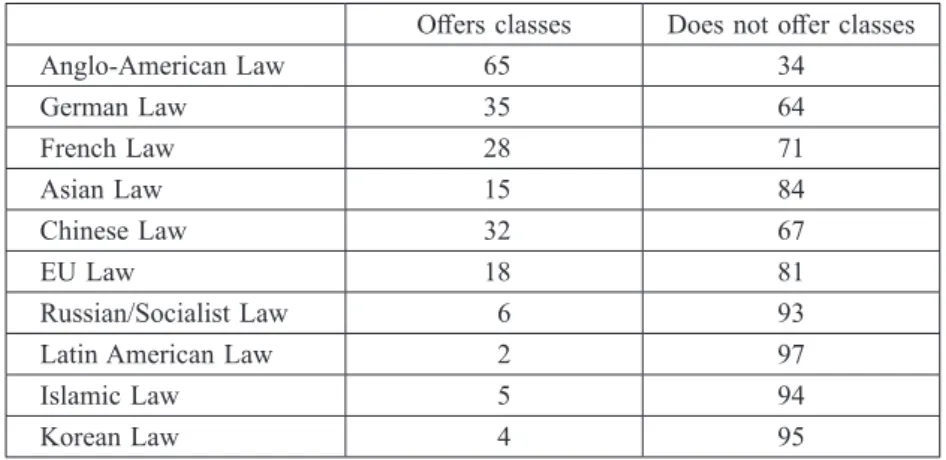
It is necessary to review which legal systems are mainly taught in Japanese universities. Table 5 tells us how many faculties offer classes on some legal families.

Table 5: Lectures on various legal families (The number of faculties that offer Foreign Law) Offers classes Does not offer classes

Anglo-American Law 65 34

German Law 35 64

French Law 28 71

Asian Law 15 84

Chinese Law 32 67

EU Law 18 81

Russian/Socialist Law 6 93

Latin American Law 2 97

Islamic Law 5 94

Korean Law 4 95

(Made by author with collected data.)

This data presents several findings about classes on foreign countries’ laws.

(1) Among legal families, classes on Anglo-American Law are the most common. Of the 99 faculties, 65 offer classes on it. Among 64 faculties, one teaches English Company Law, and four faculties teach Anglo-American Law under the title of Comparative Law.

Anglo-American Law is almost a different legal system from the Japanese one, so it is supposed that many faculties offer such classes. According to the syllabi of some faculties, subjects taught in lectures titled Anglo-American Law are broad, such as the court system of England/the United States, the mode of thinking of case law, precedents, the role of lawyers, common law and equity, litigation procedures (evidence act, jury system, etc.), development of the constitution (origin, amendments, and judicial review, etc.), class actions, exemplary damages, and so on. Many such topics are quite different from those of the Japanese legal system. However, the Japanese legal system has also

21) Takizawa, op.cit., pp.3-4.

(10)

been influenced in some fields, such as the theory of judicial review. From both sides, it is necessary to learn about the Anglo-American legal system. Moreover, many Japanese scholars study in United States. This may also affect the large number of faculties offering classes on Anglo-American Law.

(2) Next to Anglo-American Law lectures, the second largest number of classes offered are in German Law. According to the data, 35 faculties offer classes on German Law. Of these 35 faculties, one of them offers German Law under the title of Comparative Law.

Three of the classes are offered under the title of Continental Law or of European Law.

The reason why the number of classes on German Law is much less than that of Anglo- American Law is not clear. However, it may relate to Japanese legal history. For example, some scholars of Japanese criminal or administrative law may study German Law and its legal theory because of the influence of German theories. Japanese civil law was also heavily influenced by continental Europe. Thus, in a class on individual substantive law, some German legal theory might be taught.

(3) Regarding classes on French Law, most of faculties that offer it also offer classes on German Law. Of the 99 faculties, 28 faculties offer classes on French Law. Of 28 faculties, 21 offer classes on both French Law and German Law. In three faculties, only French Law is taught. One of the faculties offers classes on French Law only, but in another class, titled Comparative Law, German Law is taught. Thus, it can be said that in this faculty both legal systems are taught in lectures. Moreover, as mentioned before, three faculties offer classes titled either Continental Law or European Law.

(4) It is clear that the number of faculties offering classes on Chinese Law is increasing. Traditionally, in many faculties of Law, most students learn English, German, or French as a foreign language. However, 32 faculties offer classes on Chinese Law. Of these 32, 25 of the classes are titled Chinese Law or Chinese Law Seminar. In six of the others, such classes are titled as Asian Law. These classes are mainly focused on the modern Chinese legal system. By contrast with these classes, lectures on Chinese legal history are mostly titled Oriental Legal History. Such lectures on legal history have been since before World War II. However, the introduction of classes on Chinese Law is rather new. The reason is not clear, but it relates to Japan’s deepening relationship with other Asian countries, such as China and Korea or the ASEAN (Association of South-East Asian Nations) countries in the political/social/economic sphere.

(5) Compared to the number of classes on Chinese Law, the number of classes titled Asian Law is not that large. The table shows that the number of classes titled Asian Law is 15. However, of these 15, 6 are on Chinese Law. Thus, only nine faculties offer classes on legal systems of Asian countries other than China. This situation shows the problem of a scarcity of lecturers who can teach this subject.

In Japan, there are some debates on the character of Asian Law. Some scholars have

(11)

focused on the similarities or common features of Asian countries and their laws

22)

. By contrast, other scholars treat Asian Law as a consolidation of every country’s law or legal system. Such a point of view reflects the contents of the classes in Asian Law

23)

.

(6) It is noteworthy that the number of faculties that offer classes on Russian or Socialist Law is very low. Of the 99 faculties, only six faculties offer it, and five of these are public universities. The reason for such a low number may be the retirement of many scholars specializing in Russian Law. However, Aikyo (2017) mentions the necessity of learning about the socialist legal system to promote legal assistance to Asian countries. He states:

To tackle legal assistance to Asian countries, younger people should research and understand socialist law. They should focus on socialist countries such as Vietnam or Laos, or former socialist countries such as Uzbekistan, Mongolia or Cambodia

24)

.

However, as far as the number of lectures offered is concerned, the current situation is far from Aikyo’s expectations.

(7) Classes on Islamic Law are also few in number. Although Islamic Law is an important part of non-western legal families, only five faculties offer Islamic Law. There are few academic posts for Islamic Law, Asian Law, Socialist Law, and Russian Law.

Such a situation may tend to reduce the number of students who learn about these legal families. Thus, times are tough for basic jurisprudence scholars in Japan, such as those working in the fields of Foreign Law, Comparative Law, Legal Philosophy, and the Sociology of Law.

From the data, it can be said that the number of faculties that offer classes on Comparative Law is less than those of that offer classes on Foreign Law. Not only does the number of faculties that offer Foreign Law classes vary, but so do the contents of the classes. Such classes are influenced by the current social situation. The increased number of classes on Chinese Law is one example.

Moreover, in some Comparative Law classes, the contents mainly concern Foreign Law but the methodology or theory it that of Comparative Law. It is necessary to examine the current curricula and syllabi to understand the real situation of Comparative Law education.

22) See Yasuda (1987).

23) According to one of faculties which offer class on Asian Law, contents are as below; Comparison to Japanese Law, Continental Law and Anglo-American Law, Chinese Law, Indian and Burmese Law, Thai and Vietnamese Law, Indonesian Law, Korean and Taiwanese Law, Intellectual Property in Asian Countries, Islamic Banking, Dispute Resolution Systems.

24) Aikyo (2017), p.121.

(12)

3. Contents of Classes on Comparative Law

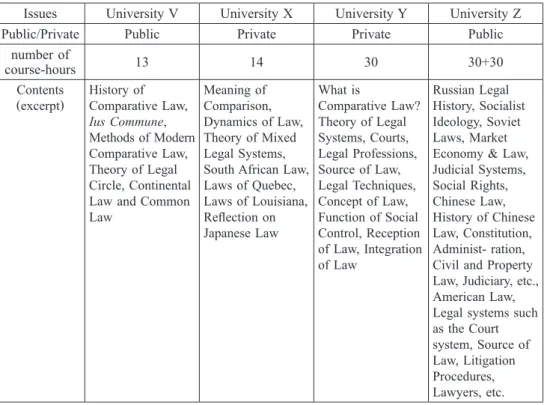
In this part, I would like to review the contents of classes titled Comparative Law. As described earlier, about 20 faculties offer classes titled Comparative Law. Of these, I will select four faculties to examine Comparative Law education.

One of them, hereinafter University V, is a public university, and the faculty has a long history of legal education. In this university, lectures in Comparative Law started in the late 1960s. The second one, hereinafter University X, is a private university. At this university, there is a Faculty of Law (undergraduate level), a Graduate School of Law, and a Law School (graduate school for legal practice), and every school offers classes on Comparative Law. According to Takizawa, this university has offered lectures on Comparative Law since the late 1950s. The third one, hereinafter University Y, is also a private university. University Y is also famous for having a legal education with a long history. The last one, hereinafter University Z, is a public university. This university also has a long history of Comparative Law education, having started lectures on Comparative Law in the early 1960s. I will review these universities’ syllabi to grasp the contents of Comparative Law classes.

Table 6: Comparison of lectures on Comparative Law

Issues University V University X University Y University Z

Public/Private Public Private Private Public

number of

course-hours 13 14 30 30+30

Contents

(excerpt) History of Comparative Law, Ius Commune, Methods of Modern Comparative Law, Theory of Legal Circle, Continental Law and Common Law

Meaning of Comparison, Dynamics of Law, Theory of Mixed Legal Systems, South African Law, Laws of Quebec, Laws of Louisiana, Reflection on Japanese Law

What is

Comparative Law?

Theory of Legal Systems, Courts, Legal Professions, Source of Law, Legal Techniques, Concept of Law, Function of Social Control, Reception of Law, Integration of Law

Russian Legal

History, Socialist

Ideology, Soviet

Laws, Market

Economy & Law,

Judicial Systems,

Social Rights,

Chinese Law,

History of Chinese

Law, Constitution,

Administ- ration,

Civil and Property

Law, Judiciary, etc.,

American Law,

Legal systems such

as the Court

system, Source of

Law, Litigation

Procedures,

Lawyers, etc.

(13)

(1) The number of course-hours is different for each university. In Japan, one class usually consists of by 15 course-hours (one course-hour is usually 90 minutes). University V chooses a different system from that of the other universities. University X may use one more course-hour for examinations. University Z offers two Comparative Law classes, titled Comparative Law I and Comparative Law II.

(2) Regarding the contents of classes, Universities V and Y are quite similar. The classes of these universities focus on an introduction of Comparative Law. The contents of University V’s class start with “Scope of Principles of Comparative Law.” Then, it proceeds to a history of Comparative Law. Worthy of note is the emphasis on Ius Commune. After that, the Methodology of Comparative Law and the Theory of Legal Circles (Rechtskreisen) are taught. Finally, a comparison between Continental Law and Common Law is made, with several viewpoints, such as the legal principles of contracts.

In University Y’s classes, students also learn the “orthodox” contents of an introduction to Comparative Law. The contents start with the meaning of Comparative Law, followed by “Legal Systems,” “Courts (institutions, procedures),” “Legal Professions (legal education, etc.),” “Sources of Law (Statute, Case Law, Customary Law),” “Legal Techniques (Continental Law and Common Law),” “Concepts of Law (Legal norms, Religion, etc.),” “Social Control Function of Law (European Law, Asian Law, Capitalist Law, and Socialist Law),” “Reception of Laws,” etc.

The contents of the classes of these two universities are almost what is described in many textbooks on Comparative Law. It may be said that such classes are somehow

“orthodox” Comparative Law. The aims of the lectures are also similar at these two universities. The aims of both classes mention that Comparative Law is a prerequisite to learning Foreign Law. As mentioned before, the Japanese legal system is influenced by many other legal systems, especially European legal systems and the American legal system. Thus, practically and academically, learning about Foreign Law is imperative.

From this viewpoint, the theory and method of Comparative Law is strongly related to the study of foreign legal systems. The aims of these lectures show this relationship between Comparative Law study and Foreign Law study.

The contents of University X’s curriculum is different, however. The lectures are focused on a “Mixed Legal System,” beginning with the theory of Comparative Law and mixed legal culture, where many course-hours are spent reviewing some cases of a Mixed Legal System. In the description of the aims of these lectures, it is explained that by reviewing Mixed Legal System theory as a critique of legal system theory and comparing several laws in different areas, students are expected to acquire the capacity to place Japanese Law in the current universal legal context.

The contents of classes offered at University Z are totally different from the others.

This university offers two classes, as mentioned before: Comparative Law I is for the

teaching of Russian Law and Chinese Law, while Comparative Law II is for the teaching

of American Law. These lectures may be categorized as Foreign Law classes but are titled

(14)

Comparative Law. This type of class is not rare. It can be construed in two ways. One is the vagueness between Comparative Law study and Foreign Law study; the other is that there are some classes to learn Foreign Law from the perspective of Comparative Law.

With regard to the case of University Z, the latter may be more applicable. The aim of the lectures are to understand the characteristics of Russian and Chinese Law through a comparison with Western European legal culture (Comparative Law I) and mainly in relation to Japanese Law (Comparative Law II).

In reviewing the contents of some classes on Comparative Law, two characteristics of Comparative Law education in Japan may be mentioned. One is that Comparative Law education is strongly connected to Foreign Law education. The other is that contents vary somewhat according to the lecturer’s specialty; even when teaching foreign legal systems, the methodology of Comparative Law or the viewpoint of comparison are not discarded.

Conclusion: Some findings

The aim of this paper is to identify the characteristics of Comparative Law education through statistics and syllabi.

Using the statistics, it is clear that the number of faculties that offer classes on Comparative Law is not large, there is no apparent difference numerically between public universities and private universities, and there is no relation between size of faculties and the offering of such classes.

Contrary to the situation for Comparative Law, classes on Foreign Law are offered in many faculties. Anglo-American Law is taught most often, followed by German Law and Chinese Law. This situation may relate to the history of the development of the Japanese legal system. It received concepts from European and American legal systems, with the result that research and education in Foreign Law is important to understand Japanese Law. From reviewing some syllabi on Comparative Law, it is clear how Comparative Law education and Foreign Law education are connected in Japan. Some classes treat Comparative Law study as a prerequisite to Foreign Law study. Other classes offer an education in Foreign Law but from the perspective of a comparison of laws or legal cultures.

While the number of classes on Comparative Law is not that large, the concepts and

methodology of Comparative Law are utilized in research and education in substantive

laws due to the influence of foreign laws on Japanese Law. Thus, especially in Japan, if

we research Comparative Law education in detail, we would be required to research

substantive law education also.

(15)

Bibliography Japanese

Aikyo Masanori, Nihon-to-ajia-wo-tsunagu (Connecting Asia and Japan: Introduction to legal assistance), Junpo-sha, 2017, Tokyo.

Igarashi Kiyoshi, Hikaku-ho Handbook (Handbook on comparative law), 2

nd

edition, Keiso-shobo, 2015, Tokyo.

Ooki Masao, Hikaku-ho Kogi (Lecture on comparative law), University of Tokyo Press, 1992, Tokyo.

Takizawa Tadashi, Hikaku-ho (Comparative law), Sanseido, 2014, Tokyo.

Yasuda Nobuyuki, Ajia-no Ho-to Shakai (Law and society in Asia), Sanseido, 1987, Tokyo.

Obunsha, Keisetsu-Jidai: Zenkoku Daigaku Annai Zokango (Information for entrance examination of universities), Aug. 2017, Obunsha, 2017, Tokyo.

English

Curran, Vivian Grosswald, Comparative Law: An Introduction, Carolina Academic Press, 2002, Durham.

David, R and John E. C. Brierley, Major Legal Systems in the World Today, Second Ed., Free Press, 1978, New York.

Husa, Jaakko, A New Introduction to Comparative Law, Hart Publishing, 2015, Oxford.

Orücü, Esin, and Nelken, David (eds.), Comparative Law: A Handbook, Hart Publishing, 2007, Oxford.

Siems, Mathias, Comparative Law, Cambridge University Press, 2014, Cambridge.

Zweigert, K and Kötz, H, (translated by Tony Weir), An Introduction to Comparative Law, Third Ed., Oxford Univ.Press, 1998, New York.

Zweigert, K and Kötz, H, Einführung in die Rechtsvergleichung auf dem Gebiete des Privatrechts, Band I, J. C. B. Mohr, 1971, Tubingen.

List of universities

University of Tokyo, Kyoto University, Osaka University, Hokkaido University, Tohoku University,

Nagoya University, Kyushu University, Kobe University, Hitotsubashi University, University of

Tsukuba, Kagawa University, Ehime University, Hiroshima University, Okayama University,

Kumamoto University, Kagoshima University, University of the Ryukyus, Kanazawa University,

Shimane University, Niigata University, Shizuoka University, Chiba University, Ibaraki University,

University of Toyama, Mie University, Shinshu University, Tokyo Metropolitan University, Osaka City

University, The University of Kitakyushu, Kansai University, Kwansei Gakuin University, Doshisha

University, Ritsumeikan University, Konan University, Kyoto Sangyo University, Kindai University,

Ryukoku University, Waseda University, Keio University, Jochi (Sophia) University, Meiji University,

Aoyama Gakuin University, Rikkyo (St. Paul’s) University, Chuo University, Hosei University,

Sapporo University, Sapporo Gakuin University, Hokkai Gakuen University, Aomori Chuo Gakuin

University, North Asia University, Tohoku Gakuin University, Asia University, Gakushuin University,

Kanagawa University, Kanto Gakuin University, Kokugakuin University, Kokushikan University,

Komazawa University, Surugadai University, Seikei University, Seijo University, Seiwa University,

Senshu University, Soka University, Daito Bunka University, Nihon University, Dokkyo University,

Meiji Gakuin University, Setsunan University, Osaka Gakuin University, Kobe Gakuin University,

(16)

Momoyama Gakuin (St. Andrew’s) University, Seinan Gakuin University, Musashino University,

Rissho University, Kyoto Women’s University, Osaka University of Economics and Law, Nanzan

University, Aichi Gakuin University, Aichi University, Chukyo University, Fukuoka University,

Kurume University, Hokusei Gakuen University, Ryutsu Keizai University, Hakuoh University, Tokyo

Keizai University, Tokai University, Chuo Gakuin University, Hiroshima Shudo University, Heisei

International University, Miyazaki Sango-keiei University, Sigakukan University, Takushoku

University, Teikyo University, Toyo University, Nihon Bunka University, Toin Yokohama University,

Takaoka University of Law, Yamanashi Gakuin University, Asahi University, Tokoha University,

Nagoya Gakuin University, Nagoya University of Economics, Meijo University, Tezukayama

University, Okayama Shoka University, Matsuyama University, Kyushu International University,

Okinawa International University, Okinawa University

(17)

Table 1: The number of universities in which a Comparative Law class is offered
Table 4: The number of universities that offer classes on foreign legal systems
Table 5: Lectures on various legal families (The number of faculties that offer Foreign Law) Offers classes Does not offer classes
Table 6: Comparison of lectures on Comparative Law

参照

関連したドキュメント

An easy-to-use procedure is presented for improving the ε-constraint method for computing the efficient frontier of the portfolio selection problem endowed with additional cardinality

On the other hand, when M is complete and π with totally geodesic fibres, we can also obtain from the fact that (M,N,π) is a fibre bundle with the Lie group of isometries of the fibre

This approach is not limited to classical solutions of the characteristic system of ordinary differential equations, but can be extended to more general solution concepts in ODE

Colmez (1998) and Perrin-Riou (1994) proved an explicit reciprocity law for tempered distributions over the formal group G m1. In this paper, the general explicit reciprocity law

modular proof of soundness using U-simulations.. & RIMS, Kyoto U.). Equivalence

We discuss strong law of large numbers and complete convergence for sums of uniformly bounded negatively associate NA random variables RVs.. We extend and generalize some

Based on two-sided heat kernel estimates for a class of symmetric jump processes on metric measure spaces, the laws of the iterated logarithm (LILs) for sample paths, local times

In Section 2, SLLN’s for triangular arrays {X,} of rowwise independent (but neither necessarily identically distributed nor independent between rows) r.v.’s are established