A Pattern-based Approach to Requirements Formalization and Its Supporting Tool
Xi Wang
Department of Computer Science, Hosei University, Japan
Abstract—Formalizing requirements in formal specifications usually requires high skills for abstraction and experience in using the formal notation in which the specification is written.
This poses a challenge to many practitioners who have to deal with realistic systems within the required schedule and budget.
To handle this challenge, this thesis describes a pattern-based approach to facilitate the formalization of requirements. In this approach, a specification pattern system is pre-defined to guide requirements formalization where each pattern provides a specific solution for formalizing one kind of function into a formal specification. All of the patterns are classified and oi^anized into a hierarchical structure according to the functions they can he used to formalize. Based on the pattern system, a method that guides the requirements formalization process by applying the pattern system is described. To facilitate the understanding of the guidance produced by the pattern system and the utilization and maintenance of the pattern knowledge, a method for representing the pattern system is proposed. We also describe a prototype tool that supports the pattern-based approach.
I. Introduction
Well-written requirements specifications are the key to successful software projects. They provide a clear direction for the development activity that may become a lengthy and error-prone process if being carried out from scratch.
They also enable the identification of software flaws in the early stage of the development process, which costs much less than discovering design errors in the later stage. Fur thermore, requirements serve as benchmarks for evaluating and improving the quality of the produced software. In the early days, natural language and graphical notation are used to write requirements specification since they are easy to use and understand. However, the inevitable ambiguities in informal languages would probably lead to specifications that are incomplete, unverifiable, inconsistent, too disorganized to be modifiable, untraceable and difiicult to be used in operation and maintenance phase. To deal with the problem, formal specification technique is proposed.
Formal specification describes expected system behaviors in mathematically based notations. With well-established formal ism, it enables rigorous analysis of requirements and can be manipulated automatically. It also sets a firm foundation for the later stages of software development and serves as prerequisite for verifying the correctness of the implementation alternatives using formal proof or specification-based testing. In spite of the statistic data that shows the improvement of software quality by using formal specification techniques and successful stories reported in the latest survey on industrial use of formal specification, applications of specification to real projects in
industrial are still rare. The major reason stems from the nature complexity of formal notations. Formalizing informal requirements into formal specifications requires sophisticated mathematical skills, abstraction ability and suflficient expe rience in using formal notations. This poses a challenge to practitioners who hardly receive any systematic training in computer science but have to face pressures to produce quali fied software systems within limited time and budget. Even if they manage to understand formal notations through long-term practice, formalizing complex functions is still error-prone and costly.
Experience suggests that resolving ambiguities of require ments is a learning process that often requires the analyst to make decisions and formalizing requirements is a means to precisely understand them. We believe that an effective way to solve the three problems in requirements formalization is to take the approach in which ambiguities of informal require ments are gradually clarified while the corresponding formal expressions are automatically generated. If the necessaiy func tion details can be correctly retrieved, its formalization only involves changing its format, which can be more efficiently and reliably done by a software tool.
To this end, a pattern-based approach to refining informal requirements into formal specifications is proposed in the thesis. In this approach, a specification pattern system is pre defined where each specification pattern provides a specific solution for formalizing one kind of function. To facilitate pattern selection, all of the patterns are categorized into a hierarchy according to the functions they can be used to formalize. The distinct characteristic of our approach is that all of the patterns are stored on computer as knowledge for creating effective guidances to facilitate the developer in writing formal specifications; they are "understood" only by the computer but transparent to the developer. To enable automatic application, we give the formal definition of the pattern system.
Based on the formal definition, the method for guiding requirements formalization by using the pattern system is described. It includes two steps: requirements derivation and requirements translation. The former guides the selection of appropriate specification patterns and applies the derivation knowledge of the selected patterns to guide the assignment of the defined attributes. The latter automatically transforms the assigned attributes into formal specifications according to the transformation knowledge of the selected patterns. During the application process of the selected patterns, necessary data
types will be automatically recognized and their definitions
will be refined.
In addition to the design and definition of the specification pattern system, the representation of the pattern knowledge is also an important factor to the performance of the pattern- based approach. We adopt attribute tree and HFSM (Hierar chical Finite State Machine) to represent the pattern knowl edge to facilitate understanding of the produced guidance and utilization of the pattern knowledge. We also describe a prototype tool that implements the pattern-based approach.
By utilizing the knowledge, it derives informal requirements through interactions with its users on the semantic level and automatically transforms the obtained information into suggested formal specifications, which enables developers to concentrate on function issues without worrying about how to guarantee the completeness and how to formally represent
these functions.
II. Related Work
Many methods have been proposed for supporting require ments formalization. They can be generally divided into two
kinds. The first kind focuses on the construction of formal
specifications. In (1), the authors describe some example approaches to integrating structured methods of software de velopment with formal notations. In (2), authors uses the structured analysis (SA) model of a system to guide the analyst's understanding of the system and the development of the VDM specifications. S. Liu (3) proposes an approach to constructing software specifications by integrating top-down
and scenario-based methods. These methods either do not
provide any guidance for formal specification construction or provide guidelines on an abstract level. There are also many methods for supporting formal specification construction using patterns. Stepney et al. describe a pattern language for using notation Z in computer system engineering (4). Lars Grunske presented a specification pattern system of common proba bilistic properties for probabilistic verification (5). Konrad et al. (6) create real-time specification patterns in terms of three commonly used real-time temporal logics based on an analysis of timing-based requirements of several industrial embedded system applications and offer a structured English grammar to facilitate the understanding of the meaning of a specification.
In spite of enthusiasm in academics, specification patterns are not yet widely utilized in industry mainly because of the difficulties in applying them. Effective applications of most specification patterns require full understandings of them, and the ability to select and solve their specific problems depends on the understanding, since their informal representations make it impossible to utilize the pattern knowledge without human involvement. By contrast, our pattern-based approach is able to provide specific comprehensible guidance by automatic application of the pattern system. Developers only need to follow the guidance and the rest of the tasks will be handled by the tool.
The second kind emphasizes the solution to the conversion of informal requirements to formal specifications. William E
et al. introduce a general framework for formalizing a subset of UML diagrams in terms of different formal languages based on a homomorphic mapping between metamodels describing UML and the formal language (7). Cory Plock et al. show how to transform LSC (Live Sequence Charts) specifications with concurrency to timed automata (8). Sunil Vadera et al. propose an interactive approach for producing formal specifications from English specifications (9). Several tools have also been proposed for automatic transformation, such as U2B (10). But such transformation is conducted based on certain pre-defined syntactic rule without considering the real meaning of the models. Due to the inherent difficulty in NLP technology, there is no effective tool-support in constructing formal specifications on the semantic level. The introduction of pattern seems to offer a solution. Informal descriptions is not treated as the resource of our pattern-based approach. The desired functions are obtained by gradually clarifying informal ideas with human involvement. Thus, the performance of the approach will not be affected by NLP technology.
Several kinds of tools have been developed for supporting requirements formalization. Z User Studio is developed as an integrated Z support tool (11). U2B translator (10) converts UML Class diagrams, including attached state charts, into the B notation (12). SPIDER (13) derives and instantiates system properties in terms of their natural language representations.
Kanth Miriyala et al. describe an interactive system called SPECIFIER for deriving formal specifications of data types and programs from their informal descriptions (14). These
tools is either unable to work on the semantic level or inca
pable of dealing with data-intensive systems without manual efforts on formal notations. By contrast, our tool supports the requirements formalization process on the semantic level and the developers can focus function design without the need of considering the formal notation details.
III. An overview on the pattern-based approach t o REQUIREMENTS FORMALIZATION
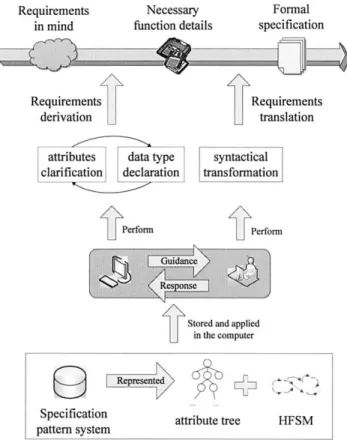
The outline of our pattern-basedapproach is given in Figure
?? where requirements formalization consists of two stages:
requirements derivation and requirements translation.
During the first stage, the informal requirements in the developer' mind is gradually clarified and the function details of the clarified requirements is derived. There are two major activities in this stage: attributes clarification and data type declaration. The former specifies each attribute of the re quirements to obtain sufficiently detailed understanding while the latter accomplishes the declaration of all the necessary data types for formalizing the requirements. Instead of being performed independently, these two activities are alternatively carried out. Clarifying attributes needs to use the existing types defined in data type declaration. Meanwhile attributes clarification help specifies the types that should be defined to enable the description of the clarified attributes. Therefore, the two activities precede hand in hand until both them are terminated. In the second stage, the obtained function details are translated into a formal specification. Such a translation is
Requirements
in mind
Requirements
derivation
Necessary function details
Formal
specification
Requirements
translation
I attributes data type syntactical j
Iclarification declaration transformation I
Represailed
specification pattern system
Stored and ^plied in the computer
^ c
Iattribute tree HFSM
Fig. I. The outline of the pattern-based approach
actually done by a syntactical transformation from the format
of the function details to a formal notation.
Both of the stages are performed through interactions between the developer and computer where computer pro duces guidance and the developer inputs the response to the computer. The response triggers computer to produce new guidance which is then followed by the developer for the next step of requirements formalization. Such a process repeats until a formal specification is achieved. The foundation of this interaction process is a specification pattern system which is stored in the computer to be applied to interact with the developer. The specification pattern system organizes a set of specification patterns in a hierarchical structure where each pattern carries two kinds of knowledge for formalizing one kind of function: derivation knowledge and transformation knowledge. The former is designed to support requirements derivation and latter is created to deal with requirements translation. We adopt attribute tree and HFSM to represent the above pattern knowledge in computer. Attribute tree is used in derivation knowledge to intuitively show the definitions of the requirement attributes that need to be clarified, which facilitates the developer's understanding on the structure of the intended requirements. HFSM is used to describe other parts of derivation knowledge and all transformation knowledge, since it is easy to be manipulated by machines and maintained by several mature supporting tools.
We will explicitly describe each component in the approach outline from the bottom level since the understanding of
the high-level components relies on that of the lower-level components. Consequently, the specification pattern system will be first introduced and the representation of the included pattern knowledge is then described. Based on the pattern knowledge, we will show how to apply it for supporting the two stages during requirements formalization.
IV. Specification PATTERN SYSTEM
Specification pattern system is composed of a set of inter related specification patterns. We will first present the concept of specification pattern and then shows how these patterns are organized in the hierarchy of the pattern system.
A. Specification pattern
A specification pattern is established to guide the formal ization of one kind of function f. It mainly consists of two parts providing solutions for tackling the two tasks during formalization: the clarification of / and the representation of the clarified / in a formal notation. In the first part, / is treated as a composition of its necessary attributes. These attributes are formally defined as elements and clarifying / is to assign values to the elements according to their definitions.
A set of clarification rules are provided for guiding such assignments. In the second part, a set of transformation rules are given for generating formal representation of / according to the values assigned to the elements. Consider the function
"belong to" which describes a relation where certain object is a member of another object. Each specific "belong to" function is composed of two attributes: the member and the object that the member belongs to. Therefore, the corresponding pattern includes clarification rules for guiding the assignment of the two attributes and transformation rules for generating a formal representation of the "belong to" function according to the assigned values. Specifically, our specification pattern is de signed with a structure for organizing the included knowledge.
It is composed of the following four items:
name the unique identity of the pattern explanation explains what kind of functions the
pattern can be used to formalize constituents specifies how to write the require
ment for the intended function
solution rules for transforming the achieved requirement into formal expressions
solution
In our approach, the specification patterns are designed to be applied by machines; any ambiguity will impede their automatic utilization. For this reason, we formalize the pattern structure in to following definition where 'P(s) denotes the power set of set s.
Definition I: A pattern p is a 6-tuple {/, E, PR, cxpl, where
• / is the unique identity of p denoting the kind of function that p is used to formalize
• E is a set of elements where each element denotes one
of the necessary attributes of /
• PR is a set of constraints on p or the elements In E
• expl : {/} U U PR —> string informally interprets /, elements in E and constraints in PR for the purpose
of human-machine interaction
• $ : U denotes the set of clarification rules for
guiding the assignment of the elements in E where - '• E —» E determines the order for specifying
elements where
* 3eo€E • Co ^ ran{^E) (eo represents the first element to be specified)
* Ve—e'€<frE • e ^ e' (e ^ e' denotes a maplet in where e' should be specified after e)
- : E —> RPT defines a rule repository for each element e in E to guide the assignment of e where each repository in RPT is a triple {R,Ro,'y) where
* R : V{PR) —> V{PR) denotes the set of rules in the repository where each rule determines the satisfactory of a set of constraints based on already satisfied constraints and ^pr^pr'^r • PRi H Pi?; = 0
* Po C P is the first set of candidate rules to be applied
* 7 : P —> P(P) determines the sequence for applying the rules in P where 7(r) indicates the candidate rules for further clarifying e after rule r is applied
* RSi^rani-y) ' PR,„-^PR'„„PR„^PR'„eRSi '
VprePfim 'pr '^pr'ePRn-^Pr' (for each r € P, only one of the candidate rules in 7(r) will be activated when formalizing a function using p)
• ^ : V{PR) —» string denotes the set of transforma tion rules for generating the formal representation of / according to the values assigned to the elements where
'^PRi-*Si,PRj^sj€^-'^prGPRi-Pf ^pr'€PRj'~'P^' (ooly
one of the rules in ^ will be activated for the specified elements)
The above definition organizes the four items of the pattern structure into a tuple and formalizes them into corresponding elements of the tuple. Specifically, item name and explanation are denoted as / and the mapping originating from name in expl respectively. The other mappings in expl are designed to explain the semantics of a subset of the formal concepts in the pattern, which enable the production of comprehensible guidance from formal notations. For item constituents, its sub-
item elements is transformed into a set denoted as P in the
tuple and the sub-item rule for guidance is formalized into rule set $. According to the rule for guidance item of the original structure, item formally defines how to guide the retrieval of the four elements in E by defining ^e and ^r.
Mapping ^ mathematically defines item solution.
B. The hierarchy in the pattern system
Due to the inherent complexity of software, the number of patterns will be so large that the selection process becomes a hard task for users and the management would be difficult. To this end, we divide them into distinct categories and organize
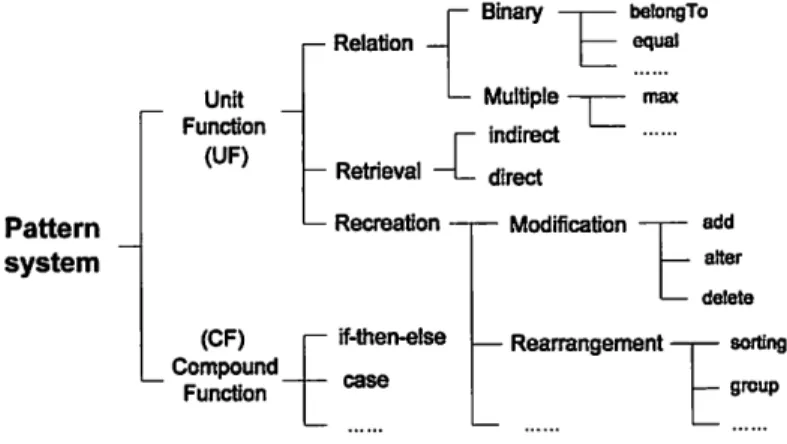
them in a hierarchical structure in the pattern system by categorizing the functions they are used to formalize. Figure 2 shows the hierarchy where rightmost items represent patterns and others represent categories. Root "Pattern system" owns two sub-items, which indicates that patterns are divided into two categories: one for describing unit functions denoted as UF and the other for depicting compound functions denoted as CF. Their sub-categories are further classified into more specific sub-categories or patterns. For example, category UF is divided into three sub-categories: Relation patterns for formalizing the descriptions of relationships between objects.
Retrieval patterns for generation formal expressions repre senting system variables and Recreation patterns for formal description of changes on the state of the system.
Pattern system
Unit Function
(UP)
(CF) Compound
Function
— Relation
Retrieval Recreation -
if-then^lse c a s e
p Binary belongTo equal
Multiple 1
indirect direct
— Modification
— Rearrangement
add
— alter
— delete sorting
— group
Fig. 2. Pattern categorization
V. Requirements formalization based on the
SPECIFICATION PATTERN SYSTEM
The major task in requirements formalization is to describe software behaviors in formal expressions, such as pre- and post-conditions of operations. Another important task is the declaration of data types since writing formal expressions requires the availability of a set of state variables which need to be formally defined by custom data types. Instead of performing sequentially, these two tasks are usually alter natively carried out. For each function to be formalized, if the existing data types are not sufficient or inappropriate for formally describing it, the developer will be guided to create new types or modify the existing ones according to the need of the function. Then the description of the function continues with the updated data types and the declaration activity will be repeatedly performed to deal with the later encountered data type problems.
We will describe the methods for supporting the above two activities in detail respectively. For function description in formal expressions, we assume the necessary data types are defined by applying the data type declaration method and focus on explaining the generation process of the target formal expressions from informal requirements. For data type declaration, we will show how the functions to be formalized guide the defining of the appropriate data types.
A. From informal requirements to formal specifications Well-defined pattern structure establishes a firm foundation for guiding the requirements formalization process. Applying the specification pattern system to refine informal requirements into formal specifications largely depends on pattern structures and is therefore straightforward.
Given a requirement rq, its formalization based on the pattern system contains two major steps.
Step 1 Pattern selection
Appropriate patterns for formalizing rq need to be selected first. The selection process can be guided by the hierarchy of the pattern categorization. Starting from the top level of the hierarchy, the developer is required to select a sub-category on each level until reaching a pattern p. It is not difficult to find the right pattern because of three reasons. First, pattern names are written in natural language and designed to be distinguishable from each other on the semantic level. Second, the patterns are organized by categories at different levels and the developer only needs to deal with one category or sub-category at a time. Third, the expl items of the patterns describe their usage in more details and can help confirm the selection decision. Human intelligence is needed in this step to analyze rq on the semantic level and decompose it into a set of basic functions where each basic function can be formalized by a pattem.
Step 2 Pattem application
With a set of patterns {pi,...,Pn} selected for all the sub-functions { /i, of rg, the next step is to apply them. Each pattem pi denoted as (/, E, PR, expl, is applied by the following two steps.
a) requirements clarification
Based on the specification pattems, requirements clarificationis to instantiate the appropriate specifi cation pattems by specifying the relevant elements.
It generates requirements composed of elements assigned with concrete values. The assignment of these elements is guided according to their definitions and results in clarified requirements where all the elements are specified with values.
The formal definitions of the involved elements guarantee the accuracy of the requirement so that it can be automatically transformed into formal specifications.
b) formal expression generation
In this step, an expression exp that formally describes f will be generated based on the values assigned to the elements in pi.
B. Data type declaration
As the complexity of software rises, data type declaration becomes more difficult to manage and more likely to result in defected data types. We put forward an approach to supporting data type declarations for requirements formalization based on specification pattems. Its underlying principle is that types
should be defined to meet the need of correctly and concisely describing relevant functions. Type definitions will evolve as function description proceeds until all the expected functions are properly represented in formal expressions. During the application of each pattem , necessary data types can be automatically recognized and their definitions will be refined.
Specifically, when applying each selected pattem, we use function-related declaration to guide the refinement of the related data types. It consists of two steps for different stages of the application process: property-guided declaration and priority-guided declaration.
The proposed approach regards data type declaration as an evolution process along with the writing of formal expressions based on function pattems. This evolution process starts with a modulized formal specification and terminates when the detailed behavior of each module is precisely given. On the as sumption that specification architecture is already established where modules are organized in a hierarchical stmcture and processes of each module are connected by their interfaces, developers will first be required to manually declare data types for defining these interfaces. Since process behaviors is not considered in this stage, the declared data types only reflects the initial idea of the intended functions and will be refined as the function details are clarified.
Then the description of individual processes is started where each process should be attached with a pair of pre- and post-condition. For each pre-/post-condition, a pattem suitable for describing the expected function will first be selected.
The selected pattem is then applied. Step 1 is to guide the specifying of its elements and step 2 is to generate an intermediate formal result based on the specified elements.
During these two sXeps, function-related declaration is carried out to declare new types and refine the existing type definitions where property-guided declaration is carried out on step I and priority-guided declaration is carried out on step 2. The former guides the refinement of type definitions under the principle that all the properties inferred from the specified elements should be satisfied while the latter provides suggested definition of certain types according to the priority attribute associated to ^ of the selected pattem. These two techniques share a type combination method that refines the existing type definitions by combining different definitions of the same type.
For example, suppose pattem p is selected to write a formal expression and type t is initially declared as definition defi for specifying element e\ of p. When specifying element 62, property-guided declaration leads to a suggestion that t should be defined as definition de/2 to enable the correct representation of the value assigned to 62. If defi is not equal to de/2, the combination method will be applied to refine defi with def2 by combining them into a new definition for declaring t.
If the generated intermediate result contains informal ex pressions, formalization of the result is needed. Since it is performed by applying the pattems indicated by the informal expressions. Junction-related declaration can be repeatedly manipulated to further refine the data types of the specification.
til ei G2
tiir".
d^, d„ ... djt CI22
attrii^
/attrii
\
\
F 611 d, di •••
I
Vj, V22
Fig. 3. The structure of attribute tree
When the formalization process terminates with a formal ex pression, a refined data context is obtained. Finally, expression update is carried out where all the formal expressions that are inconsistent with the refined data context are updated.
VI. Representation of the pattern knowledge
Instead of directly using the structure and formal definition of the specification pattern and the pattern system to represent the pattern knowledge, we adopt two languages to represent different parts of the knowledge. One language is designed to represent the part of the knowledge that needs to be displayed to the developer and the other is designed to be applied by machines in an automated manner. Considering the different characteristics between the requirements of machine-oriented knowledge representation and people-oriented knowledge rep resentation, attribute tree and HFSM are chosen to describe the two kinds of knowledge respectively.
A. Attribute tree
Figure 3 shows the attribute tree representation.
The root node F of the tree denotes that the pattern is used to guide the clarification of the requirements on function F. Its child nodes 61,62,... denote the requirement elements for composing the pattern. Each label attvi reveals that the element ei is defined to represent attribute attri of F, For each node 6^, its child nodes dii,di2,... indicate the def item of the corresponding element where each dij represents one of the constitute types. For each node dij, label Uj shows the type identifier of dij and the child nodes demonstrate the inner structure of dij.
B. HFSM
HFSM models system behaviors using a set of FSMs organized in a hierarchy. The definitions of FSM and HFSM are first given before explaining how to represent pattern knowledge.
Definition 2: A FSM (Finite State Machine) is a 9-tuple (Q, qO, F, VP, /, G, p, 6, X) where Q is a non-empty finite set of states, 9O G <5 is the initial state, F c Q is the set of accept states, VF is a set of variable states where each variable state is a triple (V, V',9) where V is the finite set of system variables, V is a set of values and 9 : V —^ V defines the associated value for each v eV, I is the finite set of symbols.
processed input
retrieved ., ..
Knowledge knowledge Guidance ^ "sponse
extractor generator
XML file stored
0
Specification pattern knowledge
developer
Preprocesser' /
Defined Qrpes and variables
Fig. 4. The design of the tool for supporting requirements formalization
G is the finite set of guard conditions, p : Q —> VP is the state function indicating the values of the involved variables on each state, 6 : Q x {I x V{G)) —> Q is the transition function relating two states by input and guard conditions, A : Qx{IxV{G)) —> I is the output function determining output based on the current state and input.
Definition 3: HFSM (Hierarchical FSM) is a pair (F, a) where F is a set of FSMs and a ; Q U / U V —^ P(F) indicates the hierarchical relations among FSMs in F where lower-level FSMs interpret certain portion of upper-level FSMs iff BaoEF •VF'€ran(a)' Aq ^ F' (Aq is the root FSM).
The HFSM representing the target pattern knowledge is built in a top-down way. The root FSM reflects the outline of the process by describing the initial and final states of steps 1 and 2 in pattern system application. The details of the steps are modeled in lower-level FSMs. The lower-level FSM for modeling step 1 reveals the state transitions made by the detailed process of pattern selection. For step 2, requirements clarification and formal expression generation are modeled by a set of lower-level FSM each describing the application of one of the patterns.
VII. Prototype tool for supporting the PATTERN-BASED APPROACH
The main goal of our pattern-based approach is to support computer-aided formalization of software requirements. To validate the approach and demonstrate its efficiency, we im plement it into a prototype tool that implements the approach.
It interacts with the developers to derive necessary function details of the intended requirements and transformed the derived requirement into formal specifications.
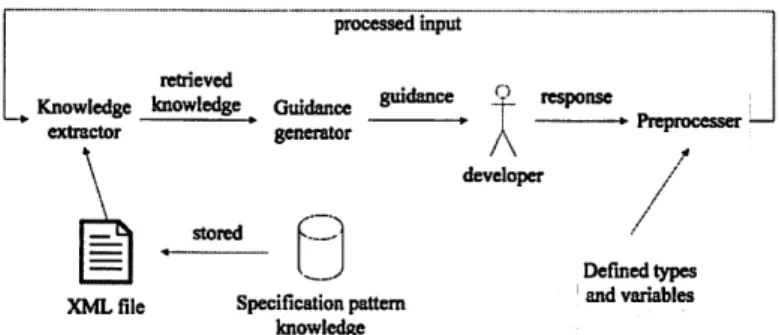
Figure 4 shows the outline of the tool that is composed of four components:
• specification pattern knowledge stored in a XML file
• knowledge extractor for retrieving appropriate knowledge
from the XML file
• guidance generator for transforming the retrieved knowl edge into explicit guidance that asks for the response from the developer
• preprocessor for collecting input from the developer and processing it for knowledge extractor
When supporting the formalization of an intended require ment, knowledge extractor retrieves appropriate knowledge
from the XML file that stores the specification pattern knowl edge. The retrieved knowledge is then used by guidance gen erator to produce comprehensible guidance. By following the produced guidance, the developer is expected to respond to the tool. After receiving the input preprocessor analyzes and processes it within the context of the defined types and variables (The tool is executed on the assumption that ail the necessary types and variables are already defined since the data type declaration method is has not been implemented).
The processed input information is used by the knowledge extractor to retrieve new knowledge from the XML file for producing new guidance. Such interactions continue until the target formal expression is generated.
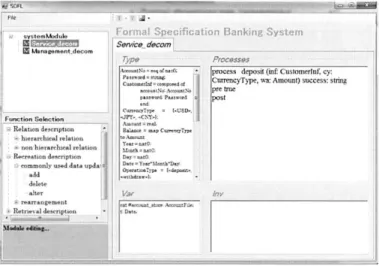
Figure 5 shows a snapshot of the main frame of the tool being executed for supporting the writing of the formal specification of a banking system.
cytfmMadiA BES^HBBSP B Uaniamafit.dvconi
- Formal Specification Bariking System ISarvkadscom^,
_FunetiBAS^lnctioA
•-bwrBfthicB] rf UtioD '
* 1MB hurarehioil Tvljlion -f IU«T**tioa d*xnptMn '
a MBieMnJjr dAU upd^tl Add
dtltU
«h«r A miTTAnCVBtBl
AfiCMBlXd S ugO>
Pimad B naaB
DajrtiMk Sm • Yw'MdetklW OpntaaTn* « I .
process de^it (inC Cuslomrrfnr, cy;
CumncyType, wa: Amouol) success: string pre true
Fig. 5. The main frame of the tool
The tree structure on the top left reflects the architecture of the specification where each node indicates a module.
High-level modules are decomposed by attaching child nodes representing low-level modules. For the banking system, the top level module systeniModule is decomposed into two low- level modules Service_decom and Managementjlecom.
The module Service_decom describes the banking services provided by the system for the customers owning authorized accounts and the module Managementjlecom. describes the operations for analyzing and maintaining the system information. The right part of the interface is used to edit the content of the selected module where Type denotes the declaration of custom data types, Var denotes the declaration of specification variables, Processes denotes the collection of processes describing various operations in the module and Inv denotes the collection of invariants each expressing a property that must be sustained throughout the entire specification.
When editing a module, its types and variables need to be first declared and the tool will use these pieces of information to guide the formalization of pre- and post-condition of each process, as well as invariants.
For each function to be formalized, a pattern should be
TABLE I
The result oe rm; eirst experiment
Software I Number of I Number of I Number processes
53 49 50 53 55 60
applied patterns To 9 9 11 (2 12
of errors 13 II 10 13 10 11
selected from the tree structure on the bottom left of the main frame. Once the selection decision is made, a new frame will be poped up as the medium to derive necessary function details of the intended basic function. When adequate function details are derived, a formal expression will be generated and displayed on the frame. It is allowed to be modified and copied to the main frame as the formalization result of the corresponding pre/post-condition or invariant.
VIII. Experiment
To evaluate the effectiveness of the pattern-based approach, two controlled experiments on the supporting tool have been
conducted.
In the first experiment, we use the supporting tool to formalize the functions of several typical software systems including Hotel reservation system, Banking system, E-ticket system, Suica card system. Library information system and Online shopping system (For concise illustration, we will use H, B, E, 5, L, O as the abbreviation of these six systems respectively). Table I shows the result of the experiment.
Although this result cannot lead to the conclusion that any requirement can be formalized by a set of our patterns, it does demonstrate that the proposed approach is able to support computer-aided formalization of commonly used functions.
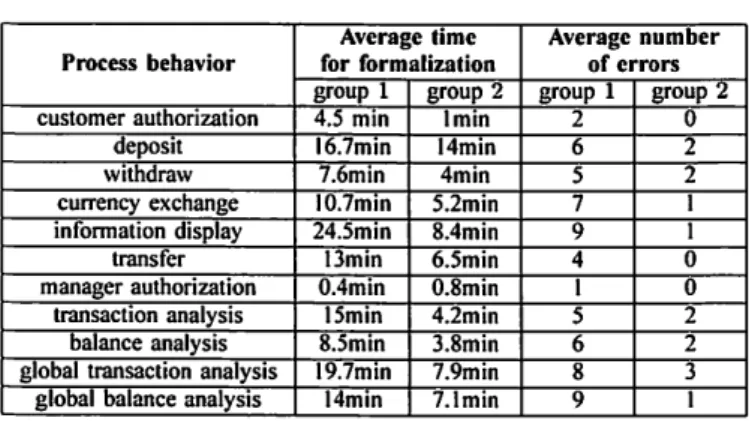
In the second experiment, we invite 76 students and divided them into two groups. Each student in group 1 is asked to manually write the formal specification of a banking system and the students in group 2 formalize the behavior of the banking system by using our prototype tool. The result of the experiment is organized in Table II. As can be seen from the table, the tool help fonnalize requirements more eflficiently and enhance the quality of the resultant formal expressions.
IX. Conclusion and Future Work
Formalizing informal requirements into formal specifica tions significantly improve the accuracy of the requirements and help deepen the understanding of the envisioned system.
However, this activity requires high skills for abstraction and the use of formal notations, which remains a challenge to most of the practitioners. To assist practitioners in formalizing requirements, this thesis proposes a pattern-based approach to guide the clarification of requirements and representation of the clarified requirements in format expressions. A specifica tion pattern system is pre-defined in this approach. It includes a set of patterns categorizes these patterns in a hierarchy according to the functions they are used to formalize. A
TABLE II
The result of the second experiment
Average time Averagenumber Process behavior for formalization of errors
group 1 group 2 group 1 group 2
customer authorization 4.5 min Imin 2 0
deposit I6.7min I4min 6 2
withdraw 7.6min 4min 5 2
currency exchange I0.7min 5.2min 7 1
information display 24.Smin 8.4min 9 1
transfer I3min 6.5min 4 0
manager authorization 0.4min 0.8min 1 0
transaction analysis ISmin 4.2min 5 2
balance analysis 8.5min 3.8min 6 2
global transaction analysis 19.7m in 7.9min 8 3
global balance analysis I4min 7.lmin 9 1
method for guiding the requirements formalization by applying the specification pattern system is given. It only requires the developers to make decisions on function design issues and
handles the rest of the formalization work.
Attribute tree and HFSM are adopted to represent the pattern knowledge. The former facilitates developers' understanding on the structure of the intended requirement while the lat ter facilitates the utilization and maintenance of the pattern knowledge. Furthermore, a prototype tool that implements the proposed pattem-based approach is developed and described.
Sometimes, the informal guidance given by the tool is not easy to understand. One solution is to adopt simple formal expressions in describing part of the guidance since they can be more comprehensible than their informal counter-part.
Experiments need to be held to investigate this feasibility.
Moreover, the correctness of the pattern knowledge is also important to the performance of our approach. We will carry out formal verification, inspection and testing technologies to
check the correctness in our future research work.
We are also interested in developing techniques for automat ically adding new knowledge to make the tool support more intelligent, as well as the techniques for supporting type and variable declarations and architecture design to support the whole process of formal specification construction.
References
[1] L. Semmens, R. B. France, and T. W. G. Docker,
"Integrated structured analysis and formal specification techniques." Comput. J., vol. 35, no. 6, pp. 600-610,
1992.
[2] M. D. Fraser, K. Kumar, and V. K. Vaishnavi, "Informal and formal requirements specification languages: Bridg ing the gap," IEEE Trans. Software Eng., vol. 17, no. 5, pp. 454-466, 1991.
[3] S. Liu, "Integrating top-down and scenario-based meth ods for constmcting software specifications," Inf. Softw.
Technoi, vol. 51, no. II, pp. 1565-1572, Nov. 2009.
[4] S. Stepney, F. Polack, and 1. Toyn, "An outline pattem language for Z: five illustrations and two tables," in Third International Conference of B and Z Users pages =.
[5] L. Grunske, "Specification Patterns For Probabilistic Quality Properties," in Proceedings of the 30th interna tional conference on Software engineering, 2008, pp. 31-
40.
[6] S. Konrad and B. H. C. Cheng, "Real-time specifica tion patterns," in Proceedings of the 27th international conference on Software engineering. ACM, 2005, pp.
372-381.
[7] W. McUmber and B. Cheng, "A general framework for formalizing uml with formal languages," in Software Engineering, 2001. ICSE 2001. Proceedings of the 23rd International Conference on, may 2001, pp. 433 - 442, [8] C, Plock, B. Goldberg, and L. Zuck, "From requirements
to specifications," in 12th IEEE International Conference and Workshops on the Engineering of Computer-Based Systems, april 2005, pp. 183 - 190.
[9] S. Vadera and F. Meziane, "From english to formal specifications," The Computer Journal, vol. 37, no. 9, pp. 753-763, 1994.
[10] C. Snook and M. Butler, "U2b - a tool for translating uml-b models into b," in UML-B Specification for Proven Embedded Systems Design. Springer, April 2004, no.
DSSE-TR-2003-3, chapter: 6.
[11] H. Miao, L. Liu, C. Yu, J. Ming, and L. LI, "Z user studio: An integrated support tool for z specifications,"
in Proceedings of the Eighth Asia-Pacific on Software Engineering Conference. IEEE Computer Society, 2001.
[12] J-R.Abrial, The B-Book: Assigning Programs to Mean ings. Cambridge University Press, 1996.
[13] S. Konrad and B. H. C. Cheng, "Facilitating the con struction of specification pattem-based properties," in Proceedings of the 13th IEEE International Conference on Requirements Engineering, Washington, DC, USA, 2005, pp. 329-338.
[14] K. Miriyala and M. Harandi, "Automatic derivation of formal software specifications from informal descrip tions," Software Engineering, IEEE Transactions on, vol. 17, no. 10, pp. 1126 -1142, oct 1991.