九州大学学術情報リポジトリ
Kyushu University Institutional Repository
機能性近赤外色素を指向した環状ヘキサピロール骨 格を基体とする新規ポルフィリノイドの合成と物性
久宗, 穣
http://hdl.handle.net/2324/1931874
出版情報:Kyushu University, 2017, 博士(工学), 課程博士 バージョン:
権利関係:Public access to the fulltext file is restricted for unavoidable reason (3)
( -t1ft
it
2 )~
)( :fi : Synthesis and Properties of Novel Porphyrinoids Consisting of Hexapyrrolic Skeleton Toward Functional Near-Infrared Dyes (~~1Hilli$1f.{s
*
~r~~G t.:~~1U'\=t-~ 1:: o- Jvff~
~~f* c: -g
~mmi.GJv
7 -1 1J ; -1
~ 0)-@i-1*c
4m·li)
0)
=
13Infrared (IR) light has invisible radiation energy with longer wavelengths than those of visible energies (400-700 nm). Corresponding wavenumbers are generally defined from 300 GHz - 430 THz, which can also be divided into three classes, i.e., near-infrared (NIR) (700-2500 nm), mid-infrared (2500-4000 nm) and far-infrared (4000 nm-). Among them, it is known that almost 50% of the sunlight that reaches to surface of the earth consists of the NIR light. For the development of organic solar cells, NIR dyes that absorb photons in the NIR region is highly demanding to cover the full range of sunlight. Furthermore, utilization of NIR light has technical advantages; for example, higher penetration of the light to the living tissues can realize the real-time and in vivo biological imaging, because NIR light allow for imaging with minimum fluorescence from the biological samples.
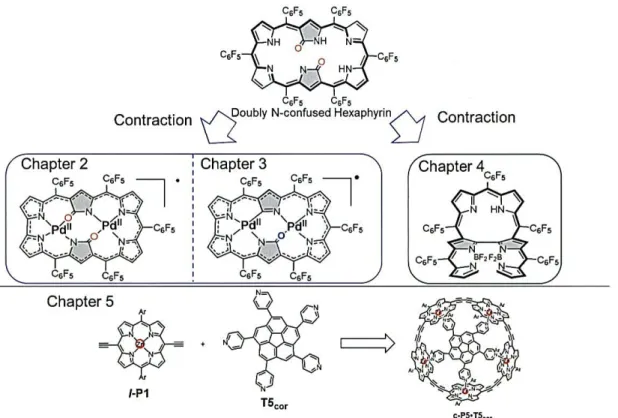
In this thesis, the author described the synthetic strategies for novel compounds based on pyrrole macrocycles which show absorption and/or emission in the NIR region. n-Extension strategy would be an effective methodology as shown in Chapter 1. Expansion modification of porphyrins is effective for electron perturbations and hence resultant expanded porphyrins exhibited red-shifted absorption spectra in the NIR region. Therefore, exploration of novel modified expanded porphyrin analogues with not only N-confusion but also contraction is investigated can provide a great opportunity for the functional NIR dyes.
In Chapter 2, a contracted doubly N-confused dioxohexaphyrin has been synthesized and characterized.
The novel contracted hexaphyrin served as a dinucleating metal ligand for unsymmetrical coordination in the cavity. Complexation of two palladium(II) cations led to the formation of n-radical species that were persistent in atmospheric conditions in the presence of moisture. The bis-palladium complex exhibited a less intense Soret-like band and broad Q-like bands reaching 1300 nm into the NIR region due to the presence of unpaired electron.
In Chapter 3, synthesis, characterization, and palladium metalation of contracted doubly N-confused nonoxo- and monooxohexaphyrins are discussed. The results in Chapter 2 suggested that the hexaphyrin having an unsymmetrical coordination environment can be considered as useful ligand to stabilize an organic radical. Contracted nonoxo- and monooxohexaphyrin ligands have unsymmetrical coordination environments similar to the dioxohexaphyrin ligand, rather the difference arises from coordination cavities inside the macrocycle. As the result, the bis-palladium(Il) complex of monooxohexaphyrin showed a highly stable organic 7t radical character deduced from various spectroscopic and magnetometric means as well as
theoretical calculations. Same to the palladium complex of dioxohexaphyrin, the complex also showed a less intense Soret-like band and broad Q-like bands reaching 1300 nm into the NIR region.
In Chapter 4, helically twisted n-extended corrorin derivative having two BODIPY moieties at the periphery, a BODIPY DYEmer cross-bridged with a n-conjugated dipyrrinylidene unit, was synthesized and characterized. The novel BODIPY DYEmer exhibited NIR absorption and distinct circular dichroism (CD) spectra of the enantiomers. The unique helically twisted BODIPY DYEmer demonstrated the unique photophysical features; acid-induced switch-on fluorescence ability. While the neutral BODIPY DYEmer is nonfluorescent, the addition of acid suppressed the internal CT process, allowing an emergence of NIR emission.
In Chapter 5, template based on corannulene can be used to direct the synthesis of the smallest porphyrin nanoring connected via butadiyne linker, five-membered porphyrin nanoring, which has a diameter of 2.1 nm.
The corannulene-based template gives a higher yield of five-porphyrin nanoring, despite being too small and having a lower affinity for five-porphyrin nanoring. The five-porphyrin nanoring exhibits highly structured absorption and fluorescence spectra extending into the NIR region.
In Chapter 6, experimental information was described.
In Chapter 7, main findings obtained from Chapters 2-5 were summarized and reviewed.
CsF5 CsF5
Contraction c oubly N-confused Hexaphyrin0 Contraction
Chapter 5
f·P1
Figure 1. Overview of this thesis.