A Longitudinal Study of the Relationship between Support Reciprocity and Mental Health (2):
Focusing on the Early Stage of Friendship Development among Junior High School Students
Hirokazu TANIGUCHI* Koji TANAKA**
サポートの互恵性と精神的健康に関する縦断的研究(2)
― 中学生の友人関係初期に着目して ―
谷 口 弘 一 田 中 宏 二 Abstract
This study focuses on the early stage of friendship development, and longitudinally examines the relationship between support reciprocity and mental health among junior high school students. The participants were 118 new students of junior high school (74 boys and 44 girls). A questionnaire package was administered at two weeks, four weeks, and three months after matriculation. At the first time of investigation, they were asked to choose a new friend they got acquainted upon matriculation, and to complete questionnaires that measured support receiving and giving in a friendship, stress responses, and relationship intimacy each time. For students whose relationship with a friend remained at a superficial level at three months after entering school, support receiving and giving in a friendship decreased over time. At either time of study, support reciprocity did not correlate significantly with stress responses, confirming the previous research results.
Key words: social support, support reciprocity, stress responses, junior high school students.
*Faculty of Education, Nagasaki University
**Okayama University
Taniguchi and Ura (2005) examined how the linkage between support reciprocity in relationship with both parents and friends and mental health among children in elementary school, junior high and high school change over time. It found a significant correlation between support reciprocity in friendships and lower depression only among high school students, which indicated that depression was the lowest when support received and support given in a relationship were at the equal level. Taniguchi and Ura (2003) conducted a longitudinal investigation of the influence of support reciprocity in friendships on stress responses among elementary school and high school students. For elementary school students, support reciprocity did not correlate significantly with stress responses either at the beginning or the end of the school year. Among high school students, support reciprocity did correlate significantly to stress responses at the end of the year, but not at the beginning. These results suggest that the relations between support reciprocity and mental health is influenced primarily when the level of each individualʼs development at the time of mutual support and second, when the friendship itself has reached a certain level.
Taniguchi and Tanaka (2007) focused on the early stage of friendship development for further longitudinal examination of how the growth of relationship among college students influences the linkage between support reciprocity and mental health. They conducted longitudinal questionnaire surveys at one week, two weeks, four weeks, and three months after entering college. It was shown that up to four weeks after matriculation, support reciprocity in a friendship was strongly associated with lower stress responses. Moreover, it was found that for students whose relationship with a friend remained shallow at three months of college, support reciprocity in a friendship correlated significantly with lower stress responses only at one week after matriculation.
These results suggest that reciprocal relationship is emphasized at the early stage of friendship development, and that a future course of relationship (either superficially or closer) is determined at about two weeks after making friends.
This study longitudinally examined the relationship between support reciprocity and mental health at the early stage of friendship (at two weeks, four weeks and three months) among junior high school students.
Method
Participants and Procedure
The participants were 118 new students of junior high school (74 boys and 44 girls). A questionnaire package was administered from April 25 to 28 (Time 1: at about two weeks after matriculation), May 17-28 (Time 2: at about four weeks after matriculation), and July 7-13 (Time 3: about three months after matriculation). The questionnaire package was distributed by homeroom teachers during a long homeroom period or after school. Before answering the questionnaire package, students were informed that their
responses were kept confidential and would have no influence on their school records.
Students completed the measures of support receiving, support giving, stress responses, and relationship intimacy at Times 1 to 3 (three times in total).
Measures
Support receiving in a friendship. A six-item scale was used to assess support receiving in a friendship. The items on this scale were adapted from the Scale of Expectancy for Social Support for Junior High School Students (SESS; Okayasu, Shimada,
& Sakano, 1993). Participants were asked to choose a new same-sex friend they had got acquainted after entering junior high school and to rate the items on the basis of how often their friend had given support to them in the past several months. Answers could range fromnever(1) tovery often(4). Scores were summed up across items. The higher scores indicate that the individual received more support from the friend. The alpha reliabilities for Time 1, Time 2, and Time 3 were .90, .92 and .94, respectively.
Support giving in a friendship. We revised six items on the support receiving scale so that each of the items could imply support given to a friend and be used to assess the actual support given to a friend. The participants were asked to choose the same friend whom they chose for rating support receiving, and to complete the items based on how often they were given support by them in the past several months. Answers could range fromnever (1) tovery often (4). Scores were added up across items. The higher scores indicate that the individual gave more support to the friend. The alpha reliabilities for Time 1, Time 2, and Time 3 were .91, .92 and .94, respectively.
Stress responses. The stress response scale was developed based on Miura, Fukuda, and Sakanoʼs (1995) 24-item Stress Response Scale for Junior High School Students. Five items were selected from the four lower-order scales (bad mood, anger, depression/anxiety, physical response and helplessness) respectively, yielding twenty items. Participants were asked to judge the degree to which the items fit them in the previous week, and to assess their own feeling or physical condition for every item. For assessment, they used a scale ranging fromtotally different(1) toexactly so (4). Scores were summed up across items. Higher scores indicated greater stress responses. The alpha reliabilities for Time 1, Time 2, and Time 3 were .90, .93 and .93, respectively.
Intimacy in a friendship. Nakamuraʼs (1990) one-item Relationship Intimacy Scale was used to assess intimacy in a friendship, in which the participants were asked to respond to the item based on how close they were to the friend. Answers could range froman acquaintance(1) toa best friend(4).
Results and Discussion Temporal transition of measured variables
One-way analyses of variance (ANOVAs) with Bonferroni post hoc comparisons were
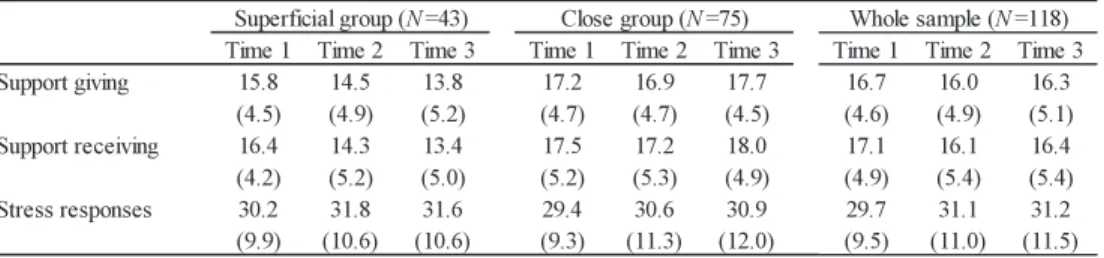
computed with the support receiving, support giving, and stress responses measures as dependent variables and time as an independent variable (Table 1). For all the dependent variables, the main effects of time were not significant. Based on the score of Relationship Intimacy Scale at Time 3, we divided the participants into two groups:
superficial relationship group (scoring 1 or 2) and close relationship one (scoring 3 or 4).
For each group, one-way ANOVAs with Bonferroni post hoc comparisons were computed again with support receiving, support giving, and stress responses measures as dependent variables and time as an independent variable. For superficial group, the main effects of time were significant for support receiving,F(2,84)=12.96, p<.01, and support giving, F(2,84) =4.62, p<.05. Bonferroni post hoc comparisons revealed that support receiving at Time 1 was significantly higher than at Times 2 and 3, and support giving at Time 1 was significantly higher than at Time 3. These results show that for students whose relationship with a friend remained on a superficial level at three months after entering school, support receiving and giving in their friendship had decreased over time.
For the close group, the main effects of time were not significant for all of the dependent variables, as is the case with the whole samples.
In contrast to these results, Taniguchi and Tanakaʼs (2007) study on college students found that for the superficial group, support receiving and giving in a friendship after three months of college remained unchanged, while that for the close group, both support receiving and giving increased together with time. As children grow older, their friendships shift from casual relationships in a group of several members, to a more intimate, one-to-one relationship (Kunieda & Furuhashi, 2006; Ochiai & Satoh, 1996;
Sugawara, 1985). Junior high school students tend to have many friendship groups, and seem not to attach great importance to the relationship with a particular friend.
Therefore, support exchange shall stay the same over time, even when the friendship grows closer. On the other hand, university students who tend to build a deeper relationship with a single friend seem to enhance involvement and intimacy of the friendship by increasing support exchange in a particular relationship.
Table 1 Means and standard deviations of measured variables
Support Reciprocity and Stress Responses at each time of investigation
In order to examine the relationship between support reciprocity and stress responses, we first computed the support reciprocity score by subtracting the support receiving score from the support giving score. A score close to zero represents equal amount of receiving and giving of support, a positive score represents more receiving than giving of support, and a negative score represents more giving than receiving. Second, to test the curvilinear relationship between support reciprocity and stress responses, we carried out a regression analysis with the squared value of support reciprocity as an independent variable, and stress responses as a dependent variable (Table 2). At each time of study, support reciprocity did not correlate significantly with stress responses. Moreover, for both students whose relationship with a friend remained at a superficial level, and students whose relationship had grown closer at three months after entering school, support reciprocity was not significantly associated with stress responses at each time of investigation. These results are consistent with those of previous research works on elementary school and junior high school students (Taniguchi & Tanaka, 2005, 2008;
Taniguchi & Ura, 2002, 2003, 2005) . It is possible that even at the early stage of relationship development to which the principle of equity or reciprocity applies more particularly (Rubin, 1973/1981) , junior high school students slough over reciprocity in friendships. As children grow older though, they start attaching importance to the reciprocity in friendship (Kusumi & Kano, 1986) . As a result, support reciprocity is thought to correlate significantly with mental health when children reach high school (Taniguchi & Tanaka, 2005, 2008; Taniguchi & Ura, 2002, 2003, 2005).
References
Kusumi, S., & Kano, S. (1986). Seinenki ni okeru yujingainen hattatsu no inshibunseki teki kenkyu [Developmental change in adolescent conceptions of friendship] . Research Bulletin of Educational Psychology, the Faculty of Education, Kyushu University, 31, 97-104.
Kunieda, M., & Furuhashi, K. (2006) . Jidoki ni okeru yujinkankei no hattatsu [The development of friend-relationships in childhood]. Journal of the Faculty of Integrated Human Studies and Social Sciences, Fukuoka Prefectural University, 15,105-118.
Table 2 Support reciprocity and stress responses
Miura, M., Fukuda, M., & Sakano, Y. (1995). Chugakusei no gakko sutoressa to sutoresuhanno no keijitekihenka [Successive changes of school stressors and stress responses in junior high school students]. Proceedings of the 36th Annual Meeting of the Japanese Association of Educational Psychology,106-107.
Nakamura, M. (1990). Daigakusei no yujinkankei no hattenkatei ni kansuru kenkyu:
Kankeikanyosei wo yosokusuru syakaitekikoukanmoderu no hikakukentou [A study on the developmental process of friendship in college students: A comparative examination of social exchange models predicting relationship commitment]. Japanese Journal of Social Psychology, 5,29-41.
Ochiai, Y., & Satoh, Y. (1996). Seinenki ni okeru tomodachi tono tsukiaikata no hattatsuteki henka [The developmental change of friendship in adolescence]. Japanese Journal of Educational Psychology, 44,55-65.
Okayasu, T., Shimada, H., & Sakano, Y. (1993). Chugakusei ni okeru sosharu sapoto no gakko sutoresu keigen koka [Alleviating effects of social support on school stress in junior high school students].Japanese Journal of Educational Psychology, 41,302-312.
Rubin, Z. (1981).Liking & loving: An invitation to social psychology (K. Ichikawa & Y.
Hino, Trans.). Tokyo: Shisakusha. (Original work published in 1973)
Sugawara, K. (1985). Seishonen no yujinkankei no hattatsutekihenka to kouzou [Developmental changes and structures of friendships among adolescents]. In Bureau of Citizens and Cultural Affairs, Tokyo Metropolitan Government (Ed.), An examination of human relations among adolescents living in a large city: An analysis from the viewpoint of relevance to the attenuation of personal relations (pp. 115-118).
Tokyo: Bureau of Citizens and Cultural Affairs, Tokyo Metropolitan Government.
Taniguchi, H., & Tanaka, K. (2005). Does the relationship between support reciprocity and depression vary with perceived stressors? Bulletin of Faculty of Education Okayama University, 128,19-25.
Taniguchi, H., & Tanaka, K. (2007). Sapoto no gokeisei to seishintekikenkou ni kansuru judantekikenkyu: Daigakusei no yujinkankei shoki ni chakumokushite [A longitudinal study of the relationship between support reciprocity and mental health: Focusing on the early stage of friendship development among college students].Proceedings of the 71th Annual Conference of the Japanese Psychological Association,97.
Taniguchi, H., & Tanaka, K. (2008). Jidoseito no sapoto no gokeisei to seishintekikenkou:
Koukanshikosei no choseikoka [Relationship between support reciprocity and stress responses among elementary, junior high, and senior high school students: Moderating effects of underbenefitting and overbenefitting exchange orientations]. Japanese Journal of Psychology, 79,53-59.
Taniguchi, H., & Ura, M. (2002). Support reciprocity and depression among elementary school and high school students.Japanese Psychological Research, 44,247-253.
Taniguchi, H., & Ura, M. (2003). Jidoseito no sapoto no gokeisei to seishintekikenkou tono kanren ni kansuru judantekikenkyu [A longitudinal study of the relationship between
support reciprocity and mental health among elementary and high school students] . Japanese Journal of Psychology, 74,51-56.
Taniguchi, H., & Ura, M. (2005). Support reciprocity and depression among children. In S.
P. Shohov (Ed.), Advances in psychology research. Vol. 33. (pp.203-217). New York:
Nova Science Publishers, Inc.