九州大学学術情報リポジトリ
Kyushu University Institutional Repository
論理プログラム学習における汎化と述語発見
石坂, 裕毅
https://doi.org/10.11501/3065651
出版情報:Kyushu University, 1992, 博士(理学), 論文博士 バージョン:
権利関係:
Generalization and Predicate Invention in Learning Logic Programs
Hiraki Ishizaka
International Institute for Advanced Study of Social Information Science (
liAS-SIS)
FUJITSU LABORATORIES LTD.
140, Miyamoto, Numazu, Sbizuoka 410-03, Japan
E-mail : [email protected]
Abstract
We consider the problem of learning logic programs from examples. In this thesis the problem is treated as a model inference problem given by Shapiro. The theory of model inference is known to be a very elegant framework for inductive inference over the first order predicate logic. Since the class of logic programs is an instance of the first order predicate logic, the theory is also applicable to inductive inference of logic programs. We reconsider the model inference problem for logic programs from the following two viewpoints: using generalization and inventing auxiliary predicates in learning logic programs.
In the first half of the thesis, the applicability of least generalizations in learning logic programs is considered. One aspect of learning is to memorize a lot of experiences and generalize them appropriately. Such an appropriate generalization over the domain of first order words was given by Plotkin. We discuss the usage of the least generalization for constructing part of a target logic program, that is, each head of clauses in the program.
Furthermore, we give an algorithm for learning the class of very restricted logic programs called primitive Prologs using minimal multiple generalizations. The minimal multiple gen
eralization is a natural extension of the least generalization. The minimal multiple gener
alization generalizes given first order words by several words, while the least generalization does by a single word. The property of the minimal multiple generalization makes it possi
ble to perform fine generalization and to construct the heads of several clauses in a target program at the same time. One of the learning algorithm presented in this thesis constructs the heads of a program using the minimal multiple generalization and will be shown to learn the class of primitive Prologs efficiently.
The second half of the thesis is concerned with the problem of inventing auxiliary predi
cates in learning logic programs. In general, a logic program consists of several predicates.
However, the main concept to be defined by the program is represented by one of them. In learning from examples, the given examples are focused on the main concept. Thus, another predicates concerned with auxiliary concepts are not observed in the given examples, so that the learning algorithm is obliged to invent such a predicate for itself if it is necessary.
In this thesis, we consider the problem in the framework of learning formal languages.
Formal languages such as regular languages can be represented by grammars or automata and the grammar or the automaton can be represented as a very restricted logic program, in which each predicate symbol corresponds to a nonterminal of the grammar or a state of the automaton. That is, the problem of inventing predicates in learning logic programs corresponds to that of inventing nonterminals or states in learning formal languages. We shall present two algorithms for learning formal languages: one for regular languages and the other for simple deterministic languages. For each algorithm, we develop methods for inventing new states of an automaton and new nonterminals of a grammar respectively. Both algorithms are shown to perform efficient learning with inventing states or nonterminals.
Acknowledgements
First and foremost, I am deeply grateful to my advisor Setsuo Arikawa of Kyushu University.
He directed my research during my last three years at Kyushu University and gave me instructive suggestions and ceaseless encouragement. He was also willing to serve as my thesis supervisor, wade through poorly written drafts, and offered numerous improvements and suggestions. I would like to thank other members of my judging committee, Nagata Furukawa, Yasuo Kawahara, and Hiroto Yasuura for their many valuable comments.
I also express my gratitude to Takeshi Shinohara for many discussions on inductive inference and much helpful advice. In particular, the study developed in Chapter 4 was conducted by him. T he chapter is also based on a joint work with Hiroki Arimura. Without his elegant framework of the minimal multiple generalization, the content of the chapter will not appear. Especially, the proofs of Lemma 4.5 and Lemma 4.6 are given by him. Akihiro Yamamoto read the initial draft of Chapter 3 and made useful comments. I appreciate the support from the people at RIFIS, Kyushu University, especially, Satoru Miyano and Ayumi Shinohara.
Thanks to Makoto Haraguchi for introducing me to least generalization and analogical reasoning. Takashi Yokomori directed my research during my first two years at Fujitsu.
Discussions with him contributed to the content of Chapter 6 and Chapter 7. Four years at ICOT Research Center were also good experiences for me. I would like to thank Kazuhiro Fuchi, the director of ICOT Research Center, Koichi Furukawa, and Ryuzo Hasegawa for giving me the opportunity to conduct a part of this work into the Fifth Generation Computer Systems Project. Conversations with David Haussler, Klaus Jantke, Philip Laird, Stephen Muggleton, and Rolf Wiehagen during the course of my research were very helpful.
Thanks to the members of liAS-SIS, Fujitsu Laboratories Ltd .. I would like to thank Toshio Kitagawa, the former president of liAS-SIS, Hajime Enomoto, the former director of liAS-SIS, Shigeru Sato, the director of liAS-SIS, Mitsuhiko Toda, Kozo Sugiyama, Hajime Sawamura, for giving me the opportunity to pursue this work and their warm encourage
ment. Discussions with the members of Machine Learning Group at liAS-SIS, Yuji Takada, Yasubumi Sakakibara, Kunihiko Hiraishi, Masahiro Matsuoka, and Takeshi Koshiba were
very fruitful. I am also grateful to all people at liAS-SIS for providing an environment of friendship and stimulation.
Finally, I thank my parents.
Contents
1 Introduction
1.1 Generalization . 1.2 Predicate Invention 1.3 Outline of Thesis
2 Preliminaries 2.1 Logic Programs
2.1.1 Basic definitions .
2.1.2 Model theory for logic programs . 2.1.3 Proof trees .
2.2 Model Inference . . 2.3 Formal Languages .
2.3.1 Finite-state automata and regular languages 2.3.2 Context-free grammars and languages . . 2.3.3 Model theory for context-free grammars
3 Least Generalization in Learning Logic Programs 3.1 Least Generalization . . . .
3.2 Model Preserving Instantiation
3.3 Program Heads and Least Generalizations
4 Learning Primitive Prologs from Positive Facts
4.1 Primitive Prologs and Model Inference from Positive Facts 4.2 Nlinimal Multiple Generalization . . . .
1 2 3 5
7
7 7 10 10 11 14 14 15 16
19 20 21 24
27 29 30
4.3 DMPLG's of Primitive Prologs
4.4 A Greedy Search Algorithm for the Body .
4.5 Polynomial Update Time Inferability from Positive Facts
5 Model Inference with Predicate Invention 5.1 An Extended Model Inference Problem 5.2 Problems in Extended Model Inference 5.3 A Simple Approach to the Problems .
5.3.1 When a new predicate is necessary 5.3.2 The model of a new predicate 5.4 Examples of Restricted Programs
5.4.1 DRLP 5.4.2 LMLP 5.4.3 SDG .
5.4.4 Simple recursive programs 6 Learning Regular Languages
7
8
6.1 Regular Model Inference Problem
6.2 An Extended Model of a Regular Model 6.3 A Regular Model Inference Algorithm . 6.4 Correctness of the Algorithm ....
6.5 Time Complexity of the Algorithm
Learning Simple Deterministic Languages 7.1 SDG and SDL ....
7.2 Learning via Queries
7.3 A Learning Algorithm for SDL.
7.4 Diagnosing an Incorrect Hypothesis
7.5 Generating Nonterminals and Productions 7.6 Correctness and Complexity . . . . . . . . Conclusion
35 41 44
49 51 52 54 54 55 56 56 57 58 59
63 64 68 70 74 81
83 85 86 88 89 91 93
97
Bibliography 103
Chapter 1 Introduction
The problem of machine learning is one of the most important and difficult problems in developing intelligent systems. In this thesis, we consider the problem of learning logic programs from examples .. The theoretical framework concerned with the problem was first given by Shapiro
[
Sha81]
. He formalized the problem as aninductive inference
over the first order logic. Our framework of learning logic programs based on his formalization.Here, we illustrate the framework of learning logic programs considered in this thesis. In learning from examples, the
example
indicates an input-output example of the program. For a logic program, such an example is represented by a ground atom. For example, suppose the following simple logic program for appending two lists:append([XIY],
Z,[XIW])
+--append(Y,
Z,W).
append(0, X, X).
For the program, ground atoms such as
append([a, b], [c], [a, b, c]), append([a], [b], [a, b]), append([a], 0, [a])
are correct examples which are computed
(
or proved)
by the above logic program and ground atoms such asappend(0, [a],[]), append(0, 0, [a]), append([a, b], [c], [c, a, b])
are incorrect ones. The problem of learning logic programs considered in this thesis is to construct a program as above from some information about its correct and incorrect examples.
By the theory of logic programs, the set of all correct examples for a program can be identified with the
least Herbrand model
of the program. Thus the learning logic programs from examples is formalized as the problem to find a logic program from information about the least Herbrand model of the program. Shapiro called such a problem amodel infer
ence problem.
In this thesis, we reconsider the problem from the two viewpoints: us1ng generalization and inventing auxiliary predicates in learning logic programs.1.1 Generalization
We often use our previous experience to solve the problem we are now faced with. The behavior can be seen as a process to solve the problem using something learned from the experiences. However, each individual knowledge obtained from the experiences seldom completely match the situation of the current problem. The direct use of the collection of individual knowledge is not so flexible to be applied to actual problem solving. Thus, the knowledge should be generalized to be applicable even in a different situation. On the other hand, every knowledge cannot be applicable to solve a problem. Thus, the generalization should be made moderately.
Plotkin [Plo70] formalized such a moderate generalization over the domain of first order words (a word is a term or an atom) as a
least generalization.
For example, suppose that the following facts about the predicateappend(_,_,_)
are known:append([a, b], [c], [a, b, c]), append([a], [b], [a, b]), append([a], 0, [a]), append([b], 0, [b]).
Then, the atoms
append( X, Y, Z)
orappend([XjY ], Z, W)
are generalizations of them andappend([XIY ], Z, [XjW])
is a least generalization, whereX, Y, Z, W
are variables. That is, a generalization is obtained from the individual atoms by replacing each different term occurring at the same position in the atoms by a different variable. On the other hand, the least generalization is a generalization preserving the properties common to the all atoms as much as possible.We can find from the above example that the least generalization corresponds to the head of a clause in the
append
program. This leads to one motivation of our study. Thatis, we consider the applicability of the least generalization to construct a part of a target program.
Recently, Arimura
(
AS091b]
proposed the notion ofminimal multiple generalization
which is a natural extension of the least generalization. The minimal multiple general
ization generalizes given ground atoms by several atoms, while the least generalization does by a single atom. This extension realizes more flexible generalization. For example, suppose the following correct examples of the
append
program.append(0, 0, 0), append([a], 0, [a]), append(0, [b], [b]), append([a], [b], [a, b]), append([a, b], [c], [a, b, c]).
Then a least generalization of them is
append(X, Y,
Z)
. On the other hand, the prur{append([], X, X), append([XIY],
Z,[XIW])}
of atoms is a minimal multiple generalization of them. Although the least generalization represents all ground atoms with predicate symbolappend(_,_,_),
the minimal multiple generalization represents more restricted ones. Thus, a minimal multiple generalization is finer than a least generalization.Furthermore, since a logic program consists of several clauses in general, it is preferable to generalize ground atoms by several atoms. That is, we can expect to construct the several heads of clauses at the same time by minimal multiple generalization. In fact, the above minimal multiple generalization corresponds to the pair of heads of clauses in the
append
program.
In Chapter 3 and Chapter 4, we discuss the problem of applicability of the least gener
alization and the minimal multiple generalization in learning logic programs.
1.2 Predicate Invention
In learning logic programs from examples, the most difficult problem is to find auxiliary predicates which are necessary for a target program but not observed in examples of the target program. For example, we know that a program for reversing a list can be written
using an auxiliary predicate
concat(_,
_,
_)
as follows:reverse([XIY ], Z)
+--reverse(Y, W), concat(X, W, Z).
reverse(O, 0).
concat(X, [YIZ], [YIW])
+--concat(X, Z, W).
concat(X, [],[X]).
Of course, we can make another
reverse
program using different auxiliary predicates, e.g.append(_,_,_).
However, the important point is that no information about such auxiliary predicates explicitly appears in the examples ofreverse(_,_).
Thus, in learning logic programs in which an auxiliary predicate is essential, the learner has to invent the predicate for itself.
Shapiro called such auxiliary predicates theoretical terms and assumed, in the theory
of model inference, that the information about them is also given to the learner. That is, the given information in model inference is extended to the entire model of some specific program but not focused on examples of some specific predicate in the program. From the viewpoint of learning from examples, the assumption seems to be so restrictive. The problem of inventing new predicates is inevitable in learning logic programs.
Recently, several researchers are try ing to solve this challenging problem
[
MB88, Mug90, Ban88, Lin89b, Lin89a]
. The second part of this thesis is also motivated by the problem.Especially, in this thesis, we consider the problem in learning formal languages. Formal lan
guages such as regular languages can be represented by grammars or automata. A grammar or an automaton can be represented as a restricted logic program, in which each predicate symbol corresponds to a nonterminal of the grammar or a state of the automaton. The restriction is helpful for us to overcome the difficulty of the problem.
In this thesis, we shall present two algorithms for learning formal languages. One is for regular languages and another is for simple deterministic languages. For each algorithm, we shall develop a method for inventing new states of an automaton and new nonterminals of a grammar. We shall show that both algorithms perform efficient learning with inventing states or nonterminals.
1.3 Outline of Thesis
In Chapter 2, we make preparations for the discussions developed in the succeeding chap
ters. First, we give definitions concerned with logic programs. Then we define the problem of learning logic programs as a model inference problem. Basic notions and the notation concerned with formal language theory are also introduced for the discussions in Chapter 6 and Chapter 7.
In Chapter 3, we discuss the applicability of the least generalization in learning logic programs. We introduce a notion of d-model preserving instance of a logic program. The d-model preserving instantiation is a kind of program transformation and shown to preserve the least Herbrand model of an original program. We show a relation between a least generalization and a d-model preserving instantiation.
In Chapter 4, we discuss the applicability of minimal multiple generalization in learning logic programs. We show that a class of very restricted logic programs called primitive Prologs is efficiently learned from only correct examples. The class of primitive Prologs is a sub-class of k-clause linear Prologs which is known to be learnable from only correct examples but not proven to be efficiently learnable. We present an algorithm which learns the class of primitive Prologs efficiently. The algorithm constructs the heads of clauses in a desired program using the minimal multiple generalization.
In Chapter 5, we discuss the problem of predicate invention in learning logic programs.
We consider what problem is essential in inventing new predicates. Then we propose several classes of restricted logic programs for which the problem might be made clear. In fact, two of them, the class of deterministic regular logic programs and the class of simple deterministic grammars will be shown to be learned efficiently by overcoming the problem in the succeeding two chapters.
In Chapter 6, we discuss the problem of learning regular languages. A regular language can be represented by a very simple logic program, called a deterministic regular logic pro
gram, which exactly simulates a deterministic finite-state automaton. We give an algorithm which efficiently learns any deterministic regular logic program. The algorithm is based on the model inference algorithm given by Shapiro
[
Sha81, Sha82]
. However, the presentedalgorithm has the ability, which Shapiro's algorithm does not have, to invent new necessary predicates (states) automatically. We develop a method for extracting the information about the invented predicates from the information about one target predicate, which corresponds to the initial state of the target automaton. We show the validity of the method and the correctness of the algorithm. We also analyze the time complexity of the algorithm.
In Chapter 7, we extend the method in Chapter 6 for learning simple deterministic lan
guages. We give an algorithm for learning simple deterministic languages with inventing necessary nonterminals. Angluin
[
Ang87a]
showed that the class of k-bounded context-free grammars is learnable in polynomial time using membership queries, nonterminal membership queries and equivalence queries. Contrastively, the algorithm presented in Chapter 7 acquires necessary nonterminals for itself. Hence it does not require the nonterminal mem
bership queries. We show the correctness of the algorithm and discuss its time complexity.
Finally, in Chapter 7, we conclude this thesis by summarizing the results presented in this thesis and stating some future problems.
Chapter 2
Preliminaries
In this chapter, we give some basic notions and notational conventions needed in this thesis.
We use the fundamental concepts from first order logic and formal language theory. More precise information on these concepts would be found in
(
CL 73, Lov78, Llo84, Har79)
.In Section 2.1, we give definitions concerned with logic programs. In Section 2.2, we define a problem of learning logic programs according to Shapiro's theory of model inference
[
Sha81, Sha82)
. In Section 2.3, we introduce some definitions on formal language theory necessary for the discussions in Chapter 6 and Chapter 7.2.1 Logic Programs
2.1.1 Basic definitions
Let .C be a first order language. r, II, and X denote the set of function symbols, the set of predicate symbols, and the set of variable symbols of£, respectively. We regard a constant symbol as a 0-ary function symbol and assume that r has at least one constant symbol throughout this thesis.
We adopt some informal notational conventions for the symbols. Variable symbols will normally be denoted by the letters U, V, W, X, Y, and Z
(
possibly subscripted)
. Constant symbols, that is, 0-ary function symbols will normally be denoted by the letters a, b, andc
(
possibly subscripted)
. Other function symbols will normally be denoted by the lettersf, g,
andh
(possibly subscripted). Predicate symbols will normally be denoted by the lettersp,
q, and r (possibly subscripted). Occasionally, it will not be convenient to apply these conventions rigorously. In such a case, possible confusion will be avoided by the context.A
clause
is a well-formed formula of the form:where
A1, ... , Am, B1,
... , En
are atoms and m,n s;
0. We denote the above clause byThe clause with m =
n
= 0 is called theempty clause
and denoted by D.A
definite clause
is a clause of the form:A is called the
head
of the clause and the sequenceB1, ... , Bm
of atoms is called thebody
of the clause. We mainly deal with definite clauses. So, hereafter, we call them just
clauses.
For a clause
C,
the head ofC
is referred byhead( C)
and the body ofC
bybody( C).
Aclause with empty body, that is in the case
n
= 0, is called aunit clause.
We identify a unit clause A�
with the atom A. Alogic program
(program, for short) is a finite set of clauses.For a program P =
{ C1, ... , Cn},
the collection ofhead( Ci) (
1s; i s;
n)
is said to be theprogram heads
of P.Example 2.1 The following is a typical program for appending two lists:
{ append(0, X, X).
}
P =
append([XIY ],
Z,[XIW]) <- append(Y,
Z,W).
'where
0
is a constant and[-1-J
is a binary function interpreted as an empty list and a list constructor, respectively. Usually, a list[a1J[a2J · ··[ani OJ···]
is abbreviated as[a1, a2, ... , an]·
A
word
is either a term or an atom. Anexpression
is either a word, a clause, or a program.The size of an expression
e,
denoted bysize( e),
is the number of occurrences of symbols appearing in the expressione.
For a set S of expression,size(
S) is defined asLeES size( e)
and lSI as the number of elements in S.
A
(
possibly empty)
finite sequence of integers of the form(i1, ... , in)
is called anindex.
For a word
W
and each sub-wordt
ofW,
theindex I
oft
inW
is defined inductively asfollows:
1.
IfW = t,
then I=( )
.2. If
W
is of the form<p(t1, ... , tm)
and tis the sub-word ofti
such that the index oft inti
is(j1, ... , Jn),
thenI= (i, J1, ... , Jn)·
Let
I
be the index of a sub-word in a wordW.
ThenW(I)
denotes the sub-word.For an expression E, var
(
E)
denotes the set of variables appearing in the expression E.An expression with no variables is said to be
ground.
TheHerbrand base
of£, denoted by B.c, is the set of all ground atoms over £. The set of all ground terms over £ is called theHerbrand universe
of£ and denoted by U.c,.A
substitution
8 is a finite set of the form{ X1/t1, ... , Xn/tn},
where eachXi
is a variable, eachti
is a term distinct fromXi
and the variablesX1, ... , Xn
are mutually distinct. Each elementX.i/ti
is called abinding
forXi.
The set of variables{X1, ... , Xn}
is called thedomain
of the substitution 8 and denoted by do
m(
B) .
A substitution 8 is called aground substitution
if the t/s are all ground terms. For two substitution 8= {X1/t1, ... , Xnftn}
and
a = {Y1/ s1, ... , Ym/ sm},
thecomposition
of 8 anda,
denoted byBa,
is defined as the substitution obtained from the setby deleting any binding
Xi/tia
for whichxi= tia
and deleting any bindingY;/
Sj for whichYj
E dom(
B)
.Let 8
= {X1/t1, ... , Xn/tn}
be a substitution and E be an expression. Then EB, theinstance
of E by 8, is the expression obtained from E by simultaneously replacing each occurrence of the variableXi
by the termti (1
�i
� n)
. If EB is ground, then EB is called aground instance
of E and G(
E)
denotes the set of all ground instances of E. Let E and F be expressions. E F, respectively( )
is said to be avariant
ofF(
E, respectively)
, denoted byE= F, if there exist substitutions B anda
such that EB=
F and E= Fa.
Let S
= {
w1, ..
., wn}
be a finite set of words. A substitution 8 is aunifier
of S ifIf there exists a unifier for S, then S is said to be unifiable. Also, a word wi is said to be unifiable with a word w2 if the set
{WI,
w2}
is unifiable. For a unifiable set S, a unifier 8 of S is called a most general unifier if, for every unifier (]" of S, there exists a substitution r such that (]" = e,.2.1.2 Model theory for logic programs
An Herbrand interpretation
(
interpretation, for short)
is a subset of B.c. Let C = A +BI,
... , En (n� 0)
be a clause and M be an interpretation. A ground atom a is said to be covered by C with respect to M if there exists a substitution 8 such that a = AB and BiB E M for each i(1 �
i�
n)
. When n =0,
the substitution 8 is sufficient to satisfy only the first condition a= AB. The set of all ground atoms covered by C with respect to M is called the derivative interpretation(
d-interpretation, for short)
of C with respect to M and denoted by C(M). Note that, for a unit clause C, it holds that C(M) = G(C), since we do not distinguish between the unit clause and the atom appearing in the head of the clause.A clause C is said to be true in an interpretation M if C ( M)
�
M, otherwise C is said to be false. If every clause in a program P is true in M, then the program P is said to be true in M and false otherwise. If a program P is true in an interpretation M, then M is called an H erbrand model(
model, for short)
of P. When M is known to be a model of some program, the above defined derivative interpretation of C with respect to M is restated as the derivative model(
d-model, for short)
of C with respect toM.Van Emden and Kowalski
[
vEK76)
showed the model intersection property, that is ,the intersection of models of a program P is also a model of P. The intersection of all models of P is called the least Herbrand model of P and denoted by M(P). Mp will be often used instead of lvf(P) to decrease the number of parentheses.2.1.3 Proof trees
For a program P and a ground atom a, a derivation tree of a on P is a finite tree that satisfies the following conditions:
1. Each node of the tree is a ground atom.
2. The root node is a.
3. For each internal node A and its children E1, ... , En
(
n >1),
A +- E1, ... , En is a ground instance of a clause in P.For a program P and a ground atom a, a proof tree of a on P is a derivation tree of a on P such that each leaf of the tree is a ground instance of a unit clause in P.
For a ground atom a and a program P, P � a denotes that there exists a proof tree of
a on P and P � n a denotes that there exists such a proof tree with n nodes.
In this thesis, we assume some effective procedure which, for any given ground atom a and any given program P, constructs a proof tree of a on P if it exists. Such a procedure can be implemented using SLD-resolution
[
Llo84]
. From the equivalence between the declarative semantics of logic programs defined by the least Herbrand model and the procedural semantics defined by SLD-resolution
[
Llo84]
, it holds that a E M(
P)
if and only if P � a for any ground atom a and a program P. Thus, the assumed procedure constructs a proof tree of any a E M(
P)
on P. Conversely, if the procedure succeeds to construct a proof tree of a E B.c of P, then it is ensured that a E M(
P)
.Unfortunately, for a ground atom a
¢.
M(
P)
, it is not decidable whether a is in M(
P)
in general. In other words, the membership problem of a ground atom in M
(
P)
is semidecidable. However, some restrictions on programs turn the problem to be decidable. Such restrictions are found in
[
ASY89, Yam89, Shi91]
. Especially, in his paper[
Ari91]
, Arimura showed that the problem for the class of weakly reducing programs is decidable. Each class of logic programs we shall discuss its learnability in this thesis is a sub-class of weakly reducing programs. Thus, in this thesis, we assume some procedure which, for a given program P and a ground atom a, returns a proof tree of a on P if a E M(
P)
, and "No" otherwise.2.2 Model Inference
The model inference problem and algorithm were originally introduced by Shapiro
[
Sha81]
.He formalized the learning problem on first order logic and gave some interesting learning strategies that takes full advantage of sy ntactic and semantic properties of logic. In this section, we review the model inference problem and algorithm for logic programs according
to [Sha82, IA91).
Let M be the the least Herbrand model of an unknown program. A fact about M is a pair of the form
(a, V)
wherea
E Be andV
==true ifa
E M,V
== false otherwise. The atoma
in a fact(a, V)
is called a positive fact (negative fact) ifV
= true(V
= false).An enumeration of facts about M is an infinite sequence
j1, !2,
... where each fi is a fact about M and, for anya
E Be,a
occurs in a fact ei ==(a, V)
for some i2
1. Usually, we assume some device called an oracle forM as a source of information about a target least Her brand model M. The enumeration of facts about Mis given by the oracle. In Chapter 5, Chapter 6, and Chapter 7, we assume an oracle which can give the information in different way from an enumeration of facts.Let £ be a first order language and M be the least Her brand model of an unknown program over £. Then a model inference problem is defined as follows:
Suppose that £ and an oracle for M are given. Then infer a program P such that M ( P) == M from the information given by the oracle.
There are several criteria for success of inference and ways of giving information about M. Actually, in Chapter 4, Chapter 6, and Chapter 7, we consider the model inference algo
rithms under three different situations in which the adopted criterion and the way of giving information are different respectively. In this section, we give only the original situation in which a model inference algorithm is defined.
A model inference algorithm (inference algorithm, for short)
A
is an algorithm that iterates the process "input request --+ computation --+ output". Each output ofA,
called a conjecture ofA,
is a program. During computing a conjecture, such an inference algorithm usually produces several programs as candidates for the conjecture. Such candidate programs are called hypotheses. Let P1, P2, . •. be a sequence of conjectures ofA
given an enumeration of facts about the least Herbrand model of an unknown program as its input sequence.A
is said to converge to a program P for the enumeration if there exists an integer n
2
1 such that Pi == P for any i2
n.A
is said to identify the model M in the limit ifA
converges to a program P such that lvf(P) = lvf for any enumeration of facts about Jv!. A class M of least Herbrand models of logic programs is said to be inferable if there exists
an inference algorithm which identifies any model in M. Identification in the limit defined
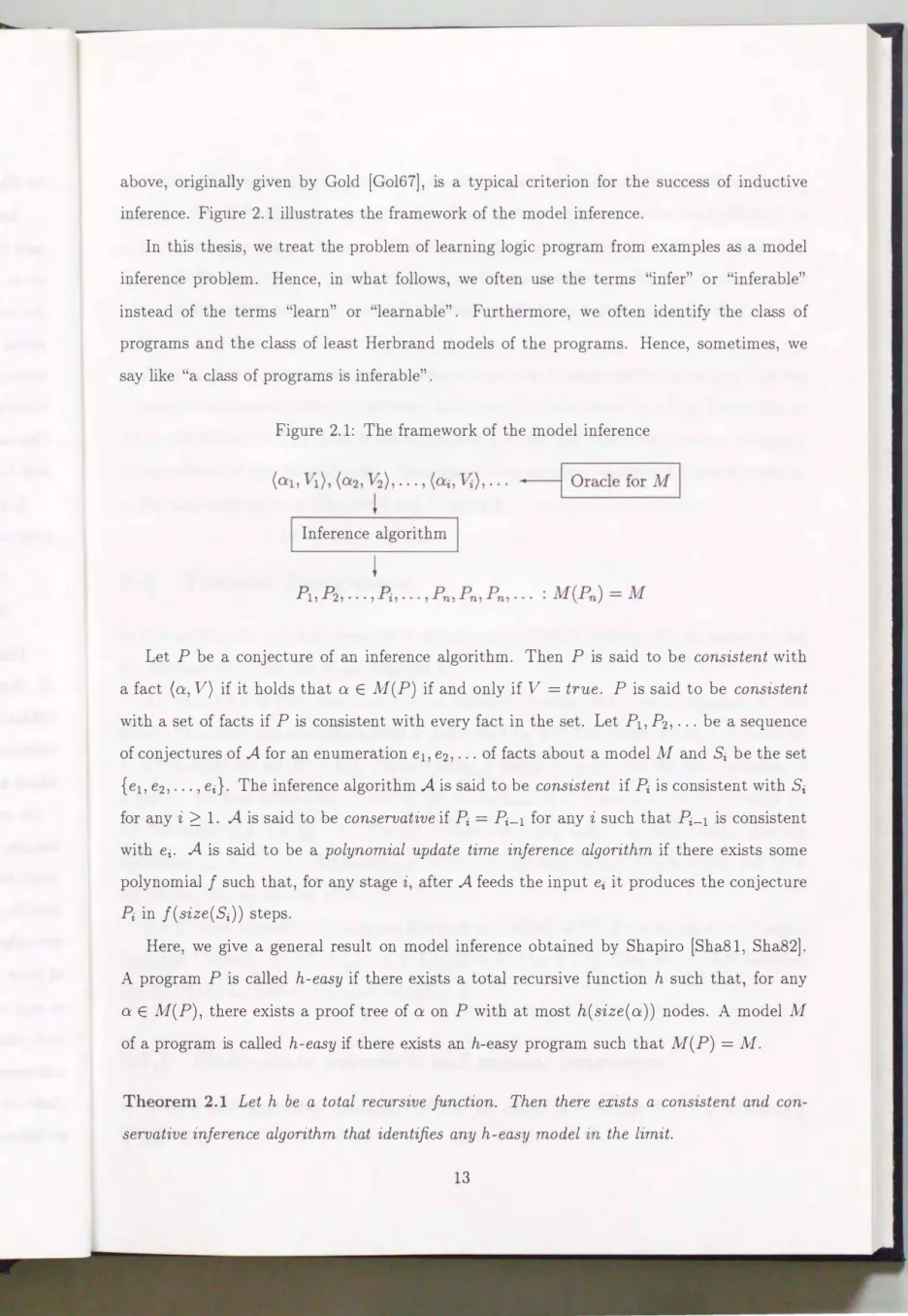
above, originally given by Gold [Gol67], is a typical criterion for the success of inductive inference. Figure 2.1 illustrates the framework of the model inference.
In this thesis, we treat the problem of learning logic program from examples as a model inference problem. Hence, in what follows, we often use the terms "infer" or "inferable"
instead of the terms "learn" or "learnable". Furthermore, we often identify the class of programs and the class of least Herbrand models of the programs. Hence, sometimes, we say like "a class of programs is inferable".
Figure 2.1: The framework of the model inference
I
Inference algorithm�
Let P be a conjecture of an inference algorithm. Then P is said to be consistent with a fact
(a,
V) if it holds thata
E M(
P) if and only if V = true. P is said to be consistent with a set of facts if Pis consistent with every fact in the set. Let P1, P2, • .. be a sequence of conjectures of A for an enumeration e1, e2, ... of facts about a model M and Si be the set{
e1, e2, ... , ei}· The inference algorithm A is said to be consistent if Pi is consistent with Si for anyi
2 1. A is said to be conservative if � = Pi_1 for anyi
such that �-1 is consistent with e . i A is said to be a polynomial update time inference algorithm if there exists some polynomialf
such that, for any stagei,
after A feeds the input ei it produces the conjecture�in
f(size(Si))
steps.Here, we give a general result on model inference obtained by Shapiro [Sha81, Sha82].
A program P is called h-easy if there exists a total recursive function h such that, for any
a
E M(
P)
, there exists a proof tree ofa
on P with at mosth(size(a))
nodes. A model M of a program is called h-easy if there exists an h-easy program such that M(
P)
= M.Theorem 2.1 Let h be a total recursive function. Then there exists a consistent and con
servative inference algorithm that identifies any h-easy model in the limit.
A simple inference algorithm based on the identification by enumeration technique
[
Gol67]
supports the above theorem. Such an algorithm, however, is known to be too inefficient. In order to improve the inefficiency, Shapiro developed an incremental inference algorithm.
Although his algorithm is essentially based on the enumeration technique, it can perform fairly efficient enumeration by taking full advantage of several logical properties desirable for inductive inference.
Shapiro gave two important sub-procedures for the incremental model inference. The one is the
contradiction backtracing algorithm
that detects a false clause in a false hypothesis in the target model M. The other is therefinement operator
that enumerates clauses according to the order from general to specific. The contradiction backtracing algorithm is also essential in our algorithm given in Chapter 6 and Chapter 7.2.3 Formal Languages
In this section, we introduce some basic definitions on formal language theory necessary for the discussions in Chapter 6 and Chapter 7.
An
alphabet
is a finite non-empty set of distinct symbols. For a given alphabet X, the set of all finite strings of symbols from X is denoted by X*. The empty string is denoted byc. x+ denotes the set X*-
{
c}.
For two stringx
andy, x
·y
denotes the concatenation ofx
andy.
We may often omit ·,
that is, the concatenation ofx
andy
is simply denoted byxy.
For a stringx = a1a2
···an, Prei(x)
denotes the stringa1a2
• · •a
i, and Su fi(x)
denotes the stringa
i+Iai+2 · ··an
. For a stringx, lxl
denotes the length ofx.
If S is a finite set, thenl
SI
denotes the cardinality of S.Let :E be an alphabet. A
language
L over :E is a subset of 2:*. For a stringx
in 2:* and a language Lover :E, let xL= {y I xy E
L} (
Lx= {y I yx E
L})
. The set xL(
Lx)
is called theleft{right)-derivative of
Lwith respect to x.
2.3.1 Finite-state automata and regular languages
A
deterministic finite-state automaton (
DFA, for short)
is a 5-tuple A where(Q,
2:, 8, qo,F),
1.
Q is a finite non-empty set. Each element of Q is called a state.
2.
I: is an alphabet such that Q
nI:
=cjJ.
3.
b is a function from Q
x I:into Q called the transition function.
4. q0 is an element of Q called the initial state.
5.
F is a subset of Q called the final states.
The transition function
8in the above definition can naturally be extended to the function from Q
xI:* into Q
asfollows:
b ( q,
c)
=q and b ( q, ax)
=b ( b ( q, a), x).
The size of a DFA A, denoted by size(A), is defined
asthe number of states of A.
A string x
EI:* is said to be accepted by a DFA A
=(Q, I:, b, qo, F) if b(q0, x)
EF.
The set of all strings accepted by the DFA A is denoted by L(A). That
is,L(A)
={x
EI:* I b(q0, x)
EF}. A language L � I:* is called regular if there exists a DFA A such that L
=L(A). For any regular language L, the minimum size DFA accepting L is unique up to an isomorphism (i.e., a renaming of the states).
2.3.2 Context-free grammars and languages
A
context-free grammar (CFG, for short) is a 4-tuple
G =(N, I:, P , S), where
1.
N is a finite non-empty set. Each element of N is called a nonterminal symbol.
2. .I:
is an alphabet such that N
nI:
=c/J. Each element of
.I:is called a terminal symbol.
3.
S is an element of N called the start symbol.
4. P is a finite set of production rules of the form A
�a, where A
ENand a
E(N
U.I:)*.
A CFG
Gis in Greibach normal form if each production rule of
Gis of the form A
�aa, where A
EN, a
E.I: and a
EN*. Note that, in Chapter
7,we consider only c-free grammars and languages. A CFG
Gis said to be in m-standard form if
Gis in Greibach normal form and, for each production A
-taa of
G,lal :::; m. The size of a grammar
G,denoted by
size( G), is the sum of INI, 12:1, IPI , and the sum of the lengths of the right-hand sides of all
the productions in P.
For {3, r E
(N
UI:)*,
binary relation * is defined as follows: {3=*
r if and only if there exist81, c52
E(Nul:)*
and a production ruleA� a
E P such that {3 =81A82
and r =c51ac52.
A
derivation from
{3to
r is a finite sequence of strings {3 =f3o,
{31, · · ·,f3n
= r such that, for eachi, f3i =} f3i+1.
If there exists a derivation from {3 to r, then we denote it by {3 **
r and r is said to begenerated
from {3. That is, the relation=**
is the reflexive and transitive closure of *.In each step of a derivation, if the left-most nonterminal occurrence in
f3i
is replaced, then such a derivation is said to be aleft-most derivation
of r from {3. In what follows, unless otherwise stated, {3=**
r denotes a left-most derivation of r from {3.The
language of a nonterminal A,
denoted byL(A),
is the set of all x EI:*
such thatA =}*
x. Similarly, fora
EN*, L(a)
denotes the set of all x EI:*
such thata =}*
x.(To emphasize the grammar being used, we sometimes use the subscript G, e.g.,
S
*a xor
L0(A).)
Thelanguage
ofa grammar G,
denoted byL(G), is
justL(S), where Sis the
start symbol of G. A language
L
is calledcontext-free
if there exists a CFG G such thatL
=L(G).
A
derivation tree
T of a grammar G =(N, l:,
P,S)
is a tree such that each internal node of T is labeled with an element ofN,
each leaf of T is labeled with an element ofI:
and, for each internal node labeled withA
EN,
there exists a productionA � a
in P , wherea
E(N
UI:)*
is the concatenation of the labels of its children in left-to-right order. Let T be a derivation tree of a grammar. The root label ofT is denoted by rt(T). Thefrontier
of T, denoted byfr(T),
is the concatenation of the labels of its leaves in left-to-right order. Aderivation tree T illustrates a derivation from rt(T) E
N
to fr(T) EI:*.
2.3.3 Model theory for context-free grammars
As in the case of logic programs, we can define the notion of models for CFG's.
Let G =
(N, l:,
P,S)
be a CFG. For each nonterminalA
EN,
amodel
ofA,
denoted byM(A),
is a subset ofI:+.
Amodellvf
for the grammar G consists of a model of each non terminal.A
replacement
is a finite tuple (possibly empty) of pairs of a terminal string y1 EI:*
anda nonterminal Ai E N:
Let p
=((Yll AI), ... , (Yn, An)) be a replacement and /3 be a string in (Nu�)*. pis said to be compatible with f3 if there are finite strings x0,
• •., Xn E �* such that /3
=XoA1x1A2
· · ·AnXn.
If pis compatible with /3, then the instance of f3 by p, denoted by p[/3], is the terminal string obtained from /3 by replacing each occurrence of Ai in f3 by the terminal string Yi· An empty replacement pis compatible with any terminal string x and p[x]
=x.
Let M be a model for a grammar
G.A production A
-4 ais said to be incorrect for M if there exists a replacement p
=((y1, A1), ... , (Yn, An)) that is compatible with
asuch that, for each i, Yi E M(Ai)1, but p(a] <t M(A). A production is said to be correct for M if it is not incorrect for M.
Example 2.2
Consider the CFG
G =( { S, A, B, C}, {a, b },
P,S) with
P =
{S
-4aA,A
-4b,A
-4aB,B
-4aBC,B
-4bC,C
-4b}.
Let M be a model such that, for each nonterminal X E N, M(X)
=L(X), that is,
M
={ M(S)
={ambm 11
�m}, M(A)
={am-lbm 11
�m}, M(B)
={am-2bm I
2 �m}, M(C)
={b} }.
Then, a production A
-4aBC is incorrect for M, because there exists a replacement p
=((bb, B), (b, C)) that is compatible with aBC such that bb E M(B), bE M(C), but the string p [ aBC ]
=abbb is not in M(A).
More generally, we have the following proposition.
Proposition 2.2
Let
G =(N, �'
P,S) be a
CFGand M be a model for
Gsuch that, for each nonterminal A EN, M(A)
=L(A). Then every production in
Pis correct forM.
1 When a:: has no non terminal, then this condition is not necessary.
Chapter 3
Least Generalization in Learning Logic Programs
Generalization is one of the most important concepts in learning. Theoretical studies on a generalization over words are found in
[
Plo70, Ley70, JLMM88)
.By Plotkin's definition, a word w1 is more general than a word w2 if w2 is an instance of w1. For any clause C, since any ground atom a which is covered by C is an instance of the head of C, the head is a generalization of ground atoms in C
(
Mp)
. Although, there exist several generalizations for a set of ground atoms, a typical generalization called a least generalization exists uniquely modulo = and can be computed in time polynomial in the size of the set. However, in general, the head of a clause C is not always the least generalization of C(
Mp)
. The problem considered in this chapter is, preserving the least Her brand model of a program P, whether each clause C in P can be replaced by C' whose head is a least generalization of C(
M p)
.In order to answer the problem, we introduce a notion of d-model preserving instanti
ation. A d-model preserving instantiation is a kind of program transformation and shown to preserve the least Herbrand model of an original program. We show that a substitution defined as the difference between the head of an original clause C and the alternative head obtained by the least generalization of C
(
lvlp)
gives the d-model preserving instantiation.That is, for any program P, there exists an instance P' of P such that M
(
P)
== M(
P')
andeach instance C' E P' of C E P has a least generalization of C
(
Mp)
as its head.In Section 3.1, we review the least generalization according to
[
Plo70)
. In Section 3.2, we introduce a d-model preserving instance of a program and show that the instantiation preserves entire model of a program, that is, the least Herbrand model of the program.In Section 3.3, we show that a least generalization of C
(
Mp)
brings a d-model preserving instantiation.This chapter is based on the paper
[
Ish88a)
.3.1 Least Generalization
For two words w1 and w2, w1 is said to be
more general than
w2, denoted by w1 t w2, if w2 is an instance of w1, that is, there exists a substitution e such that w1B = w2. Note that if w1 t w2 and w2 t w1, then it holds that w1 = w2. If w1 t w2 but w1 � w2, then it is denoted by w1 >- w2• For a set S of words, a generalization of S is a word w such that, for any u E S, w t u.Definition
3.1 For a set S of words, aleast generalization
of S, denoted bylg(S),
is a generalization w of S such that, for any generalization u of S, u t wFrom the above definition, if w1 and w2 are any two least generalizations, then it holds that w1 = w2• That is,
lg(S)
is unique modulo = if it exists.Example
3.1 For the setS =
{append([a, b), [c), [a, b, c])
,append([a], [b], [a, b]), append([a], 0, [a])},
append(X, Y, Z)
orappend([XIY ], Z, W)
are generalizations of S andappend([aiX], Y, [aiZ])
is a least generalization of S.
Two words are said to be
compatible
if they are both terms or have the same predicate symbol. A set S of words is said to becompatible
if any two words in S are compatible.Theorem
3.1(Plotkin [Plo70]) Every non-empty finite setS of words has a least gener
alization if and only if
Sis compatible.
Sub-words
t1
of a wordw1
andt2
ofw2
such thatt1 ::/: t2
are said to bereplaceable
if they satisfy the following two conditions:1. The index of
t1
inw1
is equal to the indext2
inw2.
2.
t1
andt2
begin with different function symbols or at least one of them is a variable.Algorithm 3.1 given by Plotkin
[
Plo70]
computes a least generalization of two compatible wordsw1, w2.
Algorithm 3.1: A least generalization algorithm Input: Compatible words
w1, w2.
Output:
lg( { w1, w2} ).
Procedure:
wl
:==wl; w2
:=w2;
while there exist
t1
andt2
replaceable inVi, V2
dochoose a variable x which does not occur in
V1, V2;
while there exists an index
I
such thatVi(I)
=t1, Y;(I)
=t2
do vl(I)
:= x;Y;(I)
:=Xoutput
Vi (
=V2)
For any finite compatible set
S
={ w1, w2, ... , wn}
of words, the least generalizationlg(S)
can be computed by applying the above algorithm n - 1 times iteratively, that is,lg(S)
=lg(w1, lg(w2,lg( ... , lg(wn_1, wn)
· · ·)))
. Since the above algorithm runs in time polynomial insize( w1) +size( w2), lg(S)
can be computed in time polynomial insize(S).
3.2 Model Preserving Instantiation
In this section, we consider a d-model preserving instance of a program P which is a kind of program transformation. We show that the transformation preserves the least Herbrand model of an original program.
Let P be a program and C be a clause.
Definition 3.2 A d-model preserving instance (DMP, for short) of
C
with respect to P is an instanceCB
ofC
such that, for any lvf �M(P), CB(M)
=C(M).
Definition 3.3 A d-model preserving instance (DMP, for short) of P, denoted by
dmp(P),
is a program obtained from P by replacing
C
E P with its d-model preserving instance with respect to P.Example 3.2 Consider the program P =
{ C0, C1}
whereC0
=member(X, [XIY]),
C1
=member(X, [YIZ]) +- member(X, Z).
Let M be any subset of M(P) and
C�
be the clausemember(X, [Y, ZIW]) +-member( X, [ZIW]).
Then, for any element
member(t, list)
of M, the length of thelist
is at least 1. Hence, any ground atom covered byC1
with respect toM is also covered byC�
with respect toM, that is,C�
(M) :2C1
(M). SinceC�
is an instance ofC1,
it is clear thatC�
(M) �C1 (M).
Thus, the program P' ={ C0, C�}
is a DMP of P.A similar notion to the DMP has been introduced by Marriott et al. [MNL88J. They called the notion a more specific version. A more specific version of a clause
C
is an instance of C that preserves all successful derivations concerned withC
on a program P. That is, they defined the notion from the point of view of procedural semantics of logic programs.Since our definition seems to be more restrictive than that of Marriott's, the two notions may not be identical. However, the above definition of a DMP is sufficient and comfortable for our discussion below.
In the following, we show that a DMP of a program P has the same least Herbrand model as P's. In order to show the equivalence between two least Herbrand models, we use the mapping Tp which gives the fixpoint semantics of logic programs [vEK76, Llo84]. For a program P, the mapping Tp : 2Bc -+ 28£, where 28£ is the power set of the Her brand base, is defined by
Tp(!) =
U C(I).
CEP
For a mapping
f
: 28.c � 28.c,I
E 28.c is said to be afixpoint
off
iff(I)
=I.
Theleast fixpoint
of j, denoted bylfp(f),
is a fixpointI
E 28.c off such thatI � I'
for any fixpointI'
of f.Let
n
be a non-negative integer and w be the set of all non-negative integers. ThenT p j n
andT p j
w are defined as follows:Tp j
0= ¢
Tp j n =Tp(Tp j (n-1)) T p i
w= UnEw T p in
The following theorem gives the equivalence between model theoretic semantics and fixpoint semantics of logic programs.
Theorem
3.2(van Emden and Kowalski [vEK76]) For any program P, there exists lfp(Tp) and M(P)
=lfp(Tp)
=Tp j
w.Corollary
3.3For any program P, it holds that M(P) = UcEP C(M(P)).
Here we show that a d-model preserving instantiation preserves the least Her brand model.
Theorem
3.4For any program P, it holds that M(P)
=M(dmp(P)).
Proof:
Suppose thatP
consists of clausesCi (1 �
i� m)
anddmp(P)
consists of clausesC� (1 �
i� m)
whereC�(M)
=Ci(M)
for anyM � M(P).
We show by induction thatTdmp(P) j n
=Tp j n
for any non-negative integern.
For
n
= 0,Tdmp(P) jO = ¢ = Tp
jO.Suppose that
Tdmp(P) j n = Tp j n
for some non-negative integern
> 0. From Theorem 3.2, it holds that
Tp j n � M(P).
On the other hand, sinceC�(M)
=Ci(M)
for any M� M(P),
it holds thatThus it holds that
Tdmp(P) j (n + 1) = U c:(Tdmp(P) jn)
=U Ci(Tp jn) = Tp j (n + 1).
C�Edmp(P) CiEP
Hence, it holds that
Tdmp(P) j n
=Tp j
n for any non-negative integern.
With Theo-rem 3.2, this proves the theorem.
D
3.3 Program Heads and Least Generalizations
For a clause
C
and a set of ground atomsM,
from the definition ofC(M),
it is clear thathead( C)
is a generalization ofM.
Hence, for a programP
andC
EP, head( C)
is a generalization ofC(lvlp )
. Our interest in this section is whetherhead( C)
can be a least generalization ofC(Mp )
, that is, preserving the least Her brand model of a programP,
whether each clause
C
inP
can be replaced byC'
whose head islg(C(Mp)).
In general, program heads are not always the least generalizations
lg( C(Mp )).
For example, consider the following well-known program that reverses a list:
P=
reverse([XIY ], Z)
�reverse(Y, Z1), concat(X, Z1, Z).
reverse(O, 0).
concat(X, [Y IZ], [YIW])
�concat(X, Z, W).
concat(X, 0, [X]).
Let
C
be the first clause in the above program. ThenC(Mp)
consists of ground atoms of the formreverse(listl, list2)
wherelistl f [].
Since the length oflist2
is equal to that oflistl,
it must be greater than 1. Hence, it holds thatlg(C(Mp)) ::S reverse([XIY], [ZIW])-<
head( C).
Here, we show the validity of inferring program heads as least generalizations by showing the substitution e such that
lg(C(Mp)) = head(C)B
derives a d-model preserving instantiation. That is, even if each clause
C
in an original program is replaced by ce whose head is a least generalization ofC(Mp ),
the least Her brand model of the program is preserved.Lemma 3.5
Let P be a program and C
EP be a clause. Fo r the substitution
esuch that lg(C(Mp)) = head(C)B, CB is a
DMPofC with respect toP.
Proof: Suppose
C
be a clause of the form:and A' be a least generalization of