P2P-based Mobile Video Delivery Method Using Network Coding
Meng XIE* , Ryota AYAKI* , Hideki SHIMADA*, and Kenya SATO*
(Received July 5, 2013)
Nowadays, mobile-oriented video delivery services, especially MPEG format video contents, have diversified with the increasing popularity of smart phones equipped with Wi-Fi functions and the rapid development of wireless networks, providing mobile users with an unprecedentedly convenient business and entertainment environment. One of the problems in video delivery service is that concentrated access from numerous mobile devices sometimes leads to overloads of service servers. P2P has been applied as a solution to this, however, exchanges among peers produce high network traffic.
Also, simultaneous data relays generate congestion at routing nodes, compounding the explosion of data content; these factors are becoming important for determining the quality of services. Network coding has been proposed to improve network performance, however, packet loss may cause decoding failures due to the dynamic link conditions of mobile wireless networks. In this paper, we propose a mobile-oriented video contents delivery method that utilizes network coding technology and P2P network architecture to reduce the service server load and the traffic of network. We simulate our proposed method with a QualNet simulator and compare it with traditional delivery methods.
Key words: Video content delivery, network coding, P2P, mobile network
1. Introduction
In recent years, mobile phones have evolved quickly, progressing from a mere cell phone to a mul- tifunctional business and entertainment tool. More and more people are using mobile phones not only for basic communications, for example, telephone calls and messages, but also surfing the internet, viewing videos, logging in social sites and many other enter- tainment purposes. The advent of smart phones with Wi-Fi1) functions, for example, iPhone2), Android3), allows the use of wireless LANs, which provides eas- ier internet connections and promotes renovation of mobile wireless communication. On the other hand,
such mobile-oriented delivery services as YouTube4) and Ustream5) have becoming more and more pop- ular, which provide much video contents that can be shared, greatly enriching the source of video contents.
However, such expansion of mobile users is accompa- nied by some problems. When a video delivery ser- vice server simultaneously receives requests from many users for some popular web contents, for example, live
* Information and Computer Science, Graduate School of Science and Engineering, Doshisha University 1-3 Tatara Miyakodani, Kyotanabe-shi, Kyoto, 610-0321 Japan
Telephone:+81-774-65-6297, Fax:+81-774-65-6801, E-mail:[email protected]
news, live sports broadcasting or others, concentrated accesses to the a small number of service servers may lead to overload, thus making it difficult to promptly respond to every request. Also, large data transmis- sion by wireless networks from server to mobile de- vices may cause collisions, especially at intermediate routing nodes, which increase the network traffic and exacerbate the quality of the video delivery service.
Moreover, the demand for high quality video contents continues to expand following the development of mo- bile devices with large screens and high speed wireless transmission.
A coding technology called network coding was come up in 20026, 7), which is based on the idea to encourage the mixing (for example, XOR or lin- ear operations) of different data packets at intermedi- ate nodes. Network coding technology has often been demonstrated to attain maximum information flow in a network. However, it is not easily to be applied to mobile wireless networks directly; the topology of mo- bile networks is not completely known or is liable to change resulting from the mobility of network nodes
and dynamic switches between power-on and power- off. When network coding is applied in a mobile video delivery service, this may cause insufficient data pack- ets that are needed for decoding, decoding failure at destination nodes, and finally video playing failure.
To reduce the high load of service server from large number of users and network traffic during con- tents transmission, we propose an efficient method in this paper for mobile-oriented MPEG-48)format video contents delivery service. This proposed method al- lows mobile users to receive video contents from other mobile companions through P2P network; also it di- vides an MPEG-4 file into different types and provides different transmission ways by using network coding technique.
This paper consists of 6 Sections. The rest of the paper is organized as follows. In Section 2, we give an overview of network coding. In Section 3, we propose a method for mobile-oriented video contents delivery method. The functionality and structure is described in this section. The simulation and evaluation details are given in Section 4. Section 5 introduces other re- lated work on video contents delivery using coding or other methods. Finally a summary of our work is given in Section 6.
2. Network Coding 2.1 Overview
In existing computer networks, the store-and- forward method is used in data transmission from source to destination nodes through a sequence of in- termediate nodes, in which intermediate nodes only function as “repeaters” to receive data from input links and relay them by output links without any data pro- cessing. For a long time, computer scientists generally believed that data processing at routing nodes would not benefit network appearances until the fundamental concept of network coding was advanced for satellite communication networks in6) and fully introduced in
7).
Network coding is a message switching technique that combines routing and coding. Its core idea is to encourage linear, nonlinear or other processing of data from upper transmission paths and relay them to lower transmission paths where intermediate nodes act as en- coders or data processors. Despite apprehension con-
Fig. 1. Architecture of two dimensional linear net- work coding.
cerning network security, the fact that network coding is still under research, and a lack of practical instances, it is considered valuable in such areas as buffer and delay reduction in spatial sensor networks, throughput increase in wireless mesh networks, and so on.
2.2 Max-flow Min-cut Theorem
Network coding may significantly impact the fu- ture design of switching systems and networks based on the Max-flow Min-cut Theorem7).
1. Statement The Max-flow Min-cut Theorem states that in a flow network, the maximum amount of flow passing from the source to the sink equals the minimum capacity that needs to be removed from the network so that no flow can pass from the source to the sink.
2. Definition The following is a brief definition. For any network (directed graph):
• Source nodes
• Destination nodesti(i=1, 2, . . . , L), L: num- ber of destination nodes
• Maximum flow fromstoti: fimax
• fmax=min1≤i≤L (fimax) by network coding 2.3 Linear Network Coding
While there exist several coding schemes that could be implemented in a network, linear network cod-
ing is probably one of the most successful algorithms for its low complexity to encode information and opti- mality in achieving network capacity in multicast prob- lems.
Figure 1 illustrates an example of linear network coding of two dimensional data applied in a butter- fly network. The network is represented as a directed graph G = (V, E), where V and E are respectively the set of nodes and edges in G. Message is gener- ated at source S consisting ω symbols in a base field F. Following the development in 9), we define the lo- cal encoding kernel of aω-dimensional network code at node T as a matrix KT=[kd,e]d∈In(T),e∈Out(T) of size In(T)×Out(T),whereIn(T) and Out(T) are respec- tively the set of incoming and outgoing links of node T. NodeT receives the symbolsx·fefor sending onto each channele∈Out(T) via the linear formula
x·fe=x·
d∈In(T)
kd,efd=
d∈In(T)
kd,e(x·fd).
In the example above, it is called random linear network coding when coefficients are randomly chosen.
3. Proposed Method
In this section, we propose a mobile-oriented video contents delivery method. By the cooperation of cellular network and P2P network, we manage to reduce the high load of service server compared to the existing server-client method. Besides, we introduce network coding technology and encode more than one packets together to cope with high load of network traf- fic during frequently data transmission. In the follow- ing parts, we introduce the goals and intended appli- cation environment of our proposed method, then the video file format, and after that we give explanations of the main four parts in the method in detail.
3.1 Goals and Scenarios
This paper assumes video delivery service situ- ations for massive mobile (equipped with Wi-Fi func- tion) users. For example, live news or sports broad- casts, or events and commentary broadcasts from scenic spots or theme parks.
Our proposed method addresses the following two points:
• Reduction of service server load caused by concen- trated accesses from large numbers of users.
• Reduction of network traffic as much as possible based on the quality assurance of video contents.
In order to cope with the shortcoming of net- work coding; decoding difficulty when directly utilized in mobile wireless networks, and meanwhile exploit its advantages in developing performance of network, a division procedure of video contents is supposed be- fore its transmission. In this proposal, we split a video file into a chain of frames and distinguish them with different importance levels, for each of which different transmission method will be applied.
3.2 Video Contents Format
Our method adopts MPEG-4 as the video con- tents format. MPEG-4 is a patented collection of methods defining compression of audio and visual data, which was introduced in late 1998 and des- ignated an ISO/IEC standard developed by MPEG (Moving Picture Experts Group)10). It is adopted by 3GPP (Third Generation Partnership Project)11)and 3GPP2 (Third Generation Partnership Project 2)12) and many video sharing service sites. MPEG-4 as well as MPEG-2 builds on the proven success in various fields: digital television, interactive graphic applica- tion synthetic content, for instance, and especially in- teractive multimedia, for example, World Wide Web, distribution of and access to content and so on. We adopt MPEG-4 format for its advantages as a clas- sic format in multimedia transmission during networks and widely usage by many video delivery services.
An MPEG-4 file is composed by fundamental units called VOP (Video Object Plane). There exist four types of VOPs determined by different encoding methods and they form a fragment of MPEG-4 file by a sequential permutation. The explanation of the VOPs is as follow:
• I-VOP: Intra-coded VOP, encoded based on its shape, motion and texture.
• B-VOP: Bidirectional VOP, encoded and pre- dicted from a past and a future reference VOP.
• P-VOP: Predicted VOP, encoded from a past ref- erence VOP.
Fig. 2. Fragment of MPEG-4 video file.
• S-VOP: Sprite VOP, may not exist according to profile.
Figure 2 shows a classic structure of a fragment of MPEG-4 file, which contains I, B and P VOPs only.
Solid lines and dotted lines respectively stand for en- coding connections between I - I VOPs, I - P VOPs, and P - S VOPs.
3.3 Structure
This section gives detailed definition of the four procedures composing our proposed method: video contents division, key frame transmission, sub frame transmission, and video play at destination mobile node.
3.3.1 Video Contents Division
An MPEG-4 delivery video file is divided into a sequence of VOPs and then redefined before transmis- sion.
Layered division is introduced to divide a frag- ment of MPEG-4 file into two layers: the based layer and the enhancement layer. In this proposed method, the based layer, which contains I VOPs and P VOPs, alone is enough to reconstruct the original video play at destination node but at lower quality, and the enhance- ment layer, which contains B VOPs and S VOPs (if exist), is used to improve the video quality further, for example, prediction accuracy of two VOPs. In video transmission, we define the based layer VOPs as “key frames” and enhancement layer VOPs as “sub frames”,
“key frames” and “sub frames” are transmited in dif- ferent means.
3.3.2 Key Frame Transmission
The key frame transmission is illustrated in Fig- ure 3. The video delivery service server receives re- quests from many mobile devices, stores and admin- isters request information for responses. Instead of transmitting key frames to all the mobile devices wait- ing for this content, some participants will be first al-
Fig. 3. Key frame transmission.
lowed to receive key frames by establishing connections with service servers through cellular networks. Next, a list of devices that hold key frames is transmitted among all participants, including information such as request ID and request time. Subsequent transmission between mobile devices with and without key frames is performed through a distributed P2P network ar- chitecture formed dynamically by ad-hoc mode. Each participant receives key frames that guarantee regular video play, despite a certain lack of picture quality.
3.3.3 Sub Frame Transmission
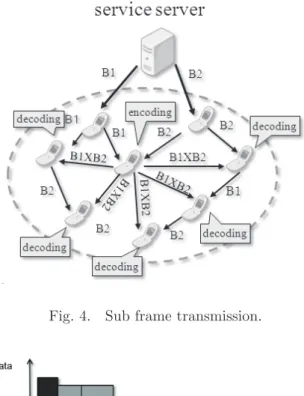
The sub frame transmission procedure performed in the network coding method is shown in Figure 4 and B1×B2 in the figure stands for a data unit after en- coding. A few mobile devices first receive sub frame data from the service server through cellular networks in the same way as key frames described, except that the chosen devices are divided into two parts and de- vices from each part synchronically receive different data packets. Cooperative reception with other partic- ipant devices will also be conducted through P2P net- works. The difference is that when a packet reaches an intermediate mobile node for data relay and another packet is waiting in a relay queue, coding procedure will be operated on the two packets. After encoding, the new packet is transmitted to other mobile peers, and decoding processing will be operated when the des- tination mobile device holds all the necessary packets for decoding.
Fig. 4. Sub frame transmission.
Fig. 5. An example of video play at a destination mo- bile device.
3.3.4 Playing Method at Destination Node
Video playing begins after a sequence of key frames (I and P VOPs) reached a mobile terminal node.
When sub frames and frames after encoding are re- ceived, the decoding process is performed with an op- eration that resembles the coding process, coefficient matrix operation, for instance. Sub frames are succes- sively played in the original order if that decoding pro- cedure is successful. When decoding failure happens or necessary packets for decoding do not timely reach the destination mobile, a corresponding key frame is utilized as a substitute without waiting for decoding to ensure the smoothness of video playing.
Figure 5 gives an example that illustrates how video contents are played at a mobile terminal in our proposed method. After a sequence of key frames - I, P1, P2 are received, video playing starts. As B1 is suc- cessfully received in time, it is played after I according
to the original order of the fragment. B2 is also played after B1 in order as it is decoded without any mistake.
After B1, P1 and B3 are played. As destination node only receives encoding packet B4×B5, which is not enough to decode the original frames B4 and B5, this B1×B2 frame is discarded and at the same time the next key frame P2 is played without waiting for the arrival of sub frames B4 and B5.
4. Simulation and Evaluation 4.1 Simulation Environment
To evaluate our proposed method, we simulate it using network simulator - QualNet13) and the edi- tion is 5.0. Simulation area is set as a square of 1000m*1000m. In order to test our method in different situation with different mobile density, we make sim- ulation in situations with different number of mobile devices. We consider all the mobile users as walkers and let the mobility of users be random mode with random waypoints and a highest speed of 5km/h (The average speed of human walk is about 5 kilometres per hour).
The simulation architecture is shown in Figure 6, As video content is first transmitted from service server to a small number of mobile devices and then shared among all the mobile participants, simulation network also mainly contains two parts: cellular network and ad-hoc network, which are shown in the two dashed borders in the figure.
4.2 Simulation File and Parameters
An MPEG-4 video file with a classical I-B-B-P structure is adopted in our simulation. We use a video analysis software - Elecard StreamEye to divide the video file into a sequence of vops, get the size of them, and according to these properties, decide the size of key frames and sub frames used in video transmission procedure.
Table 1 and Table 2 respectively show our ini- tialization parameters in cellular network and ad-hoc network. The number of mobile participants is set from a thinly scattered situation with 5 nodes to a relatively dense environment with 40 nodes. Transmission mode from service server to mobile and that among mobile devices are set to VBR (Variable Bit Rate) mode. As shown in Table 1, the attributes of physical layer, MAC
Fig. 6. Network architecture in simulation.
Table 1. Parameters in cellular network.
Nodes 5, 10, 20, 30, 40 Physical Layer Cellular PHY
MAC Layer Celluar MAC Network Layer Cellular Layer3
Applications VBR
layer, network layer are set as cellular mode. As most of the mobile devices are battery powered, we adopt a classical reactive routing protocol - AODV (Ad-hoc On-Demand Distance Vector Routing)14) protocol in ad-hoc networks considering the economizing on elec- tricity.
4.3 Simulation Scenarios
In order to prove the effectiveness of our pro- posal method in different situations, we simulate it un- der different terrain scenarios; first standard scenario which is clear and without any obstacle, building for
Table 2. Parameters in P2P network.
Nodes 5, 10, 20, 30, 40 Physical Layer 802.11b Radio
MAC Layer 802.11
Network Layer IPv4 Routing Protocol AODV
Applications VBR
Fig. 7. Scenario of urban propagation.
instance, and then urban propagation where exists ob- stacles to interfere with Wi-Fi transmission. Figure 7 is an example of the X-Y view of urban propaga- tion simulation scenario where 20 mobile devices are randomly located, including buildings represented by gray squares and a park in the middle. The white area represents roads. Mobile nodes can move randomly in- side the whole area, for example, on the road, enter or come out from buildings.
As it is difficult to implement our method in every specific situation, we choose to set the urban terrains scenario with several obstacles under uniform distribution, From these two opposite simulations, we could also know the performance of our method in a real environment, for example, in a park, near a rail- way station, to some degrees.
4.4 Simulation Results
4.4.1 Service Server Performance
Figure 8 shows the total contents sent of video service server using 4 methods: server-client method, our proposed method, SkeedCast15), a P2P method using cache technology, and BitTorrent16), which is also a P2P file sharing software. This figure indicates that our proposed method had a better performance than both server-client method and SkeedCast: in our method, service server sent slightly more that 50% of the data compared to the server-client way when there were 5 mobile participants in the network. In the sit-
Fig. 8. Total contents sent by service server.
uation with 40 mobile nodes, service server only sent about 1/6 data of that of server-client method. Be- sides, total contents sent of our proposed method was less than SkeedCast no matter the number of nodes is larger or small. Among these 4 methods, BitTorrent server sent the least data size.
4.4.2 Sub Frame Transmission Performance in Stan- dard Canvas
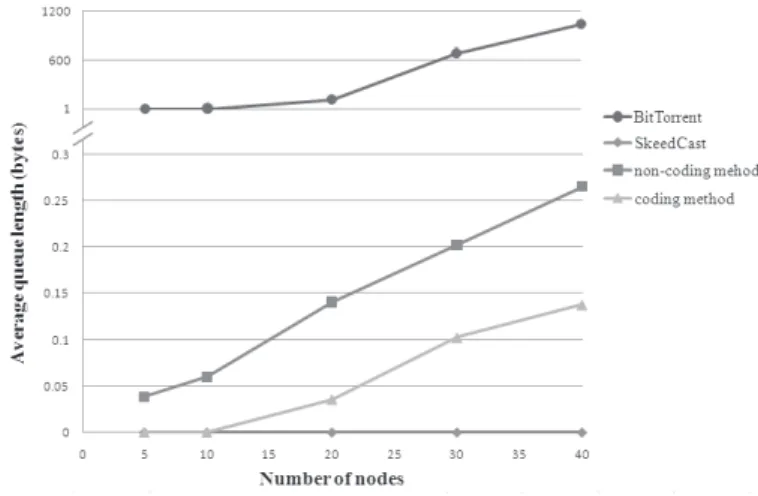
In order to verify the performance of network coding method during sub frames transmission, we measured queue length and wait time of the 4 methods.
Figure 9 shows the average queue length of non-source nodes and Figure 10 shows the average wait time when relayed at intermediate nodes.
4.4.3 Sub Frame Transmission Performance in Urban Terrain
Performances of our method in urban terrain are given in Figure 11 and Figure 12. Here we compared it with non-coding method. We also measured the av- erage queue length and the average wait time. The movement paths indicate that when the number of mo- bile devices was 5, non-coding method and network coding method had almost the same queue length and wait time. However, the discrepancy grows with the increase of mobile participant: our proposed method shorted the length of relay queue and cost less time, which proved that our method can also be applied in an urban terrain.
Fig. 9. Average queue length in standard canvas.
Fig. 10. Average wait time in standard canvas.
4.5 Result Analysis
From the simulation results in Section 4.4.1, we can see that as most of the mobile devices directly re- ceives video contents not from the service server but from other mobile participants, the total contents sent has been substantially decreased in our method. Also, the performance improved as the number of mobile devices increased, indicating that our method was ef- fective to reduce the high load of server in concen- trated access situations. As SkeedCast uses multiple service servers to cope with concentrate access prob- lem, also, if request file does not exist, this server will ask other servers for the file and at the same time store it as cache, SkeedCast servers had satisfactory perfor- mances but at the cost of multiple devices and man- agement. On the other hand, BitTorrent had a best
Fig. 11. Average queue length in urban terrain.
Fig. 12. Average wait time in urban terrain.
performance among the 4 methods and service server sent almost the same contents when the number of ac- cess was different. This because that BitTorrent di- vides file into a sequence fragments and sends them to different requesters, the more requesters exist, the more fragments BitTorrent server divides into.
From simulation results in Section 4.4.2, we can see that our method introducing network coding suc- cessfully shorted average length of packet queue and average wait time for relay at intermediate mobile devices compared to non-coding method and BitTor- rent. Besides, these two items increased much slowly when more mobile devices participate because encod-
ing chance got larger in a relatively dense environ- ment with mobiles, thus indicated that network coding method in sub frame transmission relieved the load of relay nodes and optimized network efficiency. BitTor- rent lead to very large network traffic because the ex- changes of file fragments. In SkeedCast, packets were sent from distribution servers to users directly so that relays at intermediate nodes did not happen.
Simulation in Section 4.4.3 proved that the effi- ciency of our method in urban terrain situation. Due to the obscured by buildings, a part of mobile devices had fewer chances to relay packets, which lead to the concentrate relays at a small number of mobile devices and decreased the chances of encoding at these nodes.
These factors brought relay stress of some mobile de- vices to a certain degree, and at the same time in- fluenced the efficiency of our network coding method.
These influences have been shown in the simulation results: compared to the standard canvas, the discrep- ancy between non-coding method and our proposed method was smaller. However, from the average re- sults, we can see that our proposed method using net- work coding have improved the network performance.
5. Related Work 5.1 Researches Applying Network Coding
Network coding technology has caused attentions of many researchers for its advantages in increasing network throughput. Many theoretical studies have investigated network coding for various applications.
For example, a new architecture for wireless mesh net- works rooted in network coding was supposed17), and the benefits of using a form of network coding for uni- cast communication in a mobile Disruption Tolerant Network (DTN) under epidemics was investigated18). Particularly for P2P multimedia delivery systems, net- work coding has been proved to be beneficial in helping to reduce the redundancy of bandwidth and to increase the scalability. In this research area, a scheme for con- tent distribution of large files based on network coding in which each node is able to generate and transmit encoded blocks of information was supposed 19), for instance.
5.2 Technologies for Video Delivery Service
Besides network coding, there also exists many other technologies widely applied for improving quality of video delivery service. Here gives succinctly intro- ductions of some of them.
5.2.1 Automatic Repeat reQuest
Automatic Repeat reQuest (ARQ)20) is an ef- fective error-control technique for improving reliability in the retransmission of lost packets. When the re- ceiver detects an error in a packet, it automatically requests the transmitter to resend the packet until the packet is error free or the error continues beyond a predetermined number of transmissions. ARQ is suit- able only in point-to-point communications as it needs a fee, back channel. In a broadcasting environment, the broadcaster cannot handle all the independent re- transmission requests.
5.2.2 Forward Error Correction
Forward Error Correction21) is a channel coding method of obtaining error control in data transmis- sion in which the source (transmitter) sends redundant data and the destination (receiver) recognizes only the portion of the data that contains no apparent errors.
FEC has an all-or-nothing performance; if losses are too much, the recovery capability will be exceeded and will not be recovered. If errors are less than expected, which is probable when the system is designed for the worst case, the losses will be recovered. The complex- ity of FEC can be very high because encoding and decoding of redundant packets requires computational power and memory.
5.3 Multiple Description Coding
Multiple Description Coding (MDC)22)is a cod- ing technique to create several independent descrip- tions that can contribute to one or more character- istics of video. Descriptions can have the same im- portance (balanced MDC schemes) or different impor- tance (unbalanced MDC schemes). Reception of a few parts of descriptions can build the original video at a lower quality. The more descriptions received, the higher the quality of decoded video. Many experiments have shown that MDC is very robust even at high loss rates. The problem of MDC is that extra information is added during encoding procedure, which increases the size of delivery file and leads to high load of net-
work.
6. Conclusions
In this paper, we have described the problems in existing mobile-oriented video contents delivery method; service server’s load increases with the expan- sion of mobile users and concentrate access from them.
Also, Network traffic increases during data transmis- sion to all this requesters at the same time. To solve the problem, we proposed a P2P-based video delivery method for massive users using network coding tech- nology. The proposed method does not require the ser- vice server to be installed in the client’s side of home network, and allows mobile users to get video contents not only from server but also from other mobile nodes requesting for the same contents. We have simulated the proposed method in different situations; wide open spaces and areas with many buildings. We evaluated its effectiveness by measuring the data bytes sent by service server, the waiting queue length and waiting time of relay mobile nodes. The results showed that the latency causes by these actions is negligible. We have also confirmed that the total data sent has decreased and both the average waiting queue and average time have been shorted. Thus, we have verified that in an environment with a large number of requesters, video contents can be transmitted in a efficient way by ap- plying the proposed method.
This work was partly supported by Japan Society for the Promotion of Science (JSPS), Grant-in-Aid for Scientific Research (KAKENHI).
References
1) Wi-Fi Alliance: “802.11n: Enterprise deployment con- siderations, white paper” (2008).
2) Apple Inc: “iPhone dev center, Apple developer con- nection”,http://developer.apple.com/iphone/.
3) Android Open Source Project: “Android developers, Android.com”,http://developer.android.com/.
4) YouTube, LLC: “About YouTube”, http://www.
youtube.com/.
5) Ustream: “About Us”, http://www.ustream.tv/
about.
6) R. W. Yeung and Z. Zhang, “Distributed source cod- ing for satellite communications”, IEEE Trans. Inform.
Theory,IT-45, 1111–1120 (1999).
7) R. Ahlswede, N. Cai, S.-Y. R. Li and R. W. Yeung,
“Network information flow”, IEEE Trans. on Informa- tion Theory,46, 1204–1216 (2000).
8) MPEG Industry Forum: “MPEG-4 overview - (V.21 - Jeju Version)” (2002).
9) Raymond W. Yeung, Shuo-Yen Robert Li, Ning Cai, Zhen Zhang, “Network coding theory (Foundations and Trends in Communications and Information)”, (Now Publishers, The Netherlands, 2006).
10) MPEG HOME: “About MPEG,” http://mpeg.
chiariglione.org/.
11) 3GPP Homepage: “About 3GPP,”http://www.3gpp.
org/.
12) 3GPP2 Homepage: “About 3GPP2,” http://www.
3gpp2.org/.
13) KOZO KEIKAKU ENGINEERING Inc: “About QualNet,” http://www4.kke.co.jp/network/
products/qualnet/.
14) Ian D. Chakeres, Elizabeth M. Belding-Royer, “AODV Routing Protocol Implementation Design,” Proceed- ings of the International Workshop on Wireless Ad Hoc Networking, 698–703 (2004).
15) SkeedTools.com: “What is SkeedCast,” http://www.
skeedtools.com/.
16) BitTorrent: “About BitTorrent,” http:
//www.bittorrent.com/.
17) Sachin Katti, Hariharan Rahul, Wenjun Hu, Dina Katabi, Muriel M´edard, Jon Crowcroft, “XORs in the air: parctical wireless network coding”, IEEE/ACM Transactions on Networking(TON), 16, 3, 497–510 (2008).
18) X. Zhang, G. Neglia, J.Kurose, D.Towsley, “On the benefits of random linear coding for unicast applica- tions in disruption tolerant networks”, IEEE Network Coding Workshop, 1–7 (2006).
19) Christos Gkantsidis, Pablo Rodriguez Rodriguez,
“Network coding for large scale content distribution,”
INFOCOM 2005. 24th Annual Joint Conference of the IEEE Computer and Communications Societies, 4, 2235–2245 (2005).
20) L.L.Peterson and B.S.Davie, “Compter Networks: A Systems Approach, Fifth Edition”, (Morgan Kauf- mann, United States, 2003).
21) Lin, Shu, Daniel J. Costello, Jr, “Error Control Cod- ing: Fundamentals and Applications”, (Prentice Hall, United States, 1983).
22) Vive K Goyal, “Multiple Description Coding: Com- pression Meets the Network”, IEEE Signal Processing Magazine,18, 5, 74–93 (2001).