Honing the Rhetorical Tool: Rhetoric in Political Speeches
著者 森 健二
学位名 博士(英語学)
学位授与機関 名古屋学院大学 大学院 学位授与年度 2017
学位授与番号 33912甲第13号
URL http://doi.org/10.15012/00001091
Copyright (c) 2018 森健二
ACKNOWLEDGMENTS
First and foremost, I should like to express my deepest gratitude to Dr.
Paul McGrath, my supervisor, for his constant support and advice. I would also like to thank the part icipants whose coding data have helped me throughout the production of this study. Finally, I would like to express my sincerest and profoundest gratitude to the Almight y God, the Creator of the Universe, for His unlimited wisdo m, mercy, and encouragement.
- 1 -
ABSTRACT
This dissertation is concerned with the analysis of political speeches in the current unstable and polarized world. How can politicians produce trust in themselves and their views? How can diplomats produce understanding for their countries’ positions? It is not surprising that there has been a revival of interest in rhetoric (Garsten, 2011) and its place in deliberate democracy, the idea of which has roots in ancient Greece, but continues to be ardently discussed. This rhetorical tradition can not only be traced back to Aristotle and democracy in Athens in the ancient Greece (Bohman, 1998, p.400;
Elster, 1999, p.1) but can also be seen in ardent discussions by many political theorists since the 1980s. This revival of interest in rhetoric has produced renewed interest in Aristotle, the first and foremost authority on the art of rhetoric. Aristotle defined rhetoric as “the faculty of observing in any given case the available means of persuasion”
(1355b). I pay close attention to this definition in my discussion of the renewed interest in Aristotle, pointing out that it does not define rhetoric as “the art of persuasion,” but rather as “the art of observing . . . the available means of persuasion.”
The first chapter of this dissertation reviews previous research reflecting this renewed interest in rhetoric in political speeches. I summarize some important pieces of work, comment upon key contributions, and work toward identifying and analyzing what I call “the rhetorical tool” which I employ to analyze some current political and diplomatic speeches. I focus on describing two aspects of the function of rhetoric in political speeches identified by Garsten (2011): the production of trust in the speaker through Aristotelian threefold rhetorical elements of ethos, pathos, and logos and the function of bonding rhetoric and bridging rhetoric.
The second chapter reviews how some previous researchers examined the use of the Aristotelian rhetorical elements of ethos, pathos, and logos in political discourses. In addition, in an attempt to put together a “bottom-up” analysis of “intuitive reactions” of the general public, I present a unique method applied in this dissertation which utilizes
“intuitive perceptions” of educated but non-specialist coders. While utilizing the descriptive analysis of identifying the elements of ethos, pathos, and logos as well as the functions of bonding and bridging rhetoric in political speeches, this dissertation employs the data from non-trained coders’ “intuitive perceptions” of rhetorical elements embedded in political speeches.
The third chapter analyzes the target texts and discusses the data from the coders’
perceptions of rhetorical elements in four addresses consisting of two addresses at the
- 2 -
UN General Assembly and Inaugural addresses by two American presidents.
Specifically the target texts are an address delivered by Hassan Rouhani, the president of Islamic republic of Iran, on September 29, 2015; an address by Benjamin Netanyahu, the prime minister of the state of Israel, on October 1, 2015; an inaugural address by Barack Obama on January 20, 2009; and an inaugural address by Donald Trump on January 20, 2017.
To summarize, the aims of this study are as follows:(1) To review the renewed interest/revival of Aristotelian rhetoric in political speeches as well as the function of bonding or bridging rhetoric; (2) To discover and describe the intuitive recognition of rhetorical elements on the part of educated, but non-trained coders; and (3) To discover and describe the features of the target speeches from the perspective of how the speaker employs these rhetorical elements.
This dissertation conducts qualitative descriptive and interpretative analyses utilizing the data of non-trained coders’ perceptions of rhetorical elements in target speeches. This researcher conducts the analysis according to the following procedure:
(1) addresses are examined to identify the themes delivered by speakers; (2) based on the itemized themes, addresses are coded through a line-by-line analysis to identify the elements of ethos, pathos, logos as well as bonding or bridging rhetoric utilized by speakers; (3) by employing the data in which six non-trained coders intuitively identify these rhetorical elements in target addresses based on the definition of the target rhetorical elements, the conceivable features of perceptions of the coders are examined;
and (4) some elements of rhetorical strategy missed by many coders despite an objective presence of such element are examined.
The typical features of coders’ intuitive perceptions of five targeted rhetorical elements are identified in the theme-based analysis of four addresses. First, coders tend to miss ethos despite its objective existence. Second, coders tend to identify pathos more than other rhetorical elements when they are moved by the speakers’ words. Third, coders identify logos when the speakers deliver the following words: showing a logical connection such as “because” and “consequently,” presenting the facts, or depicting scenes which present examples. Furthermore, even when the speakers do not use these words which are apparently associated with logical thought or reasoning, coders sometimes identify logos. Fourth, it seems easy for the coders to identify bridging rhetoric when the speaker calls to “particular people,” which shows the speaker’s target audience. On the other hand, it seems challenging for the coders to distinguish between bonding rhetoric and bridging rhetoric in particular in US presidential inaugural address, in which both elements of bonding and bridging rhetoric are mixed and blended. Fifth,
- 3 -
coders tend to identify bonding rhetoric when pathos exists. In particular, coders tend to identify bonding rhetoric when the speakers emphasize that the countries of the speakers have suffered unfair disadvantages.
Finally, the outstanding features of rhetorical strategy used by each speaker provide us with some implications. First, the speakers’ overly emphasized use of pathos aiming to evoke the emotions of fear or hatred tends to impair the trustworthiness of the speaker.
Second, the defective use of logos such as a lack of logical connections, a manipulative shift of the issues, or unreasonable demands casts a negative impact on the trustworthiness of the speakers. Third, although as Aristotle says, ethos is the most persuasive element of his threefold rhetorical elements, at the same time, it is challenging to check if the speaker’s use of ethos is genuine and authentic.
i
Table of Contents
Page
Introduction……….………1
Chapter 1: Revival of Rhetoric in Political Speeches ……….…….…..3
1.Features of Aristotle’s rhetoric………..………...3
Ethos, pathos, and logos……….…..……….……4
2. Anti-rhetorical tradition based on rationalism………..……….……..4
3. The argument against anti-rhetorical tradition……….….……….…….5
4. The integrated role of the Aristotelian three modes of persuasion in political speech: The production of trust in the speaker…..………...6
The elements of ethos, pathos, and logos……….……6
Ethos: the most effective means of persuasion……….…….6
Trust production by ethos, the speaker’s character………....7
5. Ideas supporting the affirmative use of rhetoric in political speech…..……..…..7
Political speech is future oriented……….….….…7
Rhetoric facilitates deliberation and produces a determinate judgment……....…..8
6. The idea of bonding and bridging rhetoric in political speech………9
The basic function of bonding and bridging rhetoric………..…..….9
Chapter 2: Previous Studies on Political Discourse Utilizing Aristotelian Ethos, Pathos, and Logos………….……….………10
1. Two types of methods regarding how to utilize coders to identify rhetorical elements in previous studies……….10
Identifying rhetorical elements all by the author………10
Utilizing trained coders to identify the rhetorical elements……….12
2. Method of this study………..………...……13
The aim of collecting data in which the non-trained coders identify the target rhetorical elements……….13
Coders in this study………..….14
Criteria for coders to identify rhetorical elements………...…..14
Definitions of ethos, pathos, and logos……….14
Definitions of bonding rhetoric and bridging rhetoric………14
ii
Target texts………..……….….…15
Numerical aspects of the data from non-trained coders………..….15
Summary of method………..…..…16
Chapter 3: Results and Discussion……….………..…..….17
Analysis of the addresses at the UN General Assembly……….….……...…17
1. The background situation of the UN addresses by Rouhani and Netanyahu in 2015.17 The impact of JCPOA……….……..……17
2. Theme-based rhetorical analysis of an address by Hassan Rouhani at the UN General Assembly, September 29, 2015……….……..18
3. Numerical results of coders’ perceptions of rhetorical elements in Rouhani’s address……….……….…………...…..28
4. Findings of the rhetorical analysis of Rouhani’s address………..……..30
Features of perceptions of the coders………..30
Features of Rouhani’s rhetorical strategy……….….…31
5. Theme-based rhetorical analysis of address by Benjamin Netanyahu at the UN General Assembly, October 1, 2015………32
6. Numerical results of coders’ perceptions of rhetorical elements in Netanyahu’s address……….………..…..47
7. Findings of the rhetorical analysis of Netanyahu’s address………....……..….49
Features of perceptions of the coders………..….…..…..….49
Features of Netanyahu’s rhetorical strategy……….……..…49
Analysis of US presidential inaugural addresses……….……….……...….51
1. Features of US presidential inaugural addresses………..…51
2. Functions of pronouns in presidential inaugural address……….…….…53
3. What can be called Obama’s Legacy?...54
4. Theme-based rhetorical analysis of the inaugural address by Barack Obama, January 20, 2009………..…...56
5. Numerical results of coders’ perceptions of rhetorical elements in Obama’s inaugural address…………..……….………..…..67
6. Findings of the rhetorical analysis of Obama’s address………….………69
Features of perceptions of the coders……….………69
Features of Obama’s rhetorical strategy………..70
7. Liberal media’s bashing of Trump……….……….70
iii
8. Theme-based rhetorical analysis of the inaugural address by Donald Trump, January
20, 2017………..………...71
9. Numerical results of coders’ perceptions of rhetorical elements in Trump’s inaugural address……….………..….…...84
10. Findings of the rhetorical analysis of Trump’s address…………...………....…86
Features of coders’ perceptions………...….……...….86
Features of Trump’s rhetorical strategy……….…..…..87
Conclusion……….…..87
1. Summary of the features of coders’ perceptions in four addresses………..….….87
2. Summary of the features of rhetorical strategies used by four speakers…...…..88
The effectiveness and weakness of Rouhani’s rhetorical strategy….………..89
The effectiveness and weakness of Netanyahu’s rhetorical strategy…….…..89
The effectiveness and weakness of Obama’s rhetorical strategy….….…..…90
The effectiveness and weakness of Trump’s rhetorical strategy……....…....90
3. Implications……….………..91
Honing the Rhetorical Tool: Rhetoric in Political Speeches
A Dissertation
Submitted to Nagoya Gakuin University
In Partial Fulfillment of the Requirements for the Degree of Doctor of Philosophy
By
Kenji MORI
Graduate School of Foreign Studies Nagoya Gakuin University
December 16, 2017
- 1 -
Introduction
After the spectacle of last year’s presidential election in the US, an uncertain but substantial change seems to progress not only in the US but also in the various countries in the world as if they struggled to seek a kind of new world order. The United Nations, which does not present us with clear solutions to a variety of issues in the world, seems to be in a kind of paralyzed situation. Liberal developed democracies and the developing nations who would follow them find themselves in conflict not only with alternative political systems such as Russia and China but also with the religious conservatism of Islamic states. Fearsome dictatorships such as Syria and North Korea have also become unstable factors for developed democracies. And within those developed democracies themselves, as the presidential contest in the US showed, deep divisions among citizens have appeared.
This dissertation is concerned with the analysis of political speeches in such an unstable and polarized world. How can politicians produce trust in themselves and their views? How can diplomats produce understanding for their countries’ positions? It is not surprising that there has been a revival of interest in rhetoric (Garsten, 2011) and its place in deliberate democracy, the idea of which has roots in ancient Greece, but continues to be ardently discussed. This rhetorical tradition can not only be traced back to Aristotle and democracy in Athens in the ancient Greece (Bohman, 1998, p.400;
Elster, 1999, p.1) but can also be seen in ardent discussions by many political theorists since the 1980s. This revival of interest in rhetoric has produced renewed interest in Aristotle, the first and foremost authority on the art of rhetoric. Aristotle defined rhetoric as “the faculty of observing in any given case the available means of persuasion”
(1355b). I will pay close attention to this definition in my discussion of the renewed interest in Aristotle, pointing out that it does not define rhetoric as “the art of persuasion,” but rather as “the art of observing . . . the available means of persuasion.”
The first chapter of this dissertation will review previous research reflecting this renewed interest in rhetoric in political speeches. I will summarize some important pieces of work, comment upon key contributions, and work toward identifying and analyzing what I call “the rhetorical tool” which I will then employ to analyze some current political and diplomatic speeches. I will focus on describing two aspects of the function of rhetoric in political speeches identified by Garsten (2011): the production of trust in the speaker through Aristotelian threefold rhetorical elements ethos, pathos, and logos and the function of bonding rhetoric and bridging rhetoric.
The second chapter will review how some previous researchers examined the use of
- 2 -
the Aristotelian rhetorical elements of ethos, pathos, and logos in political discourses. In addition, in an attempt to put together a “bottom-up” analysis of “intuitive reactions” of the general public, I will present a unique method applied in this dissertation which utilizes “intuitive perception” of educated but non-specialist coders. While utilizing the descriptive analysis of identifying the elements of ethos, pathos, and logos as well as the functions of bonding and bridging rhetoric in political speeches, this dissertation will employ the data from non-trained coders’ “intuitive perceptions” of rhetorical elements embedded in political speeches.
The third chapter will analyze the target texts and discuss the data from the coders’
perceptions of rhetorical elements in four addresses consisting of two addresses at the UN General Assembly and inaugural addresses by two American presidents.
Specifically the target texts are an address delivered by Hassan Rouhani, the president of Islamic republic of Iran, on September 29, 2015; an address by Benjamin Netanyahu, prime minister of the state of Israel, on October 1, 2015; an inaugural address by Barack Obama on January 20, 2009; and an inaugural address by Donald Trump on January 20, 2017.
To summarize, the aims of this study are as follows:(1) To review the renewed interest/revival of Aristotelian rhetoric in political speeches as well as the function of bonding or bridging rhetoric; (2) To discover and describe the intuitive recognition of rhetorical elements on the part of educated, but non-trained coders; and (3) To discover and describe the features of the target speeches from the perspective of how the speaker employs these rhetorical elements.
- 3 -
Chapter 1
Revival of Rhetoric in Political Speeches
1.Features of Aristotle’s Rhetoric
To begin with, I will attempt to clarify the long-standing denigration of rhetoric which stems from Plato’s denouncement of the Sophists and their disreputable verbal trade. In ancient Greece, some sophists such as Gorgias and Protagoras were famous for their teaching “the art of verbal persuasion” by the method of dialectic or arguing for and against a proposition, which encouraged their students to argue either side of a case regardless of its truth value (Herrick, 2016, p.34). Plato, the former teacher of Aristotle, denounced rhetoric as “anything bad” and “contemptible” in Gorgias (463d) based on his highly idealized idea of truth and justice. Aristotle also denounces the Sophists’
rhetoric in the Rhetoric. Aristotle says, “These writers [Sophists]…deal mainly with non-essentials. The arousing of prejudice, pity, anger, and similar emotions has nothing to do with the essential facts, but is merely a personal appeal to the man who is judging the case” (1354a12-18). In contrast to Plato, however, Aristotle not only criticizes sophistic rhetoric but also defends rhetoric from Plato’s denouncement of it (Herrick, 2016, p.70; Garsten, 2009, pp.119-120). Aristotle makes rhetoric something more than mere eloquence and defines it as “Rhetoric is the faculty of observing in any given case the available means of persuasion” (1355b).
In the Rhetoric, Aristotle describes four reasons why the art of rhetoric is useful.
First, Aristotle emphasizes the necessity of rhetoric in light of bringing about truth and justice in the court. After asserting that “things that are true and things that are just have a natural tendency to prevail over their opposites,” Aristotle points out “if the decisions of judges are not what they ought to be, the defeat must be due to the speakers themselves, and they must be blamed accordingly” (1355a). Second, Aristotle encourages the speaker to adjust his speech to the knowledge of the audience.
According to Aristotle, in front of some audiences, “not even the possession of the exactest knowledge will make it easy for what we say to produce conviction.” Therefore, Aristotle emphasizes, the speaker has to use “notions possessed by everybody” (1355a).
Third, Aristotle recognizes the usefulness of the argument conducted from two opposite sides. Aristotle says: “We must be able to employ persuasion…on opposite sides of a question, not in order that we may in practice employ in both ways (for we must not make people believe what is wrong), but in order that we may see clearly what the facts are...” (1355a). According to Aristotle, rhetoric plays a role in having the speaker think about both positive and negative sides of the issue to clarify what the facts are. Fourth,
- 4 -
according to Aristotle, the usefulness appears when the speaker defends himself with speech and reason (1355b). To the projected objection that a person who uses rhetoric unjustly can do great harm, Aristotle counter-argues that such a charge can be made “in common against all good things except virtue” (1355b). In contrast to the Platonic view of rhetoric, which is for instance criticized by Jamie (2015, p.10) as “the impossibly idealized picture,” Aristotle describes rhetoric as a useful tool from a realistic and pragmatic point of view.
Ethos, pathos, and logos.
In the Rhetoric, Aristotle describes three modes of persuasion by spoken words: “the character of the speaker (ethos)”, “putting the audience into a certain frame of mind (pathos)”, and “the apparent proof provided by the words of speech itself (logos)”
(1356a1-4). Aristotle adds the explanation that the person who can utilize the three modes of persuasion must be able to do the following: “(1) to reason logically, (2) to understand human character and goodness in their various forms, and (3) to understand the emotions; that is, to know their causes and the way in which they are excited”
(1356a). As I will review in detail in the later section, these three proofs of persuasion invented by Aristotle show his balanced view of rhetoric, which is different from sophistic rhetoric, a type which disregards morality and virtue, as well as from Plato’s view of rhetoric based on his truth-seeking philosophy. In the following sections, I will review several pieces of work which treat anti-rhetorical tradition embedded in political theories and the counter-arguments based on the renewed interest in rhetoric in political speeches.
2. Anti-Rhetorical Tradition Based on Rationalism
Although Plato’s denunciation against sophistic rhetoric has given a tainted stigma to rhetoric as a kind of deceptive eloquence, rhetoric was an important element of Western culture and education at least from the age of ancient Greece to the Renaissance in the fourteenth to sixteenth centuries (Herrick, 2016, p.141). However, since the age of the Enlightenment in which science and philosophy developed in the seventeenth and eighteenth centuries, rhetoric started to dwindle in its importance in Western society (Herrick, 2016, p.167). In particular in the political theories, according to Garsten (2011), Kant’s denunciation of rhetoric is a more recent element in the anti-rhetorical tradition, which can be traced back to Plato. Kant regards rhetoric as an art of “deceiving by a beautiful show,” in order for the speaker “to win minds to the side of the orator before they have formed a judgment, and to deprive them of their freedom”
- 5 -
(Critique of Judgement, section 53). O’Neill (2002) also points out that Plato’s distinction between two forms of persuasion, rhetoric and rational discourse, as “one of which confers conviction without understanding, while the other confers knowledge”
(Gorgias, 454e), is a source of anti-rhetorical tradition which affects the Kantian model of deliberation theories. O’Neill (2002) claims that “the assumption that rhetoric and reasoned public deliberation are incompatible” is succeeded by “modern neo-Kantians like Habermas and Rawls” (pp.253-254).
Recently, however, there is not only a renewed interest in rhetoric among political theorists but also a trend to utilize the rhetorical tool to analyze political speeches among rhetorical analysts. This revival of interest in rhetoric seems to stem from the features of Aristotle’s rhetoric, which aimed to persuade the audience in deliberative settings, and deliberative democracy theories, which have been discussed by many political theorists since 1980s. In the next section, I will summarize some pieces of work which argue against anti-rhetorical tradition in light of Aristotle’s view of rhetoric.
3. The Argument Against Anti-Rhetorical Tradition
In the trend of a renewed interest in rhetoric in political theories, some researchers have argued against the anti-rhetorical tradition based on rationalism from the view point of Aristotle’s rhetoric. Although the points that each work emphasizes vary, the underlying point that each work suggests is that reason or logos alone is not enough to persuade the audience in political speeches. In this section, I will present three types o f examples of arguments against the anti-rhetorical tradition.
First, several researchers argue that political emotions are compatible with public deliberation. Among them, for example, Garsten (2011) claims that “Particular political emotions, such as anger and shame, play a special and legitimate role in public deliberations.” Second, Garver (1994) argues, based on Aristotle, that “excessive rationality is unpersuasive because it makes us suspicious rather than trustful of the speaker (1395b28-1396a1)” (pp.177-178). Based on this understanding, Garver suggests, following Aristotle, “If one has logical arguments, one should speak both
‘ethically’ and ‘logically’;…And to seem virtuous suits a good person more than an exact argument does (1418a37-b1)” (1994, p.178). Third, O’Neill (2002) and Chamber (2009) show their understanding that Aristotle’s three proofs of persuasion, ethos, pathos, logos are a balanced conceptual tool which can make up for the insufficiency of persuasiveness in reason-based theories.
O’Neil claims that Aristotle criticizes the sophistic rhetoric which overemphasizes
- 6 -
the emotions rather than rational argument so he outlines three proofs of art of rhetoric which persuade through words (1356a26) (2002, p.257). Likewise, Chambers (2009) claims Aristotle knows that logos alone is not enough to succeed in persuading the public but also a proper use of emotion and an appeal to character do not destroy or impair the effectiveness of logos (p.17). To sum up, these theoretical writings argue that logos alone is insufficient to persuade the audience but also assert that Aristotelian three rhetorical proofs become more effective when all of them are employed conjunctively in political speeches. In the next section, I will review several pieces of work which present some interpretations on the role of each proof, ethos, pathos, and logos in political speeches.
4. The Integrated Role of the Aristotelian Three Modes of Persuasion in Political Speech: The Production of Trust in the Speaker
The elements of ethos, pathos, and logos.
Regarding what constitutes ethos, pathos, and logos, respectively, in the Rhetoric, Aristotle describes in detail the elements of each of the three proofs of persuasion. As for the elements of ethos, Aristotle elaborates on several elements as the forms of virtue such as “justice, courage, temperance, magnificence, magnanimity, liberality, gentleness, prudence, [and] wisdom” (1366a33-1366b23). As for the types of emotions as the elements of pathos, Aristotle says, “Such are anger, pity, fear and the like, with their opposites” (1378a20-23). As for the element of logos, Aristotle suggests that every speaker use either “enthymeme,” which is defined in Oxford Living Dictionaries as “an argument in which one premise is not explicitly stated,” or “examples” to produce the effects of persuasion (1356b6-7). In accordance with the types of speeches, according to Aristotle, “enthymeme” fits in best with forensic speeches and “examples” goes best with deliberative speeches (1368a26-34). Concerning “examples,” two types of them are described: “actual past facts” and “the invention of the facts by the speaker” such as
“fables” (1393a25-29). Aristotle claims that actual past facts are more persuasive than fables in political speeches (1394a1-8).
Ethos: the most effective means of persuasion.
While Aristotle describes three modes of persuasion, ethos, pathos, logos, he also singles out ethos, the character of the speaker. Aristotle says, “his character may almost be called the most effective means of persuasion” (1356a). In particular, this is absolutely true where “exact certainty is impossible and opinions are divided” (1356a).
- 7 -
Following Aristotle, Garver (1994) claims that “The more indeterminate the situation, and the more necessary rhetoric is, the more fundamental the need for ethos and trust.
Because the audience has to trust the speaker, the speaker has to display ethos” (p.174).
Likewise, Fontana, Nederman, and Remer (2004) claim that “when divisions are so intense that grounds for agreement seem unavailable, the moral quality of a speaker becomes a significant factor in our evaluation of the views he defends” (p.121). To sum up, when there is no certainty and consensus about the suitable resolution to the problems or issues, the trust based on the character of the speaker can be a last resort for people to make a judgement.
Trust production by ethos, the speaker’s character.
Aristotle also elaborates on three things which inspire confidence in the speaker’s own character: good sense, good moral character, and goodwill (1378a). This implies that the Aristotelian three modes of persuasion come down to ethos, the speaker’s character, which again involves three things about them, good sense, good moral character, and goodwill. Jamie explains about these three things, “If they [speakers]
were perceived as lacking one of them, they would not be treated as trustworthy” (2015, p.97).
Although I have already shown in section 3 of this chapter that Garver (1994) claims that virtue or speaking “ethically” is important, Allen (2004) also advances this point and gives us her own interpretation of Aristotle’s rhetoric. She names the substance of Aristotelian rhetoric the art of trust production (p.141). She argues that
“competence at practical reason is a character virtue” and that only practical policy proposals without general principle are not persuasive enough (pp.145-146). She argues that “the principles one espouses express character” (p.146). That is, the argument including general principles clarifies the speaker’s “ethical commitments concerning the treatment of others.” Therefore, according to Allen, the audience easily finds whether or not the speaker is reliable through his arguments (p.146).
5. Ideas Supporting the Affirmative Use of Rhetoric in Political Speech
Political speech is future oriented.
In the previous section, I reviewed several pieces of works arguing that Aristotelian three proofs of persuasion can be interpreted as useful tools to produce trust in the speaker. My next inquiry will focus on features of political speeches. Is there any specific feature of political speeches, which can justify the use of rhetoric? Some studies,
- 8 -
following the description in the Rhetoric, point out the fact that the nature of political speech per se justifies the use of rhetoric. According to Aristotle, “The duty of rhetoric is to deal with such matters as we deliberate upon without arts or systems to guide us…”(1357a) and “The hearer must be either a judge, with a decision to make about things past or future, or an observer. A member of the assembly decides about future events, a juryman about past events”(1358b1-5). Triadafilopoulos (1999) claims that
“Political speech is future oriented,” which stems from the fact that the speaker needs to suggest one of a variety of policies and actions the audience can select to implement for their better future (p.747). Allen (2004) also argues that uncertainty about the future in the political sphere decreases the trust for logos but increases the trust for the judgment based on the character of the speaker. She claims, “Character judgments, when they focus on evaluating a speaker’s competence at practical reason, are assessments of probability as to whether the proposed policy is likely to achieve success” (p.146).
Rhetoric facilitates deliberation and produces a determinate judgment.
Aristotle says that “rhetoric exists to affect the giving of decisions…” (1377b20-25).
Abizadeh (2002) argues that the Aristotelian integrative account of the three proofs of persuasion is related not only to his understanding the insufficiency of logos but also to the end of Aristotelian rhetoric that is “not just to persuade, but to persuade in producing a determinate judgment (1377b20-8, 1378a6-9)” (p.275).
Furthermore, some scholars argue that rhetoric facilitates deliberation on political issues. Garsten (2009) argues that “Aristotle thought emotions were integral to and partly constitutive of judgment and deliberation.” He claims that “Aristotle defined emotions as types of judgment” and “he aimed to turn rhetoric into a technique of deliberation” (p.122, p.129). Chambers (2009) claims, “Aristotle maintains that deliberative rhetoric can engage an audience in such a way as to stimulate reasoned judgement,” because “good rhetoric makes people think, it makes people see things in new ways, it conveys information and knowledge, and it makes people more reflective”
(p.18). Young (2010) claims that “rhetoric constitutes the flesh and blood of any political communication, whether in a neighborhood meeting or on the floor of Parliament” (p.65). Dryzek (2009) claims that “rhetoric plays an important role in deliberating across differences, as well as across the boundary between the state and the public sphere” (p.167).
In the following section, I will review the concept of two types of rhetoric, bonding and bridging, which Dryzek (2010) suggests as an attempt to systematically describe how rhetoric functions positively or negatively in a democracy (p.320, p.328).
- 9 -
6. The Idea of Bonding and Bridging Rhetoric in Political Speech
The basic function of bonding and bridging rhetoric.
The original terms of bonding and bridging come from Robert Putnam’s usage which describes two aspects of what he calls “social capital”: bonding social capital represents identities of groups whose members tend to be homogeneous and exclude others from different social backgrounds, while bridging social capital represents ones whose members tend to accept a variety of people from different social backgrounds (Putnam, 2000, p.22). According to Dryzek (2010), bonding rhetoric, which energizes
“similarly disposed people,” usually has a negative aspect “to deepen divisions with out-groups, to invoke dangerous emotions, to mobilize passions, to move groups to extremes.” In contrast, bridging rhetoric, which adopts the ideas of “an intended audience that is different in key respects from the speaker” as well as ones from “the kind of people or discourses the speaker represents,” has an important role to “expand the audience that might be sympathetic to a position” (pp.328-330). Dryzek introduces two cases of Martin Luther King, Jr. and Nelson Mandela as successful models where the speakers could “combine bonding and bridging rhetoric to good effect” (2010, p.329). At the same time, Dryzek claims that when the speaker employs only bonding rhetoric and expels a bridging rhetoric, “the consequence can be disastrous” (2010, p.329). His insight about the consequence of disregarding bridging rhetoric reminds us of a current case where Donald Trump met fierce backlashes by anti-Trump citizens even after his presidential inauguration in the US. Current political leaders need to address much more diverse listeners than those in Athens in ancient Greece. In that sense, analyzing the functions of bonding and bridging rhetoric in political speeches will be a useful guidepost to check if the speaker’s rhetoric produces effective persuasion in this modern pluralistic societies.
In the second chapter, I will review a couple of previous studies which conducted a rhetorical analysis of political speeches and present the method of this dissertation.
- 10 -
Chapter 2
Previous Studies on Political Discourse Utilizing Aristotelian Ethos, Pathos, and Logos
This chapter will review some previous studies which conducted rhetorical analyses on political discourses and present the method of this dissertation. The first section will focus on the method utilized in those previous studies from two perspectives: how to identify Aristotelian three rhetorical elements of ethos, pathos, and logos; and how to utilize coders in the process of identifying these rhetorical elements.
1. Two Types of Methods Regarding How to Utilize Coders to Identify Rhetorical Elements in Previous Studies
There are various approaches and themes of previous studies dealing with the rhetorical analysis of political speeches, but they can be categorized into two main types in light of the method of who codes and analyzes the text of political speeches: the researcher by himself, or the researcher together with trained assistants (“coders”). The first type of previous study dealing with the rhetorical analysis of political speeches employs analysis conducted solely by the researcher himself (e.g., Teten (2011); Wu (2015); Ko (2015)). Teten (2011) conducted an extensive rhetorical analysis by himself through “a line-by-line reading” and “rhetorical examination” of four types of presidential addresses from George Washington to George W. Bush consisting of the State of the Union address, the Inaugural addresses, executive orders, and presidential proclamations (p.5). Wu (2015) analyzed American presidential use of “divine election cues” by employing threefold criteria to distinguish “divine” election religious rhetoric from “non-divine” election religious rhetoric in presidential speeches from Harry S.
Truman to George W. Bush (pp.59-61). Ko (2015) coded Taiwan’s President Ma Ying-Jeou’s political discourse through “a line-by-line analysis” to identify the elements of Aristotelian rhetorical language (p.116). Of this first type of previous study in which the researcher analyzes the target texts all by him/herself, the following section will review Ko (2015), which focuses on Aristotelian rhetorical elements of ethos, pathos, and logos.
Identifying rhetorical elements all by the author.
Ko (2015) explored the content of ethos, pathos, and logos in Taiwan’s President Ma Ying-Jeou’s political discourse on the cross-strait Economic Cooperation Framework Agreement (ECFA). In this study, it was found that pathos was the most
- 11 -
prevalent rhetorical strategy that Ma adopted during the debate, while ethos was rhetorical strategy least used. As for methods of data analysis used in the same study,
“qualitative descriptive and interpretative analyses” based on the itemized subject and theme were done as follows: (1) The text was scrutinized to find the “subjects presented by Ma” during the ECFA debate; and (2) “data were coded through a line-by-line analysis to identify the elements of Aristotelian rhetorical language utilized by Ma”
(p.116).
The author identifies ethos, when the speaker increases his/her “credibility and trustworthiness” by appealing to his/her character “by deliberately establishing his or her image in such a way that convinces the audience through an argument, that they are competent, reliable, fair, and honest” (p.116). The author utilizes the element of
“competent, reliable, fair, and honest” to identify Aristotelian proof of ethos.
The author identifies logos, when the speaker emphasizes “reason and logic.” To clarify the trait of this proof, the author refers to “the clarity and integrity of the argument itself” and “facts and figures” which “political elite will often use to convince the audience of his or her position” (p.116).
The author identifies pathos, when the speaker “denotes the arguments appealing to the audience’s compassion or evokes their emotions (e.g., fear, anger, sadness, contempt, satisfaction, sympathy, happiness, and hope).” Especially, the author claims, “Hope is a positive emotion that is conceptualized with arguments relating to enthusiasm, optimism, and other affirmative feelings” (p.116).
One of the advantages of this first type of study is that the researcher can not only deepen the analysis of the target texts based on his/her knowledge and intensive analysis but also consistently describe the features or meanings of the target texts. On the other hand, a weakness of this type of study is that all the contents of the analysis depend on the researcher’s cognitive facility so that it lacks the strength provided by the perceptions of others who listen to/ read through such political speeches.
The second type of previous studies employs analysis by both the researcher and trained coders (e.g., Erisen, C., & Villalobos, J. (2014); Samuel-Azran, T., Yarchi, M.,
&Wolfsfeld, G. (2015); Amos, C., Spears, N., & Pentina, I. (2016)). Erisen, et al. (2014) examined three types of emotions, fear, anger, and hope in four types of American presidential speeches: Inaugural addresses, SOTU addresses, addresses on the nation, and addresses to Congress from Franklin D. Roosevelt to Barack Obama through the analysis by four trained coders (pp.475-476).
Amos, et al. (2016) examined the rhetorical structure of the Resisting the Green Dragon (REG) movement’s YouTube campaign, which was “designed to activate
- 12 -
resistance to environmentalism,” through the analysis by the main author and two assistants. After “individually” viewing and analyzing the video to characterize the
“rhetorical themes,” they discussed how to set the rhetorical themes and identify the Aristotelian rhetorical elements of ethos, pathos, and logos (pp.224-233).
Samuel-Azran, et al. (2015) conducted an analysis of rhetorical strategies used by Israeli politicians on their Facebook walls during the 2013 elections. They employed analysis by three trained coders who had a high level of intercoder agreement in their reliability test (p.11). Of this second type of previous study in which the researcher analyzes the target texts with trained coders, the following section will review Samuel-Azran, et al. (2015), which focuses on the Aristotelian rhetorical elements of ethos, pathos, and logos.
Utilizing trained coders to identify the rhetorical elements.
Samuel-Azran, et al. (2015) conducted analysis of rhetorical strategies used by Israeli politicians on their Facebook walls during the 2013 elections. In this study, the authors used the method of coding posts based on ethos, logos, and pathos consisting of two steps to enhance the reliability of the analysis. They set up the procedure to identify the elements of ethos, logos, and pathos and utilized three trained coders to find those elements. First, the authors set up the procedure to identify three proofs as follows:
Ethos: Posts were coded as ethos if 75 percent or more of the post’s content was designed to convince readers of the candidate’s credibility or character, or establish a specific image for the candidate by recalling her accomplishments, life story or plans for the future.
Logos: Posts were coded as logos if 75 percent or more of the post’s content constituted an appeal to logic and reason. Such appeals typically present facts and figures to support the candidate’s claims, discuss party ideology, attempt to counter opponents’ allegations using statistics, etc.
Pathos: Posts were coded as pathos if 75 percent or more of the post’s content constituted an emotional appeal designed to persuade readers by appealing to their emotions, through the use of humor, fear, sympathy or anger. (p.11)
In the procedure above, the authors list several elements with which coders can identify each proof. To regard the post as ethos, for example, the coders find the parts of
- 13 -
posts whose “content was designed to convince readers of the candidate’s credibility or character, or establish a specific image for the candidate by recalling her accomplishments, life story or plans for the future” and measure the percentage of the ethos-related parts in the whole content. The authors conduct “a reliability test based on a random sample of 100 posts showed a high level of inter-coder agreement (Kappa coefficient above 0.857)” (p.11).
One of the advantages in this second type of study is that the researcher/s can analyze the target rhetorical elements on the basis of analysis by trained coders, which increases the objectivity of the process of identifying the rhetorical elements in the speeches. As is the case with the first type of study, this second type of study has clarity and precision, but it does not reflect more intuitive reaction of the untrained, general public as they listen to/ read through such political speeches.
2. Method of This Study
The aim of collecting data in which the non-trained coders identify the target rhetorical elements.
In my attempt to put together a “bottom-up” analysis of political speeches, which reflects the intuitive reaction of the general public, this study employs a descriptive and qualitative analysis of the target rhetorical elements based on the data in which educated but non-trained coders “intuitively” identified these elements based on generalized definitions provided to them of the Aristotelean elements. The approach in this study has two aspects: one aspect is a bottom-up approach which identifies the target rhetorical elements relying on the “intuitive perceptions” of educated but non-trained coders; the other is a top-down approach similar to conventional approaches in which a researcher steeped in rhetorical theory analyzes and interprets the rhetorical elements.
However, using the data by non-trained coders involves not only advantages but also disadvantages. One of the expected advantages of using the data of non-trained coders’
“intuitive perceptions” of target rhetorical elements is that their perceptions are closer to the “intuitive reactions” of the general public. On the other hand, it can be assumed that the results identified by non-trained coders might have huge differences and lack coherence. Moreover, because non-trained coders “intuitively” identify the target rhetorical elements, the researcher cannot clearly identify their reasons for such identification.
In order to address these expected disadvantages relevant to the data by non-trained coders, this study sets four guidelines for this researcher to analyze the data: (1) mainly
- 14 -
focus on rhetorical elements in which more than a half of six coders identified the same rhetorical elements in the paragraph; (2) scrutinize the contents of target texts with the knowledge of background situation of the speech; (3) analyze conceivable reasons that could have led coders to such coding; and (4) discuss the rhetorical elements which were not identified by the coders despite an objective presence of such elements.
Coders in this study.
Six coders participated in the survey in this dissertation. Five of them are native English speakers from the US, the UK, and Canada, and one of them is a Bulgarian with native fluency in English. All six coders have a bachelor degree or higher, but they are neither specialists in rhetoric nor trained to code the target texts in this survey. They coded the target texts based on the criteria for coders in the following sections (see Appendix A for the original “Instructions to Coders” and Appendix B for the form of
“Agreement to Participate in the Survey.”)
Criteria for coders to identify rhetorical elements.
Coders watched the video of the target speeches and read through the target texts and identified the parts of the texts in which they intuitively recognized the elements of ethos, pathos, or logos based on their exposure to the definitions below. Definitions of bonding and bridging rhetoric are also included.
Definitions of ethos, pathos, and logos.
Ethos: A speaker is using ethos when he or she tries to persuade the audience based on his or her trustworthiness, and good character or by putting together an image of the self that includes past achievements or future goals.
Pathos: A speaker is using pathos when he or she tries to appeal to the audience’s emotions of pity, fear, anger or even humor.
Logos: A speaker is using logos when he or she appeals to logic and reason. This type of approach typically includes facts and figures and tries to overturn popular and possibly unfavorable images of the country.
Definitions of bonding rhetoric and bridging rhetoric.
Bonding rhetoric is evident when a speaker reaches out to his/her own group or political base; e.g., Catholic speakers talking on abortion to Catholic believers, Trump speaking to coal miners in West Virginia, etc.
Bridging rhetoric is evident when a speaker not only represents or defends the group
- 15 -
or group ideology that he or she belongs to, but reaches out to people outside the group to include them; e.g., Martin Luther King, Jr. reaching out to southern whites, Nelson Mandela reaching out to white South Africans.
Target Texts.
The target texts are four addresses consisting of addresses at the UN General Assembly and inaugural addresses by two American presidents:
(1) an address delivered by Hassan Rouhani, the president of Islamic republic of Iran, on September 29, 2015 (Appendix C);
(2) an address by Benjamin Netanyahu, the prime minister of the state of Israel, on October 1, 2015 (Appendix D);
(3) an inaugural address by Barack Obama on January 20, 2009 (Appendix E); and (4) an inaugural address by Donald Trump on January 20, 2017 (Appendix F).
The number of coders who identified the target rhetorical elements in the paragraphs are described together with the abbreviation of the five rhetorical elements (Ethos=E, Pathos=P, Logos=L, Bonding rhetoric=Bon, and Bridging rhetoric=Bri) in the parenthesis placed at the end of each paragraph.
Numerical aspects of the data from non-trained coders.
Numerical aspects of the data from coders are presented in four types of tables as follows:
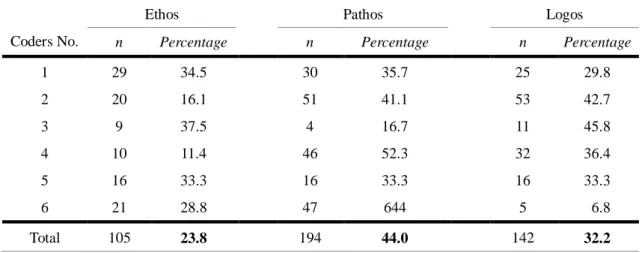
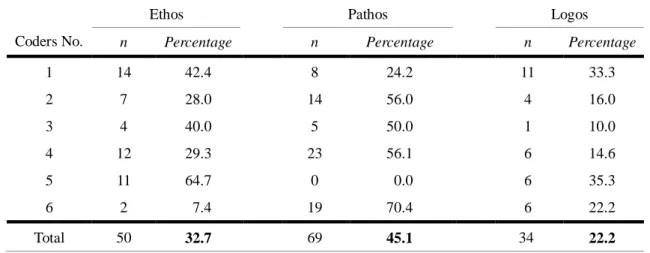
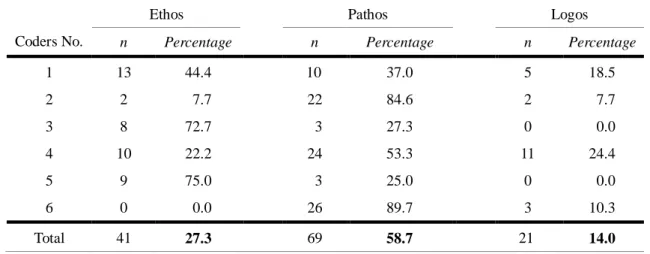
1. The first type of table shows the numbers and the percentages of the paragraphs in which each coder identified the rhetorical elements of ethos, pathos, and logos respectively under the condition that coders are allowed to identify multiple elements in a paragraph in a target speech;
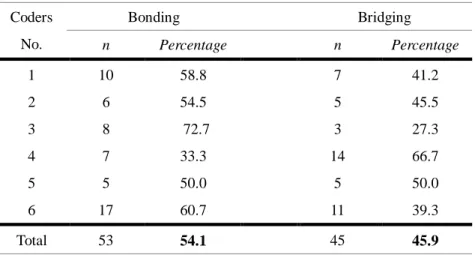
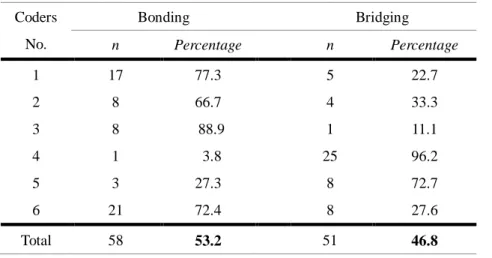
2. The second type of table shows the numbers and the percentages of the paragraphs in which each coder identified bonding rhetoric and bridging rhetoric respectively under the condition that coders are allowed to identify either or both of them in a paragraph in a target speech;
3. The third type of table shows the numbers of paragraphs in which more than a half of coders identified the same rhetorical elements of ethos, pathos, and logos respectively under the condition that coders are allowed to identify multiple elements in a paragraph in a target speech; and
4. The fourth type of table shows the numbers of the paragraphs in which more than a half of coders identified the same rhetorical elements of bonding rhetoric and
- 16 -
bridging rhetoric respectively under the condition that coders are allowed to identify either or both of them in a paragraph in a target speech.
Summary of method.
This dissertation conducts qualitative descriptive and interpretative analyses utilizing the data of non-trained coders’ perceptions of rhetorical elements in target speeches. This researcher conducts the analysis according to the following procedure:
(1) addresses will be examined to identify the themes delivered by speakers; (2) based on the itemized themes, addresses will be coded through a line-by-line analysis to identify the elements of ethos, pathos, logos as well as bonding or bridging rhetoric utilized by speakers; (3) by employing the data in which six non-trained coders intuitively identify these rhetorical elements in target addresses based on the definition of the target rhetorical elements above, the conceivable features of perceptions of ordinary listeners will be examined; and (4) some elements of rhetorical strategy missed by many coders despite an objective presence of such element will be examined.
- 17 -
Chapter 3 Results and Discussion
Analysis of the Addresses at the UN General Assembly
1. The background situation of the UN addresses by Rouhani and Netanyahu in 2015
The impact of JCPOA.
To understand the situations of Iran’s president Rouhani and Israel’s prime minister Netanyahu at the time when their addresses were delivered at the UN General Assembly in 2015, it is useful to know about the historical agreement “The Joint Comprehensive Plan of Action (JCPOA).” According to the U.S. Department of State, JCPOA was reached on July 14, 2015, between Iran, six world powers (China, France, Germany, Russia, the UK, and the US) and the EU to “ensure that Iran’s nuclear program will be exclusively peaceful.” According to Sterio (2016), JCPOA means that “Iran agreed to curb its nuclear program in exchange for the lifting of United Nations-imposed sanctions against Iran” (pp.69-70).
Regarding Iran’s economic advantages coming from “the lifting of sanctions against Iran,” Sterio (2016) claims that “Iran will be positioned to recover approximately $100 billion of its assets frozen in overseas banks” (pp.76-77). On the other hand, as for the shortcomings of JCPOA, Sterio (2016) points out the facts that “Iran could, in fifteen years, resume operating a larger military-purpose oriented nuclear production” and that
“IAEA inspectors…will have to ask Iran’s permission to visit any non-declared sites….which may enable it [Iran] to hide and remove any forbidden nuclear production items” (p.78).
These advantages for Iran from the JCPOA were certain to affect the tone of Rouhani’s address at the UN General Assembly in 2015. The article “Iranian’s U.N.
Speech Appears to Favor Engagement” by Rick Gladstone in The New York Times on September 27, 2015 asserted that “Rouhani’s choice of words…was largely optimistic and appeared to reflect an increased confidence partly because of the nuclear agreement.”
In contrast to Rouhani’s advantages from JCPOA and his “optimistic” address at the UN, Netanyahu not only blamed the agreement but was also forced into a period of delicate relations with the US at that time. An article “Obama secures votes to protect Iran nuclear deal” by Karoun Demirjian and Carol Morello in The Washington Post
- 18 -
reported on September 2, 2015 cites the remarks of Israeli officials that “Netanyahu will keep attacking the deal” as follows: “‘The Prime Minister [Netanyahu] has a responsibility to point out the flaws of an agreement that endangers Israel, the region and the world….He believes the deal is a mistake.’” In addition, as for the situation of the US relevant to the implementation of JCPOA at that time, Sterio (2016) says that “If the United States Congress disapproves the Agreement, President Obama will most certainly veto Congressional disapproval….it is extremely unlikely that Congress will be able to override the presidential veto” (pp.79-81).
This backdrop of Rouhani and Netanyahu with respect to JCPOA provides us with some hints about how to analyze their addresses at the UN General assembly in 2015. In the following sections of my dissertation I will examine addresses by Rouhani and Netanyahu at the UN General Assembly in 2015 from two perspectives: how coders identified the target rhetorical elements in their addresses; and how Rouhani and Netanyahu delivered their messages in their respective situations just after an epoch-making agreement of JCPOA, which they call the Iran Nuclear deal.
2. Theme-Based Rhetorical Analysis of Address by Hassan Rouhani at the UN General Assembly, September 29, 2015
Theme 1: Blaming Saudi Arabia for its incompetence in Muslim pilgrims’ accident.
(2) (Note. Hereafter, the numbers in the parenthesis at the end of each theme show the paragraphs concerned.)
Rouhani begins his address by referring to the stampede which occurred just four days earlier at the annual Hajj pilgrimage to Mecca in Saudi Arabia and blamed Saudi Arabian officials for their incompetence and mismanagement. According to Alghunaim (2014), Saudi Arabia is regarded by Iran as “its main rival in the Middle East” (p.127).
He says:
…(S)audi Arabia chose to ally with the United States and adopted a long term foreign policy to ensure this alliance…. Saudi [Arabia] also continues to ally with regional states that are allies with the U.S. to powerfully position itself. On the other hand, Iran allies with Russia…. Iran also allies with states that choose Russia as an authoritative power such as Syria to broaden its regional spectrum and power, and insure its security. (p.125)
- 19 -
In light of the fact that Iran has rivalry with Saudi Arabia, it is understandable for Rouhani to harshly blame Saudi Arabia for its “incompetence and mismanagement.”
Rouhani’s opening remarks about the stampede are substantially different from the contents of other parts of his address, which shows that Rouhani takes advantage of his address at the UN General Assembly as an opportunity to criticize Saudi Arabia before delivering his main massage. Four coders identify pathos and three coders identify logos in this paragraph. This shows that Rouhani’s blaming Saudi Arabia evokes the emotions of the coders as well as sounding reasonable to them. Although two coders identify bonding and bridging rhetoric in this paragraph, in light of the fact that Iran has rivalry with Saudi Arabia, Rouhani utilizes bonding rhetoric to the Iranian people rather than bridging rhetoric to Saudi Arabia.
Theme 2: Emphasizing the success of JCPOA. (3, 4, 5)
After “proudly” declaring that “today, a new chapter has started in Iran’s relations with the world” in paragraph 3, Rouhani refers to the successful result of the Joint Comprehensive Plan of Action (JCPOA) between Iran and six major powers in paragraph 4. Rouhani emphasizes that JCPOA becomes “an international instrument with the ratification of the United Nations Security Council” as well as a “strong precedent” where two opposing sides “engaged in dialogue and understanding before the eruption of conflict.”
According to the description by U.S. Department of State, JCPOA, which was reached on July 14, 2015 between Iran and six world powers (China, France, Germany, Russia, the UK, and the US) and the EU, aims “to ensure that Iran’s nuclear program will be exclusively peaceful.”Given the fact that JCPOA is an epoch-making event, it is quite reasonable that five coders identify logos within the facts Rouhani refers to in this paragraph.
Rouhani emphasizes that the successful result of JCPOA was due to “all the negotiators [’] ” diplomatic efforts utilizing “the full capacity of international law” as well as the “potentials of constructive dialogue” in paragraph 5. Then Rouhani presents his political stance giving importance to “multilateralism and win-win solutions.” He says:
As in commerce and economic activity, where the interests of both parties should be taken into account, in politics and international relations as well multilateralism and win-win solutions should be the basis of engagement.
- 20 -
Four coders identify ethos, logos, and bridging rhetoric in this paragraph. In light of the fact that the concepts that Rouhani presents with several key words such as “[utilizing]
the full capacity of international law,” “constructive dialogue,” and “multilateralism and win-win solutions” can be accepted as a sign of the benign and positive disposition of the leader of the nation in the international community today, it is quite natural that a majority of coders identify ethos presenting the speaker’s trustworthy character, logos for the reasonable message accepted in the international community, and bridging rhetoric to other member states of the UN.
Theme 3: The United Nations made the right decision this time. (6, 7, 8, 9)
Rouhani claims that previous UN resolutions and sanctions against Iran were “unfair”
as well as “unjust and illegal,” due to “[some countries’] illusive and baseless allegations” from paragraph 6 to 9. As proof of Iran’s being innocent of any intention to possess nuclear arms, Rouhani not only refers to “fatwa,” which is defined in Oxford Islamic Studies Online as “authoritative legal opinion given by a mufti (legal scholar),”
but also emphasizes Iran’s sincere attitude in the process of “negotiations” of JCPOA in paragraph 8. He says:
But these sanctions never in any way affected the policy we adopted and the approach we took towards negotiations. We proved in these negotiations that there is nothing on Iran’s table other than logic, reason and ethics, and where necessary, legitimate and decisive self-defense against any kind of aggression.
Four coders identify pathos and logos, three coders identify bonding rhetoric, and two coders identify ethos in this paragraph. This shows a couple of interesting implications relevant to coders’ perceptions and Rouhani’s rhetorical strategy.
First, although Rouhani emphasizes the “unjust and illegal” aspect of UN sanctions against Iran as well as the existence of “logic” and “reasons” on Iran’s side in the negotiations, on closer look at his remarks here, it is apparent that he just presents his one-sided interpretation of Iran’s righteousness without any supporting evidence. The only plausible factor supporting his claim is the fact that sanctions against Iran will be lifted by the successful implementation of JCPOA. This interpretation is in line with the fact that Rouhani emphasizes that “the United States of America was prompted and forced to set aside pressure and sanctions and choose the table of negotiations and discussions” in paragraph 9. In other words, Rouhani tries to fully utilize Iran’s
- 21 -
successful consequence of negotiation in JCPOA as the sole evidence to support Iran’s righteousness. Rouhani’s assertion that “We proved in these negotiations that there is nothing on Iran’s table other than logic, reason” probably plays the role of causing the coders to identify logos in this paragraph. In this respect, Rouhani does not necessarily present true logos or reason, but he succeeds in making the coders identify logos in this part.
Second, although Rouhani emphasizes his ethos in paragraphs 7 and 8, the majority of coders ignore the element. For example, in paragraph 7, after blaming the previous
“unfair resolutions” against Iran as “a result of misunderstandings and sometimes overt hostilities of some countries,” Rouhani says that “However, we believe, an old Iranian saying goes, ‘the sooner you stop harm, the more benefit you will reap.’” His remarks here can be interpreted as a sign that Rouhani tries to show his virtuous character, but only one of the coders identifies ethos in this paragraph. In addition, although Rouhani refers not only to the “fatwa” as the proof of Iran’s lack of any intention to produce nuclear weapons but also to “ethics” of Iran in the negotiations of JCPOA in paragraph 8, only two coders identify ethos. Instead, a majority of the coders identify pathos. This implies that the coders tend to identify pathos more than ethos even when the speaker refers to something relevant to his moral foundation.
Third, the fact that three coders identify bonding rhetoric implies that Rouhani’s emphasis on the unfairness and the unjustness of the sanctions as well as the righteousness and necessity of Iran’s action against these sanctions are regarded by the coders as bonding rhetoric, which brings about the unity among the people of the nation.
Theme 4: Emphasizing advancing a “nuclear weapons-free Middle East.” (11) Rouhani expresses his expectations for nuclear powers in paragraph 11: to “fulfill their [nuclear powers’] commitment of full nuclear disarmament based on Article 6 of the Non-Proliferation Treaty”; to advance a “nuclear weapons-free Middle East”; and not to allow “the Zionist regime” to be the “impediment” to realize the initiative.
Rouhani’s requests for “full nuclear disarmament” of nuclear powers as well as “nuclear weapons-free Middle East” based on the Non-Proliferation Treaty is not only legitimate and reasonable but also effective enough to highlight the unfairness and the absurdity between nuclear powers and non-nuclear nations in the world. In this respect, it is quite natural that four coders identify logos and three coders identify pathos in this paragraph.
In addition, given the fact that, as Mori (2016) points out, Rouhani “took advantage of a kind of open secret in the international community that Israel has developed and does