テレビ会議を用いた語学教育のあり方
(課題番号 15520375)
平成15(2003)年度〜平成16(2004)年度 科学研究費補助金 基盤研究(C)(2)
研究成果報告書
2005 年 3 月
研究代表者 川口義一
(早稲田大学国際学術院大学院日本語教育研究科 教授)
目 次
はしがき………p. 5
研究論文一覧………p. 5
研究資料一覧………p. 5
研究論文………p. 11
研究資料………p. 75
はしがき
本文書は、平成15年度から平成16年度科学研究費補助金による基盤研究(C)(2)課題
番号15520375(研究代表者:川口義一)による研究成果の報告書である。
本研究の目的は、外国語教育において学習者が習得した言語を実際に使う機会、すな わちインプットだけではなくアウトプットの機会を持つことが、目標言語の習得にどの ような影響・効果があるかを検討しようとするものであるが、その際、新たな語学教育 のあり方として、日本と海外の教育機関の間の「テレビ会議」システムを使用した教室 活動からデータを収集する方法を採用した。
本文書は、「研究成果」と「資料」の2部から成る。第1部の研究成果には、「テレビ 会議」授業の学習効果の評価に関する論文(英文)、「テレビ会議」におけるインターア クションの生成に関する論文(英文)、および「テレビ会議」授業におけるタスク設定の 意義に関する論文(英文)を掲載した。ただし、最初の論文は、本研究の出発点となる論 考で、本研究の直接の成果ではない。研究の流れを了解しやすくするために、参考とし て掲載した。第2部は、上掲の論文のうち後者2編を書くときに使用した日本・アメリ カ間の「テレビ会議」授業の学生間・学生/教師間のやり取りの談話資料を文字化した 資料である。本文書発行の時点では論文化していないが、日本・台湾間の「テレビ会議」
授業の同様の文字化資料も、参考として掲載した。
研究組織
研究代表者 川口義一(早稲田大学大学院日本語教育研究科教授) 研究者番号:70120912
研究分担者 宮崎里司(早稲田大学大学院日本語教育研究科教授) 研究者番号:151979
シェパード, クリス(早稲田大学理工学術院教授) 研究者番号:60350386
フィールド, マルコム(早稲田大学語学教育研究所助教授:当時) 研究者番号:50350385
アイズマンガー, イアン(早稲田大学語学教育研究所助教授:当時) 研究者番号:40350384
高木亜希子(早稲田大学語学教育研究所助手:当時) 研究者番号:50343629
木下直子(明海大学総合教育センター講師:当時) 研究者番号:40364715
海外協同研究者 東昭二(米国・ユタ大学文学部助教授)
交付決定額(配分額)
年 度 研究経費(千円)
使用内訳(千円)
設備備品費 消耗品費 国外旅費 謝 金 その他
平成15年度 2160 1348 112 400 300 0
平成16年度 780 0 80 400 300 0
総 計 2940 1348 192 800 600 0
研究開始当初の背景と研究の目的
加速度的な勢いでグローバル化・国際化していく今日において、コミュニカティブな 側面を重視した語学教育の必要性が関係者の間で叫ばれている。高等教育機関における 言語教育の現場でも、さまざまな工夫がなされており、国民の外国語運用能力の向上が 図られている。しかしながら、日本における外国語教育の根本的な欠陥は、教育内外と もに、実際に目標言語の母語話者とインタラクションする機会がほとんどないか、極め て限られていることである。この問題を根本的に解決しない限り、日本の語学教育は、
それにかける膨大な時間とエネルギーに比して十分な効果を期待することはできない。
このことは、海外における日本語教育についても同様である。
本研究は、この深刻な物理的制約を解決し、テクノロジー化する21世紀の語学教育に 向けて、新しい語学教育のありかたを模索するものである。具体的には、インターネッ トを使ったテレビ会議と電子メールを通じての語学教育の方法・実践・効果・課題を検 討するものである。参加機関は、早稲田大学と米国ユタ大学言語文学部である。両校の 間では、すでに3回(夏期それぞれの機関で1時間半ずつ)テレビ会議を実施しており、
必要な機材はすべて整っていて、技術的・物理的側面で本研究が実行可能であることが 両校関係者の間で確認済みであった。
研究の方法
◆ 平成14年度
① デジタルビデオカメラを米国側と日本側の教室に設置し、テレビ会議で行った討 論(日本語と英語使用)の内容を双方に送信する。また、テレビにはビデオレコー ダーを設置し、討論内の言語行動・ボディランゲージを収録する。送信するとき には、ISDNの電話線を利用(使用料1時間2万円)する。
② 参加学生の音声が収録しやすいように、各自にデジタルレコーダーをと携帯用マ
イクロフォンを設置して、独り言などのプライベートスピーチも記録する。
③ 収録語、参加学生には反省点や意見を書かせ、テレビ会議形式の授業が参加者に いかなる心理的影響を与えるかを記録する。
④ 収録したビデオを参加学生に見せ、自分たちの発言や行動の理由を考えさせる。
その場面もビデオ録画しておく。
⑤ 研究者(授業の教師を兼ねる)は、テレビ会議を観察して、研究ノートに気づいた 点を記録する。
⑥ テレビ会議で発言された内容をデータとしてコンピュータに入力する。その際、
音声は文字化して資料とし、データベースを作成する。
◆ 平成15年度
① 平成14年度と同様に資料を収集する。
② 平成14〜15年度に収録したデータベース(約60時間分)をもとに、会話分析(CA)を 行う。
研究成果の発表(全3件)
(1) 学術論文:2件
◆Field, M., Sheppard C. and Fegan, J. (2005)A Preliminary Evaluation of a Video-Conference Exchange. Bulletin of the Institute of Language Teaching, 57, 57-81 Center of Language Teaching, Waseda University
◆Sheppard C. and Field, M. Video-conference, task-based language learning and interaction:
Making conferencing meaningful in the classroom (forthcoming) (2) 図書(分担執筆):1件
◆Sheppard C. and Kawaguchi, Y. (2002) Task performance, language learning and video conferencing: An experiment in across-boarder collaboration, Chapter 15 in Field, M. H. and Fegan, J., eds ., Education Across Borders Philosophy, Policy and Pedagogy-New Paradigmas and Challenges, 237-257, Tokyo: Waseda University Media-Mix Co. Ltd
公開資料
ビデオで収録したテレビ会議の様子と参加学生の音声資料は、本報告書に添付するに は膨大すぎるので、web上にて公開する予定である。
研究論文一覧
◆Field, M., Sheppard C. and Fegan, J. (2005)A Preliminary Evaluation of a Video-Conference Exchange. Bulletin of the Institute of Language Teaching, 57, 57-81, Center of Language Teaching, Waseda University
………p. 13
◆Sheppard C. and Field, M. Video-conference, task-based language learning and interaction: Making conferencing meaningful in the classroom (forthcoming)
………..…p. 32
◆Sheppard C. and Kawaguchi, Y. (2002) Task performance, language learning and video conferencing: An experiment in across-boarder collaboration, Chapter 15 in Field, M. H. and Fegan, J., eds., Education Across Borders Philosophy, Policy and Pedagogy-New Paradigmas and Challenges, 237-257, Tokyo: Waseda University Media-Mix Co. Ltd
………p. 54
研究資料一覧
テレビ会議資料
Waseda University – Utah University 2003 Session Transcripts……… ……..……77
Waseda-Utah (session One) (14th October, 2003): English…………... …………..77
Waseda-Utah (session One) (14th October, 2003): Japanese……… ...……95
Waseda- Utah Session Two (October 28th): English………... ……….…120
Waseda-Utah (session Two) (28th October, 2003): Japanese……… …….……143
Waseda-Utah Session Three (2003 November): English……… ….………151
Waseda-Utah Session Four (November, 2003): English………. …....……179
東呉大学−明海大学 2005 Session transcripts………..…197
東呉−明海20050411……...………197
東呉−明海20050425.…………..………201
東呉−明海20050516.………..………217
東呉−明海20050523.………..………233
東呉−明海20050530.………..………240
東呉−明海20050606.………..………255
東呉−明海20050613….………..………270
研 究 論 文
A Preliminary Evaluation of a Video-Conference Exchange.
M. H. Field, C. Sheppard, J. Fegan
Introduction
The initial concern with the role of media and communication technology in education in Japan was in the early 1920’s. Monbusho “Standards” issued in 1973 were primarily intended to get educators to “brush up” their audio-visual materials skills (Takakuwa, 1997). In 1990, the Monbusho issued a new in-service teacher training manual, in which ‘The curriculum included computers and communication systems, databases and so on’ (Sakamoto, 1992, p.132). In 1995, further recommendations were issued encouraging every teacher to acquire a basic knowledge of computing.
Government plans for the ‘information society’ have been put in National terms, the assumption being that the new technologies would strengthen Japan's global competitiveness, and the central government would play a key role in orchestrating the introduction of the technologies (Morris-Suzuki, 1999).
During the same period in the nineties, universities in Japan began to adopt Information Technology (IT) tools for the learning/teaching of English as a Foreign Language (EFL). In some cases, huge amounts of money were spent on developing IT classrooms that could utilize web-based systems and communicative tools. CALL (Computer Assisted Language Learning) became the acronym for the use of IT in language education. The attitude to the new tools and the use of IT in EFL education in Japan in those early years might best/fairly be described as one of “youthful excitement”.
Teachers who recognized the need to improve CALL pedagogy and the effectiveness of CALL- based classes, however, began to ask questions and looked to second language-acquisition theories as a way to improve delivery and provide better opportunities for language acquisition (Hegelheimer
& Chapelle, 2000). It was argued that CALL could provide conditions for ‘real language’ exposure (Laurillard & Marullo, 1993, Kuramoto, 1999), in that it merged language and culture, which is considered the starting point of language acquisition (Gardner, 1985, Spolsky, (1989).
Vygotsky (1978) also realised the inter-relationships between culture, language and learning in his presentation of how social factors affect learning. Jones and Mercer (1993) argue that Vygotsky’s
work provides a basis ‘for a communicative perspective in the process of teaching and learning, a way of observing and analysing that process which contrasts with those more individualistic approaches...’ (p.21). Generally, Vygotsky’s theories have remained in the shadow of the more dominant Piagetian and Skinner theories (ibid.). Piaget saw himself more concerned with epistemology and the development of knowledge and intelligence. Vygotsky, on the other hand, was concerned with pedagogy - the science of teaching (Mercer, 1993).
Vygotsky (1978) argued that language is essential in cognitive development, problem solving and learning. In other words, acquiring a language enables the ‘child’ to think in new ways, and, therefore, to come to and make sense of the world he/she is engaging with. The child, furthermore, does not learn independently, but rather learns through a process of interactions in the ‘zone of proximal development’ (ZPD). The ZPD refers to the cognitive development that occurs in a social nature with ‘cognitive support’ from a more capable person (Jones & Mercer, 1993).
The traditional view and the ZPD result in very different ways of presenting tasks to learners. In the traditional approach... thus there is a tendency to emphasize rote learning of lower level components. The ZPD approach has an opposite emphasis...
the goal is being accomplished interactively from the beginning... There is always opportunity for ... actions to be made meaningful... (Newman, Grifin and Cole, 1989, p.153/154).
If, therefore, a pedagogy based on Vygotsky is used with IT or CALL, IT becomes the facilitating medium through which the teacher and learner, or learner and learner communicate. Vygotsky’s experiments on second language learning, however, were conducted at a time when the structuralist approach was the norm. He, therefore, proposed that second language learning develops in the reverse order to the first language acquisition, in that it is purposeful, conscious and deliberate (Laurillard & Marullo, 1993).
Laurillard and Marullo (1993) argue, however, that there is little opportunity within the traditional class-based (structuralist or functionalist) approaches for self-regulation. They argue that what second language teaching needs are task-based approaches that promote self-regulation. ‘[T]he aim, therefore, is to re-create in the second-language classroom the conditions under which individual learners acquired their first language’ (ibid. p.148). These first-language conditions, however, may not always be appropriate for learning the target language. ‘To speak any language appropriately, language use must change according to context’ (Siegal, 1996, p.357). Language and language usage are context -dependent and the social context within which we see, hear and produce language
affects what we process and how (Laurillard & Marullo, 1993 The context as much as the content of the language encounter, therefore, needs to be considered when developing language-learning classes that utilize IT as a tool for target language production.
Kitade (2000), through an analysis of Internet cyber-chat sessions among advanced American students of Japanese as a foreign language argues that computer-mediated communication (CMC) provides collaborative and comprehensible student-centred interaction in a foreign language. She states that ‘CMC-based goal-oriented activity creates a positive environment for SLA [second language acquisition]’ (p.163). The Japanese, however, who are traditionally passive and culturally and socially sensitive (Ikegami, 1991, Doi, 1973), and whose language supports that passivity (DeMente, 1993, Suzuki, 1986), may make choices that are rooted in the culture of their first language when they use English. These communication choices and strategies may not be conducive to communicating effectively in English, or acquiring the target language for communicative purposes.
Therefore, the provision of opportunities similar to first-language acquisition and which are student-centered and comprehensible may still not eliminate difficulties, as L1 cultural communicative strategies may still have a major effect on the interactive and communicative event.
Students...require special and thoughtful treatment when given new, non-traditional school subjects. There should be comprehensive planning when an innovation like that of IT is introduced into a school situation. The methods and strategies used for teaching... have to be thought through in detail[,] taking into consideration... academic, social and physical backgrounds, and their learning preferences and personalities…should enjoy some measure of success.
(Chen & Looi, 1999, p.171)
In other words, theoretically ideal conditions for one group or culture may not be ideal conditions for another group or culture. When developing cross-cultural IT-based interactions, creating ‘ideal’
conditions that are the result of giving careful thought to students’ academic, social and physical backgrounds may be difficult.
The Study
This paper details three video-conferencing/ sessions between students from a university in Tokyo and students at the University of Utah in Salt Lake City. A teleconference provides the closest
‘real-to-life’, or authentic face-to-face IT-based communication. Although a small delay can be experienced with picture frames (this should improve with the provision of broad-band access), interlocutors are able to speak ‘face-to-face’ with each other in real time, even though they are in different locations, even time zones. Teleconference interaction does not require the students to have developed computer literacy or skill competency. The teacher, or computer technician, can initiate a session as easily as dialling a telephone number or replaying a video, if the technical address protocols have been established.
The eleven American students were enrolled in a short intensive advanced Japanese as a Foreign Language course, and all had previously lived in Japan for at least two years. The Japanese students were predominantly second- or third- year undergraduate students enrolled in a Waseda University Institute of Language Teaching (Goken) course – Intermediate English (Chukyu) or the Study Abroad Preparatory (Ryugakujumbi) Course). One male student was a post-graduate Business major, one female was a visiting researcher, and another female participant was enrolled in the Institute’s Returnee (Kikkokushijo) course. These participants, however, only attended one of the three sessions.
In all, fourteen Japanese students participated in the teleconferencing sessions. The first session had ten Japanese participants, the second five, and in the third session, nine students interacted with the American students. All eleven American students attended all three sessions.
Data collection
The data for description of the teleconferencing sessions were collected using several methods, as this provided with a more accurate picture of the various processes. Data were collected through video recording of the sessions, two open questionnaires, and a guided composition In addition, there were post-session interviews with both teachers involved and the students conducted by the researchers.
Two video recordings were made of each session at Waseda. The first video was taken using a video camera set on a tripod at the Japanese-end. The size of the room in which the session took place limited the image, with some students being out of the picture. The US-end was taped from the monitor. Thus, the second video is what was seen by the Japanese participants.
The questionnaires were designed to obtain as much information from the Waseda participants as possible for this descriptive study. The first survey was conducted in Japanese and focused on
learner expectations, the difficulties they may have had, and the value of the session. The second questionnaire was in English and focused on use of language and possibilities for future courses using teleconferencing technology. Both questionnaires were administered after the third session.
Free composition format evaluations/responses were produced by the Utah student participants.
The final data-collection method employed at the Japanese end was the post-session interview. This was an informal discussion period in which the Waseda participants and teachers were asked various questions, and asked to give comments.
The following is a description of the major factors involved in the teleconferencing sessions, namely the physical setup, topic selection, language selection and, learning. This is followed by a discussion of the problems and possible solutions to those problems.
Physical set-up
Each of the two separate locations in which the sessions were conducted will be described, starting with the Japanese location.
Japanese location
The camera was located in the corner of the room next to the blackboard. Direction and zoom were controlled by a remote control. This was only changed occasionally, when a participant who was off-screen contributed to the conversation. There was only one microphone, which was placed in front of the students. Although the mike was sensitive enough to pick up speaking anywhere in the classroom, when participants wanted to speak they felt the need to establish their turn by either moving to the mike, or placing the mike in front of them. The significance of this for interaction will be discussed later. The seating arrangement was free and changed from session to session. The first session was typical of a teacher-to-the-front class, with the desks set in rows facing the front of the room. In the second and third sessions, there was an attempt by the teachers to make it easier to participate, and the seats were moved to a u-shape.
US-end.
The camera was placed at the front of the room and, as in Japan, the zoom and direction were controlled by a remote control. The session was conducted in an AV room, where the desks were fixed. The students were seated around the room, with ample space between them. There was also
only one mike, which was passed around from student to student.
Topic Selection
The topics for the sessions were decided before the session and e-mailed to the students before each session. These topics were based on current affairs, as it was assumed that the participants would have some familiarity with these topics, and therefore, have something to discuss. The topics suggested for Session 1 were:
What is the process and system for getting a job in Japan (How does somebody get a job)? Consider the different approaches for an individual who has graduated from junior high school, high school, university and/or graduate school. Is this process the same for men and women? Are the opportunities to develop a career the same for men and women? Do women feel that they have the same opportunities as men? Do men feel that women have the same opportunities? How does this compare to the US? Do you think that PM Koizumi can turn Japan's failing economy around? From an American perspective, how have American attitudes toward Japan, the Japanese people, Japanese economy and Japanese business systems and way of doing things, changed in the last 15 years?
The topics suggested for the second session were also sent the day before, and were as follows:
Should Japan compensate the 'comfort women'? What is the general attitude about this situation in Japan and in the US? The Kyoto Protocol attempts to address environmental issues at a macro level. How are environmental issues being addressed at the micro level? In other words, what are individuals, local governments, etc., doing to reduce greenhouse gases, pollution, protect wildlife and rivers, etc.? What role should Japan/US play in the global economy? What is the average American's (if that is possible) understanding regarding Japan's culture, people, lifestyle, thinking, etc? Reciprocally, what is the average Japanese view of the US culture, people etc.? Do Japanese women still 'walk one step behind' the men? How do Americans view (the stereotyped) Japanese women? How do Japanese view (the stereotyped) American women?
During the actual discussion, these topics were largely simplified to personal preferences. The second session discussed relationships, and even advice was requested on how to become more
popular with the opposite sex.
Language selection/Choice of Language
As the participants at both ends had both English and Japanese proficiency, to a degree, both languages might be used for communication. Communication, in fact, took place in both languages.
However, Japanese tended to be dominant. Language is a communication system, and, usually, the system that is most efficient for this purpose will be selected by the participants. In this case, the US participants had two years’ experience of using Japanese in Japan. In contrast, the Japanese participants, although they had studied English for over six years, had, in most cases, had little opportunity to use the language in communicative contexts. Thus, communication in Japanese was more efficient. This was supported by the survey results, as all of the Japanese participants indicated that they felt more comfortable actually usingJapanese.
However, personal choice and strategy use also played a part in language selection. Some participants had decided that this was an opportunity to use English, or Japanese, and used it regardless of the situation, whereas, other students were more accommodating and responded in the language in which they had been addressed.
Language and Cultural acquisition
From the point of view of learning and education, there are three main reasons for conducting teleconferencing sessions. They are: to exchange ideas and content, to learn about another’s culture and to learn language. Although, all three are interrelated, and all three were goals for the students participating, because of the topics discussed, only the latter two were developed.
Culture
There was ample evidence that the participants gained some useful insights from the interaction with their interlocutors. In particular, the US participants, who had discussedthe cultural aspects of the 3-session exchange later in a regular class, dealt with cultural differences at length in their composition evaluations. Cultural differences noted concerning Japanese interaction included the Japanese tendency to give opinions after consulting with one another, or by electing ‘an expert’ to express present group opinion. Another Utah participant discussed the non-confrontational /character of Japanese interaction, where Japanese avoid confrontation and Americans embrace it. The same student noted that Americans were probably breaking Japanese cultural rules by being so
‘aggressive’. The explanation suggested for this behavior was the/a Japanese need for conformity and avoidance of conflict. Other comments dealt with the differing roles played by gender in the interaction. One American participant commented that the Japanese seemed to know were to sit, as if seating was pre-assigned. Another, pointed out that girls sat with girls and the boys with the boys.
Girls also seemed to be more willing to discuss serious topics.
The Japanese students also commented on cultural differences. However, their comments were more on superficial aspects., This difference may have been owing, in part, to the fact that the Americans had had a post-session discussion focussing on explaining Japanese behavior from a cultural perspective. One Japanese student noted that seeing the cultural differences was interesting, but did not elaborate on what those differences were. Another student,found the American’s life interesting.
Several commented on differences by reflecting on their own behavior and the behavior of Japanese.
They pointed out, for example, that Americans were very good at expressing their ideas and opinions, whereas they were not.
The post-session/exchange interview also produced some comments about culture. One was that through direct contact, they found their previous image of American culture, differed considerably from that reported by the US participants.
It is clear that both sides in the interaction were obtaining from these sessions and processing cultural information which is very probably contributing to understanding, or misunderstanding, depending on the accuracy of the interpretation.
Interaction and Language Acquisition
One important aspect of this kind of exchange is the opportunity to get the student away from teacher-fronted classrooms. According to Markee (2000), the structure of conversation of most teacher-fronted classes is structured by initiation/response/follow-up (IRF) where the teacher asks the student a question, the student answers the question and the teacher supplies feedback in the form of some kind of evaluation. Markee pointed out that this interaction is not beneficial for language acquisition.
In these Waseda-Utah sessions, the teachers made a conscious decision to stay on the periphery of the conversation as much as possible. However, some prompting was given through the interaction.
This allowed the participants to take control of the interaction, which is something that assists both first- (Wells, 1985) and second-language acquisition; this is also known as the topicalization
hypothesis (Hatch, 1978).
Negotiation of meaning, where there is some kind of communication breakdown, is also hypothesized to provide the opportunity for language learners to obtain information for a gap in their knowledge (Long, 1983; Pica and Doughty, 1985) at the ZPD (Vygotsky, 1978). This is also known as the interaction hypothesis. Later, in an attempt to bring the interaction hypothesis up to date, Long (1996) also suggested that negotiation assisted the language-acquisition process by allowing the learner more processing time to notice language form. Assuming the interaction hypothesis is valid (and evidence from Ellis, 1999; Bygate, Skehan and Swain, 2001 and Ohta, 2001, provide ample evidence to suggest that, if a teleconferencing session is to assist in the development and acquisition of language, then we need to ensure that negotiation of meaning takes place.
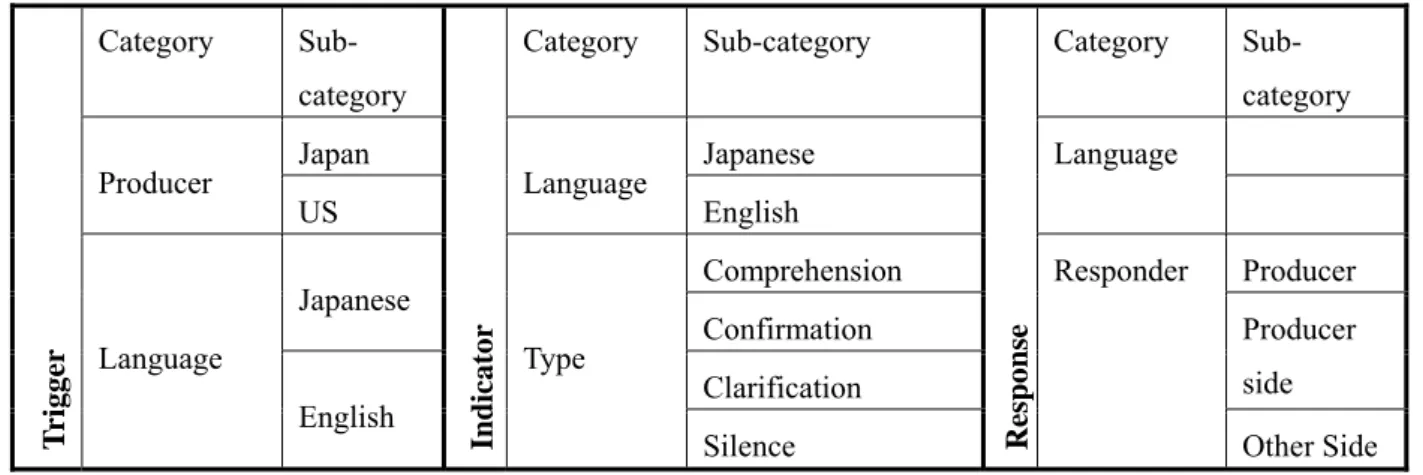
From the videotapes of the three sessions, there is evidence, both that negotiation took place, and that opportunities for negotiation were missed. Learners frequently indicated misunderstanding, requested clarification, and confirmation, all of which are triggers for negotiation. These triggers were often responded to. However, because of the physical distance of the participants from the camera and the monitor, because of the time lag, and because of the group setting, many of these triggers were missed or ignored. So although interaction is taking place, it may be limited by the medium through which it is taking place. A detailed analysis of the interaction and negotiation is beyond the scope of this paper, and will be reported at a later date.
However, in response to one of the questionnaire items, the Japanese learners did report that they had learned language from the session. Six of the nine respondents indicated that they were conscious of having learned some aspect of the language, with most indicating between one and three, and one indicating that he/she had taken in more than six. Particularly interesting is the fact that in the post-exchange interview, the students cited the item that was the subject of the most explicit focus of negotiation during the session.
Problems and suggestions for the future
Thus far, we have dealt with a description of the teleconferencing sessions. In order to develop this method so that it may be a more effective teaching tool, it is necessary to focus both on the problems relating to interaction and on suggestions for future exchanges. The topics dealt with in the descriptive sections above will be treated separately in what follows, focusing on those problems and offering such suggestions.
Technology and set-up
Many of the students commented that the mike was very difficult to use. As there was only one mike, possession of it was often used to indicate turn control, that is, the person who had it, had the right to speak. This was especially true in the American classroom, where the students were quite spread out over a fairly large AV room. When one student had possession of the turn, other students seemed to
“switch off”/”tune out”, or, at least, change their role from that of an auditor, a potential participant in the conversation, to that of an ”over-hearer”, one who has no potential to participate/possibility of participating. According to Ohta (2001), personal participation is much higher when the participator is an auditor than when he/she is just over-hearing the conversation.
One solution would be for each student to have his/her own mike, and, thus, equal participation rights in the dialogue. This has been shown to be successful in another inter-pacific session between Japanese and US students.
As noted above, another problem was with the seating arrangements. In the first session, many of the Waseda students were out of range of the camera, and so not visible on the screen, which seriously reduced the opportunity for participation in the interaction. Students overcame this problem by moving to the row in front of the camera when they wanted to take their turn., We were able to solve this problem by changing the desk layout to a U-shape so that students did not need to move in order to take part in the interaction.
The problem was more serious in America, as each desk was attached to a tape recorder desk and the floor. This resulted in most of the interaction from the American side being one person at a time, rather than group-to-group. An American student noticed this and suggested that perhaps the studentsshould/mightsit in a circle so that all were more available to contribute to the discussion.
The third problem concerns the actual technology used. Several students at both ends referred to problems with the image, which was not smooth. They said that this had been a somewhat distracting. However, we have been informed that bandwidth is the main cause of this image distortion, and that the problem can be solved by using a larger bandwidth.
In general, the set-up needs to take account of the kind of interaction expected of the students. If is group-to-group, we need to provide a physical environment in which all the students can contribute to the discussion easily and at virtually any point. From our experience in these sessions, this can largely be achieved through a better mike system and appropriate desk layout.
Topic Selection
Along with classroom set-up, and other environmental factors, selection of the topic, task and goal is a very important aspect of pedagogy. For two of the three sessions, topics were e-mailed to the students the night before so that they could prepare for the discussion. However, in the actual sessions, the participants only treated these topics shallowly, if at all. The topics treated tended to be about personal experience and daily lifestyle topics: the Americans’ time in Japan and relationships, for example. Such superficial discussion seems to have been unsatisfactory for some of the American students, several of whom commented that Japanese students didn’t seem to be able to discuss topics of a more serious nature.
Although these topics may be beneficial for some aspects of language learning, they were not really felt to be at the students’ ZPD (zone of proximal development). Thus, the opportunities for the learners to develop their English were greatly diminished. In this respect, the sessions were a pedagogical failure.
To avoid such failure in the future, we need to ask ourselves, what we can do as teachers. First we need to examine the reasons behind the failure. There are several possibilities: practical, culture, language level and motivation. One possibility is that the students do not check their e-mail everyday, so they did not have the opportunity to consider the topics before the class. Of the nine students who replied to the questionnaire, three said they did not get any information before the sessions. However, they were informed before hand to check their e-mail before the sessions, so there are other constraints involved here. One is a possible lack of motivation for English study. These students, however are attending the sessions as volunteers, so they are making an effort to study, thus lack of motivation may not be a factor. A third reason could be cultural. That is a serious discussion between these participants, who do not know each other well, could be to threatening for these students. And the last factor is that the topics could be too difficult for the students to prepare independently.
Whatever the reason there is obviously a need to try and make sure the participants do prepare the topic in advance, so that they have the content under control, which frees up more attentional resources (VanPattern, 1996) for use in acquiring new forms, and producing for fluent, complex or accurate (Skehan, 1998) output. The first is the selection of the topic. The topic needs to be interesting and relevant to all of the participants. For these sessions, this was considered, and topics which were supposed to be relevant and in the participants experience were selected (current affairs).
It is possible that student interest in current affairs was over estimated. Two of the Japanese students
wrote that they would have liked more of the personal experience style topics during the sessions.
Perhaps a survey of future participant interest would assist in topic selection, but in general, I believe that the use of current affairs is the most appropriate, considering all the factors involved.
Preparation is another factor to be considered. One of the main reasons for the failure of the topics was lack of preparation. Several of the Japanese students confessed to not preparing the topics before the class. Whatever the reasons are for this, as teachers we need to ensure that students are prepared for this kind of interaction, to ensure that the maximum possible benefit is derived from these sessions. Perhaps, rather than requiring the students to prepare the topic on their own, it would be wiser to have a pre-session meeting. There are multiple benefits. The first is students have an opportunity to process the content and some of the language before the session freeing up processing resources. The second is that students meeting one another for the first time can get to know each other. The last is that the ideas can be developed as a group, thus a unified opinion can be presented to the other group during the interaction. As noted before in the culture section above, the need to present a group view was cited by American students as one of the mechanisms behind Japanese interaction. Both Japanese in questionnaires and the post-session interview, and Americans in their reports suggested preparation as one way to enable the sessions to proceed at a higher level.
Another suggestion made by one American student is to move away from a content-based approach, to a task-based approach, where each student involved in the interaction is given a task so complete during the session. This would mean that participants are forced to interact so that they can complete their tasks. This would also require a preparation session to ensure that the students understand their task. The same student also pointed out that these task could be a part of a greater project.
The reports from the US-end, showed that post-session focus was also extremely beneficial, in this case to the students critical understanding of Japanese culture.
Language Selection
In addition to preparation of content or tasks for the session, we also need to consider structuring the interaction during the sessions. For these sessions the language used was left to the individual learners. This, according to the Japanese learner’s questionnaires made the task of communication a lot more comfortable, they knew they could fall back on Japanese if necessary. This may have been a factor contribution to the overall success of the videoconferencing exchange by reducing stress and the so-called affective filter (Krashen: 1981, 1982, 1985).
While recognizing that they were more comfortable have the opportunity to use both languages, many participants commented that this was not facilitative to their language learning as there was no need to push their English output which Swain (1985) claims is so necessary for full language development. There needs to be a balance between a low stress interaction and required use of the target language. In deciding whether free or restricted language selection is utilized the overall goals of the interaction need to be considered. If exchange of information and opinions is the goal, then the language used is not important. However, if language development is the objective, then we should consider restricting language choice.
Language and culture
Finally, what are the impediments to the acquisition of language and culture in videoconferencing?
From the discussion above, there is ample evidence of participants noticing cultural differences and of the uptake of language. Could this development be greater?
One of the major problems with videoconferencing discussed previously, and one which we have little control over is the distance between the learners. From observations of the sessions, it was clear that a large amount of information, especially non-verbal communication was being lost. This affected the structure of the conversation, and many opportunities for communication repair were missed. These differences need to be examined closely to determine which are characteristic of this kind of interaction and which can be minimized through the teaching of strategies.
Conclusion
Overall, the use of videoconferencing proved to be beneficial. Students found the use of this technology interesting and useful. All students showed they had gained something from the interaction, be it an understanding of a cross-cultural view point (or similarity), a deeper understanding of the interlocutors culture and, development of their second language proficiency and skills.
Despite these benefits, there is still more we can do to improve various aspects of the interaction to make it even more effective. These include use of the mikes and the arrangement of the desks, selection of topics and pre/ post-session focuses and, more consideration of the goals and the language of interaction.
Future research in this area needs to examine the effects of these suggestions on videoconferencing
interaction to confirm, or disconfirm, their validity.
Pedagogical implications for a videoconferencing course
These suggestions have implications for a course based on videoconferencing technology. A course would need to stagger videoconferencing sessions with classes set aside for preparation activities and post-session activities. For maximum effect, the pre/ post-sessions activities would need to be completed as close to the sessions as possible, so that the learners do not forget the session content.
Thus such a course would be most effective run twice a week.
Bibliography
Chen, A-Y. & Looi, C-K. (1999) Teaching, learning and inquiry strategies using computer technology, Journal of Computer Assisted Learning, 15/2, (162-172)
DeMente, B.L. (1993) Behind the Japanese Bow: An Indepth Guide to Understanding and Predicting Japanese Behavior. Chicago, Ill: Passport Books
Doi, T. (1973) The Anatomy of Dependence. New York, NY: Kodansha International
Ellis, R. (1999) Learning a Second Language Through Interaction. Philadelphia, PA: John Benjamins
Gardner, R. (1985). Social Psychology and Second Language Learning, London. U.K.: Edward Arnold
Hatch, E. (1978). Discourse analysis and second language acquisition. In E. Hatch, Second Language Acquisition. Rowley, Mass: Newbury House.
Hegelheimer, V. & Chapelle, C.A. (2000). Methodological issues in research on learner-computer interactions in CALL, Language Learning & Technology, 4/1, May, 2000, (41-59)
Ikegami, Y. (1991). Introduction: Semiotics and Culture. In Y Ikegami (Ed.) Empire of Signs:
Semiotic Essays on Japanese Culture, Amsterdam: John Benjamin Publishing Company, (1-23)
Jones, A. & Mercer, N. (1993). Theories of learning and information technology. In P. Scrimshaw (Ed.), Language, Classrooms and Computers, London & New York: Routledge
Kitade, K. (2000). L2 Learners’ Discourse and SLA Theories in CMC: Collaborative Interaction in Internet Chat, Computer Assisted Language Learning, 13/2, (143-166)
Krashen, S. (1981). Second Language Acquisition and Second Language Learning, Oxford:
Pergamon.
Krashen, S. (1982). Principles and Practice in Second Language Acquisition. Oxford: Pergamon.
Kuramoto, A. (1999) A Cognitive Psychological Study of L2 Learning Environments. In Paul Lewis (Ed.), CALLING ASIA: The Proceedings of the 4th Annual JALT CALL SIG Conference, Kyoto, Japan, May 1999, (115-118), Nagoya: JALT
Laurillard, D. & Marullo, G. (1993) Computer based approaches to second language learning. In P.
Scrimshaw (Ed.), Language, Classrooms and Computers, London & New York: Routledge, (143-165)
Long, M. (1985) ‘Input and Second Language Acquisition Theory’. In S. Gass and C. Madden (eds), Input in Second Language Acquisition, Rowley, Mass: Newbury House
Long, M. (1996) ‘The Role of Linguistic Environment in Second Language Acquisition’. In W.
Ritchie and T. Bhatia (eds). Handbook in Second Language Acquisition. San Diego:
Academic Press.
Markee, (2000). Conversation Analysis. Independent Press.
Mercer, N. (1993) Computer based activities in classroom contexts. In P. Scrimshaw (Ed.) Language, Classrooms and Computers, London & New York: Routledge, (27-39)
Morris-Suzuki, T. (1999) Cyberstructure, Society, and Education: Possibilities and Problems in the Japanese Context, National Institute of Multimedia Education's International Symposium, 1999, Japan http;//www.nime.ac.jp/conf99/pre/Morris-Suzuki.html
Pica, T. (1987) ‘Second Language Acquisition, Social Interaction in the Classroom’, Applied Linguistics 7: 1-25.
Sakamoto, T. (1992) Impact of informatics on school education systems: National strategies for the introduction of Informatics into schools - Nonsystematic but still systematic, Education and Computing, Vol.8, (129-135)
Siegal, M. (1996). The role of learner subjectivity in second language sociolinguistic competency:
Western women learning Japanese, Applied Linguistics, 17/3 (356-382)
Skehan, P. (1998). A Cognitive Approach to Language Learning. Hong Kong: Oxford University Press
Spolsky, B. (1989). Conditions for Second Language Learning. Oxford, U.K.: Oxford University Press
Suzuki, T. (1986) Language and Behavior in Japan: The Conceptualization of
Personal Relations. In Takie Sugiyama Lebra & William P. Lebra (Eds.), Japanese Culture and Behavior: Selected Readings, Honolulu, Hawaii: Honolulu University Press (201-246)
Swain, M. (1985) ‘Communicative competence: some roles for comprehensible input and comprehensible output in its development’. In S. Gass and Madden (eds.). Input in Second Language Acquisition. Rowley, Mass: Newbury House.
Takakuwa, Y. (1997) The Situation in Japan, Educational Media International, 34/1, (22-24)
VanPattern, B. (1996) Input Processing and Grammar Instruction in Second Language Acquisition.
Norwood, New Jersey: Ablex Publishing Corporation.
Vygotsky, L.S. (1978) Mind in Society, Cambridge, Mass: Harvard University Press Quoted from Jones, A. & Mercer, N. (1993) Theories of learning and information technology. In P.
Scrimshaw (Ed.), Language, Classrooms and Computers, London & New York: Routledge
Wells, G. (1985) Language Development in the Pre-School Years, Cambridge, Cambridge University Press
Appendix A.
A.
You had been told that the Utah students 1) would be native speakers of English proficient in Japanese, 2) had been in Japan for two years. [Did you find they knew Japanese and Japan better than you had expected? ( Yes No )]
Did this make your more comfortable or less comfortable in the interaction?
More comfortable Less comfortable
Why? In what way(s)
1.
2.
3.
B.
How do you feel the factors referred to in A. affected the other Waseda students?
1.
2.
3.
C.
In this exchange, one language was supposed to be used in a particular time "block" ("switching from one to the other was discouraged). It would be possible to obtain the same advantages but structure the exchange so that later in the session you could go back to a topic(s) and use the other
language.
1. Do you think this would be (a) Good, b) Not good?
1a. Why?
1.
2.
D.
Are you conscious of having learned, or of having learned how to use, English words, expressions or grammatical constructions in these sessions?
Video-conference, task-based language learning and interaction: Making conferencing meaningful in the classroom
Chris Sheppard, International Christian University Malcolm Field, Hakodate Mirai University
Abstract
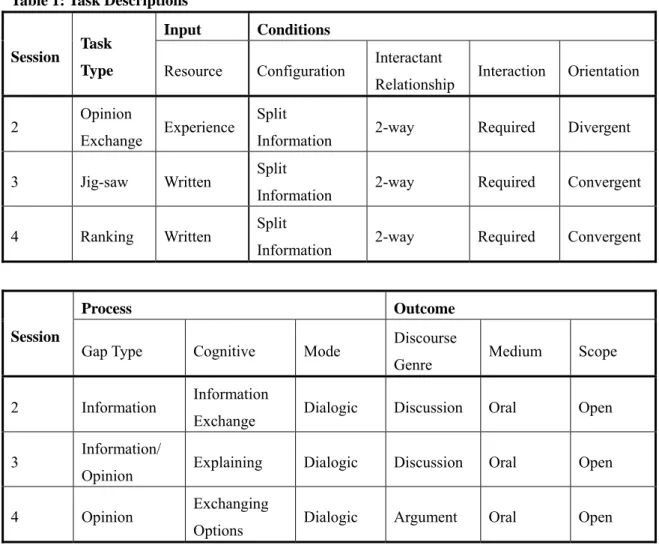
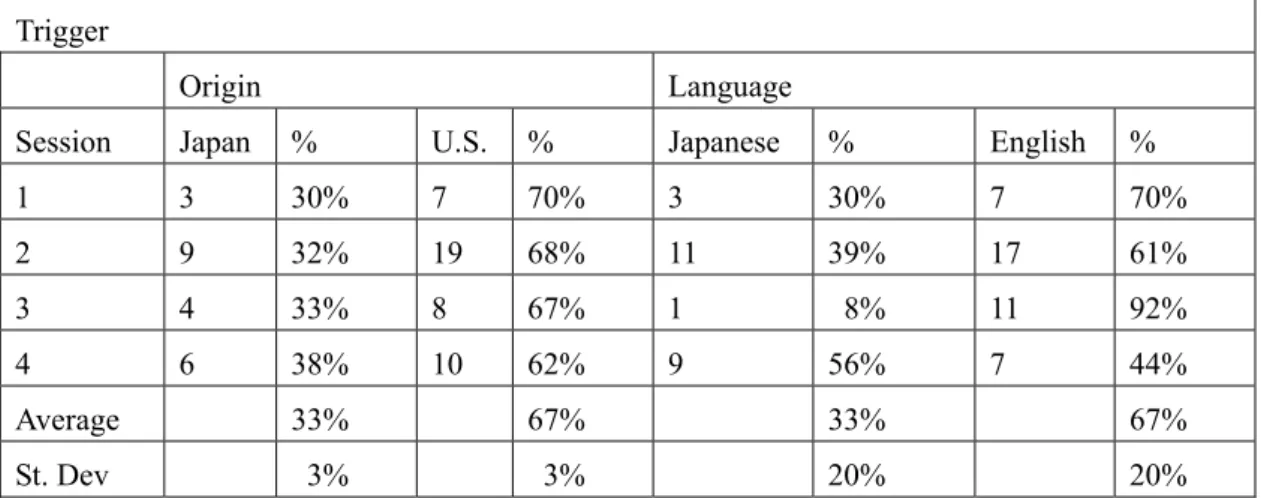
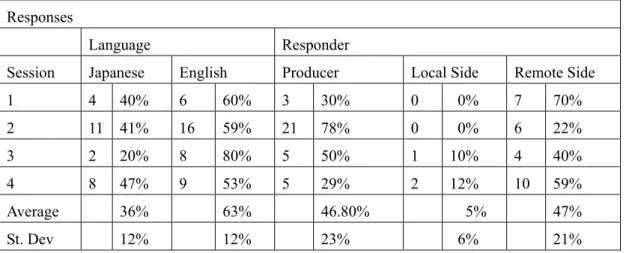
This paper examined the use of tasks to foster negotiation in video-mediated interaction in the language classroom. Four content-based video-conferencing sessions held between Japan and the U.S., each using a different task, were analyzed for the levels of negotiation in both Japanese and English. Findings showed that divergent tasks where the outcome can be different for each participant produce more incidents of negotiation. A further analysis also showed that for this task, the levels of negotiation were similar to those of face-to-face interaction. Another interesting result was that the Japanese side was more likely to initiate the interaction.
Introduction
A benefit of using of video-conferencing in the language classroom is that it enables authentic communication with native speakers in target language contexts, in our case English and Japanese as Foreign Languages, where opportunities for face-to-face communication with native speakers can be extremely limited. This technology introduces a ‘reality’ of authentic face-to-face communication, where previously only approximations through communicative and task-based methodologies were available. This new authenticity can be motivating to the language learner.
However, the interface of this media is very different from face-to-face interaction, and there has been very little research in video-mediated interaction showing how this medium influences communication and language learning. Chappelle (1997, p. 39) emphasizes the need to know how and in what ways computer-mediated-communication can be exploited to develop learner language.
This study attempted to fill the gap and developed as a natural result between the universities that hosted the conferences. It was also motivated by our own experiences using the technology for content-based communication between the United States and Japan where we found difficulty planning successful sessions which met the goals we had developed for the courses involved. Our experiences seemed to be confirmed by results, minimal at best, from other video-mediated sessions we observed both locally and abroad. The literature was also largely silent on this matter.
After a discussion of the theoretical rationale for the use of this technology to develop language, this paper reviews the role of video-conferencing for interaction. This is followed by a description of the methodology used to investigate negotiation. The results are then described and discussed in terms of both the research hypotheses and other issues raised by the data.
Theoretical Constructs
Interaction and Language Acquisition
The Interaction hypothesis suggests that learning through communication takes place as a result of interaction. Long (1996) proposed the interaction hypothesis in which he claimed that
‘negotiation for meaning, and especially negotiation work that triggers interactional adjustments by the NS [native speaker] or more competent interlocutor, facilitates acquisition because it connects input, internal learner capacities, particularly selective attention and output in productive ways’ (pp.
451 - 452). Negotiation assists language in two ways. The first is that it makes input more comprehensible, and the second is that it pushes learner output (Swain, 1985, 1993, 1995).
Comprehensible input at a level slightly above learners’ current level of competence is proposed by Krahsen (1981, 1982, 1985) to be the necessary and sufficient condition for language learning to take place. Long (ibid.) suggests that negotiation learners enter into when something is not understood enables them to make previously incomprehensible input comprehensible. Although
there are some indications that negotiation does not assist acquisition in every learning situation, for example, Loschky (1994), generally research (Pica, Young and Doughty 1987; Gass and Varonis 1994; Ellis, Tanaka and Yamazaki 1994; Ellis 1999; Fuente 2002; and Mackey 1999) shows that under certain conditions, the opportunity for interaction improves comprehension and therefore acquisition. Pica, Young and Doughty (1987) first showed that opportunities to negotiate increased levels of comprehension more than pre-modified input, especially where the complexity, quantity and repetition of instructions were increased. Gass and Varonis (1994, 283) found that modified input and negotiation both affected concurrent task performance, but ‘only interaction has an effect of subsequent performance’. Ellis, Tanaka and Yamazaki (1994, 449) confirmed that ‘interactionally modified input resulted in better comprehension than premodified input’, and also determined that
‘interactionally modified input led to more new words being acquired than premodified input’.
Fuente (2002) replicated Ellis et al’s study showing that negotiation resulted in the acquisition of vocabulary for both perceptive and productive second language (L2) vocabulary knowledge. Mackey (1999) also found interaction important for the development of second language question formation.
A second way in which interaction assists second language acquisition is through output or language production (Swain, 1985). Swain (1993, 1995, p.128) later suggests that output can assist language acquisition in four ways; by raising consciousness as to gaps in learners’ knowledge, by testing learner hypotheses about the language, by a metalinguistic discussion about the language as an object, and, finally, by facilitating the generation of more comprehensible input. The process of negotiation enables learners to receive feedback for hypotheses tested, from either positive or negative evidence, and to receive information about the comprehensibility of their output, thus the completeness of their interlanguage knowledge. Both processes are hypothesized to push ‘the learner from a purely semantic analysis of the language to a syntactic analysis of it’ (Swain, 1985, p. 252), resulting in language acquisition.
Research (Pica 1988; Pica, Holliday, Lewis and Morgenthaler 1989; Iwashita 1999; and Shehadeh 1999, 2001) has shown that negotiation leads to modification of learner output, or
‘comprehensible output: output: that extends the linguistic repertoire of the learner as he or she attempts to create precisely and appropriately the meaning desired’ (Swain 1985, p. 252). Pica (1988) found that ‘NS-NNS (native speaker – non-native speaker) interaction in which NS signals of incomprehension were successfully negotiated with NNS, played a role, albeit somewhat constrained, in getting the NNS to modify their interlanguage toward comprehensible and target-like production’
(p.68). Pica, Holliday, Lewis and Morgenthaler (1989), demonstrated that NNS were more likely to modify their output in response to clarification requests (where the interlocutor repeats what s/he thought was said) than to confirmation checks (where the interlocutor indicates that the message has not been comprehended entirely). Pica’s results have also been supported by Iwashita (1999) and Shehadeh (1999). Iwashita extended the findings for Japanese learners of English and found, in
comparing performance on a two-way jigsaw task and a one-way picture description task, that the one-way task provided ‘more opportunities for modified output and actual production of modified output.’ Shehadeh (2001) argued in a later report that in NNS-NNS interaction, a mixed level dyad produced more interactional moves than same-level dyads and confirmed Iwashita’s findings by showing that NNS-NNS interaction on a one-way picture description task produced more other-initiated modifications of output than an exchange of opinion task.
These studies have highlighted that opportunities to modify output exist in interactive communicative settings; however, the support for Swain’s idea that comprehensible output leads to language acquisition has, as yet, been limited to a handful of studies. The experimental evidence suggests that negotiation, through making input more comprehensible and by pushing output (Van den Branden, 1997, Nobuyoshi and Ellis, 1993), results in changes in performance linked to language acquisition. However, the question remains as to whether interaction through video-conferencing media in language classrooms fosters this negotiation. For Harrington and Levy (2001) the interaction account (IA) could explain language development in computer-mediated-communication: ‘the tenability of the IA as the basis for CALL research rests on…. the degree of similarity between traditional FtF (face-to-face) interaction and computer-based interaction’ (p. 18). We agree with Chapelle (1997), therefore, that research in Computer Assisted Language Learning needs to be steeped in second language acquisition theory.
Interaction and video-conferencing
Although the use of video-conferencing in various fields has been increasing rapidly from the mid-1990s, as the availability of technology and infrastructure spread, (for example, in business:
Penteli and Dawson, 2001, and Rosenberg, 2001; or in Distance Education: Annison, 2002, Carville and Mitchell, 2000, Freeman, 1998 Hall and Marrett, 1996, and Katz, 2002), to date no research can be located which quantitatively examines the interaction and negotiation between NS and NNS in language learning environments using the electronic media. In recent years, several papers have examined the impact of video-conferencing on interaction between NS. Suh (1999), for example, tested the media-richness theory (MRT) which predicts communication will take place more smoothly in information abundant media. To do this he compared decision quality, time, process, and outcome satisfaction of two tasks, completed through four media: text, audio, video and face-to-face.
Suh’s results showed no significant differences in any of the four measures between face-to-face interaction and video. There was a significant difference for process and outcome satisfaction, with more satisfaction resulting from the intellective task. However, there was no interaction between task and media, so this could be an inherent characteristic of the task rather than the medium.
Muhlfelder, Klein, Simon and Luczak (1999) compared the influence on trust between two media, face-to-face and video, for thirty-two participants. Upon completing the assigned collaborative task through the two media, participants completed questionnaires evaluating the levels
of trust they exhibited of their interlocutor. Results showed no significant differences in the means quantifying participant trust, but find differences in standard deviations were found, for which the researchers claimed that when participants met for the first time, video-conferencing had a negative effect on their ability to gain a clear and detailed picture of the person, and thus, this medium has a negative impact on the origin of trust because it reduced the accuracy of assessment when compared to face-to-face situations.
Although much of the research of SLA and video mediated technology has involved an examination of dyadic interaction, Crede and Sniezek (2003) compared groups of three interacting face-to-face or via a video-conferencing system. They used a jig-saw judgment task where the solution required the pooling of information, one part of which was held by each triad member. The researchers compared fourteen variables measuring the group judgment processes and outcomes for each of the two media. All but two measures proved to be equivalent. Confidence in the groups’ final outcome was lower for the video-conferencing context, but was more appropriate relative to the solution (the number of parking tickets issued per year at a university campus), and face-to-face groups were found to be more likely to improve on their best individual solution. These results led the authors to conclude based on the measurements they took, ‘that computer mediated group decision-making closely approximates face-to-face interaction’ (2003, p. 894).
Reporting three experiments, O’Malley et al. (1996) described how they compared different interaction conditions in video-mediated interaction. The first experiment compared the results of the lack of direct eye-contact with the results of a direct eye-contact condition. In many video-conferencing systems, including the system used in this study, the camera is mounted on the top of the television. This results in the impression that the interlocutors are not looking directly at one another, as their gaze is on the screen rather than the camera. Results showed that there was no effect for medium on task performance; however, there were more turns and words exchanged in the eye-contact condition. There was no significant difference in the number of interruptions. The conclusion was that turn-taking information was being lost through the lack of eye contact.
Their findings also showed that a close-up ‘head only’ image size produced significantly more turns and words than the head-and-shoulders image. This, they argue, is evidence that ‘subjects were using cues mainly from the face (e.g. gaze, expression, lip movements)’ (ibid. p. 182), rather than more global cues like posture and gestures. In time-lag conditions, a characteristic of standard video-conferencing equipment, Dyads were significantly less accurate in the outcome of their task and produced significantly more interruptions. And a regression analysis showed that ‘the higher the level of interruptions, the less accurate the performance of subject pairs’ (p. 186).
In summary, research into video-mediated interaction between NS-NS has shown that there are quantitative differences between face-to-face interaction and video-mediated interaction.
Although the results of some measures show the conditions are comparable, differences in
satisfaction with the outcome of the interaction, the ability to gauge the character of interlocutors and the negative impact on interaction when time-lag or the lack of eye-contact were present was also demonstrated. These findings were considered in the design of this research as the equipment used did not facilitate direct eye-contact, and time-lag was often noticeable.
Second language learning, interaction and video-conferencing
Research into the video-mediated interaction in a second language learning context is mostly limited to descriptions of use in the classroom (such as, Adachi, Oshitani and Oofuji, 1999;
Field, Sheppard and Fegan, 2002; Hiraga and Fujii, 1994; Miyazaki, 2001). The little research published on interaction has not been very promising for video-conferencing as a medium for learning. Field et al (2002) report interaction between Japanese and English non-native speakers over three sessions. They observed that:
Evidence from the video tape of the three sessions, suggests that opportunities for negotiation were missed. Students frequently indicated misunderstanding, requested clarification, and confirmation…. However, many of these triggers were not responded to, and this may be attributed to the physical distance between the students, and the camera and monitor, the time lag, or the group seating. (p. 71)
Another study conducted in Japan (Hasegawa, 2001) analyzed the number of turns and number of words between Japanese NS and NNS. The task required an opinion exchange regarding a video both groups watched. Hasegawa found that Japanese NS produced fewer turns and words than the non-native speakers. This was attributed partly to the Japanese inability to debate aggressively;
although, it was also suggested to result from the difficulty encountered to time turns because of time-lag, and from non-verbal cues which could not gained from their non-native interlocutors.
The small number of studies conducted to date demonstrates that negotiation is difficult in video-mediated communication. However, as argued above, one of the conditions for language acquisition to occur in a communicative context is for negotiation to take place. On the face of it, simply connecting NS and NSS in a relatively cost effective environment provided by video-conferencing tools should enable the teacher to draw on a wider range of teaching repertoire and pedagogy, but if we are to adopt this technology and benefit from what it could bring to the language learning classroom, we need to examine ways in which we can make its use more effective in fostering negotiation. We argue that the process of assigning tasks is one way to achieve this.
Tasks and negotiation
The use of different tasks and conditions in the second language classroom to elicit differing levels of performance has been documented in the literature (e.g. Skehan and Foster, 1997, Robinson, 2001, and Sato, 1985). For example, Gass and Varonis (1985) compared the use of a one-way picture descriptions task, and a two-way jig-saw discussion task. The interaction was
analyzed for the number of indicators of misunderstanding, but they found no differences between the two tasks. In contrast, Pica et al. (1989), also counting indicators, found differences when comparing NS-NNS interaction in three tasks; an information-gap picture description task, a picture story jigsaw task and an information exchange discussion task. A chi-squared analysis showed significant differences in the frequency of indicators, with the information gap task producing many more. The jig-saw task had twice as many occurrences as the discussion task, but this was not significant. Modified output in response to the indicators followed the same patterns with more responses being made in the information gap task than the jigsaw and discussion tasks.
A third researcher to examine the influence of task on negotiation was Shehadeh (1999), replicated Pica et al’s (1989) study by examining performance of both NNS – NNS interaction and NS – NNS interaction on two tasks: a picture description task and an opinion exchange discussion task. The results were also similar, finding more indicators of misunderstanding in the picture description task. Only one study, Suh (1999), which compared task performances in video-conferencing, has been located to suggest that outcome and process satisfaction was higher for a jig-saw task than it was for a ranking activity. This difference was maintained across the four media tested in Suh’s study, thereby showing that differences in task characteristics remain constant across communication media. Other research (Muhlfelder et al. 1999) comparing the differences between face-to-face and video-mediated interaction has also shown that the loss of information across the video medium can have negative impact on communication.
However, the term ‘task’ attracts a variety of definitions in the literature. For the purpose of this study we chose to adopt Ellis (2003) synthesized definition of the literature, which highlights four ‘critical features’ for a task: a primary focus on meaning with an information gap, involving real-world processes of language use, and a clearly defined communicative outcome. Research results about tasks are somewhat conflicting but the evidence seems to suggest that different tasks - those which focus more on the exchange of accurate information, such as the picture description task - result in a larger number of negotiated moves. There is a need, therefore to consider whether these tasks can be used in the same way to promote negotiation of meaning, and language acquisition in video-mediated communication.
Research Questions
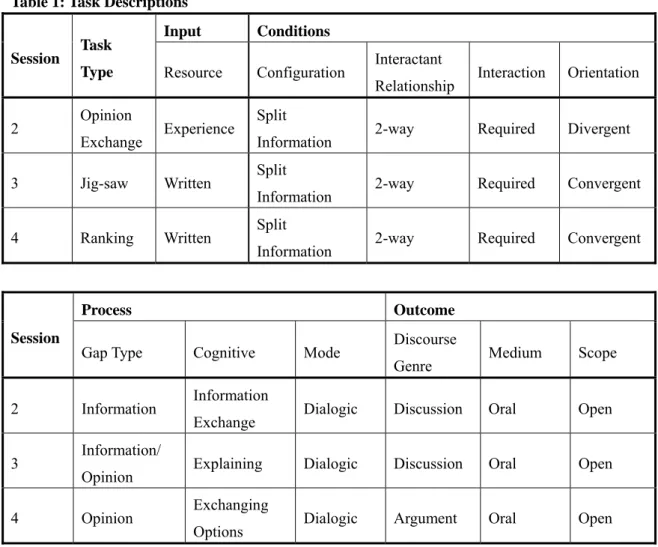
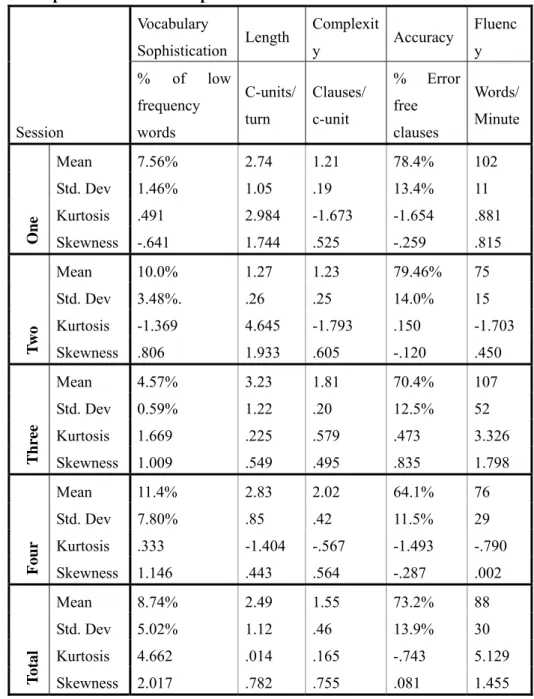
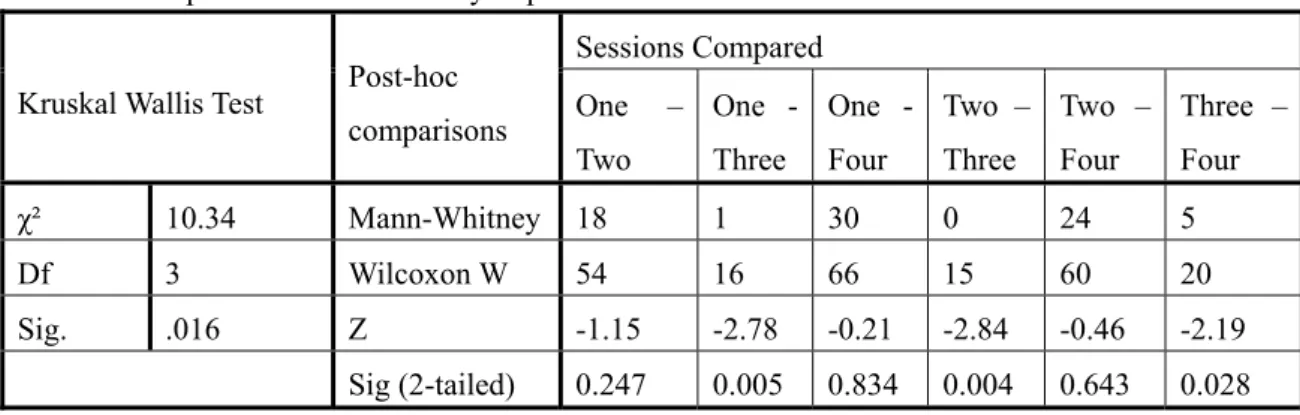
As previously mentioned, much of the quantitative research which has looked into negotiation has dealt with dyadic interaction, with some studies looking at interaction between groups of three or four. However both types of studies, which have examined video-mediated interaction in second language acquisition, have used large groups. It is possible that the cause of lack of negotiation might be a result of the size of the group involved in the interaction, rather than the medium. It is important, therefore, to confirm that video-mediated interaction and negotiation