Chapter 5 Industrial Policy, Structure, and
Locations during the Transition toward a
Market-oriented Economy in Myanmar
権利
Copyrights 日本貿易振興機構(ジェトロ)アジア
経済研究所 / Institute of Developing
Economies, Japan External Trade Organization
(IDE-JETRO) http://www.ide.go.jp
journal or
publication title
Spatial Statistics and Industrial Location in
CLMV
page range
1-55
year
2010-03
Kuroiwa ed., Spatial Statistics and Industrial Location in CLMV: An Interim Report, Chosakenkyu Hokokusho, IDE-JETRO, 2010.
Chapter 5
Industrial Policy, Structure, and Locations during the Transition toward a
Market-oriented Economy in Myanmar
Toshihiro Kudo
INTRODUCTION
This paper examines Myanmar’s industrial policy, structure, and locations during the
transition from a centrally planned economy to a market-oriented one throughout the 1990s
and up to the present. After the military government assumed power in 1988, it abandoned the
socialist centrally planned economic system and began instituting a market-oriented one
through a series of liberalization and deregulation measures, although most of which have
stalled since 1997 and remain half-way implemented.
Against this background, it is rather surprising that the impact of these new policies of
international trade, finance, regulations, licensing and ownership requirements on industrial
structure and location in Myanmar has been poorly documented and examined to date. Some
key issues to understanding the impact and effectiveness of the market-oriented policies
during the last two decades in Myanmar remain to be answered: Have the new trade and
industrial policies changed the industrial structure and organizational behavior in Myanmar?
Have they improved the performance of Myanmar’s industrial sector? Have they had any
impact on industry location in Myanmar?
2
government—the State Law and Order Restoration Council (SLORC) and the State Peace and
Development Council (SPDC)—and assesses their impact on industrial structure and its
spatial distribution.
1. INDUSTRIAL POLICY: PAST AND PRESENT
Industrialization is an essential element in the development of a country as a whole. Among
the Third World countries newly independent after World War II, there was a desire for
economic growth through industrialization: to transform their traditional agrarian economies
into modern industrial ones. Economic development had often been equated with
industrialization, and independent Myanmar shared the same aspiration for a modern
industrial economy. However, looking at Table 1 we can clearly see the underdeveloped state
of the industrial sector in Myanmar compared with that of neighboring countries.
Myanmar is rich in natural resources and has a highly literate population, which are
apparently good signs for development prospects. Its economy was slightly larger than that of
Thailand before World War II; its exports reached $195 million, while Thailand's were only
$76 million. Although Myanmar's economy was devastated by the war, most economic and
development indicators show that it was not too far behind Thailand by 1950. Therefore, it
was not at all unrealistic in the 1950s to be optimistic about Myanmar's economic prospects,
3 Table 1 GDP by industry (%) 1980 1990 2000 2007 1980 1990 2000 2007 Myanmar 47 57 57 44 13 11 10 19 Cambodia - 56 38 32 - 11 23 27 Laos - 61 53 43 - 15 23 32 Vietnam 50 39 25 20 23 23 37 42
Primary Industry Secondary Industry
(Source) ADB, Key Indicators , various numbers.
(Note) Myanmar and Laos figures for 2007 are based on 2006.
Taking these historical facts and the natural resources endowments of Myanmar into
consideration, the apparent explanation for economic stagnation and stunted industrialization
lies in the industrial policies that successive governments have adopted since independence.
Table 2 gives a brief chronology of the political economy of industrialization in Myanmar. It
is clear that Myanmar’s governments have long clung to control-oriented, or at least
interventionist, policies, rather than utilizing market mechanisms.
Table 2: A Brief chronology of Myanmar’s political economy of industrialization
Period Political
System
Economic
System Industrial Strategy Result
1.1886-1948 Colonialism Laissez-faire policy Export-propelled “agriculturization ” Foreign-dominated industrial sector Poor spread effect for nationwide industrial development 2.1948-1962 Parliamentary democracy Moderate economic nationalism in the framework of market mechanisms Raw material-oriented import substitution industrialization Moderate industrial performance Foreign-dominated industrial sector 3.1962-1974 Military rule (Burmese Way to Socialism) Command economy, Radical nationalism, Burmanization & Strict isolation
Import Substitution industrialization Self-reliant line Burmanization of economy and industry
Poor economic and industrial
4 4.1974-1988 BSPP rule (Burmese Way to Socialism) Centralized planning inward-looking policy with the exception of ODA acceptance Import substitution industrialization Agro-based industries Inflows of ODA
Poor economic and industrial performance Import-dependent industries 5.1988 to 1997 Military rule (SLORC) Transition toward market economy Open-door policy Agriculture-based & export-oriented industrialization Inflows of foreign direct investment Economic recovery Gradual increase in foreign and local private enterprises 6.1997 to Present Military rule (SPDC) Controlled market economy Natural resources exploitation, offshore gas in particular No explicit industrial strategy Stalled economic reforms Enhanced economic control Cronyism
Source: Based on Mya Than and Joseph L.H. Tan, "Introduction: Optimism for Myanmar's Economic Transition in the 1990s?" in Mya Than and Joseph L.H. Tan, eds., Myanmar
Dilemmas and Options: The Challenge of Economic Transition in the 1990s (Singapore:
ASEAN Economic Research Unit, Institute of Southeast Asian Studies, 1990), Appendix I, pp.14-15; and Maung Maung Lwin, “Industrialization of Myanmar and Economic Dynamism of Pacific Asia,” Kaigai-Jijo Kenkyu (Studies on Foreign Affairs), Vol.24, No.1 (Kumamoto: Kaigai-Jijo Kenkyu-jo, Kumamoto Gakuen University, September 1996). Major changes and additions are by the author.
During the socialist period in particular, an inward-looking growth strategy, nationalization
(Burmanization), and import substitution had long been pursued. However, Myanmar’s
centrally planned economy, like other socialist countries, faced many obstacles as well as
stagnant growth in not just the industrial sector but the economy as a whole. In the mid-1970s,
the socialist government relaxed some its strict policies and introduced reforms for
State-owned Economic Enterprises (SEEs) along with the prescription of commercial
guidelines to improve their efficiency. Although the economy picked up shortly after the
reforms, it was not sustainable, mainly due to a shortage of imported material goods. After
5
inflation, rising living costs, and macroeconomic and monetary mismanagement including
demonetization in 1987 worsened the situation, which eventually led to the collapse of the
socialist regime in 1988.
Subsequently, the SLORC/SPDC officially gave up on the establishment of a socialist
economic system and started to promote a market-oriented economy. Two pillar laws were
promulgated: the Foreign Investment Law (FIL) in November 1988 and the State-owned
Economic Enterprises Law (SEEs Law) in March 1989. The former resumed the intake of
private foreign capital after a 25-year interval, and the latter authorized private enterprises to
engage in all but 12 proscribed industries. In addition to these, various reform measures were
taken to promote the active participation of the private sector in the national economy. These
included the decentralization of control of economic activities, relaxation of price controls,
deregulation of export and import restrictions, opening of border trade, reduction of
government subsidies, announcement of full-fledged privatization of all SEEs, streamlining of
taxes and duties, establishment of industrial zones, and improvement of infrastructure (Table
3). Between 1988 and 1997, 27 new business-related laws, including the two above, were
promulgated, and successive military governments apparently committed themselves to the
global trend toward a market-oriented economy.
Table 3: Major economic reforms under the military rule 1988 * Introduction of Foreign Investment Law
1989 * Decontrol of prices
* Regularization of border trade
* Introduction of State-owned Economic Enterprises Law delineating the scope of the state sector
* Revocation of the 1965 law that established the socialist economic system 1990 * Introduction of Myanmar Tourism Law
6
* Introduction of Private Industrial Enterprise Law * Introduction of the Central Bank of Myanmar Law * Introduction of Financial Institutions of Myanmar Law
* Introduction of Myanmar Agricultural and Rural Development Law * Introduction of Commercial Tax Law
1991 * Initiation of industrial zones in Yangon
* Announcement of the Central Bank of Myanmar Rules and Regulations * Introduction of Promotion of Cottage Industries Law
* Reestablishment of the Union of Myanmar Federation of Chambers of Commerce and Industry (UMFCCI)
1992 * Announcement to lease out inefficient state-owned factories * Announcement of denationalization of nationalized sawmills * Announcement of the establishment of four private banks * Introduction of Tariff Law
* Introduction of Savings Bank Law
1993 * Introduction of US$ denominated Foreign Exchange Certificate (FEC) * Introduction of Myanmar Insurance Law
1994 * Introduction of Myanmar Citizens Investment Law * Licensing of representative offices of 11 foreign banks * Introduction of Science and Technology Development Law 1995 * Announcement of the formation of Privatization Committee
* Announcement of permission to establish joint venture banks between local private banks and foreign banks (although not realized until now)
* Opening of the licensed foreign exchange center for FEC trading in Yangon
1996 * Permission given to local private banks to conduct foreign exchange business and to pay interest on foreign currency deposits
* Establishment of the Myanmar Securities Exchange Centre Co. Ltd. (MSEC), a joint venture between Japan's Daiwa Research Institute and the state-owned Myanmar Economic Bank (MEB)
* Introduction of law on development of computer knowledge
* Official rate of exchange for levying custom duties changed to K100 per US$ accompanied by reduction of tariffs to a fraction of previous values
1997 * Announcement of paddy procurement through a tender bid system (but this was not implemented)
1998 * Announcement of leasing of fallow and virgin land for paddy and cash-crop cultivation or livestock breeding by private entrepreneurs, including foreigners
7
2000 * Across-the-board increase of public sector salaries, by 5-6 times, to come in line with private sector wages
2003 * Announced liberalization of rice export
* Abolishment of distribution of rice to government-related officials 2005 * Export permits given to private rice exporters
* An increase of official prices of gasoline and diesel by 8-9 times 2006 * Across-the-board increase of public sector salaries by 6-12 times
* An increase of official prices of electricity by 10 times
2007 * An increase of official prices of gasoline and diesel by about 2 times
2008 * Large-scale privatization of government properties and liberalization of some public utilities
2010 * Liberalization of some import restrictions and permission of imports of previously restricted items such as cars, motorcycles, and diesel
However, Myanmar people can never be fully confident of the military government’s
commitment to transition to a genuine market economy, which would guarantee a level
playing field for all of the economic actors including the private sector. The trend in
Myanmar’s policy has turned increasingly inward and against market-mechanisms,
particularly after the Asian currency crisis in mid-1997. The State Peace and Development
Council (SPDC), the reorganized body of the military government in 1997, has consciously
adopted an import substitution and self-reliant, or what may even be called survival, policy by
starting to intervene in many economic activities and strengthening state controls. The Trade
Policy Council (knows as TC), an extra-ministerial committee, is said to be responsible for
such policy changes.
The Trade Policy Council was formed in July 1997, with General Maung Aye,
Vice-Chairman of the SPDC, as Chairman, and with the Minister for National Planning and
Economic Development as Secretary. The Trade Policy Council has laid down important
policies concerning not only external trade but also other economic affairs. These measures
8
10% export tax, advanced purchase of beans and pulses for export, advanced purchase of
cotton, market-price-based taxation on imported vehicles, import restrictions on motor
vehicles, monthly grants for palm oil imports, reduced FEC limits on overseas bank transfers,
strengthened revenue collection from MIC-approved projects, and inspection of under-priced
import invoices. The motivation for a number of these might be the capture of foreign
exchange earnings for the government budget.
Foreign companies have faced a more challenging business environment under such policy
changes, and some foreign investors requested relaxation of economic controls from the
authorities concerned. Responses to such requests from the authorities were, however,
generally stereotyped and lacking in commitment. For example, the Myanmar Investment
Commission (MIC) often proclaims the FIL of 1988 as its most liberal and encouraging
investment act, which permits 100% foreign-owned investment and provides attractive tax
incentives. Theoretically, it is comparable to those of even advanced ASEAN members.
However, to the extent that the existence of laws such as this were used as an excuse not to
listen to the claims of foreign investors, so the deep-seated structural problems which were
real impediments to the inflow of foreign direct investments were not be addressed.
Favoritism and corruption, which is endemic and constitutes a serious problem in many
developing economies, had been largely avoided by Myanmar. On the contrary, successive
governments had taken pride in being clean, even since the socialist period. Nevertheless, it is
also true that economies transitioning from being centrally-planned to market-oriented tend to
suffer from problems of favoritism and corruption because they often lack the legal and
institutional foundations for the functioning of a free and fair market economy.
The military holding companies, Myanmar Economic Corporation (MEC) and the Union of
9
manufacturing and services sectors, are exerting increasing influence over business activities.
The SEEs Law of 1989 was amended in 1997 to make it possible to establish a 100%
military-owned company. Military-related companies themselves are not necessarily harmful
to economic development; however, they can become harmful if they are afforded especially
favorable treatment by the government and thereby damage the idea of a level playing field
for all. In addition to these military holding companies, the government has started to embrace
so-called national entrepreneurs who, it is claimed, are given preferential treatment in doing
business. Such arbitrary favoritism, if provided, would send a worrying signal to businesses
that the government could change even the rules of the game.
We should note that once a business environment is created where personal connections to
the authorities rather than management and technical skills are the most important factors for
business success, then it becomes difficult to provide sound economic incentives to
entrepreneurs of ability, and hence they lose confidence in the policy environment. In such a
situation, emerging enterprises and entrepreneurs as well as potential foreign investors may
well divert their interests to other economies or just chase windfall profits through
rent-seeking activities. A recent series of sales of government properties to well-connected
businessmen has also raised concerns about rampant nepotism and corruption in the Myanmar
economy. In order to prevent Myanmar moving headlong toward so-called crony capitalism, it
is important for the government to establish a level playing field where all economic actors
can compete with each other in a free and fair manner.
2. THE IMPACT OF ECONOMIC REFORMS ON INDUSTRIAL STRUCUTRE
10
structure and performance? Whether or not the policies of the military government have
changed industrial structure and organizational behavior and hence improved performance is a
key issue for future industrial development in Myanmar. Nevertheless, the impact of
economic reforms on industrial structure and performance has been poorly documented. This
section examines this issue.
2.1 Classification of industries
In Myanmar, the Central Statistical Organization (CSO) established the Burma Standard for
Industrial Classification (BSIC) regarding economic activities in 1952 based on the UN’s
International Standard for Industrial Classification (ISIC) of 1948. The BSIC also categorizes
industrial activities into three levels, that is, Divisions (1 digit), Major Groups (2 digits) and
Groups (3 digits). Each Division is as follows: 0 Agriculture, Forestry, Hunting and Fishery; 1
Mining and Quarrying; 2 & 3 Manufacturing; 4 Construction; 5 Electricity, Gas, Water, and
Sanitary Services; 6 Commerce; 7 Transport, Storage, and Communication; 8 Services; and 9
Activities Not Adequately Described. The Ministry of Industry (1) is said to be revising the
BSIC based on the ISIC of 1990; however, the new version of BSIC has not yet been utilized
in government reports.
Apart from the BSIC, the Ministry of National Planning and Economic Development
(MNPED) has used another classification in compiling national income statistics. This
classification has been employed by the said Ministry for compiling an annual economic
report called Review of the Financial, Economic and Social Conditions (hereinafter the
“Review”). Under this classification system, all economic activities are classified into 14
sectors: Agriculture; Livestock and Fishery; Forestry; Energy; Mining; Processing and
11
Institutions; Social and Administrative Services; Rentals and Other Services; and Trade.1 The
Processing and Manufacturing sector is further subdivided in the Review into 13 commodity
groups: Food and Beverages; Clothing and Wearing Apparel; Construction Materials;
Personal Goods; Household Goods; Printing and Publishing; Industrial Raw Materials;
Mineral and Petroleum Products; Agriculture Equipment; Machinery and Equipment;
Transport Vehicles; Electrical Goods; and Miscellaneous.
2.2 GDP
Industrial structure can be defined in terms of the relative importance of individual
industries, or groups of related industries, within an economy. One of the most frequent
measures of an industry’s importance is based on its production (value added or net output).
Table 4 shows the relative importance of different sectors to GDP. As mentioned above, a
14-sector classification is employed here. In addition to the problem of industrial
classification, there is another issue as to whether we use nominal GDP or real GDP when
looking at industrial structural changes. Nominal GDP is measured at current prices. If all
prices doubled without any changes in quantities, then nominal GDP would double. Yet it
would be misleading to say that the economy’s ability to satisfy demand has doubled, because
the quantity of goods produced has remained the same. In contrast to this, real GDP, which is
the value of goods and services measured at constant prices of a base year, would not be
influenced by changes in prices. Since a society’s ability to provide economic satisfaction for
its members ultimately depends on the quantities of goods and services produced, real GDP,
which summarizes the output of the economy measured at base-year prices, provides a better
1 Until the Fiscal Year (FY) 1996 Review, 13 sectors were used for GDP statistics. Since the FY 1997 Review, “Energy” was added to make a total of 14 sectors. However, the MNPED stopped issuing the Review thereafter. Myanmar’s fiscal year (FY) starts from April and ends in March.
12
measure of economic well-being than nominal GDP. Myanmar’s GDP is calculated in
different base years: it was calculated from FY1985 to FY2000 at FY1985 constant prices,
from FY2001 to FY2005 at FY2000 constant prices, and the later years at FY2005 constant
13
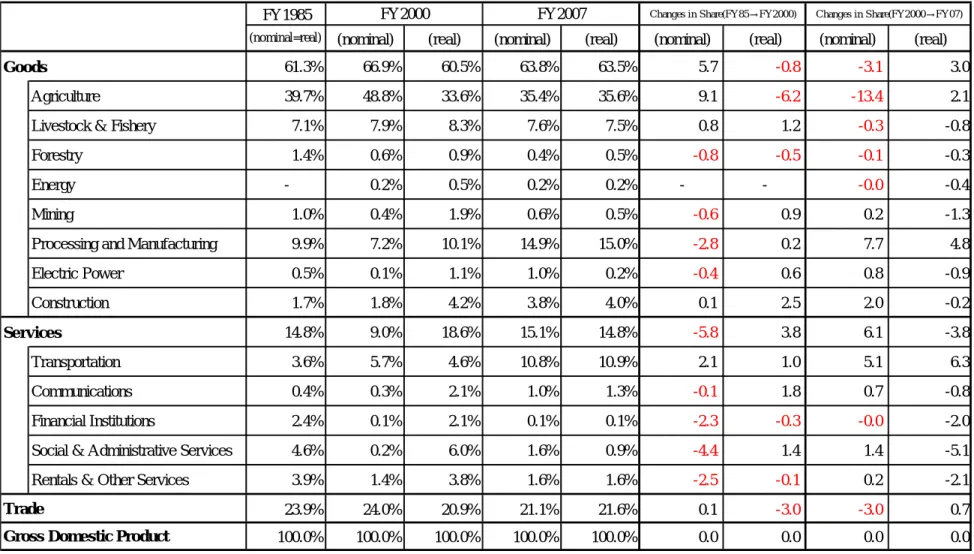
Table 4: GDP by industrial se ctors (Unit: %; % Point)
FY1985
(nominal=real) (nominal) (real) (nominal) (real) (nominal) (real) (nominal) (real)
Goods 61.3% 66.9% 60.5% 63.8% 63.5% 5.7 -0.8 -3.1 3.0
Agriculture 39.7% 48.8% 33.6% 35.4% 35.6% 9.1 -6.2 -13.4 2.1
Livestock & Fishery 7.1% 7.9% 8.3% 7.6% 7.5% 0.8 1.2 -0.3 -0.8
Forestry 1.4% 0.6% 0.9% 0.4% 0.5% -0.8 -0.5 -0.1 -0.3
Energy - 0.2% 0.5% 0.2% 0.2% - - -0.0 -0.4
Mining 1.0% 0.4% 1.9% 0.6% 0.5% -0.6 0.9 0.2 -1.3
Processing and Manufacturing 9.9% 7.2% 10.1% 14.9% 15.0% -2.8 0.2 7.7 4.8
Electric Power 0.5% 0.1% 1.1% 1.0% 0.2% -0.4 0.6 0.8 -0.9 Construction 1.7% 1.8% 4.2% 3.8% 4.0% 0.1 2.5 2.0 -0.2 Se rvice s 14.8% 9.0% 18.6% 15.1% 14.8% -5.8 3.8 6.1 -3.8 Transportation 3.6% 5.7% 4.6% 10.8% 10.9% 2.1 1.0 5.1 6.3 Communications 0.4% 0.3% 2.1% 1.0% 1.3% -0.1 1.8 0.7 -0.8 Financial Institutions 2.4% 0.1% 2.1% 0.1% 0.1% -2.3 -0.3 -0.0 -2.0
Social & Administrative Services 4.6% 0.2% 6.0% 1.6% 0.9% -4.4 1.4 1.4 -5.1
Rentals & Other Services 3.9% 1.4% 3.8% 1.6% 1.6% -2.5 -0.1 0.2 -2.1
Trade 23.9% 24.0% 20.9% 21.1% 21.6% 0.1 -3.0 -3.0 0.7
100.0% 100.0% 100.0% 100.0% 100.0% 0.0 0.0 0.0 0.0
(Notes) Real GDP for FY1985 and FY2000 is based on FY1985 constant prices; and one for FY2007 is on FY2005 constant prices. (Source) MNPED, Review (various issues); and CSO, Statistical Yearbook (various issues).
Changes in Share(FY2000→FY07)
FY2007 Changes in Share(FY85→FY2000)
Gross Domestic Product
14
Our main concern here is, however, with changes in industrial structure, which presupposes
changes in price structure as well. In this section, we will pay closer attention to the relative
importance of different sectors in nominal GDP, which also reflects changes in price structure.
The question of whether to use nominal GDP or real GDP to ascertain structural changes in
an economy is particularly important in the case of Myanmar. We should note that there are
large differences in shares between nominal GDP and real GDP in different sectors. Table 4
shows both nominal GDP and real GDP in FY1985, FY2000 and the latest year of FY2007. In
terms of GDP share, there are differences between the nominal and real figures. For example,
in FY1985, the agriculture sector accounted for 39.5% of both nominal and real GDP, while in
FY2000, it accounted for 48.8% of nominal GDP and 33.6% of real GDP. On one hand, the
agriculture sector decreased its relative importance to real GDP by 6.2 percentage points
between FY1985 and FY2000, on the other hand it increased its share of nominal GDP by 9.1
percentage points during the same period. On the contrary, the processing and manufacturing
sector increased its relative importance to real GDP by 0.2 percentage points, whereas it
decreased its share of nominal GDP by 2.8 percentage points. According to the figures for
nominal GDP, some “agriculturalization” occurred, rather than “industrialization” during
FY1985 and FY2000.
Such differences between nominal GDP and real GDP are due to the differentiated rates of
increase by the different sectors of GDP deflator. A GDP deflator compares the current price
of a basket of goods and services produced this year with the price of the same basket in the
base year. In other words, the GDP deflator measures the price of the typical unit of output
relative to its price in the base year. Figure 1 and 2 show the indices of GDP deflators in
various sectors, where the base year of FY1985 is set at 1 for Figure 1 and that of FY2000 is
15 0 5 10 15 20 25 30 35 40 45 50 55 FY1985 1986 1987 1988 1989 1990 1991 1992 1993 1994 1995 1996 1997 1998 1999 FY1985=1
(Source) MNPED, Review (va rious issues); and CSO, Statistical Yearbook (va rious issues).
Figure 1: GDP deflator by industry, FY1985-99
Agriculture Livestock & Fishery Processing and Manufacturing Construction Transportation Social & Administrative Services Trade GDP Deflator
16 0 5 10 15 20 25 FY2000 2001 2002 2003 2004 2005 2006 2007 FY2000=1
(Source) MNPED, Review (va rious issues); a nd CSO, Statistical Yearbook (va rious issues).
Figure 2: GDP deflator by industry, FY2000-07
Agriculture Livestock & Fishery Processing and Manufacturing Construction Transportation Social & Administrative Services Trade GDP Deflator
17
It is often the case that when transitioning from a centrally-planned economy to a
market-oriented one, price structure undergoes a big change. In Myanmar’s case, the prices of
agricultural produce and food, which had long been controlled at lower prices throughout the
socialist period, jumped up to market level prices on account of the liberalization measures.
The price hikes in agricultural products such as rice and vegetables were much higher than
those in other sectors, such as industrial goods, construction, transportation, and social and
administrative services. The share of the agriculture sector of nominal GDP increased due to
the effect of the relative price hikes for the period between FY1985 and FY2000, although its
share in real GDP terms decreased during the same period.
Bearing in mind the above discussion, we now look at Table 4 to consider the structural
changes in the economy. Looking at the figures for nominal GDP, we see that only the
agricultural sector has increased its share substantially, while most other sectors have reduced
their share or are little changed. It may be said that the industrial structure in Myanmar has
been static throughout the 1990s.
Then, why did the agriculture sector raise its share in nominal GDP in the 1990s? Firstly,
the production of agriculture has increased. For example, the production of paddy, the sown
area of which occupies more than 40% of the total sown area, increased by 54% from 12,956
thousand tons in FY1988 to 19,888 thousand tons in FY1999. The increase was remarkable
but achievable with an annual average growth rate of about 4%. As shown by the decline in
the share of the agricultural sector in real GDP for the period between FY1985 and FY2000,
the increases in quantity of other sectors must had surpassed that of the agricultural sector.
Secondly, and more importantly, price hikes of agricultural produce contributed to an
18
agricultural produce increased more rapidly than industrial products and services throughout
the 1990s. In other words, the terms of trade of agricultural produce over industrial goods
improved just after the open-door and market-oriented policies were introduced. Hence, it
may be said that, in the 1990s, the economic welfare of farmers in rural areas was elevated
more than that of industrial workers in urban areas.
This policy contrasts sharply with that of the socialist regime. During the socialist period,
the price of agricultural produce was consistently suppressed to well below normal market
levels, which was a de facto subsidy to urban dwellers. Moreover, external trade was
monopolized by the state and the socialist government poured much of its earnings from the
export of agricultural produce into import substitution industries, mainly located in urban
areas.
The military government suddenly abandoned such policies favorable to the urban
population and showed more concern about the well being of farmers in rural areas. Such a
policy change was probably driven by the political and economic crisis in 1988 and the
people’s uprising against the then government. The military government must have
understood the importance of improving the living standards of the rural population, which
constitutes 75% of the national population. The agriculture/rural-favored attitude of the
present government is also expressed in their often repeated economic slogan, “Development
of agriculture as the base and all-round development of other sectors of the economy as well”.
However, entering the twenty-first century we saw some “industrialization” in the
Myanmar economy. The processing and manufacturing sector increased its share in nominal
GDP by 7.7 percentage points for the period between FY2000 and FY2007. On the contrary,
the share of the agriculture sector of nominal GDP decreased in spite of its increase in real
19
trade of agricultural produce against industrial goods and services. The transitional effect
from the planned economy to market economy on the price structure settled down by the end
of the 1990s.
There is certainly an impression that Myanmar’s economy has changed visibly. High-rise
buildings are conspicuous in major cities such as Yangon and Mandalay. International hotels
and shopping malls are no longer new to the Yangon and Mandalay dwellers. Streets are
crowded with cars, and traffic jams have become a regular morning and evening occurrence.
Moreover, the building of the new capital city, Naypyitaw, has brought a mini boom to the
construction sector since the early twenty-first century.
With a series of economic reforms and transition toward a market-oriented economy, there
was steady economic development leading to an average annual growth rate of 7.5% for the
period of the four-year plan (1992/93-95/96), which was reasonably high in an agrarian
economy such as Myanmar’s. The success of the first short-term plan was due to various
factors: private sector development following the liberalization policy; inflows of FDI
following the open-door policy; substantial increases in agricultural produce (especially rice
following the introduction of summer paddy); growth of exports following decontrol of the
state monopoly of foreign trade; encouragement of tourism; and the construction mini-boom.
During the period of the Second Short-Term Five Year Plan (1996/97 to 2000/01), the
average annual growth rate was 8.5%, mainly due to the agricultural sector and showed the
highest growth rate in the industry sector. In the Third Short-Term Five Year Plan (2001/02 to
2005/06), the average annual growth rate was at its peak, at 12.8 %, which was mainly due to
an industry and energy sector development. Such substantial growth in the official GDP is,
however, considered dubious by many economists both inside and outside the country.2
2 The statistics on GDP were collected by the central government through the 64 nationwide prefectural offices of the Planning Department, the MNPED, and the 16 state and division
20 2.3 Labor force
Labor force statistics are another indicator of industrial structural changes. Through what is
generally known as Petty-Clark’s law, as economic development progresses, as measured by
per capita income, the relative importance of the primary sector falls, in terms of both
production and labor force, while that of the secondary sector and then the tertiary sector
rises.
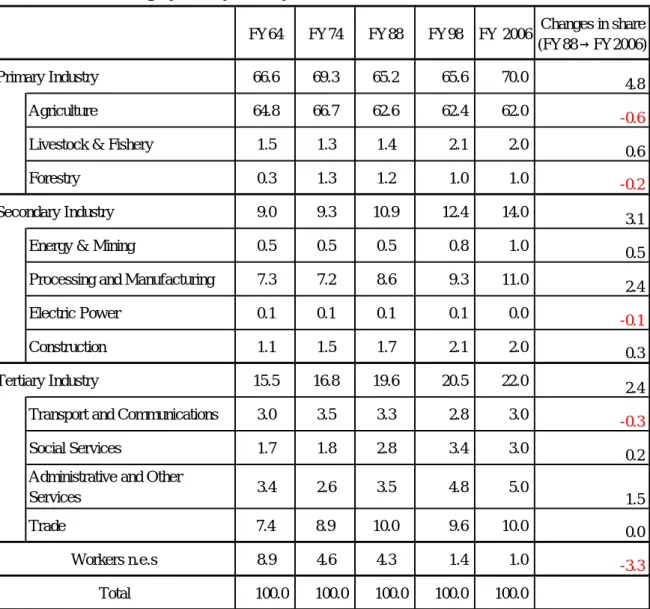
Table 5 shows changes in labor force distribution by industry. In FY2006, the agriculture
sector constituted more than 60% of the total labor force, followed by processing and
manufacturing (11%) and trade (10%), while all the other sectors each constituted 5% and less
of the total labor force. The pattern of labor force distribution clearly shows the agrarian
nature of the Myanmar economy. It also highlights the very static situation of Myanmar’s
industrial structure. During the period between FY1988 and FY2007, changes of less than one
percentage point occurred in the share of any industry, except the processing and
manufacturing sector (2.4 percentage points) and the administrative and other services sector
(1.5 percentage points); hence, dynamic structural changes are yet to be observed.
offices (which are in the northern, southern and eastern parts of Shan State and 13 other states). Reportedly, prefectural governors (military officers at the Lieutenant Colonel level) and commanders in military divisions (members of the National Peace Development Council at the Brigadier General and Major General levels) strongly influence statistics that are sent to senior organizations. It has long been pointed out that GDP is often inflated to make the rate of economic growth appear higher than it is. It is also possible that statistics may have been manipulated in various ways in different areas, depending on the particular nature and way of thinking of prefectural governors/commanders in military divisions. If so, the accuracy of statistics on national income in Myanmar is rather questionable.
21
Table 5: Estimate d e mployme nt by industry (Unit:%)
FY64 FY74 FY88 FY98 FY 2006 Changes in share (FY88→FY2006)
Primary Industry 66.6 69.3 65.2 65.6 70.0 4.8
Agriculture 64.8 66.7 62.6 62.4 62.0
-0.6
Livestock & Fishery 1.5 1.3 1.4 2.1 2.0 0.6
Forestry 0.3 1.3 1.2 1.0 1.0 -0.2
Secondary Industry 9.0 9.3 10.9 12.4 14.0 3.1
Energy & Mining 0.5 0.5 0.5 0.8 1.0 0.5
Processing and Manufacturing 7.3 7.2 8.6 9.3 11.0 2.4
Electric Power 0.1 0.1 0.1 0.1 0.0 -0.1
Construction 1.1 1.5 1.7 2.1 2.0 0.3
Tertiary Industry 15.5 16.8 19.6 20.5 22.0 2.4
Transport and Communications 3.0 3.5 3.3 2.8 3.0
-0.3
Social Services 1.7 1.8 2.8 3.4 3.0 0.2
Administrative and Other
Services 3.4 2.6 3.5 4.8 5.0 1.5
Trade 7.4 8.9 10.0 9.6 10.0 0.0
8.9 4.6 4.3 1.4 1.0 -3.3
100.0 100.0 100.0 100.0 100.0 (Source) MNPED, Review (various issues); and CSO, Statistical Yearbook (various issues).
Workers n.e.s Total
We can calculate each sector’s relative productivity (or relative income) from Tables 4 and
5. Relative productivity is the ratio of the labor productivity of an industry (Yi/Li, where Yi
stands for the income of industry i and Li stands for the labor force of industry i) divided by
the labor productivity of the whole economy (Y/L, where Y denotes national income and L
denotes total labor force). In practice, relative productivity can be calculated as the ratio of the
share of nominal GDP (Table 4) divided by the share of labor force (Table 5), as shown in the
22
(Yi/Li) / (Y/L) = (Yi/Y) / (Li/L).
If the figure for relative productivity in an industry exceeds 1, the industry has better than
average labor productivity.
0.0 0.2 0.4 0.6 0.8 1.0 1.2 1.4 1.6 FY1988 1998 2006
(Note) Average labor productivity equals 1.0.
Agriculture Primary Industry
Processing and Manufacturing Secondary Industry
Tertiary Industry
(Source) Calculated from the figures given in Table 4 and 5.
Figure 3: Relative productivity of major industries and groups of related industries
Figure 3 shows relative productivity of major industries and groups of related industries.
While the agriculture sector increased its relative productivity for the period between FY1988
and FY1998, secondary industry including processing and manufacturing declined its relative
productivity for the same period. As have discussed, this was mainly due to the improvement
of terms of trade of agricultural produce over industrial goods. However, entering the
twenty-first century, the trend has been reversed. The secondary sector including
23
3. THE IMPACT OF ECONOMIC REFORMS ON OWNERSHIP STRUCTURE
In order to ascertain industrial structural changes, it is also important to examine shifts in
ownership patterns, especially, as in the case of Myanmar, when transitioning from a
centrally-planned economy, where the state sector is a major player, to a market-oriented
economy, where the private sector is expected to play a major role. In this section, we
examine the impact of economic reforms on ownership patterns.
3.1 GDP
The economic reforms of the military government began with the open-door policy and the
recognition of private businesses. The government announced the FIL in November 1988 and
opened the doors to foreign investment after a 25-year hiatus. It also announced the SEEs
Law in March 1989, in which the Law conferring powers for Establishing the Socialist
Economic System, 1965 was repealed. In other words, the military government officially
renounced the Burmese Way to Socialism by promulgating this law.
The SEEs Law stipulated 12 economic enterprises that the SEEs would continue to
monopolize.3 By stipulating the 12 enterprises exclusive to SEEs, the government conversely
allowed the private sector to enter other fields. In other words, the industrial policy for private
sector participation in the national economy changed from “banned in principle” to “allowed
in principle”. Under these policies, the private sector has gained momentum.
3 Those are (a) extraction of teak and sale of the same in the country and abroad; (b) cultivation and conservation of forest plantation; (c) exploration, extraction, and sale of petroleum and natural gas and production of products of the same; (d) exploration and extraction of pearls, jade, and precious stones and export of the same; (e) breeding and production of fish and prawns in fisheries which have been reserved for research by the Government; (f) Postal and Telecommunications Service; (g) Air Transport Service and Railway Transport Service; (h) Banking Service and Insurance Service; (i) Broadcasting Service and Television Service; (j) exploration and extraction of metals and export of the same; (k) Electricity Generating Services other than those permitted by law to private and
co-operative electricity generating services; (l) manufacture of products relating to security and defense which the Government has, from time to time, prescribed by notification.
24
Table 6: Re al GDP by industry and owne rship
(%. % point)
Share State Co-operative Private Share State Co-operative Private share State Cooperative Private Changes
(FY86-FY98)
Changes
(FY98-FY07) Major Factors for Changes
Ⅰ Goods 61.3 11.9 5.3 82.7 59.6 11.4 1.4 87.2 63.5 - - - 4.5
1 Agriculture 40.3 0.1 6.4 93.4 34.5 0.2 1.9 97.9 35.6 0.4 2.4 97.2 4.5 -0.7Decontrol of trade of agricultural produce
2 Livestock & Fishery 7.3 1.3 2.6 96.2 7.2 0.3 1.1 98.6 7.5 0.1 0.7 99.2 2.5 0.5 Development of private enterprises
3 Forestry 1.3 38.0 4.4 57.6 1.0 46.2 0.6 53.2 0.5 50.0 0.3 49.7 -4.4 -3.5 Strengthened conservation of forests
Primary Industry 49.0 1.3 5.8 92.9 42.7 1.3 1.8 97.0 43.7 - - - 4.1
4 Energy - - - - 0.2 99.9 0.1 0.0 0.2 76.3 9.3 14.4 - 14.4 Entry restrictions by SEEs Law
5 Mining 0.9 89.8 2.2 8.0 1.6 10.8 1.0 88.2 0.5 2.9 0.2 96.9 80.2 8.7 Provision of mining concession
6 Process & Manufacturing 9.2 41.6 4.2 54.2 9.2 28.2 0.9 70.8 15.0 9.2 0.2 90.6 16.6 19.7 Development of SMIs
7 Electric Power 0.5 100.0 0.0 0.0 1.0 99.9 0.1 0.0 0.2 79.5 0.3 20.2 0.0 20.2 Entry restrictions by SEEs Law
8 Construction 1.7 88.3 1.0 10.8 4.9 45.8 0.2 54.0 4.0 60.1 0.0 39.9 43.2 -14.1Entry of SMEs and NPT construction
Se condary Industry 12.4 54.0 3.4 42.6 16.9 36.9 0.7 62.4 19.8 - - - 19.9
-Ⅱ Services 15.5 60.6 2.5 36.9 19.3 54.5 2.6 43.0 14.8 14.8 0.1 85.0 6.1 42.1
1 Transportation 3.6 36.0 4.9 59.1 4.3 29.8 1.0 69.2 10.9 1.5 0.1 98.4 10.1 29.3 Development of private enterprises
2 Communications 0.5 100.0 0.0 0.0 1.9 100.0 0.0 0.0 1.3 100.0 0.0 0.0 0.0 0.0 Entry ban by SEEs Law
3 Financial Institutions 2.6 98.9 1.1 0.0 2.0 54.8 14.4 30.7 0.1 68.9 3.8 27.3 30.7 -3.4 Lift of entry ban by LAW
4 Social & Admin Services 4.8 98.8 1.2 0.0 6.8 88.8 0.5 10.7 0.9 76.9 0.2 22.9 10.7 12.2 New entry to social services
5 Rentals & Other Services 4.1 9.0 3.2 87.8 4.3 3.9 2.9 93.3 1.6 0.4 0.4 99.1 5.4 5.9 Development of private enterprises
Ⅲ Trade 23.1 33.9 13.5 52.6 21.1 21.3 2.4 76.3 21.6 5.0 2.4 92.7 23.7 16.4 Development of private enterprises
Te rtiary Industry 38.7 44.6 9.1 46.3 40.4 37.2 2.5 60.3 36.5 - - - 14.0
-Gross Domestic Product 100.0 24.6 6.8 68.6 100.0 21.8 1.9 76.3 100.0 7.8 1.5 90.7 7.7 14.4
(Source) MNPED, Review (various issues); and CSO, Statistical Yearbook (various issues).
25
Table 6 shows real GDP by industry and ownership. Thus far, figures for nominal GDP
have mainly been used to view industrial structural changes. However, the data for GDP by
industry and ownership are only available in real GDP terms; hence the use of real GDP
figures in this section.
Firstly, it is noticeable in Table 6 that the private sector accounted for about 70% of real
GDP even in FY1986, which was in the midst of the socialist regime. This high proportion of
real GDP accounted for by the private sector in Myanmar contrasts sharply with that of other
transitional economies in Central and Eastern Europe, where the state played a major role in
the economy during the socialist period. The significance of the private sector in Myanmar’s
economy was largely due to the agriculture sector, as the biggest industry, accounting for
about 40% of real GDP in FY1986, having long been categorized as mostly in the private
sector in GDP statistics.
However, it should be noted that even though the private sector contributed to more than
90% of the agriculture sector in both FY1986 and FY1998, in reality it is substantially
different between the two periods. Throughout the socialist period, agriculture was not
collectivized and land holdings remained in the hands of small farmers. In this sense, it may
not be wrong to categorize the agriculture sector as a private one. Nevertheless, farmers were
under strict state control at that time. They could not grow what they wanted, but had to
cultivate their lands according to government policy and planning. Nor could they sell their
produce freely at market prices, but had to sell most of their produce to the state at lower
prices, which were unilaterally fixed by the government. Farmers could not enjoy freedom of
management in those days.
In November 1987, the government decontrolled trade of the main agricultural produce,
26
have been able to sell their products at market after selling a proportion to the state. After this,
farmers have become more responsive to market forces, reacting positively to the price
incentives. Farmers now enjoy a relatively larger freedom of management compared to the
socialist era. In this way, even though the agricultural sector has always been categorized as
“the private sector”, the real situation is totally different before and after 1988.
Secondly, in contrast to the agriculture sector, some of the other sectors were largely
occupied by SEEs, even in FY2007. Energy, Electric Power, Communications, and Social and
Administration Services were mostly monopolized by the state. The state also controlled
substantial shares of Forestry, Construction, and Financial Institutions. Many of the said
industries that were monopolized or dominated by the state are on the list of 12 industries
exclusively for the SEEs. But an exception clause (Section 4 of the SEEs Law) exists whereby,
with a view to the interest of the state, private business enterprises may be allowed to enter
the 12 industries in the form of joint-ventures with SEEs or even in the form of pure private
ownership. Accordingly, many private companies, including foreign ones, have invested in
some of 12 enterprises. Large-scale foreign investments in Yadana and Yetagon natural gas
exploration are good examples. On the other hand, although the entry ban to industries such
as Forestry, Construction, and Financial Institutions was lifted, still large-scale SEEs persist,
giving the state a considerable share of those industries.
Thirdly, in spite of the remaining entry barriers, and other restrictions, the private sector
positively reacted to industrial liberalization. The participation of the private sector increased
particularly in Mining, Process and Manufacturing, Construction, Transportation and
Financial Institutions, in fact, the share of the private sector increased in all industries except
Forestry from FY1986 to FY2007. The government provided mining concessions to private
27
private sector in Mining rose from 8.0% in FY1986 to 96.9% in FY2007. As for Construction,
private construction companies mushroomed along with the construction mini-boom which
started in the early 1990s but had burst by mid-1997. Regarding the Financial Institutions
sector, although it was one of the 12 enterprises exclusively for SEEs, the establishment of
private financial institutions was allowed by the Financial Institutions of Myanmar Law,
enacted in July 1990. Under to this Law, 20 private banks were established since 1992, but
only 14 now remain.4 The share of GDP of private sector financial institutions increased
rapidly from zero in 1991 to 42% in FY2002 before the domestic banking crisis, after which it
decreased to 27% in FY2007. The share of the private sector in the Processing and
Manufacturing sector has also substantially and steadily increased since FY1986, and reached
to more than 90% in FY2007, mainly due to the emerging small and medium-sized industries
(SMIs). The same case is applicable to the Trade sector.
All these figures point to the active participation of the private sector in the national
economy. As entry barriers and restrictions imposed upon private businesses are lifted, the
participation of the private sector in economic activities is further enhanced, even in the
industries that are still monopolized or controlled by the predominant SEEs. Myanmar’s
private sector is active and efficient enough to respond to government liberalization policies.
Myanmar’s private sector has demonstrated its resilience by surviving the socialist period and
its ability to participate in the national economy once the market economy was revived. Given
equal chances, the private sector will actively penetrate most economic sectors and contribute
to economic development; this is an important finding in this section.
3.2 Business registration
28
As the private sector takes an increasing role in the national economy, business entities
registered with the authorities concerned have mushroomed. Table 7 shows the number of
various kinds of businesses, the data for which was collected from several sources such as the
Directorate of Hotels and Tourism, the Directorate of Investment and Company
Administration, and the Directorate of Trade.
Almost certainly there is some overlapping and double counting in the table. For example,
Myanmar Companies Limited can be organized according to the Burma Companies Act
(1913) and Partnership Firms can be established according to the Partnership Act (1932).
When these companies or partnerships engage in external trade, they must obtain export and
import licenses from the Ministry of Commerce and are thus counted as Exporters and as
Importers too. In the same way, hoteliers have to obtain a business license from the Ministry
of Hotels and Tourism and are therefore counted as a Hotel Business in Table 7. If a hotel also
runs a tourist business, it may be registered as a Tourist Enterprise as well. Tourist Enterprises
and Tourist Transport Businesses may also overlap. Moreover, some entities may be just paper
companies not engaged in any actual business. For these reasons, we must remain aware that
29
Table 7: Number of registe re d e xporte rs, importers, limite d companie s, partne rships and joint-ve nture companie s limite d
FY1989 FY1997 FY2000 FY2001 FY2002 FY2003 FY2004 FY2005 FY2006 FY2007 FY2008
1 Exporters 770 8931 15142 1350 1231 777 920 1089 1591 1054 1221
2 Importers 216
3 Business Representatives 183 2076 2230 74 48 44 41 27 19 19 13
4 Myanmar Companies Limited 174 10844 15418 9596 10444 11266 12512 14376 14234 14876 16656
5 Partnership Firms 376 1214 1264 1264 1269 1269 1270 1270 1270 1270 1072
6 Foreign Companies and Branches 39 1184 1414 1410 1446 1456 1466 1477 1489 1494 1258
7 Joint Venture Companies Ltd.* 15 123 60 64 66 66 66 66 66 66 67
(a) SEE and Private Entrepreneurs 7 31 45 50 52 52 52 52 52 52 52
(b) SEE and Foreign Companies 8 92 15 14 14 14 14 14 14 14 15
8 JV Companies Ltd. formed
under Foreign Investment Law - 78 116 77 77 79 80 81 81 82 117
9 Other Organizations 3 35 39 39 40 40 41 41 41 41 41
10 Tourist Enterprises - 474 601 601 568 536 594 700 678 697 767
11 Tourist Transport Business - 1642 423 423 357 397 352 378 442 465 310
12 Hotel Business - 302 343 336 353 375 405 427 438 462 476
13 Lodging-House Business - 198 178 178 174 161 165 168 168 156 148
14 Tour Guide Business - 2767 5034 5019 5442 6028 6069 6327 4157 4278 4701
Total 1776 29868 42262 20431 21515 22494 23981 26427 24674 24960 26847
(Note) *Excluding those under Foreign Investment Law. Exporters include Importers since FY1992. (Source) MNPED, Review (various issues); and CSO, Statistical Yearbook (various issues).
30
Bearing such shortcomings in mind, it can be seen from Table 7 that, firstly, there is a
significant increase in the number of various business entities registered, increasing by 15
times from the total of 1,776 as of FY1989 to 26,847 as of FY2008. Of course, not all of them
would be truly new entries, some having already existed and just registered with the
authorities concerned according to newly promulgated laws. Nevertheless, it can be safely
said that the private sector responded positively to the market-oriented policy and started up
businesses.
Secondly, although the number of various business entities shows strong growth until the
end of the 1990s, since then the growth rate has slowed and declined further due to the
economic downturn. FY2001 saw a major decline in the numbers of Exporters/Importers and
Myanmar Companies Limited, probably due to the changes of the government policy.
Thirdly, the so-called formalization of business entities is observed. The share of Exporters
and Importers, which are generally regarded as simple business entities, substantially declined
from 55% in FY 1989 to 4.5% in FY 2008. Similarly, the share of Partnership Firms, which
are also regarded as simple business entities, declined from 21% to 4% in the same period.
Contrary to these, Myanmar Companies Ltd., that is, formal business entities, increased its
share from 10% in FY 1989 to 62 in FY 2008. This is what may be termed the formalization
of business entities.
Lastly, tourism-related businesses recorded a high growth rate. The aggregated share of
tourism-related businesses, covering 10 to 14 in Table 7, increased from 3% in FY 1992 to
24% in FY 2008. However, the increased number of registered tourism-related businesses
does not necessarily indicate the prosperity of tourism in Myanmar. For example, there are
31
a job in the tourism sector due to stagnant tourism in Myanmar. The number of overseas
visitors jumped from 170,143 in FY1995 to 310,298 in FY1996 due to the Visit Myanmar
Year campaign, and recorded 345,829 in FY1998. However, visitor numbers suffered a
downturn, falling to 309,418 in FY1999. Tourist arrivals reached a peak of 448,135 in
FY2006, then showed a decline in FY2007 to 363,976. The number of tourism-related
businesses has declined since 2007 after demonstrations by monks in some major cities.
4. PRIVATE MANUFACTURING FIRMS
In the previous sections, we reviewed the changes in industrial structure from the aspects of
GDP, labor force, and business registration. A drastic industrial change, namely,
industrialization, was not observed during the 1990s and the first decade of the twenty-first
century.
However, when visiting some of the newly established industrial zones in Yangon, one is
able to get a real sense of the vitality that exists in the nation's manufacturing industry, which
goes beyond the impressions given by the above-mentioned macro-economic indices. This
vitality is supported by manufacturing industries in the private sector. In FY1986, the private
sector accounted for 54.2% in the processing and manufacturing sector, yet by FY2007 this
share recorded more than 90%. The industrial development in Myanmar can be solely
attributed to the growth of private enterprises.
4.1 Statistics regarding the manufacturing industry
Statistics related to the manufacturing industry are available from three major sources: a.
32
private plants and establishments that have registered with the Directorate of Industrial
Supervision and Inspection (DISI), Ministry of Industry (1), and c. statistics on 18 industrial
zones which fall under the umbrella of the Myanmar Industrial Development Committee
(MIDC).
The first source covers private, cooperative, and state-owned enterprises. The second
source covers only private factories and establishments that registered with the DISI, and
basically excludes very small businesses such as cottage industries. The Private Industrial
Enterprise Law (November 1990) stipulates that enterprises using power equipment of 3HP or
over or which have 10 or more employees (except companies involved in joint ventures with
state-owned enterprises) must register with the DISI. Private enterprises with power
equipment of less than 3HP or which have fewer than 10 employees and those in the manual
industry (irrespective of the number of employees) can register with the Department of
Household Industry, Ministry of Cooperatives, based on the Promotion of Cottage Industries
Law (October 1991), although this registration is neither compulsory nor obligatory.5 The
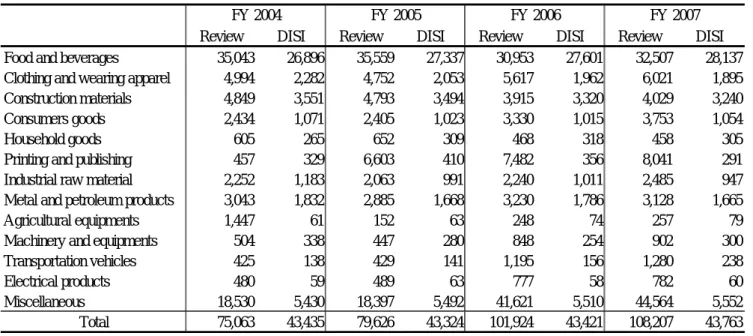
relationship between the two kinds of statistics can be seen from Table 8. When the figures of
various sectors are compared, large gaps are seen to exist between them. The differences
between those are quite anomalous, and the DISI figures are usually much smaller than the
Review. Reportedly, there exist quite a few factories that are not yet registered with the DISI.
This means the DISI statistics involve only a portion of the currently existing plants and
establishments in the country. Such incompleteness and inconsistency regarding the statistics
leads to an ambiguous picture of the actual situation regarding the nation's private
manufacturing industry.
5 The third source covers only private factories and establishments in 18 industrial zones. However, the author was not able to obtain the data. In this section, we use only the first and second sources.
33 Table 8: Private factorie s and establishments from two sources
Review DISI Review DISI Review DISI Review DISI
Food and beverages 35,043 26,896 35,559 27,337 30,953 27,601 32,507 28,137 Clothing and wearing apparel 4,994 2,282 4,752 2,053 5,617 1,962 6,021 1,895
Construction materials 4,849 3,551 4,793 3,494 3,915 3,320 4,029 3,240
Consumers goods 2,434 1,071 2,405 1,023 3,330 1,015 3,753 1,054
Household goods 605 265 652 309 468 318 458 305
Printing and publishing 457 329 6,603 410 7,482 356 8,041 291
Industrial raw material 2,252 1,183 2,063 991 2,240 1,011 2,485 947
Metal and petroleum products 3,043 1,832 2,885 1,668 3,230 1,786 3,128 1,665
Agricultural equipments 1,447 61 152 63 248 74 257 79
Machinery and equipments 504 338 447 280 848 254 902 300
Transportation vehicles 425 138 429 141 1,195 156 1,280 238
Electrical products 480 59 489 63 777 58 782 60
Miscellaneous 18,530 5,430 18,397 5,492 41,621 5,510 44,564 5,552
Total 75,063 43,435 79,626 43,324 101,924 43,421 108,207 43,763
(Source) MNPED, Review (various issues); and DISI.
FY 2004 FY 2005 FY 2006 FY 2007
4.2 Growth of private manufacturing
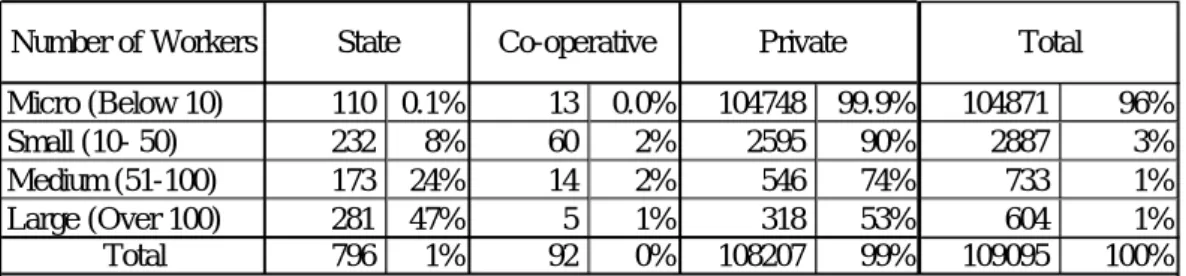
Table 9 shows the ownership pattern of factories and establishment by size, measured in
terms of number of employees. Most of the manufacturing enterprises in Myanmar are
micro-sized establishments with fewer than 10 workers, which account for 96% of the total in
FY2007. Among them, 99.9% are owned by private entrepreneurs. On the other hand, state
economic enterprises constitute 47% of large-scale factories, which accounts, however, for
only 1% of total establishments. Thus, the ownership structure of the manufacturing sector in
Myanmar is characterized as one with a small number of large-scale state-owned economic
34
Table 9: Factorie s and e stablishme nts by numbe r of worke rs as of FY2007
Micro (Below 10) 110 0.1% 13 0.0% 104748 99.9% 104871 96%
Small (10- 50) 232 8% 60 2% 2595 90% 2887 3%
Medium (51-100) 173 24% 14 2% 546 74% 733 1%
Large (Over 100) 281 47% 5 1% 318 53% 604 1%
Total 796 1% 92 0% 108207 99% 109095 100%
(Source) M NPED, Review (various issues); and CSO, Statistical Yearbook (various issues). The ratio of column of Total is one as of total number of factories and establishments.
Number of Workers State Co-operative Private Total
(Note) The ratios of columns of State, Co-operative and Private are ones as of each row's number of factories and establishments.
Tables 10 and 11 show the development of private industries that registered with the DISI.6
According to the Private Industrial Enterprise Law enacted in November 1990, any private
industrial enterprise using 3HP and with 10 or more wage-earning workers shall register
themselves with the DISI. Then Procedures relating to the Private Industrial Enterprise Law
were issued on February 1, 1991. In the Procedures, the authorities concerned requested that
existing private industrial enterprises apply for registration within 120 days from February 1,
1991. If they applied for registration within 120 days, then they would be allowed to continue
their production activities before receiving any directive from the Directorate. The number of
registrations jumped from 27 in FY1990 to 23,848 in FY1991. However, the growth of
registered number stabilized in the following fiscal year: it increased by only 5.2%, recording
25,081 in FY1992. It can be said that almost all private enterprises that should be registered
according to the Law and Procedures and had intentions to do so had actually registered by
the end of FY1991. Thus, increases in the figures of registered industries after FY1992 can
generally be regarded as new entrants.
6 Industries are classified using the two-digit classifying method of ISIC. The Ministry of Industry (1) has revised the Myanmar standard industry classification (BSIC, 1952 version) based on the 1990 version of the International Standard Industry Classification (ISIC).
35
Table 10: Registered private industries by product group, 1992-1999
Product group No.of estbts Employment Av.no.of employment
Share in no.of estbts
Share in
employment No.of estbts Employment
Av.no.of employment
Share in no.of estbts
Share in
employment No.of estbts Employment
Av.no.of employment Share in no.of estbts Share in employment Food products 13,406 60,537 4.5 56% 54% 22,106 92,922 4.2 63% 54% 22,152 93,957 4.2 62% 51% Tobacco products 130 868 6.7 1% 1% 149 1,726 11.6 0% 1% 146 1,913 13.1 0% 1% Textiles 1,520 10,543 6.9 6% 9% 2,348 17,334 7.4 7% 10% 2,093 18,158 8.7 6% 10% Wearing apparel 17 230 13.5 0.1% 0% 69 8,870 128.6 0% 5% 160 12,863 80.4 0% 7%
Leather and its products 133 645 4.8 1% 1% 231 1,232 5.3 1% 1% 289 3,038 10.5 1% 2%
Wood, wood products 2,571 13,797 5.4 11% 12% 2,647 16,011 6.0 8% 9% 2,756 17,243 6.3 8% 9%
Paper and its products 231 973 4.2 1% 1% 250 1,133 4.5 1% 1% 267 1,299 4.9 1% 1%
Publishing and printing 251 1,048 4.2 1% 1% 280 1,223 4.4 1% 1% 285 1,268 4.4 1% 1%
Coke and petrol products 1 3 3.0 0% 0% 5 40 8.0 0% 0% 5 29 5.8 0% 0%
Chemicals and its products 399 1,841 4.6 2% 2% 392 1,874 4.8 1% 1% 411 2,157 5.2 1% 1%
Rubber and Plastics 637 2,969 4.7 3% 3% 722 3,951 5.5 2% 2% 733 4,493 6.1 2% 2%
Other non-metallic mineral
products 226 1,081 4.8 1% 1% 270 1,867 6.9 1% 1% 282 2,104 7.5 1% 1%
Basic metals 539 2,837 5.3 2% 3% 581 3,356 5.8 2% 2% 607 3,691 6.1 2% 2%
Metal products 661 3,179 4.8 3% 3% 1,101 5,380 4.9 3% 3% 1,206 6,069 5.0 3% 3%
Machinery and equipment 102 424 4.2 0% 0% 353 1,580 4.5 1% 1% 586 3,408 5.8 2% 2%
Electrical, machinery and
apparatus 293 777 2.7 1% 1% 272 911 3.3 1% 1% 255 900 3.5 1% 0%
Radio,TV, others 2 6 3.0 0% 0% 4 17 4.3 0% 0% 8 22 2.8 0% 0%
Medical and optical instrumen 4 23 5.8 0% 0% 5 27 5.4 0% 0% 7 36 5.1 0% 0%
Motor vehicles and trailers 2,622 8,751 3.3 11% 8% 2,871 10,356 3.6 8% 6% 2,802 10,275 3.7 8% 6%
Other transport equipment 71 300 4.2 0% 0% 103 507 4.9 0% 0% 119 500 4.2 0% 0%
Furniture 301 1,396 4.6 1% 1% 432 2,105 4.9 1% 1% 428 2,453 5.7 1% 1%
Total 24,117 112,228 4.7 100% 100% 35,191 172,422 4.9 100% 100% 35,597 185,876 5.2 100% 100%
(Note) Av.No.of Employment stands for Average Number of Employment. Figures for 1999 is as of end of September 1999.
(Source)DISI, Ministry of Industry (1).
36
Table 11: Re gistere d private industrie s by product group, 2000-2008
Product group 2000 2005 2006 2007 2008 Food 23,478 23,689 23,885 26,161 26,896 27,337 27,601 28,137 28,728 Clothing 1,826 1,830 1,589 2,378 2,282 2,053 1,962 1,895 1,802 Shelter 3,086 3,193 3,295 3,507 3,551 3,494 3,320 3,240 3,111 Consumers goods 1,123 1,112 1,126 1,129 1,071 1,023 1,015 1,054 1,003 Household goods 282 290 215 196 265 309 318 305 307
Printing and publishing 341 345 355 340 329 410 356 291 283
Raw material 1,403 1,380 1,322 1,259 1,183 991 1,011 947 899
Metal and oil products 1,624 1,610 1,759 1,787 1,832 1,668 1,786 1,665 1,665 Agricultural equipments 47 48 48 52 61 63 74 79 77
Machinery and equipments 625 685 680 718 338 280 254 300 278
Transportation 86 86 83 79 138 141 156 238 233
Electrical products 40 48 47 54 59 63 58 60 64 General machinery 3,638 3,938 4,107 4,769 5,430 5,492 5,510 5,552 5,337 Total 37,599 38,254 38,511 42,429 43,435 43,324 43,421 43,763 43,787 (Source)DISI, Ministry of Industry (1).
37
The number of registered private industries increased from 24,117 factories in 1992 to
35,597 in 1999, with an average annual growth rate of 5.7%. The growth of Garment
(Wearing Apparel) was the highest, with a growth rate of 37.8% per annum, which was
followed by Machinery and Equipment with 28.4%, Coke and Petrol Products with 25.8%,
and Radio, TV, Communication Equipment Manufacturing with 21.9%.
As registered industries increased, so too did their employment. Once again the Garment
Industry recorded the highest growth rate, of 77.7% per annum. This was followed by Coke
and Petrol Products with 38.3%, Machinery and Equipment with 34.7%, Leather and Leather
Products with 24.8%, and Radio, TV, Communication Equipment Manufacturing with 20.4%.
The average number of workers at Garment Industry establishments exceeded 80 workers
per factory, whereas that of all manufacturing industries was just 5.2. As a result, the share of
total employment by the Garment Industry increased from a negligible percentage in 1992 to
7% in 1999. Both domestic and foreign companies vigorously invested in Garment Industry
and the number of garment factories is estimated to have reached more than 300 at its peak
around 2000, making it surely one of the most vibrant industries in Myanmar.7
Apart from the garment industry, however, the industrial structure shown in Table 10 has
not been much changed. Myanmar’s industry is still characterized by the extremely large
share of agro-based consumer goods industries with less importance on heavy industries.8
The upgrading and diversification of the industrial sector in Myanmar has yet to be observed.
Starting from 2000, the groups of registered private industries have changed from 21
product groups to 13 business types. The new industrial grouping is shown in Table 11. By
comparing the figures for 2000 and 2008, in terms of percentage share, the food industry
7 See Kudo [2010 forthcoming] for the growth and decline of garment industry in Myanmar in the 1990s and early 2000s.
8 Although Motor Vehicles and Trailers occupy 8% of total establishments, most of them are considered to be small and medium-size repair workshops.
38
sector grew by 4% points, clothing and garment decreased by 1% point, general machineries
grew by 2% points, and other industries remained the same.
5. GEOGRAPHICAL DISTRIBUTION OF INDUSTRIES 5.1 Geographical distribution
We next review the spatial distribution of plants and establishments. The sovereign territory
of Myanmar is 1.8 times greater than that in Japan, and the country has diverse geographical
and climatic aspects, with levels of industrial concentration that vary from district to district.
Tables 12 show the number of privately owned plants in different divisions and states. In
terms of the number of establishments, the greatest industrial concentration in 2000 was in the
Mandalay Division (21%), followed by Yangon (14%), Bago (13%), Ayeyarwady (13%), and
Sagaing (11%).9 The spatial distribution has not changed for the period between 2000 and
2009.
9 Yangon is the largest in terms of number of employees, production amount, and amount of investment, reflecting its size.
39
Table 12: Re gistere d private industries by state and division
as of 2009 Mandalay Division 7,651 21.6% 7,655 21.2% 17.7% 6,574 13.4% 11.6 0.02% 8.1% Yangon Division 5,466 15.5% 5,117 14.2% 14.0% 5,560 11.3% 9.2 -2.2% 10.7% Bago Division 4,358 12.3% 4,784 13.2% 10.9% 5,099 10.4% 9.4 3.2% 13.5/15.0* Ayeyarwaddy Division 3,875 11.0% 4,690 13.0% 14.9% 6,779 13.8% 6.9 6.6% 8.7% Sagaing Division 4,094 11.6% 3,986 11.0% 10.8% 5,488 11.2% 7.3 -0.9% 17.4% Shan State 1,943 5.5% 2,447 6.8% 8.6% 4,851 9.9% 5.0 8.0% 6.5/11.2/8.3** Magway Division 2,228 6.3% 2,020 5.6% 5.1% 4,548 9.3% 4.4 -3.2% 10.4% Mon State 1,934 5.5% 1,778 4.9% 5.6% 2,502 5.1% 7.1 -2.8% 9.7% Tanithayi Division 1,121 3.2% 923 2.6% 2.0% 1,356 2.8% 6.8 -6.3% 8.2% Rakhine State 845 2.4% 909 2.5% 4.9% 2,744 5.6% 3.3 2.5% 8.2% Kachin State 837 2.4% 781 2.2% 2.3% 1,272 2.6% 6.1 -2.3% 23.9% Kayin State 363 1.0% 423 1.2% 1.2% 1,489 3.0% 2.8 5.2% 8.0% Chin State 380 1.1% 401 1.1% 1.2% 480 1.0% 8.4 1.8% 13.7% Kayah State 253 0.7% 238 0.7% 0.8% 266 0.5% 8.9 -2.0% 15.8% Total 35,348 100.0% 36,152 100% 100% 49,008 100.0% 7.4 0.8% 10.5%
(Notes)* 13.5% for Bago Central; 15.0% for Bago West, ** 6.5% for Shan East; 11.2% for Shan South; 8.3% for Shan North. (Source)DISI, Ministry of Industry (1).
Population % Establishments/ 100person in 2000 Growth of no of estab (1997-2000) GDP Growth in FY99 March 1997 March 2000 No of establishment
State / Division Population in