Female labor force participation and dowries
in Pakistan
著者
Makino Momoe
権利
Copyrights 日本貿易振興機構(ジェトロ)アジア
経済研究所 / Institute of Developing
Economies, Japan External Trade Organization
(IDE-JETRO) http://www.ide.go.jp
journal or
publication title
IDE Discussion Paper
volume
728
year
2018-11
INSTITUTE OF DEVELOPING ECONOMIES
IDE Discussion Papers are preliminary materials circulated to stimulate discussions and critical comments
Keywords: Dowry, Female labor force participation, Marriage market, Assortative
matching, South Asia, Pakistan
JEL classification: J12, J16, J29, O53, Z13
* Institute of Developing Economies, 3-2-2 Wakaba Mihama-ku Chiba 261-8545, Japan. Tel.: 81-43-299-9589, E-mail address: [email protected]
IDE DISCUSSION PAPER No. 728
Female Labor Force Participation
and Dowries in Pakistan
Momoe Makino*
November 2018
Abstract
Dowries are prevalent in South Asian countries, despite legal bans. Theoretical studies suggest that increasing women’s financial contribution to households is the key to effectively abolishing this practice. To empirically examine this proposition, we conducted a unique survey in rural Pakistan, and gathered contemporaneous information about the expected amount of dowry for unmarried daughters. The estimation results show a negative association between female labor force participation and the expected amount of dowry, whereas no negative association is observed with other marriage expenses. These findings suggest that the negative association derives from appreciation of working women rather than their stigmatization.
The Institute of Developing Economies (IDE) is a semigovernmental, nonpartisan, nonprofit research institute, founded in 1958. The Institute merged with the Japan External Trade Organization (JETRO) on July 1, 1998. The Institute conducts basic and comprehensive studies on economic and related affairs in all developing countries and regions, including Asia, the Middle East, Africa, Latin America, Oceania, and Eastern Europe.
The views expressed in this publication are those of the author(s). Publication does not imply endorsement by the Institute of Developing Economies of any of the views expressed within.
INSTITUTE OF DEVELOPING ECONOMIES (IDE), JETRO 3-2-2, WAKABA,MIHAMA-KU,CHIBA-SHI
CHIBA 261-8545, JAPAN
©2018 by Institute of Developing Economies, JETRO
No part of this publication may be reproduced without the prior permission of the IDE-JETRO.
1
Female Labor Force Participation and Dowries in Pakistan*
Momoe Makino November, 2018
Abstract
Dowries are prevalent in South Asian countries, despite legal bans. Theoretical studies suggest that increasing women’s financial contribution to households is the key to effectively abolishing this practice. To empirically examine this proposition, we conducted a unique survey in rural Pakistan, and gathered contemporaneous information about the expected amount of dowry for unmarried daughters. The estimation results show a negative association between female labor force participation and the expected amount of dowry, whereas no negative association is observed with other marriage expenses. These findings suggest that the negative association derives from appreciation of working women rather than their stigmatization.
* I thank Takeshi, Aida, Andrew M. Francis, Yuya Kudo, Seiro Ito, Kazuki Minato, Tomoya
Matsumoto, Keijiro Otsuka, Tetsushi Sonobe, and seminar/conference participants at PAA,
SEHO, AASLE, GRIPS, JASAS, and IDE for their valuable comments and suggestions. My
special thanks go to Tariq Munir and his assistants at the Faizan Data Collection and Research
Centre for their sincere efforts in conducting field survey in Punjab, Pakistan. Financial support
from JSPS (Grant-in-Aid for Scientific Research, Kakenhi-15K17065) is gratefully
2
Keywords: Dowry, Female labor force participation, Marriage market, Assortative
matching, South Asia, Pakistan
3
1 Introduction
Dowry, broadly defined as a transfer from the bride’s parents at the time of marriage, is prevalent in South Asian countries. It is often considered as a root cause of unequal treatment of women, such as sex-selective abortion, female infanticide, and “dowry murder.”1 Dowry may be related to “missing women” (e.g., Sen, 1990), a term that refers to the unnaturally high male-female ratio in South Asian countries. Pro-gender activists and non-governmental organizations initiated anti-dowry movements in the late 1970s. The stance against dowry also becomes politically important (Palriwala, 2009). Given its alleged negative consequences, dowry is prohibited or restricted by laws in South Asian countries.2 However, the legal ban on dowry is ineffective, because the practice remains widespread, and its monetary value seems to be inflating.
Kishwar (1988, 1989) argued that assuring women’s property rights is important
1 “Dowry murder” means the death of a woman caused by her husband and his relatives in
connection with any demand for dowry. There is an argument that any domestic homicide tends
to be claimed as “dowry murder” by the victim’s side (who can thereby transfer the burden of proof to the accused’s side), and thus, the term “dowry murder” may be misleading (e.g.,
Kishwar, 1989; Narayan,1997; Leslie, 1998; Oldenburg, 2002; Palriwala, 2009).
2 The Dowry Prohibition Act of 1961 and its amendments in India; the Dowry Prohibition Act
of 1980 and its amendments in Bangladesh; the Dowry and Bridal Gifts (Restriction) Act of
4
to discourage dowry.3 However, it is not clear whether providing women with property rights is effective in abolishing the practice. Anderson and Bidner (2015) theoretically demonstrated that strengthening women’s formal property rights does increase dowries.4 Roy (2015) empirically showed that an amendment assuring female siblings’ inheritance rights equal to their brothers increased the amount of dowry that they received from their parents. According to Anderson and Bidner (2015), the only way to effectively abolish dowry is to increase the returns to women’s human capital. Although higher educational attainment of women itself may not discourage the dowry practice, the associated income-earning abilities of women are key to abolishing the practice. This argument is consistent with seminal work by Boserup (2007), indicating that in South Asian countries, where people often regard women as economically burdensome because they generally do not participate in the labor force and depend financially on male household members, the bride’s parents compensate the groom’s household by paying dowry.
There is no consensus on whether income-earning women curb dowry, however, and many mixed anecdotes exist. Some report that women’s higher education and greater income-generating opportunities have not discouraged dowry in India (e.g., Philips, 2003;
3 This view is consistent with empirical evidence that dowry plays a role in enhancing women’s
status for those women who do not have equal inheritance rights as their brothers (Makino,
2017).
4 Anderson and Bidner (2015) separate dowries into the groom-price portion and the bequest
portion. The former indicates a transfer to the groom and his family, and the latter indicates a
transfer to the bride. They argue that assuring women’s property rights increases the
5
Srinivasan & Lee, 2004; Srinivasan, 2005). In Bangladesh, others report anecdotes that those who earn income do not need to pay dowry because they are not a financial burden on their marital household (Kabeer, 2000, pp. 170–171). To the best of our knowledge, there is only one empirical study showing that women’s higher income-earning ability decreases the amount of dowry in South Asia (Mbiti, 2008).
This lack of consensus is partly due to tangled factors affecting the dowry amount. There is a consensus that a higher income-earning ability of the groom is positively evaluated in the marriage market and increases the dowry amount. This is consistent with the price model of dowries (see Becker, 1991), which suggests that the one who gains in marital life pays a price at the time of marriage. In contrast, it is arguable whether the income-earning ability of a bride is symmetrically evaluated as having a higher quality. In South Asian countries, where purdah (the practice of gender segregation and the seclusion of women in public) is prevalent, female labor force participation is often associated with poverty and is stigmatized (see, for example, Kabeer, 2000; Salway
et al., 2003; Kabeer & Mahmud, 2004; Kodoth, 2008; Klasen & Pieters, 2015). Female
labor force participation due to financial necessity may not be seen favorably in the marriage market. If so, an income-earning bride may be assessed as having lower or no higher quality at best, thus not necessarily discouraging dowry.
A negative association between female labor force participation and dowry amounts can be observed, even though income-earning women are not positively evaluated in the marriage market. Because working women are more likely to be observed in worse-off families in South Asia, the negative association simply may reflect the household’s low relative wealth level (the wealth effect). Alternatively, but not exclusively, because arranged positive assortative matching is the norm in South Asian
6
marriages (Banerjee et al., 2013), a lower-quality bride matched with a lower-quality groom does not need a high dowry if the quality of grooms, rather than the relatively homogeneous quality of brides, determines the dowry amount (Anderson, 2003, 2007). If women working outside the home for wages are stigmatized, as is alleged, these women, who will be matched to lower-quality grooms, will not have to pay a high dowry. A lower dowry for income-earning women is also consistent with the bequest model of dowry, which argues that the bride’s parents pay dowry as a pre-mortem bequest by disinheriting their daughters (e.g., Tambiah, 1973; Botticini & Siow, 2003). According to the bequest model, a worse-off family or a family with many children, especially one with many girls, offers a low dowry. Given these various and tangled factors associated with the dowry amount, whether or not female labor force participation leads to curbing dowries is an open question. The objective of the current study is to empirically answer this question by investigating which factors, positive evaluation, assortative matching at lower quality, or the wealth effect, is most likely to explain the negative association between female labor force participation and dowries.
This lack of consensus is also partly due to data unavailability and inadequacy.5 Because dowry is banned in India and Bangladesh, people are usually unwilling to reveal the correct amount and the recipients of a dowry to outsiders. Even though dowry is not legally prohibited in Pakistan, and people do not hesitate in answering questions about dowry, recall errors are very common. It is hard to remember precisely the amount of
5 Empirical studies suggest individual or household-specific determinants of dowry, other than
women’s income-earning ability (Behrman et al., 1995; Behrman et al., 1999), but clear-cut
7
dowry at the time of marriage, because a dowry usually consists of cash, gold, jewelry, furniture, electronics, kitchen items, and others. The current study adds to the limited number of empirical studies on the determinants of dowry by overcoming the problem of data unavailability and inadequacy. We conducted a unique survey targeting poor households in rural Pakistan where dowry is not prohibited, freeing people to answer questions about dowries. We asked about both the expected amount of dowry for unmarried daughters and the amount of dowry paid earlier at the time of marriage (for those already married). By using the expected amount of dowry as a main outcome variable, the current study is free from recall errors. To the best of our knowledge, this is the first study gathering contemporaneous information about expected dowries for unmarried women still residing with their parents. In obtaining information on retrospective amounts, we took careful measures to alleviate recall errors by asking the community-based dowry for each household,6 double-checking its real value, and confirming it with informants who actually attended the wedding ceremony. Furthermore, our unique survey collected information about other marriage expenses in an effort to disentangle factors associated with the dowry amounts, despite the difficulty in finding instrumental variables (IVs) to exogenously determine female labor force participation. Our empirical analysis shows a negative association between female labor force participation and the dowry amount. This negative association is not significantly observed with other marriage expenses, such as bride price and ceremony expenses,
6 The community-based dowry is obtained by asking each household the dowry amount paid by
the community that consists of families sharing the same status and standard of living with the
8
which counter the negative wealth effect or assortative matching at low quality as critical factors that explain the negative association between female labor force participation and dowries. Being a female teacher, who are respected in society (e.g., Boserup, 2007), also seems to be negatively associated with dowry. Female teachers are likely to be matched with higher-quality grooms, but the matching effect is not strong enough to eliminate the negative association between female labor force participation and dowries. Positive evaluation of an income-earning bride is a stronger determinant of dowry amounts than is assortative matching. Thus, female labor force participation seems to discourage dowry overall.
The remainder of this paper is constructed as follows. Section 2 explains the estimation strategy to structure the empirical analysis. Section 3 describes our household survey and the dataset. Section 4 presents the empirical results. Section 5 concludes the study.
2 Estimation Strategy
Preceding the empirical analysis, we set up our estimation strategy. According to the price model, dowry is paid to clear the marriage market (see Becker, 1991). Although various theoretical predictions of the model were developed in existing studies (Rao, 1993; Anderson, 2003, 2007; Dalmia, 2004; Arunachalam & Logan, 2016), the key feature of the model postulates an equilibrium marriage matching, as follows:
9
where 𝜔𝐵 and 𝜔𝐺 are characteristics of the bride and her family, and the groom and his family, respectively, 𝜏 is the dowry amount, and 𝑆 is a social, cultural, and demographic shifter of matching function. Note that 𝜔𝐵, 𝜔𝐺, and 𝑆 are all scalars capturing respective characteristics, such as 𝜔𝐵= 𝐵(𝒘𝑩) , 𝜔𝐺 = 𝐺(𝒘𝑮) , and 𝑆 = 𝐹(𝒔). Suppose that female labor force participation is appreciated in the marriage market. In this case, 𝑎𝐵 would be positive with respect to a bride’s working status, and she would be matched to a higher-quality groom. In contrast, if female labor force participation were despised, as is alleged, she would be matched to a lower-quality groom.
How does this equilibrium marriage matching interact with the amount of dowry? Solving Equation 1 for the dowry amount yields a hedonic function of dowry. Posit a linear hedonic function for simplicity as follows:
𝜏 = 𝒘𝑮′𝜶𝑮 − 𝒘𝑩′𝜶𝑩 + 𝒔′𝜶𝑺. (2)
The implication of the dowry function is that a groom and his family’s desirable traits increase the dowry, whereas a bride and her family’s desirable traits decrease it. The question for our purposes is whether a bride’s income-earning ability is positively evaluated in the marriage market. Directly estimating the dowry function given by Equation 2 without taking the endogeneity of female labor force participation into account, we may not be able to answer this question. Assume that a negative association is observed between female labor force participation and the dowry amount. We cannot immediately conclude that female labor force participation is positively evaluated in the marriage market and that working women do not have to pay a higher amount of dowry. The negative association between female labor force participation and household wealth
10
is likely observed in South Asia. A family with a working bride may not be able to afford to pay a higher dowry. Also, given strong assortative matching in the South Asian marriage, an income-earning bride likely will be matched to a groom from a worse-off family and thus will not have to pay a higher dowry. Alternatively, if a working bride is stigmatized, she will be matched to a lower-quality groom and will not have to pay a higher dowry. Likewise, when a positive association is observed between female labor force participation and the dowry amount, it may not necessarily indicate that female labor force participation is stigmatized. The positive association may simply reflect the fact that households with income-earning women have more financial resources. These tangled factors associated with female labor force participation and dowry amounts are illustrated in Figure 1 and summarized in Table 1.
Given the absence of persuasive exogenous variables determining female labor force participation, we use predicted associations of female labor force participation with different marital expenses to answer the question of whether or not female labor force participation is appreciated in the marriage market, thereby reducing the dowry amount. We eliminate alternative channels in Figure 1 one by one. First, to eliminate channel B (the wealth effect), the association between female labor force participation and expected ceremony expenses is examined. We assume that if a set of included wealth variables is sufficient and no significant association between female labor force participation and ceremony expenses is observed, female labor force participation carries no significant information about the wealth of a bride’s household and the matching of wealth between the bride and groom’s households. Second, the association between female labor force participation and the expected bride price is examined to eliminate channel A (assortative matching of low quality). Although there is no consensus about whether a bride’s higher
11
quality increases or decreases the dowry amount, the bride’s quality seems to be unambiguously and positively related with the bride price (Anderson, 2007; Ashraf et al., 2015). The positive association suggests that a working bride is appreciated in the marriage market, while the negative association suggests the opposite.
For the sake of completeness, we take other strategies to answer the question. First, we control household fixed effects. This strategy contains caveats, however, because only limited variation exists in a household, and the non-working status of daughters can be temporary, especially for younger ones.
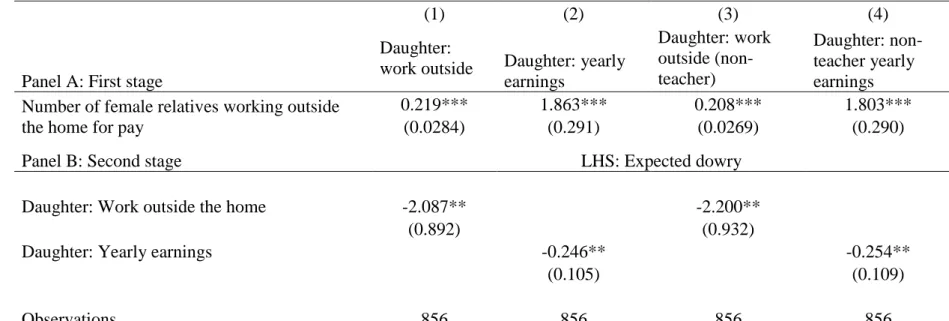
Second, we use the number of female non-household-member relatives working outside for pay as an instrument to determine an unmarried daughter’s labor force participation. This strategy also contains caveats because the number of female relatives working outside the home may possibly capture some unobserved household characteristics. However, since we have no alternative candidate for IVs,7 we report the estimation results with this IV in the Appendix.
3 Household Survey
3.1 The estimation equation and the survey’s design
We conducted the survey in Punjab, Pakistan in 2014–2015, to explore whether
7 Another, and more exogenous, candidate for an IV may be the average commuting time from
villages to factories. However, this is subject to the problem of weak instruments because of the
specific stratified sampling strategy of the survey (see Section 3.2), in which the sampled
12
earning women lead to discouraging dowry. The estimation equation, derived from Equation 2 that shows the price model of dowries, assumes that a future groom’s quality is absorbed by the assortative matching between a bride and groom’s households, on average. This assumption is plausible because we explore the association between unmarried daughters’ labor force participation and their expected amount of dowry in a society where marriage is almost exclusively arranged by parents of both sides. The estimation equation is given by:
𝐷𝑗𝑘 = 𝛽0+ 𝛽1𝐹𝐿𝑃𝑗𝑘+ 𝑹𝒋𝒌′𝜷𝑹 + 𝑿𝒋𝒌′𝜷𝑿 + 𝑽𝒌′𝜷𝑽 + 𝜀𝑗𝑘 (3)
where 𝐷𝑗𝑘 is the expected amount of dowry, in 2014 Pakistan Rupees (PKR),8 decided by the household head for his unmarried daughter in household 𝑗 in village 𝑘. We use a level amount instead of a log amount, because the expected dowry amount is neither left-censored at zero nor right-skewed, unlike wages (See the Appendix, Figure A1).9 𝐹𝐿𝑃𝑗𝑘
8 All the values are in 2014 prices throughout the text. On average, USD 1 = PKR 109.8 in
2014. For the expected amount of marriage expenses, the 2014 prices are calculated based on
the nominal expected amount of marriage expenses, the expected year of marriage for each
unmarried daughters, and the average CPI over the past 20 years.
9 The amount of non-dowry expenses are not left-censored at zero, but are right skewed.
Therefore, we repeat the estimation procedure with a log amount as well as by dropping outliers
for non-dowry expenses. The estimation results are consistent with those presented in Table 5,
13
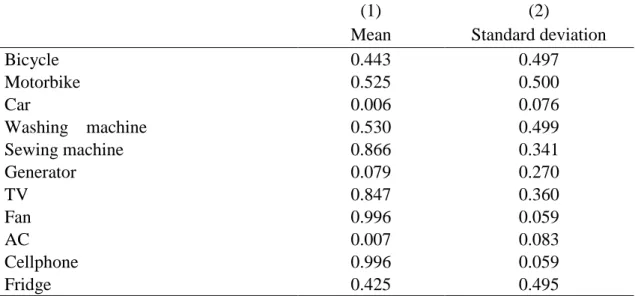
takes the value one if a daughter works outside for wages. 𝑹𝒋𝒌 is a vector of the daughter’s characteristics, namely, her age, enrollment status, and education level. 𝑿𝒋𝒌 is a vector of household characteristics, namely, the head’s and his wife’s age, education level, and number of living daughters and sons, religion, caste, and wealth of the household. A household’s wealth is measured by four variables less related to the current decision of a daughter’s labor force participation: the size of agricultural land, the value of residential land and homes, the dowry paid by the wife’s natal family, and the wealth index.10 𝑽
𝒌 is a vector of village characteristics, namely, the measure of village wealth, which is measured by the ratio of pucca (solid and permanent) house, and the marriageable male to female ratio in the village.11
10 The wealth index is constructed by principal component analysis, allowing for correlations
across factors. The index variable is the only factor having an eigenvalue greater than one.
Variables used in constructing the index are shown in the Appendix, Table A1.
11 The marriageable male-female ratio is the measure of marriage market competitiveness in the
village, following the literature testing the price and bequest models of dowry (Rao, 1993;
Arunachalam & Logan, 2016). Taking marriageable ages in the current Pakistani context into
account, we apply but adjust Rao’s (1993) methodology calculating the sex ratio so that the
ratio is given by the number of unmarried males aged 20–35 divided by the number of
unmarried females aged 15–30. It should be noted, however, that the number of cousins may be
more appropriate to measure marriage market competitiveness. Among wives in our sample, the
weighted probability of marrying within the same village is 23 percent while that of marrying
their first cousin is 41 percent. However, the number of cousins does not have any significant
14
The questionnaire is uniquely designed to collect the information necessary for estimating Equation 3 and consists of three parts. The first part consists of questions to the head of household, including a household roster concerning age, enrollment status, working status, and education level of all household members, typical socioeconomic questions, and unique questions particular to this survey, such as marriage practice and (expected) dowries paid or received at the time of the head of household’s children’s marriage. In our sample, the head of the household is exclusively male but for a widowed or divorced household or a household with a mentally disabled husband, the head is female. The second part contains questions for the wife, including questions about her socioeconomic characteristics, natal family, and gender relations, such as decision-making power, mobility, level of son preference, and time allocation. If the head of the household is female, she responds to both the first and second parts. The third part contains questions for an unmarried daughter aged 15 to 30. (As described in the next section, the population of our survey contains households with at least one unmarried daughter in this age group). Questions to her regard working status, attitude toward work, wages (if applicable), level of son preference, and time allocation.
3.2 Sampling
Because Pakistan does not legally prohibit dowry, people have no hesitation answering questions about it. Of the four provinces of Pakistan, we selected Punjab, which accounts for more than 50 percent of the Pakistani population. The Sindh province also observes the practice of dowry but because of the deteriorating law and order situation in Sindh, our study focuses on Punjab province. Working opportunities for women, especially in factories, are generally limited in Pakistan. We purposely selected the districts of
15
Faisalabad, Hafizabad, Nankana Sahib, and Sialkot (see Figure 2), where women’s working opportunities are relatively abundant.
First, we identified a rural area within commuting distance of export-oriented garment factories. Using a district census, we randomly selected 57 villages within a commutable, rural area. Second, we profiled all households in each village. Eligible households were defined as either landless or with no more than five acres of land and with at least one unmarried daughter aged 15–30. Eligible households were classified into three strata, based on daughters’ working status: (i) working for pay outside the home as a non-teacher; (ii) working as a teacher; and (iii) not working outside the home. If more than one such daughter was found within the household, a randomly selected daughter became the respondent of the third part of the questionnaire. We explicitly sampled households with female teachers, because teaching is the one respectable job for women in a purdah-observing rural area (e.g., Boserup, 2007).
We used the following stratified random sampling methodology. Among eligible households, we selected six from strata (i) and (ii) (i.e., households with unmarried female workers) and ten from stratum (iii) (i.e., households without unmarried female workers). When there were more than five households in stratum (ii) in a village, we randomly selected four households from stratum (i) and two from stratum (ii). Otherwise, we randomly selected five from stratum (i) and one from stratum (ii). In villages with no unmarried female teacher, we randomly selected six households from stratum (i).
3.3 Data
Panel A of Table 2 presents summary statistics of household characteristics, and Panel B presents the characteristics of daughters who responded to the questionnaire. All means
16
are weighted by the inverse of the probability being sampled. Our survey’s population consists of households with no more than five acres of land and with at least one unmarried daughter aged 15–30. Also, our stratified random sampling methodology oversamples households with at least one unmarried female worker. Households with female workers in Pakistan are allegedly worse off, and summary statistics of these households (columns (3) and (4)) supports the view that the survey oversamples relatively worse-off households among the eligible households. For the full sample, the weighted share of kammees,12 or functionally lower castes, is 42 percent. The weighted mean of agricultural land owned is 1.3 acres, the weighted mean of residential home and land value is 670,414 PKR, and the weighted mean of a wife’s dowry is 79,022 PKR.
Ninety-two percent of households are headed by men. Forty-three percent of household heads completed primary education, but 79 percent of wives never enrolled in primary school. Based on our survey population, the number of daughters is 1.4 times greater than the number of sons.
The weighted share of working daughters is 31 percent, and the weighted probability of being enrolled in school is 27 percent. The weighted mean of the expected amount of a dowry is 171,961 PKR.
12 In a traditional rural Punjabi economy, one’s occupation was determined by birth (Eglar,
1960). Those who provide various services to landowning households (zamindars) have been
collectively called kammees. Although Islam denies the caste system, and those born in kammee
households have rarely engaged in traditional services recently, social stratification by birth
stubbornly exists. For descriptive purposes in the current study, we refer to the
17
Average yearly earnings by unmarried daughters’ occupation are shown in Figure 3. Interestingly, and perhaps surprisingly, earnings of private teachers are far lower than those of factory workers. The number of factory workers in our sample is greater than any other profession, for a survey area restricted to commuting distances of export-oriented garment factories. Although public sector workers, including teachers, earn the highest among all, our sample includes only two public school teachers. Because securing a public sector job is very competitive, the term “unmarried female teacher” usually means working in a private school. Hence, average teachers’ wages are lower than those of factory workers. For the purpose of our study, it is important to understand the cultural context in which a female teacher earns less than a factory worker, although the former is respected and the latter is not.
4 Estimation Results
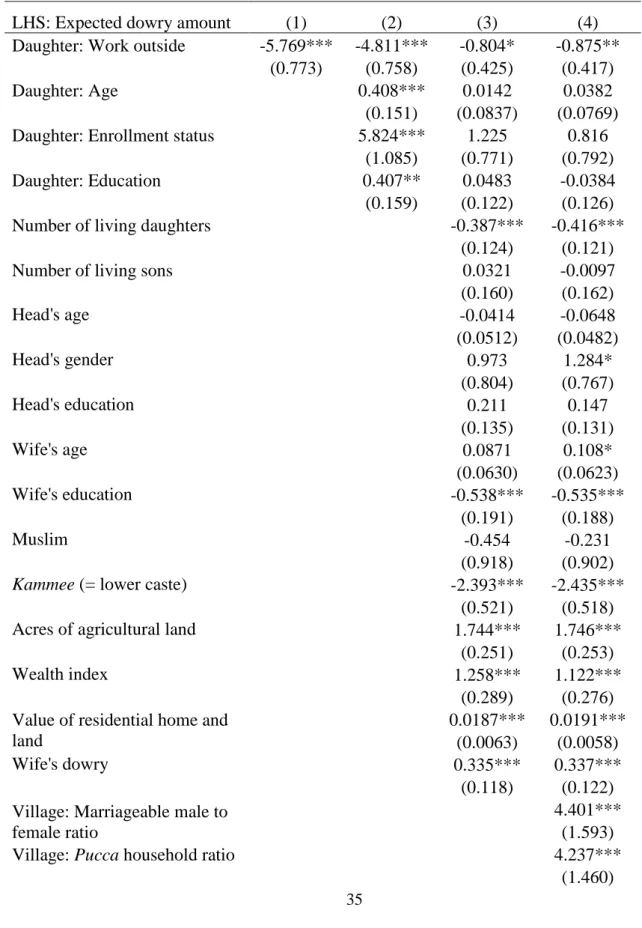
Taking the stratified random sampling into account, the linear equation model is regressed using the sample weighted by the inverse of the probability of being included in the sample.13 Equation 3 is first estimated without control variables and then gradually estimated with them to see how female labor force participation and household wealth are related. The estimation results are presented in Table 3. Column (1) shows that when a daughter works for pay outside the home, her dowry decreases by PKR 57,690 on average. We cannot, though, interpret this as a causal effect. Women’s labor force
13 The estimation results for the ordinary least squares (OLS) and the two-stage least squares
18
participation, in particular, is negatively associated with low household wealth in South Asia (e.g., Pradhan et al., 2015). The coefficient estimates of a daughter working outside the home may simply capture the negative wealth effect. Columns (2), (3), and (4) add a daughter’s attributes, household characteristics, and village characteristics, respectively. As expected, wealthier households offer a higher dowry, as shown by significantly positive coefficient estimates of the size of agricultural land, the wealth index, the value of residences, and the wife’s own dowry paid at the time of her marriage. Lower-caste households pay a smaller dowry. As with the household wealth level, the village wealth level is significantly positively associated with the dowry amount. A significantly positive sign on the marriageable male-female ratio in the village seems to be counter-intuitive,14 as a higher ratio, i.e., surplus of grooms, indicates a relatively favorable marriage market condition for brides. Given that the village endogamy is not common in rural Punjab, Pakistan (see Footnote 11), however, the ratio is not necessarily related with the marriage market competitiveness. Possibly, it may reflect the level of village wealth as more working opportunities attract male workers into the village, or the level of son preference that can be associated with a higher dowry. By controlling household and village wealth levels, the magnitude of the estimated coefficient for daughters working outside the home decreases from −5.769 to −0.875. Although not significant, the positive association between enrollment status, which captures an expected higher education level, and dowry amounts possibly suggests that enhancing women’s education, without their working, may lead to a higher dowry, reflecting the assortative matching of education. A wife’s
19
level of education has a significantly negative association with the dowry amount, which may suggest that when mothers are relatively empowered, they tend to decrease their daughter’s dowry. When the daughter has a sister, the dowry amount significantly decreases, by PKR 4,160 on average, which is consistent with the bequest model.
Equation 3 is repeatedly estimated by replacing a daughter’s working status with her yearly earnings. There is weakly (at the 10 percent level) significant negative association between a daughter’s yearly earnings and an expected dowry amount (Table 4). It may be because association between earnings and dowry amounts are blurred as female teachers earn much less than factory workers (see Figure 3), despite being the only inarguably respectable occupation in the survey area. The estimation is repeated by separating earnings between non-teachers and teachers. The negative association between the expected dowry amount and women’s earnings as non-teachers remains weakly significant, and the magnitude becomes slightly larger. Although not significant, the association between a teacher’s earnings and an expected dowry amount is negative, which may suggest that the negative association between female labor force participation and dowries is not derived from assortative matching at low quality.
Equation 3 is repeatedly estimated by assigning other marriage expense measures for 𝐷𝑗𝑘 to figure out which mechanism more likely explains the negative association between dowries and working brides. Three possible mechanisms corresponding those in Figure 1 are: (A) she is despised and matched to a lower-quality groom in the marriage market (assortative matching); (B) she is from a worse-off family that cannot pay a higher dowry (wealth effect); and (C) she is appreciated in the marriage market and does not have to pay a high dowry (appreciation of working women). Other
20
marriage expense measures are the expected amount of bari (customary bride price15) paid by the groom’s family at the time of a daughter’s marriage and the expected marriage ceremony expenses for both the bride’s and groom’s families. Note that while a dowry paid by the bride’s family is the largest expense in a Pakistani marriage, expenses incurred by the groom’s families are not negligible (Figure 4). The estimation results are presented in Table 5. Female labor force participation as teachers and as non-teachers is separately included in the estimation equation, given their different nature, as discussed above. The insignificant association of a daughter’s working status with ceremony expenses (columns (3) and (4) of Table 5) can be supportive evidence that included wealth measures sufficiently control the wealth level of households. The insignificant association between a daughter working as a teacher and ceremony expenses can also complement the evidence, given that female teachers are more likely to come from a relatively better-off family that can afford to invest in girls’ higher education. We safely rule out (B), the wealth effect, as a mechanism behind the negative association between a dowry and a working bride.
Next, the insignificant association between a daughter’s working status and bride price (column (2) of Table 5) hints that negative association is least possible from (A), assortative matching, otherwise it should significantly lower her bride price, reflecting lower-quality matching. Although insignificant association cannot assertively support the view that a working bride is respected, it at least suggests that she is not assertively
15 Both religious and customary bride prices are paid in typical Pakistani marriage. The bride
price usually indicates a religious portion, called mehr, which nowadays is a mere token
21
disrespected in the marriage market, contrary to general belief. Collateral evidence indicates that the coefficient estimate of a daughter working as a teacher remains negative with respect to dowry (column (1) of Table 5). Given that female teachers are respected in society and thus appreciated in the marriage market, they are more likely to be matched with higher-quality grooms, leading to a higher dowry. In sum, a negative association is more likely generated by (C) appreciation of a bride’s income-earning ability rather than by (A) assortative matching at a low quality.
Our empirical analysis is not intended to show any rigorous causality but rather to explore mechanisms behind the negative relationship between daughters’ working status or income-earning ability and dowry amounts. In particular, we do not exclude the possibility of reverse causality, where parents unwilling to pay a higher dowry tend to let their daughters work outside the home. Also, unobserved parental characteristics such as gender progressiveness may simultaneously enhance a daughter’s labor force participation and also decrease the dowry amount, but it may not be her labor force participation that leads to a lower dowry. Even in these cases, the mechanism connecting female labor force participation and dowry is positive from the perspective of women’s empowerment. However, for the sake of completeness, we estimate the equation with household fixed effects. The estimation is feasible because we collected basic information (e.g., age, education, and working status) of the daughter-respondent’s sisters aged 15– 30 and their expected marital expenses. The estimated results show insignificant association between female labor force participation and dowry (Table 6). This is not surprising, given that the number of households with at least two daughters aged 15–30 totals 428 out of 857. Moreover, the within-family variation with regard to daughters’ labor force participation comes only from 213 households. In practice, fathers, who
22
almost always decide their daughters’ labor force participation, do not usually differentiate one daughter’s dowry from another based on whether or not they participate in the labor force. A currently non-working daughter may start working soon or as soon as she becomes her older sister’s age. In this case, the working status of daughters within the household simply captures the timing of the survey relative to their ages and does not correlate with their expected dowry amounts. This is especially likely for daughters who engage now or later in occupations requiring fewer qualifications and skills, e.g., factory workers. In fact, the share of households with two or more daughters working in factories out of those with at least one daughter working in factories is 22 percent, while the share of households with two or more daughters working as a teacher out of those with at least one daughter working as a teacher is only 5 percent. This suggests that to be factory workers is far easier than to be a teacher controlling for household fixed effects. A significantly positive association is observed between daughters’ working status as a teacher and her bride price, even within the household.16 Given a consensus about the positive relationship between a bride’s quality and her bride price (Anderson, 2007; Ashraf et al., 2015), it supports the view that a female teacher is in fact positively evaluated in the marriage market.
Although the number of female relatives working outside the home for pay may correlate with unobserved household characteristics, as discussed in Section 2, for the sake of completeness, we also repeat the estimation procedure with an IV, namely, the number of female non-household-member relatives working outside for pay. The
16 The within-family variation with regard to daughters’ labor force participation as a teacher
23
estimation results of the linear equation model with an IV are presented in the Appendix, Table A2. Female labor force participation significantly decreases expected dowry amounts. The magnitude is twice as large as that of a linear equation model without an IV. This may be because parents count on their daughter’s income-earning ability as a source of future dowry, which gives upward bias to the expected amount. Alternatively, parents who decide to let their daughter work outside the home believe that a working bride will be matched to a higher-quality groom, which increases the expected dowry amount. Female yearly earnings also, although weakly, significantly decrease the expected dowry amount.
Because the population of our survey is defined as households with at least one unmarried daughter aged 15–30, the sample may be selectively biased to households that do not marry their daughters earlier for some unobserved reasons. In particular, despite no rigorous evidence, it is often believed that parents in South Asia can save a dowry by marrying their daughters earlier. If this is true, delayed marriage of daughters and dowry amounts are likely correlated. Because the average age of Pakistan women at marriage was 23 in 2012–2013, according to the United Nations Marriage Data 2015, the main estimation is repeated, with the subsample restricted to households with at least one unmarried daughter aged 15–23. The estimated coefficient is robust in terms of magnitude, and is not substantially different from that presented in Table 3 (see the Appendix, Table A3), although the significance level becomes weak, probably due to a decreased sample size of 692 households. The insignificant relationship between daughters’ working status and non-dowry marriage expenses is also consistent with the results using the full sample.
According to Boserup (2007), because the perception that women are financially burdensome in the marital household lies behind the dowry practice, it is important for
24
women to continue earning income after marriage. We asked the unmarried daughters about their intention to continue their jobs after marriage. Out of daughters working outside the home, 38 percent say that they are willing to continue their jobs after marriage. Then, the estimation procedure is repeated by separating daughters’ working status with and without their intention to work after marriage. The estimation results (Appendix, Table A4) show that the association with the dowry amount is not significantly different between those with and without their intention to work after marriage. However, the association between daughters’ yearly earnings and the dowry amount is only significant and negative among those who are willing to work after marriage. This is consistent with Boserup’s (2007) argument that dowry is paid by the bride’s parents to the groom and his parents as the compensation for the bride’s financial dependence.
One may argue that unmarried daughters’ willingness to work after marriage will not affect the dowry amount a la Boserup (2007), if purdah is imposed by their husband. However, the majority of women seem to decide whether and to what extent they should observe purdah. In this survey, we asked whether the wives (i.e., the daughters’ mothers) have to have their husbands’ permission to visit their friend/relatives in and outside of the village, the neighborhood shops, and the local health center. We make a variable “purdah imposed,” which takes the value one if the wife has to ask her husband’s permission to visit any of these places. The share of wives who have to ask their husbands’ permission to visit these places is 31 percent. The estimation procedure is repeated by including the variable “purdah imposed” and its interaction term with daughters’ working status/yearly earnings. The estimation results (Appendix, Table A5) show that the association between daughter’ working status/yearly earnings and the dowry amount is only significantly negative among those whose mothers do not have to ask her husband’s permission to go
25
out. The negative association significantly disappears when purdah is imposed on daughters’ mothers by their fathers. The results suggest that female labor force participation alone does not necessarily discourage the dowry practice, and strong gender conservativeness of the household may counteract its deterrence.
Our survey also collected information on the daughter’s brothers’ paid (if he is married) or expected (if he is not married) dowry amount. And thus, we can check whether there is any association between the daughter’s working status and the daughter’s brothers’ average amount of marriage expenses. The estimation results (Appendix, Table A6) show that there is no significant association between the daughter’s working status and her brothers’ average marriage expenses. The results suggest that, although households with working daughters may be relatively gender progressive, it is not households’ gender progressiveness alone that leads to a lower amount of dowry. Besides, the positive association, although insignificant, between the daughter’s working status and her brothers’ bride price and ceremony expenses may support the argument that the wealth level and financial capacity of the households are sufficiently controlled by included covariates, even though working daughters are, on average, from worse-off households.
5 Conclusion
The empirical analysis in this study consistently shows a negative association between female labor force participation and dowry. It supports the view that this association relates to an appreciation of women’s income-earning ability rather than to assortative matching at low quality or negative wealth effects. It is also consistent with Anderson and
26
Bidner’s (2015) recent theoretical model, showing that enhancing returns to education is the key to curbing dowries. Educated brides without working opportunities do not seem to be evaluated positively in the marriage market and this does not decrease the dowry amount. In the long run, however, enhancing female education itself may be effective in discouraging the dowry practice, because we found a negative association between more educated mothers and their daughters’ expected dowry. This may be because they are more empowered and enjoy a higher bargaining position within a household.
Our estimation results are also consistent with anecdotes about female sewing operators hired by the garment industry in Bangladesh, which report that they do not need to pay dowry at the time of marriage (e.g., Kabeer, 2000). In Bangladesh, this relatively new industry provides opportunities for women in poor rural families by paying them relatively higher wages compared with alternatives such as housekeeping and agricultural labor. The phenomenon is very similar in Pakistani villages within commuting distance of this industry. Although female sewing operators in Pakistan are less common than in Bangladesh, this is undoubtedly a new income-earning opportunity that pays higher wages than other existing alternatives, including teaching in private schools. According to Makino (2014), these women earn as much as men, who are typically employed as construction workers, drivers, and factory workers. These women are surely not financially burdensome, and following Boserup’s (2007) logic, they do not need to pay dowries. Anecdotally, it is said that working women in factories are dishonored and that a strong stigma is attached to their working outside the home. However, our qualitative interviews reveal that working women have a positive outlook about working outside the home for pay. The majority think that working outside the home helps them find a good match in marriage. This may indicate the possibility that women working in factories are
27
nowadays less stigmatized, which is pointed out by Klasen and Pieters (2015).
If a policy objective is to abolish dowries, generating new, income-earning opportunities for women in poor households, such as those in the garment industry, seems more effective than a legal ban on dowries. However, such opportunities alone are not necessarily promising in the effort to extinguish dowries. As the association between brides’ earnings and the expected dowry amount is only significant among those who are willing to work after marriage, the financial independence of women before and after marriage may be the key to abolishing dowry. Further investigation of factors behind persistent dowry practice in contemporary South Asia is clearly called for.
28
References
Anderson S. 2003. Why dowry payments declined with modernization in Europe but are rising in India. Journal of Political Economy 111 (2): 269–310. https://doi.org/10.1086/367679
Anderson S. 2007. The economics of dowry and brideprice. Journal of Economic
Perspectives 21 (4): 151–174. doi: 10.1257/jep.21.4.151
Anderson S, Bidner C. 2015. Property rights over marital transfers. Quarterly Journal of
Economics 130 (3): 1421–1484. https://doi.org/10.1093/qje/qjv014
Arunachalam R, Logan TD. 2016. On the heterogeneity of dowry motives. Journal of
Population Economics 29 (1): 135–166. https://doi.org/10.1007/s00148-015-0544-1
Ashraf N, Bau N, Nunn N, Voena A. 2015. Bride price and the returns to education for women. Cambridge, MA: Harvard University. Available from: http://scholar.harvard.edu/nunn/publications/bride-price-and-returns-education-women [Accessed 15 December 2015].
Banerjee A, Duflo E, Ghatak M, Lafortune J. 2013. Marry for what? Caste and mate selection in modern India. American Economic Journal: Microeconomics 5 (2): 33– 72. doi: 10.1257/mic.5.2.33
Becker GS. 1991. A Treatise on the Family, Enl. Edition. Harvard University Press: Cambridge.
Behrman JR, Birdsall N, Deolalikar A. 1995. Marriage markets, labor markets, and unobserved human capital: An empirical exploration for South-Central India.
Economic Development and Cultural Change 43 (3): 585–601. http://www.jstor.org/stable/1154241
29
home teaching, and economic growth. Journal of Political Economy 107 (4): 682– 714. https://doi.org/10.1086/250075
Boserup E. 2007. Women's Role in Economic Development. Earthscan: London.
Botticini M, Siow A. 2003. Why dowries? American Economic Review 93 (4): 1385– 1398. http://www.jstor.org/stable/3132295
Dalmia S. 2004. A hedonic analysis of marriage transactions in India: Estimating determinants of dowries and demand for groom characteristics in marriage. Research
in Economics 58: 235–255. https://doi.org/10.1016/j.rie.2004.03.002
Eglar Z. 1960. A Punjabi Village in Pakistan. Columbia University Press: New York. Francis AM. 2011. Sex ratios and the red dragon: Using the Chinese communist
revolution to explore the effect of the sex ratio on women and children in Taiwan.
Journal of Population Economics 24 (3): 813837. http://www.jstor.org/stable/41488330
Kabeer N. 2000. The Power to Choose: Bangladesh Women and Labour Market Decision
in London and Dhaka. Verso: London.
Kabeer N, Mahmud S. 2004. Globalization, gender and poverty: Bangladeshi women workers in export and local markets. Journal of International Development 16 (1): 98–109. https://doi.org/10.1002/jid.1065
Kishwar M. 1988. Rethinking dowry boycott. Manushi 48: 10–13.
Kishwar M. 1989. Towards more just norms for marriage: Continuing the dowry debate.
Manushi 53: 2–9. http://www.manushi-india.org/issues/issue_cover53.htm
Klasen S, Pieters J. 2015. What explains the stagnation of female labor force participation in urban India? World Bank Economic Review 29 (3): 449–478. https://doi.org/10.1093/wber/lhv003
30
Kodoth P. 2008. Gender, caste and matchmaking in Kerala: A rationale for dowry.
Development and Change 39 (2): 263–283.
https://doi.org/10.1111/j.1467-7660.2008.00479.x
Leslie J. 1998. Dowry, ‘dowry deaths’ and violence against women: A journey of discovery. In South Asians and the dowry problem, Menski W (ed.). Vistaar Publications: New Delhi; 21–35.
Makino M. 2014. Pakistan: Challenges for women’s labor force participation. In The
garment industry in low-income countries: An entry point of industrialization,
Fukunishi T, Yamagata T (eds). Palgrave Macmillan: Hampshire UK; 132–176. Makino M. 2017. Dowry in the absence of the legal protection of women’s inheritance
rights. Review of Economics of the Household. https://doi.org/10.1007/s11150-017-9377-x
Mbiti IM. 2008. Monsoon wedding? The effect of female labor demand on marriage markets in India. Charlottesville, VA: University of Virginia. Available from https://sites.google.com/site/isaacmbiti/ [Accessed 15 December 2015].
Narayan U. 1997. Dislocating Cultures: Identities, Traditions, and Third World
Feminism. Routledge: New York.
Oldenburg VT. 2002. Dowry Murder. Oxford University Press: New York.
Palriwala R. 2009. The spider’s web: Seeing dowry, fighting dowry. In Dowry: Bridging
the gap between theory and practice, Bradley T, Tomalin E, Subramaniam M (eds).
Women Unlimited: New Delhi, India; 144–176.
Philips A. 2003. Stridhanam: Rethinking dowry, inheritance and women’s resistance among the Syrian Christians of Kerala. Anthropologica 45 (2): 245–263. http://www.jstor.org/stable/25606144
31
Pradhan BK, Singh SK, Mitra A. 2015. Female labour supply in a developing economy: A tale from a primary survey. Journal of International Development 27: 99–111. https://doi.org/10.1002/jid.2994
Rao V. 1993. The rising price of husbands: A hedonic analysis of dowry increases in rural India. Journal of Political Economy 101 (4): 666–677. http://www.jstor.org/stable/2138743
Roy S. 2015. Empowering women? Inheritance rights, female education and dowry payments in India. Journal of Development Economics 114: 233–251. https://doi.org/10.1016/j.jdeveco.2014.12.010
Salway S, Rahman S, Jesmin S. 2003. A profile of women’s work participation among the urban poor of Dhaka. World Development 31 (5): 881–901. https://doi.org/10.1016/S0305-750X(03)00016-0
Sen A. 1990. More than 100 million women are missing. New York Review of Books 37: 61–66. http://www.nybooks.com/articles/archives/1990/dec/20/more-than-100-million-women-are-missing/
Srinivasan P, Lee GR. 2004. The dowry system in Northern India: Women’s attitudes and social change. Journal of Marriage and Family 66 (5): 1108–1117. https://doi.org/10.1111/j.0022-2445.2004.00081.x
Srinivasan S. 2005. Daughters or dowries? The changing nature of dowry practices in South India. World Development 33 (4): 593–615. https://doi.org/10.1016/j.worlddev.2004.12.003
Tambiah SJ. 1973. Dowry and bridewealth and the property rights of women in South Asia. In Bridewealth and dowry, Cambridge papers in social anthropology, No.7, Goody JR, Tambiah SJ (eds). Cambridge University Press: Cambridge, MA; 59–169.
32
Table 1. Theoretical prediction about the relationship between female labor force participation and marital expenses (+ positive, -
negative)
Mechanism Condition Dowry
Bari (customary bride price) Bride's side ceremony expense Groom's side ceremony expense (A) Assortative matching
Working women are stigmatized. - - (-) (-) Working women are appreciated. + + (+) (+)
(B) Wealth effect
Working women are from worse-off families. - - - - Working women financially contribute to
their families. + + + + (C) Price model: marriage market clearing
Working women are stigmatized. + - (no prediction) (no prediction) Working women are appreciated. - + (no prediction) (no prediction)
33
Table 2. Summary statistics of household and unmarred daughters, aged 15-30
(1) (2) (3) (4)
N = 856 Households with working daughter (N = 327)
Weighted mean Standard deviation Weighted mean Standard deviation
Panel A: Household characteristics
Head's age 50.85 6.37 51.87 6.08
Head's gender 0.92 0.27 0.88 0.33
Head's education 2.41 1.68 1.92 1.45
Wife's age 46.33 5.85 47.77 5.98
Wife's education 1.60 1.18 1.30 0.78
Kammee (= lower caste) 0.42 0.49 0.71 0.45
Acres of agricultural land 1.34 1.60 0.39 0.98
Value of residential home and land (2014 PKR) 670,414 277,133 596,020 254,510 Wife's dowry (2014 PKR) 79,022 48,464 57,923 45,285
Number of living daughters 2.95 1.47 3.28 1.52
Number of living sons 2.14 1.20 2.02 1.23
Muslim 0.95 0.22 0.87 0.34
Number of female relatives working outside the home
0.37 0.71 0.85 0.92
Panel B: Characteristics of unmarried daughter-respondents, aged 15-30
Age 20.35 3.06 21.51 2.74
Enrollment status 0.27 0.44 0.01 0.07
Education (not enrolled only: N = 655) 3.58 1.66 3.45 1.82 Working status (work outside the home for pay) 0.31 0.46
34
Working as a teacher 0.02 0.14
Expected dowry (2014 PKR) 171,961 71,077 134,260 54,622 Expected bride price (2014 PKR) 85,613 61,772 58,189 46,100 Expected ceremony expenses (2014 PKR) 90,767 56,789 65,235 38,084 Expected ceremony expenses by in-laws
(2014PKR) 118,622 67,674 86,755 40,824
The sample is weighted by the inverse of the probability being sampled. Education is a categorical variable: 1= No education; 2= Below primary (less than 5 yrs.); 3= Primary completed (5 yrs.); 4= Middle completed (8 yrs.); 5= Matric completed (10 yrs.): 6= Intermediate completed (12yrs.); 7= Graduate or Post-graduate degree
35
Table 3. Association between unmarried daughters' labor force participation and
expected dowry amount (2014 PKR10,000)
LHS: Expected dowry amount (1) (2) (3) (4) Daughter: Work outside -5.769*** -4.811*** -0.804* -0.875**
(0.773) (0.758) (0.425) (0.417) Daughter: Age 0.408*** 0.0142 0.0382 (0.151) (0.0837) (0.0769) Daughter: Enrollment status 5.824*** 1.225 0.816
(1.085) (0.771) (0.792) Daughter: Education 0.407** 0.0483 -0.0384 (0.159) (0.122) (0.126) Number of living daughters -0.387*** -0.416***
(0.124) (0.121) Number of living sons 0.0321 -0.0097 (0.160) (0.162) Head's age -0.0414 -0.0648 (0.0512) (0.0482) Head's gender 0.973 1.284* (0.804) (0.767) Head's education 0.211 0.147 (0.135) (0.131) Wife's age 0.0871 0.108* (0.0630) (0.0623) Wife's education -0.538*** -0.535*** (0.191) (0.188) Muslim -0.454 -0.231 (0.918) (0.902)
Kammee (= lower caste) -2.393*** -2.435***
(0.521) (0.518) Acres of agricultural land 1.744*** 1.746***
(0.251) (0.253)
Wealth index 1.258*** 1.122***
(0.289) (0.276) Value of residential home and
land
0.0187*** 0.0191*** (0.0063) (0.0058)
Wife's dowry 0.335*** 0.337***
(0.118) (0.122) Village: Marriageable male to
female ratio
4.401*** (1.593) Village: Pucca household ratio 4.237***
36
Constant 18.35*** 6.977** 8.938*** 0.218 (0.830) (3.151) (2.651) (3.768)
Observations 856 856 856 856
R-squared 0.137 0.201 0.595 0.611 Linearized standard errors are in parentheses (*** p<0.01, ** p<0.05, * p<0.1). The survey year is controlled.
37
Table 4. Association between unmarried daughters' yearly earnings and expected
dowry amount (2014 PKR 10,000)
LHS: Expected dowry amount (1) (2)
Daughter: Yearly earnings -0.0682* (0.0397)
Daughter: Non-teacher yearly earnings -0.0706* (0.0372) Daughter: Teacher yearly earnings -0.0750
(0.147)
Observations 856 856
R-squared 0.610 0.610
Linearized standard errors are in parentheses (*** p<0.01, ** p<0.05, * p<0.1). Included control variables (daughter's attributes, household and village
characteristics, and year fixed effects) are the same as in the estimation reported in column (4) of Table 3.
38
Table 5. Association between unmarried daughters' labor force participation and
expected marriage expenses (2014 PKR 10,000)
(1) (2) (3) (4)
Dowry Bride price
Bride-side ceremony expense Groom-side ceremony expense
Daughter: Work outside the home (non-teacher)
-1.067** -0.107 -0.0849 -0.135 (0.450) (0.491) (0.440) (0.511) Daughter: Teacher -1.476 -0.134 0.336 0.110 (1.128) (1.068) (0.875) (1.133) Observations 856 856 856 856 R-squared 0.612 0.458 0.427 0.499 Linearized standard errors are in parentheses (*** p<0.01, ** p<0.05, * p<0.1). Included control variables (daughter's attributes, household and village characteristics, and year fixed effects) are the same as in the estimation reported in column (4) of Table 3.
39
Table 6. Association between female labor force participation and dowry/bride price,
with household fixed effects (2014 PKR 10,000)
(1) (2)
Dowry Bride price
Daughter: Work outside the home (non-teacher) 0.143 0.734 (0.176) (0.570) Daughter: Teacher 0.426 0.644** (0.288) (0.316) Daughter: Age -0.0159 -0.0774 (0.0288) (0.0592) Daughter: Enrollment status -0.285 0.519
(0.336) (0.568) Daughter: Education -0.122** -0.00239 (0.0557) (0.0577) Constant 17.62*** 8.975*** (0.629) (1.181) Observations 1,424 1,424 R-squared 0.011 0.016 Number of households 857 857 Clustered (household level) standard errors are in parentheses (*** p<0.01, ** p<0.05, * p<0.1).
40
Figure 1. Tangled factors associating female labor force participation and
dowries
The objective of the estimation strategy is to extract the channel C and its sign. Negative relationships between female labor force participation and dowries are
consistent with A (= assortative matching at low quality) if working women are stigmatized, B (= negative wealth effect), and C (= appreciation of working women). Likewise, positive relationships are consistent with A (= assortative matching at high quality) if working women are appreciated, B (= positive wealth effect), and C (= stigmatized working women).
41
Figure 2. Locations of household surveys conducted by the author in 2014–2015
The survey districts, i..e, Hafizabad, Faisalabad, Nankana Sahib, and Sialkot, are purposely selected so that women’s working opportunities are relatively abundant.
42
Figure 3. Average yearly earnings by unmarried daughter’s occupation (2014 PKR)
The number of observations in each occupation category is in parentheses, which in total exceeds the number of households with working daughters as some households include two or more working daughters. Other occupations include
agricultural labor, housekeeper, brick maker, traditional service, and so on. Note that the households with at least one unmarried daughter being a teacher are oversampled. This explains the low share of daughter-teacher households in Table 2, which shows the weighted means by the inverse of the probability being sampled, while the sample includes 76 teachers (74 private and 2 public school teachers).
43
Figure 4. Average expected marriage expenses (2014 PKR)
The values are calculated in 2014 prices (USD 1= PKR 109.8), based on the nominal expected amount of marriage expenses, the expected marriage year for each unmarried daughters, and the average CPI over the past 20 years.
Bari (bride price) Ceremony expense
Dowry Ceremony expense
0 100,000 200,000 300,000 Groom's side
1
Appendix
Table A1. Ownership of goods that comprise the household wealth index (N = 857)
(1) (2)
Mean Standard deviation
Bicycle 0.443 0.497 Motorbike 0.525 0.500 Car 0.006 0.076 Washing machine 0.530 0.499 Sewing machine 0.866 0.341 Generator 0.079 0.270 TV 0.847 0.360 Fan 0.996 0.059 AC 0.007 0.083 Cellphone 0.996 0.059 Fridge 0.425 0.495
The wealth index is constructed by principal component analysis, allowing for correlations across factors. The index variable is the only factor having an eigenvalue greater than one.
2
Table A2. Association between unmarried daughters' working status/yearly earnings and the expected dowry amount (linear
equation model with IVs, 2014 PKR 10,000)
(1) (2) (3) (4)
Panel A: First stage
Daughter:
work outside Daughter: yearly earnings Daughter: work outside (non-teacher) Daughter: non-teacher yearly earnings Number of female relatives working outside
the home for pay
0.219*** 1.863*** 0.208*** 1.803*** (0.0284) (0.291) (0.0269) (0.290) Panel B: Second stage LHS: Expected dowry
Daughter: Work outside the home -2.087** -2.200**
(0.892) (0.932)
Daughter: Yearly earnings -0.246** -0.254**
(0.105) (0.109)
Observations 856 856 856 856
Linearized standard errors are in parentheses (*** p<0.01, ** p<0.05, * p<0.1). Excluded variable is the number of female relatives working outside for pay. Other included control variables (daughter's attributes, household and village characteristics, and year fixed effects) are the same as in the estimation reported in column (4) of Table 3.
3
Table A3. Association between unmarried daughters' (aged 15-23) working status and
the expected marital expenses (linear equation model, 2014 PKR 10,000)
(1) (2) (3) (4) Dowry Bride price Bride-side ceremony expense Groom-side ceremony expense Daughter: Work outside the home -0.755* 0.0631 0.135 0.0786
(0.434) (0.536) (0.473) (0.566)
Observations 692 692 692 692
R-squared 0.629 0.444 0.425 0.510 Linearized standard errors are in parentheses (*** p<0.01, ** p<0.05, * p<0.1). Included control variables (daughter's attributes, household and village characteristics, and year fixed effects) are the same as in the estimation reported in column (4) of Table 3.
4
Table A4. Difference in association between unmarried daughters' working status and
expected dowry amount by willingness to work after marriage (2014 PKR 10,000) LHS: Expected dowry amount (1) (2)
Daughter: Work outside× willing to work after marriage -0.937* (0.537) Daughter: Work outside× not willing to work after marriage -0.844* (0.434)
Daughter: Yearly earnings× willing to work after marriage -0.0807* (0.0481) Daughter: Yearly earnings× not willing to work after marriage -0.0602
(0.0418)
Observations 856 856
R-squared 0.611 0.610
Linearized standard errors are in parentheses (*** p<0.01, ** p<0.05, * p<0.1). The indicator variable willing to work after marriage takes the value one when the daughter is willing to work after marriage. Included control variables (daughter's attributes, household and village characteristics, and year fixed effects) are the same as in the estimation reported in column (4) of Table 3.