165
The Sakata Society in the Congo
Socio-Political and Religious Organizational Patterns
Roger Vanzila Munsi
Key words
Sakata society, matrilineal kinship system, socio-political organization, religious determinants, time-persistent patterns, changes
Introduction
The Sakata constitute a substantial minority of ethnographically recorded societies in the hinterland of the Democratic Republic of Congo (formerly Zaïre, henceforth Congo).1 It is of signal importance that research is conducted to further explore and reinterpret their original cultural identity and current experiences. This article provides an important opportunity to highlight the singularity of some salient socio-political and religious constructs that define and determine the Sakata in their present localities, and to forge a connection between these significant characteristics. Employing data triangulation at the micro-level of analysis, I hope, among other things, to demonstrate how time-persistent patterns of socio-political and religious life have been significant in identifying and preserving Sakata society, despite the changes brought about by colonialism, decolonization, neo-colonialism, state hegemony, urbanization and autonomization of social fields, as well as the spread of Christianity and global culture into the region between the nineteenth century and the present.
The synthesis draws on ethnographic data gleaned from two Congolese settings, namely the Mabie Chiefdom and Bandundu City, on various dates between 2003 and 2007; 2009
1 The Sakata speak of themselves as Basakata (singular Musakata) and their language as Kisakata. However, I omit herein the prefix ‘Ba”, except in some instances of quotations, in the interest of simplicity. Studies on the existence or non-existence of the terminology Basakata in pre-colonial Sakata communities are too scarce to allow us to draw any definite conclusions from it. However, it is a valuable clue in our investigations that the ethnonym “musakata” or “mosakata” probably derived from the verb ‘zaa boi” (to inhabit) and from the Lingala word “kati” (middle, centre). Given the prefix “moba”, its origin would be “mosakata” (plural
basakati), meaning “inhabiting in the middle”, a formulation that would refer to the present geographical
location of Sakata homeland (Bayens 1913-1914, IV: 160). Throughout this article, I have, on the basis of a great deal of valuable information, represented the Sakata as a matrilineal society. It would be incorrect, however, to claim that they are patrilineal society, as Tonnoir (1970) did, perhaps for lack of sufficient ethnographic evidence.
166
and 2015. For data collection, I chose these two field-sites because of my extensive experience of living and working in the region. The Mabie Chiefdom is home to approximately 50 small subsistence farming villages located in the Sector of Mfimi that belongs to the present-day Kutu District (Mai-Ndombe Province) in western Congo. Apart from the purely practical consideration of ease of access, it was typical for this case study because the Sakata formed the mass of the population. Bandundu City (headquarter of Kwilu Province) is located on the Kwango River, between the Kwilu and Kasai Rivers, about 432 km from Kinshasa (the national capital and largest city) in the central-west of the Congo. It is divided into three large administrative areas (Basoko, Disasi and Mayoyo) known as Communes. Within each of these communes there is a further geographical division into Quartiers. More recently, however, the city has continued to expand through new large residential and commercial developments. Its population is made up of about 20 ethnic groups speaking different Bantu languages. Christianity is the majority religion in the area, followed by Kimbanguism (officially “the Church of Christ on Earth” founded by the prophet Simon Kimbangu), and traditional religions. I chose this site because I noticed there a great number of long-term Sakata residents and more transient Sakata households. Interestingly, pilot research has shown that they have brought with them religious beliefs, therapeutic techniques, relic veneration, and social forms of the Sakata, using the cherished traditional resources to set going something local but something recognizably African.
Sixty-five Sakata households (45 in rural and 20 in urban settings) agreed to participate in the research and a total of forty individuals from these households participated in the interviews. Over half of the participants were male. These Sakata households were chosen because of the level of participation in various socio-political and religious activities and the importance ascribed to their historically recorded past and some changing social conditions in the present. Within this sample, specialist informants, who provided relevant points of view on the aspects researched, included the traditional political chief and village chiefs of Mabie chiefdom, and elderly persons of different localities. Regular informants, who have a far-reaching knowledge of local history and culture, included local officials, social workers, eminent academics, and persons representing the younger generation. Almost half of the participants had lived in the region all their lives. Sakata participants who engaged in subsistence farming accounted for almost three quarters of the sample. Given the nature of the research aims, I decided that participants should be over 18 years of age to assure meaningful responses.
The research was conducted in the Lingala and Kikongo languages (two of the four national languages spoken in the region) as well as in the Kisakata language and in French (the official language) as needs demanded.2 Data collection was conducted in a flexible manner, within a multi-method approach (David &Sutton 2004; Axinn & Pearce 2006; Maxwell 1996; Russell 2006), in order to access different types of data so as to complete the
167
required ‘picture’ of the present-day Sakata society. At all phases I worked with four qualified Sakata research assistants (two from the Mabie chiefdom and two others from the Mbantin and Batere chiefdoms respectively). The two-hour semi-structured interviews focused on the socio-religious and political systems of the Sakata, and historical events that have befallen them. The opened-ended, unstructured interviews (Mattson & Stage 2003) were conducted in the home with single households and key informants together. The interviews were taped and transcribed for the purposes of analysis. In addition, two focus group discussions were held with women from different age groups. In the process, I scrupulously reviewed all the relevant data. Every year, during the period of the study, key informants in rural and urban areas were then re-interviewed to obtain additional information and to make comparisons. On some occasions, however, the country’s political unrest/turmoil and social insecurity which disabled means of transportation prevented my access to some of my intended interviewees. Secondary data were also used, whenever available, to contextualize the key outputs of the assessment. Data gathered through different methods therefore allowed triangulation of various datasets and contributed to the reliability of data analysis.
Within the sampling strategy adopted, I particularly tried to understand various aspects of their society and religion, perceptions and lived experiences from the members’ point of view—not merely analyzing them from a third-person perspective. The term ‘religion’ is used herein merely to denote ‘a covenant faith community with teachings and narratives that enhance the search for the sacred and encourage morality (Dollahite 1998:5). Three main integrated and interrelated themes surveying past and recent research drive the analysis forward. I argue that the matrilineal kinship ideology and religious forms constitute dynamic forces at the foundation of the Sakata culture. It is precisely in terms of this enduring interdependence between these two areas of their social and religious life that the Sakata have increasingly ensured the combination of adaptation and continuity in their present localities.
1. Ethnographic Background of the Sakata
1.1 Identification and Geographical Location
In his seminal work (1966a), Belgian Anthropologist Jan Vansina classifies the Sakata as part of the Lower Kasai Bantu-speakers found in the hinterland of the Congo. This heterogeneous group of Bantu-speaking peoples indeed forms what he calls the ‘Boma-Sakata cultural clusters’ (peoples sharing features of social structure, material culture and worldviews) which includes the Nku and several ethnic groups broken up into small political fragments. These diverse groups speak different though related languages and have different histories, socio-political organizations, cultural and religious practices (For further details, see Birmingham 1981:87-93; Vansina 1966b; 1992; 1994; 1995; 1999).
168
precisely located in the Kutu District (19,237 km²). There it covers an area of roughly 180,000 km² bounded in the north by the Mfimi and Lukenie Rivers, and in the south by the Kasai River which flows into the Congo River, the second largest river in the World in terms of freshwater discharge (1457 km³ yr-1).3 The vast area forms an isosceles triangle, starting in the west at Mushie District with a latitude of about 2.30˚, at the confluence of the Mfimi and Kasai Rivers, and ending in the east at the Lukolela River with a longitude of about 17˚, where the Sakata share borders with their neighbors, the Nkundo-Ipanga. The length of the whole Sakata homeland measures about 225 kms and the width distance between the Kasai River and Lukenie Rivers measures approximately 80 kms (Nkiere 1984:31; see also Bylin 1966: 31, 37-46; Denis 1935:481). A glance at the data in Figure 1.3 below shows that Sakata communities share borders with many Bantu-speaking ethnic groups, namely the Boma, Sengele, Ntomba, Nkundo-Mbelo and Nkundo-Mbindjankama in the north, and with the Nkundo-Ipanga in the east, as well as with the Yanzi in the south (on the left side of the Kasai River).
3 From the socio-cultural anthropologist and social archeologist’s standpoint, it is interesting to note in the words of Patton (2014:89) that, like the Australian Aboriginal people, so too the Sakata’s utilization of their landscape (lake, rivers and land) is “mediated by long-term patterns of customary tenure and reinforced through rituals to maintain and negotiate boundaries and interfaces, and through these interactions, maintain individual and group identities”.
Figure 1.1 Map of the Democratic Republic of Congo showing Mai-Ndombe Province and Bandundu City mentioned in the text
169
The vast region exhibits a tropical semi-humid climate, with heavy rainfall. The vegetation is mostly savannah covered plateaus which are naturally cut by streams, springs, rivers and Lake Mai-Ndombe (120 kms long and as much as 50 kms wide at one point), as well as by pockets of thick and gallery forest every 20 to 50 meters, all along the Figure 1.2 Map of the Kutu District showing Sakata Corporate Land and surrounding regions
Figure 1.3 Ethnic Groups in Central Congo Basin Source: De Saint Moulin 2003:108 (Carte 3, fig. 6)
170
waterways. There is a further consideration: “In the north–eastern parts of the region can you also find the big National Park of Salongo. Oil has been found near the big lake (Lake Mai-Ndombe) some twenty years ago but no one has bothered to pursue this for many years, because of the collapsed infrastructure and problems involved in operating a company there” (Eriksson 2006:22). The huge river system has historically served as a primary means of transportation, and thus also of cultural diffusion and influence. The main means of transportation for the Sakata people are ferries, planes, and dugout canoes. Lack of jobs and better means of transportation is the most often cited barrier to employment among the Sakata living in rural areas. Equally the lack of road communication resulted to the isolation of the area from the rest of the country for a long time. Sakata populations living in urban areas continue their ethno-historic linkages and attachments to the area.
1.2 History
The following is a brief historical sketch of Sakata society. Note at the outset that I will not be interested in the past for its own sake, but only as it throws light on the present structures and social life of the Sakata.
1.2.1 Migration and Settlement
There is scarcely any scholarly material about the origins of the Sakata. The attempt to conduct systematic research in this specific area is a far from straightforward task. This is partly because the absence of early historical and archeological records makes it difficult to be definite about their pre-colonial society4. However, by comparing fragmentary oral evidence preserved through generations with the empirical and linguistic evidence so far available, ethnographers and historians have recently attempted to piece together the narrative of historical trajectories, early and late material, social and ideological processes of the Sakata in the region.
The intriguing question of when, how and why the early Sakata groups migrated to the region of Lower Kasai has prompted considerable debate (Tonnoir 1970; Cornevin 1963; Bompere 1958; Denis 1954; see also Van Everbroecker 1961; Focquet-Van Kerken 1924 quoted by Nkiere 1984:26), and not all research points convincingly into the same direction. However, the orthodox view, to the best of my knowledge, is that early Sakata groups probably migrated into their present homeland (Kutu District) around the ninth and tenth centuries (or even earlier) from the northwestern corner of present-day Cameroon and southern Nigeria (Tonnoir 1970:57; see also Cornevin 1963:27-28, hypothesis based on the 1957, 1958 and 1959 Carbon 14 dated by Naquin and J. Hiernaux). They are said to have
4 This observation is not surprising, partly because of the following widely acknowledged reason: “The study of history came late to Central Africa but is now developing rapidly. In the pre-colonial period it asks new questions about each facet of population growth, each economic innovation, each interface between the inner world and the outer world, each evolution of religious perception, each new mastery of political skills, each realignment of kinship networks” (Birmingham 1981:vii).
171
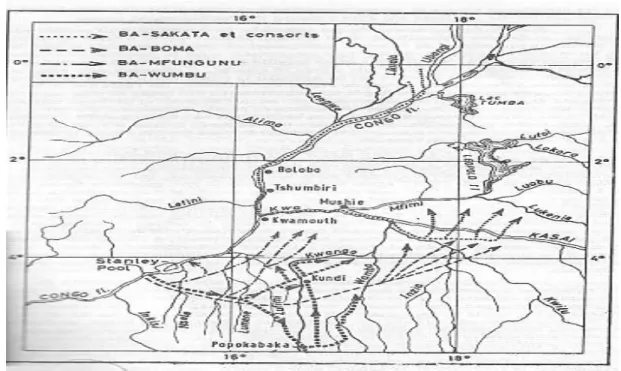
left those parts of Africa before the arrival of Europeans by crossing the Ubangi River. It might seem peculiar that this migration took place in different groups and periods (Figure 2).
Oral tradition that I recorded in 2003 from specialist informants and elders of the Sakata, for example, suggests that the ancestors of the Sakata migrated in large numbers in the middle of the second century. Overpopulation, draught and famine in their original locality could have been incentives of their migration into the Central African Republic, where they were called “Basar”, a descriptive appellation meaning “people from the Sahara desert”. From there they moved to Congo-Brazzaville, crossing the Congo River embarking on the coast at the present-day Bolobo village. Even though the land appeared unoccupied, they decided not to settle, but rather to continue the journey until they reached the coast of the present-day Mushie District, where the Mfimi River joins the Kasai River. At this stage, the large community of the Sakata split into two groups. The small group, which was afraid to continue the long journey, settled at the wells, and was then called Baboma of the north by others who saw themselves as courageous. The word ‘Boma” means “fear, afraid” in Kikongo language, and literally Baboma (plural of “Boma”) would mean fearful people. Members of the large group then continued the journey until they reached the wells of Biboko, an Island that separates the Kasai and Mfimi Rivers. Later the remaining community of Biboko split again into two groups. The small group migrated towards the right bank of the Kasai River, where it connects with the Kwango and Kwilu Rivers, and finally settled in the Ombali village, on the opposite side from Bandundu city. This group was then called Baboma of the south. The large group that remained in Biboko land
Figure 2 Map of Presumed migrations in 9th, 11th and 12th centuries Source: Tonnoir 1970:44
172
occupied both the left coast of the Kasai River from Biboko to Dungu land (where the Sakata share borders with the Nkundo of the Kasai River), and the right coast of the Mfimi River, as well as the land along the Lukenie River, where the Sakata share borders with the Nkundo of the Mai-Ndombe Lake. Of great interest to this narrative on the earliest ancestors of the Sakata is the peculiar fact that their occupation of the Kimbali-Mayi land is attested to by the “great baobab tree” (biboko), in an excellent state of preservation today.
Not much is known about the distribution of the earliest forebears of the Sakata in the Kutu region. Nkiere (1984:30)’s evidence, however, indicates that they would have probably settled first in the present-day Lemvia-Sud (Mbanzankwi) chiefdom.
According to testimonies gleaned from my informants, the ancestors of the Sakata would have immigrated by clan groups. On their arrival in the region they currently occupy, each clan settled in unoccupied territory. It was in the present-day Lemvia-Sud (Mbanzankwi) chiefdom that these pioneers initially settled before experiencing a gradual dispersion due mainly to overpopulation. The rest of the country, in particular, the present-day Mabie chiefdom, was still uninhabited and was part of the two Lemvia [Lemvia-Nord and Lemvia-Sud] chiefdoms which at the time formed a single whole entity starting from Lukenie to Kasai Rivers. (My translation from the original French).
Already from their earliest forebears the Sakata had inherited a history of domination and power. Under the pressures of overpopulation, for instance, it is reportedly that the Sakata had usurped some neighboring ethnic groups and conquered their lands, leading to a social crisis. Nkiere (1984:30) aptly observes:
The dispersion of the clans throughout the country was not made without a blow here and there. There was sometimes a tradition of conquest. The best-known case concerns the country’s eastern region. A conflict between members of the same clan among the Batere [sub-group of the Sakata] pushed one of the members, the chief Mukamata, to cross the Kasai River and forcefully settle in Bagata territory. As a conqueror, he organized several clashes in Yanzi country and hence spread panic [and desolation in the area]. To make peace the Yanzi of the region had, by customary treaty, to give portions of land to the chief Mukamata. In addition, the sister of the Yanzi chief of the region was also given in marriage to the chief Mukamata. This union therefore cemented the ties between the two sides, fostering peaceful coexistence [in this specific region]. (My translation form the original French).
This becomes telling because one major finding of our previous study (Munsi 2008) is that many chiefs engendered antagonism in their own communities by unscrupulously
173
seizing upon their new-found authority as an opportunity for defrauding their people. Those conflicts affected the population rate and were one of the incentives for the practice of ‘secret societies’, sorcery and witchcraft as means of defense and protection of the families, lineages and clans, as well as the village communities and chiefdoms. One thing seems certain: If any organization existed in pre-colonial Sakata society, it was rather within the framework of customs which had been institutionalized over the centuries at the level of village communities, matrilineal lineages and clans, which I discuss further below. Since their settlement in Kutu territory, Sakata communities have been commonly known for iron arms and tools technology, arts of pottery and weaving, folkloric dance, and traditional medicine and health. 5 The study by (Bekaert 2000) offers probably the most comprehensive empirical analysis of the latter theme.
1.2.2 Exploration and Colonial Periods
The encounter between the Sakata European navigators, explorers, conquerors, colonizers, merchants and missionaries had reportedly a two-fold aspect: immediate and practical. At both levels, much evidence indicates that conquest, colonization and trade led to modes of domination or coexistence and multi-faceted trans-cultural relationships. The following is a glowing review of it. From 1874 to 1884, during his third trip to Africa in the service of King Leopold II of Belgium, Welsh-born journalist I. Henry Morton Stanley opened the Congo River Basin and laid the groundwork for the Congo Free State, largely by persuading local chiefs to grant sovereignty over their land to the King Leopold II (1835-1909) of Belgium, after setting up 21 trading posts along the river. During the Berlin West Africa Conference—but not the Conference as such (1884-5)—convoked by the German chancellor Otto von Bismarck, the participants, representing fourteen European states and the United States of America, agreed to recognize King Leopold II of Belgium, as the sovereign of a “Congo Free State” (CFS) or Etat Indépendant du Congo (AIC). As a result, his government began a move to "imprint a Belgian character upon Christian missionary work in the Congo” (Reardon 1968: 85;86) That character was Belgian Catholic, the religion of their motherland, which was also a state supported church.
The first extended contact of the Sakata with Western culture took place between 1882 and 1888 when Henry Morton Stanley explored the Mai-Ndombe region, followed by Kund, Tappendeck and A.Delcommune (see Van der Kerken 1941:476; Van Everbroeck 1961:49, quoted by Nkiere 1984:148). These explorers have reportedly gathered the most ethnographic history to date. Their studies included that of the social, political, economic, and religious aspects of the Sakata culture.
5 In the light of Maes’ empirical evidence (1930:88-90; 100-1), Rowlands (1973:594) for example, recorded that the Sakata metalsmiths in Congo are hierarchically ranked on the basis of the metalwork they can produce. Thus “the production of parade objects and insignia could only be done by the master -smith who also happened to be the village chief”.
174
There is a further aspect. Between 1885 and 1895 the Sakata territory was also attached to the District of Kasai, which then included a portion of Katanga, Kasai, the whole Leopold II Lake, and the whole Kwango region. In August 1895, however, the Sakata were detached from the Kasai District to be incorporated into Leopold II District, with the Centre Kutu as the administrative capital. On 9 August 1895, a large portion of the Sakata homeland fell under the patronage of the King Leopold II, in what was variously called either “le domaine
de la couronne”, or “the crown domain”, which covered a total area of approximately
250,000 square kilometer (Barbara 1988:259). It is surmised that the colonial powers’ main source of income was the exploitation of rich rubber plantations and ivory resources (Anstey 1966:1-3; see also Greinker, Lubkemann & Steiner 2010:425), as well as copper and gold in the Congo. Consequently, Sakata populations were subjected to horrible atrocities during this time. Hands were cut off, people were whipped, and kidnapped, held hostage and many other cruelties were committed in Leopold’s search for ivory and rubber (For further details, see Hochschild 1998). In concrete terms this means that “[from] 1885 to 1908―the crucial years during which the Congo was opened up to European exploration and settlement―Leopold controlled its destinies. The Sovereign—who never set foot in his African kingdom—was very largely responsible for the way in which relations between Europeans and Africans developed there” (Slade 1962: iii). It should be noted in passing that European (especially Belgian) presence signified forced labor and relocation, but also availability of manufactured goods, services like health and education, and the introduction of cash economy.
1906 brought some structural changes to the Sakata homeland. Notable among them are the shift of the administrative centre from Malepie (present-day Kutu) to Inongo, the administrative headquarter of present-day Mai-Ndombe Province. The pre-existing seven large chiefdoms of the Sakata were officially recognized and integrated into the colonial administration by Belgian colonial authorities. With minor exceptions, the Belgian administration came to control the entire Sakata society through its prominent chiefs, leaving the internal organization of the society intact. These changes took place under the ‘colonial policy’ that was generally ‘paternalistic’ in tone and ‘indirect’ in administration.6 Local chiefs were used as pawns of the government; often they were removed from power if rumored to be anti-colonialist. Belgian colonial authorities played the role of tutor among local populations and controlled them through local traditional institutions. To reduce the power of the regional ethnic groups, the latter were all incorporated into a unified administrative system (Nkasa 2005; for historical review, see Fabian 2001). Even though the extreme violence of the state, which the Belgian monarch Leopold II held as his private property, led to a huge international scandal and obliged the Belgian parliament to annex it in 1908, it is assumed that this pre-independence Belgian rubber regime lasted until 1933 (Anstey 1966:67). Even now, the majority of long-time residents interviewed still
6 It might seem peculiar that the Belgian colonial administration affected local leadership by sometimes changing chiefs based on their willingness or lack of willingness, to collaborate with Belgian administ rators.
175
remember those Belgian colonial atrocities.
Since the middle of the nineteenth century Christianity has been adopted by large segments of the rural Sakata population (Mputu 1999 among others). Major life transitions (such as birth, puberty, and death) were marked by religious ceremonies, many of which combined Christian and ancestral traditions. Thus far, many contemporary ethnographers, especially Congolese professor Nkiere (1984)−whose work features prominently in this paper−have argued that the spread of Christianity and urbanization, and urban development (as a result of the period of state hegemony and modernization), have, in many ways, changed some religious perceptions and attitudes of the Sakata. This reflects the acknowledgement that“[no] religious world can remain the same forever and in response to this traditions undergo transformation processes, answering to the needs of the community; new places, roles and powers gain recognition whilst old places, roles and powers gain new meanings” (Lawson 1984:9).
But the positive aspects of Christian (mostly Catholic) mission apply only to certain subjects, or in certain contexts. In other places, we are told that the misinterpretation of the Bible and Christian teaching instead led some ministers to destroy precious things such as statues that embodied the cultural heritage of the Sakata. It is reported for example that in a moment of desperation, a Sakata chief decided to give one precious statue to a vendor. Interestingly, this statue, which held within it the energy to support women in the birth process, was later displayed at the Cultural Surviving Bazaar held at the Prudential Center mall in Boston in 2009. A note was stuck to the statue with tape, written in red magic marker and read: “Congo, the last Sakata mask (original) 100 years old” (Figure 3), suggesting that all of the other remaining statues had been thrown into a fire by the Sakata in the insistence of a Roman Catholic missionary priest.
1.2.3. Some Structural Changes in Post Independent Period
It is reported that the integrity of the existing seven chiefdoms in Sakata society has Figure 3 The probable last surviving Statue in a Sakata Village
176
continued to be preserved in the region since the creation of the Leopold II District (present-day Mai-Ndombe District) in 1960 and the reunification of the Dia and the Sakata in Kutu territory (present-day Kutu District) and later the attachment of the whole Leopold II District to the Province of Bandundu (present-day Kwilu Province) in 1970 (For further details, see Mouvements géographiques 1885:7732;1910:30 & 1913-1914: 4; Profils du
Zaire 1972:102-112; quoted by Nkiere 1984: 148-149).
Throughout the 1970s, the whole of Sakata society experienced changes brought about by the reorganization of provinces and districts, which resulted in the incorporation of the paramount chiefs into the structure of the wider Congolese administrative system. In a sense, a Sakata chief became the principal agent between his chiefdom or village community and the colonial authorities. In this context, however, it must be noted that Sakata society had to cope with all these external pressures without losing its internal autonomy. It can thus be submitted here that the great strength and tenacity of the socio-political and religious systems of the Sakata have remained evident throughout these stages of their historical development (see especially Bompere 1998; Nkiere 1984; Mave 1975). Viewed from the public domain, it is ironical that they have been displaying a kind of ‘cultural conservatism’, which should always be regarded as a good thing, rather than as liable to hinder the assimilation of their matrilineal society into the Congolese national society.
1.4 Population Growth (1970 -2012)
Sakata communities are mainly concentrated in the Kutu District, where they represent the majority of the population. However, Sakata individuals and families also have a substantial presence in various parts of the Congo and of the world, where their numbers have reportedly spiked in recent years. The 1970 census indicated that about 92.900 Sakata people lived in the region, while in 1972 the number rose to 144,718. The 1981 census estimated the number at 140,130 out of a regional population of about 209,513 (Monse 1987:10); in 2003, according to the Interior Provincial Division of Bandundu, the figure was 200,000 out of the total population of 450,930. Since the mid-1980’s, however, the Sakata population has been increasing, with an average population density of about 5,16 persons per square kilometer (Nkiere 1984:34). This increase was due to a slight increase in the birth rate combined with a small decline in the death rate. Estimates range upward from 207,000 (see People Groups Organization 2016). The true figure of the core Sakata group’s population is probably 300,000 Sakata individuals, excluding those who have permanently settled in urban areas.
Despite this, reliable figures for the total number of the Sakata are still unavailable. In 2012 the population of Kutu District was estimated at 405,796 out of 1,500,000 inhabitants found in the present-day Mai-Ndombe Province. We may estimate (very approximately, in the absence of precise censuses) that there has been a great increase in the Sakata population, due to the rapid increase in the regional population in recent years. In passing,
177
it should be noted that migration plays a part in population fluctuations. Experience shows that increased permanent or seasonal migration to cities or urban areas accompanied the country’s economic development during the 1980’s, but there is also significant migration between rural areas as people leave their places for more productive work or farm opportunities.
1.5 Linguistic Classification
The Sakata―united in the special type of kinship resulting from the matrilineal descent system―speak Kisakata (Kesakata or Keshaa), a Bantu language that the Turveren School (1867) classified into the category of B/B34 Zone languages within the phylum of the Niger-Congo family, whose varying degrees of similarity and dissimilarity have long been recognized.7 Knowledge of the spoken and written language of the Sakata is nevertheless scant, due to the small number of systematic studies. Given the size of the population and the territorial range of the Sakata, there is much dialectical variation in their language (i.e.
waria, kebai, mokan, kengengei, kitere and kintuntulu), to the point that some dialects are
barely intelligible mutually (Monse 1987; De Witte 1955). However, in education, government, trade (including expatriate business), and evangelization Lingala (one of the four national languages) and French (the official language) are preferred as a tool of communication. Practically, the Sakata residents of Bandundu city are also well acquainted with Kikongo (a national language). In practice of course, Lingala appears to function as a crucial element in local communities’ political and economic development and ultimate regional integration.
1.6 Subsistence and Economic Activities
The Sakata, whom some ethnographers have accurately identified as hard workers and who value self-sufficiency, live in an area which is, by Sub-Saharan African standards, densely populated and agriculturally productive. For livelihood, they rely mainly on stable, ecologically sound, and efficient slash-and-burn type of shifting cultivation and a mix of fishing. Men are primarily involved in 4 to 6 months fishing expeditions, but heavy agricultural labor such as logging and cleaning fields also fall to them. Women are engaged almost exclusively in subsistence agriculture. Put differently, they are major agricultural producers. They farm the land above water-levels and hoe the weeds, but both genders do the harvesting together. The main food crops (old and new) include cassava the (main staple food since the nineteenth century), corn (maize), sweet potatoes, yams, beans, root
7 The linguistic foundations of Bantu migrations are discussed in two chapters in Collins, Problems in
African History: Joseph Greenberg, “The languages of Africa,’’ 78-85, and Thomas Spear, ‘‘Bantu
migrations,’’ 95-98. Vansina’s evidence (1995) is also of greatest interest. More recently, however, it is reportedly that on account of the “lack of ancient written records, historical-comparative linguistics has grown to be an important way of accessing the early history of Africa. Within the realm of Bantu studies, ongoing internal classifications of the Bantu languages have not only led to changing hypotheses on their evolution and dispersion, but these linguistic theories have also incited and oriented archaeological and cultural historical research in this field of study” (Bostoen 2006:1)
178
crops, groundnuts and plantains, peanuts and other grain legumes, oil palm nuts, and rice.8 Other crops include coffee, fibers, rubber, vegetable crops, or wild fruits, hunting and domesticated livestock (ducks, chicken, sheep, goats and cows). Beside their contacts with Bobangi traders, the Sakata have increasingly been involved in a symbiotic network of regional exchanges and the high degree of specialization in fishing and commercial exchanges.
2. Socio-Political Organization
In this section I shall bring together material information gleaned from a variety of sources to determine how the influence of Kinship determinants in Sakata society is particularly reflected in the patterns of village settlements and in the socio-political structures, and why. In so doing, I shall also identify key features of how their dynamic interplay is construed, attempting a holistic account of Sakata society with its institutions. For analytical purposes, I shall deal separately with the social and the political while bearing in mind that the social and political systems develop asynchronously. I draw inspiration from a descent theory that follows Radcliffe-Brown’s formulation and deals with actual relations between persons and lineages (Schneider 1965), and Bondarenko (2013; 2006).
2.1 Social Organization
My primary attempt here is to highlight the function of the kinship system of the Sakata in relation to their living arrangements, social classes and political structure, as well as norms and behaviors in different circumstances. Understanding the intricacies of their patterns of social structuring is “significant from a materialistic perspective because they reflect a society’s adaptations to its social and material environments” (Keegan &Maclachlan 1989:618).
2.1.1 Living Arrangements The rural settlement of the Sakata is in villages (officially referred to as localities)
8 Cassava (manioc), the most prevalent crop in the region, is classified among many other crops that were
introduced by the Portuguese from the Western Hemisphere, while rice was introduced from the East coast of Africa by the Afro-Arabs in the nineteenth century (Meditz and Merrill 1993). Originally the “agriculture of the Lower Kasai was reportedly founded on sorghum and bananas, but ese were gradually being supplemented or replaced by maize, and later by cassava, which became the staple food by the nineteenth century…Although it is clear that crops, agricultural techniques, currencies and material goods spread from the west into the Lower Kasai area, it is not clear by what means these influences spread, or at what periods. There is also much uncertainty about the social, political, linguistic and demographic changes which may be ascribed to the influence of western neighbours” (Birmingham 1981:88). Due to its ease and convenience, manioc cultivation would have extended along much of the Mfimi, Lukenie and Kasai Rivers and must have been easily accessible to most of the population.
179
generally fairly large in size, composed of fifty to a hundred rectangular wattle-and-daub houses. The village infrastructure includes churches and in some cases meeting areas for social activities and for the local chef de terre (land chief), a dispensary, and a school. Each village (uleba or lebenge) is traditionally headed by a local chief or chef de terre (Mbe ne
kyum, Ndza uleb) issuing from the landowner matrilineal descent group (Bambe).
Individual households are not interspersed evenly, but in clusters of closely kin-related compounds (sprawling structures). The practice of exogamous marriage serves to create an overlap between residence and kin. 9 Inter-clan and inter-chiefdom marriage was encouraged. Post-marital residence is virilocal. A Musakata wife moves to her husband’s village. She uses land that belongs to her husband’s matrilineage and that will be inherited by his sister’s children. Thus her children do not automatically contribute to the strength of the household, as they have their own interests to protect in their mother’s brother’s village. Although the virilocal residence naturally forces brothers and sisters to live separately, it is assumed that male and female members are necessary for the normal working of Sakata society. For this reason, there is always social activity devoted to overcoming the difficulty of the spatial separation inherent in the system.
From the structural point of view, there are two main axes upon which the cluster is internally created. The first is the parent-child relationship, which is a vertical axis. It is about continuity, in the form of developmental cycles and access to land for building houses. In practice of course, the relations between the father and children are carefully cultivated in individual Sakata families. As Schatzberg (1998:83) has commented:
For the matrilineal Sakata, the most crucial relations within the basic family are those between father and children. Compared to the maternal uncle, the Musakata father incarnates understanding, tenderness, and comprehension. The cash economy and spread of capitalist values and modes of production has accentuated the fundamental importance and influence of the father.
The point for consideration is that the father of the family has a definite role to play in the household affairs. However, according to the matrilineal kinship principles, his role is limited by the final word of the maternal uncle (pipi or Ngonshi) who holds more power in a given individual Sakata lineage. Thus, we could argue that the maternal uncle is the sustainer of their social, economic and legal interests.
The second aspect to be considered in this social interaction is the sibling set, which is a horizontal axis. It is primarily about cohesion, keeping things together, either through co-residence or affinity. Actually both of these axes are equally important, but they have
9 “Exogamous (substantive exogamy) “means marrying outside,” and implies that marriage is forbidden within a specified group, usually though not necessarily a clan… A clan is usually a named group of people who believe themselves from a common ancestor in the remote past. Members of the same clan usually have special obligations toward one another” (Beattie 2002:1).
180
different roles in social organization and therefore are not opposed to each other. What this translates into is the observation that kinship and family continue to exist as the foundation of economic, social and reproductive behavior in the Sakata homeland, though the situation of urban areas indicates now the increasing importance of the nuclear family as an economic, residential, and psychological unity.
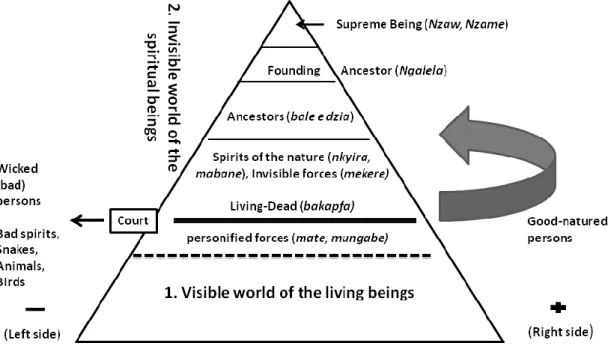
Why is this residence pattern still exactly and finely maintained? What does this signify to present-day Sakata individuals? Conceivably, this notion of physical proximity of kin-groups and family networks of sharing and reciprocity is essential to the psychological proximity required for stabilizing family units within the wider descent groups and maintaining at the same time people’s closeness and their relations to the Sakata hereditary chiefs. If anything, the following points understate the case. Most notably, the house of the village headman (Mbe ne kyum, Ndza uleb), for example, is purposely located at the centre of the village, in order to assure the unity of individual households through his political, socio-juridical, economic and religious authority. Nearby are lined up the houses of his married children and nephews who claim a common founding ancestor (Ngalela). This matrilineal ancestor occupied a higher position among many other ancestors (Bale e dzia) who also lived on earth and have already crossed what is evoked in Sakata myths as the ‘river of life’.
Equally important is the fact that the house of the traditional political chief (Mudju) is placed at the entrance of the village. And it turns out that there are a number of intriguing reasons for this specific location. One of the most important of these is the emphasis on the mystical security or protection of the village populations and their lands. This suggests that political and religious leadership among the Sakata consists of a series of features that are causally interconnected. One further example should suffice. Close by the house of the traditional political chief (Mudju) is found the ‘palaver tree’ (nshima). More usually, it is a place where family and village issues are discussed and resolution of conflicts takes place. Traditionally the Sakata have subscribed to the belief that this important ‘palaver tree’ was secretly planted in the village by former matrilineal religious priests through a series of rites called ‘Placing the first stone to protect the village’ (eteka nshima n’uleba) performed before settlement. Evidence is still incomplete as to when exactly this tree was planted. All we know is that during those secret religious ceremonies, they also buried two ceramic vessels endowed with spiritual powers with a twofold aim: first, to be in conformity with the will of the deities in the area, and second to protect the population from any misfortune (usa) sent by witches. This specific tree has therefore its practical aspect. Its sacredness justifies the strict prohibition against cutting it down.
My sense from the field is that the strict norms of Sakata kinship regarding authority and inter-generational relationship continually play an important part in maintaining the identity and cohesion of residential groups. In addition, there is also a simple realization, given people’s mobility and the migration to urban areas, that the influential role played by the matrilineal kinship system even extends beyond village communities, whether through
181
marriages with other lineages or with kinsmen distantly related. An interpretation of the facts gleaned in Bandundu city, for example, reveals that many Sakata virtually live in a close-knit community and they look out for one another. A common thread linking these kinship networks is the deep-felt requirement to engage in social interaction with people of common cultural history and identity. The Sakata encourage their members to maintain traditional practices of obligation and reciprocity in a new environment. This set in motion a reciprocal, feedback relationship between Sakata migrants to Bandundu city and their circle of relatives in the new location.
Although the experience of the Sakata found in Bandundu city is not quantitatively typical, it is nonetheless characteristic. My sense from the field is that the Sakata extended families tend to nurture the virtues of extended kinship obligations, generosity, cooperation and hospitality. This reality also becomes clear when kinship distance is evaluated vertically and laterally or horizontally. Generational distance affects both intensity and mode (behavior) of social interaction. Laterally or horizontally, affinity induces extra distance, also both in the intensity and mode of interaction (avoidance of behavior). This finding purports to say how cultural background has a strong effect on Sakata migrants’ likely choice of adaptive strategy in the new setting. This should not be surprising. It is widely acknowledged in many societies that social behavior, ritual occurrence, and legal action are for a large part governed by a tacit evaluation of kinship distance. One note, however, must be made here. While extended family networks remain extremely important in the maintenance of ethnic identity among Sakata residents of Bandundu city, non-kin networks developed through neighborhood community centers have also taken on a new role of increasing prominence.
Of greatest interest to us is the observation that some Sakata individuals living in urban settings are often engaged in circular migration from rural to urban and back again. Sakata individuals’ interrelationship and their degree of cultural emphasis on kinship in a new environment might have facilitated the implantation of modern values into rural areas and the importation of traditional concepts (i.e. kinship ties, religious beliefs and practices and cultural celebrations) into urban areas by Sakata migrants. The impression that emerges is that the interactions among the Sakata residents of Bandundu city involve various kinds of knowledge sharing, the establishment of kinship networks and religious and cultural transmissions. It is evident that some of these Sakata migrants have been engaged in the web of relations and practices within urban institutions of development cooperation. By contrasting the results, we see that the kinship networks that have been transplanted to the urban areas apparently do not differ from the traditional rural networks. Conducting even limited studies would, however, satisfy the intellectual needs of anthropologists. The next step is to describe the matrilineal lineages and clans which represent the binding forces of Sakata society.
182
2.1.2 Matrilineal Lineages and Clans
The Sakata are organized into a number of structurally similar and functionally equivalent family segments which traditionally follow matrilineal descent patterns. These surviving segments are called lineages—localized communities composed of extended families, whose members trace descent to a known ancestor. These unilineal lineages thus constitute exogamous units, with distinctive facial marks, food taboos, and sets of names: minimal lineages (mpare); major lineages (ipfune) and maximal lineages (mapfune, also referred as kenkare). The lineages themselves are characterized by their being represented by certain members who are specifically related by their social and religious positions to the matrilineal figure from which the lineage descended (Nkiere 1984:46-48). Thus identity in the life of the Sakata is constructed in large measure through a concern for lineages. As corporate units in economic, political, juridical and religious respects, Sakata matrilineage lineages join together to form clans (kenkare), that is, a totem and exogamous community whose members are not allowed to intermarry. These matrilineal clans include all the closely related people in a particular subsistence village community and historical antecedents. Analysis has shown that members of a single Sakata descent group still maintain a high sense of community and a high level of solidarity, which are expressed through kinship terms, sharing practices, and a constant concern for one another’s welfare.
It is important to note that these matrilineage lineages and clans are communities of both the living and the dead. The clan category is more appropriate than ethnicity in analysing the Sakata kinship system. The essential point here is that the matrilineal clans represent functional units. They are social entities in which individuals practically disappear in the midst of collectivity. Thus viewed, they constitute social or even socio-political units perfectly defined and customarily immutable, and hence continue to exist as ‘the cornerstone of the total traditional fabric’, fostering and sustaining Sakata communities linked by a shared culture and spiritual values. There are therefore clear indications that the matrilineal lineages and clans continue to be meaningful for the Sakata by reference to their social functions in relation to certain social practices such as exogamy and incest prohibition. Most notably, the influential role of the Sakata kinship system is seen in the upsurge in social stratification discussed below.
2.1.3 Social Stratification
The entire Sakata society is made up of three major matrilineal clans, which are themselves organized into three strata: the high-rank clan (Badju), the landowners (Bambe) who also preside over matters of land allocation, and commoner kin groups (Nsane) who form the majority. This segmented clan system has been presented as the foundation of Sakata society, and to understand Sakata politics, history and even culture, one merely has to look at their kinship and clan system. The interaction between these three strata is intricate. To date, these Sakata social groupings continue to serve as the most important instrument of social continuity in knitting human relations horizontally and vertically
183
through generations to demarcate and discharge social obligations with devotion and enthusiasm. Their potential impact is in evidence as societal coordination continues to be largely mediated through the kinship relationship. My understanding of the material thus leads me to believe that Sakata kinship constitutes the major bond for maintaining human relations between the aforementioned three social classes and for regulating ownership even in changing environments. However, it should be noted in passing that the social organization of the Sakata also appears to have functioned simultaneously as an incubator of forces of unity and conflicts, and the history of the Mabie chiefdom reveal valuable examples of this kind.
The above descriptions are of necessity simplified. In the Sakata lands, all social differences continue to be institutionalized as hereditary and inviolate, and social status finds its expression generally through matrilineal descent. Other things being equal, age requires respect, although seniority does not necessarily confer access to the office of highest status in the descent group or in the local community. Males have higher status than females in Sakata society, despite the presence of matrilineal descent groups and matrilineally based succession and inheritance. Moreover, the supporting material and cultural (including religious) base of local identity is inhibited, and class differentiation promoted. More usually, the social differences expressed by variation in Sakata society include community membership, residential group differences, occupational differences, and social ranking. The extent and degree of social inequality expressed by this variation is decidedly less certain in the present study and hence requires much further analysis. It merits remarks as well that lineage chieftainship is also an absolute, not a relative matter. Therefore, it is imperative to argue that without the dynamic elements we find in lineages, clans and social strata founded on the matrilineal system it would be impossible to explain the existence of Sakata society as we know it today.
2.1.4 Gender-Roles Divisions and Father-Children Relationship
The influential role of the matrilineal kinship system is also crafted from other roles, the responsibility of women and men within a specific social milieu defined by specific duties. On the basis of matrilineal descent, for example, Sakata women are the channels through which identity, titles, land rights, and property are acquired. Also understandable in this context is the fact that they exercise considerable influence over the conduct of domestic affairs, and even the allocation of use rights to land. Sakata men typically control the political and economic affairs in the public sphere and have ultimate authority over domestic decisions (a role not available to a woman unless her husband has died or can no longer support his family). However, evidence is accruing that shared tasks provide males and females with valued roles in Sakata society. The continued existence and vitality of the matrilineal kinship ideology among the Sakata is also evident in the area of political organization discussed below.
184
2.2. Political Structure
This theme also recurred throughout the dataset. Here I focus on Sakata society to more specifically consider the political system as only one of its integral parts. I also treat political culture as a natural part of Sakata culture as a whole, as a manifestation of its general pattern in the sphere of the political that is embedded in institutions, ideologies, legal norms, etc. In the light of the viewpoints developed by Bondarenko (2006:67-72), I therefore label Sakata society according to its more general, inclusive feature (the societal type; or culture pattern).
2.2.1 Territorial Divisions
The Sakata administer their society on the basis of organized kinship groups through social units by a system of decentralization. The results, as shown in Figure 4 below, indicate that the entire Sakata homeland is divided into seven large autonomous chiefdoms known as Idju, which have received official recognition since 1906. Traditionally these autonomous chiefdoms are considered as the third level of administrative subdivision, with their administrative centres in parentheses listed below: Mabie (Ndwakombe), Mbamushie (Mongobele), Mbantin (Kempa), Lenvia Nord (Mbaizakwi), Batere (Nsobie), Lenvia-Sud (Ikoko), and Nduele (Admin. centre Nselekoko). It is certainly with the descendants of the early occupants of Sakata homeland that the ethnonyms and toponyms of the chiefdom are associated. Analysis shows that these kinship-based permanent political entities, the framework of which is very old, draw their spatial and human structure from a logic that is clearly one of Sakata identity.
Figure 4 Diagrammatic Representation of Political Organization among the Sakata Source: Author’s Field notes 2003; 2015
185
More significantly, as can be seen from Figure 4 above, the whole socio-political construction’s encompassment of the Sakata is from below, that is from the local community level, while the community itself is underpinned by matrilineal kin ties. The synchronic ‘vertical axis’ of the social organization represents a purely static aspect of the hierarchical order of social entities with all three categories of matrilineage lineages (mpare
ipfune, kenkare) and their leaders (mfra-maa), village communities (ibue), each with its
headman (Mbe ne kyeum), and finally seven chiefdoms (idju), each with its administrative centre. This suggests that each single Sakata Chiefdom (idju) represents an aggregate of social units: lineages, traditional homogeneous village communities (basic units of political structure) and sub-divisions organized by custom. Each of them is headed by a prominent political and sacred chief (Mudju n’itsui) issuing from the matrilineal line. After investiture, he is usually recognized and inaugurated by the provincial governor. Traditionally the Sakata have subscribed to the belief that the traditional political chief (Mudju) is the repository and guardian of the symbols and mysteries of their culture in his chiefdom. Equally, when viewed cross-sectionally, it is perhaps not too fanciful to suggest that without relevance to the individual households and village communities that make up the socio-political and religious dynamics of a single chiefdom, the traditional political chief (Mudju) is not fully living up to his mission.
Moreover, a closely linked assumption has been that this political system of the Sakata, to a significant degree, displays similarities to that of the Mongo of the northern Congo. A possible explanation for this might be that “[the] interaction between the western Mongo and the eastern Teke apparently led to the creation of a new system of kingship with a strong religious core and hereditary court of secular administrators. This pattern of ‘socialized kingship’ seems to have influenced the Boma-Sakata peoples and led to the evolution of a more complex political hierarchy than existed south of the Kasai” (Birmingham 1981:89). This influence is also manifest in the monosyllabic and consonant terms Kp and gb found in the Kisakata language (Tonnoir 1970). All we can claim with some certainty is that the earliest ancestors of the present Bantu speakers in the hinterland of the Congo were preceded by the Pygmy inhabitants.
Defined as radically, politically, vertically and decentralized autonomous unit, a single Sakata chiefdom (idju) therefore conducts its own social and religious activities. Moreover, it carries on local welfare work among the cluster of villages or hamlets (which are made up of several families and lineages) and provides a meeting place for social functions. In practice, of course, it has its own functionaries (hierarchy of chiefs), whose duties, responsibilities, and rights have been formally allocated. The powers and prerogatives of these Sakata officials are defined by the customary law. This suggests that, for Sakata households and individuals interviewed, kinship is not only ideology but also the real socio-political background. Indeed the very existence and prosperity of the populace is believed to be guaranteed by the presence of the chiefdom (Idju) headed by a sacralized
186
ruler titled Mudju. It is also noteworthy that the Mudju’s privilege of being vested with titular dignity and the tinsel insignia of office did not prevent his authority being subject to constant interference. This leads us to consider more closely below some salient aspects of chieftaincy or coordinating structure in Sakata society.
2.2.2 Status and Legitimacy of Chiefs
The political organization of the Sakata is based on chieftainship which is linked in principle, and in fact, to the system of unilineal matrilineal descent groups that provides the basic sociopolitical framework of their society. The politically significant matrilineal descent groups are those localized in a single village or a cluster of related village communities. There are also clear indications that in all chiefdoms (Idju)―which continue to function more effectively and efficiently in the face of changing conditions―the matrilineal kinship system claims to rule through autonomous paramount chiefs (men and women) recruited from the female line. Until more recently, females sometimes used to inherit chiefly positions. During the period of the study, however, most chiefs I met in Sakata corporate lands were men. 10 The fact that the Sakata’s matrilineal kinship system has male leadership means that the clan or lineage segment will have to have both males and females born each generation. Experience of the ruling families in the Mabie Chiefdom between 1923 and 1987 has shown that where there is no male in the matrilineage, the role of lineage head is not assumed by one of the women, but rather, the unit merges with another matrilineage. This is a structural process that needs further investigation in the future, especially in light of labor migration, cash cropping and so forth. Specifically, the mechanism of power in the Sakata homeland is marked by a striking hierarchy of chiefs (men and women) whose secular authority considerably differs at any level. Let us consider now closely the status and legitimacy of these Sakata chiefs.
(i) Traditional Political Chief (Mudju)
At the apex of the pyramid of traditional authority is the office of the traditional political chief (Mudju n’itsui) selected from the dominant matrilineal clan of Badju and endowed with the power of decision making for a particular chiefdom. He lawfully accomplishes several tasks, such as (a) to assure the maintenance of social order by instilling in people the duty to observe the customary law; (b) to protect the whole chiefdom from any external attack; (c) to strengthen relationships between individual families, households and lineages within the village communities, and between the visible community of the living and the invisible community of the ancestors, deities and Supreme Being (Nzaw). Thus viewed, the Sakata consider the traditional political chief (Mudju) as a visible representative based on
10 In the past, certain eminent women seized the political opportunities afforded by the crumbling of male-dominated centres of power. Not only were there women chiefs and counsellors, but common women were permitted to take part in discussion. During the period of the study, however, there was apparently little information about newly invested woman chiefs in the Sakata lands. The reasons for this fact, according to key informants, were diagnosed as lack of observing the regulations and constraints related to the office secre cy.
187
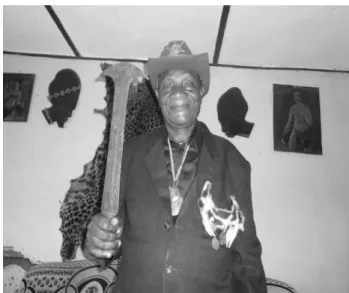
the blood relationship between him and the ancestors of the clan. In fact, this link with ancestors is symbolized by the stool which the reigning chief occupies. This position as a political and spiritual leader both makes his office a sacred one and let him wield a considerable influence upon his local community. Traditionally, Sakata chiefs wore a red uniform as (Figures 5-1 and Figure 5-2).
However, Sakata history records that some of these chiefdoms were unstable on account of several conflicts. This happened as lesser chiefs or persons not qualified for chieftaincy tried to take power from higher ranking chiefs, or when one chief conquered another. In the chiefdom of Mabie, for example, I noticed at least three salient conflicts. The first was the conflict between the women chiefs Mudju Boshang and Mudju Mamonie. The second was between two men chiefs, Mudju Mbakala and Mudju Iluna. The third conflict occurred between the current chief Mudju Kenine Kenzo (Figure 5-3 & Figure 5-2) and Mvula Tazu (cousin of a chief). Analysis shows clear indications that all these conflicts affected the socio-political and religious organization of the Mabie chiefdom.
Figure 5-1 A Mudju, Traditional Political Chief in Sakata Society
Figure 5-2 Two Badju, Traditional Political Chiefs in Sakata Society
188
(ii) Land Chief (Mbe)
Beneath the office of the traditional political chief (Mudju) is the office of the land chief (Mbe ne nkeyun). Lest we overlook the traditional value of the Sakata land chief (Mbe) and the authority he formerly had in the pre-colonial period, it is important to note at the outset the deep-seated change in traditional political structure in the history of Sakata society. In pre-colonial Sakata society, we are told that only chiefs issuing from the landowning kin-groups (Bambe) had the monopoly to fulfill the basic functions of both the chiefdom and the village. This dual role continued virtually unchanged until the colonial era when the Belgian territorial administrators replaced the office of the traditional political chief (Mudju
n’itsui) with that of the land chief (Mbe) for purposes of control and taxation. What is
significant for our analysis, however, is that this major change theoretically created two distinct offices in the Sakata homeland. Interestingly enough, this separation of powers still continues to be routinely applied today in the radically altered social and political scene of the Congo. Over decades it has been grimly reinforced by the initiative strategies that the Congolese State designed in the 1970’s to adapt traditional systems of governance to modern urban management, and the political opportunities opened by the changes in Sate policy after the 2006 general elections.
Yet even in this context, analysis has nevertheless shown that the existing office of the land chief (Mbe) in Sakata society continues to effectively preserve the institutional form of land allocation. There is a further aspect. In practice, with hindsight one can see in the Sakata homeland that the relationship between the land chief (Mbe) and the traditional political chief (Mudju) is quite intriguing. As Riddell, Salacuse and Tabachnick correctly observe:
Figure 5-3 Mudju Kevine Kenzo Jean-Pierre Current Traditional Political Chief of Mabie Chiefdom
Photo by the author, 20 August, 2012
Figure 5-4 Mudju Kevine Kenzo Jean-Pierre holding in his hands a document released by the Congolese officials to end up the issue over leadership power
that occurred in the Mabie Chiefdom Photo by the author, 20 August, 2012