【論文】
A House Built on Sand
1)1):
Unstable Multiculturalism at Yamagoe Church School
LeMay, Alec R.*砂の上に建てた家: ⼭越教会における不安定な多⽂化 ラメイ・アレック
Abstract: The Roman Catholic Church in Japan has been struggling
for the better part of three decades to accept large numbers of foreigners-born Catholics from Brazil, the Philippines and Vietnam. The Tokyo Archdiocese, for example, focused on second-generation migrants from the Philippines and elsewhere through multicultural summer camps offered by the Catholic Tokyo International Center. Filipino Catholics’ numbers grew in the 2000s affecting suburban churches like Yamagoe Catholic Church to offer multicultural church schools for children with Filipino roots. This church school has become a unique feature of this parish with monthly catechism classes, sleepovers and summer camps. This paper examines prescient multicultural concerns of the second-generation, and appeals for better collaboration between regional and local actors.
Key words: Roman Catholic Church in Japan, Second Generation,
Filipino, Church School, Multiculturalism
*ラメイ アレック ⽂教大学⽂学部外国語学科
1)“But everyone who hears these words of mine and does not put them into practice is like a foolish man who built his house on sand. The rains came down, the streams rose, and the winds blew and beat against the house, and it fell with a great crash”. NRSV Bible, Matthew 7:24-27.
Ⅰ.Introduction
The Roman Catholic Church in Japan (RCCJ hereafter) has been
painted positively by academics who point to its acceptance of foreign-born Catholics as an example of adopting a progressive multiculturalism. Accolades have been heaped on this institution by scholars who point out how migrants from Brazil, the Philippines and Vietnam have disproportionately brought foreigners in close contact with Japanese Catholics transforming the RCCJ. Sure, the RCCJ response was slow to get started, but its current situation makes it one of the most ethnically diverse groups in the country (Shirahase 2018; Takahashi, et. al. 2012).
The RCCJ official membership hovers around 440,000 registered Catholics (or 0.345% of the Japanese population) (Japan Mission Journal 2019: 283).2) This number does not give the RCCJ sufficient political clout to enact multicultural change on a national
要旨:⽇本におけるカトリック教会は30年以上多⽂化に取り組んで いる。1990年に東京大司教区のカトリック東京インターナショナル センターが設⽴され、外国⼈の⼦供、いわゆる「第⼆世代」のため に夏の⼦どもキャンプを通じて上記⼦供の⽀援を⼀歩踏み出した。 急増する外国⼈信者は、⼩教区に影響を及ぼし、「⼭越カトリック教 会」というフィリピン⼈の多い⼩教区教会は、代表的な教会学校を 始動させた。この教会学校では、⽉1回の聖書クラスとお泊まり会 と夏のキャンプが年に各1回⾏われている。本論⽂は10年間の出席 データを基に、⼭越教会学校は多⽂化のどのような⼿掛かりとなる かを考える。 キーワード:⽇本におけるカトリック教会、フィリピノ、第⼆世 代、教会学校、多⽂化化
2)Unofficial numbers set foreigner and Japanese Catholics at closer to one million, with more than half foreign-born (Mullins 2011; Terada 2013).
scale. Regardless, it has been a consistent advocate for Japanese multiculturalism (Alva 2007). Despite its shining achievement, the multicultural success of the RCCJ looks different when considering the second-generation.
The second-generation find themselves overshadowed by first-generation migrants and ignored by Japanese Catholics. The precarious nature of multicultural church schools in the Tokyo Archdiocese demonstrates how the liminal space second-generation children occupy has led to weak infrastructure aimed at their care. At the turn of the century, the Catholic Tokyo International Center (CTIC hereafter) made special initiatives to minister to second-generation children despite “youth ministry” being omitted from its mission statement. By 2020, CTIC doubled-down on its focus toward the first-generation by disbanding its summer school for multicultural youth and avoiding support of parish church school programs. Parishes have stepped up to fill local needs with a patchwork of church schools run by busy volunteers. But the result has been less than copacetic.
Whose responsibility is it to construct church schools capable of meeting the multicultural goals of the RCCJ? This paper argues the responsibility must be shared at regional diocesan and local parish levels. Only then can parish church schools maintain the consistent response second-generation children need to function in the culturally conservative climate of Japan. This is achieved in four parts: the need for a multicultural church school, an overview of the regional multicultural ministries of CTIC, an explanation of the local church school at Yamagoe Catholic Church, and an analysis of problems that exist in regional and local church schools.
will help churches throughout the country better assess the needs of the second-generation as well as provide examples for structural reform. Greater than this, the following provides an important resource for multicultural groups who struggle to create local solutions to Japan’s increasing multicultural problems. The data provided is not limited to the RCCJ, but reflects the growing difficulty of teaching a generation of children with multiple cultures.3)
1. Fieldwork
Observations for this study were conducted at 1) RCCJ parishes in the Tokyo Archdiocese and throughout Japan, 2) summer camps sponsored by the Catholic Tokyo International Center (CTIC hereafter), and 3) two-day events sponsored by the Yamagoe Church School (YCS
hereafter). Observations at these locations were conducted over a
decade from 2008-2020. This included attending summer camps, church school classes, and countless Masses to monitor children’s development.
Before progressing, it is important to acknowledge the author’s conflict of interest as a leader at CTIC camps, and as a director of the YCS. Participant observations have revealed important aspects of diocesan and parish structures that would otherwise be difficult to ascertain by maintaining objective distance. With that said, the author has taken the liberty to protect the identity of informants by blurring the pixels around faces and replacing names of people and places with pseudonyms. Exceptions to this are CTIC and the Salesian order, both religious institutions examined by data collected from public record. As an aside, all references to Roman Catholicism are abbreviated as ‘Catholic’. 3)For more on social benefits of church schools see Snell 2009.
2. Three Styles of Church School
Church schools observed for this study are listed in figure 1. Observations of six church schools were carried out from 2005-2017. Churches labeled ‘continuous’ were where the author was a member of these parishes. Additionally, the author observed church school activities, including annual summer camps at the Tokorozawa and Edogawa churches. These six church schools were chosen for their categorical difference.
According to observations, the most common form of exposure to Catholicism for the second-generation comes from foreign-language Masses. In addition, most second-generation attend Mass with their foreign parents at urban parishes that offer foreign language Masses. Children who attend English Mass might experience one of three ‘styles’ of church school.
Church schools in the first style are small, insular groups run by older Japanese volunteers. This style of church school targets Japanese children or those attending Japanese Mass. At Shiga church in the Kyoto diocese, catechism classes were taught in preparation for first
Church Pseudonym Shiga Yokohama Ikebukuro Fukuoka Edogawa Tokorozawa Style 1 1 2 2 3 3 Diocesan/order led Kyoto diocese Yokohama Diocese Order Fukuoka Diocese Order Tokyo Diocese Period observed 2005-2007 2008-2011 2008-2010 2017 2008-2010 2008-2010 Time observed Continuous Continuous 12 1 12 10
communion and confirmation, with no weekly schedule of events. Children gathered when the need presented itself. Similarly, the church school at Yokohama Church in the Yokohama diocese taught children how to be altar servers and prepared them for first-communion, but outside these goals it operated without a comprehensive plan, rendering it more a social club than a “school” committed to teaching religion.
Style 2 church schools are conducted in multicultural parishes with Japanese and English Masses. Churches in this style outsourced children’s activities to religious orders or diocesan multicultural centers. Style 2 church schools exist in parishes that offer English language Masses (unlike style 1), but suffer from inadequate communication between foreign and Japanese members. In other words, ‘Japanese’ parishes outsource English Masses to priests who originate from outside the parish, maintaining poor communication with parish priests and church boards. In this case, church schools affiliated with Japanese Mass receive greater pastoral aid than those affiliated with the English Mass. Fukuoka and Ikebukuro Churches reflected this model of multicultural outsourcing.
Style 3 church schools were those that operated between Japanese and English Masses, cooperating with the church board and the parish priest. Edogawa and Tokorozawa (and Yamagoe referred to below) were representative of this style. These churches maintained a close relationship between parishioners at Japanese and English Masses, planned events together, and shared a common budget.
These three styles of church schools illustrate how multiculturalism is dealt with in the RCCJ in various ways. In many cases, the model of church schools from parish to parish is left to the discretion of the parish priest with little input or help from the diocese.
This independence has opened the way for some parishes to develop innovative and cutting-edge responses to their ethnically diverse second-generation (style 3).4) But for most small or medium-sized churches (illustrated in styles 1 and 2), this independence has left them without
vital support needed to implement RCCJ multicultural guidelines.
II. The Need for a Multicultural Church School
Due to their busy schedules, many foreign parents struggle to bring children to Mass on Sunday. At church, many parents find translating scripture passages or the homily message to children an impossible task. As a result, foreign parents often depend on clergy and church volunteers to teach the religion they themselves cannot.5) This section examines social factors leading to parents’ inability to teach their children on their own.
1. Placating the Curiosity of a Bored Catholic Child
Japan is a busy country that demands migrants to juggle long hours of work with domestic responsibility. The relatively poor social standing of migrants makes them susceptible to overtime work and poor church attendance. Former Archbishop of Tokyo, Peter Takeo Okada, comments on the busyness of Filipinos and the challenges of raising children Catholic saying migrants have “little time at home because of their work” and insufficient “time to encounter God in tranquility, 4)An example of third style church schools are introduced by Hamada (2020),
Ochante and Ochante (2007) and Macaraan (2017).
5)For more on the difficulty Filipinos have teaching their children Catholicism see Muncada (2008) and LeMay (2014).
silence and prayer.” Busy schedules mean that sometimes children are forced to “return to an empty house” and even put themselves to bed at night (Okada 2014).
Overwork inside and outside the home leave foreign parents little time to teach children about Catholicism (LeMay 2018). When they do find time to attend Mass, children are instructed to stay quiet and passively follow adults’ movements.6) For the unsettled child, many parents placate their boredom with handheld video games or by sending them(alone) to the cry room (See Illustration 1). This physical or psychological isolation from Mass symbolizes how insufficient social and linguistic capital can interfere with children’s ability to comprehend the Mass. Without someone to translate this hour of worship into their ‘language’ it sounds to them like “incantations” and “sorcery” rather
Illustration 1: Child playing video game next to her praying mother
6)Ochante and Ochante (2017) give an example of Brazilian children complaining to their foreign parents about being bored at church.
than the transformative message parents believe it to be.7)
2. Parental Difficulty of Teaching Catechism
Teaching religion to young children is not for the weak-hearted. Many Filipinos, who have been raised in a Catholic family and culture, underestimate the energy needed in Japan to single-handedly teach children Catholicism. Miura (2015) observed how a Filipino church school leader failed in her attempts at teaching children about the Bible. At a church school she attended, “Nicole” struggled to teach children about the Bible lesson of the day.
[Nicole] had translated part of a children’s Bible into Japanese in a handwritten note she distributed. From the looks of it, she had translated this herself, because there were several parts that were confusing. To this the children replied, “I don’t get it”! (…) Nicole reads from the Bible in Japanese. “Do you understand (now)?” she checks. The girls listened, but most of the boys continued to talk. (…) Afterwards, an excerpt from an English children’s Bible is passed out. The words on this print are written on the whiteboard, while checking their meaning. These words are “pool”, “sick”, “everyday”, “healed”, “lament”, “people”, etc. Nicole has all the children repeat these out loud as she checks their comprehension and pronunciation. After this, she picks each student and has them write on the board (p.106: translated from the Japanese).
Miura recounts how this lesson and its goals were unclear to her and the children. It was also confusing whether the lesson focused on Christian scripture, or the English used to explain it. This was reflected by the words Nicole had to write on the board: “everyday” and “people”. One might question how children who cannot understand these simple words could ever hope to comprehend more difficult terms like “lament”. Without proper knowledge of an English lexicon, Nicole’s students found her lesson incomprehensible.8)
Miura’s experience exemplifies why CTIC and the YCS use Japanese as the medium for instruction. These groups understand that there is more to overcoming cultural difference than language. It is for this reason, group activities focus heavily on topics like multiculturalism, poverty, empathy, and a host of difficult moral lessons to help children understand Catholicism and its relation to their lives, instead of devoting limited time to language instruction.
III. CTIC and the Second Generation
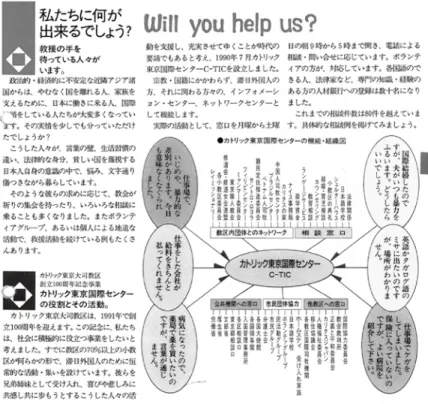
CTIC (founded in 1990) was one of the first locations in the RCCJ to deal with the second-generation. Yet according to Illustration 2, youth ministry was a subject absent from its original design. In the first few years of its operation, CTIC provided first-generation migrants legal advice, foreign-language translation and parish support (summarized from Illustration 2). Youth ministry came afterwords as migrants settled
8)Similar observations were made by the author at an English church school associated with the English Mass at Fukuoka Church (See section Ⅰ).
down. The first of CTIC’s youth events came in the shape of its summer camp.
1. CTIC Summer Camp
As the number of migrants in the Tokyo Archdiocese grew throughout the 1990s, CTIC hired a YMCA director by the name of Mr. Suzuki to help create a diocesan-wide multicultural youth camp. Afterwords, a Filipina lay volunteer was also hired named Rosita who was contracted from 2000 to 2010. That same year (1990), CTIC collaborated with existing parishes like St. Anselm Parish (Kasai Church) and religious
orders like the Salesians of Don Bosco. The result was a camp held in Nasu, Tochigi prefecture called the “Working Day” camp. From 2000 to 2004, CTIC and St. Anselm Parish used the Salesian Gakuin Sansō Retreat Center at Lake Nojiri in Nagano prefecture. The themes of some of its retreats included: “The Road I have Traveled̶A Multicultural Road” (2001), “Nature Camp: Myself within Nature” (2002), and “Everyone is Different, Everyone is Special” (2003).
By 2005, summer camp participants had grown to over 40 children, shifting the focus from affluent families who could afford chartered buses to modest, middle-class families who desired cheaper and more convenient options. This demographic change led CTIC to break from St. Anselm and start its own camp. Some themes at these new CTIC camps included: “Multi-Cultural Youth Camp” (2006) and the “Family Camp” (2007). Throughout the decade of activity, CTIC participants grew more diverse in economic standing, ethnicity and family structure.
The CTIC camp ended abruptly in 2011 with the Great East Japan Earthquake and subsequent Fukushima Daiichi nuclear reactor meltdown. The facility CTIC had planned to use in 2011 was contaminated from nuclear fallout. With little time to lose, CTIC changed the venue to a church far from danger and changed the schedule from a three-day to a one-night retreat (called the “CTIC Youth One-Night Camp”). At this sleepover, children would ‘inculturate’9) the Mass by creating banners for decoration, baking communion bread, rewriting difficult Japanese liturgical expressions, and thinking of their own prayers.
Unfortunately, without Rosita’s help (who returned to the Philippines in 2010), Mr. Suzuki could not garner adequate support to expand the summer camp. The “One-day Multicultural Training Session” was planned in 2012 to inspire youth leadership. Meguro Church, the office of CTIC, became the venue for this activity. In the end, the CTIC Youth Leader Summer Camp was planned in 2012, and became the last attempt by CTIC to create a diocesan-wide response for its multicultural second-generation.
2. The Rough Transition from MCY to YCS
As the popularity of CTIC events waned, Fr. Tanaka the pastor of Yamagoe Church reached out to Mr. Suzuki to develop a multicultural seminar called the Multicultural Youth Program (MCY hereafter). This was a progressive plan to teach children about Filipino culture that was rolled out with the help of Ms. Takeda (future Yamagoe Church School director), a few Filipinos from Yamagoe Church, and myself. The MCY was a year-long program held every Sunday at Yamagoe Church. After each session, leaders compiled their experiences into a public-access, internet resource.10)
The MCY marked a shift in CTIC activity. No longer would it require children to travel across Tokyo to meet multicultural youth they did not know. This time CTIC would come to them. By taking advantage of parish structures and the pre-existing relationships children had with others, CTIC focused on a warmer market that parish leaders could more easily support. The MCY also catered to younger children who were dependent on their parents, unlike those teenagers 10)Parishes outside Tokyo thanked Mr. Suzuki personally for this service.
who attended the CTIC “One-day Multicultural Training Session”. The MCY was developed without an exit plan. The reasons for this might have been the over-zealousness of Mr. Suzuki and Fr. Tanaka to start something in the absence of CTIC’s summer camp. Whatever the case, the effect of having no church school to ‘catch’ children as they finished the MCY led many to disappear shortly after MCY’s end, erasing the modest multicultural gains that were made.
IV. Yamagoe Church School Organization
The Yamagoe Church School (YCS) would fill the void left at MCY’s end with a structured program that would space children’s religious and multicultural education over the course of six to nine years. The YCS’s stability was rooted in a structure that combined multiple activities over children’s adolescence. This structure included a four-tiered division of activities children would participate in over three, three-year cycles for a total of nine years.
1. Four Tiers of YCS Activities
The YCS structure consists of four activities (Figure 2): 1. spring sleepovers, 2. summer camps, 3. catechism classes, and 4. CTIC and seasonal events. The first tier are sleepovers held in March that teach
Illustration 4: Dare to Share Sleepover 2016 Illustration 3: Many Colors, One Faith Summer Camp 2019
children about the Japanese Mass.11) Sleepovers teach about the importance of community, social interaction and goodwill. Second-tier summer camps, focus on building multicultural friendships in an outdoor setting with themes such as cultural diversity, teamwork and cultural tolerance. Third-tier activities are monthly activities designed to increase the catechetical and biblical knowledge of children. These meet for 40 to 60-minute sessions on the first Sunday of the month and are divided according to Mass times. Classes address various themes touching on issues such as the life of Jesus and his disciples, Christmas, Lent, and topics like world religions. The fourth tier are seasonal activities and those sponsored by CTIC. These include Easter and Christmas parties or art projects like making advent wreaths or baking bread for communion. The focus of these activities is to unite children from both Masses and all age groups to learn essential Christian terminology.
2. Three-year Cycle of Sleepovers and Camps
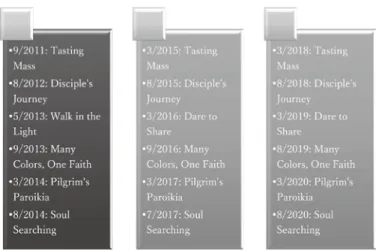
The above four tiers of yearly activities are organized in a three-year cycle to ensure children receive a wide range of religious knowledge.12) Thirty-six catechism classes and six, two-day events comprise one three-year cycle. At the end of each cycle, lessons repeat again and leaders can reuse course content (See Figure 3).
11)Despite children’s multicultural background few speak languages other than Japanese fluently.
12)This three-year cycle was inspired by the liturgy, which is divided into A, B and C years according to synoptic gospels Matthew, Mark and Luke.
The YCS has also instituted three grades that correspond roughly to the above three-year cycle. Figure 4 shows three classes of Lower Class, Upper Class, and Junior-Leader. Each child attends a class for a period of up to three years before graduating to the next. For example, children who experienced the Many Colors, One Faith 2013 sleepover as a lowerclassman experienced the same sleepover in 2016 as an upperclassman and 2019 as a junior-leader. In this fashion, students move from one grade to another receiving a lesson with similar content, directed to a more mature audience.
Figure 3: Dates of 3 Three-Year Cycle of Two-day Events13)
13)All events do not perfectly align due to adjustments made every cycle. Pilgrim’s Paroikia 2020 and Soul Searching 2020 were canceled due to the Corona Virus.
V. Church School and Problems with Cohort Replacement
Since its modest beginnings in 2011, the YCS has taught over a hundred children through a variety of mediums. This has led to a thriving church school. However, much of this success is due to the hard work of a handful of volunteer leaders who have yet to see a replacement materialize from its graduates. This section illustrates, through data collected at catechism classes, sleepovers and summer camps, how short-lived attendance of children and leaders interferes with cohort replacement.
1. Truancy and Church School Attendance
This section is divided into three parts that analyze: 1) the frequency of children’s attendance at catechism classes and two-day activities, 2) the disparity between monthly and yearly attendance, and 3) the average age of children attendees. This quantitative data analysis will reveal how the largest problem church schools face is continuity of attendees, which leads to stagnation and paralysis.
a. Attendance
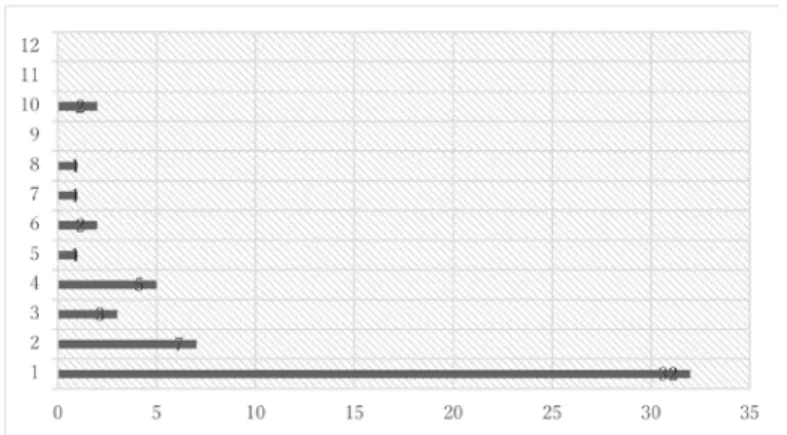
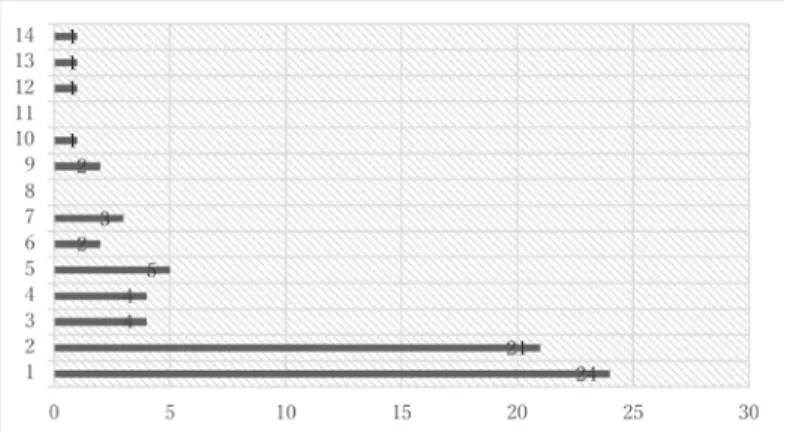
The first data set comes from 2017 and 2018 catechism classes (Figures 5 〜 7). Out of 54 children in 2017, 59% (32/54) attended
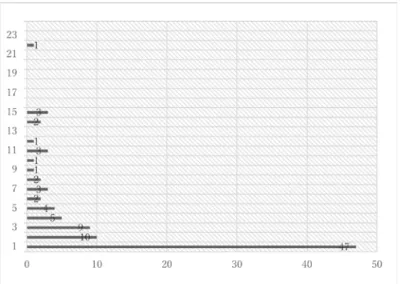
catechism class once, 13% (7/54) twice and 5% (3/54) three times. The remaining 23% (12/54) of children attended between four and ten times. No children attended nine, eleven or twelve classes (Figure 5). Similarly, out of 75 attendees in 2018, 52% (32/75) attended once, 11% (7/75) attended twice and 11% (7/75) attended three times. 27% (20/75) of attendees attended four or more times, with 1%, (or one child), attending twelve times (Figure 6). When 24 classes were calculated over 2017 and 2018, 51% (47/93 of children attended once, 11% (10/93) attended twice, 10% (9/93) three times, and 29% (28/93) attended four times or more. The child with the best attendance participated twenty-two out of twenty-four classes (Figure 7). Over 2017 and 2018 attendance improved slightly with children attending more continuously in the second year than the first. The two-year average was 4.4 catechism classes or once every 5.4 months.
Figure 6: Frequency of Catechism School Attendance in 2018 (n=75)
Infrequent attendance at catechism classes improved slightly at two-day events with 35% (24/69) of 69 children attending one camp, 30%(21/69) attending two and 6% (4/69) attending three. The
remaining 29% (20/69) attended between four and fourteen camps over a nine-year period. The average rate of attendance from all 69 children was 3.2 camps, or roughly two years of attendance. Two-day events were attended by fewer children than catechism classes, but those who attended showed a longer period of activity (Figure 8).
Findings from attendance collected at catechism and two-day camps reveal that more children attend the former than the latter. This is due to some fundamental differences. First, catechism classes are used as a platform to invite all children to attend, regardless of their familiarity with church school. Every month before the English Mass, leaders circle the chapel inviting children. Sometimes this involves personally asking parents for their children’s participation. Such direct invitation attracts children who would otherwise not attend. This is reflected in their high rate of one-time attendance (over 50%). By comparison, leaders limit sleepover and camp invitations to those who have already attended catechism class. Enrollment and a fee is required
at these events, leading to children’s heavier commitment. This has resulted in fewer, more dedicated children attending two-day events, illustrated by a higher percentage of repeated attendance.
b. Variance
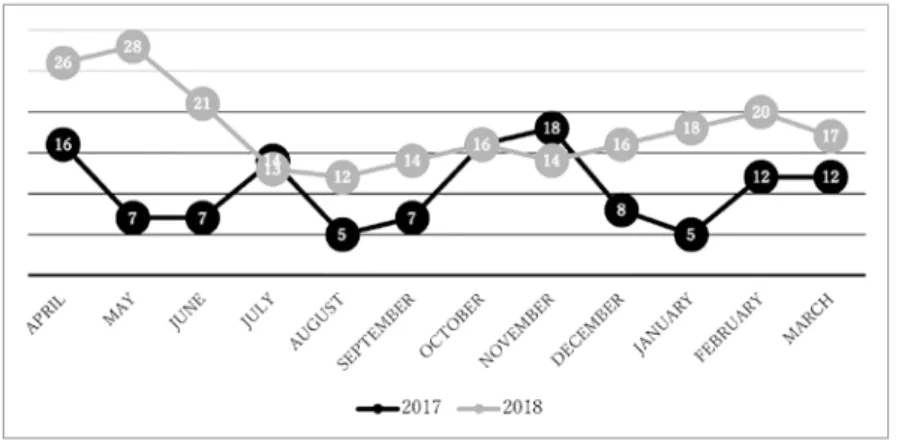
Another obstacle to church school is the short period of children’s attendance. Attendance at catechism classes and two-day events is not only infrequent, but difficult to predict. In other words, leaders have trouble planning for lessons because they never know how many children will attend. This is shown in figure 9 which compares attendance between catechism classes from 2017 to 2018 and figure 10 which compares two-day events of sleepovers and summer camps.
Attendance at catechism class tends to fluctuate greatly (Figure 9). An example of this fluctuation comes from May 2017 when only 7 children attended catechism class, but 28 children attended the following year. Another month with high fluctuation was January with 5
children in 2017 and 18 in 2018. When monthly attendance is compared to the 24-month average attendance of 14.3 children per month, what we find is each month varies by 17%. This means that on any given month, average attendance can be as high as 17 children and as low as 12.
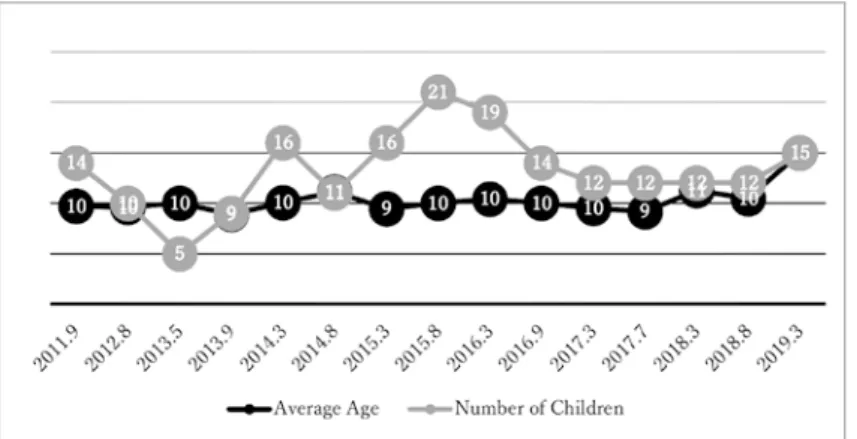
We find in figure 10 less variation of attendance at biannual, two-day events than at catechism classes. From 2011 to 2019, the lowest attendance was 5 children at the first sleepover in 2013. By contrast, the highest attendance was 21 children at the summer camp of 2015. The average rate of attendance at all two-day events over this period was 14.0 children. The average fluctuation of attendance was 7% above and below this average. In other words, the average attendance at any given two-day event fluctuated between 13 and 15 children. Compared with the catechism class, the variation of attendance at two-day events is less pronounced. This is due to more consistent attendance (Figure 10).
c. Age
The final variable of attendance is age. By calculating when
children first and last attended two-day events, we can better predict why children enter and leave church school. Figure 11 shows the number of children and their ages of attendance at two-day events. The average age children begin to attend is 9.1 years old, or grade 3. Conversely, the average age of discontinuation is 10.8, or grade 4. On average, children attended 3.2 two-day events (or roughly two years) before discontinuing. Most children begin catechism class in the second grade, shortly after first-communion class is offered in May of children’s second year. After children attend a few classes, they often make friends with those with whom they attend a sleepover or summer camp. Children’s attendance continues until the end of grade 4 where they stop coming to church in place of club activities (grade 5), entrance exams (grade 6) or some other outside influence. By the time of graduation from elementary school, few children remain.
d. Analysis of Data
The above data reveals that the numbers of children who remain at the YCS long enough to graduate from one class to the next are an extreme minority. In most cases, children never experience two three-year cycles. To add insult to injury, attendance, even when children are active at church school, is inconsistent. This means most children who attend the YCS receive little in the way of catechetical instruction, and the ‘friendships’ they make never last long.
This does not mean, however, that the YCS’s efforts are meaningless. Numbers may be small in comparison, but those children who continue church school as upperclassmen develop a close relationship with other peers and leaders, even if their numbers pale in comparison to underclassmen. These children’s attendance never improves much beyond elementary school, but they become more stable, consistently attending two-day events and church festivals like Easter and Christmas. In fact, there are two young girls set to become junior-leaders in 2020. These ‘success stories’ of Yamagoe Church attended catechism and two-day events faithfully for the better part of eight years. Further research is necessary to tell whether they will continue as leaders, but their continual participation into high school is significant.14)
2. The Problem with Raising Multicultural Leaders
The potential of a church school to continue depends on its ability to raise its own multicultural leaders. For the YCS, it has had little success
14)It is still too early to tell if these girls will become junior-leaders because the 2020 sleepover was canceled due to the COVID-19 pandemic.
with Filipino leaders due to the difficulty of the Japanese language. The YCS discovered this early on with Filipino volunteers, who disappeared weeks into the MCY. The YCS continues to outsource some activities to Filipino parishioners, such as cooking at events, but it has had better success with recruiting teenagers and university students. The decision not to place Filipinos at the center of its leadership does not mean the YCS has no ethnic diversity. As can be seen from figure 12, leaders come from a variety of ethnic backgrounds.
Over nearly a decade of activity, the YCS has always had a problem with leader turnover. In fact, with few exceptions, the YCS has yet to see children transition from underclassmen to junior-leaders.15) Without graduates, the YCS has been forced to depend on leaders who enter church school as young adults. But their attendance is not much better than the children they teach. Most leaders continue over 5.5 two-day events, or about three years. This means that leaders leave church school shortly after completing one three-year cycle. The goal of maintaining a three-year cycle was to give leaders experience they could use to teach the same content in a second, three-year cycle. Yet few volunteers continue long enough to gain sufficient experience to teach underclassmen, thus creating undue stress for the directors who fill in.
Similar with children, leaders need to attend church school longer if they are to become sufficiently experienced to teach lowerclassmen and upperclassmen (or junior leaders). Without at least six years of leader activity, the multi-year structure which the YCS is built upon, will never function the way it was intended.
VI. Conclusion
The YCS has succeeded in building a strong peer group by continuing CTIC’s idea of a summer camp, and adding monthly classes and spring sleepovers. The YCS also learned valuable lessons from the progressive MCY program that attracted children from Filipino backgrounds, but which was too laborious to continue. After MCY concluded, YCS directors constructed a four-tiered structure of activities over a three-year cycle to provide essential catechetical teaching in a platform that would not exhaust leader or child. It is no exaggeration to say that the YCS exists thanks to the experience its directors gained as leaders at CTIC camps and MCY classes; but there remain considerable problems it must face in the future if it is to avoid a similar fate.
The first of these problems is leadership turnover. The YCS is fortunate to have numerous active and on-call leaders to institute its
progressive activities, but the staircase from student to leader has never worked as it was designed. Ms. Takeda and I knew in the beginning the busy schedules of parents and children would interfere with expectations for weekly church school activity. Our solution was to aim for continual, casual attendance rather than heavy commitment. This tradeoff required children to commit for three-year cycles̶something few have done. Attendance no more than a few years has compromised the YCS system and threatened its future.
The same can be said for leaders. Because most leave after three or four years, they never become experienced enough to repeat topics they had learned three years prior. The YCS created a structure leaders would find easy to continue despite their busy schedules. Instead of depending on them to attend weekly, a monthly calendar would be sufficient assuming they continue for a longer period. Yet again, this has not happened. Leaders’ poor attendance and early absence has resulted in few becoming sufficiently competent to teach independently. This has required directors̶whose role is to teach leaders, not children̶step in and fill the void.
The YCS structure is both its biggest strength and its weakness. To complete a three-year cycle, the YCS uses spring (March) and summer (August/September) vacations for its two-day activities. These times are ideal because they coincide with periods when public school is on vacation. Unfortunately, these vacations also coincide with entrance exams and job-hunting (summer) or graduation and changing schools (spring). During these busy times, church school activities depend heavily on leaders who may have commitments elsewhere. Should tragedy strike, the YCS may find its burden too great to overcome.
If the YCS desires a more stable environment, it will need to better collaborate with CTIC and other regional actors. In the past, Mr. Suzuki would help at two-day events and run seasonal events at Yamagoe parish; but this support ended in 2020 as CTIC shifted its focus more toward refugees and the first-generation. Without the safety valve of CTIC’s full-time staff to intervene in times of trouble, part-time volunteers may easily reach their limit, leading to their burnout and disappearance. The need for such a safety valve is even greater given church schools depend on inexperienced teenagers and young adults to meet the high demands of the second-generation.
Multiculturalism of the second-generation is best dealt with at the local level as seen with the YCS; but this does not mean regional actors like CTIC have no role to play. Given that the only paid staff at the local level tends to be the parish priest, church schools have almost entirely become the purview of part-time volunteers. Such a system that depends on volunteers to implement idealistic multicultural plans made by a small number of paid clergy is both irresponsible and unfair. If the RCCJ is serious about its call to multiculturalism, better collaboration must occur between regional and local actors to care for its second-generation. Producing directives and guidance from diocesan experts would be a good start. Such a collaborative effort could help parish volunteers meet the needs of its second-generation without producing feelings of abandonment.
The case study of the YCS illuminates how constructing and managing a multicultural church school requires systemic efforts that tackle issues of children’s poor attendance, ephemeral participation, and ineffective cooperation between regional and local actors. Unless these problems are addressed, it is only a matter of time until
second-generation ministry is lost completely as the weak structures of RCCJ church schools collapse like a waterfront house built on sand.
Bibliography
Alva, Reginald. 2017. “Bridging the Gap between Orthodoxy and Orthopraxis: The Catholic Church’s Concern for Migrants”, Transformations (34/1): 1-11.
Hamada, Akihisa. 2020.2. “Kono Chi ni Mebuku Kaigai kara no Fukuin (part one): Yūkiteki ni ugoki, Icchisuru Takokuseki Kyōkai [A Multicultural Church that Moves Effectively and Works Together]”, Fukuin Senkyō (74/2): 23-35.
Japan Mission Journal, “Trends and Events” (73/4): 283-286.
LeMay, Alec. 2014. “Applying Double Limited Studies to the Religiosity of Filipino-Japanese Children within the Roman Catholic Church of Japan,” Lingua Bulletin (25): 19-43.
LeMay, Alec. 2018. “No Time for Church: School, Family and Filipino-Japanese Children’s Acculturation,” Social Science Japan Journal (21/1): 9-26.
Macaraan, Willard Enrique R. 2017. “Filipino Catholics in Japan and Ambiguity of ‘Full Integration’”, Journal of Dharma (42/2): 137-158.
Miura, Akiko. 2015. Nyūkamaā no Kodomo to Imin Komyunitī: Daini Sedai no Esunikku
Aidentitī (Immigrant Communities and Newcomer Children: Ethnic Identity of
the Second Generation), Tokyo: Keisō Shobō.
Mochizuki, Hiroki. 2019. Futatsu no Nihon: “Imin Kokka” no Tatemae to Genjitsu, Kōdansha Gendai Shinsho.
Mullins, Mark R. 2011. “Between Inculturation and Globalization: The Situation of Catholicism in Contemporary Japanese Society.” In Kevin M. Doak (ed.), Xavier’s
Legacies: Catholicism in Modern Japanese Culture, (169-192). Vancouver: UBC Press.
Muncada, Felipe L. 2008. “Japan and the Philippines: Migration Turning Points,” Fabio Baggio and Agnes M. Brazal, eds. In Faith on the Move: Toward a Theology of
Migration in Asia, (20-48). Quezon City: Ateneo de Manila University Press.
Ochante, Muray Rosa Mercedes and Carlos Ochante. 2017. “Multicultural and Multilingual Environment in Catholic Church̶Case Study of Iga City, Mie Prefecture,” Bulletin of Nara Gakuen University (7): 167-177.
Okada, Peter Takeo. 2014. “Response to the Secretariat of the Extraordinary Synod,”
Catholic Bishop’s Conference of Japan.
https://www.cbcj.catholic.jp/2011/10/07/4594/
Shirahase, Tatsuya. 2018. Katorikku ni okeru Jūsōteki na Imin Shien (Stratified Immigrant Support in the Catholic Church). In Gendai Nihon no Shūkyō to Tabunka
Kyōsei: Imin to Chiiki Shakai no Kankeisei wo Saguru (Religious and Multicultural
Symbiosis in Contemporary Japan). Edited by Takahashi Norihito, Shirahase Tatsuya and Hoshino Sou. Tokyo: Meiseki Shoten. 25-44.
Analysis of Religious Youth Group Participation Outcomes”, The Society for the
Scientific Study of Religion (48/3): 572-587.
Takahashi Norihito, Tsukada Hotaka, Okamoto Ryosuke, eds. 2012. In Shūkyō to Shakai
no Furonteia: Shūkyō Shakaigaku kara Miru Gendai Nihon (The Frontier of Religion
and Society: Considering Contemporary Japan from the Sociology of Religion), (129-150). Tokyo: Keisō Shobō.
Terada, Takefumi. 2013. “Nihon no Naka no Filipinjin [Filipinos in Japan].” Fukuin to