Metal-free isotactic-specific radical polymerization of N-isopropylacrylamide with pyridine N-oxide derivatives: the effect of methyl substituents of pyridine N-oxide on the isotactic-specificity and the proposed mechanism for the isotactic-specific radical polymerization
Tomohiro Hirano*, Hideaki Ishizu, Tsuneyuki Sato
Institute of Technology and Science, Tokushima University, Minamijosanjima 2-1, Tokushima 770-8506, Japan
Corresponding author. Tel.: +81-88-656-7403; fax: +81-88-655-7025; E-mail: [email protected] (T. Hirano).
Abstract
The radical polymerizations of N-isopropylacrylamide (NIPAAm) in chloroform at low temperatures in the presence of pyridine N-oxide (PNO) derivatives were investigated. It was found that the methylation at meta-positions of PNO improved the isotactic-specificity induced by PNO, whereas the methylation at ortho-positions prevented the induction of the isotactic-specificity. NMR analysis revealed that NIPAAm and PNO derivatives formed predominantly 2:1 complex through a hydrogen bonding interaction. Furthermore, the induction of the isotactic-specificity was attributed to the conformationally-limited propagating radicals. Based on these findings, the mechanism
© 2007. This manuscript version is made available under the CC-BY-NC-ND 4.0 license http://creativecommons.org/licenses/by-nc-nd/4.0/ The published version is available via https://doi.org/10.1016/j.polymer.2007.11.053.
of the isotactic-specific radical polymerization was discussed.
Keywords: N-isopropylacrylamide; isotactic-specific radical polymerization; hydrogen bond
1. Introduction
Poly(NIPAAm) is one of representative polymers which exhibit a lower critical solution temperature (LCST) [1]. Recently, several stereospecific polymerization of NIPAAm or NIPAAm derivatives were developed via radical or anionic mechanisms [2-9] and, as a result, the stereoregularity of poly(NIPAAm) was found to strongly affect the phase transition behavior; an increase in isotacticity gradually reduced the LCST of poly(NIPAAm) and poly(NIPAAm)s with meso (m) dyad over 72% were changed into insoluble in water [10], and an increase in syndiotacticity slightly increased the LCST and sharpened the phase transition behavior [3b, 8].
An anionic polymerization of trimethylsilyl-protected NIPAAm derivative with
t-C4H9Li / n-(C4H9)3Al in toluene at –40°C followed by deprotection produced an
N-isopropyl-N-methoxymethylacrylamide with alkyllithium / diethylzinc at –95°C
followed by deprotection afforded a syndiotactic poly(NIPAAm) with racemo (r) dyad of 83% [3b]. Moreover, an addition of Lewis acid such as yttrium trifluoromethanesulfonate directly gave isotactic poly(NIPAAm)s over m dyad of 90% even by a radical polymerization mechanism [4]. In all the cases, however, metal complexes played important roles for control of the stereospecificity, so that isolation of the resulting polymer is difficult due to strong interaction between the used metal compounds and the resulting polymer materials. Thus, development of metal-free stereospecific polymerization system has been strongly desired.
Recently, we have found that a hydrogen-bonding interaction of NIPAAm with Lewis bases or alcohol compounds is available for controlling the stereospecificity of radical polymerizations of NIPAAm [5-9]. The hydrogen-bond-induced stereospecificity depends on polymerization conditions such as the kind of added agents and the solvents. Syndiotactic poly(NIPAAm)s were obtained in toluene in the presence of phosphoric acid derivatives [5,6] or alkyl alcohols [8]. In particular, by the addition of an excess amount of hexamethylphosphoramide (HMPA) [5c] or 3-methyl-3-pentanol [8] at –60°C, the dyad syndiotacticity of the obtained poly(NIPAAm)s reached up to 72% or 71%. On the other hand, the addition of pyridine N-oxide (PNO) into NIPAAm polymerization in CHCl3 induced isotactic-specificity and the dyad isotacticity of the obtained poly(NIPAAm)s reached up to 61% by adding a twofold amount of PNO [7].
In this study, we examined the effect of methyl substituents of PNO on the isotactic-specificity and found that the introduction of two methyl substituents at
meta-position significantly enhanced the isotactic-specificity and isotactic poly(NIPAm)
with m = 68% was obtained in the presence of 3,5-dimethylpyridine N-oxide (3DMPNO) at –60°C. Then, we discussed the mechanism of this polymerization system with the aid of the thermodynamic analysis of polymerization and NMR analysis of NIPAAm-35DMPNO mixtures.
2. Experimental
2.1. Materials
NIPAAm (Tokyo Kasei Kogyo Co.) was recrystallized from hexane-benzene mixture. Chloroform and N,N-dimethylacrylamide (DMAAm) (Tokyo Kasei Kogyo Co.) were fractionally distilled before use. Dimethyl 2,2’-azobisisobutyrate (MAIB) (supplied by Otsuka Chemical Co., Ltd) was recrystallized from methanol. Tri-n-butylborane (n-Bu3B) as a tetrahydrofuran (THF) solution (1.0M) (Aldrich Chemical Co.), 2-methylpyridine N-oxide (2MPNO), 3-methylpyridine N-oxide (3MPNO),
4-methylpyridine N-oxide (4MPNO), 2,6-dimethylpyridine N-oxide (26DMPNO) (Tokyo Kasei Kogyo Co.), and 3,5-dimethylpyridine N-oxide (35DMPNO) (Aldrich Chemical Co.) were used without further purification for polymerization reaction.
2.2. Polymerization
Typical polymerization procedure is as follows; NIPAAm (0.628 g, 5.5 mmol) was dissolved in CHCl3 to prepare the 5 ml solution of 1.1 mol/l. Four milliliter of the solution was transferred to the glass ampoule and cooled at 0°C. The polymerization was initiated by adding n-Bu3B solution (0.44 ml) into the monomer solution under air [11]. After 48h, the reaction was terminated with a small amount of THF solution of 2,6-di-t-butyl-4-methylphenol at polymerization temperature. The polymerization mixture was poured into a large amount of diethyl ether, and the precipitated polymer was collected by filtration or centrifugation, and dried in vacuo. The polymer yield was determined gravimetrically.
2.3. Measurements
The 1H NMR spectra were measured on an EX-400 spectrometer (JEOL Ltd.) operated at 400MHz. The tacticities of the obtained polymers were determined from 1H NMR signals due to methylene group in main chain measured in deuterated dimethyl
sulfoxide (DMSO-d6) at 150°C. The 100MHz 13C NMR spectra of NIPAAm monomer, 35DMPNO, or both were measured in chloroform-d at –60°C. The molecular weights and molecular weight distributions of the polymers were determined by size exclusion chromatography (SEC) (HLC 8220 instrument (Tosoh Co.)) equipped with TSK gels (SuperHM-M and SuperHM-H (Tosoh Co.)) using dimethylformamide (LiBr 10 mmol/l) as an eluent at 40°C ([polymer] = 1.0 mg/ml, flow rate = 0.35 ml/min). The SEC chromatogram was calibrated with standard polystyrene samples.
3. Results and discussion
3.1. Radical polymerization of NIPAAm in the presence of mono-methylated PNO
Table 1 summarizes the results of radical polymerization of NIPAAm in CHCl3 at low temperatures in the absence or presence of mono-methylated PNOs (2MPNO, 3MPNO, and 4MPNO). The addition of mono-methylated PNOs reduced polymer yield at higher temperatures, regardless of the position of methylation. The polymer yield, however, increased with a decrease in the temperature in the presence of mono-methylated PNOs. Furthermore, the number-average molecular weights of the obtained polymers gradually increased with a decrease in the temperature. These results correspond with those in NIPAAm polymerization in the presence of non-substituted PNO [7].
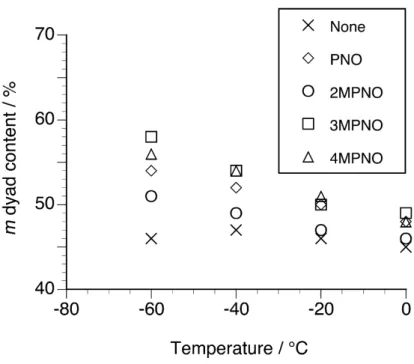
Fig. 1 demonstrates the relationship between the polymerization temperature and m dyad content of poly(NIPAAm)s obtained in the absence or presence of equimolar amounts of mono-methylated PNOs. The data for NIPAAm polymerization in the presence of an equimolar amount of PNO were also plotted [7]. Isotacticity slightly increased with the addition of PNO derivatives as compared with that in the absence of PNO derivatives and lowering the temperature enhanced the magnitude. Furthermore, as compared with the isotacticity of the polymers obtained with non-substituted PNO, isotacticity increased by adding meta- and para-methylated PNOs and decreased by adding ortho-methylated PNO, indicating that the position of methyl substituent affected the induced isotactic-specificity. The increase in the added amount of mono-methylated PNOs also enhanced the induced isotactic-specificity (cf. Table 1, Runs 9, 14, and 19) and
m dyad content reached up to 64% by adding a twofold amount of meta-methylated PNO
at –60°C.
<Fig. 1>
3.2. Radical polymerization of NIPAAm in the presence of di-methylated PNO
We conducted NIPAAm polymerization in the presence of di-methylated PNOs, 26DMPNO and 35DMPNO, to investigate the effect of number of substituents on the induced isotactic-specificity (Table 2). Poly(NIPAAm)s were obtained at relatively high yields in the presence of 26DMPNO regardless of the polymerization temperature, whereas 35DMPNO showed similar tendency to non- and mono-substituted PNOs. The
addition of equimolar amount of 26DMPNO slightly induced the isotactic-specificity as well as 2MPNO, but 35DMPNO further enhanced the induced isotactic-specificity as compared with 3MPNO.
<Table 2>
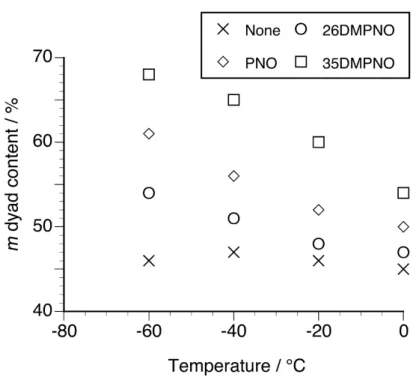
Fig. 2 displays the relationship between the polymerization temperature and m dyad content of poly(NIPAAm)s obtained in the absence or presence of twofold amounts of di-methylated PNOs. The data for NIPAAm polymerization in the presence of a twofold amount of PNO were also plotted [7]. The effects of both the polymerization temperature and the position of two methyl substituents were more pronouncedly observed and m dyad content reached up to 68% by adding a twofold amount of 35DMPNO at –60°C.
<Fig. 2>
3.3. Radical polymerization of NIPAAm in the presence of 35DMPNO
As mentioned above, 35DMPNO exhibited the best performance to induce the isotactic-specificity among the PNO derivatives examined. Thus, the effect of polymerization conditions, such as the amount of the added Lewis base and the polymer yield, on the isotacticity of the poly(NIPAAm)s obtained in the presence of 35DMPNO were examined in more detail.
Fig. 3 displays the relationship between the ratio of [35DMPNO]0 / [NIPAAm]0 and m dyad content of the obtained poly(NIPAAm)s (cf. Table 2, Runs 16-20). The m dyad content gradually increased until the [35DMPNO]0 / [NIPAAm]0 ratio of 1.5. This result suggests that an excess amount of Lewis base was required at least under the given conditions to significantly induce the isotactic-specificity.
<Fig. 3>
Poly(NIPAAm)s with almost the same isotacticities were obtained, regardless of the polymer yield, in the presence of a twofold amount of 35DMPNO at –60°C (Table 2, Runs 16 and 21-24). This result contrasts with the syndiotactic-specific NIPAAm polymerization with HMPA, in which stereoregularity of the obtained poly(NIPAAm)s gradually varied with the polymer yield [5c].
3.4. Thermodynamic analysis of the isotactic-specific NIPAAm polymerization in the presence of PNO derivatives
In order to evaluate the difference in activation enthalpy (∆H‡) and the difference in activation entropy (∆S‡) between isotactic and syndiotactic propagations, we conducted Fordham’s plots for NIPAAm polymerization in the presence of PNO derivatives. For example, we displayed the plots for NIPAAm polymerization with 35DMPNO in Fig. 4. The values were determined by the linear dependences according to the following Eq. (1): [12]
(1)
where Pi and Ps denote the mole fractions of isotactic and syndiotactic dyads, respectively. The obtained values are summarized in Table 3, together with those for HMPA-mediated syndiotactic-specific NIPAAm polymerization in toluene [5b]. Both values decreased by the addition of PNO derivatives, as compared with those in the absence of Lewis bases. Furthermore, the magnitude related not only to the added amount but also to the isotactic-specificity-inducing ability of the PNO derivatives.
<Fig. 4> <Table 3>
As previously reported [7], the absolute values of the ∆Si‡ – ∆Ss‡ for the polymerization in the presence of PNO derivatives were quite larger than those for HMPA-mediated syndiotactic-specific NIPAAm polymerization, whereas the absolute values of the ∆Hi‡ – ∆Hs‡ were comparable with those with HMPA. Thus, it is assumed that the isotactic-specificity was achieved by taking some degrees of freedom away from the propagating chain-end. The mechanism will be in detail discussed later.
3.5. Stoichiometry of NIPAAm-35DMPNO complex
In the previous communication [7], we reported that the induced isotactic-specificity was attributable to a complex formation between NIPAAm monomer
and PNO through a hydrogen-bonding interaction, based on the NMR analysis. Thus, we conducted 13C NMR analysis under the following conditions ([NIPAAm]0 + [35DMPNO]0 = 0.25 mol/l, in CDCl3 at –60°C in the presence of TMS as an internal reference) to investigate the stoichiometry of the NIPAAm-35DMPNO complex.
Fig. 5(a) displays changes in the chemical shift of methylene carbon of NIPAAm at –60°C, when the fraction of [NIPAAm]0 was varied. The signal was linearly shifted to a higher magnetic field as the fraction of [NIPAAm]0 decreased. Thus, the stoichiometry of the complex was evaluated by Job’s method [Fig. 5(b)] with the following Eq. (2); [13]
(2)
where δ(CH2=) and δ(CH2=)f are the chemical shifts of methylene carbon of the sample mixture and NIPAAm alone, respectively, from the internal TMS. As previously reported [5,6], the chemical shift of NIPAAm alone also varied with the concentration, since NIPAAm itself also associates each other through a hydrogen-bonding interaction. Thus, the chemical shifts of NIPAAm alone at the corresponding concentration were applied as δ(CH2=)f (cf. Fig. 5(a)). The chemical shift for the saturated mixture [δ(CH2=)c] was calculated from the intercept of a linear dependence in Fig. 5(a), since the saturation should be independent of NIPAAm concentration. Unlike NIPAAm-HMPA complex, the calculated data were asymmetrically plotted, and a broad maximum was observed between 0.5 and 0.67 of the [NIPAAm]0 fraction [Fig. 5(b)]. This means that NIPAAm and 35DMPNO afford both 1:1 and 2:1 complexes, but the 2:1 complex is preferentially
formed. A few examples on such 2:1 complexes of PNO derivatives have been reported in the crystalline state [14].
<Fig. 5>
3.6. Proposed mechanism for the isotactic-specific NIPAAm polymerization induced by PNO derivatives
3.6.1. Induction of the isotactic-specificity
It is well known that methacrylates give isotactic polymers by anionic polymerizations in non-polar solvents such as toluene. The isotactic propagation is attributable to the intramolecular coordination of countercation by carbonyl group in the penultimate monomeric unit [15]. Similar mechanism has been proposed for isotactic-specific radical polymerizations of α-alkoxymethylacrylates [16] and acrylamides [17] in the presence of a catalytic amount of Lewis acid. Thus, it is assumed that, in the present polymerization systems, the incoming monomer approached the radical center from the side opposite to amide groups of the penultimate and chain-end monomeric units, which formed double hydrogen bonds with PNO derivatives, to form m dyad and, as a result, the isotactic-specificity was induced.
This proposed mechanism is strongly supported by the experimental results; (1) the methylation at ortho-positions of PNO resulted in the reduce in the isotactic-specificity, probably because of the steric repulsion (cf. Figs. 1 and 2), (2) the isotactic-specific propagating chain-end should be conformationally limited (cf. Table 3), (3) 35DMPNO preferentially formed 2:1 complex through a hydrogen-bonding interaction (cf. Fig. 5). Further, the improvement by the methylation at meta- or
para-positions of PNO is explainable with the increase in the Lewis basicity of the PNO
derivatives. However, unexplainable results still remain as follows:
1. Why an excess amount of PNO derivatives was required for the significant induction of the isotactic-specificity (cf. Fig. 3).
2. Why the polymer yield in the presence of PNO derivatives increased with a decrease in the temperature, although the addition of PNO derivatives drastically reduced the polymer yield at higher temperatures (cf. Tables 1 and 2).
3.6.2. Explanation for the requirement of an excess amount of PNO derivatives to induce the significant isotactic-specificity
In the course of the determination of the stoichiometry of the NIPAAm-35DMPNO, we found that the 1H NMR signals due to both the amide proton of NIPAAm and CHCl3 showed downfield shifts by adding 35DMPNO. Taking into account that CHCl3 easily forms hydrogen-bonding interaction with Lewis bases [18], this result indicates that 35DMPNO forms complexes not only with NIPAAm monomer but also with the solvent CHCl3 through a hydrogen-bonding interaction. This means that the amount of the PNO derivatives effective for the stereocontrol decreases. Furthermore, the complex formation between NIPAAm monomer and PNO derivatives resulted in a decrease in the polymerizability of NIPAAm monomer, as described later. Thus, the polymerization of the free monomer would proceed preferentially to afford atactic polymers, if a catalytic amount of PNO derivatives is added. Therefore, an excess amount of PNO derivatives was required for the significant induction of the isotactic-specificity.
3.6.3. The roles of PNO derivatives in regard to the polymer yield
As previously reported [5a], the polymer yield strongly depended on the kind of the added Lewis base; the addition of n-hexylamine prevented radical polymerization of NIPAAm, probably because the added Lewis base formed a complex with the Lewis-acidic initiator (n-Bu3B) [19]. Thus, it is assumed that a complex formation between the added PNO derivatives and the initiator is also attributable to the drastic reduce of the polymer yield. To confirm the above-mentioned assumption, we conducted radical polymerizations of DMAAm, which has no amide proton to form hydrogen bonds,
at –60°C and 0°C for 3h in the absence or presence of a twofold amount of 35DMPNO (Table 4). At 0°C, although poly(DMAAm) was obtained at a relatively high yield in the absence of 35DMPNO, the addition of 35DMPNO drastically reduced the polymer yield [20]. This result supports the above-mentioned assumption. On the other hand, the polymer yield in the presence of 35DMPNO increased by lowering temperature to –60°C, whereas the relatively high yield was kept in the absence of 35DMPNO. The reason is discussed later.
<Table 4>
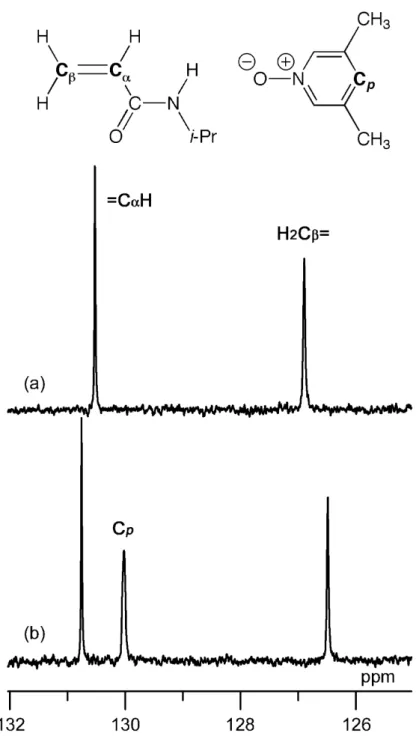
If the complex formation between PNO derivatives and n-Bu3B is the sole reason for the drastic reduce in the polymer yield, the use of other initiators would avoid such tendency. Thus, we conducted NIPAAm polymerization by changing the initiator from n-Bu3B to MAIB, which is not Lewis acid, with UV irradiation. However, the polymer yields significantly decreased by the addition of 35DMPNO (cf. Table 2, Runs 25 and 26). It has been reported that, among homologous monomers such as acrylates, methacrylates, and substituted styrenes, the chemical-shift difference between α- and β-carbons in vinyl groups increases with a decrease in the Q value [22]. The signals due to α- and β-carbons of NIPAAm exhibited slight downfield and slight upfield shifts, respectively, with the addition of 35DMPNO (Fig. 6), resulting in an increase in the chemical shift difference. This result suggests that resonance stabilization in the CH2=CH-C=O moiety of NIPAAm is reduced by the coordination with PNO derivatives,
probably because of the cross-conjugated structure (CH2=CH-C=O and O=C-N-H) [23]. As a result, the polymer yield would be further reduced by the complex formation.
<Fig. 6>
At lower temperatures, PNO derivatives should strongly coordinate to the solvent CHCl3 (and NIPAAm monomer in the NIPAAm polymerization). Thus, as the polymerization temperature decreased, the complex formation between PNO derivatives and the adding initiator n-Bu3B would become difficult. This means that n-Bu3B efficient for initiating the polymerization increases more at lower temperatures. As a result, the polymer yield increased at lower temperatures regardless of the kind of the monomer used, (although the NIPAAm monomer was deactivated by coordination with PNO derivatives in NIPAAm polymerization).
4. Conclusions
We succeeded in the improvement for the PNO-induced isotactic-specificity in NIPAAm polymerization by methylating PNO. In particular, the methylation at meta-positions of PNO was effective and the m dyad content reached up to 68% with the addition of 35DMPNO. Although the obtained isotacticity was lower than those observed in the Lewis-acid-mediated isotactic-specific radical polymerizations [4], it appeared that the isotactic-specificity of radical polymerization of NIPAAm can be significantly induced even under metal-free conditions. Further works are now under way to examine the
effects not only of the N-substituents but also of the solvents on the isotactic-specificity induced by PNO derivatives.
Acknowledgements
This work was supported in part by a Grant-in-Aid for Young Scientists (B) (18750102) from the Ministry of Education, Culture, Sports, Science and Technology. The authors are grateful to Dr. T. Mori of Kyushu University for helpful discussions
References and notes
[1] (a) Schild HG. Prog Polym Sci 1992; 17: 163-249. (b) Kikuchi A, Okano T. Adv Drug Delivery Rev 2002; 54: 53-77. (c) Kawaguchi H, Kisara K, Takahashi T, Achiha K, Yasui M, Fujimoto K. Macromol Symp 2000; 151: 591-598. (d) Hoffman AS, Stayton PS, Bulmus V, Chen G, Chen J, Cheung C, Chilkoti A, Ding Z, Dong L, Fong R, Lackey CA, Long CJ, Miura M, Morris JE, Murthy N, Nabeshima Y, Park TG, Press OW, Shimoboji T, Shoemaker S, Yang HJ, Monji N, Nowinski RC, Cole CA, Priest JH, Harris JM, Nakamae K, Nishino T, Miyata T. J Biomed Mater Res 2000; 52: 577-586.
[2] Kitayama T, Shibuya W, Katsukawa K. Polym J 2002; 34: 405-409.
[3] (a) Ito M, Ishizone T. Des Monomers Polym 2004; 7: 11-24. (b) Ito M, Ishizone T. J Polym Sci: Part A: Polym Chem 2006; 44: 4832-4845.
[4] (a) Isobe Y, Fujioka D, Habaue S, Okamoto Y. J Am Chem Soc 2001; 123: 7180-7181. (b) Habaue S, Isobe Y, Okamoto Y. Tetrahedron 2002; 58: 8205-8209.
[5] (a) Hirano T, Miki H, Seno M, Sato T. J Polym Sci: Part A: Polym Chem 2004; 42: 4404-4408. (b) Hirano T, Miki H, Seno M, Sato T. Polymer 2005; 46: 3693-3699. (c) Hirano T, Miki H, Seno M, Sato T. Polymer 2005; 46: 5501-5505.
[6] Hirano T, Ishii S, Kitajima H, Seno M, Sato T. J Polym Sci: Part A: Polym Chem 2005; 43: 50-62. (b) Hirano T, Kitajima H, Ishii S, Seno M, Sato T. J Polym Sci: Part A: Polym Chem 2005; 43: 3899-3908. (c) Hirano T, Kitajima H, Seno M, Sato T. Polymer 2006; 47: 539-546.
[7] Hirano T, Ishizu H, Seno M, Sato T. Polymer 2005; 46: 10607-10610.
[8] Hirano T, Okumura Y, Kitajima H, Seno M, Sato T. J Polym Sci: Part A: Polym Chem 2006; 44: 4450-4460.
[9] Hirano T, Kamikubo T, Okumura Y, Sato T. Polymer 2007; 48: 4921-4925.
[10] Ray B, Okamoto Y, Kamigaito M, Sawamoto M, Seno K, Kanaoka S, Aoshima S. Polym J 2005; 37: 234-237.
[11] Zhang Z, Chung TCM. Macromolecules 2006; 39: 5187-9. [12] Fordham JWL. J Polym Sci 1959; 39: 321-334.
[13] Gil VMS, Oliveira NC. J Chem Educ 1990; 67: 473-478.
[14] (a) Krzywda S, Jaskólski M, Gdaniec M, Dega-Szafran Z, Grundwald-Wyspianska M, Szafran M, Dauter Z, Davies G. J Mol Struct 1996; 375: 197-206. (b) Dega-Szafran Z, Kosturkiewicz Z, Tykarska E, Szafran M, Lemanski D, Nogaj B. J Mol Struct 1997; 404: 25-32.
[15] Kitayama T, Fujimoto N, Hatada K. Makromol Chem Macromol Symp 1993; 67: 137-146.
[16] Baraki H, Habaue S, Okamoto Y. Macromolecules 2001; 34: 4724-4729.
[17] Okamoto Y, Habaue S, Isobe Y. In: Matyjaszewski K, editor. Advances in controlled/living radical polymerization. ACS Symposium Series 854, American Chemical Society, Washington, D.C., 2003. pp. 59-71.
[18] (a) Rintoul L, Shurvell HF. J Raman Spectrosc 1990; 21: 501-507. (b) Jeffrey GA. J Mol Struct 1999; 485-486: 293-298. (c) Hippler M. J Chem Phys 2005; 123: 204311.
[19] Sonnenschein MF, Webb SP, Redwine OD, Wendt BL, Rondan NG. Macromolecules 2006; 39: 2507-2513.
[20] The addition of 35DMPNO slightly increased the syndiotacticity of the obtained poly(DMAAm)s. This result agrees with the result that an increase in polarity decreased the isotactic-specificity of DMAAm polymerization [21].
[21] Liu W, Nakano T, Okamoto Y. Polym J 2000; 32: 771-777.
[23] This result corresponds with the fact that the chemical shift difference between α- and β-carbons of NIPAAm decreased by mixing NIPAAm monomer and alkyl alcohol, which accelerated the NIPAAm polymerization though the hydrogen-bonding interaction with the carbonyl group of the NIPAAm monomer [8].
Table 1.
Radical polymerization of NIPAAm in CHCl3 for 48h at low temperatures in the absence or presence of mono-methylated PNO
Run Added [MPNO]0 Temp. Yield Tacticity / %a Mnb Mwb
Lewis bases mol/l °C % m r x 104 Mn
1 2 3c 4c 5 6 7 8c 9c 10 11 12 13c 14c 15 16 17 18c 19c None None None None 2MPNO 2MPNO 2MPNO 2MPNO 2MPNO 3MPNO 3MPNO 3MPNO 3MPNO 3MPNO 4MPNO 4MPNO 4MPNO 4MPNO 4MPNO 0.0 0.0 0.0 0.0 1.0 1.0 1.0 1.0 2.0 1.0 1.0 1.0 1.0 2.0 1.0 1.0 1.0 1.0 2.0 0 –20 –40 –60 0 –20 –40 –60 –60 0 –20 –40 –60 –60 0 –20 –40 –60 –60 >99 >99 96 26 44 65 80 84 83 29 40 52 54 33 51 62 93 96 >99 45 46 47 46 46 47 49 51 56 49 50 54 58 64 48 51 54 56 59 55 54 53 54 54 53 51 49 44 51 50 46 42 36 52 49 46 44 41 0.98 1.33 1.26 1.69 1.01 1.15 1.25 1.53 1.40 0.83 1.01 1.18 1.24 0.86 1.03 1.32 1.77 2.34 3.28 1.4 1.5 1.6 1.6 1.3 1.2 1.3 1.5 1.4 1.2 1.3 1.3 1.3 1.3 1.2 1.3 1.5 1.5 1.3 [NIPAAm]0 = 1.0 mol/l, [n-Bu3B]0 = 0.10 mol/l.
a. Determined by 1H NMR signals due to methylene group. b. Determined by SEC (polystyrene standards).
Table 2.
Radical polymerization of NIPAAm in CHCl3 at low temperatures in the presence of di-methylated PNO
Run Added [DMPNO]0 Temp. Time Yield Tacticity / %a Mnb Mwb
Lewis bases mol/l °C h % m r x 104 Mn
1 2 3 4 5 6 7 8 9 10 11 12c 13 14 15 16c 17c 18c 19c 20c 21c 22 23 24c 25d 26d 26DMPNO 26DMPNO 26DMPNO 26DMPNO 26DMPNO 26DMPNO 26DMPNO 26DMPNO 35DMPNO 35DMPNO 35DMPNO 35DMPNO 35DMPNO 35DMPNO 35DMPNO 35DMPNO 35DMPNO 35DMPNO 35DMPNO 35DMPNO 35DMPNO 35DMPNO 35DMPNO 35DMPNO 35DMPNO 35DMPNO 1.0 1.0 1.0 1.0 2.0 2.0 2.0 2.0 1.0 1.0 1.0 1.0 2.0 2.0 2.0 2.0 0.25 0.50 0.75 1.5 2.0 2.0 2.0 2.0 0.0 2.0 0 –20 –40 –60 0 –20 –40 –60 0 –20 –40 –60 0 –20 –40 –60 –60 –60 –60 –60 –60 –60 –60 –60 –20 –20 48 48 48 48 48 48 48 48 48 48 48 48 48 48 48 48 48 48 48 48 6 12 24 72 3 3 88 87 80 85 67 83 76 94 30 27 47 61 5 5 20 40 90 84 82 14 15 18 26 51 43 12 45 47 50 52 47 48 51 54 50 52 58 61 54 60 65 68 51 55 59 67 66 68 68 67 50 57 55 53 50 48 53 52 49 46 50 48 42 39 46 40 35 32 49 45 41 33 34 32 32 33 50 43 1.65 1.52 2.56 1.90 1.50 1.68 2.85 2.53 1.14 1.24 1.57 1.60 0.72 0.93 0.99 0.94 1.71 1.86 1.55 1.15 0.88 0.92 0.84 0.89 1.75 1.05 2.0 1.5 1.3 1.6 1.7 1.7 1.6 1.9 1.2 1.3 1.4 1.4 1.3 1.2 1.2 1.3 1.5 1.4 1.5 1.3 1.4 1.3 1.4 1.5 1.9 1.2 [NIPAAm]0 = 1.0 mol/l, [n-Bu3B]0 = 0.10 mol/l.
a. Determined by 1H NMR signals due to methylene group. b. Determined by SEC (polystyrene standards).
d. [MAIB]0 = 0.1 mol/l. UV irradiation.
Table 3
Activation parameters for NIPAAm polymerization in the absence or presence of PNO derivatives
Added Lewis base ∆Hi‡ - ∆Hs‡ kJ / mol ∆Si‡ - ∆Ss‡ J / mol•K Nonea PNO (1 equiv.)a PNO (2 equiv.)a 2MPNO (1 equiv.) 3MPNO (1 equiv.) 4MPNO (1 equiv.) 26DMPNO (1 equiv.) 26DMPNO (2 equiv.) 35DMPNO (1 equiv.) 35DMPNO (2 equiv.) –0.36 ± 0.36 –1.93 ± 0.10 –3.67 ± 0.30 –1.66 ± 0.10 –3.06 ± 0.37 –2.60 ± 0.30 –2.32 ± 0.19 –2.35 ± 0.23 –3.84 ± 0.49 –4.76 ± 0.68 –2.8 ± 1.5 –7.7 ± 0.4 –13.6 ± 1.3 –7.5 ± 0.4 –11.8 ± 1.6 –10.0 ± 1.2 –10.1 ± 0.8 –9.7 ± 1.0 –14.1 ± 2.0 –15.7 ± 2.8 HMPA (1 equiv.)b HMPA (2 equiv.)b 1.85 ± 0.14 2.31 ± 0.09 2.7 ± 0.5 3.7 ± 0.3 a. Data taken from ref. [7].
Table 4.
Radical Polymerization of DMAAm in CHCl3 at –60 or 0°C for 48h in the absence or presence of a twofold amount of 35DMPNO
Run [35DMPNO]0 Temp. Yield Tacticitiy / %a
[DMAAm]0 °C % m r 1 2 3 4 0 0 2 2 0 –60 0 –60 91 89 5 47 59 73 56 65 41 27 44 35 [DMAAm]0 = 1.0 mol/l, [n-Bu3B]0 = 0.1 mol/l.
Fig. 1. Relationship between the polymerization temperature and m dyad content of poly(NIPAAm)s prepared in CHCl3 at low temperatures in the absence or presence of an equimolar amount of PNO or mono-methylated PNO.
Fig. 2. Relationship between the polymerization temperature and m dyad content of poly(NIPAAm)s prepared in CHCl3 at low temperatures in the absence or presence of a twofold amount of PNO or di-methylated PNO.
Fig. 3. Relationship between the [35DMPNO]0 / [NIPAAm]0 ratio and m dyad content of poly(NIPAAm)s prepared in CHCl3 at –60°C.
Fig. 4. Fordham’s plots for radical polymerization of NIPAAm in the absence or presence of 35DMPNO.
Fig. 5. (a) Changes in the methylene carbon chemical shifts of NIPAAm in the presence of 35DMPNO at –60°C ( ) ([NIPAAm]0 + [35DMPNO]0 = 0.25 mol/L, in CDCl3, denotes chemical shift of NIPAAm alone at the corresponding concentration) and (b) Job’s plots for the association of NIPAAm with 35DMPNO.
Fig. 6. 13C NMR spectra of vinyl groups of (a) NIPAAm alone (0.125 mol/l) and (b) an equimolar mixture of NIPAAm (0.125 mol/l) and 35DMPNO (0.125 mol/l), as measured in chloroform-d at –60°C.
![Fig. 3. Relationship between the [35DMPNO] 0 / [NIPAAm] 0 ratio and m dyad content of poly(NIPAAm)s prepared in CHCl 3 at –60°C](https://thumb-ap.123doks.com/thumbv2/123deta/6778309.1163090/27.892.242.655.146.497/relationship-dmpno-nipaam-ratio-content-nipaam-prepared-chcl.webp)

![Fig. 5. (a) Changes in the methylene carbon chemical shifts of NIPAAm in the presence of 35DMPNO at –60°C ( ) ([NIPAAm] 0 + [35DMPNO] 0 = 0.25 mol/L, in CDCl 3 , denotes chemical shift of NIPAAm alone at the corresponding concentration) and (b) Job’s](https://thumb-ap.123doks.com/thumbv2/123deta/6778309.1163090/29.892.237.661.153.871/changes-methylene-chemical-nipaam-presence-chemical-corresponding-concentration.webp)