Keywords : unmarked word order; third factor; symmetry; Galois group; algebraic structure of equations
0. Introduction
I would like show some evidence for the hypotheis that human mathematical capacity is derived from human language (Chomsky 2005: 16; 2007: 7, 20; 2010: 53). The paper is organized as follows. In Section 1, I claim that a set of syn-tactic relations constitutes a group (G) under a synsyn-tactic operation Merge. In Section 2, I review Arikawa (2012 b) that proposes that geometrical cost asym-metry is the fundamental cause of the word order asymasym-metry among S, O and V. I indicate a correspondence between transformational cost and geomet-rical cost. Section 3 suggests that a type of conservation law is working in CHLand that word‐order cost, agreement cost, and scrambling cost interact. Section 4, which employs the 24 isometries of a regular tetrahedron, applies the geometrical cost approach to DP‐internal unmarked word order. Section 5 summarizes the paper. Appendix uses elementary algebra in a more radical attempt to speculate, at least roughly, about what it would be like if something such as a language equation truely existed in CHL. Despite a possible lack of promise from a purely mathematical viewpoint, I hope that my approach will lead to possibile future research from the combined perspective of applied
To Basic Word Order Asymmetry
in Human Language
ARIKAWA Koji
mathematics and biolinguistics.1
1. Syntactic Relation as Group under Merge
I first argue that a set of syntactic relations constitutes a group (G) under a syntactic operation Merge.2
Merge takes a pair (unordered set) of syntactic objects (SOi, SOj) and replaces them by a new combined syntactic object SOij (Chomsky 1995: 226). A group G, unlike a set, is a good mathematical tool for characterizing dynamic phenomena such as syntactic relations under Merge.3 G must satisfy the following four requirements (G axioms).
(1) A group G Axioms
a. G is closed under a relevant operation: If a∈G and b∈G, then a9b∈G.4 b. G has an identity element:
a9x = a and x9a = a, where x is a member of G. x is the identity element (I ).
c. G has an inverse element:
a9y = I and y9a = I , where y is a member of G. y is the inverse element of a.
d. G obeys the associative law:
a9(b9c) = (a9b)9c, where a, b, and c are arbitrary members of G.
Consider axiom (1 a). In the structure of a sentence, the terms stand in constitu-ent‐command (c‐command) relations (syntactic relations). The c‐command relation is defined as follows:5
Figure 1 : X》Y》Z
Figure 2 : Z》X》Y》Z (2) C‐command
α c‐commands β if and only if (i) α does not dominate β, and
(ii) all nodes that dominate α also dominate β.
The c‐command relation expresses an equilibrium between connection and disconnection among the terms in a tree.6
Condition (2 i) expresses the discon-nection; no dominance, i.e., no direct descent, and (2 ii) expresses the connec-tion; α and β share the maternal nodes. Suppose that X c‐commands Y, and Y c‐commands Z, expressed as X》Y》Z (i.e., X is higher than Y, which is higher than Z), as in Figure 1:
If a copy of Z remerges (internally merges) with the node that dominates X, Y, and Z, Merge transforms X》Y》Z to Z》X》Y》Z, as shown in Figure 2:7
All these terms stand in the c‐command relation. A merge of any two
Figure 3 : Base vP that is Mapped to S》O》V
tic objects realizes a syntactic relation. The CHL syntactic relation is closed under the merge operation, thus obeying axiom (1a).8
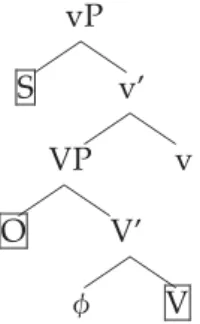
Consider axiom (1b). I propose that CHLcreates the base vP, which is the identity element under the Merge operation.9
The base vP has the c‐command relation S≫O≫V. The base vP is formed with the least effort, that is, only an external merge (the simplest possible structure‐building operation) builds it. Every sentence structure starts with the base vP.
Why is this structure the base?10
First, it is the most cost‐effective structure: the base vP is built by external merges only. If the cost is zero, the base vP corresponds to the identity (do‐nothing) operation, which is the most cost‐ef-fective transformation. It is like the identity operation +0 under addition, which does not affect a number (for example, 3 + 0 = 3). Second, it is the most fun-damental structure: every sentence structure contains the base vP at its deep-est structure. Third, it gives us semantic universality: the base vP is the mini-mal domain where the V s inherent semantic information is assigned to O and S, and this holds universally. Fourth, there is V s affinity for O: universally, V has an affinity for O rather than S.11Thus, C
HLdisallows other possibilities. Let us demonstrate how the base vP is constructed. Given that each set
includes the empty set by definition and that a syntactic object is a set, each syntactic object includes the empty set φ . V externally merges with φ .12V and O merge, and V assigns Patient θ (a semantic role) to O.13
The light verb v merges with VP. The v merges with S and v assigns Agent θ to S. Thus, the base vP is the most inexpensive base for building the structure of {S, O, V} because it is formed by external merges only, given the Merge‐over‐Move hypothesis, and so every sentence starts with the base vP. Every final struc-ture contains the base vP as a subset, and the base vP does not affect the usable c‐command relations in the final structure. As noted above, the base vP is like the identity element 0 in addition. Probe uninterpretable feature in v agrees with the goal interpretable feature in O, the relevant structural fea-ture is valuated and deleted (Chomsky 2000).14
The structural Case variable is deleted within the CHLlanguage system because such a variable is unknown to the performance systems (the sensorimotor system and the thought sys-tem).15
The base vP is the most economical structure that satisfies the Linear Correspondence Axiom (LCA; originally proposed by Kayne 1994). LCA is a principle at the sound interface that maps two‐dimensional structures to one‐ dimensional linear orders. A structurally higher term should be pronounced earlier. Assum the following definition of LCA (Uriagereka 2012: 56).16
(3) LCA : When x asymmetrically c‐commands y, x precedes y.
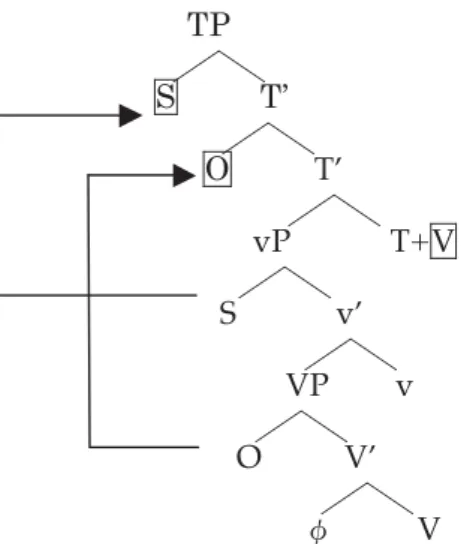
The base vP does not influence later structures. Suppose we arrived at V》S》O as the final structure. LCA sees only the boxed terms in Figure 4 (T = Tense).
Figure 4 : V》S》O
Spell‐out sends the final CP structure to the PF (semantic interface), and LCA maps this structure to the linear order <VSO> or [VSO]. Although the final CP structure contains the base vP whose syntactic relation is S》O》V, the final structure is not affected by the base vP (recall that the base vP is like the identity element 0 for addition). The CHLsyntactic relation thus obeys ax-iom (1b).
Consider axiom (1c). Suppose that we reached the structure shown in Figure 4. The inverse of V》S》O corresponds to movements of O and S, where O moves to the lower edge of TP and S to the higher edge, thus yield-ing the c‐command relation of the base vP, that is, S》O》V, as in Figure 5.
Figure 5 : Application of the Inverse Operation to V》S》O
Produces the Identity Relation S》O》V
A set of internal merges can transform any relation, V》S》O in this case, to the identity relation S》O》V. This relation‐changing operation, V》S》O → S》O》V, is the inverse element. The CHL syntactic transformation thus has an inverse element and obeys axiom (1c).
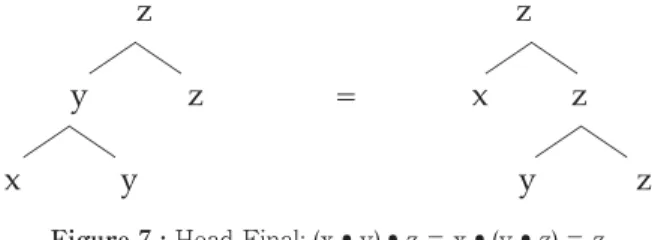
Consider axiom (1d). Let us assume that a set‐merge structure {α, β} is asymmetrical in that either α or β projects. Suppose that α and β merge and α projects, forming α. Does the following equation hold in CHL?
(4) (x9y)9z = x9(y9z)
On the left side of the equation, in the first step, x and y merge and form x (x projects). In the second step, x and z merge and form x (x projects). On the right side of the equation, in the first step, y and z merge and form y (y
Figure 6 : Head Initial: (x • y) • z = x • (y • z) = x
Figure 7 : Head Final: (x9y)9z = x9(y9z) = z
jects). In the second step, x and y merge and form x (x projects). The equation holds. The following trees show the associativity.
The final output is the same: x is the maximal dominator.
Suppose next that α and β merge and β projects, forming β. Does the equation hold? On the left side of the equation, in the first step, x and y merge and form y (y projects). In the second step, y and z merge and form z (z pro-jects). On the right side of the equation, in the first step, y and z merge and form z (z projects). In the second step, x and z merge and form z (z projects). The equation holds. The following trees show the associativity.
The final output is the same: z is the maximal dominator. Therefore, the CHL syntactic relation obeys the associative law in axom (1d).17
The CHLsyntactic relation constitutes a group G under Merge.18
Figure 8 : Identity Element I = <SOV> 2. Transformational Cost as Geometrical Cost
2.1. Equilateral Triangle and Basic Word Order Asymmetry
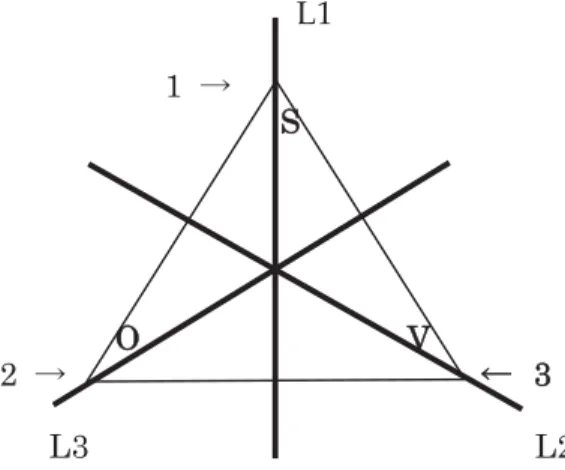
In Arikawa (2012b), I argued that the symmetry structure of an equilateral triangle, expressing the group‐theoretical structure of cubic equation, ac-counts for the asymmetry of basic word orders. I used an equilateral triangle that is the Identity Element (the basic word order <SOV>) as in the following.
The six symmetrical transformations are as follows.
(5) a. r0 = 0°= I (do‐nothing rotation) b. r1 = 120°(counterclock) rotation c. r2 = 240°rotation
d. f1 = Flip around axis L 1 e. f2 = Flip around axis L 2 f. f3 = Flip around axis L 3
Transformation Cost Input Output Ratio r0 0 <SOV> <SOV> 48.5% r1 2 <SOV> <VSO> 9.2% r2 4 <SOV> <OVS> 0.7% f1 1 <SOV> <SVO> 38.7% f2 3 <SOV> <OSV> 0.5% f3 3 <SOV> <VOS> 2.4%
Table 1 : Transformations and Costs for {S, O, V}
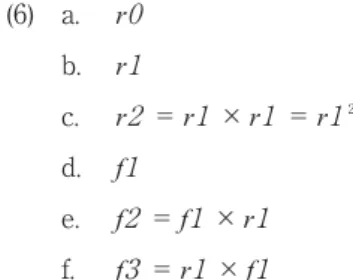
The six operations are expressed by r0 , r1 , and f1 . These three operations are atoms of transformation in that they are more basic (Armstrong 1988).
(6) a. r0 b. r1 c. r2 = r1 r1 = r12 d. f1 e. f2 = f1 r1 f. f3 = r1 f1
The following table summarizes the transformations and costs.
I assume the ratio observed in Yamamoto (2002), which considers the largest number (2,932) of languages for typological analysis to date (gross ≒ 6000). The Galois theory and the Economy Principle can explain the current ratio of languages with the top three unmarked word orders:
(7) a. r0 (cost 0) produces <SOV> with a ratio of 48.5%. b. f1 (cost 1) produces <SVO> with a ratio of 38.7%. c. r1 (cost 2) produces <VSO> with a ratio of 9.2%.
r0 f1
r0 r0 f1
f1 f1 r0
Table 2 : Multiplication Table for r0 and f1: Closed
Although the geometrical cost approach fails to predict the internal ranking among f2 , f3 , and r2 , it does predict their relatively low probability:
(8) a. f2 (cost 3) produces <OSV> with a ratio of 0.5%. b. f3 (cost 3) produces <VOS> with a ratio of 2.4%. c. r2 (cost 4) produces <OVS> with a ratio of 0.7%.
The geometrical cost approach accounts for the fact that CHLshows the follow-ing asymmetry with respect to basic word order frequency.
(9) SOV > SVO > VSO > VOS > OVS >? OSV
2.2. CHLSelects Cheaper Subgroups
The steps in the top two transformations, unlike the other four, constitute a subgroup of G. Let us consider the multiplication table that consists of the single steps r0 and f1 . The intersection of each column and row expresses the multiplication operation for that column and row.
The table entries are r0 and f1 . By axiom (1a) of the definition of groups, {r0 , f1 } is closed. It constitutes a subgroup of G. Incidentally, {r0, f2 } and {r0 , f3 } are also closed and constitute a subgroup of G. The cyclic permutations (rotations), namely r0 , r1 , and r2 , are closed and constitute a subgroup of G. On the other
r1 r2 f2 f3
r1 r2 r0 f1 f2
r2 r0 r1 f3 f1
f2 f3 f1 r0 r1
f3 f1 f2 r2 r0
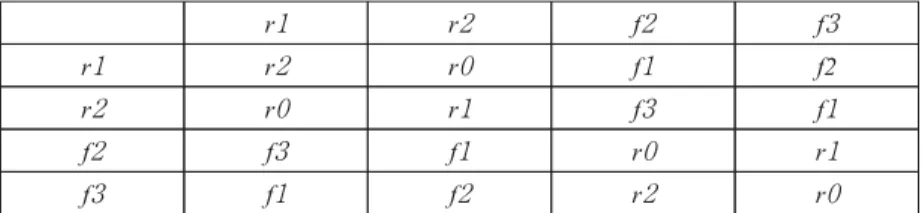
Table 3 : Multiplication Table for r1, r2, f2, and f3: Not Closed
hand, the set of noncyclic permutations {f1 , f2 , f3 } is not closed and does not constitute a subgroup of G (Stewart 2007: 112). CHLseems to employ a subgroup that consists of the cheapest costs among both rotations and of flips, avoiding exclusive use of either type of transformation. Consider the multiplication ta-ble that consists of the steps in r1 (= r1 ), r2 (= r1 r1 ), f2 (= f1 r1 ), and f3 (= r1 f1 ):
The table entries include other operations, namely r1 , r2 , f2, and f3 . Accord-ing to axiom (1a) of the definition of G, the set {r1 , r2, f2 , f3 } is not closed under the multiplication operation and therefore does not consitute a sub-group of G. I believe it is significant that the transformational steps involved in the two basic word orders with relatively high probabilities, <SOV> and <SVO>, constitute a subgroup of G, while those involved in producing remain-ing word orders, which have relatively low probabilities, do not. The set {r0 , r1 , r2 , f1 , f2 , f3 } has six subgroups: {r0 , r1 , r2 , f1 , f2 , f3 }, {r0 , r1 , r2 }, {r0 , f1 }, {r0 , f2 }, {r0 , f3 }, {r0 } (Stewart 2007: 112‐113). CHLselects the two cheap-est subgroups, {r0 } and {r0 , f1 }, which produces <SOV> and <SVO> as the two most common basic word orders.
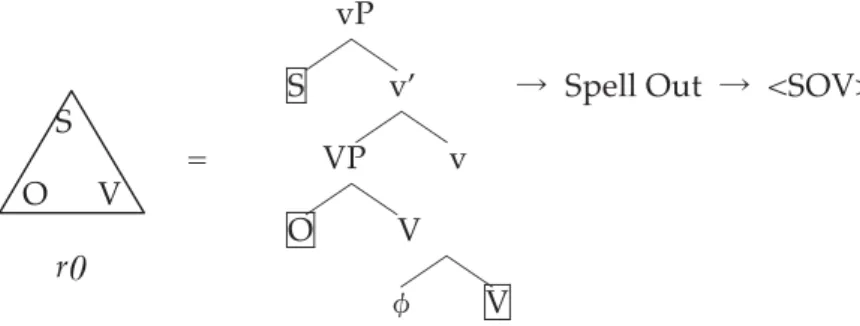
Figure 9 : Spell‐Out Structure Corresponding r0 and <SOV> 2.3. Geometrical Transformation Corresponds To Syntactic Transformation
The geometrical cost of a syntactic structure corresponds to the transforma-tional cost. The spell‐out structure of <SOV> is the identity vP. LCA demands that the boxed terms be pronounced. The identity vP corresponds to Θ‐Do-main (Thematic relation) proposed in Grohmann (2000: 55; 2011: 274‐275).
Only external merges are involved in forming the base vP, and its structure building is the most cost‐effective. This is the reason why CHLdemonstrates that <SOV> has the highest probability (48.5%) of the six possible unmarked word orders. The base vP is the domain in which v initiates n‐agreement (Elouazizi and Wiltschko 2006). The spell‐out transfers the base vP structure to the semantic interface, where LCA computes it as <SOV>. Let us next consider the spell‐out structure of <SVO>, namely, TP. The TP corresponds to Φ‐Domain (Agreement properties) proposed in Grohmann (2000: 55; 2011: 274‐275).
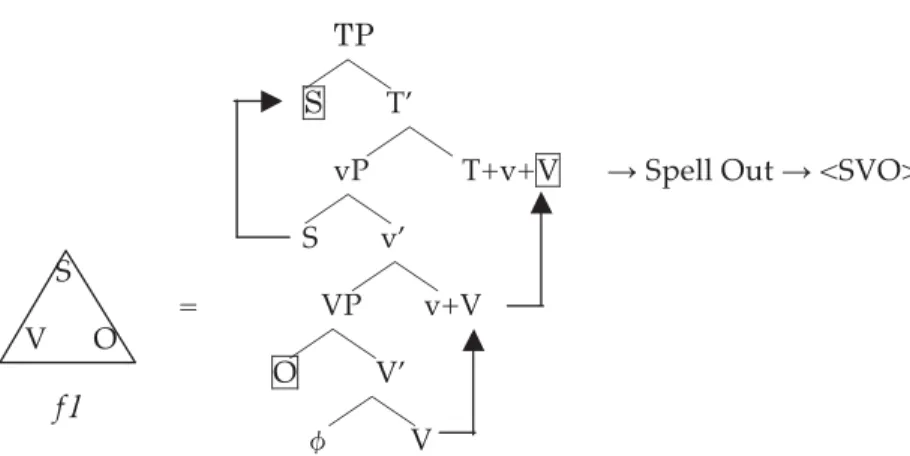
Figure 10 : Spell‐Out Structure Corresponding to f1 and <SVO>
The new head T merges with vP, and the heads and the subject undergo movement (internal merge).19
Since internal merge = external merge + copy + remerge and there are three internal merges, this structure is more costly to build than the base vP. This is the reason why <SVO> has a lower prob-ability (38.7%). TP is the domain in which T initiates what Elouazizi and Wilt-schko call Φ‐agreement. Let us consider the spell‐out structure of <VSO>, namely CP. The CP corresponds to Ω‐Domain (Discourse information) pro-posed in Grohmann (2000: 55; 2011: 274‐275).
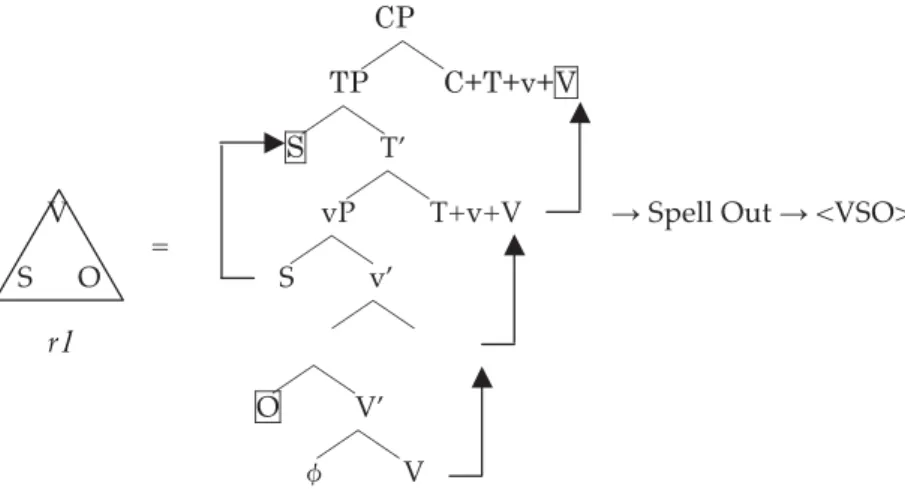
Figure 11 : Spell‐Out Structure Corresponding to r 1 and <VSO>
C merges with TP, and V moves to C. Building the structure for such a CP requires more energy. The CP structure is the third most cost‐effective, and this is the reason why the unmarked <VSO> order has a probability of 9.2%. CP is the domain in which C initiates what Elouazizi and Wiltschko call D‐ agreement. In modern standard Arabic (<VSO>), for example, D‐agreement occurs only when V moves to C (Elouazizi and Wiltschko: 156).
I propose that MLCA applies to the base vP and derives <VOS> in lan-guages such as Malagasy (Austronesian family). In Malagasy, MLCA applies to phrases and LCA applies to heads. If this approach is on the right track, we have a partial explanation of why CHLproduces the unmarked word order asymmetry. Table 4 summarizes the four major word orders.
Ordering principle Input structure Output order Geometrical transformation Cost Probability
Type 1 LCA Base vP <SOV> r0 0 48.5%
Type 2 LCA TP (S+V mmt) <SVO> f1 1 38.7%
Type 3 LCA CP (S+V mmt) <VSO> r1 2 9.2%
Type 4 MLCA Base vP <VOS> f3 3 2.4%
Table 4 : Deriving the Major Unmarked Word Orders
Why is MLCA so costly when it applies to the base vP in Type 4? Note that MLCA generally applies to heads, but in Type 4, it applies to a phrase. This unusual application of MLCA to a phrase may be responsible for the relative low probability.20
A mathematical fact is that the six symmetric transformations of an equi-lateral triangle with the three vertexes {a, b, c} express the six permutations of the three roots {a, b, c} of a cubic equation. A linguistic fact is that the cost difference in the syntatic tree formation with three terms {S, O, V} matches the probability difference in the unmarked word orders of {S, O, V}. CHLmust be solving a cubic equation with the roots {S, O, V}. Appendix provides a baby algebra of {S, O, V}. Let us summarize the discussion up to this point.
(10) a. The CHLsyntactic relations constitute a group.
b. The cost hierarchy among the six geometrical operations that corre-spond to the six unmarked word orders in CHLis:
r0 < f1 < r1 < f2 = f3 < r2 ,
where r0 produces <SOV>, f1 <SVO>, r1 <VSO>, f2 <OSV>, f3 <VOS>, and r2 <OVS>. The geometrical cost approach predicts the current percentages of languages. The top three word orders: <SOV> (48.5%), <SVO> (38.7%), and <VSO> (9.2%).
c. Although this approach fails to predict the internal relative ranking of the lower three basic word orders, it nevertheless predicts a divi-sion between the higher three orders (<SOV>, <SVO>, and <VSO>) and the lower three orders (<VOS>, <OSV>, and <OVS>). d. The fourth major unmarked word order <VOS> (2.4%) can be derived
by applying MLCA to the base vP. LCA applies to it generally. e. The steps in the transformations corresponding to the top two
un-marked orders, that is, the operation r0 (I ) that produces <SOV> and the operation f1 (OV) that produces <SVO>, are closed and con-stitute a subgroup of G. The transformation for the remaining four orders are not closed and do not constitute a subgroup of G. f. The sound interface of CHLemploys LCA and MLCA for phrases and
heads. LCA and MLCA eliminates all technologies related to head movement, simplifying the model of structure‐order mapping.
3. Scrambling and the Conservation Law
The conservation law answers question about asymmetry of operations.
(11) Conservation law The gross cost is fixed.
Suppose that the maximum cost for CHLcomputation is 1. <SVO> languages have an overt (phonetically realized, hence costly) agreement morphology. <SOV> has cost 0 for deriving the basic order, whereas <SVO> has cost 0.5 for the same purpose and 0.5 for pronouncing agreement. If the gross cost is 1, more energy is left for other work (scrambling) in <SOV> languages, whereas no energy is left in <SVO> languages. A language such as Hindi shows a
<SOV> SOV/SVO Mixed23 <SVO> SVO/ VSO Mixed <VSO> Main: SOV Sub: SVO Main: SVO Sub: SOV Language family (selected) Afro-Asiatic, Altaic, Chibchan, Dravidian, Indo-Aryan, Uto-Aztecan Indo-Aryan Indo-European Arawakan, Anstrone-sian, Indo-Enropean, Niger-Congo, Sinae Anstrone-sian, Indo-Enropean, Semitic, Totozoque-An Austrone-sian, Celtic, Oto-Manguean, Niger-Congo, Semitic Examples (selected)24 Amharic, Korean, Bengali, Hopi, Quechua, Tamil Hindi Dutch, German English, Indone-sian, Mandarin, Swahili, Wayuu Batak (karo), Modern Greek, Syrian Arabic, Topehua Modern Standard Arabic, So, Tagalog, Welsh25, Zapotec C o s t Basic order 0 About 1/3 or less About 1/3 or more About 0.5 About 0.5 or more About 1 Overt agreement
About 0 About 1/3 About 1/3 About 0.5 About 0.5 or less About 0 Scrambl-ing About 1 About 1/3 or more About 1/3 or less
About 0 About 0 About 0
Gross 1 1 1 1 1 1
Table 5 : Cost of {Basic Order, Agreement, Scramblability},
and the Conservation Law
mixed order: head‐final <SOV> for the main clause and head‐initial <SVO> for the subordinate clause.21Duch and German demonstrate the opposite: the main clause shows <SVO>, and the subordinate clause shows <SOV>. It is reported that <VSO> languages have relatively rigid word order. A hypotheti-cal cost hypotheti-calculation is shown in Table 5.22
The gross cost is the same in all languages. CHL has to manage on the same cost. <SOV> shows relatively higher symmetry of derived orders (scrambling) because CHLcan use (and uses) more energy in scrambling. On the other hand, <SVO> and <VSO> show relatively lower symmetry of derived orders (per-mutation is more restricted) because CHLneeds more energy in producing the unmarked orders and not much energy is left for scrambling. CHLobeys the conservation law. The unmarked word order, the overtness of agreement, and the possibility of scrambling interact. They are epiphenomena resulting from the dynamic cost equilibrium of CHL.
4. DP‐Internal Order and Geometrical Cost
How does the geometrical‐cost approach explain the word‐order asymmetry within nominal expressions? Extending Greenberg (1963, 1966), Cinque (2005: 319‐320) reports the four major orders of the four elements in DP as follows:
(12) Top four word orders in DP
a. <Dem, Num, A, N> (Very many)26 b. <N, A, Num, Dem> (Very many)27 c. <Dem, Num, N, A> (Many)28 d. <Dem, N, A, Num> (Many)29
I propose that CHLselects these four patterns from the 24 (4 ! ) possible patterns simply because they are cheaper. Cinque assumes that order (12a) is the struc-ture that is produced only by external merges and that the other three orders are derived from the movement of the terms in (12a). Assuming that external merge is cheaper than internal merge, (12a) is the most cost‐effective order:
Figure 12 : Base DP: Nominal Structure by External Merge Only
Figure 13 : Mapping Between Tetrahedral Vertexes and Linear Order Following Cinque, I propose that the above structure is the identity element I , which is realized with the minimum cost 0. Let us consider this structure to be the base DP. The base DP for a nominal expression corresponds to the base vP for a verbal expression. LCA produces <Dem, Num, A, N>.30
A syn-tactic structure of four terms corresponds to the geometrical image of a regu-lar tetrahedron. The linear order of the four terms corresponds to the follow-ing vertexes in their relative positions. Dotted lines indicate see‐through edges.31
A regular tetrahedron has 24 isometries, forming the symmetry group Td, which is isomorphic to S4. Three kinds of symmetry axis exist. The first kind is rotational axis L, which goes through a vertex, perpendicular to the
Figure 14 : Rotation around Axis L
site plane. Rotations of 0°,120°,and 240°around L preserve the symmetry. Four Ls exist.
The second kind is another rotational axis M, which penetrates through the tetrahedron between the middle point mp of an edge and the mp of the edge on the opposite side. Rotations by 0°and 180°around M preserve the symme-try. Three Ms exist. An origami tetrahedron is necessary at this point.
Figure 15 : Rotation around Axis M
Figure 16 : Reflections in R
The third kind is reflectional axis R (mirror), which is perpendicular to an edge. Reflections in the plane R replace two positions in the base, which is an equi-lateral triangle. Three Rs exist.
Let us assume that LCA computes the base‐DP tetrahedron as
Figure 17 : Base‐DP Tetrahedron
Figure 18 : Simplified Structure for Base‐DP Tetrahedron
<Dem, Num, A, N>. The base DP, which involves no internal movement, is the most cost‐effective base (with a cost of 0). The base DP geometrically corresponds to a regular tetrahedron as follows. In the base DP, the vertex (top) Dem protrudes over the base equilateral triangle with the apexes Num (front), A (left), and N (right).
Let us simplify the base‐DP tetrahedron as follows:
Let us consider the 24 isometries. First, consider rotations around L1 , which goes through the Dem vertex of the base DP. L1 is the default axis. Start from the base DP, which involves a 0°rotation around L1 . Keeping Dem at the top, we have three isometries: 0°,120°,and 240°rotations around L1 . In Figure 19‐23, the frequency expressions and the letters inside the brackets [ ]
! " #
Figure 19 : Rotations of Base DP around L1
$ % &
Figure 20 : Rotations of Base DP around M
spond to those in the table in Cinque (2005: 319‐320). The structures in the boxes are the attested four major DP‐internal unmarked word orders.
The isometry ① (the most cost‐effective) corresponds to the base DP, which is built by external merges only. Let us next consider the rotations around M. There are three isometries. We begin with M1 . (The term mp (x, y) de-notes the midpoint between x and y.
Why does CHLselect the axis M3 ? What is the difference between M1 , M2 , and M3 ? M1 is obtained by bending L1 45°toward Num, M2 by bending L1 45°toward A, and M3 by bending L1 45°toward N . Since the base DP is fun-damentally a nominal (N ), I propose that M3 , which bends L1 45°toward
' ( )
Figure 21 : Applying R to Base DP
N , is the default M axis (the most cost‐effective M axis). That is, CHLshows the affinity of M3 for N , which is the fundamental lexical property of the base DP. This is the reason why ⑥ is selected over ④ and ⑤. I propose that ⑥ <N, A, Num, Dem> is derived from applying MLCA to the base DP structure. Therefore, both LCA and MLCA apply to the base DP. If LCA applies to ①, <Dem, Num, A, N> arises. If MLCA applies to ①, <N, A, Num, Dem> arises. These word orders are the most cost‐effective because the linearing corre-spondence principle applies to the most cost‐effective structure. The DP struc-ture has both the phrasal property and the head property. (Recall that the probability that MLCA applies to the base vP is very small (2.4%)). Howsoever small, the fact that the unmarked word order <VOS> emerges (the ranking is fourth) indicates that S and Owith V being a head universallyhave a strong head property in the languages that have this unmarked order.35
Let us now consider reflections, start from the base DP.
The reflections' and ( are more cost‐effective than " and # because the former replace just two positions in the base equilateral triangle, whereas the latter replace all three positions. Why does CHLchoose reflection axes R1 and R2 , but not R3 ? What is the difference between R1 and R2 , on the one hand, and R3 , on the other? I propose that CHLchooses a reflection R that is perpen-dicular to an edge whose end points constitute a natural class. That is, {A, N}
* + ,
- . /
Figure 22 : L1 (120°) M and L1 (240°) M
(both have the semantic feature lexical ) and {Num, N} (both are connected to the structural feature [number] ∈Φ ) constitute natural classes, whereas {Num, A} (Φ and lexical ) does not. Therefore, CHLselects R1 and R2 . CHLallows A and N to interchange and allows Num and N to interchange, but it does not allow Num and A to interchange. It is more cost‐effective to select two switching elements within the same natural class, rather than selecting two elements from two distinct classes. Therefore, R1 and R2 are more cost‐ef-fective axes.
So far, we have considered a simple application of transformations. It is significant that the four major DP‐internal unmarked word orders appear in the subgroup of simple applications of the entire group G. Simple applications are more cost‐effective, and CHLtherefore chooses them. Let us next consider multiple applications of transformations. Multiple applications of non‐zero transformations are more costly. CHLavoids them as much as possible. When " and # are followed by an application of M , we have the following results.
0 1 2
3 4 5
6 7 8
Figure 23 : R M
When simple Rs (', (, and )) are followed by an application of M, we have the following results.
It is significant that the four major DP‐internal unmarked word orders corre-spond to the more cost‐effective symmetric transformations of a regular tet-rahedron with a simple application and the default axes of symmetry. I distin-guish necessary (loose and broad) and sufficient (strict and narrow) conditions for the optimal selection of DP‐internal word order in CHLas follows:43
(13) Necessary condition for optimal DP‐internal word order CHLmust choose a single operation.
(14) Sufficient condition for optimal DP‐internal word order CHLmust choose a cost‐effective axis.
The necessary condition comes from the Galois‐theory (mathematics) taking cost into account. Within 24 possible DP‐internal linear orders, the observed top four come from zero or one, rather than two, applications of an operation and this teaches us something. The sufficient condition comes from linguistic facts that are governed by the Economy Principle (physics). CHLselects more cost‐effective axes that are compatible with linguistic facts: the most funda-mental nucleus of DP is N , and {A, N } and {Num, N } form natural classes, while {Num, A} does not. Table 6 contains the summary. Assume the cost difference as follows. I = L1 (0°) has cost 0, M3 cost 1, and R1 /R2 cost 2. As stated above, these operations involve more cost‐effective axes of symmetry. Less cost‐ef-fective axes, L1 (120°), L1 (240°), M1 , M2 , and R3 have cost 3. Assume addi-tion for cost accumulaaddi-tion.
Transformation Cost Principle Input Output Probability ! I = L1(0°) 0 LCA Base DP <Dem, Num, A, N> Very many & M3 1 MLCA Base DP <N, A, Num, Dem> Very many
' R1 2 LCA?MLCA? Base DP <Dem, Num, N, A> Many
( R2 2 LCA?MLCA? Base DP <Dem, N, A, Num> Many
- L1(240°) M1 6 LCA?MLCA? Base DP <Num, N, A, Dem> Few
2 R1 M3 3 LCA?MLCA? Base DP <N, A, Dem, Num> Few
8 R3 M3 4 LCA?MLCA? Base DP <N, Num, A, Dem> Few " L1(120°) 3 LCA?MLCA? Base DP <Dem, N, Num, A> Very few # L1(240°) 3 LCA?MLCA? Base DP <Dem, A, N, Num> Very few % M2 3 LCA?MLCA? Base DP <A, N, Dem, Num> Very few , L1(120°) M3 6 LCA?MLCA? Base DP <N, Dem, A, Num> Very few 1 R1 M2 5 LCA?MLCA? Base DP <A, N, Num, Dem> Very few 3 R2 M1 5 LCA?MLCA? Base DP <Num, A, N, Dem> Very few 5 R2 M3 3 LCA?MLCA? Base DP <N, Dem, Num, A> Very few
$ M1 3 Base DP <Num, Dem, N, A> None
) R3 3 Base DP <Dem, A, Num, N> None
* L1(120°) M1 6 Base DP <Num, A, Dem, N> None
+ L1(120°) M2 6 Base DP <A, Num, N, Dem> None
. L1(240°) M2 6 Base DP <A, Dem, Num, N> None
/ L1(240°) M3 4 Base DP <N, Num, Dem, A> None
⑯ R1 M1 5 Base DP <Num, Dem, A, N> None
4 R2 M2 5 Base DP <A, Num, Dem, N> None
6 R3 M1 6 Base DP <Num, N, Dem, A> None
7 R3 M2 6 Base DP <A, Dem, N, Num> None
Table 6 : Transformations and Costs for DP‐Internal Word Order
The four major unmarked DP‐internal word order have cost 2 or lower. There is a tendency that simple operations show higher probability. The ten minori-ties (few and very few) have the average cost of 4.1 (41 10), whereas the un-attested ten permutations (none) have the average cost of 5.0 (50 10). Hence,
the distinction between possible and impossible permutations has mathemati-cal ground. A question remains: Does CHLemploy LCA, MLCA, or both?44
5. Conclusion
Unlike Charles Robert Darwin (a British naturalist and biologist; 1809‐1882), Alfred Russel Wallace (a British naturalist, explorer, geographer, anthropolo-gist and bioloanthropolo-gist; 1823‐1913), the coauthor of the evolutionary theory of natu-ral selection, was puzzled: The gigantic development of the mathematical capacity is wholly unexplained by the theory of natural selection, and must be due to some altogether distinct cause, if only because it remained unused.45 Capitalizing on the idea of Leopold Kronecker (a German mathematician; 1823‐ 1891), who said that God (the human DNA, environment and the 3rd
factor pro-ducing CHL) made integers; all else is the work of man (Die ganzen Zahlen hat der liebe Gott gemacht, alles andere ist Menschenwerk), Chomsky states that the theory of natural numbers may have derived from a successor function aris-ing from Merge and that speculations about the origin of the mathematical capacity as an abstraction from linguistic operations are not unfamiliar.46 Chomsky (2007: 7) proposed the following hypothesis:
(15) Mathematical capacity is derived from language.
If so, Wallace s puzzle is partially answered: Some altogether distinct cause is an operation in CHL. I speculate the following hypothesis.
(16) Equations and sentences share an elementary algebraic structure.
If this is true, we can study CHLwith Galois‐theoretic tools.47As a Galois group
characterizes the algebraic (or symmetric) structure of an equation, it can also characterize the algebraic (or symmetric) structure of a sentence.
Appendix: Unmarked Word Order as a Galois Group for the Language Equation? A Speculative Introduction to the Elementary (High‐School Level) Algebra of the Human Language Equation A Toy (Baby) Model
A.1. Human Language Equation?
The algebraic structure of an equation E is equivalent to the Galois group Gg
that consists of the roots:
(1) E ⇔ Gg .
A radical conjecture follows: A sentence is an expression of a human language equation EHLthat CHLsolves (Jenkins 2000: 164, 2003), and the algebraic struc-ture of EHLis equivalent to the Galois group GgHL(of unmarked word orders in CHL):
(2) EHL⇔ GgHL.
A.2. Sentence as an Equation?
When CHLcomputes a sentence with S , O , and V , it solves a cubic equation that has three solutions: s, o, and!.The word order patterns are the permu-tation patterns Gg
HLof the roots. A simple transitive sentence must, therefore, have an algebraic structure similar to the following cubic equation:48
(3) ax3 + bx2
+ cx + d = 0.
If factorization is possible, that is, if EHLis reducible and the reducibility var-ies according to the field used for factorization, we have
(4) (x−s) (x−o) (x−v) = 0.
Because
(5) x−s = 0, x−o = 0, x−v = 0,
we have three solutions, s, o, and v:
(6) x = s, o, v.
Let us imagine that these are rational numbers, that is, the relevant field con-sists of rational numbers (putting aside a possible puzzle about what this means).49
Expanding the factored cubic equation, we get
(7) (x−s) (x−o) (x−v) = (x2 −(s + o) x + so) (x−v) = x2 (x−v)−(s + o) x (x−v) + so (x−v) = x3 −vx2 −(s + o) x2 −(s + o) x (−v) + sox−sov = x3 −(s + o + v) x2 + (so + ov + vs) x−sov = 0.
The coefficients and constant consist of elementary symmetric polynomials with s, o, and!:
(8) a. Second order coefficient:−(s + o + v) = b b. First order coefficient: (so + ov + vs) = c c. Constant:−sov.
Then, the equation in (3) with the roots {s, o, v} is equivalent to:
(9) ax3 + bx2 + cx + d = (x−s) (x−o) (x−v) = x3 −(s + o + v) x2 + (so + ov + vs) x−sov = 0.
This equation indicates the relationship between the solutions and coefficients. The Gg
of an equation is a permutation set of solutions that satisfies the follow-ing conditions (Nakamura 2010: 91) :
(10) Definition of the Galois group Ggof an equation a. Gg
is closed under the multiplication of permutations, and
b. For any rational expression R (with rational coefficients) formed by the solutions, the following holds: the value of R remains the same under all permutations of solutions in Gg
⇔ the value of R is a rational number.50
Condition (10b) maintains that to determine all Rs that have rational values, all one needs to know is the Gg
of the equation (ibid.: 91). What is the Gg of an equation in (11) ?
(11) (x−s) (x−o) (x−v) = 0
Elementary algebra tells us the following. Because the value of R is a rational
number, Gg
must preserve the same value. In fact, there are Rs whose values remain the same. Such Rs consist of a single root. Assume that there are no multiple roots: that is, s≠o≠v.
(12) R 1 = s, R 2 = o, R 3 = v
By definition, Gg
should not change the value of R. Thus, Gg
should be I alone, in which s changes to s, o changes to o, and!changes to !, i.e., everything remains the same. The other five permutations in which <sov> is altered to <svo>, <osv>, <ovs>, <vso>, or <vos> change the values. If EHLwere of this type, CHL would produce <SOV> only, which is diachronically correct. The ancient CHLmay have been solving an EHLthat is similar to this equation, in which factorization is possible (reducible), given the rational number field. However, synchronically, this result contradicts the facts about CHL. The cur-rent CHLdoes not solve this type of equation.51It follows that the present CHL is solving an EHLthat is not reducible if the field consists of rational numbers.52 However, what are (s + o +!), (so + o!+ !s) and (so!)? What do these elementary symmetric polynomials mean for CHL?53A polynomial is symmet-ric when a permutation does not affect it. Let us stipulate that the cubic EHL in (9) has an algebraic structure Gg= <so!> with the field of rational numbers. If CHLis solving this equation, it should produce <SOV> as the sole possible unmarked word order. This was true for the ancient CHLbut not for the cur-rent CHL, which solves an EHLwith the Ggthat includes all six permutations as unmarked word orders.54
Let us ask another fundamental question before tackling these questions. What is solving an equation? Solving an equation is the following (Ueno 2011: 50). One starts from symmetric polynomials that consist of coefficients and constant as (s + o +!), (so + o!+ !s) and (so!). These polynomials are
metric in that any permutation does not alter the formulae and the values. One breaks the symmetry little by little.55Finally, the symmetry completely breaks and one obtains the roots, s, o, and!,which are completely asymmet-rical; one cannot permute the roots because any permuation will change the values (and the formulae, that is, the roots themselves). This was the starting point of Joseph‐Louis Lagrange (a French mathematician, physicist and as-tronomer born in Italy; 1736‐1813) when he took a crucial step forward in solv-ing a conundrum as to why equations of the 5th
degree or more resist solutions by a formula. That is, given the general form of f (x) = xn
+ an−1xn−1+ a0= 0, a formula is a radical expression that is built up from the coefficient ajby the four basic operations of arithmetic (addition, subtraction, multiplication, division) and nth roots, n = 2, 3, 4, (Stewart 2004: 86). A metaphor of Rubik s Cube works.56
A Rubik s Cube with completely random colors (symmetrical state) paralles symmetric polynomials as (s + o +!), (so + o!+ !s) and (so!): any permutation will cause the cube to look like the same as before. In this case, we have an equation of the 6th
degree. One breaks the symmetry little by little.57
When one obtains consistent colors for each of the 6 planes of the cube, the symmetry is completely broken. That is to say, the consistent‐col-ored 6 planes are the 6 roots of the sextic equation. A random‐colconsistent‐col-ored cube is a sextic equation (input) and the final consistent‐colored 6 planes express the six roots (output).58
On the other hand, we have the opposite situation in solving EHL. We know the roots (output) s, o, and!at the biginning, and are looking for the cubic equation (input). This is an ill‐posed (inverse) problem: output is given, but input is unknown.59
I hypothesize that EHLshares essentially the same algebraic property as a mathematical equation E. The problem re-garding EHLis just ill‐posed.60
More specifically, we could say that CHL(both ancient and current; at its final state) of native speakers of <SOV>‐type languages solves the following
cubic equation, as in (9), which I repeat. (9) ax3 + bx2 + cx + d = (x−s) (x−o) (x−v) = x3 −(s + o + v) x2 + (so + ov + vs) x−sov = 0.
We know that the Galois group Ggof this equation is <so!> only. In a sense, the coefficients and constant as symmetric polynomials express the scram-bling property (higher level of symmetry) of <SOV>‐type languages.61
It is worth noting that the number of argument (the minimum informa-tion that is necessary for the event denoted by the predicate to hold) is at most 3, namely, the subject (s), the indirect object (io), and the direct object (do). If we include the verb!in the equation, CHL is solving equations of the 2nd, 3rd
, or 4th
degree. There is no equation of the 5th
degree or more for CHL. This is reminiscent of a methematical fact that there is no formula for equations of 5th
degree or more, the explanation of which Galois finalized about 200 years ago.62
A.3. Is EHLLinear (1stDegree Polynomial)?
Suppose that EHLhas an algebraic structure similar to that of a linear equation such as
(13) x−s = 0.
Then, the only root is s:
(14) x = s.
64
Elementary algebra indicates the following. To permute s, one must permute it by itself (I ). The Gg
HLof EHLmust consist of I alone and CHLwould produce only <S>. However, this contradicts the facts about CHLas would an algebraic structure based on other linear equations such as x−o = 0 and x−!= 0. There is no natural human language with an unmarked word order such as <S> alone, <O> alone, or <V> alone.63
Therefore, EHLcannot be a linear equation.
A.4. Is EHLQuadratic (2ndDegree Polynomial)?
A.4.1 If s and!are in QQ…
Suppose that the algebraic structure of EHLwith the roots {s,!} is similar to that of the following quadratic equation:
(15) x2
+ 3 x−4 = 0.
Given the set of two solutions {a, b} , the Gg
of (15) would consist of the iden-tity permutation I alone.65
Elementary algebra indicates the following. Suppose that the permutation K = (s!) were in the relevant Gg
HL.66If we perform K on (s−!), (s−!) changes to (!−s) =−(s−!). That is, K changes the value of R. Therefore, Gg
HL must not contain K . On the other hand, I does not change the value of R = (s−!). If the structure of EHLwere similar to this type of quad-ratic equation, Gg
HLwith the two solutions {s,!} would contain I alone. If we start from the base VP in which S c‐commands V and stipulate that the base VP is the identity element, it would follow that CHLexhibits only <SV>, since I changes <SV> to <SV>. This conclusion is not empirically correct, however. When V is intransitive, the present CHLshows both unmarked orders.67
(16) a. <SV> (79.7%) An example: English The child ran.
b. <VS> (13.0%) An example: Tagalog Tumakbo ang bata. ran ANG child
The child ran.
The present CHL does not solve a quadratic equation in which factorization is possible and the roots are like rational numbers. There is a remaining puz-zle that why do <SV> languages outnumber <VS> languages? It might be economical to apply LCA, rather than MLCA, to the base VP, as we saw in the case of the base vP for {S, O, V}.
A.4.2 If s and!are not in QQ…
Suppose that EHLhas an algebraic structure similar to the following quadratic equation:
(17) x2
+ 3 x + 1 = 0.
Factorization is not possible. The roots are irrational numbers. Given the two solutions {a, b} , the Gg
is <ab> and <ba>.68
Elementary algebra indicates the following. Because we have two roots, s and!,there are two possible candi-dates for Gg
HL: I and K = (s!). Suppose that GgHLcontained I and K . Would Gg
HLsatisfy condition (10a) (that is, would GgHLclosed under the multiplication −58−
operation)? As
(18) I K = K , K I = K , K K = I , I I = I ,
Gg
HLwould be closed under multiplication. Would GgHLsatisfy condition (10b) ? An example of R is the difference product Δ = (s−!). Given that D = Δ2
and D = 5, we have
(19) Δ = (s−!) = !5 .
However, the positive and negative square roots of 5 are not rational numbers. If we are in the rational number field, the value of R = Δ does not exist in this field.69
Therefore, Gg
HLwould contain a permutation that changes the value of R = Δ. If Gg
HLcontained only I , GgHLwould not change the value of Δ. GgHL must contain a permutation other than I; that is, Gg
HLmust additionally contain K . With K , R = Δ = + (s−!) changes to R = Δ = (!−s) =−(s−!). The plus sign of R = Δ has changed to a minus sign. By I , R = Δ = + (s−!) remains the same. If Gg
HLcontained I and K , GgHLwould contain <s!> and <!s>. This is empirically true, as we saw in (16). Hence, the present CHLsolves a quadratic equation that has the same type of algebraic structure as (17) with two irra-tional number roots.
A.5. Is EHLCubic (3rdDegree Polynomial)?
A.5.1 If s, o, and!are in QQ…
Suppose that CHLis solving an EHLwith a structure that is similar to the follow-ing equation:
(20) x3 −x = 0. By factorization, (21) x3 −x = x (x2 −1) = x (x−1) (x + 1) = 0.
This is not a genuine cubic equation because it consists of first degree parts. The calculation cost must be cheap. The three roots are three distinct rational numbers:
(22) x = 0, 1,−1.
Elementary algebra tells us the following. Let the three roots be s, o, and!. Thus,
(23) x = 0 (= s), 1 (= o), −1 (= v).
Consider the following difference product Δ as an example of R:
(24) R = (s−o) (s−!) (o−!) = −1 · 1 · 2 =−2. Provided that the value of R is a rational number, Gg
HLmust exclude the per-mutation that changes the value of R. Thus, Gg
HL contains I . What about f1 = (o!), which exchanges o and !? f1 transforms R as follows:
(25) f1 : (s−o) (s−!) (o−!) → (s−!) (s−o) (!−o) = 1 · −1 · −2 = 2. f1 changes the value of R. Gg
HLdoes not contain f1 . What about r1 = (s!o), −60−
which changes s to!,!to o, and o to s? r1 transforms R as follows: (26) r1 : (s−o) (s−!) (o−!) → (!−s) (!−o) (s−o) = −1·−2·−1 =−2. r1 does not change the value of R. Gg
HLmight contain r1 . However, we must consider all possible Rs. If there is an R whose value is altered by r1 , then Gg
HLdoes not contain r1 . In fact, r1 alters the values of the following Rs:
(27) s = 0, o = 1,!=−1. Therefore, Gg
HLdoes not contain r1 . Only I preserves symmetry (the values remain the same). If CHLwere solving this type of a cubic equation, it would produce only <SOV> languages. This might be true diachronically, but not synchronically. The ancient CHL might have been solving a cubic equation where factorization is possible and the roots are like rational numbers.
A.5.2 If s is in QQ, and {o,!} are not in QQ…
Suppose that CHLis solving an EHLwith a structure that is similar to that of the following equation:
(28) x3 + 3 x2 + x = 0. By factorization, we obtain (29) x (x2 + 3 x + 1) = 0.
The three roots are one rational number and two irrational numbers:
(30) x = 0, −3 +!52 , −3−!5 .2
The calculated cost of (28) must be higher than that of (20). Given the three roots {a, b, c}, where a = 0, the Gg
of (28) contains the identity permutation I and the permutation (bc), which switches the two irrational roots, b and c.70 Elementary algebra tells us the following. Let us stipulate that the three roots are s, o, and!:
(31) s = 0, o = −3 +!5
2 , != −3−!5 .2
Since s is rational, the Gg
HL contains the identity operation I (= r0 ) and f1 = (o!), which switches o and !. I produces Δ as follows:
(32) Δ = (s−o) (s−!) (o−!) = R. f1 produces Δ as follows:
(33) Δ = (s−!) (s−o) (!−o) =−(s−o) (s−!) (o−!) =−R.
I and f1 produce difference products that have distinct values (the plus sym-bol in +R changes to a minus in −R). The Δs being irrational numbers, Gg
HL contains a permutation that changes the value of R.71
Therefore, the Gg HLmust contain f1 . I corresponds to LCA mapping the c‐command relation S》O》V to the linear order <SOV> (48.5% of languages), and f1 corresponds to LCA mapping S》V》O to <SVO> (38.7% of languages). The present CHL is very close to solving this type of cubic equation.72
A.5.3 If EHLwere a Genuine Cubic Equation with the Three Roots
not in QQ…
Suppose that CHLis similar to the following:
(34) x3
−3 x + 1 = 0.
As this is a real cubic equation, factorization is not possible. The calculation cost must be the highest. Elementary algebra tells us the following. Let us postulate that the three roots are s, o, and!. The difference product Δ is (35) Δ = (s−o) (s−!) (o−!).
Given a cubic equation in the more general form: x3
+ px + q = 0, the coeffi-cients are p =−3 and q = 1. The formula yields Δ = 9.73
The values of Δ are rational numbers. By (10b), Gg
HLmust not change the value of Δ. Among the six permutations, three flips, namely f1 = (o!), f2 = (so), and f3 = (s!), change the value of Δ. Therefore, Gg
HLexcludes f1 , f2 , and f3 .74This leaves us with I , r1 = (s!o), and r2 = (so!). I, r1 , and r2 are recurring permutations (rotations) in which all three members are affected. Calculating, we see that I , r1 , and r2 do not change the value of R.75
Therefore, Gg
HLcontains these rotations. However, we do not yet know whether all or only some of them constitute Gg
HL. Let us use one root, s, as one of the simplest possible examples of R. We consider the fact that the value of s is an irrational number. Gg
HL must contain a permutation that changes the value of s. First, consider I . By applying I to s, the value of R remains the same (s). By applying r1 = (s!o) to s, the value of R changes from s to!.By applying r2 = (s!o) to s, the value of R changes from s to o. Therefore, Gg
HLcontains r1 and r2 . Provided that −63−
Gg
HLis closed under multiplication, GgHLmust contain I as well because r12= r2 and r13= I and hence, the G
HLshould select <SOV>, <VSO>, and <OVS> as the major unmarked word orders. However, this contradicts the facts about CHL. Therefore, the present CHLdoes not solve a real cubic equation, which resists factorization and has three irrational number roots.
A.5.4 If EHLis a Cubic Equation with Ggthat Includes All Six Permutations …
The Gg
of the following equation includes all six permutations (Lieber 1932, Nakamura 2011) : (36) x3 −2 = 0. The Gg corresponding to (36) is as follows:76 (37) Gg
= {<SOV>, <SVO>, <VSO>, <VOS>, <OVS>, <OSV>}
This Gg
is the maximum of all Gg
s of cubic equaitons. Given that the present CHLpermits all six unmarked word orders, the present CHLis solving an EHL of this type. The initial state of the current CHLsolves an EHLthat is similar to (36). When the parameter setting takes place under the <SOV> environ-ment, the final state of CHLwould be specialized to solve an EHLthat is similar to (20), x3
−x = 0, for which the Ggincludes only <so!>. However, a puzzle then remains as to why <SOV> and <SVO> emerge in almost the same per-centage of languages and make up more than 80% of all the six possible un-marked word orders.
A.6. Summary
Let us summarize the typology of the possible algebraic structures (Gg ) of EHL. I include a possible EHLfor DP‐internal word order (Section 4). Notes for abbreviations in the table are as follows. The identity operationI : Do nothing to <a>, <ab>, <abc>, <abcd >, <s>, <o>, <!>, <s!> (the base VP), <so!> (the base vP), and <Dem, Num, A, N> (the base DP) = <abcd >, where a = Dem, b = Num, c = A, d = N. #: order of equation. CHL1: Ancient CHL, CHL2: Current CHL. *: unattested,!: attested. Rational field: a field that consists of rational numbers; real field: a field that consists of real numbers.
Mathematical Algebraic Structure Linguistic Algebraic Structure # E Reduction Root Gg E HL Reduction Root GgHL CHL1 CHL2 1 xp=0 p <p> xs=0 s <s> * * xo=0 o <o> * * xv=0 ! <v> * * 2 x2+ 3 x + 1 =0 a b <ab> <ba> rational field x2+px+q= 0 s ! <sv> <vs> rational field ? ! <ab> real field <sv> real field ? * x2+ 3 x 4 =0 (x+4)(x1) =0 a=4 b=1 <ab> x2(s+v)x +sv=0 (xs)(xv) =0 s ! <sv> ? * 3 x3x=0 x(x1)(x+ 1)=0 a=0 b=1 c=1 <abc> x3(o+v) x2+ovx=0 x(xo)(x v)=0 s=0 o ! <sov> ! * x3+3 x2+x =0 x(x2+3 x+ 1)=0 a=0 b c <abc> <acb> x3+px2+qx =0 x(x2+px+ q)=0 s=0 o ! <sov> <svo> * ! 86% ? x3 3 x + 1 =0 a b c <abc> <cab> <bca> x3+px+q= 0 s o ! <sov> <vso> <ovs> * * x32=0 a b c <abc> <acb> <cab> <cba> <bca> <bac> x3+p=0 s o ! <sov> <svo> <vso> <vos> <ovs> <osv> * ! 4 x44 x25 =0 (x2+1)(x2 5)=0 a=i b=i c=!5 d=!5 <abcd> <bacd> <abdc> <badc> x4+ px2+ q =0 (x2+r)(x2+t) =0 a b c d <abcd> <bacd> <abdc> <badc> ? * ? a b c d <abcd> <dcba> <abdc> <adcb> ? a b c d <abcd> <dcba> <abdc> <adcb> ? !
Table 1 : Typology of E and EHL
The (x3 + 3 x2
+ x = 0)‐as‐similar‐to‐EHLhypothesis can explain the fundamen-tal asymmetry of unmarked word orders (<SOV> (an average of about 45%) and <SVO> (an average of about 37%) ), whereas it fails to explain all six per-mutations are available for CHL. On the other hand, the (x3−2 = 0)‐as‐similar‐ to‐EHLhypothesis can explain the fact that all six permutations are available for CHL, whereas it fails to explain the fundamental asymmetry. The current CHL must be solving EHL that is similar both to (x3 + 3 x2 + x = 0) and to (x3
−2 = 0). What is it? Appendix is summarized as follows.
(38) a. Unlike the current CHL, the ancient CHLmight have been solving an EHLsuch as (x−s) (x−o) (x−!) = x3−(s + o +!) x2+ (so + o!+ !s) x−so!= 0 (in which factorization is possible and the roots are ra-tional), which produces <so!> only.
b. EHLcannot be a linear equation.
c. The present CHLdoes not solve a quadratic equation in which factori-zation is possible and the roots are rational numbers.
d. The present CHLsolves a quadratic equation in which factorization is impossible and the roots are irrational numbers.
e. The present CHLuses the real number field for s and!,whereas ra-tional number field for o and!.This is the reason why <SV> (79.7%) outnumbers <VS> (13%), while the ratios for <OV> (46.9%) and <VO> (46.4%) are almost the same.
f. Unlike the current CHL, the ancient CHL might have been solving a cubic equation where factorization is possible and the roots are ra-tional numbers.
g. The present CHLis close to solving a cubic equation that consists of linear and quadratic equations (factorization is impossible and there are two irrational roots). The Gg
HLof such an EHL includes I and f1 −67−
= (!o), which explains the facts that 48.5% of languages are <SOV> and 38.7% of languages are <SVO>.
h. The factorized EHL structure consisting of simple and quadratic parts expresses the algebraic structure of the base vP: EHL = [vPx [VP(x2+ px + q) ] = 0. The vP edge (the rational root) constitutes s, and the quadratic equation part of the VP (the two irrational roots) constitutes!and o.
i. The present CHLdoes not solve a real cubic equation that resists fac-torization and has three irrational number roots.
j. The initial state of the current CHL solves an EHL that is similar to x3
−2 = 0, whose Gg
includes all six permutations. If the parameter setting occurs under an <SOV> environment, the final state of CHL would be specialized to solve an EHLthat is similar to x3−x = 0, for which the Gg
includes only <SOV>. However, the puzzle then remains as to why <SOV> and <SVO> emerge in almost the same percent-age of langupercent-ages and make up more than 80% of all the six possible unmarked word orders.
References
Arikawa, Koji. 2011. Flexible Command: A Solution to the Symmetry Problem of Adjunction, Scrambling, and Dislocation. Human Sciences Review 40: 65‐ 200. Osaka: St. Andrew s University.
Arikawa, Koji. 2012a. Some Problems of the Island Explanation Based on the Minimize Chain Link Principle (Shortest Movement Condition) and the Uniformity Corollary on Adjunction. Human Sciences Review 42. Osaka: St. Andrew s University.
Arikawa, Koji. 2012b. Does Word Order Asymmetry Have Mathematical
Grounds? ms. St. Andrew s University.
Armstrong, Mark A. 1988. Groups and Symmetry. New York: Springer‐Verlag. Barrie, Michael, J. M. 2006. Dynamic Antisymmetry and the Syntax of Noun
Incorporation. University of Toronto dissertation.
Boeckx, Cedric. 2009. The Nature of Merge: Consequences for Language, Mind, and Biology. In Piattelli‐Palmarini, M., Pello Salaburu, and Juan Uriagereka (eds.) Of Minds and Language: A Dialogue with Noam Chomsky in the Basque Country. 44‐57. Oxford University Press.
Boeckx, C., J. D. Fodor, L. Gleitman, & L. Rizzi. 2009. Round Table: Language Universals: Yesterday, Today, and Tomorrow. In Piattelli‐Palmarini, M., Pello Salaburu, and Juan Uriagereka (eds.) Of Minds and Language: A Dia logue with Noam Chomsky in the Basque Country. 195‐222. Oxford University Press.
Butterworth, Brian. 2000. The Mathematical Brain. London: Macmillan. Chomsky, Noam. 1965. Aspects of the Theory of Syntax. Cambridge, Mass: MIT
Press.
Chomsky, Noam. 1995. The Minimalist Program. Cambridge, MA: MIT Press. Chomsky, Noam. 2000. Minimalist Inquiries: The Framework. In Roger
Mar-tin, David Michaels & Juan Uriagereka (eds.) Step by Step−Essays on Mini malist Syntax in Honor of Howard Lasnik, 89‐155. Cambridge, MA: MIT Press.
Chomsky, Noam. 2005. Three Factors in Language Design. Linguistic Inquiry 36: 1‐22.
Chomsky, Noam. 2007. Approaching UG from Below. In Uli Sauerland and Hans‐Martin Gärtner (eds.) Interfaces + Recursion = Language? 1‐29. Ber-lin and New York: Mouton de Gruyter.
Chomsky, Noam. 2009. Opening Remarks. In Massimo Piattelli‐Palmarini, Juan Uriagereka, and Pello Salaburu (eds.) Of Minds & Language: A Dialogue
with Noam Chomsky in the Basque Country. Oxford University Press. Chomsky, Noam. 2010. Some Simple Evo‐Devo Theses: How True Might They
Be For Language? In R. K. Larson, V. Déprez, and H. Yamakido (eds.) The Evolution of Human Language: Biolinguistic Perspectives. 45‐62. Cam-bridge: Cambridge University Press.
Chomsky, Noam & James McGilvray. 2012. The Science of Language: Interviews with James McGilvray. Cambridge University Press.
Cinque, Guglielmo. 2005. Deriving Greenberg s Universal20and its Exceptions. Linguistic Inquiry 36: 315‐332.
Dryer, Matthew S. & Haspelmath Martin (eds.). 2011. The World Atlas of Language Structures Online. Munich: Max Planck Digital Library. http://wals.info/ (8 October 2011).
Elouazizi, Noureddine & Martina Wiltschko. 2006. The Categorical Status of (Anti‐) (Anti‐) Agreement. In Donald Baumer, David Montero & Michael Scanlon (eds.), Proceedings of the 25 th West Coast Conference on Formal Lin guistics: 150‐158. Somerville, MA: Cascadilla Proceedings Project. Fukui, Naoki & Yuji Takano. 1998. Symmetry in Syntax: Merge and Demerge.
Journal of East Asian Linguistics 7: 27‐86.
Gell‐Mann, Murray & Merritt Ruhlen. 2011. The Origin and Evolution of Word Order. Proceedings of the National Academy of Sciences of the United States of America, 108 (42) : 17290‐17295.
Greenberg, Joseph. 1963. Some Universals of Grammar with Particular Refer-ence to the Order of Meaningful Elements. In Joseph Greenberg (ed.) Uni versals of Language, 73‐113. Cambridge, Mass.: MIT Press.
Greenberg, Joseph. 1966. Some Universals of Grammar with Particular Refer-ence to the Order of Meaningful Elements. In Joseph Greenberg (ed.) Uni versals of Language, 2 nd edition. 73‐113. Cambridge, Mass. : MIT Press. Grohmann, Kleanthes, K. 2000. Prolific Peripheries: A Radical View from the
Left. Ph.D. thesis, University of Maryland, College Park.
Grohmann, Kleanthes, K. 2011. Anti‐Locality: Too‐Close Relations in Grammar. In Cedric Boeckx (ed.) The Oxford Handbook of Linguistic Minimalism, 260‐ 290. Oxford University Press.
Jenkins, Lyle. 2000. Biolinguistics: Exploring the Biology of Language. Cambridge, UK: Cambridge University Press.
Jenkins, Lyle. 2003. Language and Group Theory. A lecture for a graduate‐ school class on biolingusitics by Piattelli‐Palmarini Massimo at MIT. Jurka, Johannes. 2010. The Importance of Being a Complement: CED Effect
Revisited. University of Maryland dissertation.
Kayne, Richard S. 1994. The Antisymmetry of Syntax. Cambridge, MA: MIT Press. Kamei, Takashi, Rokuro Kono & Eiichi Chino (eds. ). 1989. Sanseido’s Linguistic
Encyclopedia, Vol. 2. Tokyo: Sanseido.
Kim, Jung Myeong. 2011. 13‐Sai‐no Musume‐ni Kataru Garoa‐no Suugaku [Galois Mathemetics that I Teach to My 13‐Year‐Old Daughter]. Tokyo: Iwanami Syoten.
Larson, Richard. 1988. On the Double Object Construction. Linguistic Inquiry 19: 335‐91.
Lebeaux, David. 1988. Language Acquisition and the Form of the Grammar. Amherst, MA: University of Massachusetts dissertation.
Lieber, Lillian R. 1932. Galois and the Theory of Groups: A Bright Star in Mathe sis. New York: The Galois Institute of Mathematics and Art.
Longa, Víctor, M., Guillermo Lorenzo, and Juan Uriagereka. 2011. Minimizing Language Evolution: The Minimalist Program and the Evolutionary Shaping of Language. 595‐616. In Cedric Boeckx (ed.) The Oxford Handbook of Linguistic Minimalism. Oxford University Press.
Nakamura, Akira. 2010. Garoa no Riron: Hooteeshiki wa Naze Tokenakattanoka Galois Theory: Why the Equation Could Not Be Solved. Tokyo:
sya.
Pereltsvaig, Asya. 2011. Was Proto‐Human an SOV Language?. Language of the World.
http://languagesoftheworld.info/historical‐linguistics/was‐proto‐human‐ an‐sov‐language. html (25 February 2012)
Richards, Norvin. 1997. What Moves Where When in Which Language? Cambridge, MA: MIT dissertation.
Rizzi, Luigi. 1990. Relativized minimality. Cambridge, MA: MIT Press. Ross, John Robert. 1967. Constraint on Variables in Syntax. Massachusetts
In-stitute of Technology dissertation. [Published in 1986 as Infinite Syntax! . Norwood, NJ: ABLEX.]
Stewart, Ian. 1975. Concepts of Modern Mathematics. New York: Dover Publica-tions.
Stewart, Ian. 2004. Galois Theory 3rd edition. Chapman & Hall/CRC.
Stewart, Ian. 2007. Why Beauty is Truth: The Story of Symmetry. New York: Ba-sic Books.
Strang, Gilbert. 2003. Introduction to Linear Algebra. Wellesley, MA: Wellesley‐ Cambridge Press.
Suzuki, Wataru. 2002. Gengo Ruikee‐no Junkan‐teki Kaisoosee [The Cyclic Hierarchy of Language Types]. Journal of Nagoya Women’s University (Hu manities and Social Science) 48: 249‐262. Nagoya.
Ueno, Kenji. 2011. Garoa‐no Kangaeta Koto [Things that Galois Thought]. Gendai Shisoo (revue de la pensée d’aujourd’hui) Vol. 39‐5, 38‐58). Tokyo: Seedosya.
Uriagereka, Juan. 2012. Spell‐Out and the Minimalist Program. New York: Ox-ford University Press.
Wallace, Alfred Russel. 1889. Darwinism. London: Macmillan.
Yamamoto, Hideki. 2002. Sekai Shogengo no Gojun Ruikee Kenkyuu niokeru
Syomondai: Chiriteki, Keetooteki Gojun Bunpu nitaisuru Kenkyuu Josetsu‘Issues in Word Order Typology on the World s Languages: An Introduction to the Study of Areal and Genealogical Distribution of Word Order. Studies in the Humanities, Cultural Sciences, 7: 79‐101. Aomori, Japan: Hirosaki Uni-versity.
Yang, Charles, D. 2002. Knowledge and Learning in Natural Language. Oxford University Press.
Yuki, Hiroshi. 2012. Suugaku Gaaru−Garoa Riron [Mathematics Girl−Galois Theory]. Tokyo: Softbank Creative.
Notes
I would like to thank Makoto Toma (mathematics, St. Andrew s University) for his valuable comments and suggestions. Without his constructive criticism regarding my amateurish mathematics, I could not have realized this article. Further, I thank Piattelli‐Palmarini Massimo (physics and biology of language, University of Arizona) for allowing me to join his class on biolinguistics at MIT in 2003, which marked the beginning of this project. I would also like to thank Lyle Jenkins (Biolinguistics Institute, Boston, USA) for the insightful lecture on human language and Galois theory in Mas-simo s class and for taking the time to listen to my idea in an on‐campus café. I submit-ted a paper on relasubmit-ted topics to Biolinguistics in November 2011, and after one revision and a year‐long reviewing process, the paper was finally rejected (as of October 31, 2012). I would like to thank the editor Kleanthes K. Grohmann and the two anonymous reviewers (a computer scientist and a group theorist) for their constructive criticism and suggestions. I am grateful to Lyle who still encourages me to continue this project. All remaining errors are my own.
1 I thank an anonymous reviewer (a group theorist) who expressed concern that my approach may be too simple, immature, groundless, and without promise, and that my research has a long way to go even if it should turn out to be tenable. The reviewer pointed out several fatal faults. First, S3 and S4are too simple to
say anything about general patterns. Second, since one can superficially analyze any permutation phenomenon by means of the group theory, there is no substance to the argument that CHLworks group theoretically. The reviewer advised me
to write this speculative paper without claiming to present any scientific findings, at least raise a set of good questions. I hope that this version manages to do that. Given this honest criticism by a pure mathematician, as a biolinguist and a mathe-matical amateur, I might be offering a groundless metaphor even from the view-point of applied mathematics.
2 Merge has at least four characteristics: binarity, asymmetric labeling, structural preservation ( extension and no‐tampering conditions), unboundedness, and flexi-bility (long‐distance dependency) (Longa et al. 2011: 599). I propose that G axioms derive these properties. The closure axiom derives the unboundedness. Suppose that terms are like NN(natural numbers) and merge is like addition. Addition is closed over NN, which is discrete and infinite. Merge is closed over terms, which