Emotion as “Deeper” Than Cognition :
Theoretical Underpinnings and
Multidisciplinary Lignes de Faits to the
Emotion-Involved Processing Hypothesis (EIPH)
journal or
publication title
Journal of international studies
volume
9
number
1
page range
185-206
year
2020-03-30
Theoretical Underpinnings and Multidisciplinary Lignes de
Faits to the EmotionInvolved Processing Hypothesis (EIPH)
Yu KANAZAWA*
認知より「深い」ものとしての情動:
情動関与処理仮説(EIPH)の理論的基盤と学際的事実の線
金澤 佑
Abstract :
The present paper is an original attempt to unbury philosophical and multidisciplinary lignes
de faits (lines of facts ; Bergson, 1919/1920) that are rarely taken into account in Second Lan
guage Acquisition (SLA) to shed new light on the significance of emotion in cognition. In Sec tion 1, the parsimonious classification of cognition is introduced and the significant characteris tics of cognition are summarized in the form of Axioms of Levels of Cognition (LoC). In Sec tion 2, an influential levels of processing (LoP) memory model (Craik & Lockhart, 1972) is in troduced as a consequence of LoC, followed by an explanation of criticisms against LoC and psychological models proposed as antitheses of LoP (viz., TAP & TOPRA). It is argued that de spite the fact that these models against LoP are persuasive and common, they have a critical problem in disregarding deep philosophical values. The following three sections (Section 3, 4, 5) are the affirmative philosophical and multidisciplinary review rebuttals in favor of the LoP against its counterarguments. In the final section (Section 6), the Emotion-Involved Processing
Hypothesis, which not only sophisticates the original LoP but also incorporates significant in
sights of the philosophy of emotion, is proposed as the new alternative theory.
要旨:本論は、心理学的・学際的な事実の線を辿って認知における情動の重要性について の新たな洞察に至る試みである。第一節では認知の分類について考察し、認知処理公理が 導き出される。第二節では認知処理公理の帰結としての処理水準モデルが紹介されるとと もに、処理水準モデルを批判する心理学的諸見地が検討される。それらの批判的モデルは 広く受け入れられているものの、処理水準モデルが有する深い洞察が見過ごされている点 で問題があることを指摘する。続いて、第三節では心理言語学的モデル、第四節では情動 的デザインと直観、第五節では「深さ」の理論的洗練の諸観点から、反処理水準的見地が 反駁される。最後に、第六節で、元の処理水準モデルの知見を取り入れたうえで情動をめ ぐる哲学的な深い洞察を組み込んだモデルとして、情動関与処理仮説が提起される。
Key words : Levels of Cognition, Depth of Processing, EmotionInvolved Processing
──────────────────────────────────────────── *Assistant Professor, School of International Studies, Kwansai Gakuin University
1. Introduction
Contrary to the traditional dichotomous view to regard emotion and cognition as natural an tagonists, their interconnectedness is now accepted widely (Swain, 2013). Accordingly, even in sec ond language acquisition (SLA), a research field which is becoming more and more important in the modern global society, not only cognition but also emotion has become a hot topic to investigate (e. g., Dewaele, 2011). Although SLA researchers have frequently derived theories and perspectives from psychology, it is rare for them to delve deeper to examine and investigate fundamental theo ries, which can be derived from philosophy. The present paper is an original attempt to unbury philosophical and multidisciplinary lignes de faits (lines of facts ; Bergson, 1919/1920) that are rarely taken into account in SLA to shed new light on the significance of emotion.
2. Axioms of Levels of Cognition
Cognition is a pluralistic term which lacks a disciplinefixing definition in spite of its highly frequent use (Allen, 2017). As Charles Sanders Peirce notes, cognition is the most confused of the Kantian three mental faculties consisting of cognition, emotion, and will (Peirce, 18871888/1931 a, para. 1.381). Cognition includes a wide range of mental phenomena differing in quality and function such as learning, acquisition, memory, inference, and synthesis (Peirce, 18871888/1931 a, para. 1.376), whereas emotion includes feeling, sensation and mood no matter they are subconscious (e.g., gut feelings) or intense (e.g., euphoria) ; deviated from the homeostasis (e.g., feeling disgust) or not (e.g., feeling familiar). Likewise, the term “cognitive processing” is vague and ambiguous even though the dichotomy of cognitive processing and emotional processing has been widely adopted (e. g., LeDoux, 1993). In this section, the idea of cognition is operationally disentangled and a parsimo nious subdivision is introduced.
Arthur Schopenhauer provides a helpful insight toward the parsimonious classification of cogni tion. According to him, the concept and perception are different cognitive faculties. The former be longs to human alone while the latter are also to be attributed to all the lower animals (Schopen hauer, 1819/1909, p.44). These two types of cognition, however, are neither independent of each other nor symmetrically influencing each other. Instead, there is an implicational dependency be tween the two.1) “As from the direct light of the sun to the borrowed light of the moon, we pass from the immediate idea of perception, which stands by itself and is its own warrant, to reflection, to the abstract, discursive concepts of the reason, which obtain their whole content from knowledge of perception, and in relation to it” (ibid., p.45). In other words, concepts emerge only after percep tion has provided enough ingredients for it. “Reason . . . can only give after it has received. . . . concepts in general only exist after experience of ideas of perception, and as their whole nature con sists in their relation to these, it is clear that they presuppose them” (ibid., p.65). The lower percep tion precedes the higher concepts.2)
The directional implicational relation of different levels of cognition is modeled in the stateof
────────────────────────────────────────────
1)Here, the term implicational is not to be confused with implicative ; the former denoting the logical relation of “if p then q (p → q)” whereas the latter denoting that something is suggested or inferred.
2)The philosophical perception/cognition divide (Kriegel, 2019) corresponds to perception/concepts distinction in the pre sent discussion.
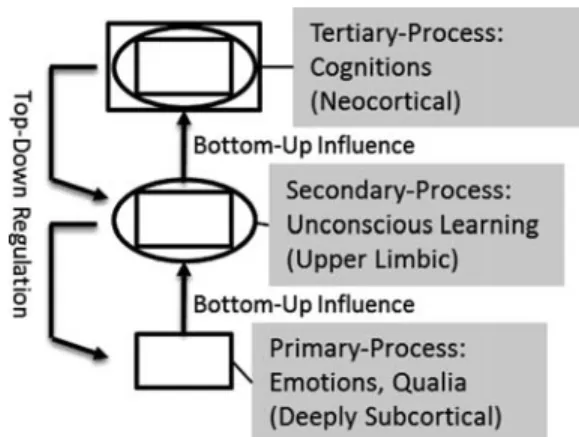
theart theory in affective neuroscience (Panksepp, 2015 a ; 2015 b ; Figure 1). According to this model, the brainmind relation is continuous, hierarchical, and nested, reflecting evolutionary trajec tories. The operation of higher cognitive functions is dependent on lower brain functions with pri mary processes such as emotion and perception, which allow secondary learning processes to engen der higher cognition at the top tertiaryprocesses level, forming a bidirectional circular system (cf. Panksepp, 2015 a, pp.3336 ; 2015 b, pp.231237).
Metaphorically speaking, in the vast ocean of cognition, you have to swim through the shallow level surface of perception in order to reach the deep level realm of concepts and reason. There are different degrees of depth in cognition ; from the shallow level of perception to the deep level of concepts and intelligence. This view is hereinafter referred to as the Levels of Cognition (LoC) view. The LoC view discussed so far can be axiomatized as follows (Table 1).
Perception and higher cognition can be analyzed separately for the sake of analysis by intelli gence (LoC Axiom A). However, they are not so much separate entities independent of each other as synechistic continuity (LoC Axiom B).3) As Henri Bergson declares, “we must bring back again,
────────────────────────────────────────────
3)Synechism is a Percean doctrine that “all that exists is continuous” (Peirce, 1897/1931 b, para. 1.172). Nonetheless, ↗
Figure 1 The nested brain-mind hierarchical system consisting of bottom-up (nested) and top-down (circular) causation of evolutionary continuum is depicted. It was made by the author based on Panksepp (2015 b, p.231) with modifications and elimination of unrelated labels.
Table 1 Axioms of the Levels of Cognition View
Axioms Description
LoC Axiom A. (multileveledness)
Shallow/perceptual cognition and deep/conceptual cognition are functionally dif ferent and epistemologically separable from each other.
LoC Axiom B. (nested synechism)
Shallow/perceptual cognition and deep/conceptual cognition are essentially con tinuous and ontologically inseparable from each other.
LoC Axiom C
(bidirectional implicationality)
Shallow/perceptual cognition precedes deep/conceptual cognition for afferent processing (e.g., memory encoding ; input processing ; bottomup processing) and vice versa for efferent processing (e.g., memory retrieval ; output process ing ; topdown processing).
under one form or another, at one moment or another, the continuity which we have thus broken be tween the perception, the memory and the idea” (Bergson, 1896/1911 a, p.155). Their logical and biological relation is implicational and whenever the human cognition functions properly, there is an interplay between the two polarities of cognition (LoC Axiom C). Also, from the perspective of evolution, in reference to the triune brain model of phylogenesis and ontogenesis (MacLean, 1990),4) the fact that the layers of brain are functionally different and separable (LoC Axiom A) does not im ply that they are separate modules with clear boundaries. Rather, they are living parts and functional attractors in the complex dynamic systems of the organismal brain (LoC Axiom B ; cf. Barrett,
────────────────────────────────────────────
↘ synechism is more than just continuity. Synecmsm is the consequence of pragmatism (Peirce, 1906/1933, para. 4.584). Synechism is “that tendency of philosophical thought which insists upon the idea of continuity as of prime importance in philosophy and, in particular, upon the necessity of hypotheses involving true continuity” (Peirce, 1902/1934 c, para. 6.169). More importantly, “the synechist will not admit that physical and psychical phenomena are entirely distinct, ― whether as belonging to different categories of substance, or as entirely separate sides of one shield,― but will insist that all phenomena are of one character, though some are more mental and spontaneous, others more material and regular” (Peirce, 1892/1958 b), which is the basic standpoint of this paper.
4)According to the triune brain model, the limbic system, which is involved in emotional behavior and the subjective ex perience of emotion (MacLean, 1990, p.247), is layered beneath the neocortex, which is the seat of higher cognition that only humans are reported to have. Limbic system phylogenetically and ontogenetically precedes neocortex and has a strong connection to the socalled reptilian brain, which is allegedly the seat of survival mechanism and biological homeostasis control system. Recent biological findings are in accordance with the triune view ; emotion is reported to be a limbic adaptation to homeostatic demands (Rhodes & Rhodes, 2017) and ancestral emotional systems underlie hu man personality structures and intelligence (Montag & Panksepp, 2017). The triune brain model was so persuasive and intriguing that it has been cited and extended by such prominent figures as Carl Sagan (1977, pp.5758), Daniel Gole man (1995), and Atsushi Yamadori (2008). However, it is also noteworthy that positing just “three separately evolved and to some degree independently functioning cognitive systems” (Sagan, 1977, p.266) is severely criticized in the stateoftheart theories of emotion (Barrett, 2017).
Figure 2 The contribution of emotional cues in synchrony with perceptual and higher-cognitive cues is modeled. The drawing was made by the author in reference to Gentsch and Synofzik (2014, p.4) with slight modifications.
2017). Moreover, bidirectional flows of vast array of information are processed all over the brain and even beyond (LoC Axiom C ; cf. Bergson, 1896/1911 a ; Gibson, 1977). To provide an addi tional case from neuroscience, Gentsch and Synofzik (2014) modelized the integration of the affec tive dimension into the cognitivesensorimotor mechanisms in a Venn diagram, which is in accord with the LoC view (Figure 2). As these examples suggest, the LoC view is legitimate not only psy chologically but also evolutionarily.
3. Levels of Processing and its Criticisms
In the field of cognitive psychology, there is a distinguished model of memory that operational ized the LoC view for experimental studies : the Levels of Processing (LoP) model (Craik & Lock hart, 1972 ; Figure 3). Until the 1960s, there had been a prevalent psychological dogma to think of memory as a group of static storages (Atkinson & Shiffrin, 1971). The LoP proposed that memory should be viewed and investigated not as a static structure but in terms of dynamic processing, revo lutionizing the memory research paradigm (Craik, 2002, p.312).
The LoP is a model to explain high levels of retention and longterm memory traces in terms of the difference in depth of processing. As Ekuni and colleagues succinctly summarize, “in the en coding stage of a stimulus, there is a series of processing hierarchies ranging from the shallowest level (perceptual processing−the subject initially perceives the physical and sensory characteristics of the stimulus) to the deepest level (semantic processing−related to pattern recognition and extrac tion of meaning)” (Ekuni, Vaz, & Bueno, 2011, p.333). Conceptual processing, which requires deep/ semantic analysis (hereinafter referred to as deep/semantic processing), is more effective in making stronger and lasting memory traces than shallow/perceptual processing. There is a qualitative differ ence between the two modes of processing that cannot be accounted for by mere quantity of proc essing (e.g., repetition of processing and spaced learning ; cf. Pimsleur, 1967 ; Folse, 2006 ; Nakata, 2015). The difference between shallow perception and deep cognition is not merely in de gree, but is a radical difference in kind (Bergson, 1896/1911 a, p.84).
The significance of the LoP model is not restricted to cognitive psychology. It has been applied not only in educational research (e.g., Watkins, 1983) but also in second language vocabulary acqui sition (Laufer & RozovskiRoitblat, 2015).
Figure 3 The LoP model is depicted. The figure was drawn by the author based on the explanation by Craik and Lockhart (1972).
However, as is the case with any influential model, the LoP has never been free from criticism. For example, the idea of depth was criticized to be too elusive an index to test its effect rigorously (Baddeley, 1978). Also, psychological reality of each LoP was doubted ; the distinct loci for differ ent levels of processing were unclear (Treisman, 1979).5) Moreover, shallower processing enhanced by repetition was reported to be more effective in making stronger memory traces than deeper proc essing (Nelson, 1977). Such criticisms were later refuted by the proposers of LoP (Lockhart & Craik, 1990 ; Craik, 2002) except for a sharp opposing proposition (antithese) : the transfer appro priate processing (TAP ; Morris, Bransford, & Franks, 1977).
Morris and colleagues (1977) conducted experiments under the LoP experimental paradigm and found that the memory performance was higher when the TAP was ensured, that is, when the mode of retrieving a word at the test session was identical to the mode of encoding a word at the preced ing study session (Figure 4). Franks and colleagues (2000) further reported that the strongest repeti tion priming effect was detected when the TAP is ensured. Not only the mode of input processing but also the mode of retrieval was suggested to influence the memory performance.
The TAP has been applied to the theories in multilingualism and SLA. Similar phenomenon to TAP has been found in multilingual language processing (Brysbaert, Ameel, & Storms, 2014). The TAP is regarded to be a key phenomenon of second language (L2) fluency (Segalowitz, 2010, pp.62 66). Professor Norbert Schmitt argues that not only deep strategies of vocabulary learning but also shallow strategies can be effective if applied optimally (Schmitt, 2010 a, p.39). The concept of TAP has also been stretched further to the classroom instruction and is used to criticize explicit instruc tion (cf., Lightbrown, 2008 ; Ellis & Wulff, 2015, p.88).
The TAP has also been applied to the criticism of the LoP in the field of L2 lexical processing and memory (Barcroft, 2015). He declares assertively that “TAP debunked the notion that (deeper) semantically oriented processing . . . should lead to better memory across the board” (Barcroft, 2015, p.62) compared to shallower processing, protesting against the current pedagogical trend to emphasize the LoP and the effectiveness of semantic elaboration. The LoP on one hand (these) and the TAP on the other hand (antithese), he vigorously attempted his way of aufheben by proposing
────────────────────────────────────────────
5)As a matter of fact, there is no clear and distinct loci for most mental faculties unless one adopts the dubious presup position of phrenology.
Figure 4 The TAP is depicted. The figure was drawn by the author based on the expla-nation by Morris and colleagues (1977).
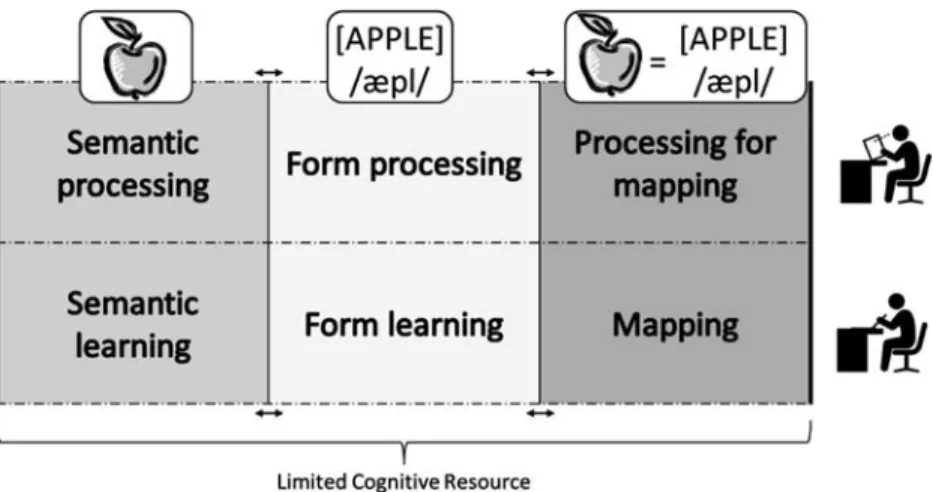
the Type of Processing−Resource Allocation (TOPRA) model (Barcroft, 2000 ; Figure 5).6) The TOPRA model inherits the basic idea of TAP that “for good applememory one should do apple processing and for good orangememory do orangeprocessing” (Lockhart & Craik, 1990, p.101). In addition, based on the theory of limited cognitive capacity, the TOPRA model postulates a tradeoff between different types of processing and learning. To cite the succinct explanation of TOPRA model by Kida (2010), “the allocation of L2 learners’ cognitive resources determines what aspect of L2 vocabulary (e.g., meaning, form, and formmeaning connection or FMC) is learned. The model also predicts that one type of processing depletes remaining resources that otherwise could be used to process other aspects of vocabulary” (p.171). Therefore, according to the TOPRA model, “in creased semantic processing can function like a double or multipleedged sword, increasing seman tically oriented learning while decreasing formoriented learning, other types of learning, or both.” (Barcroft, 2015, p.67). The TOPRA model has also been introduced in studies targeted to English as a foreign language (EFL) learners (Kida, 2010).
Having been faced with all these criticisms, has the LoP been dethroned, miserably waiting to be abandoned? Nay, it has not ; and it ought not to be. The following is the affirmative rebuttals for the LoP against the aforementioned counterarguments, aiming for the reappreciation of the LoP and for the better abduction and aufheben for the constructive integration of the LoP and the TAP TOPRA.7)
4. Argument A : Psycholinguistic Models8)
The first argument concerns the LoC Axioms (Table 3). The LoP, which is one of the conse
────────────────────────────────────────────
6)In Hegel’s dialectics, the contradiction between two opposing prepositions (these & antithese) can be integratively solved via the preserving/canceling process (aufheben) to reach a higherlevel preposition (synthese ; cf. Hegel, 1894/ 18271830).
7)As Peirce notes, abduction is anything but mere groundless intuition but it “consists in examining a mass of facts and in allowing these facts to suggest a theory” (Peirce, 1905/1958 b, para. 8.209).
8)A partial synopsis of this section in Japanese can be found in Kawasaki et al. (2018).
Figure 5 The TOPRA model is depicted. The figure was drawn by the author based on Barcroft (2015, p.63) with small modifications.
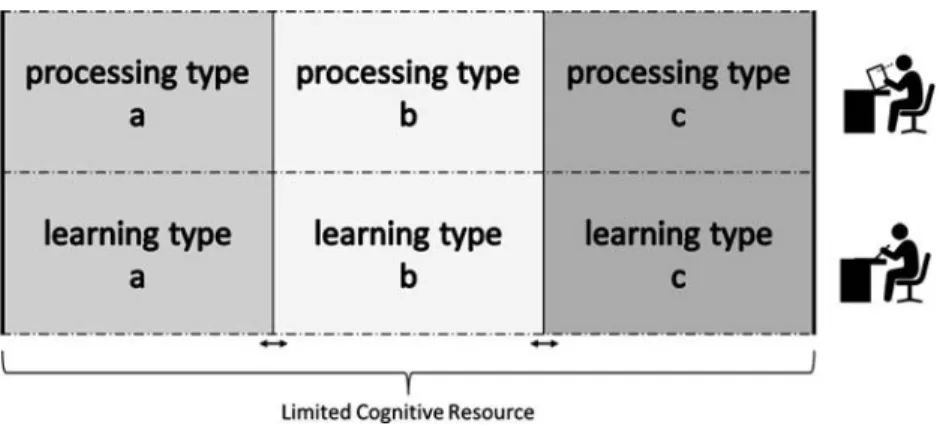
quences of of the LoC, satisfies all the Axioms A, B, and C ; whereas the TAP and the TOPRA satisfy only the Axiom A, neglecting the characteristics of cognitive processing expressed in Axiom B and C. The LoC Axiom A is easily satisfied by analyzing and classifying cognitive processing into plural parts. The LoP and the TAP posit shallow/perceptual processing and deep/semantic proc essing, which correspond to form processing and semantic processing in the TOPRA, respectively (cf. Figure 3, 4, & 5). Barcroft (2002) even provides a general model in which semantic processing/ learning, form processing/learning, and processing for mapping/mapping are replaced surprisingly simplistically as processing/learning type a, processing/learning type b, and processing/learning type c, respectively (Barcroft, 2002, p.326 ; Figure 6).
In this view, “the inside lines that separate different types of processing (processing type a, b, c, d, . . .) and their corresponding types of learning (learning type a, b, c, d, . . .) can move, increas ing and decreasing different types of processing and learning, whereas the outside lines do not move.” (Barcroft, 2002, pp.325326). Different modes of processing can simply be substituted by any processing if it occupies certain amount of cognitive resource. In this view, any processing is equally interchangeable, leaving the possible relations between each different processing unan swered. It is as if each processing was a commodity sold at a market and you could simply choose what to buy within the cognitive budget in your wallet. In a similar vein, it is as much as to say that each processing was an atomic entity separated from one another, fighting against one another for the cognitive resource. What is more, what Xprocessing facilitates is supposed to be nothing more or nothing less than Xlearning, and each processing=learning has tradeoff relations with other processing=learning. Such a view overlooks the synechistic nature of cognition (LoC Axiom B) and its implicational structure (LoC Axiom C). Whenever successful deep/semantic encoding is ac complished, shallow/perceptual encoding is accomplished milliseconds prior to it ; otherwise you would not be aware of the target of encoding from the first place.9)
Psycholinguistic models on speech production and lexical access provide further corroboration
────────────────────────────────────────────
9)It must be noted that the criticism against LoP in the TOPRA account is far from a dogma but the conclusion of well planned empirical studies. In his early experimental studies, Dr. Joe Barcroft, the propounder of the TOPRA model, himself was surprised to find that the antiLoP effect was detected when he expected the LoP effect would be (J. Bar croft, personal communication, September 13, 2016).
Figure 6 The general TOPRA model is depicted. The figure was drawn by the author based on Barcroft (2002, p.326) with small modifications.
to support the LoC Axioms (cf. Kadota, 2003 ; Pollatsek, 2012 ; Tokowicz, 2015). As for the LoC Axiom B, it has been found that there is a modalityswitch effect across perceptual processing and conceptual processing, suggesting that perceptual and conceptual representations are based on the same system (van Dantzig et al., 2008). As Tresp and Ma (2016) argue, “perception includes an ac tive semantic decoding process, which relies on latent representations of entities and predicates, and that episodic and semantic memories depend on the same decoding process” (p.1). As for the LoC Axiom C, it has been known that there are different levels (i.e., stages) of processing between the intention of output processing (e.g., speaking) and the actual utterances : the conceptual level, the lemma level, and the lexeme level ; in which lexicalsemantic representations, modalityneutral lexi cal representation, and modalityspecific lexical representations, respectively, are produced and trans ferred to the adjacent stages accordingly in a cascadic fashion (Caramazza, 1997). For cognition driven output processing, as Lev Vygotsky notes, “thought must first pass through meanings and only then through words” (Vygotsky, 1934/1986, p.252). The order of information processing flow is reversed for input processing (e.g., reading), which too can be consummated within one second (Gough, 1972). As Henri Bergson notes, “we see no harm in reversing the real order of the proc esses, and in asserting that we go from the perception to the memories and from the memories to the idea” (Bergson, 1896/1911 a, p.155) as long as the intercommunication between the mental fac ulties is asserted.
One of the most famous models embodying the LoC Axiom C is Levelt’s (1989) speech pro duction model. In the model, the deepest cognition (i.e., conceptualizer) and the shallow perceptual acoustic level (i.e., overt speech) are connected vectorbasedly with the mediation of intervening processors (e.g., formulator & speechcomprehension system) and knowledge stores (i.e., mental lexicon). This basic multileveledsynechisticimplicational structure is shared with other noteworthy psycholinguistic or neurolinguistic models including all of the follows : the Connectionist PDP
Model (Seidenberg & McClelland, 1989, p.526), the Multiple-Levels Model (Taft, 1991, pp.8087), the WEAVER ++Model (Levelt, Roelofs & Meyer, 1999, p.3), the Dual Route Cascaded Model
(Coltheart et al., 2001, p.213), the ACT-R/PM System (Byrne, 2001, p.45), the Bilingual Interactive
Activation Plus Model (Dijkstra & van Heuven, 2002, p.182), the Dual Processing Model of Read-ing (Kadota, 2006, p.193), the Connectionist Dual Process++Model (Perry, Ziegler, & Zorzi,
2010, p.116), the WEAVER ++/ARC Model (Roelofs, 2014, p.36), and the Word’s Journey Model (Schütze, 2017, p.58).
As can naturally be implied from all of these models and theories, the concept per se is insuffi cient for speech production. Successful output processing requires the serial activation of processing components, from the deep/semantic level to the shallow/perceptual level. Likewise, no input proc essing is successful without the serial activation of processing components, from the shallow/percep tual level to the deep/semantic level. Thus, there is no deep/semantic processing without shallow/ perceptual processing ; the latter is the epiphenomenon of the former regardless of whether one is conscious of it or not.
Shallow/perceptual processing, on the other hand, can be devoid of deep/semantic processing during input processing.10)Although it is possible to swim on the ocean surface, you cannot skip the
────────────────────────────────────────────
10)van Veen and colleagues (2011) provide further implication in favor of the LoC Axiom C. They implemented an ↗ ― 193 ―
shallows if you are willing to reach the abyss. In order to reach the depth out of your own volition, sustained attention and conscious effort are needed ; otherwise you will get drown or lost (cf. Thomson, Smilek, & Besner, 2014 ; van Veen et al., 2001). Accordingly, the asymmetry of differ ent modes of processing must not be overlooked in the integrative theory that is yet to be.
5. Argument B : Emotional Design and Intuition
The second argument concerns the value of the conceptual construct of the LoP from the per spective of the emotional design, (Norman, 2004). Contrary to what most people would expect, hu man decision making (e.g., purchasing decision) is not only conducted by conscious and linguistic contemplation (viz., reflective level) but also incessantly and critically influenced by automatized daily habits and gut feelings, which are unconscious affect (viz., behavioral level & visceral level ; cf. Eagleman, 2011). These different levels of processing are interwoven through any design, be it of tangible sales commodities or of intangible ideas. Those which appeal to all the levels of process ing (i.e., those which meet the emotional design) prevail. If it was a sales commodity, it would sell well.11)If it was an idea, it would be accepted and discussed by a wide number of people, permeat ing the collective consciousness over a long time (cf. Durkheim, 1893/2014) or sometimes even reaching the deepest structure of the collective unconsciousness (cf. Jung, 1936/1968).12) Taking an extremely longterm example, mythological stories and poems have been passed down beyond gen erations to modernity in each culture and society owing to the fact that the words were involved with instinctive knowledge of emotion and thus appealed to each listener’s heart (cf. function
fabu-latrice ; Bergson, 1932/1935). That is why stories facilitate learning compared to mere mechanical
drill even in the modern world (cf. Curtis, 2016 for an applied example in English language teach ing).
The same thing goes for academic conceptual constructs. The just example in the study of lexi cal input processing is none other than the aforementioned LoP model. As has been reviewed so far, the LoP has its deep roots in philosophy and classical psychology and is compatible with the latest scientific approaches, regardless of whether the propounders intended it or not. The LoP is still a
────────────────────────────────────────────
↘ fMRI study in the LoP paradigm and reported that anterior cingulate cortex (ACC), which correlated with higher top down processes, was responsive only to deep processing. A deeper processing, compared to a shallow processing, cer tainly involves additional neural operation in terms of the activation of ACC.
11)It must be noted that to meet the emotional design is one thing and to be virtuous is another. The modern urban world is saturated with those effective and attractive objects. The Internet, the smartphone, the TV, the magazine, and any modern media are saturated with contents, apps, programs, and commercial advertisements with glittering, mesmeriz ing, or sensuous images, sounds, their multisensory compounds, and their quick subliminal transitions. They may be pleasant and enjoyable at the lowly hedonic level, but they can be poisonous for deep reflective contemplation and higher longterm wellbeing by distracting attention, hindering higher contemplation, and what is worse, even intoxicat ing the user. So much for the higher eudaimonic happiness as an intellectual being! The danger has already been intu ited by many educators and parents as it is common to hear an advice for students preparing for an exam not to touch the smartphones. In the longrun, however, such an aversive coping strategy is no longer effective nor pragmatic in the imagesaturated modern world. One pragmatic way is to fight fire with fire ; to utilize helpful images actively in edu cation. Three-E-Imaginizer (Kanazawa, 2016 c) for classroom reading instruction is among the various pedagogical at tempts on this line. For further discussion and contemplation on ethical issues, see Kanazawa (2019).
12)Or, to be exact, such an idea might have had its original intuitive source in the root of the collective unconscious from the first place. A true creative evolution would occur if the collective unconscious was not a static entity to maintain the status quo but was compatible with the élan vital, the active dynamic emotional spur toward the future (Bergson, 1907/1911 b).
popular model and is adopted in stateofthe art studies in multidisciplinary fields across the globe (cf. references of the discussion above ; note how many recent papers and articles have the words “levels of processing” in their titles).13) To show further examples, the LoP effect has been reported in Nigerian educational study (Mefoh, Chukwuorji, & Nwonyi, 2014), neural substrates of different LoP has been detected (Rudner et al., 2013), the variety in the shallower level of processing has been investigated in the context of EFL learning (Kanazawa, 2015 a), and even the early critics of the LoP have conducted experiments on the LoP, acknowledging the effect, extending the scope from individual written words to visual and verbal stimuli, and suggesting a constructive theoretical connection with Gibsonian concept of affordance (Baddeley & Hitch, 2017). A close investigation reveals that the LoP model, despite its oldness and theoretical ambiguity, has been popular and well discussed because it is persuasive not only intellectually at the reflective level but also intuitively at the emotional level.
The “depth” is an excellent metaphor, making the intangible tangible at the intuitive emotional level.14) The importance and fundamentality of metaphor and intuition in cognition is worth empa thizing using a paragraph. In the field of cognitive science, it has been widely recognized that meta phor is important in the process of knowledge construction since “metaphors contribute to model our way of thinking and in building bridges between abstraction and perception” (Ervas, Gola, & Rossi, 2017, p.1). Furthermore, as Kövecses (2017) incisively argues, “the metaphors are actively (though not necessarily consciously) present in cognition . . . metaphors are actively present in crea tive theory construction−a key aspect of human thought” (Kövecses, 2017, p.40). Contrary to the derogatory view of metaphorical or metonymic intuition to equate it with groundless untrustworthy whims, refined intuition is an indispensable intellectual operation which enables the third type of reasoning, abductive reasoning (Peirce, 1903/1934 e, para. 5.1715.173 ; Semetsky, 2004). “Intui tion is the regarding of the abstract in a concrete form, by the realistic hypostatization of relations ; that is the one sole method of valuable thought. Very shallow is the prevalent notion that this is something to be avoided” (Peirce, 18871888/1931 a, para. 1.383).15) Only through intuition can we put ourselves in the dynamic objects themselves sub specie durationis and glimpse the subtlety of
here-and-now phenomena under the lucid light uncontaminated by the habituated interpretational
system (cf. Bergson, 1903/2007).
The intuition, a form of emotioninvolved cognition, is the wielder of heuristics and the omen of newness, innovation, and creative evolution (cf. Bergson, 1907/1911 b). The significance of intel
────────────────────────────────────────────
13)To be concrete, the number of papers and articles titled either “levels of processing” or “depth of processing” pub lished by 2017 detected on Google Scholar amount to as many as approximately 2,699,000 while those of “transfer ap propriate processing” being approximately 1,050,000.
14)From depth psychology (Freud, 1921/1949) to deep ecology (Næss, 2016), the metaphor of depth has been inspired and endangered quite a number of academic theories and studies. An excellent example is seen in Bergson’s discussion on self : moi superficiel (shallow self) and moi profond (deep self ; Bergson ; 1889/1910). One of the promising lat est theories in machine learning is named deep learning, whose application to second language assessment is being at tempted (Yamauchi et al., 2017). Not to mention sustained deep learning (Schumann, 1997), depth metaphor has also been applied to vocabulary knowledge (e.g., Nagy & Herman, 1987 ; cf. Kanazawa, 2016 a) and the structure of men tal representation (van Dijk & Kintsch, 1983), which are widely accepted and have been discussed.
15)The quote might surprise some readers since Peirce is known for his early theories against the existence of intuition (Peirce, 1868/1934 b). As is the principle of pragmatism which Peirce initiated (cf. pragmatic fallibilism), Peircean the ory itself evolves over time and the negation of intuition in his early rather nominalistic theory was later revised (cf. Brent, 1998).
lectual intuition has not only been discussed philosophically (e.g., Kant, 1781/1998 ; Whitehead, 1933/1967) but also proven in groundbreaking mathematical inventions (e.g., Poincaré, 1908/1913) and has been applied systematically and pragmatically in management and marketing (e.g., Parikh, Neubauer, & Lank, 1994). Accordingly, what is needed is not to ward away intuitive concepts and metaphors but to try to construct and update models and concepts to enhance constructive intuitions and abductions more, both in quantity and in quality. To conclude, it cannot be overemphasized that the integrative theory that is yet to be should meet the emotional design and be thoughtprovoking, intuitionprovoking, and imaginationprovoking, serving as a powerful impetus for abductive reason ing and further research.16)
6. Argument C : Theoretical Sophistication of the “Depth”
The third argument concerns the theoretical update and sophistication of the LoP itself. The propounders of the LoP themselves have attempted to refute criticisms against the LoP (Lockhart & Craik, 1990). Replying to the criticism from the perspective of the TAP, that the LoP neglects re trieval (Morris et al., 1977), they argue that “the critical issue is not the existence of such encoding/ retrieval interactions, but whether there are also main effects determined by the form of encoding” (Lockhart & Craik, 1990, p.107). In fact, the reanalysis of the original TAP experiment revealed that there did exist such a main effect, whose graph is shown in Figure 7. The most prominent point in the graph is not the existence of interaction effect, which is indicated by the different angles of the two bars (the TAP effect), but the existence of the main effect, which is indicated by the dif ferent positions of the two bars (the LoP effect). Statistically, the interaction effect means something only when the main effect is significant. In other words, the existence of the TAP effect (the signifi cant interaction effect) will not negate the existence of the LoP effect (the significant main effect of orienting tasks).
Concerning the vagueness of the notion of the depth, Lockhart and Craik (1990), the pro pounders of the LoP themselves, expound it that deeper analysis in one cognitive domain (e.g., read ing text) has rich interconnections with other domains (e.g., spoken language). They further made a new, more sophisticated update to the concept of depth ; “deeper refers to the greater involvement of processes associated with interpretation and implication within the relevant domain” (Lockhart & Craik, 1990, p.102 ; italicization by the author). In this newer view, a processing is deep when it is involved with information of various relevant mental domains in the cognitive network. This is an excellent theoretical clarification. As a matter of fact, the concept of meaning itself, which is the tar get of deep/semantic processing, is known to be a complex dynamic conglomerate of activated in formation from various sources of different modality (Figure 8). One legitimate line of reasoning re
────────────────────────────────────────────
16)The LoP model is synchronous to this point. As the propounders note, “the function of a heuristic model for research is not to provide the foundation for a career spent defending a fixed set of ideas, but to stimulate change and develop ment through experimentation and refinement of theory. . . . The major goal of levels of processing as a research framework was to promote a climate of empirical research and theory development in which specific theories, when re vised or abandoned, would leave behind them a cumulative data base that would serve as a foundation for a better the ory “(Lockhart & Craik, 1990, p.109). Static theories, as is the traditional notion of static Reason, are no longer de sired. For scientific inquiry, pragmatic fallibilism is more valuable than theoretical impeccability in vacuo (cf. Peirce, 1898/1934 d, para. 5.587). It is a powerful active dynamic progressive research program that is wanted (Lakatos, 1978).
garding the processing depth is that it would be effective to go upstream the sources of meaning and to involve other sources in the deep/semantic processing. Taking visual information as an example, involvement of imagery processing by means of pictures and images has been reported to be effec tive in making stronger memory traces both in first language (L1, Paivio, 1971) and in L2 (Paivio & Desrochers, 1979). Such an imageryinvolved processing has also been applied to enhance educa tional performance (Clark & Paivio, 1991). The facilitatory effect of imagery in cognition is also widely known in the context of second language vocabulary acquisition (e.g., Nation & Webb, 2011, p.10 ; Schmitt, 2010 b, p.53).
Figure 7 Data from Morris and colleagues (1977) are graphed. The orienting tasks (x-axis) are the encoding tasks in the study session. Rhyming test is perceptual/shallow whereas standard test is semantic/deeper. The figure was drawn by the author in reference to Eysenck (2001, p.179) with slight modifications.
Figure 8 The sources of meaning are depicted. The figure was drawn by the author based on Ikari (2009, p.81).
7. Emotion-Involved Processing
In a recent study, Paivio (2014) attempted to expand the scope of the facilitatory nonverbal code from the imagery processing to the emotional processing. This is a thoughtful theoretical up date, synchronizing with the rising awareness of the importance of emotion (cf. Sharwood Smith, 2017). There is, however, a significant difference between imagery and emotion. Although both are ingredients of meaning (Figure 8), the former is a kind of outer perception with a distinct modality whereas the latter is feelings from within.17) As Potter (2018) criticizes Paivio’s (1971) dual coding theory, neither verbal codes nor imagery codes are fundamental. There is a third type of code which underlies not only language but also perception. According to Potter (2018), it is the abstract con cepts, or what Fodor (1975) called the language of thought (Potter, 2018, p.240). Amorphous thoughts lurk behind the realm of the distinct, within which both the verbal and the perceptual are located. In Saussurean terms, it is the signifiant that gives shapes to the signifié. Metaphorically, thought is compared to a cloud shedding a shower of words through meaning (Vygotsky, 1934/ 1986, p.251). Thought must first pass through meanings and only then through words. However, even the thought is not the fundamental building blocks of cognition. What lies behind every thought is none other than emotions (ibid., p.252). This subtle elusive unverbalized emotion is the deepest basis and the fountain of thought, meaning, and language. As Charles Sanders Peirce argues, “It is the instincts, the sentiments, that make the substance of the soul. Cognition is only its surface, its locus of contact with what is external to it” (Peirce, 1898/1992, p.110). As William James expati ates, “intellect, everywhere invasive, shows everywhere its shallowing effect . . . [whereas] the re cesses of feeling, the darker, blinder strata of character, are the only places in the world in which we catch real fact in the making, and directly perceive how events happen, and how work is actu ally done” (James, 19011902/1913, pp.501502). The living archetypes of the deepest structure of
signifié are cognized only via emotional feelings and intuition.
The distinctiveness of the processing involved with emotion (hereinafter referred to as Emotion Involved Processing)18)is supported by many different lines of facts (Bergson, 1919/1920). In addi tion to the vast number of multidisciplinary facts and evidences on the nature of emotion and cogni tion and the interconnection between them and the diversity within them, there still remain further findings and evidences yet to be mentioned, specifically from the perspectives of emotion in proc essing. Panksepp (2003) succinctly lists six traits of emotional processing compared to non emotional cognitive processing as follows : (a) the presence of experienced valence, (b) cortical sub cortical locus of control, (c) precocious developmental trajectory, (d) organic, analog type nature, (e) spontaneous, transcultural, bodily expressions, and (f) involvement of both cerebral hemispheres (pp.911). No other processing than EmotionInvolved Processing meets all of these standards. Be sides, emotionality has been experimentally found to be one of the best predictors of which words are recalled (Rubin, 1980 ; Rubin & Friendly, 1986). Even imageabiliy rating is reported to be sig
────────────────────────────────────────────
17)In Peircean phaneroscopy, the former corresponds to a type of the secondness and the latter to the firstness. The firstness is the most fundamental category (cf. Peirce, 1904/1958 a).
18)EmotionInvolved Processing was defined as “a ‘deeper’ version of semantic processing which does not only have (a) cognitive advantage to facilitate linguistic processing and retention more than mere semantic processing but also have (b) affective advantage to invigorate learning process in a bottomup direction” (Kanazawa, 2015 b).
nificantly influenced by emotionality (de Groot, 2006).
In regard to L2 processing, it has been widely known that emotionality is attenuated in L2 processing compared to in L1 processing (Fan et al., 2018). For instance, Keysar, Hayakawa, and An (2012) report that emotional distance is farther in foreign language than in L1. CaldwellHarris (2015) reveals that compared to emotional phrases in a native language, emotional phrases heard or read in a foreign language elicit weaker skinconductance response (SCR), which is a marker of cognitive activation, heightened attention, and succeeding retention. AyçiçeğiDinn, ŞişmanBal, and CaldwellHarris (2018) propose that foreign language jokes are less humorous than native language jokes unless both proficiency levels and the L2 investment are high. For negative valence, Dewaele (2004) finds that emotional force of swearwords and taboo words is higher in the L1 while lower in L2. Also, for positive valence, Dewaele (2008) reports that the emotional weight of the phrase “I love you” is the heaviest in L1 whereas the weakest in LX (i.e., L2, L3, . . .). All of these lines of
facts are in favor of the emotional detachment effect (Marcos, 1976), suggesting that semantic proc
essing and emotional processing are different in quality and that L2 may be processed semantically, but not emotionally (Pavlenko, 2012). Especially for L2 processing, it is likely that semantic proc essing is in short of the involvement of emotion. This is often the case in EFL pedagogical practice. As Yanase and Koizumi (2015) point out, EFL teaching often ends up in “quotation games,” that is, mere formsemantic practices deprived of emotioninvolvement and of life. To borrow from Alfred North Whitehead, “you cannot put life into any schedule of general education unless you succeed in exhibiting its relation to some essential characteristic of all intelligent or emotional perception” (Whitehead, 1929, p.12).
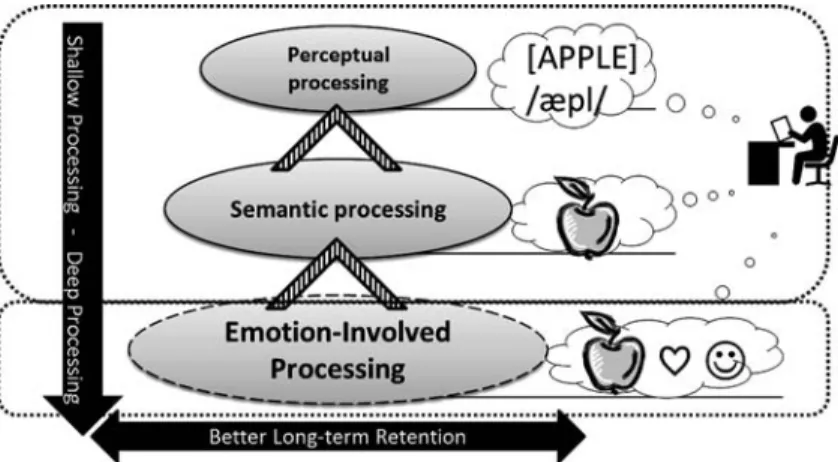
The contemplation above leads to a hypothetical conclusion that emotioninvolvement might best be theorized as a phenomenon qualitatively different from mere deep/semantic processing. In view of the fundamentality of emotion, the LoP model might be revised as follows, adding an even deeper level of processing : EmotionInvolved Processing (EmotionInvolved Processing Hypothe sis ; Figure 9).
This model meets the aforementioned important criteria for a better theoretical aufheben ; it employs the implicational system (cf. Argument 1 of this paper), it meets the emotional design (cf.
Figure 9 Emotion-Involved Processing Hypothesis (EIPH) is depicted, in which Emotion-Involved Processing is hy-pothesized to be an even deeper level of processing than semantic processing such as imagery processing.
Argument 2 of this paper), it is based on the theoretical sophistication of Levels of Processing (cf. Argument 3 of this paper) and it has a pragmatismic value in education and pedagogy ; mere se mantic processing is not enough and you have to delve deeper into the realm of phenomenological subjectivity and attain the active emotioninvolvement for better learning.19) In order to test the hy pothesis, it is needed to compare the effects of EmotionInvolved Processing with nonemotional se mantic processing such as imageryinvolved processing and to prove the superiority of the former to the latter in learning and acquisition.20)
The reason why the author coined a new word “EmotionInvolved Processing” instead of
emo-tional elaboration (Toyota, 2016) must be clarified. Elaboration is originally a cognitive psycho
logical concept which explains the enhanced mnemonic effect of encoding (i.e., input processing).
Elaboration has been applied in the field of second language vocabulary acquisition. For example,
Nation (2015) classifies the quality of processing supporting the success of vocabulary acquisition in the following layers from the shallowest to the deepest : (a) noticing, (b) receptive or productive re trieval, (c) varied meetings or use, and (d) elaboration. Although all of these four levels contribute to successful vocabulary acquisition, the most definitive of them is the deepest : elaboration. He even agrees that emotional elaboration can be one of the various modes of elaboration (I. S. P. Na tion, personal communication, November 21, 2015). Boers and Lindstromberg (2009) critically ana lyze the Involvement Load Hypothesis (Laufer & Hulstijn, 2001 ; cf. 1.2.3 of this paper) and sug gest that elaboration should be incorporated in the index, instead of evaluation. What is the original psychological account of elaboration? According to Anderson and Reder (1979), elaboration leads to better memory because of redundancy. Redundancy denotes the interconnectedness of propositions (Bradshaw & Anderson, 1982). The more redundancy there is, the more links there are between ideas and propositions, the richer the processing and the subsequent conceptual network will be. Elaboration, a cognitive enhancement via redundancy, thus concerns more with the increase of infor mation involved, regardless of the levels of processing (Kamiya, 1984). Craik and Tulving (1975) use the concept of richness of processing to denote elaboration and regard it as an increase of quan tity of processing in the same level of processing (cf. ibid., Experiment 6, 7). The originality of the EmotionInvolved Processing Hypothesis by the author of this paper concerns the difference in the quality/kind of processing rather than the increase of quantity/degree of processing, hence coining the original term Emotion-Involved Processing instead of using the term elaboration.
8. Future Direction
Although the EmotionInvolved Processing Hypothesis (EIPH) is of a pragmatic value to edu cators planning effective learning activities, it is true that it is based more on theoretical and reflec
────────────────────────────────────────────
19)The word “pragmatic” is used here not as an adjective form of pragmatics, which is a branch of linguistics, but as that of pragmatism, a philosophical movement initiated by Charles Sanders Peirce, succeeded and extended notably by William James and John Dewey. Pragmatics is an adaptation of pragmatism to linguistics. In order to avoid the termi nological confusion with the adjective form of linguistic pragmatics, the author sometimes uses other adjectives to de note pragmatismrelated, not pragmaticsrelated (viz., “pragmaticistic,” which is the adjective form of pragmaticism, which is the later rename of pragmatism by the propounder himself (Peirce, 1908/1934 a), or “pragmatismic,” which is a coined adjective and an anagram of pragmaticism). An apt example of pragmatic stance toward scientific inquiry is seen in the comments by the propounders of the LoP model (Lockhart & Craik, 1990 ; cf. Note 15).
20)It was partly accomplished in Kanazawa’s (2017) quasiexperimental study in the Vocabulary Learning and Instruction journal, in which the hypothesis was supported.
tive contemplation than on psycholinguistic experiments. The EIPH, as is the case with the LoP, is not an information processing model. In other words, although the EIPH depicts the differences in modes of processing in terms of their effects on forming stronger memories, the model depicts in sufficiently about the differences in modes of processing in terms of their level of neuropsychologi cal activation.21)Therefore, further theoretical sophistication such as applying philosophical and psy chological insights of emotion to pragmaticistic purposes including second language acquisition and second language vocabulary acquisition, and its empirical verification are desired for future studies. (cf. Kanazawa, 2016 b).
References
Allen, C. (2017). On (not) defining cognition. Synthese, 194, 42334249.
Anderson, J. R., & Reder, L. M. (1979). An elaborative processing explanation of depth of processing. In L. S. Cermak & F. I. M. Craik (Eds.), Levels of processing in human memory (pp.385403). Hillsdale, NJ : Lawrence Erlbaum.
Atkinson, R. C., & Shiffrin, R. M. (1971). The control of shortterm memory. Scientific American, 225(2), 8290.
AyçiçeğiDinn, A., ŞişmanBal, S., & CaldwellHarris, C. (2018). Are jokes funnier in one’s native language? Humor : Inter-national Journal of Humor Research, 31(1), 537.
Baddeley, A. D. (1978). The trouble with levels. Psychological Review, 85, 139152.
Baddeley, A. D., & Hitch, G. J. (2017). Is the levels of processing effect languagelimited? Journal of Memory and Lan-guage, 92, 113.
Barcroft, J. (2000). The effects of sentence writing as semantic elaboration on the allocation of processing resources and sec-ond language lexical acquisition (Unpublished doctoral dissertation). University of Illinois at UrbanaChampaign, ChampaignUrbana, IL
────. (2002). Semantic and structural elaboration in L2 lexical acquisition. Language Learning, 52(2), 323363. ────. (2015). Lexical input processing and vocabulary learning. Amsterdam, Netherlands : John Benjamins Publishing
Company.
Barrett, L. F. (2017). How emotions are made. Boston, MA : Houghton Mifflin Harcourt.
Bergson, H. (1910). Essai sur les donnèes immèdiates de la conscience [Time and free will : An essay on the immediate data of consciousness]. (F. L. Pogson, Trans.). London, England : George Allen & Unwin. (Original work published 1889)
────. (1911 a). Matière et mémoire [Matter and memory]. (N. Paul & W. Palmer, Trans.). London, England : George Allen and Unwin. (Original work published 1896)
────. (1911 b). L’Évolution créatrice [Creative evolution]. (A. Mitchell, Trans.). New York, NY : Henry Hold and Company. (Original work published 1907)
────. (1920). L’Énergie spirituelle : Essais et conférences [Mindenergy : Lectures and essays]. (H. W. Carr, Trans.). Westport, CT : Greenwood Press. (Original work published 1919)
────. (1935). Les Deux sources de la morale et de la religion [The two sources of morality and religion]. (R. A. Audra, C. BreretonPalmer, & W. H. Carter, Trans.). London, England : Macmillan and Co., Limited. (Original work published 1932)
────. (2007). Introduction à la métaphysique [Introduction to metaphysics]. In M. L. Andison (Trans. & Ed.), The crea-tive mind : An introduction to metaphysics (pp.133169). Mineola, NY : Dover Publications. (Original lecture delivered 1903)
Boers, F., & Lindstromberg, S. (2009). Optimizing a lexical approach to instructed second language acquisition. Basing stoke, England : Palgrave Macmillan.
────────────────────────────────────────────
21)For example, a first impression can be emotioninvolved without being aware of it, skipping semantic processing. In such a case, the involved emotion is passive, automatic, and difficult to harness, which is contrastive to the actively harnessed emotion directed to the target cognitive object with conscious attention and volition. The EmotionInvolved Processing is more about the latter kind of active emotion than the former kind of passive emotion.
Bradshaw, G. L., & Anderson, J. R. (1982). Elaborative encoding as an explanation of levels of processing. Journal of Ver-bal Learning and VerVer-bal Behavior, 21, 165174.
Brent, J. (1998). Charles Sanders Peirce : A life (Revised and enlarged edition). Bloomington, IN : Indiana University Press. Brysbaert, M., Ameel, E., & Storms, G. (2014). Bilingual semantic memory. In R. R. Heredia, & J. Altarriba (Eds.),
Founda-tions of bilingual memory (pp.133146). New York, NY : Springer.
Byrne, M. D. (2001). ACTR/PM and menu selection. International Journal of Human-Computer Studies, 55, 4184. CaldwellHarris, C. L. (2015). Emotionality differences between a native and foreign language. Current Directions in
Psycho-logical Science, 24(3), 214219.
Caramazza, A. (1997). How many levels of processing are there in lexical access? Cognitive Neuropsychology, 14(1), 177 208.
Clark, J. M., & Paivio, A. (1991). Dual coding theory and education. Educational Psychology Review, 3(3), 149210. Coltheart, M. (1981). The MRC Psycholinguistic Database. Quarterly Journal of Experimental Psychology, 33(4), 497505. Craik, F. I. M. (2002). Levels of processing. Memory, 10(56), 305318.
Craik, F. I. M., & Lockhart, R. (1972). Levels of processing. Journal of Verbal Learning and Behavior, 11(6), 671684. Craik, F. I. M., & Tulving, E. (1975). Depth of processing and the retention of words in episodic memory. Journal of
Ex-perimental Psychology, 104, 268294.
Curtis, K. (2016). The neuroscience of stories and why our brains love them. Kobe City University of Foreign Studies Jour-nal of Research Institute, 54, 7390.
de Groot, A. M. B. (2006). Effects of stimulus characteristics and background music on foreign language vocabulary learning and forgetting. Language Learning 56(3), 463506.
Dewaele, J. M. (2004). The emotional force of swearwords and taboo words in the speech of multilinguals. Journal of Mul-tilingual and Multicultural Development, 25(23), 204222.
────. (2008). The emotional weight of I love you in multilinguals’ languages. Journal of Pragmatics, 40(10), 1753 1780.
────. (2011). Reflections on the emotional and psychological aspects of foreign language learning and use. Anglistik. In-ternational Journal of English Studies, 22, 2342.
Dijkstra, T., & van Heuven, W. J. B. (2002). The architecture of the bilingual word recognition system. Bilingualism : Lan-guage and Cognition, 5(3), 175197.
Durkheim, E. (2014). De la division du travail social [The division of labour in society]. (W. D. Halls, Trans.). New York, NY : Free Press. (Original work published 1893)
Eagleman, D. (2011). Incognito. New York, NY : Pantheon Books.
Ekuni, R., Vaz, L. J., & Bueno, O. F. A. (2011). Levels of processing. Psychology & Neuroscience, 4(3), 333339.
Ellis, N. C., & Wulff, S. (2015). Usagebased approaches to SLA. In B. VanPatten & J. Williams (Eds.), Theories in second language acquisition (pp.7593). New York, NY : Routledge.
Ervas, F., Gola, E., & Rossi, M. G. (2017). How embodied cognition still matters to metaphor studies. In F. Ervas, E. Gola, & M. G. Rossi (Eds.), Metaphor in communication, science and education (pp.125). Berlin, Germany : Walter de Gruyter.
Eysenck, M. W. (2001). Principles of cognitive psychology (2nd ed.). Hove, UK : Psychology Press.
Fan, L., Xu, Q., Wang, X., Xu, F., Yang, Y., & Lu, Z. (2018). The automatic activation of emotion words measured using the emotional faceword Stroop task in late ChineseEnglish bilinguals. Cognition and Emotion, 32(2), 315324. Fodor, J. A. (1975). The language of thought. Cambridge, MA : Harvard University Press.
Folse, K. S. (2006). The effect of type of written exercise on L2 vocabulary retention. TESOL Quarterly, 40(2), 273293. Franks, J. J., Bilbrey, C. W., Lien, K. G. & McNamara, T. P. (2000). Transferappropriate processing (TAP) and repetition
priming. Memory and Cognition, 28(7), 11401151.
Freud, S. (1949). Massenpsychologie und Ich-Analyse [Group psychology and the analysis of the ego]. (J. Strachey, Trans.). London, England : The Hogarth Press. (Original work published 1921)
Gentsch, A., & Synofzik, M. (2014). Affective coding. Frontiers in Human Neuroscience, 8, 608.
Gibson, J.J. (1977). The theory of affordances. In R. Shaw & J. Bransford (Eds.), Perceiving, acting, and knowing (pp.67 82). Hillsdale, NJ : Lawrence Erlbaum.
Goleman, D. (1995). Emotional intelligence. London, England : Bloomsbury Publishing.
Gough, P. B. (1972). Theoretical models and processes of reading. In J. F. Kavanagh, & I. G. Mattingly (Eds.), Language by ear and by eye (pp.661685). Cambridge, MA : The MIT Press.
Hegel, G. W. F. (1894). Hegel’s philosophy of mind. (W. Wallace, Trans.). Oxford, England : Clarendon Press. (Original work published 18271830)
Ikari, Y. (2009). Ikita kotoba wo shutoku suru tameno eigokyoiku [English education for the acquisition of living language] (Doctoral dissertation). Osaka City University, Osaka, Japan.
James, W. (1917). The varieties of religious experience. New York, NY : Longmans, Green, and Co. (Original Gifford Lec ture delivered 19011902)
Jung, C. G. (1968). The concept of the collective unconscious. In G. Adler & R. F. C. Hull (Eds.), The archetypes and the collective unconscious (2nd ed. ; pp. 4253 ; R. F. C. Trans.). Princeton, NJ : Princeton University Press. (Original lec ture given 1936)
Kadota, S. (2003). The English mental lexicon. Tokyo, Japan : Shohakusha.
────. (2006). Reading and phonological processes in English as a second language. Tokyo, Japan : Kuroshio Shuppan. Kamiya, S. (1984). Effects of elaboration on retention of words. The Japanese Journal of Psychology. 55(3), 145151. Kanazawa, Y. (2015 a). Do listening and oral reading of visually presented English words affect implicit lexical recognition
memory? An empirical study with Japanese learners of English. Annual Review of English Language Education in Ja-pan, 26, 141156.
────. (2015 b, August). Emotional valence and L2 lexical processing. Paper presented at the sixth joint Foreign Lan guage Education and Technology Conference (FLEATVI), Harvard University, Boston, MA.
────. (2016 a). Measuring lexical fluency for L2 users. Journal of the Japan Society for Speech Sciences, 17, 3959. ────. (2016 b). Microlevel emotion as a factor of L2 vocabulary memory. Language Education & Technology, 53, 23
52.
────. (2016 c, May). Three-E-Imaginizer. Classroom Tips presented at the 2016 Spring Conference of the LET Kansai Chapter, Kobe Gakuin University, Kobe. (available at https : //www.youtube.com/watch?v=o7Wtsv_fIk)
────. (2017). EmotionInvolved Semantic Processing and L2 vocabulary memory. Vocabulary Learning and Instruction, 6(2), 2330.
────. (2019). Beyond positive psychology. Journal of International Studies, 8(1), 109118.
Kawasaki, M., Kanazawa, Y., Omotedani, J., Takase, A., Ito, S., & Kadota, S. (2018). Recent developments in the ESL read ing acquisition and instruction. JACET Kansai Journal, 20, 6980.
Keysar, B., Hayakawa, S., & An, S. (2012). The foreign language effect. Psychological Science, 23, 661668.
Kant, I. (1998). Kritik der reinen Vernunft [Critique of pure reason]. (P. Guyer & A. W. Wood, Trans.). Cambridge, Eng land : Cambridge University Press. (Original work published 1781)
Kida, S. (2010). The role of processingresource allocation in incidental L2 vocabulary learning through reading. Annual Re-view of English Language Education in Japan, 21, 171180.
Kövecses, Z. (2017). Metaphor and metonymy in folk and expert theories of emotion. In F. Ervas, E. Gola, & M. G. Rossi (Eds.), Metaphor in communication, science and education (pp.2942). Berlin, Germany : Walter de Gruyter.
Kriegel, U. (2019). The perception/cognition divide. In C. LimbeckLilienau & F. Stadler (Eds.), The philosophy of percep-tion and observapercep-tion (pp.149170). Berlin, Germany : Walter de Gruyter.
Lakatos, I. (1978). The methodology of scientific research programmes. Cambridge, England : Cambridge University Press. Laufer, B., & Hulstijn, J. H. (2001). Incidental vocabulary acquisition in a second language. Applied Linguistics, 22(1), 126. Laufer, B., & RozovskiRoitblat, B. (2015). Retention of new words. Language Teaching Research, 19(6), 687711. LeDoux, J. E. (1993). Cognition versus emotion, againthis time in the brain. Cognition and Emotion. 7(1), 6164. Levelt, W. J. M. (1989). Speaking. Cambridge, MA : The MIT Press.
Levelt, W. J. M., Roelofs, A. & Meyer, A. S. (1999). A theory of lexical access in speech production. Behavioral and Brain Sciences, 22, 175.
Lightbrown, P. M. (2008). Transfer appropriate processing as a model for classroom second language acquisition. In Z. H. Han (Ed.), Understanding second language process (pp.2744). Clevedon, England : Multilingual Matters.
Lockhart, R. S., & Craik, F. I. M. (1990). Levels of processing. Canadian Journal of Psychology, 44(1), 87112. ― 203 ―
MacLean, P. D. (1990). The triune brain in evolution. New York, NY : Plenum Press.
Marcos, L. R. (1976). Bilinguals in psychotherapy. American Journal of Psychotherapy, 30(4), 552560.
Mefoh, P. C., Chukwuorji, J. C., Nwonyi, S. K. (2014). Effects of levels of processing and disciplinary differences in recall memory. Nigerian Journal of Psychological Research, 10(1), 6571.
Montag, C., & Panksepp, J. (2017). Primary emotional systems and personality. Frontiers in Psychology, 8, 464.
Morris, C. D., Bransford, J. D., & Franks, J. J. (1977). Levels of processing versus transfer appropriate processing. Journal of Verbal Learning and Verbal Behavior, 16(5), 519533.
Næss, A. (2016). Ecology of wisdom. London, England : Penguin Classics.
Nagy, W. E., & Herman, P. A. (1987). Breadth and depth of vocabulary knowledge. In M. G. McKeown & M. E. Curtiss (Eds.), The nature of vocabulary acquisition (pp.1935). Hillsdale, NJ : Lawrence Erlbaum.
Nakata, T. (2015). Effects of expanding and equal spacing on second language vocabulary learning. Studies in Second Lan-guage Acquisition, 37(4), 677711.
Nation, I. S. P. (2015, November). Recent research in vocabulary learning. Lecture given at the 41stAnnual International
Conference on Language Teaching and Learning & Educational Materials Exhibition (JALT 2015), Granship−Shizuoka Convention & Arts Center, Shizuoka, Japan.
Nation, I. S. P., & Webb, S. (2011). Researching and analyzing vocabulary. Boston, MA : Heinle.
Nelson, T. O. (1977). Repetition and depth of processing. Journal of Verbal Learning and Verbal Behavior, 16(2), 151171. Norman, D. A. (2004). Emotional design. New York, NY : Basic Books.
Paivio, A. (1971). Imagery and verbal processes. Hillsdale, NJ : Lawrence Erlbaum.
────. (2014). Bilingual dual coding theory and memory. In R. R. Heredia & J. Altarriba (Eds.), Foundations of bilin-gual memory (pp.4162). Dordrecht, Netherlands : Springer.
────., & Desrochers, A. (1979). Effects of an imagery mnemonic on second language recall and comprehension. Cana-dian Journal of Psychology, 33(1), 1728.
Panksepp, J. (2003). At the interface of the affective, behavioral, and cognitive neurosciences. Brain and Cognition, 52, 414. ────. (2015 a). Primal emotions and cultural evolution of language. In U. M. Lüdtke (Ed.), Emotion in language (pp.27
48). Amsterdam, Netherlands : John Benjamins Publishing Company.
────. (2015 b). The neuroevolutionary sources of mind. In S. M. Miller (Ed.), The constitution of phenomenal con-sciousness (pp.226259). Amsterdam, Netherlands : John Benjamins Publishing Company.
Parikh, J., Neubauer, F., & Lank, A. G. (1994). Intuition. Oxford, England : Blackwell Publishers.
Pavlenko, A. (2012). Affective processing in bilingual speakers. International Journal of Psychology, 47(6), 405428. Peirce, C. S. (1931 a). A guess at the riddle. In C. Hartshorne & P. Weiss (Eds.), Collected papers of Charles Sanders Peirce
(Vols. 12 ; Paras. 1.3541.416). Cambridge, MA : Harvard University Press. (Original draft written 18871888) (Here inafter referred to as CP)
────. (1931 b). Fallibilism, continuity, and evolution. In C. Hartshorne & P. Weiss (Eds.), CP (Vols. 12 ; Paras. 1.141 1.175). (Original draft written 1897)
────. (1933). An improvement on the Gamma Graphs. In C. Hartshorne & P. Weiss (Eds.), CP (Vols. 34 ; Paras. 4.5734.584). (Original lecture given 1906)
────. (1934 a). A neglected argument for the reality of God. In C. Hartshorne & P. Weiss (Eds.), CP (Vols. 56 ; Paras. 6.5426.493). (Original work published 1908)
────. (1934 b). Questions concerning certain faculties claimed for man. In C. Hartshorne & P. Weiss (Eds.), CP (Vols. 56 ; Paras. 5.2135.263). (Original paper published 1868)
────. (1934 c). Synechism. In C. Hartshorne & P. Weiss (Eds.), CP (Vols. 56 ; Paras. 6.1696.173). (Original paper published 1902)
────. (1934 d). The first rule of logic. In C. Hartshorne & P. Weiss (Eds.), CP (Vols. 56 ; Paras. 5.5745.589). (Origi nal lecture delivered 1898)
────. (1934 e). Three types of reasoning. In C. Hartshorne & P. Weiss (Eds.), CP (Vols. 56 ; Paras. 5.1515.179). (Original lecture delivered 1903)
────. (1958 a). On signs and the categories. In A. W. Burks (Ed.), CP (Vols. 78 ; Paras. 8.3278.341). (Original letter written 1904)