Species composition and stand structure of an exploited
mangrove forest
Ismail Jusoh
1*, Muhammad Anuar Aziz
11 Faculty of Resource Science and Technology, Universiti Malaysia Sarawak,
94300 Kota Samarahan Abstract
A study was conducted in a disturbed mangrove forest that had been gazetted as a national park in Sarawak, Malaysia. This study provides information regarding the status of disturbed mangroves and can be used as baseline data to support decision making in managing mangrove forests. The objec-tives of this study were to determine the tree species composition and structure of an exploited man-grove forest. This study was carried out in Kuching Wetland National Park (KWNP). Eight transects were established and in each transect sampling plots of 20 x 20m were established. All standing trees with a diameter at breast height (DBH) ≥ 5 cm within each plot were enumerated. Generally there are three major forest types in KNWP: mixed-mangrove forests, Sonneratia alba forest and heath or kerangas forest; a total of 98 species were recorded. Sonneratia alba forest dominates the sandy mud-flats. However, their occurrence is not extensive, being confined to areas along the rivers, coastlines and estuaries of Batang Salak opposite Pulau Salak. The forest occurs on the seaward fringe as a narrow strip about 20 – 30 meters wide. The vast majority of the mangrove area can be classified as mixed-mangrove forest composed of Rhizophora apiculata and Rhizophora mucronta interspersed with Xylocarpus granatum, Avicennia alba and Nypa fructicans. More than 60% of the mangroves are pole size with a DBH between 5 and 10 cm. Avicennia alba recorded the highest basal area with 4.5 m2/ha followed by Rhizophora apiculata (3.8 m2/ha) and Avicennia marina (1.3 m2/ha). Some areas
in KNWP are made up of heath forests scattered throughout the interior of the park. The heath forest has a uniform single-layered canopy with trees reaching up to 22 m in height. There are no mangrove species in the heath forest and the common trees are Syzygium ochneocarpa, Whiteodendron moulto-nianum and Casuarina sumatrana. In general, the species composition in KNWP is rich and the regeneration status is good.
Key words: Mangroves, Kuching Wetland National Park, Stand structure, Species composition, Heath forest
*Corresponding author: e-mail [email protected] Introduction
The total area of mangrove forest in Sarawak is approximately 127,736 ha, which is about 1% of the total area of Sarawak (Abg Ahmad et al. 2008). The majority, about 80% of the state’s mangrove forest, is found in the Kuching and Mukah Divisions. Another 5% is found in the Limbang Division. The remaining 15% of forest areas are located in Sri Aman, Sibu and Miri. In Sarawak, the management of mangrove forest began in the 1920’s and the main objective was to sustain the production of mangrove-related products (Abg. Ahmad 2008).
The area now making up the current Kuching Wetland National Park was exploited by licensed
con-tractors prior to its incorporation as a national park. After the creation of KWNP in 2002 and the Ramsar site in 2005, extraction for mangrove poles continued. However, after the establishment of KWNP, the license to extract mangroves was only given to locals living in the vicinity of the national park. For the area to continue providing ecological and commercial benefits mangrove forests must remain intact with minimal or no disturbance. The park provides protection of the coastline, various villages, farms and some areas of Kuching from erosion, salt intrusion, storm damage, flooding and siltation. Rapid development in the surrounding area will certainly have an impact on the park vegetation due to the increasing clearing of mangroves for agricultural activities, tourism, housing and urbanization. Nevertheless, information
regarding the park vegetation impacted by the continued mangrove extraction is scarce. Comprehensive species-specific data is important for implementing conservation initiatives including regulation of resource extraction and clearing (Polidoro et al., 2010). The objectives of this study were to determine tree species composition and structure of an exploited mangrove forest. The data can serve as a baseline in managing the park.
Materials and Methods
Sampling
The study was carried out using eight transects. Along each transect, sampling plots of 20 x 20 m were established. Except for the heath forest, the survey area experiences daily tides and the soil is somewhat water-logged. The area is relatively flat with occasional low and small mud mounds. In each plot, all standing trees with a diameter at breast height (dbh) ≥ 5 cm within each plot were enumerated. The tree diameter at breast height (i.e. 1.30 m above ground level) was measured over bark to the nearest cm. Enumerated trees were identified up to the species level. The identification was based on bark, slash and leaf characteristics. However, if the species of the tree could not be identified, it was sufficient to iden-tify the plant up to genus level. Trees with a diameter of five cm and below were classed as saplings and were recorded. Tree diameters at breast height were measured over bark to the nearest cm using a diameter tape. Total tree heights were estimated using Suunto Clinometer. Results and Discussion
Forest Type
Generally there are three major forest types in KNWP: mixed-mangrove forests, Sonneratia alba (perepat) forest and heath or kerangas forest. Many of the forest subtypes classified by Chai (1975) were observed in KNWP, however, the distinctive features were not obvious due to the continuous extraction of mangroves. Sonneratia alba (Perepat) forest domi-nated the sandy mudflats. However, their occurrence is not extensive, being confined to areas along the rivers, coastlines and estuaries of Batang Salak opposite Pulau Salak. The mangrove area occurs on the seaward fringe as a narrow strip about 20 – 30 meters wide. This spe-cies colonizes newly formed silty mudflats and is seen as a pure stand. Sonneratia alba trees are the host trees of fireflies (Pteroptyx tener) and flashing is evident at dusk. The leaves of Sonneratia alba is the main source of food for the proboscis monkey (Nasalis larvatus) of
Borneo (Salter et al. 1985). The presence of the pro-boscis monkey is very noticeable with single monkeys or groups of three or four monkeys being present during daytime hours and consuming Sonneratia alba leaves.
Sonneratia leaves contain high levels of protein,
phos-phorus and potassium (Yeager et al., 1997).
The majority of the mangrove area is classified as being made up of mixed-mangrove species. This area is composed of Rhizophora apiculata (Bakau minyak) and
Rhizophora mucronta (Bakau kurap) interspersed with Xylocarpus granatum, Avicennia alba and Nypa fructi-cans. Young Rhizophora apiculata stands dominate the
river, tributaries and channel banks. The ground, which is usually silty and composed of sandy-loam soil, is totally covered by dense, interlocking and tangled stilt roots. Bakau minyak regenerates very well (Chai 1982). Old Rhizophora apiculata trees are found on higher ground. The trees are straight and pole-like, and most of the pole-size (4 – 10 cm) trees in KNWP have been extracted for commercial use. Rhizophora mucronta is generally found to be less extensive than Rhizophora
apiculata. In KNWP, Rhizophora apiculata is associated
with Avicennia alba, Xylocarpus granatum, Nypa
fruc-ticans, Bruguiera sexangula, Bruguiera gymnorrhiza, Kandelia candel. The associated species vary according
to soil type, estuarine upstream location, and tidal posi-tion. In frontal stands, young Rhizophora apiculata man-groves may be associated with Avicennia alba and Nypa
fructicans. The occurrence of Xylocarpus granatum in
drier ground is associated with Bruguiera spp. and older
Rhizophora apiculata. On the landward sites where
the ground is much drier, mixtures of Lumnitzera spp.,
Excoecaria agallocha, Kandelia candel and Xylocarpus granatum are common.
Some areas in KNWP are made up of heath forests scattered throughout the interior of the park (Fig. 2). The heath forest occurs on higher and drier ground of about 5-6 m a.s.l. and receives no tidal inundation. These for-ests are extremely different from the mangrove forest in structure and species composition and they have a uni-form single-layered canopy with trees reaching up to 22 m in height.
Species composition
A total of 98 species were recorded in the KNWP (Table 1). Of that total, about 36% or 23 species were trees in the mangrove environment. According to Tomlinson’s (1986) definition, 14 species (six families) were major mangroves, four species (four families) were
minor mangroves and five species (four families) were mangrove associates. Tomlinson’s (1986) classification of mangroves divided them according to their features and morphological adaptations: major mangroves are a group of plants that are adapted to a wet, saline habitat, are found exclusively in that mangrove habitat and can form a pure stand. Minor mangroves are groups of plants that do not occur in exclusively mangrove habitats, include inconspicuous vegetation, may occupy peripheral habitats and rarely form pure stands. Mangrove associ-ates are plants present in mangrove habitats that do not show obvious morphological adaptations that can deal with the demanding mangrove habitat and may occur together with terrestrial vegetation.
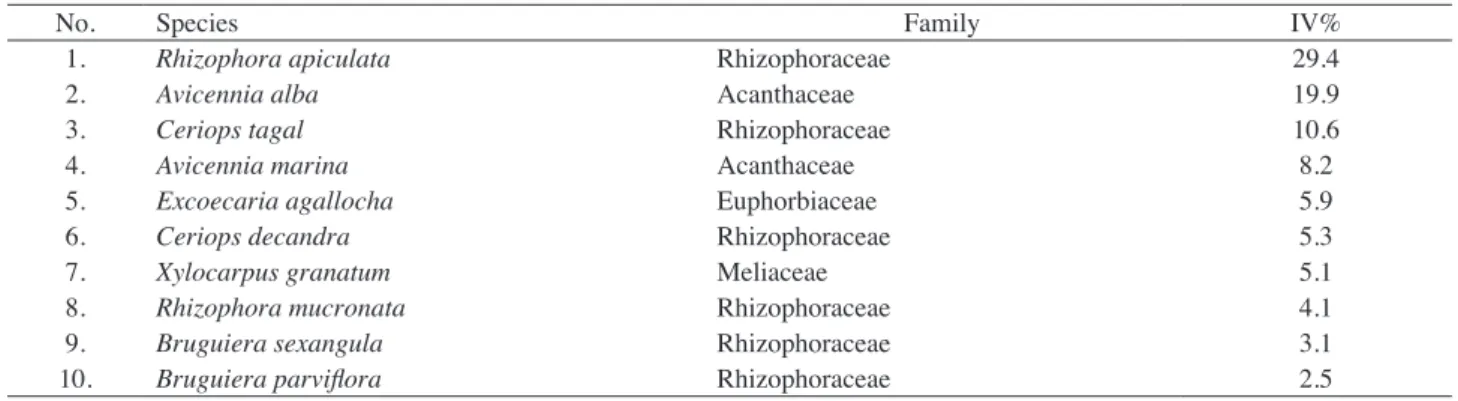
In the mixed-mangrove area, the three dominant species were Rhizophora apiculata, with an importance value (IV) of 29.4% followed by Avicennia alba (19.9%) and Ceriops tagal (10.6%). The top ten most dominant species as indicated by the IV is listed in Table 2. Of the 14 major mangroves, four -- Avicennia alba, A. marina,
Sonneratia alba and Lumnitzera littorea -- are listed as
protected plants under the ‘Wildlife Protection Ordinance
Sarawak 1998 (WPOS 1998). Avicennia alba and A.
marina are probably abundant in the area as their timber
has limited commercial value. Ecologically these two species are very important as they exhibit a wide physi-ological tolerance and provide a conducive environment for other mangroves species to become established.
The protected species of special concern is
Sonneratia alba, because the leaves are a food source for
the endangered Proboscis monkey, Nasalis larvatus. The distribution of S. alba is not widespread, and is confined only to newly formed sandy mudflats in sheltered areas of the park. Lumnitzera littorea is a commercially impor-tant species and it is threatened by the loss of habitat pri-marily due to extraction. By protecting this species from continuous extraction it is hoped that this species will continue to flourish. However, it should be noted that none of the species recorded here are listed in the IUCN Red List of threatened species.
Some areas in KNWP are made up of heath forests scattered throughout the interior of the park. The heath forest occurs on higher and drier ground of about 5-6 m a.s.l. and receives no tidal inundation. The heath for-ests are generally species-rich (73 species) compared with the adjacent mangrove forests and are extremely different from the mangrove forest in structure and species composition. In the heath forest, the two domi-nant species recorded were Syzygium ochneocarpa and
Whiteodendron moultonianum dominant species with IV
at 14% and 12%, respectively (Table 3). Species from the Dipterocarpaceae family such as Cotylobium spp., Table 2. Importance value indices for the ten most dominant mangrove species in KWNP.
Table 3. Importance value indices for the six most dominant non-mangrove species in KWNP.
No. Species Family IV%
1. Rhizophora apiculata Rhizophoraceae 29.4
2. Avicennia alba Acanthaceae 19.9
3. Ceriops tagal Rhizophoraceae 10.6
4. Avicennia marina Acanthaceae 8.2
5. Excoecaria agallocha Euphorbiaceae 5.9
6. Ceriops decandra Rhizophoraceae 5.3
7. Xylocarpus granatum Meliaceae 5.1
8. Rhizophora mucronata Rhizophoraceae 4.1
9. Bruguiera sexangula Rhizophoraceae 3.1
10. Bruguiera parviflora Rhizophoraceae 2.5
No. Species Family IV%
1. Syzygium ochneocarpa Myrtaceae 14
2. Whiteodendron moultonianum Myrtaceae 12
3. Diospyros siamang Ebenaceae 6.6
4. Calophyllum spp. Calophyllaceae 5.4
5. Knema sp. Myristicaceae 5.4
6. Cotylelobium spp. Dipterocarpaceae 5.3
Table 1. Species distribution of Kuching Wetland National Park.
Mangrove category No. of species
Major mangroves 14
Minor mangroves 6
Mangrove associate 5
Non mangrove (Terrestrial flora) 73
Dipterocarpus spp., Hopea spp., Shorea spp. and Vatica
spp. were also recorded. Other common species include
Dacrydium spp. and Garcinia bancana, Oncosperma tigillarium and Baccaurea spp.
In general, the species composition in KNWP is rich. The Indo-Malaysian region has 48 mangrove spe-cies (Duke et al. 1998) and in Sarawak the total number of mangrove species recorded was 40 (Chai 1975). The 14 major mangrove and six minor species recorded in this study can be considered as diverse. In fact, by taking into account the non-mangrove trees species found in the heath forest within the park, KNWP has a high biological diversity of plants.
Stand structure of Kuching Wetland National Park
More than 60% of the mangroves were pole-size with DBH between 5 and 10 cm. None of the trees recorded had a diameter of 30 cm or above. In the mangrove area excluding the heath forest, Rhizophora
apiculata was recorded at the highest frequency with 548
tree/ha (42%) followed by Ceriops tagal at 150 trees/ ha (15%) and Avicennia alba at 168 (13%) (Table 4). In term of basal area, Avicennia alba was recorded as having the highest basal area with 4.5 m2/ha followed by
Rhizophora apiculata (3.8 m2/ha) and Avicennia marina
(1.3 m2/ha).
The dominance of pole-size trees indicates that the mangroves are capable of reestablishing themselves by means of seed germinations following extraction. This means that selective extraction of individual mangrove has little impact in terms of regeneration. However, the established mangrove community lacks regular zona-tion perhaps due to the level of extraczona-tion. Moreover, the park consists of extensive interconnecting streams and tidal creeks that make zonation difficult to establish. Meandering streams and irregular canals yield a mosaic community in mangroves (Tomlison, 1994). A com-parative study on disturbed and undisturbed mangroves ecosystems in Semporna Sabah showed that the mean DBH in disturbed ecosystems ranged from 10 to 20 cm while a larger DBH of 23 to 35 was common in
undis-turbed ecosystems (Wah et al. 2011). Observers noted that diameter distribution in undisturbed mangroves was symmetrically distributed and irregularly distributed in disturbed mangroves.
Conclusion
Generally there are three forest types in KWNP: mixed-mangrove forests, Sonneratia alba (perepat) forest and heath or kerangas forest. Zonation of mangroves in the area is not distinct due to the numerous streams and canals as well as exploitation. More than 60% of the mangroves are pole-size with a DBH between 5 and 10 cm indicating a healthy mangrove forest due to good regeneration of propagules. The species composition in KNWP is rich. Taking into account the non-mangrove tree species found in the heath forest within the park, the plant diversity in KNWP is high.
References
Abg Ahmad, A.M., Hamden, M. and Ali, Y. 2008. Pengurusan dan Pemuliharaan Hutan Bakau Di Sarawak. Seminar Pemuliharaan Hutan Pesisiran Pantai Negara 2008, Kuantan Pahang, 28 – 29 Oktober 2008.
Chai, P. K. (1975). The mangrove trees and shrubs of Sarawak. Malaysian Forester, 38(3), 187-208. Chai, P.P.K. 1982. Ecological studies of mangroves
in Sarawak. Ph.D. Thesis. Universiti Malaya, Malaysia (Unpublished).
Duke, N.C. Ball, M.C. and Ellison, J.C. 1998. Factors influencing biodiversity and distributional gradients in mangroves. Global Ecology and
Biogeography Letter 7, 27-47.
Polidoro, B.A., Carpenter, K.E., Collins, L., Duke, N.C., Ellison, A.M., Ellison, J.C., Farnsworth, E.J. Fernando, E.S., Kathiresan, K., Koedam, N.E., Livingstone, S.R.,Miyagi, T., Moore, G.E., Nam, N.M., Ong, J.E.,Primavera, J.H.,Salmo, S.G., Sanciangco, J.C., Sukardjo, S.,Wang, Y. & Yong, J.W.H. (2010). The loss of species: mangrove extinction risk and geographic areas of global Table 4. Tree density and the basal area per ha of six common mangroves in KWNP.
No. Species Tree density (No./ha) Basal area (m2/ha)
1. Rhizophora apiculata 548 3.8 2. Ceriops tagal 198 0.7 3. Avicennia alba 168 4.5 4. Excoecaria agallocha 80 0.6 5. Ceriops decandra 75 0.09 6. Avicennia marina 65 1.3
concern. PLoS ONE, 5(4), 1-10.
Salter, R.E., MacKenzie, N.A., Nightingale, N., Aken, K.M., and Chai P.K., P. 1985. Habitat use, ranging behaviour, and food habits of the pro-boscis monkey, Nasalis larvatus (van Wurmb), in Sarawak. Primates. Vol. 26(4), 436-451.
Tomlinson, P.B. 1986. The botany of mangroves. Cambridge UK: Cambridge University Press. Wah, L.M., Mojiol, A.R. & Saleh, E. (2011). Diversity
of mangroves ecosystems in sempurna mangrove
forest. Bioscience 28, 8-17.
WPOS (1998) – Laws of Sarawak. Chapter 26: Wild life Protection Ordinance Sarawak (1998). Government of Sarawak. Percetakan Nasional Malaysia Berhad, Kuching, Sarawak.
Yeager, C.P., Silver, S.C., and Dierenfeld, E.S. 1997. Mineral and phytochemical influences on foliage selection by the proboscis monkey (Nasalis
lar-vatus). American Journal of Primatology 41,