Japan Advanced Institute of Science and Technology
JAIST Repository
https://dspace.jaist.ac.jp/
Title Difficulties of Global R&D Projects and Role of Bridge Managers [博士論文計画調査報告書]
Author(s) Chalarak, Nawarerk
Citation
Issue Date 2018-03
Type Thesis or Dissertation
Text version author
URL http://hdl.handle.net/10119/15149
Rights
Description Supervisor:内平 直志, 先端科学技術研究科, 修士
Report of Survey for Doctoral Research Plan
Difficulties of Global R&D Projects
and Role of Bridge Managers
1610120 Nawarerk Chalarak
Supervisor: Naoshi Uchihira
Main Examiner:
Naoshi Uchihira
Examiners: Takashi Hashimoto
Tsutomu Fujinami
Kunio Shirahada
Graduate School of Advanced Science and Technology
Japan Advanced Institute of Science and Technology
Master of Science (Knowledge Science)
October 2017
Abstract
The globalization has brought so many challenges to the business. The competitiveness is increasing and having higher pressure in the markets. The new product development process, innovation, and research and development (R&D) are implemented in the industry in order to introduce new products or services to the markets. In addition, the organizations have access to the global market to acquire more benefits from a larger demand and access to global knowledge resources. However, conducting business in foreign countries is not an easy task. There are many problems and difficulties to overcome in a global context where people from different countries and different cultures are working in different time zones and using different languages. Previous researches discussed the global R&D structure and coordination mechanisms from the organization perspective. The global R&D project requires collaboration between project members for the success of the project even though the global context is a kind of diverse environment.
In the case of offshoring IT projects, there are bridge system engineers who are working as a coordinator to enhance the relationship between client and developer teams. The bridge system engineers have to work closely with the customers and developer teams. The working process of bridge system engineer can be separated into four main phases which are 1) Planning with client and offshore project 2) Breaking down requirements; design plan and transfer 3) Problems solving, review, fix, final quality assurance and deliver the product 4) After delivery: externalizing and sharing experience. The role of bridge system engineer is considered in three different aspects. The first one is the communication aspect. The offshoring projects consist of teams from different countries and speaking different languages. Bridge system engineers should have a language skill so that they can overcome language barrier by communicating between teams and providing additional documents which explain more detailed information. Second, the cultural aspect, there is a cultural gap between people from different background. Bridge system engineers overcome this gap by encouraging both sides to solve problems together. Lastly, the social capital and networks, this is a critical role of bridge system engineer. Bridge system engineers have a strong relationship with client teams and developer teams. They are not only working as a coordinator but also as an insider of the team. Similarly, in global R&D project, the R&D bridge managers are facilitating the projects, which have different cultures, time zones, and languages environment. This research aims to identify the difficulties that R&D bridge managers have in global R&D project. The causes, effects, and solutions to those difficulties are discussed in this research.
The R&D bridge managers have to develop and utilize some skills and knowledge in the project with a global context. This situation makes the work of R&D bridge manager as a challenging task. In addition, since the world is becoming more globalize so it is indispensable to investigate a proper way to approach global R&D project. The role of R&D bridge manager is important in this situation, especially, in R&D project because this kind of project requires a high level of collaboration among the project members. Particularly, the knowledge transfer for the research process and quality control in the development process. A better understanding of R&D bridge manager work could contribute to the knowledge about this important role and help us to enhance the global R&D management practice.
This research investigates the role of R&D bridge manager in global R&D project and explains the difficulties of facilitating the projects. In addition, this research also talks about the causes and effects of those difficulties so that the solutions to approach the difficulties can be initiated. The mechanism model of difficulties is a theoretical contribution from this research. Moreover, this research is considered as a first phase of the whole research project, which aims to
propose a competency development framework for R&D bridge manager. The difficulties found from this research will be used a data sources to identify crucial competency that the R&D bridge managers should have so that they can use for solving difficulties.
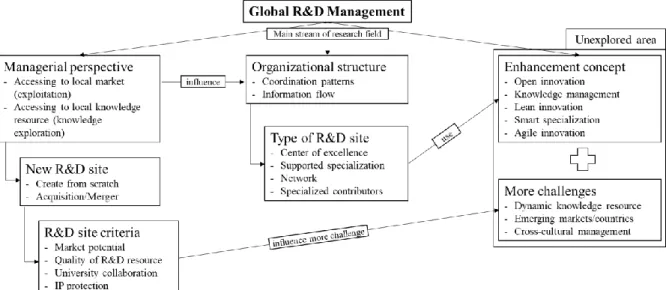
The intensive literature review was conducted at the beginning of this research to find out the current trend of global R&D research. There are about fifty literature from around 1970 to 2016 were selected to cover four main topics, which are research and development (R&D), cross-cultural management, knowledge transfer, and bridge system engineer and R&D bridge manager. According to the literature, we found that previous research discussed the foundation of setting up R&D site abroad such as the objectives, criteria, and processes. The structure and coordination pattern of R&D teams are also discussed many studies. However, both of them (foundation and structure) are the organizational perspective. This research also found that there are a few researches from individual level such as from the perspective of project members. More importantly, the research direction of R&D management research is moving forward and investigate more on the incoming challenges such as the new concept of innovation, the emerging markets and countries, and the globalization of knowledge resources.
The semi-structured interviews were conducted with seven experienced R&D bridge managers who have at least three years of experience in the IT industry. This data collection method provides an opportunity to explore the insight from the interview. The list of questions was prepared but did not strictly use them as we carried on the conversation so that the managers can reveal their insightful information. The interviews were audio recorded, transcribed, and coding for qualitative analysis. Even though we have a limited number of interviews, we can make some conclusions and provide insight to some extent. The working process of R&D bridge manager was explored in order to provide a better understanding of the activities that R&D bridge manages have to do throughout the project. We found that there are four important difficulties facing by R&D bridge managers. They are 1) the quality control, 2) the communication, 3) the R&D activity facilitation, and 4) the requirement and needs transfer. The quality control is a highlight as all managers mentioned and emphasized during the interview. We also found that the causes of difficulty in quality control are 1) the unclear specification of global R&D project and 2) the different outcome expectation of headquarters and R&D team. These difficulties have effects to the R&D project in several perspectives. For example, the outcome is not satisfied by headquarter or customers, the miscommunication during the project, and using inappropriate research approaches. Thus, R&D bridge managers have to apply their knowledge and skills to establish solutions to overcome difficulties such as using several product releases to check the outcome regularly, switching the role between different teams, initiating additional documents and visualization, and providing an education or training. Finally, the mechanism model of difficulties was developed. It consisted of the causes, difficulties, and effects in global R&D project. The R&D bridge managers can utilize this knowledge in practical when they facilitate the global R&D project. In addition, the difficulties and the mechanism model found from this research will be used to identify crucial competency of R&D bridge manager and we will propose the R&D bridge manager competency development framework in the future research.
Keywords: Global R&D project, R&D bridge manager, Bridge system engineer, Project management, Cross-cultural collaboration, Competency development framework
Acknowledgments
I would like to express my sincere gratitude and highest respect to my supervisor, Professor Naoshi Uchihira from Japan Advanced Institute of Science and Technology (JAIST), for his encouragement, supports, and guidance throughout my research as well as other supports for my personal life while living in Japan. He has always provided a lot of valuable suggestions in all discussions we had and also helps me prepare for my future career. I have learned so many things from him not only for the research project but also how to be a good researcher in the future. My research could not be completed without his supervision.
My appreciation also goes to Professor Tsutomu Fujinami, Professor Takashi Hashimoto, Associate Professor Kunio Shirahada, and Assistant Professor Yasuo Sasaki, all from JAIST, for their concrete comments and suggestions to improve my research. I would like to thank JAIST and all staff members who provide a great support in any aspect of my life in this lovely institute. Also, I would like to thank all managers who gave me opportunities to have interviews, provided insightful information, and spent their valuable time for my research.
During my stay and work in JAIST, I have received a lot of support from my dear friends in Uchihira Laboratory. All of them make my life in JAIST more enjoyable. I would like to thank Kinoshita-san for having many discussions together about our research, leisure life, and let me know Japanese language and culture in a deeper detail.
Finally, I would like to express my gratitude to my parents and family for their endless love and support. They always trust and believe in all my decisions and always be with me side by side. I would like to thank my brother and sister who are taking care of our parents while I am studying far away.
List of Contents
Chapter 1 Introduction ____________________________________________________________ 1 1.1 Research Background ________________________________________________________ 1 1.2 Research Objectives __________________________________________________________ 2 1.3 Research Questions __________________________________________________________ 2 1.4 Research Significance ________________________________________________________ 3 1.5 Research Composition ________________________________________________________ 3 1.6 Organization of the Report _____________________________________________________ 4Chapter 2 Intensive Literature Review _______________________________________________ 5
2.1 Research and Development ____________________________________________________ 5 New Product Process: The Stage gate ______________________________________________ 6 Open Innovation ______________________________________________________________ 9 Global R&D Management _____________________________________________________ 11 Types of Global R&D Management ______________________________________________ 13 2.2 Cross-cultural Management ___________________________________________________ 14 Culture_____________________________________________________________________ 14 Cultural Expertise ____________________________________________________________ 15 Multicultural Team ___________________________________________________________ 15 Culture and International Management Research ____________________________________ 16 Cultural Dimensions __________________________________________________________ 18 2.3 Knowledge Transfer _________________________________________________________ 20 Information Stickiness ________________________________________________________ 20 Barrier of Knowledge Transfer __________________________________________________ 21 Knowledge Management ______________________________________________________ 23 2.4 Bridge System Engineer and R&D Bridge Manager ________________________________ 25 Bridge System Engineer _______________________________________________________ 25 Bridge Manager Education _____________________________________________________ 27 2.5 Findings based on Literature Review ____________________________________________ 29 2.6 Summary _________________________________________________________________ 32
Chapter 3 Research Plan _________________________________________________________ 33
3.1 Research Design ____________________________________________________________ 33 3.2 Data Collection ____________________________________________________________ 34 3.3 Data Analysis ______________________________________________________________ 35 Global Project Management Framework __________________________________________ 35
Chapter 4 Interview Results for R&D Bridge Manager Difficulties ______________________ 40
The Working Process of R&D Bridge Manager _____________________________________ 40 The Difficulties in Global R&D Project ___________________________________________ 42 Difficulty Mechanism Model ___________________________________________________ 45 4.2 Summary _________________________________________________________________ 46
Chapter 5 Conclusion and Discussion _______________________________________________ 47
5.1 The Working Process of BMs in Global R&D Projects _____________________________ 47 SRQ 1: What is the working process of BMs in global R&D projects? ___________________ 47 5.2 Difficulties in Global R&D Projects and Its’ Cause ________________________________ 48 SRQ 2: What are the difficulties in facilitating global R&D projects and how are they caused? 48 5.3 Effect of difficulties on performance of global R&D projects_________________________ 50
SRQ 3: How have the difficulties of BMs effected on the performance of global R&D projects? __________________________________________________________________________ 50 5.4 Role of BMs to Solve Difficulties ______________________________________________ 50 SRQ 4: What is the role of BMs to solve these difficulties? ___________________________ 51 5.5 Difficulties of BMs in Global R&D Projects ______________________________________ 51
MRQ: What are the difficulties that BMs face in facilitating global R&D projects and how are they important? ______________________________________________________________ 51 5.6 Theoretical and Practical Implications ___________________________________________ 52 5.7 Research Limitations ________________________________________________________ 53
Chapter 6 Future Research _______________________________________________________ 55
6.1 Competency Development Framework for R&D Bridge Manager _____________________ 56
References _____________________________________________________________________ 57 Appendix ______________________________________________________________________ 61
Reviewed literature list __________________________________________________________ 61 Interview with R&D bridge managers ______________________________________________ 65 R&D bridge manager A _______________________________________________________ 65 R&D bridge manager B _______________________________________________________ 70 R&D bridge manager C _______________________________________________________ 83 R&D bridge manager D _______________________________________________________ 88 R&D bridge manager E________________________________________________________ 92
List of Figures
Figure 2.1 The typical Stage-Gate model ___________________________________________ 8 Figure 2.2 Closed innovation model ______________________________________________ 10 Figure 2.3 Open innovation model _______________________________________________ 10 Figure 2.4 Four types of virtual project organization _________________________________ 13 Figure 2.5 The project leader must manage the culture shock effectively at an early stage ____ 19 Figure 2.6 Iterative problem-solving pattern often encountered in new product and service development ________________________________________________________________ 21 Figure 2.7 SECI Model ________________________________________________________ 24 Figure 2.8 Project-management training support systems _____________________________ 28 Figure 2.9 R&D management research ____________________________________________ 30 Figure 3.1 Overall research project sequences ______________________________________ 34 Figure 3.2 Dimensions of Global Projects _________________________________________ 36 Figure 3.3 Global project management framework __________________________________ 38 Figure 4.1 Difficulty mechanism model ___________________________________________ 45 Figure 6.1 Overall research project sequences ______________________________________ 55
List of Tables
Table 2.1 Six types of international management research _____________________________ 17 Table 4.1 Difficulties of R&D bridge manager _____________________________________ 46
1
Chapter 1 Introduction
This chapter provides the importance of R&D management in globalization, particularly, the global R&D project. Then the role of R&D bridge manager (BM) is described together with the role of bridge system engineer (BSE) and information gatekeeper. Research questions and objectives are included in this chapter and follow by the research significance and the structure of this report.
1.1 Research Background
In a highly competitive business environment, the firms are finding ways to utilize knowledge in order to introduce new services or products to the market. The trend of open innovation (Chesbrough, 2003) accelerates the utilization of both internal and external knowledge and resources. Both domestic and international R&D activity are playing an important role in the era of globalization (Coe & Helpman, 1995). There are two main objectives to establish R&D site abroad. The first one is for knowledge exploration and the second one is knowledge exploitation (Kuemmerle, 1997). The firms could have a great benefit from acquiring knowledge from outside their home country and commercializing knowledge into the global market. Therefore, the international R&D is important for the firms to maintain and increase the level of competitiveness. Previous studies discussed from the organizational perspective about the process to setup new R&D abroad, the R&D site criteria, the types of R&D site, the team structure, and the communication patterns (Chiesa, 1996; Kuemmerle, 1997; Boutellier et al., 1998; Reger, 1999; Gassmann & Von Zedtwitz, 1999). It is beneficial to investigate the global R&D management not only from the organizational point of view but also from the perspective of individual who facilitates the project.
Huong et al. (2014) investigated the role of BSE from knowledge management perspective and explained as follows. In the case of offshore software development project, the role of BSE is employed to enhance the relationship between clients and developer team. There are four phases in the working process of BSE. The first phase is “planning with client and offshore project”. BSEs gather information about the project from both client and offshore team. The second phase is “breaking down requirements; design plan and transfer”. BSEs transfer information between the two partners. However, before transferring, BSEs have to use their knowledge and skills to minimize gaps between client and offshore team. The third phase is “problems solving, review, fix, final quality assurance and deliver the product”. BSEs get involved in almost every step of the offshoring process such as designing plan and requirements, reviewing and fixing bugs. The last
2
phase is “after delivery: externalizing and sharing experience”. BSEs accumulate their experience by gathering and externalizing tacit knowledge throughout the project. Then BSEs develop manuals, handbooks, guidelines, which are easier for sharing with others. In addition, the role and skills of BSE were also discussed. BSEs overcome communication gaps by using language skill, and overcome cultural gaps by their cultural understanding and encourage the offshore to adapt themselves to the custom of clients.
For the global R&D project, the role of BM is employed to facilitate the project. However, the characteristic of global R&D project and the offshore software development project are different, so BMs are facing different challenges. In the global context, BMs are dealing with the different culture, language, and time zone. The difficulties of BM arise throughout the R&D process. Many BMs in multinational companies (MNCs) based in Japan feel about the difficulties and they are finding ways to solve those difficulties by themselves. There are a few researches, that investigate the role of BM. Therefore, a deeper understanding of BM role is indispensable.
1.2 Research Objectives
This research has an aim to investigate the difficulties of BMs in global R&D projects. The difficulties will be identified as well as a deeper understanding of BM role in global R&D project will be provided. We will perform an analysis on the interviews with experienced BMs then develop the mechanism model to explain the causes and effects of difficulties in the context of global R&D project. This is a benefit for practitioners who are working as BM and contribute to the knowledge of global R&D management.
1.3 Research Questions
According to the research objectives, they can be achieved by answering the following one major research question and four subsidiary research questions.
Major research question (MRQ)
What are the difficulties that BMs face in facilitating global R&D projects and how are they important?
Subsidiary research question (SRQ)
3
SRQ 2: What are the difficulties in facilitating global R&D projects and how are they
caused?
SRQ 3: How have the difficulties of BMs effected on the performance of global R&D
projects?
SRQ 4: What is the role of BMs to solve these difficulties?
1.4 Research Significance
The findings from this research will provide a deeper understanding of BM role in global R&D project. This study will also provide benefit for the organization strategy to employ future BMs. By understanding of the causes and effects of BM difficulties in global R&D project, the BMs could foresee and be prepared for the solutions to overcome future challenges, particularly, in the more globalized context.
Moreover, this research will provide an academic contribution to the global R&D management and role of BM by showing the mechanism model of BM difficulties. This model will be used in the future research to develop a competency development framework for BM.
1.5 Research Composition
This research report consists of two important parts. The first one is the intensive literature review and the second part is the BM interviews. The intensive literature review was conducted to explore related researches in this research field and determine the current situation and trend. There are more than fifty literature which provides broader and deeper understanding of the research. Moreover, the literature review is a foundation and building blocks of knowledge for future research.
The experiment is also included in this research to be a starting point of the research project. The interview with managers helps to develop a relationship between theoretical knowledge and practical knowledge. It also helps to validate our understanding from academic research compare to real business implications. The interview in this research has an objective to identify the difficulties of BMs when they facilitate the global R&D projects.
4
1.6 Organization of the Report
Chapter 2 discusses related literature, which covers four main areas, which are research and development, cross-cultural management, knowledge transfer, and BSE and BM. Chapter 3 provides overall research design and explains the research methodology, data collection, and data analysis. Chapter 4 shows the result of data analysis. Then, Chapter 5 provides the conclusion and discussion by answering each research question. Moreover, the limitation of this research is included in Chapter 5. Lastly, in Chapter 6, there is a future work, which is the investigation of crucial competency that the BM should have in order to overcome the difficulties in global R&D projects.
5
Chapter 2 Intensive Literature Review
The globalization becomes more important for the industry for a few decades. The company gets some advantages from accessing to the market and resources in foreign countries other than their home country. However, the industry has to overcome several barriers in globalization to gain the most efficiency. There is some related literature, which has been conducted previously. Some of them are discussed in this chapter.
The research and development (R&D) definition and its’ importance are shown in section 2.1. Then, section 2.2 talks about the cross-cultural management, which is a part of globalization. After that, the R&D project is discussed from knowledge transfer perspective in section 2.3. Section 2.4 explains about the BSE and BM who are a kind of facilitator and play an important role in the success of offshoring IT projects and global R&D projects. Lastly, section 2.5, the intensive literature review was conducted and summarized in this section.
Many literature consists of information from different perspectives, which provide a broader understanding of the research. They also show the direction and trend of the research theme and studies in this field. In addition, gaps in the literature can be identified and this research would make a contribution to the body of knowledge and shed light on the further research.
2.1 Research and Development
Since the industrial revolution in 1760, the manufacturing process has changed dramatically. The production line using human power was changed to machines and other tools. The machines and steam engines have been widely used which extremely helped to improve the efficiency of manufacturing industry. That was an important time in history when people’s life had changed like never before. Later on, the research and development (R&D) emerged for the competitiveness of the industry and played a vital role since then. The R&D could be different from institute to institute. Accordingly, the industry R&D is described in this section.
Before moving forward, setting mutual understand about R&D is important by starting with the definition of R&D. According to The Measurement of Scientific and Technical Activities: Frascati Manual 1980, the definition of R&D are as follow.
Basic research is an experiment to acquire new knowledge from phenomena and facts without any application.
6
Experimental development is the work using existing knowledge and experience in order to develop something new or provide improvement.
Demonstration is a prototype testing for checking a reliability and usability of the prototype
before commercialization.
System development is a development to fulfill utility function of users.
Component development is a development of components that can be applied to many kinds
of system.
Engineering consultancy is the technical support for operation and solving problems. It
provides feedback and improvement for R&D process.
Having R&D in the industry provides advancement of knowledge and product development, which is a strategic advantage over the competitors. This is why R&D is important for the industry. First, R&D helps the industry to have a long-term strategy and to maintain competitiveness. Second, R&D leads industry toward the innovation, which is indispensable for today’s business.
R&D and the innovation process have a close relationship with the initial step to discover new insight, which is useful for industry. Follow by the invention to create something new and then innovation for users to use new products or services. Lastly, the diffusion that is the adoption of innovation to the market. Consequently, Chesbrough (2003) has offered more theoretical information about a new paradigm for the advancement of traditional R&D and innovation, which is the “Open Innovation”.
New Product Process: The Stage gate
Time to market is one of the most important factors in business competitiveness. The firms have a pressure from reducing cycle time and, at the same time, improve the new product success rate. The “Stage Gate” system could help to manage and accelerate the innovation efforts. This systematic process will move the new product through several stages from idea to launch. Cooper (2001) explains more detail about the Stage-Gate as following. Firstly, the seven goals of new product process are examined.
1) Quality of Execution: The quality problem could occur in any step of the process. To deal
with it, the product innovation should be visualized as a process. Then apply process management and quality management techniques to that process. The quality of execution is embedded into the new product process to ensure the high-quality end product.
7
2) Sharper Focus, Better Prioritization: Lacking of project evaluations and the failure to set
priorities could lead to the difficulty of decision making. In the Stage-Gate system, it is called the gates are weak. There are many gates along the product development process. They are considered as the quality-control checkpoints. Each gate has its own criteria, which deal with the quality of execution, business rationale and the path forward.
3) Fast-Paced Parallel Processing: Shorten cycle time and improve product quality are the
dilemma of the product managers. The parallel processing is one solution that several activities can be done at the same time. Moreover, the new product process becomes a cross-functional and multidisciplinary, consists of multiple teams in the company.
4) True Cross-Functional Team Approach: As mentioned in the previous topic, the new
product process is multifunctional and requires participation from all players. This is to emphasize the word “true” of the cross-functional team because there are some “fake” teams such members just show up in the meeting, do not give a release time for their job, given lots of responsibility but less authority. Therefore, the real cross-functional teams should have the following characteristics committed team players with release time, having dedicated leader with accountability and authority, dedicated resources, fluid team structure, and all members accountable for the result.
5) Strong Market Orientation with Voice of the Customer Built In: The market orientation
must be built into the new product process starting from the beginning until the end of the project. It is including the following activities customer-based idea generation, preliminary market assessment, market research to determine user needs, competitive analysis, concept testing, customer reaction, user test, test market and market launch.
6) Better Homework Up-Front: This is to define the product and build the business case for
development. It should be done before the project gets approval. The up-front activities are including initial screening, preliminary technical assessment, preliminary marketing assessment, detailed technical assessment, manufacturing or operations assessment, detailed market studies, resource and capabilities assessment, financial and business analysis, product definition and business case, and decision on the business case.
7) Products with Competitive Advantage: Firms have to seek for the differentiated products,
unique benefits and superior value of the customer. It can be as following every gate has the criteria focusing on the product superiority, each stage includes actions to deliver product superiority, the project team has to provide evidence of product superiority, and ensure about the “value proposition” for the customer.
8
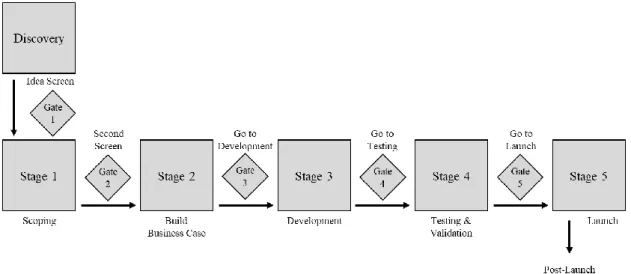
The stage gate process consists of two main elements, which are “Stage” and “Gate”. This process helps to improve the effectiveness and efficiency of the innovation process. The “Stage” includes a set of prescribed, cross-functional, and parallel activities. Each stage has an entrance, which is “Gate” to act as a quality control checkpoint. There are several stages through the innovation process to gather information for processing to the next gate. They are cross-functional and parallel activities to bring down the uncertainty. The activities have the best practice, success factors and goals. The typical stage gate process is consisting of six stages as shown in Figure 2.1.
1) Discovery: To discover opportunity and generate ideas. 2) Scoping: To perform initial investigation and research.
3) Building the business case: To perform detailed investigation and research on marketing
and technical then derive the business case.
4) Development: To design and develop the new product, operations, and production process. 5) Testing and validation: To verify the proposed new product, marketing, production, and
operations.
6) Launch: To move to the full production then selling.
Figure 2.1 The typical Stage-Gate model (Cooper, 2001, p. 130)
Before entering each stage, there is a gate for making go/kill decision. All information will be brought to the gate to support decision making whether to move on to the next stage or not. Each gate consists of the following elements.
9
1) A set of required deliverables: Team members must come to the gate with deliverables,
which is the output from the previous gate.
2) Criteria against which the project is judged: It includes “must-meet” criteria and
“should-meet” criteria.
3) Defined output: It is the decision, approved an action plan for next stage, and list of
deliverables and date for the next gate.
Once the stage gate process is successfully installed into the firms, it can be improved by applying the following six features.
1) Flexibility: The stages can be omitted and the gates can be combined, so the decision is
made with full understanding of the risk. This is typically applicable to a low-risk project.
2) Fuzzy (conditional) gates: The decision from the gates can be made with some conditions.
Therefore, the project can move on without waiting for a piece of information, which will come later and the result is positive.
3) Fluidity: Some activities are overlapping over several stages. The project can move from
stage to stage with some conditions (Fuzzy gates).
4) Focus: Instead of paying attention to the single project, the focus should be on the entire
portfolio consists of several projects and the resource is reallocated to the best project.
5) Facilitation: Facilitator is indispensable for implementing stage gate process. This role helps
to ensure that the process is efficient and effective.
6) Forever green: The stage gate process is continual renew, redesign and improve by
incorporating the mentioned five features. This could adjust the stage gate process to suite the specific need of the firms.
Open Innovation
Previously, the research project of a company is conducted to satisfy the company’s goal, by the company’s researchers, and using company’s internal knowledge. The open innovation is not using only the internal knowledge but also external knowledge to improve the innovation of the company, internally. In addition, the open innovation also expands the markets and promote the external use of innovation. The internal ideas can be brought to the market through external channels. R&D would be an open system in open innovation paradigm. The valuable ideas can come from inside and outside of the company.
10
Chesbrough (2006) also explained that the innovation paradigm was changed from closed to open model. This open innovation concept has a great contribution in globalization and shows the potential of R&D function to be outsourced which is similar to the outsourcing of manufacturing function in many years ago. The following figures, figure 2.2 and 2.3, illustrate two different paradigms, “Closed Innovation Model” and “Open Innovation Model”.
Figure 2.2 Closed innovation model (Chesbrough et al., 2006, p. 3)
Figure 2.3 Open innovation model (Chesbrough et al., 2006, p. 3)
The open innovation has eight different points compare to the traditional innovation approach, closed innovation. According to academic literature, each different point is explained as follow (Chesbrough, 2006).
11
1) External knowledge and internal knowledge are equally important.
2) The inventive output is not restricted to the current business model but can go into the market in several ways.
3) Type I and type II error when evaluating R&D projects within the firm.
4) The purpose of knowledge outbound flow, the technology can find ways to go to the market externally. These channels need to be managed properly.
5) The underlying knowledge landscape, important knowledge should be widely distributed with high quality.
6) The proactive role of intellectual property (IP) management. IP could be cross-licensed and becomes a critical element of innovation.
7) The rise of innovation intermediaries because the innovation process becomes more open. Other parties can transact in any stages during the innovation process.
8) The new metrics for assessing innovation capability and performance of the firm.
Since the introduction of “Open Innovation”, it has been playing an important role in R&D management of the organization. The practitioners and managers apply this useful concept into their own business and gain a better competitiveness. However, because of the dynamic of the markets and social construct, several challenges of open innovation in R&D activity are needed to be resolved. Therefore, the academic researchers get involve and pay attention to the improvement of open innovation by conducting a deeper investigation in innovation activity at multiple levels ranging from individual, group, community, and institution.
Global R&D Management
For the international corporations, operating R&D in different regions of the world is a driving force for R&D process. The industry has advantages and opportunities from cultural different and other circumstances when having cross-boundary R&D teams. This is a focus of this research and that is called global R&D management.
R&D plays an important role helping the company to promote technology adoption and to support innovation (Griffith, 2000). In the past few decades, team members were working for one single organization and all of them were located in the same location (Binder, 2007). Thereafter, the internationalization has changed the structure and process of the working environment. The
12
objective of internationalization of business is to look for additional markets, cheap labor, localization of existing products, and fully developed R&D (Boutellier et al., 2000).
In this research, internationalization of the projects and distributed projects are included in the globalization. In global projects, the industry can get some advantages such as the utilization of global knowledge resources as Uchihira et al. (2016) classified global knowledge resources into three categories 1) Global knowledge resources (technologies and human resources) are globally acquired; 2) Global manufacturing resources for making products and services are globally utilized; 3) Global deployment resources to deploy products and services into a global market.
The globalization of R&D projects has some challenges that need to overcome. Some scholars pay attention to different perspectives such as identification of factors that influence R&D structure (Chiesa, 1996), identification of phases to initiate R&D sites and information flow between headquarter and R&D site (Kuemmerle, 1997), coordination patterns of R&D teams (Reger, 1999), management of virtual R&D teams (Von Zedtwitz et al., 2004), and the knowledge flow and R&D activities in multinational company (MNC) (Kurokawa et al., 2007).
Many studies mainly focus on the organization management perspective such as there are four types of organization for virtual R&D teams (Gassmann and Von Zedtwitz, 2003). Each type is explained as follows.
1) Decentralized self-coordination which has no strong central management and authority.
This type of virtual R&D team is suitable for producing highly independent products. Those products have a standard interface between the products and the whole product system. Moreover, the standard interface should be well known by other R&D sites.
2) System integrator as coordinator which is a kind of coordinator who facilitates the
R&D activities. This type of virtual R&D team eliminates the interface problem in the decentralized team. The coordinator facilitates and supports cooperation among different R&D sites.
3) Core team as system architect, in this case, the core team works together closely. In the
case that team members from all teams cannot work together in the same location, then the core team is established. The core team including team leaders from several decentralized teams.
4) Centralized venture team is that the center responsible only for the strategic and very
important decision making for both technical and business perspectives. The venture should be in the same location, having a strong relationship among team members in order to reach the team objective effectively.
13
On the other hand, the internal factors such as individual R&D facilitator is an important person in R&D strategy. The facilitators contribute to the improvement of global R&D project performance and the success of the projects. The study in this area are limited and need to be explored. In globalization of today’s business, there are some challenges for the facilitators to overcome.
Figure 2.4 Four types of virtual project organization (Gassmann and Von Zedtwitz, 2003, p. 246)
Types of Global R&D Management
In addition, the literature study by Nobel and Birkinshaw (1998) identified three typologies of foreign R&D units. They are Local adaptor, International adaptor, and International creator.
1) Local adaptor: The existing technology will be utilized for supporting local production. The
local adaptor helps to transfer technology from headquarter to subsidiary in a foreign country in order to introduce a new product into the local market. However, this type of R&D unit becomes rare because the foreign subsidiaries improve their technological innovation and expand the scope to international.
2) International adaptor: This unit is focusing on the development of new product for foreign
markets. Because of the globalization, the support laboratories have a responsibility toward regional or global. Moreover, the local laboratory could provide technological enhancement for the firms, which mean subsidiary can have a leading role in product innovation.
3) International creator: The important characteristic of this type of unit is not only providing
improvement and adaptation but also R&D. This unit could be a leader in a specific area, located with a particular market. It is expected to have more linkages to other R&D units and some business units as well.
Even there are some unclear points and the distinction between different types of unit, the knowledge about the characteristic of foreign R&D unit can be used for further analysis.
14
2.2 Cross-cultural Management
The dramatic change shift of economics, politics, and technology change the way business is managed. What happens with business in one part of the world can have an effect on the business in another part of the world which far away geographically. The manager has to deal with many challenges such as economics, politics, and technology. However, the most important and difficult topic for business management is the cultural environments. Culture is import in all aspects of international business.
Culture
According to Hofstede (1980), culture is “the collective programming of the mind” as anthropologists emphasis on culture as something that is shared by many but proposed to access it through surveying a large number of individuals. The key idea of this method is to combine the measurement from personal endorsements of a particular value. However, there are lots of definition of culture (Schneider and Barsoux, 2003). Some of them embrace everything from law and religion to art, while others focus on specific value orientation such as individualism/ collectivism. For the business, which is driven by number (for example, ROI, ROE, and P/E ratio), the culture has been seen as too soft, too vague, and too difficult to grasp. It is difficult to make it clear about the definition of culture. Although, the culture has been defined as “shared pattern of behavior” by Margaret Mead (1953). However, only behavior observation is not enough. The important thing is the meaning of that behavior. Even the same behavior, it could have a different meaning. On the other hand, the different behavior could have the same meaning.
Motivation is the core construct in organizational behavior. The difference of national values shows the relationship to the individual motivational difference between people from those nations. Basically, organizations have a system, process, and practice that motivates and control their members in the ways that consistent with national value. The content and process of motivation theories have been seen separately and link them to the cultural difference. The content theory related to the research about national differences but the process theory linked to the cultural difference. The individual values are more likely to be seen as primary by researchers in a strong individualist and materialist nation.
15
Cultural Expertise
Although the researchers study about the expertise typically does not analyze in the more general form of behavior beyond the specific skills, they have an analogy “the basic skills required for living in a culture” (Ericsson, Krampe, & Tesch-Romer, 1993). The children recognize the meaning of the words and separate them from the set of letters without meaning (Ericsson, 2005). People have many options for doing activities with values. However, with those options, the way people understand these options, the social constructs that have an effect to the reward for selecting societally preferable options unavoidably come to be structured into a person’s cultural expertise.
Multicultural Team
Previous research on the multicultural team, the single conclusions from the single studies cannot provide the integrated understanding of the global virtual team. It is challenging to establish the integrated finding report. Moreover, the cultural diversity may have an association with the pattern of identification, communication, conflict, and performance (Van Knippenberg & Schippers, 2007). Sagiv and Elron (2001) found that the norm that emerges in newly created teams are associated with a particular composition of individual-level values that team members bring with them to the team. The value from national culture level may have a similar effect on the team norms. Therefore, the future research should not focus on the number of nationalities in a team, but pay attention to qualitative in addition to the quantitative difference in the cultural composition of the teams.
The working culture could be formulated in different level ranging from individual, team, department, organization, or even nation. In addition, it can be formulated by the members of the global organization who share a common understanding when they are working in a global work environment (Erez & Gati, 2004). It is the global work culture and its definition is that shared understanding of the visible rules, regulations, and behaviors and the deeper values and ethics of the global work context (Erez & Gati, 2004; Shokef & Erez, 2006). There is a various number of organization cultures but still lacking the global work culture. Therefore, Smith et al. (2008) use deductive approach to derive global work values from the characteristics of the global work environment. The values show that what is good or bad, right or wrong, should be rewarded or should be punished. Moreover, the global work culture represents the values that facilitate adaptation to the global work context. The difference of location and culture between headquarter and subsidiaries weaken their relationship and their identification. To overcome this challenge, the value of organizational social responsibility is adopted to the local communities and the environment they operate (Gradberg & Fombrun, 2006). There are several values can be found in
16
the organizational culture, however, competitive aspect of outcome orientation, organizational social responsibility, openness to cultural diversity, and trust have emerged directly from the global work environment characteristics.
Culture and International Management Research
Since 1990, there has been an increase of the interconnected economic among countries. According to the World Trade Organization (2016), there are 621 regional trade agreements (RTAs) (as of 31 December 2015) and among all of them, the complexity is increasing. The new RTAs broaden and deepen coverage, and some of them become more comprehensive. The overlapping regional trade creates the more complex situation.
The increasing of interconnected economies and organizations have an effect on the organization management such as downsizing and team-based management. The business situation in one country can have an impact on the change of business in another country more easily. For example, the company has to layoffs some employees due to the cheaper labor in other countries. Another example is mergers and acquisitions to remain competitive.
According to Thomas and Peterson (2015), the international management research can be carried out in several forms for different purposes and characteristics. There are six different types of study as shown in the table below.
17
Category Description Cultural Assumptions Research Questions
Domestic Management studies in a single country Culture is ignored, or university of theory is assumed.
How can we explain and predict the behavior of people in organizations?
Replication Management study repeated in another country
University is
questioned; there is no theory available to predict the effect of culture.
Does this theory that applies in culture A also apply in culture B? Indigenous Individual management studies conceived and executed in one or many cultures
Cultural differences are assumed to exist; indigenous theory is needed to explain behavior.
How can we explain and predict the behavior of people in organizations in country X?
Comparative Management study conducted in two or more countries
Similarities and differences exist; there may or may not be a theory available to predict the effect of culture.
What similarities and differences exist in the behavior of people in organizations? Is this theory universal? International Studies of multinational organizations Similarities and differences exist, or culture is ignored.
How do organizations that operate in multiple countries function? Intercultural Studies of intercultural interactions in organizations Specific aspect of culture are part of the theoretical framework underlying the study.
How is this theory influenced by cultural differences, and how is it universal?
Table 2.1 Six types of international management research (Thomas & Peterson, 2015, p. 14)
The international management has influenced how managers should perform their work. Dealing with cultural difference is one of the most challenging tasks for international managers. This research is focusing on the difficulties that may have in transnational R&D projects, which require an intensive collaboration among project members.
Cultural intelligence is a source of competitive advantage for both individuals and organizations (Earley et al., 2006). It is an intangible asset, which could have a profound impact on the organization management. The culture is consisting of belief, moral, knowledge, custom, and habit of human in societies. It is able to separate culture in several levels such as individual culture, team culture, organization culture, and national culture. Therefore, it is important to be more specific which types of culture that we are focusing on. In business management, particularly, international business management the national culture influences very much on business strategy (Haghirian, 2011).
18
The globalization causes a movement of workforces around the world from one country to another. This situation brings us to face with the cross-cultural communication. The effective communication is always crucial for any kind of collaboration because it provides a deeper understanding and effective cooperation. Language difference is considered to be one of the important barriers in cross-cultural communication. However, in many cases, there are still misunderstanding between people who speak the same language but the lack of cultural expertise (Haghirian, 2011). The cross-cultural management is indispensable in the global projects.
In global R&D project, where the intensive communication takes place, cross-cultural management plays an important role in the success of the projects because, in R&D projects, researchers and engineers are having collaboration closely to exchange their professional knowledge and ideas. The communication could be done in several ways such as face-to-face meeting, teleconference, telephone call, e-mail, etc. The detailed explanation could be described using text, voice, figure, however, the meaning or the message cannot be clearly delivered if senders and receivers have a different culture.
Cultural Dimensions
Culture can influence the business in several ways. Managing cross-cultural project becomes a challenging task for project managers because the cultural difference could affect structures and processes in the organization. Hofstede (1984) identified four value dimensions, which have an effect on the management of the organization.
1) Individualism versus collectivism shows that people prefer to take care of themselves
and families (Individualism) which are opposite from the collectivism which is focusing on clan or relatives.
2) Large versus small power distance is about the different level of power distributed in
the organization structure. Large power distance people tend to accept more hierarchical structure. For the small power distance people, they look for the equality of power. This dimension has an effect on the organization structure.
3) Strong versus weak uncertainty avoidance is the uncomfortable feeling of uncertainty.
Strong uncertainty avoidance people tend to keep maintaining their belief and behavior and contrast with weak uncertainty avoidance people who are more flexible.
4) Masculinity versus femininity is the different approaches toward preferences. The
masculinity pays attention to achievement and material success. On the other hand, femininity is focusing on the relationships and quality of life.
19
The four dimensions provide a framework for considering the effects of cultural differences on management and organization. This framework elaborates the differences between cultures base on those mentioned values. For example, North America and Europe are more on individualistic while Asia, Africa, and Latin America are collectivism. This could cause problems in collaboration between people who come from different cultures. This kind of difficulty requires attention and solution to handle them properly.
The cross-cultural issue can be managed at different levels such as individual level, team level, or organization level. In multinational corporations, the strategy for cultural diversity is required so that employees from different nations can work together smoothly. The individuals who can handle this situation are required to have necessary competencies. Many companies employed ‘international manager’ for this job. Traditionally, the international managers refer to the experienced expatriate managers who have rich experience working in several countries. However, with the expanding of international business, then the international managers are collecting more global mindset when they are managing the projects. They are not only working in different locations but also managing across cultural boundaries.
Figure 2.5 The project leader must manage the culture shock effectively at an early stage (Boutellier et al., 2000, p.216)
It is important for managers to keep in mind that the cultural difference should be managed as early as possible after starting the project, or early project stages (Figure 2.5). Building trust among project members is important for team development because of communication problems, different working styles and decision making are the causes of culture shock of team members. Several techniques such as intercultural training or seminar can be implemented to improve team spirit. The team leader needs to manage to improve and maintain a level of team morale. Thus, the high
20
level of team morale would turn to be a positive driving force for innovation. Experience and specific competencies of the leaders help to facilitate the smooth operation of the cross-cultural projects. It is indispensable to identify manager competencies, which support to overcome cultural different issue in global R&D project.
2.3 Knowledge Transfer
The corporate asset has been changed from tangible assets to intangible assets such as information and knowledge (Dunning, 2000). Then knowledge becomes an important resource for the organizations (Grant, 1996). This kind of intellectual capital is not easy for organizations to manage. The organizations have to deal with them more wisely to make the most effective use. In many cases, knowledge management in the organization plays an important role and it is included in organization management discipline (Nonaka & Takeuchi, 1995). In order to create and maintain knowledge in the organization, the knowledge transfer techniques are applied. There are some studies proposed knowledge transfer models and tools (Hislop, 2005; Uchihira et al., 2012; Uchihira, 2013).
Information Stickiness
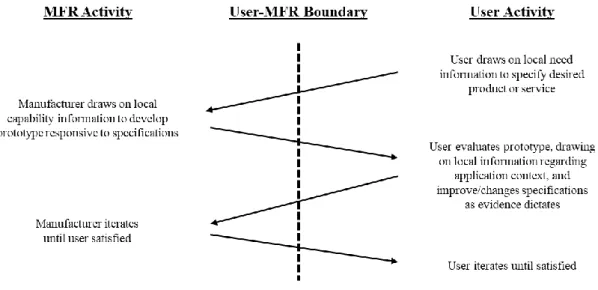
The information and problem-solving capability are two important factors to solve some problems. Basically, the information itself is not easy to acquire and use, especially, when applying them to the different location of origin. “Sticky” is coined by Von Hippel (1994) and this term has an effect on the innovation-related problem-solving.
The definition of “Sticky Information” is that the information used in technical problem solving is costly to acquire, transfer, and use in a new location (Von Hippel, 1994). The stickiness of information is the incremental expenditure required to transfer that unit of information to a specific locus and usable by the information seeker. There are three reasons why information is sticky. First, the nature of the information. Second, The amount of information. Lastly, the attributes of seekers and providers. The nature of the information deals with the difference between tacit and explicit information. Polanyi (1958) explained that the human skills and expertise are often tacit, which can be perceived by observation. It can be transferred by showing an example by master to novice.
21
Figure 2.6 Iterative problem-solving pattern often encountered in new product and service development (Von Hippel, 1994, p. 432)
For the innovation-related problem-solving activity (Figure 2.6) that need to access to multiple locations of sticky information, sometimes, it will be “task partitioned”. Each task uses only one location of sticky information. In the case of the high cost to transfer sticky information, the “Unsticking” is a solution to reduce the stickiness of information. The tacit knowledge, experience, technical expertise are converted into an explicit form, which is easier to transfer.
Barrier of Knowledge Transfer
Szulanski (1996) analyzed the internal stickiness of knowledge transfer within the organization. This research showed the major barriers to internal knowledge transfer which is the knowledge-related factors such as the absorptive capacity of the recipient, causal ambiguity, and the relationship between source and recipient of knowledge.
Transfer of best practice is considered one of the most important issues in management. The performance of different units within the firm indicated that the knowledge utilization needs to be improved. The “practice transfer” inside the firm has a concrete and fairly unambiguous meaning to practitioners. “Practice” means the organization’s routine use of knowledge, which has tacit component, embedded in individual skills, and collaborate the social argument. “Transfer” is used to show the movement of knowledge in an organization. Thus, the “transfer of best practice” is a dynamic exchange of knowledge between the source and recipient units in the organization.
The transfer process can be explained as follows. Firstly, the organization has a need and the knowledge to meet that need. The discovery of the need may trigger a search for potential solutions
22
and lead to the discovery of the superior knowledge. After the need and the potential solutions are identified, then the feasibility of the transfer is explored. Second, the decision need to be made to start transferring knowledge. The transferred practice is adapted to meet the recipient need. This process is diminished when the recipient starts using the transferred knowledge. Third, after recipient starts using the transferred knowledge, the recipient also concerns about identifying and resolving unexpected problems, which could stop the ability to match the post-transfer performance. The recipient will gradually improve to utilize knowledge until the satisfactory level is met. Fourth, after recipient satisfied the result of using transferred knowledge, it will become a routine of the recipient.
There is a cost of knowledge transfer according to the “sticky information” (Von Hippel, 1994). The difficulty of knowledge transfer could be reflected as the cost of transferring information. Szulanski (1996) investigated the origins of internal stickiness, which occur through the four stages of best practice transfer, starting from the efforts to identify needs and identify knowledge, the efforts to bridge communication gap between source and recipient, the struggle to achieve satisfactory performance, and the efforts to achieve and preserve routine use of new knowledge.
1) Characteristics of the knowledge transferred
Causal ambiguity: It happens because the factors of production and the interaction among
them during production are not clear. The key is as Polanyi (1962) suggested that the undefinable portion of knowledge is embodied in highly tacit human skills. The unclear understanding of the feature in a new context where the knowledge is used could cause the causal ambiguity as well.
Unprovenness: The knowledge without a proven record makes it more difficult to induce the
potential recipients to engage in the transfer. The proven record is helpful when selecting knowledge to be transferred.
2) Characteristics of the source of knowledge
Lack of motivation: The knowledge sources may not willing to share an important knowledge
because they think they will lose an ownership, a position of privilege, superiority.
Not perceived as reliable: The sources should be reliable so that they can influence the
behavior of the recipient. It is difficult to initiate the transfer from unreliable sources and the knowledge transferred from that sources could be challenged and resisted.
3) Characteristics of the recipient of knowledge
Lack of motivation: The “not invent here syndrome” makes the recipient reluctant to receive
23
Lack of absorptive capacity: Lacking of the preexisting stock of knowledge may cause the
recipient unable to value and apply new knowledge successfully.
Lack of retentive capacity: It is difficult to integrate the received knowledge if the recipient
does not have the retentive capacity. The integration process cannot continue and then return to the previous status.
4) Characteristics of the context
Barren organizational context: The organization context may have an effect on the transfer
of best practice. Knowledge could be effective in one context but ineffective in another context. Previous studies show that formal structure and systems, sources of coordination and expertise, and behavior-framing attributes of the organizational context have an effect on the number of attempts to transfer knowledge and the outcome of those attempts.
Knowledge Management
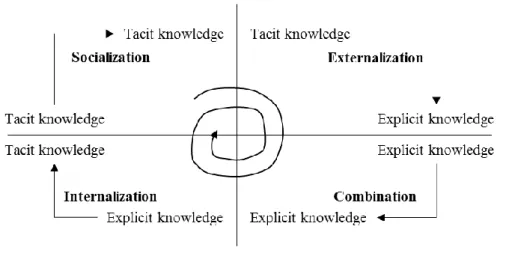
According to Nonaka and Takeuchi (1995), there are two types of knowledge. The first one is called “explicit knowledge” which can be codified and transferred using media such as documents, processes, computer systems, etc. The second one is called “tacit knowledge”. This kind of knowledge is unable to codify, articulate and difficult to transfer. The knowledge can be created and transferred by applying with SECI Model. In SECI model, it is separated into four different phases.
1) Socialization, tacit knowledge is exchanged between people through participation in
social activities. The social gathering such as meeting or brainstorming is important for team members in different R&D sites.
2) Externalization, tacit knowledge is transformed into explicit knowledge by using
metaphors, analogies, or models. The project procedures and knowledge from all R&D sites can be shared during the intensive communication.
3) Combination, the explicit knowledge from several sources are merged into knowledge
system. The combination of concepts, specification formulate prototypes of R&D projects.
4) Internalization, the combined knowledge from the previous phase is internalized into
individuals from explicit knowledge to tacit knowledge through learning-by-doing. The explicit knowledge in the form of documents and manuals become a part of project cultures, which is tacit knowledge.
24
The whole process keeps cycling and accumulating new knowledge like a spiral. This knowledge transfer process is a fundamental process for international R&D project.
Figure 2.7 SECI Model (Adapted from Nonaka and Takeuchi, 1995, p. 62)
To be more specific in R&D project, which is a kind of knowledge-intensive project, they very much rely on the professional knowledge. Some scholars discussed R&D projects from the knowledge transfer perspective (Blecker and Neumann, 2000; Uchihira et al., 2012; Arunagiri et al., 2016) and some of them proposed solutions to mitigate the barriers to knowledge transfer (Milton, 2005; Bruneel et al., 2010).
In addition, it becomes more challenging in the context of globalization when the knowledge has to be transferred across different geographical locations and between people who are from different cultures. The studies on R&D knowledge transfer in the global environment was conducted for a few decades (Boutellier et al., 2000). The studies are mainly about the knowledge transfer by managing the human resource. Because of the hierarchical organization structure and functional of work, the knowledge is separated into several small pieces. Moreover, in globalization, the R&D team members are not working in the same location. These are the reasons of the challenges in managing global R&D projects.
In general, most of the knowledge is tacit knowledge and they are subjective, experiences, know-how, organization routine, values, culture, etc. In order to manage knowledge in global R&D projects, the human resource management is a key because the tacit knowledge is attached to a person and will be manipulated with the human resource management.
Boutellier et al. (2000) have discussed the knowledge management in global R&D projects. There are four perspectives to be considered. First, building bridges between islands of knowledge.