E. Meron\ddagger
Department
of
Energyand EnvironmentalPhysics, BIDR,and PhysicsDepartment,$Ben$-Gurion University, Sede Boker Campus 84990, Israel
$\ln$bistablesystems,the stabilityof frontstmcturesofteninfluencesthedynamics of extended patterns. We
show how thecombinedeffect ofaninstability to curvaturemodulationsandproximitytoapitchfork front
bifurcation leadsto spontaneousnucleationofspiralwavesalong thefront. This effectis demonstratedby
directsimulationsofaFitzHugh-Nagumo (FHN)model and bysimulationsof order parameterequations
for thefront velocityand curvature. Spontaneous spiral-wave nucleationoftenresultsinastate of
spatio-temporal disorder involvingrepeated events of spiral wavenucleation,domainsplittingand spiralwave
annihilation.
I. INTRODUCTION
Spatio-temporal disorderis aubiquitous phenomenon in ex-tended nonequilibrium systems yetthemechanisms
respon-sible for it are only partially explored. A generic
mecha-nism for theonset of disorder inperiodicpattemsconsists
ofphase instabilities followed by the formation of phase sin-gularities whichappear asdislocation defectsorvortices [1].
This mechanism has been observedinnumerical simulations ofthe complex Ginzburg-Landau equation$[2, 3]$, andin ex-periments, e.g. electro-convectionin liquid crystals [4]. A
considerableefforthasbeendevoted toelucidatingthenature
ofthetransition from the regular phase regimetotheregime wherevorticesordefects spontaneouslyappear[5-9]. Other mechanisms involving instabilitiesofperiodicpatterns,
lead-ingtospiral breakup, have been reported recently[10-13]. In this article we present a mechanism for the onset of spatio-temporal disorder associatedwith
front
structures.This type of disorder is illustrated by a numerical solution of a bistable$\mathrm{F}\mathrm{i}\iota \mathrm{z}\mathrm{H}\mathrm{u}\mathrm{g}\mathrm{h}$Nagumo (FHN) typereaction-diffusionsystem(Fig. 1).An almost flatfront,connecting thetwostable
uniformstationarystates,begins traveling throughthe system.
The frontrepresentsan “up”state(black)invadinga“down”
state(white).Initial nonuniform perturbations of the front
po-sition grow intowiggles which nucleatepairsofspiral
waves
(see the Appendix fora differentview of the middle frame in Fig. 1). The solution then evolves intoadisordered state with repeatedeventsofdomain splitting and spiral-wave
nu-cleation and annihilation. Similar phenomena have been ob-servedin experimentsonthe$\mathrm{f}\mathrm{e}\mathrm{r}\mathrm{r}0\mathrm{c}\mathrm{y}\mathrm{a}\mathrm{n}\mathrm{i}\mathrm{d}\mathrm{e}-\mathrm{i}_{\mathrm{o}\mathrm{d}\mathrm{u}1}\mathrm{a}\mathrm{t}\mathrm{e}-\mathrm{S}\mathrm{f}\mathrm{i}\mathrm{t}\mathrm{e}$(FIS) reaction$[14, 15]$.
1I. THENIB FRONTBIFURCATION AND SPONTANEOUS
FRONT REVERSALS
The keytounderstanding the disorder associated with front structuresisapitchfork bifurcation in the velocity ofa propa-gatingfront. The front bifurcationisrepresented by the
equa-tion
$C^{3}-(\lambda_{C}-\lambda)c=0$, (1)
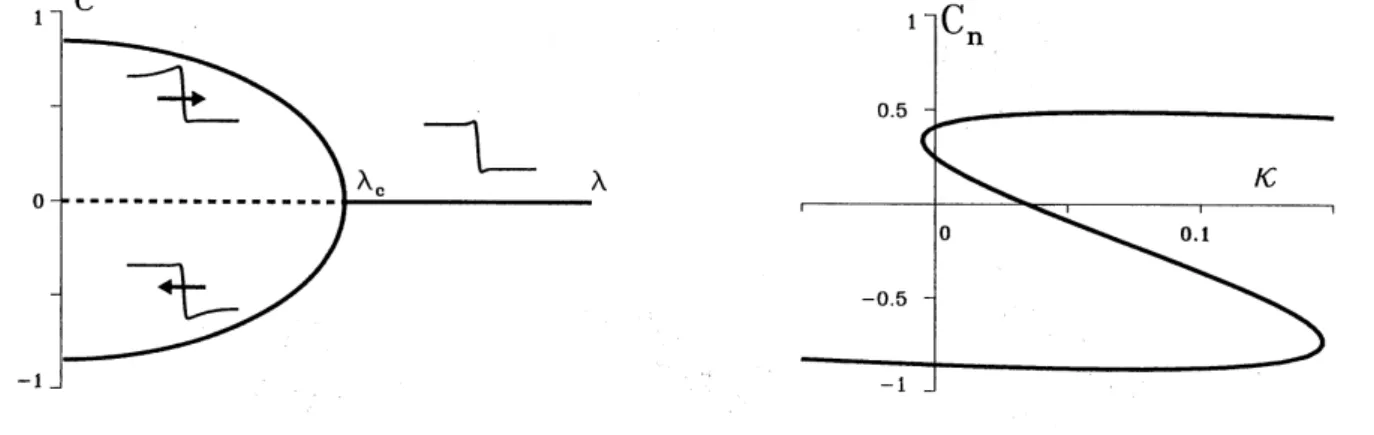
where$C$is the velocity ofaflat front and $\lambda$ is acontrol pa-rameter. Thecorresponding bifurcation diagram is shownin
Fig. 2. Astationary front$(C=0)$becomes unstable belowa
criticalparametervalue, $\lambda=\lambda_{c}$. At thatpointtwonew
sta-ble front solutions appear, representing an up stateinvading
adownstate $(C>0)$ andadownstateinvadingan upstate
$(C<0)$. Hereafter,werefer to these front solutionsasto“UD front”and “DUfront”,respectively.
This type of front bifurcation has been derived for period-ically forced oscillatory systems [16] andfor bistable FHN typemodels[17-19]. Experimental observations of front bi-furcations, or supporting evidence for their existence, have
been reported in Refs. $[20, 21]$ for liquid crystals, and in
Refs. $[22, 23]$ for chemical reactions. The stationary and
counter-propagating frontsaresometimes referredtoasIsing and Blochfronts, respectively, and the bifurcation itselfas a
nonequilibrium Ising-Bloch(NIB)bifurcation$[16, 18]$.
Physical realizations of front bifurcations usually involve perturbations that unfold the pitchfork form of Eq. (1) into[24]
$C^{3}-(\lambda_{c}-\lambda)c+\nu_{1}+\nu_{2}C2=0$ . (2)
An asymmetry between the
up
anddown statesisanexample of suchaperturbation. In the followingweconfineourselvesFIG. 1: The evolution of anunstable front solution connecting theup state (black) to the down state (white) in a bistable FHN reaction-diffusionsystem. Theframes, from left toright, represent the pattern solutionatsuccessivemoments in time.
Perturbations on the flat traveling frontgrow and nucleate spiralpairs along the front line (seethe Appendix foradifferent view of the middleframe). The resulting disorderedstateischaracterized by domain splitting and spiral-wave nucleation and annihilation.
FIG. 2: The pitchfork front bifurcation. At$\lambda=\lambda_{c}$ the
sta-tionary$(C=0)$front solution becomes unstabletoa pairof
counterpropagating traveling fronts. spanned by$C,$$\lambda$ and
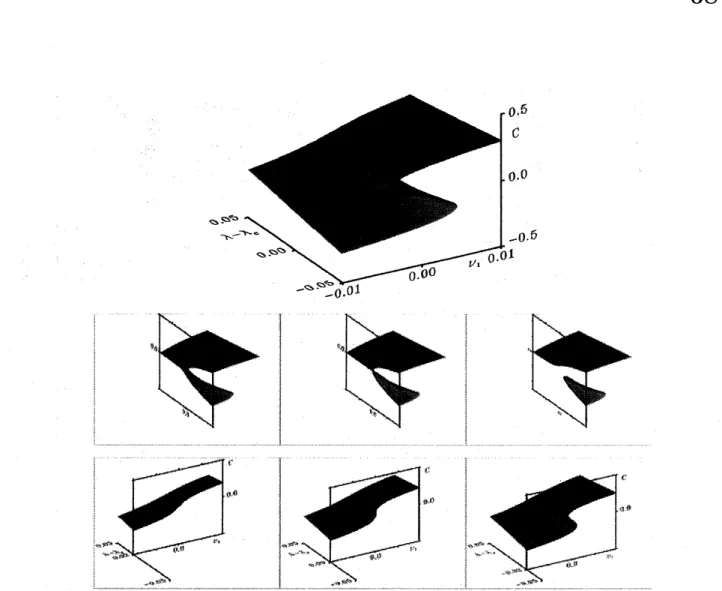
$\nu_{1}$ is shown in Fig.3. Thesignificance of smallvariations of$\nu_{1}$ in the vicinity of the pitchfork bifur-cation point,$\lambda=\lambda_{c},$ $\nu_{1}=0$, isnowevident: perturbations may induce transitions between the upper andlower sheets
andreversethedirection of front propagation. Notice that far-ther from the bifurcation point thevariations of$\nu_{1}$ mustbe largerin ordertoinduce front reversal.
Thedynamics ofasingleflat frontmayalso be changed by slow dynamicalprocessessuchas anapproachtoa boundary, an interaction with another front, or development of
curva-ture. Figure4 shows atypical graph of the normal velocity ofa front, $C_{n}$, versus its curvature, $\kappa$, for fixed $\lambda$ nearthe front bifurcation. The figure
was
obtained using asingular perturbation analysis ofanFHNmodel, assuming slowcur-vature dynamics with respect to the time scale of front
re-versal [25]. The hysteretic shape, similar tothe graph of$C$
versus
$\nu_{1}$for fixed$\lambda$(seeFig.3),suggeststhat front reversals canbeinduced by smallcurvatureperturbations. Sincecurva-ture isan intrinsic dynamicalvariable,reversals of propaga-tiondirectionoccurspontaneouslyasthecurvatureofafront changes.Spontaneous front reversalsincatalyticreactions on
FIG.4:Normal front velocity$C_{n}vs$curvature$\kappa$in the vicin-ity ofthefrontbifurcation. The development of small negative
curvaturemayinducea transitionfromaUDfront$(C_{n}>0)$
toaDUfront$(C_{n}<0)$. $.\mathrm{A}$ ,.
platinum surfaces have indeed been observed forparameters
in thevicinitya front bifurcation[22]. Experimental obser-vations of front reversals induced by boundaries have been reported in[23].
Imaginenow a flat UD front thatis unstabletotransverse
perturbations (i.e. an instability to curvatureperturbations). As the frontpropagates,alternatingsegmentsalong the front acquire negative and positivecurvatures. For parametersthat place thesystemnearthe the frontbifurcation,whereFig. 4
applies, segmentswithnegativecurvaturewill eventually re-versepropagation direction. Such local front reversals involve thecreationoftransition
zones
between the counterpropagat-ing UD and DU fronts. Thesezonesform thecoresofrotating spiralwaves.
Thescenariosketched above providesa heuristic
explana-tionfor the spontaneous nucleation of spiral
waves
in Fig. 1which precedes theonsetof spatio-temporal disorder. Similar
argumentshold for otherintrinsicperturbations suchasfront
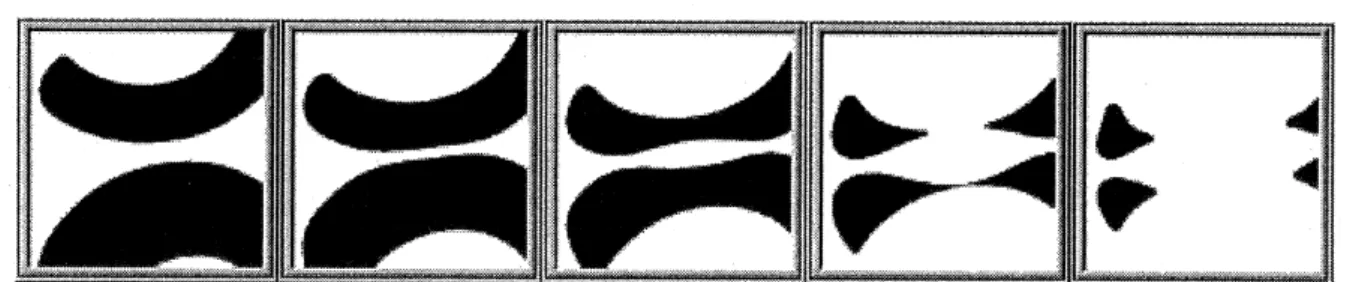
interactions. IndeedFig. 1 includes manyevents where lo-calfront reversalsareinducedby theinteractionsbetween
ap-proaching domains. An example of suchaneventis showninFIG.3:Top: The surface$C^{3}-(\lambda_{c}-\lambda)c+\nu_{1}=0$inthespacespanned by$C,$$\lambda,$$\nu_{1}$(thecuspcatastrophe).First triad: Asection
at$\nu_{1}=0$showing thepitchforkbifurcation(center),andsectionsat$\nu_{1}<0$(left)and$\nu_{1}>0$(right)showing unfoldings of the
pitchfork. Second triad: Sections of the surfaceatconstant$\lambda$ showing the hysteresispoint(center)with single valued(left)and multivalued(right)relationsawayfromthe hysteresispoint.
Fig. 5. Similarprocesseshave beenobserved in experiments
(Fig.6)ontheFISreaction$[14, 15]$.
II..I.
THEDYNAMICS OF FRONT REVERSALSAlgebraic relations like that displayed in Fig. 4areuseful for predictingtheonsetofspiral-wave nucleation: nucleation
eventsbecome feasible whenasingle valued relation becomes
multivalued(orhysteretic). Such relations donot, however, contain information about the nucleationprocess itself. To study the nucleation process a time-dependent approach for thefront dynamicsis needed. Near thebifurcation,the asymp-toticfront dynamicsaregoverned by bothatranslational
de-greeoffreedom andan order parameter associated with the bifurcation: the frontvelocity$C$
.
InRefs.$[26, 27]$ wederivedasymptoticdynamicequationsfor asingleunperturbed
one-dimensional frontusingFHN type models. Theequationsfor
the frontposition,$X$,andvelocity are
$\dot{X}=C$, (3)
$\dot{c}=(\alpha_{C^{-}}\alpha)c-\beta c^{3}$
.
These uncoupledequationsdescribe theconvergenceto
con-stantspeedmotion Ising(zerospeed)andBloch fronts. Order
parameterequations for front propagation inonespace
dimen-sionnear aNIB bifurcation have also been derived in Ref.[28] tostudy the effects of external fixed heterogeneities.
The effect ofcurvature is to couple the two equations in
a way that allows for front reversal. Theequations for the dynamicsofasingle two-dimensional front with smooth cur-vature,$\kappa$,are[29]
FIG. 5: A closer lookatfrontinteractions in the numerical solution of the FHN model from Fig. 1. The repulsiveinteraction
betweenapproaching frontscausesthemtoreversedirection. The reversalis followed by domain splitting.
FIG. 6: Patterns in the$\mathrm{F}\mathrm{e}\mathrm{r}\mathrm{f}\mathrm{o}\mathrm{c}\mathrm{y}\mathrm{a}\mathrm{n}\mathrm{i}\mathrm{d}\mathrm{e}- \mathrm{I}\mathrm{o}\mathrm{d}\mathrm{a}\mathrm{t}\mathrm{e}-\mathrm{s}_{\mathrm{u}1}\mathrm{f}\mathrm{i}\mathrm{t}\mathrm{e}$reaction show interactionsleadingto front reversals followed by domain splittings. Theseimagesarefromexperiments performed in the Center for Nonlinear DynamicsattheUniversity of Texasat
Austin.
and
$\frac{\partial C}{\partial t}=(\alpha_{c}-\alpha)c-\beta c^{3}+\gamma\kappa+\gamma 0+\frac{\partial^{2}C}{\partial s^{2}}$
$- \frac{\partial C}{\partial s}\int_{0}^{S}\kappa C_{n}d_{S’}$, (5)
where$C_{n}$,the normal front velocity,is given by
$c_{n}=C-D\kappa$, (6)
and$s$is the arclength coordinate along the front. In deriving
theseequationsanasymmetry between theupand downstates
has been introduced. Equation (4), for thecurvatureofthe
front,follows from purelygeometricconsiderations$[30, 31]$.
Equation(5),forthespeedof thefront,is validnearthe front bifurcation and the boundary of instabilityto transverse
per-turbations$[25, 29]$. Theintegralterminbothequations
repre-sents“advection” of changesin$C$and$\kappa$from thestretching
of the arclengthover time. Note thatawayfrom the front$\mathrm{b}\mathrm{i}$,
furcation where thetimescaleassociated with frontreversal,
$(\alpha_{C}-\alpha)-1$, isshort,$C$isnolongeraslow variable andcan
beeliminated adiabatically. Foracircularfront,equation(5) then reduces toanalgebraic relation between the normal front velocity anditscurvaturesuch
as
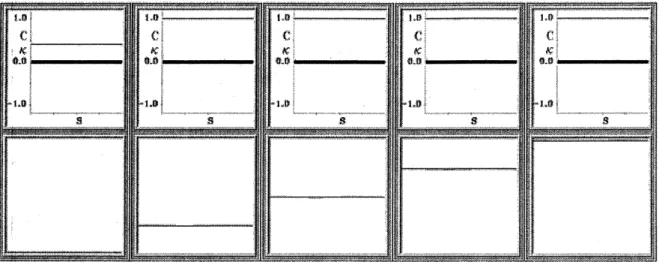
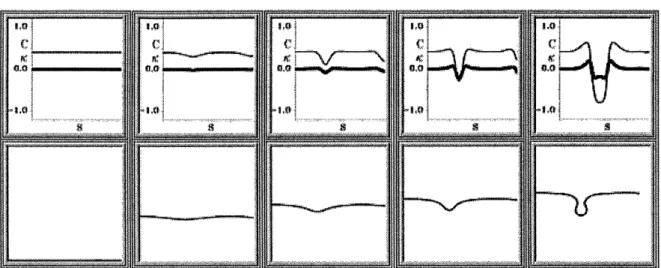
theonein Fig.4.We have computed numerical solutions of Eqs.(4)and(5) starting with an almost flat UD frontas aninitial condition. Figure 7 pertains to parameter values in the Bloch regime
wh$e\mathrm{r}\mathrm{e}$the UD and DUfronts$\mathrm{c}\mathrm{o}\mathrm{e}\mathrm{x}\prime \mathrm{i}\mathrm{S}\mathrm{t}$ and areboth stable to
transverseperturbations. The initial frontconvergestoa flat
UDfrontpropagatingat constantspeed. Crossing the
trans-verse
instability boundarycauses
perturbationson thefronttogrow.Nearthe NIBbifurcation,thegrowingcurvature trig-gers the “nucleation” of a frontsegmentwithopposite velocity
asshownin Fig.8.The frontstructuresin theC-splane,
sep-aratingsegmentswithpositive and negativevelocities,pertain
tospiralwavesin the physical two-dimensional plane.
IV. CONCLUSION
We have presented a new mechanism for spontaneous spiral-wave nucleationin bistable media that leadsto spatio-temporal disorder. Unlike most other mechanisms which
in-volvedestabilization of periodic patterns (see however [32,
33]), this mechanism involves destabilization of
fronts
andmayinducespatio-temporal disorder fromasingle frontstate.
Thedynamicalequations,(4)and(5),for thefrontspeed and curvature,describe theasymptoticbehavior of frontsnearthe front bifurcation and thetransverseinstabilities. These equa-tionscapture the process ofspiral-wave nucleation and can
be used to analyze the transition from the stable curvature
dynamics shown inFig. 7to dynamicsinvolving nucleation eventsshownin Fig. 8. Itwould beinteresting tofind ifan
intermediate parameterrange existswhere the curvature
fluc-tuatesbut
no
nucleationeventsoccur.FIG. 7: A solutiontoequations (4)and(5)when thetwo-dimensional frontis stableto transverseperturbations. The frames
in the toprowshow the timeevolution of$C(s)$ (thin line)and $\kappa(s)$ (thickline). The solutionconvergestoa constant speed
flat$(\kappa=0)$traveling front. The frames in the bottomrowdisplay the corresponding dynamics of the front in the physical
two-dimensionalplane.
APPENDIX
The model used to demonstrate the nucleation of
spiral-vortices in Fig. 1 is a doubly-diffusive version of the $\mathrm{F}\mathrm{i}\mathrm{t}\mathrm{Z}\mathrm{H}\mathrm{u}\mathrm{g}\mathrm{h}$-Nagumo Equations
$u_{t}=\epsilon^{-1}(u-u^{3}-v)+\delta^{-}1u_{x}x$ ,
$v_{t}=u-a_{1}v-a0+v_{xx}$.
Theparameters$a_{0}$and$a_{1}$ arechosen such that theequations
havetwostable uniform solutions(bistable)and$\epsilon$and $\delta$ con-trol th$e$typeand stability of front solutions between those two
stablestates.
Figure9showsacloseup of the middle frameinFig. 1.The
transverseinstability oftheoriginal front solution has already
caused the formationof spiral-vortex pairs along the front. Thespiral-vorticesareidentified with the crossing points of
thezerocontourlines of the$u$ and$v$ fields. At thesepoints
thenormal front velocityiszero. On either side of the
spiral-vortex thefrontpropagatesinopposite directions.
REFERENCES
\dagger Electronic address: aric@lanl. gov
\ddagger Electronic address: $\mathrm{e}\mathrm{h}\mathrm{u}\mathrm{d}\Theta \mathrm{b}\mathrm{g}\mathrm{u}\mathrm{m}\mathrm{a}\mathrm{i}\mathrm{l}.$b9u.ac.il
[1] P.Coullet,L.GiI,and J.Lega, PhysicaD37,91(1989).
[2] P. Coullet, L. Gil,and J. Lega, Phys.Rev. Lett.62, 1619
(1989).
[3] T.Bohr,T.Pedersen,and A. W.Jensen,Phys. Rev. A42,
3626(1990).
[4] I.Rehberg, S.Rasenat,and V.Steinberg, Phys. Rev. Lett. 62,756(1989).
0 128 256
$\mathrm{x}$
FIG. 9: Nucleationofspiral-vortexpairs in the FHN model. Each crossing of thezerocontourlines of the $u$ field (thick
line) and $v$ field (thin line) represents a spiral-vortex that
forms thecoreofarotating spiralwave.
[5] B. I.Shraiman,A.Pumir,W.vanSaarloos,P. C. Hohen-berg, H.Chate,and M.Holen,Physica$\mathrm{D}57,241$(1992).
[6] H. S. Greenside and D. A. Egolf, Phys. Rev. Lett. 74,
1751 (1995).
[7] G.D. Granzow and H.Riecke,Phys. Rev. Lett.77,2451 (1996).
[8] P. Mannevilleand H.Chate,Physica$\mathrm{D}96,30$(1996).
[9] H. Chate and P.Manneville,Physica A224,348(1996). [10] M.Courtemanche and A. T.Winfree,Int. J.Bifurcation
andChaos1,431 (1991).
FIG.8: Asolution to Eqs.(4)and(5)when thetwo-dimensional frontisunstableto transverseperturbations. The framesinthe toprowshow the evolution of$C(s)$ (thin line)and $\kappa(s)$ (thickline). The framesin the bottomrowdisplay the corresponding
dynamicsof the front line in thephysical two-dimensional plane. A smallcurvatureperturbationgrowsand thenegativecurvature
triggers th$e$formation ofaregion where the front speed becomes negative. The boundary points of this region form thecoresof newrotating spiralwaves.
Chaos1,219(1991).
[12] A. Karma,Phys.Rev. Lett.71,1103(1993).
[13] M.B\"arand M.Eiswirth,Phys Rev.$\mathrm{E}48$,R1653(1993).
[14] K. J.Lee, W. D. $\mathrm{M}\mathrm{c}\mathrm{C}\mathrm{o}\mathrm{r}\mathrm{m}\mathrm{i}\mathrm{c}\mathrm{k}$, J. E. Pearson, and H. L. Swinney, Nature369,215(1994).
[15] K. J. Lee and H. L. Swinney, Phys. Rev. $\mathrm{E}51$, 1899
(1995).
[16] P.Coullet,J.Lega,B.Houchmanzadeh,and J.
Lajzerow-icz,Phys. Rev. Lett.65, 1352(1990).
[17] H.Ikeda,M.Mimura,andY.Nishiura,Nonl. Anal. TMA 13,507(1989).
[18] A.Hagberg and E.Meron,Nonlinearity7,805(1994).
[19] M. Bode,A. Reuter, R. Schmeling, and H.-G.Purwins,
PhysLett.A185,70(1994).
[20] T.Frisch,S.Rica,P.Coullet,and J. M.Gilli,Phys. Rev.
Lett. 72, 1471(1994).
[21] S. Nasuno, N. Yoshimo, andS. Kai, Phys. Rev. $\mathrm{E}51$,
1598(1995).
[22] G. Haas, M. B\"ar, I. G. Kevrekidis, P. B. Rasmussen,
H.-H.Rotermund, andG.Ertl, Phys Rev. Lett.75,3560 (1995).
[23] D. Haim, G. Li, Q. Ouyang, W. D. $\mathrm{M}\mathrm{c}\mathrm{c}\mathrm{o}\mathrm{r}\mathrm{m}\mathrm{i}\mathrm{C}\mathrm{k}$, H. L.
Swinney, A. Hagberg, and E. Meron, Phys. Rev. Lett.
77, 190(1996).
[24] M. Golubitsky and D. A. Schaeffer, Singularities and Groups in
Bifurcation
Theory (Springer-Verlag, Berlin, 1985).[25] A. Hagberg and E.Meron,Chaos4,477(1994). [26] C.Elphick, A. Hagberg, and E.Meron,Phys. Rev.$\mathrm{E}51$,
3052(1995).
[27] A.Hagberg, E. Meron,I. Rubinstein,and B. Zaltzman, Phys. Rev. Lett. 76,427(1996).
[28] M. Bode, “Frontbifurcations in reaction-diffusion
sys-tems with inhomogeneous paramters” Submitted to
Physica$\mathrm{D}$(1996)(unpublished).
[29] A. Hagberg and E. Meron, “The dynamics of curved fronts: beyond geometry”, preprint (1996) (unpub-lished).
[30] A. S. Mikhailov, Foundation
of
Synergetics $I:$Dis-tributedActive Systems(Springer-Verlag, Berlin,1990).
[31] E.Meron,Physics Reports218, 1(1992).
[32] M.B\"ar,M.Hildebrand,M.Eiswirth,M. Falcke,H.
En-gel, and M.Neufeld,Chaos 4,499(1994).
[33] J. H. Merkin,V.Petrov, S. K. Scott, and K.Showalter,
Phys. Rev. Lett. 76,546(1996).