Japan Advanced Institute of Science and Technology
JAIST Repository
https://dspace.jaist.ac.jp/
Title
Option-Games and Bayesian MCMC Analyses on Business Development Investment in Eco-system of New Energy Industry in Myanmar
Author(s) Aye, Nyein Nyein; Fujiwara, Takao
Citation 年次学術大会講演要旨集, 33: 451-456
Issue Date 2018-10-27
Type Conference Paper
Text version publisher
URL http://hdl.handle.net/10119/15695
Rights
本著作物は研究・イノベーション学会の許可のもとに 掲載するものです。This material is posted here with permission of the Japan Society for Research Policy and Innovation Management.
2C04
Option-Games and Bayesian MCMC Analyses on Business Development Investment in
Eco-system of New Energy Industry in Myanmar
Nyein Nyein Aye (Toyohashi University of Technology) & Takao Fujiwara (Toyohashi University of Technology)
Abstract: With low levels of electrification in Myanmar, the demand for power is not adequately met. If we want to solve climate change and change our energy infrastructure, we need to be innovative and entrepreneurial in energy generation. This research will help us in examining a possibility of option-games for the assessment of optimizing the firms’ equity between flexibility and commitment. And Bayesian MCMC Analysis will be applied to the parameters estimation between the firm’s revenue and investment cost in the Eco-system for the sustainability of new energy industry.
Keywords: Renewable Energy, Option-Games, Bayesian MCMC Analysis, Regional Development, Sustainability, Cooperation
1. Introduction
Myanmar is naturally endowed with energy resources. But they are so far to fulfill the energy requirements of the community; and much remains to be done in terms of research, experimentation and cost-benefit studies taking priority to the awareness of environmental impacts like pollution, deforestation, floods, and so on. At such time, sustainable energy has turned into one of the most promising ways to handle the challenges of energy demand problems of numerous consumers worldwide. Moreover, Cooperation in energy has been a major concentration of future initiative for all developed and developing nations.
If we want to solve climate change and change our energy infrastructure, we need to be innovative and entrepreneurial in energy generation in order to meet the increase in energy demand in the 21st Century. In this condition, technology investment is also important for the industrial development as a result of economic progress of Myanmar.
My research aims to solve the following questions: 1) What kinds of investment strategies make possible
for the financial performance of new energy industry in the competitive market?
2) How can the industry survive in valley of death during the period of negative profits?
3) How can R&D investment optimize the trade-off between sustainability and eco-system investment of energy development?
The first objective of this research is to evaluate the potential of technological new energy industry and support them in eco-system as entrepreneur.
And the second one tends to develop an appropriate model for R & D investment in innovative and initiative production technology for the implementation of the
future plan of energy efficiency, conservation and sustainability.
Finally it aims to search the implications for invitation of foreign technology and capital investment from a perspective of win-win relationship and mutual benefits for regional development.
2. Myanmar Energy Status
Despite Myanmar sitting on huge energy resources, currently, only 39 % of Household has access to electricity but 61% not yet [1]. Only 57.01% of total population can use electricity in 2017. As of 2014, only 16% of rural households had a connection to electricity power among them [2].
According to Figure 1, residential energy consumption mainly depends on biomass and traditional fuel woods. Energy mix in electricity supply of commercial energy can be seen in Figure 2.
The local energy demand is increasing nowadays and the ongoing enhancement and expansion of Myanmar’s energy (electricity) industry is thus an important part of enabling economic growth to occur. Myanmar urgently needs to increase the electricity generating capacity to meet ambitious economic development targets and accommodate rising power demands from new foreign and local investment projects.
The 2015 Myanmar Energy Master Plan is put forward by the Asian Development Bank (ADB) and Myanmar Ministry of Electricity and Energy (MOEE) in order to analyze energy demand development from 2014 to 2035 [3]. The plan especially intends to promote rural renewable energy purposes. There are other development partner supports as World Bank Group, Japan International Cooperation Agency (JICA), German Development Bank, Department for
International Development, The Government of
Thailand and The Government of Norway.
Source: Current Status of Oil and Gas Sector, MOEE, Myanmar
Figure 1: Primary Energy Supply (2014 15) KTOE
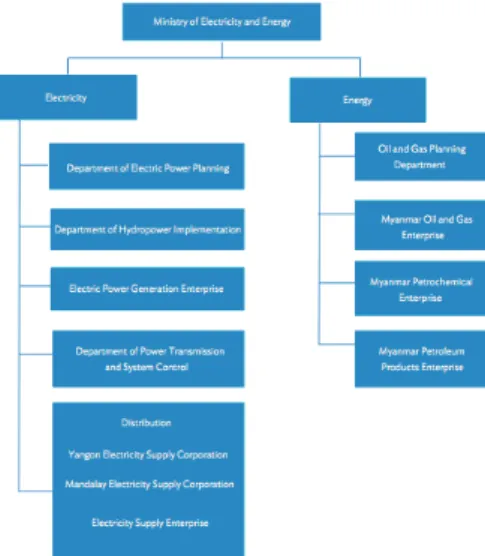
Source: Nyein Nyein Aye, Master Thesis in 2013 Figure 2: The Energy Mix in Electricity Supply (2013) Ministry of Electricity and Energy (MOEE) is taking the responsibilities of electricity, oil & gas and renewable energy (Hydro, solar, bio-fuel & geothermal) sub-sectors. Myanmar has a unified interconnected transmission and distribution network covering some parts of the country. There are also some off-grid distribution systems. Shortage of electricity, unstable voltage, and frequent blackouts are the common occurrence, indicating that demand by far still outstripped supply. The national grid system can be seen in Figure 4.
Source: Ministry of Electricity and Energy, 2016 Figure 3: Organizational Structure of Ministry of Electricity and Energy
Source: Myanmar Energy Summary, National Energy Grid Index
Figure 4: The National Grid System 3. Research methodology
A new energy industry is defined as the portfolio of real options by considering that the renewable energy resources are ample and investment opportunities that will result in eco-system and commercialization later [4]. In this research, a combination of real options, game theory, and Bayesian Markov Chain Monte Carlo (MCMC) Analyses will be utilized to the assessment of firm’s value for the overcoming of “Valley of Death” and unforeseen risk impact [5] & [6] as the research methodology.
I have a plan to build and apply Real Option Model for the investment in promising but high risky projects as eco-technology start-ups for their research and development process.
And then, I intend to integrate them with game theoretical aspects for the strategy to be able to compete with the global large energy companies. Thus, game theory is also necessary to optimize the cluster growth of eco-system of new energy start-ups among competitive players.
In order to understand and verify the importance of growth option value for the eco-system of new energy start-ups to carry out the R&D investment in the “Valley of Death”, the data analysis will be made by the utilization of Bayesian Markov Chain Monte Carlo (MCMC) Analysis [7].
4. Nature of Industry and Economic Assessment on its Power Generation Project
Energy industry is one of the most capital intensives among high-tech industries. Moreover, strategic investment decisions involve a great deal of uncertainty in this dynamic and competitive environment. To capture the need for managerial flexibility is especially
51% 17%
17%
13%2%
Biomass Hydro Oil & Petroleum Natural Gas Coal
70% 20%10%
important when investments are in such an irreversible situation and under uncertainty [8]. Companies must make huge capital investments with a corresponding high degree of risk because falling behind competitors means dropping out of the game. Rapid responses to competition and technology improvements are critical to success in this industry. In this section the evaluation on the project will be made by using the combination of real options and game theory to analyze the investment strategies with competitor in the market for the such type of energy industry.
Two-Stage Option-Games Model for Optimizing between Flexibility and Commitment Values
Main Concepts and Model Framework
Notes:
defer (D) by firm A or B. moves.
The combination of competitive decisions (A or B) and market demand moves ( may result in one of the following market structure game outcomes:
C : Cournot Nash quantity / price competition equilibrium outcome
S : Stackelberg Leader (SL)/Follower (SF) outcome
M : Monopolist outcome A : Abandon (0 value)
D : Defer / stay flexible (option value)
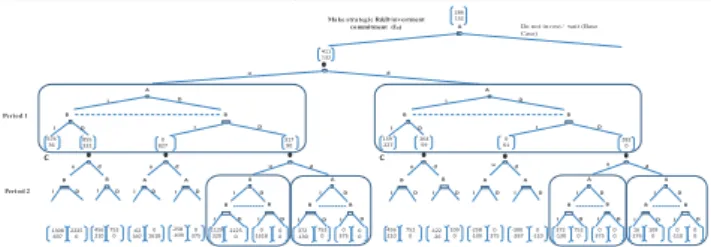
Figure 5: Two-Stage Investment Game under Different Market Structures
Basic set up is two-stage game which has two players, A and B. At first stage, initial investment is made only by Player A as the pioneer or he will choose not to invest (called Base Case). First stage is the basic research phase of the project. During the second stage, the commercialization phase, the two players will make endogenous competition. There are two cases for such game: 1) Base Case of no R&D investment and 2) The Case of Making Investment by proprietary or shared strategy. In second stage, Base case assumes that the firms will continue to use the existing production technology from the basic research phase. The case of making R&D investment is made for development of a new, cost-efficient or upgrade of technological process.
Game model and its valuation
Here it is assumed a two-player game between player A and B (new entrant in renewable energy generator and conventional firms). To illustrate the valuation process,
firm A can make the decision to invest its first stage initial investment or not to invest with its initial technological investment, I0 = 125 and follow-up
expansion investment I1
with its binomial parameters up and down moves of u = 1.21 and d = 1/u = 0.83. The risk-adjusted discount rate, k = 0.15 while risk-free interest rate, rf = 0.075. Each
perating cost, ci = 10 and cj = 10. If constant
asset payout yield, , risk neutral probability is:
The equations for the results of the game are as follows: General equation for Cournot-Nash equilibrium (C) is:
In 2nd period, general equation of monopoly (M) is:
Equation of the Stackelberg leader equilibrium is:
Equation of the Stackelberg follower equilibrium is:
At 1st period, general equation of the monopoly (M) is
meanwhile monopolist profit for 1st period is:
As for the general equation of deferment (D) is:
By the backward binomial risk-neutral valuation, the expected equilibrium value at the first stage (t = 0) is:
Scenarios for the Game
(i) In Base Case, the two firms would have the symmetric operating costs based on 1st stage old technology, ci = cj.
(ii) In Propriety Case, pioneer A achieves a degree of propriety cost reduction, 0.5 times in 2nd stage, thus
ci < cj.
(iii) In Shared Strategy, costs are symmetric and they can exploit the cost reduction to certain amount
st stage cost-effective
technology, ci = cj and thus less than Base Case.
After calculating numerical results and constructing the strategic game event trees for each case, the comparison of their final outcomes for propriety and shared investment cases will be made relative to base case. In each case, the competitive strategy of each firm consists D A I I I D I D I D I D I D I D I D I D A A A A A A A A u d u d u d u d u d u d A I D I D I D B B B B C C D I D A u d
Make strategic R&D
Investment commitment (I0) Do not invest / wait (Base Case)
A I D B B B B A A B B B B A I D I D I D S M S M S M S M C M M A C M M A S M S M S M S M C M M A C M M A I D I D I D I D I D I D I D I D Period 1 Period 2
of mapping the information set about its competitor’s
actions and the development of market demand to an optimal investment action by the firm.
(i) Base Case Illustration
It is the game where new entrant firm A does not make a first-stage strategic investment that results in a deterministic operating cost advantage in the second stage and firm B is a follower. The base case value is symmetric for both firms when no one invests on technological development project. Then both payoff are identical at (61, 61) for both firm as illustrated in the Figure 6 below.
Figure 6: Base Case Game Model (ii) Propriety Strategy of Investment
In this case, Firm A will make its initial investment at 1st stage as the pioneer and as the consequence, A gain
the right of competitive advantage by reducing its total cost at 2nd stage. And thus, there are asymmetric costs
between pioneer firm A and follower B. Specifically, the operating cost of firm A is reduced from 10 to 5 (cA
=5). But, it remains at 10 for firm B (cB = 10). The game
result can be seen in Figure 7.
Figure 7: Propriety Investment Model in two-Stage Game As the result of this strategy, the rival firm without initial investment (B) tends to decrease the NPV with the expansion of the cost effect of the pioneering firm (A) as an initial investor. In this way, the bigger the cost reduction effect, the more advantage for the pioneer firm against its rival company is possible.
(iii) Shared Investment Case
Under this strategy, there is no mean to benefit from initial investment and pioneering firm (A) shares development findings with the rival firm (B) with the advantage of 50% cost reduction effect, Ci = Cj = 5. The other values remain unchanged and calculated equilibrium values can be checked in Figure 8.
Figure 8: Shared Strategic Investment Game
The open market strategy strengthens the competitor’s position and enhances its incentive to respond aggressively in the future. As a consequence of this strategy, the pioneer firm A becomes disadvantageous compared with its base case of no investment.
Figure 9: Optimal Actions between Base Case and Operation expansion Investment
Proprietary Investment vs. Base Case
According to Panel A of Figure 9, firm A may use the up-front R&D investment to strengthen its strategic position in second stage and consequently increase its relative market share. Pioneer firm A should make the basic research investment in first stage. It should then make a follow-on commercialization investment in second stage for high demand and it should retain a flexible wait-and-see position for the lower level of demand. The asymmetry (propriety) investment clearly influences each firm’s reaction function and end-node equilibrium payoffs values.
Share Investment vs. Base Case
As seen in Panel B of Figure 9, firm A should not invest in early stage, but should rather defer investment while retaining its flexibility and; attaining the base case equilibrium values of (61, 61). In summary, investing in basic research as the pioneer may create a strategic disadvantage for firm A by paying the cost of creating valuable investment opportunities for competition or by enhancing the competitor’s ability for the incentive to respond aggressively in the future.
5. Bayesian Inferences on Power Generation Business
Energy industry is one of the most capital intensives among high-tech industries. Here, the revenue analysis on such kind of capital investment project will be made by using Bayesian MCMC Analysis. In this section, I will focus on Japan’s electric power business to search
B B A B B A A B B A A B B A B B B B A B B A A B B A S uu M uu S ud M ud S uu M uu S ud M ud S ud M ud S dd M dd S ud M ud S dd M dd C uu M uu M uu A uu C ud M ud M ud A ud C ud M ud M ud A ud C dd M dd M dd A dd 659 179 33 -133 179 659 -133 33 552552 0 1617 -4 -4 0 367 33 -133 -208 -300 -133 33 -300 -208 -4 -4 0 367 -218 -218 0 -117 1617 0 0 1617 367 0 0 367 1617 0 0 0 367 0 0 0 367 0 -117 0 0 367 0 -117 367 0 0 0 -117 -0 0 0 212 212 55451 51554 158 158 -137-137 570 57 0 00 61 61 I D I D u d (Base Case) C C u d u d u d u d u d u d I D I D I D I D I D I D I D I D I D I D I D I D I D I D I D I D I D I D I D I D I D I D I D I D Period 1 Period 2 commitment (I0) B B B B A A B B A A B B A B B B B A A B B A A B B A A S M S M S M S M C M M A C M M A S M S M S M S M C M M A C M M A 1308 697 22250 4562107520 397-6216180 -109-2583750 112932022250 16180 00 -1303727520 3750 00 210456752 0 -122-261090 -109-258 3750 -300-287-110 0 372-130752 0 3750 0 0 -276161090 -1100 0 0 676 36 855 332 8270 31790 159 -227 264 59 0 61 282 0 411 132 I D I D u d
Make strategic R&D investment
commitment (I0) Do not invest / wait (Base Case) C C u d u d u d u d u d u d I D I D I D I D I D I D I D I D I D I D I D I D I D I D I D I D I D I D I D I D I D I D I D I D Period 1 Period 2 286 132 u2 ud u2 ud u2 ud ud d2 ud d2 ud d2 B B B B A A B B A A B B A B B B B A A A A A A B B A A SM SM SM SM CM M A C M M A SM SM SM SM C M M A C M M A 962 331 226 -40 331 962 -40 226 822 822 0 2225 168 168 0 742 226 -40 -95 -198 -40 226 -198 -95 168 168 0 742 -118 -118 0 109 2225 0 0 2225 742 0 0 742 2225 0 0 0 742 0 0 0 742 0 109 0 0 742 0 109 742 0 0 0 109 0 0 0 426 426 739 93 93 739 340 340 -7 -7 344 0 0 344 47 47 150 150 I D I D u d
Make strategic R&D investment
commitment (I0) Do not invest / wait (Base Case)
C C u d u d u d u d u d u d I D I D I D I D I D I D I D I D I D I D I D I D I D I D I D I D I D I D I D I D I D I D I D I D Period Period 25 150 A A 61 61 u d
Do not invest / wait (Base Case) C0 I B B A 212 212 554 51 51 554 158 158 I D I D D B B A -137 -137 57 0 0 57 0 0 I D I D I D 411 132 B B A B B A 676 36 855 332 0 827 317 90 159 -227 264 59 0 61 282 0 I D I D u d
Make strategic R&D investment commitment (I0)
I D I D I D I D
286 132
Panel A: Propriety Investment and Base Case
150 150 B B A B B A 426 426 739 93 39 739 340 340 -7 -7 344 0 0 344 47 47 I D I D u d
Make strategic R&D investment commitment (I0)
I D I D I D I D
61 61
u d
Do not invest / wait (Base Case) I B B A 212 212 554 51 51 554 158 158 I D I D D B B A -137 -137 57 0 0 57 0 0 I D I D I D
Panel B: Shared investment and Base case
61 61
CS CS
CP M/SP
for the possibility of efficient and secure energy generation and supply in Myanmar.
Electricity Review in Japan
Electric power companies in Japan are committed to developing an optimal combination of power sources including renewable energy, thermal and nuclear power in order to provide electricity for modern living in a stable manner at the lowest prices. Hydroelectric, geothermal, solar, wind, and biomass energies are all clean and renewable. Electric utilities are striving to develop them for the decarbonization of energy on the supply-side. Especially, it is developing mega-solar power generation in large scale. According to Chubu Electric Power business, Japan stands for world’s No. 3 in solar power.
Source: Electricity Review Japan, 2017
Figure 10: Amount of Generating Capacity (Renewable Energy) in 2017
Current Financial Situation and Electricity Tariffs in Myanmar
According to Myanmar Times, the government’s suffers from net income losses every year at current electricity prices. If the government can reduce these losses, it would enable the government to build the power stations, lines and sub-stations.
1MMK = 0.0006USD on 8th September, 2018
Source: Current Status of Oil and Gas Sector, MOEE Table 1: The Electricity Tariffs in Myanmar
Revenue Analysis on Electricity Company in Myanmar Based on the current electricity tariffs for the households and percentage of households who can use electricity, I will make Bayesian revenue analysis for its economic assessment to endure and overcome financial deficit period.
Company’s expected revenue can be calculated from: E[R] = 35p35 + 40p40 + 50p50 + 0p0
The analysis is made for the purpose of the electricity access promotion to more households by the Bayesian MCMC analysis by Python Programming. By the use of Dirichlet/Multinomial model, we can see the result of the revenue analysis in Figure 12.
Figure 11: Posterior Distribution of the Probability of user rates by electricity tariffs
As we see in above figure, there is still uncertainty in probabilities of user rates and so there will also be uncertainty in our expected value. In figure, the base price of MMK35 per unit for the electricity usage of 1 to 100 units has the highest probability indicating that most of the households use the electricity between 1 to 100units. The second one is MMK40 per unit which indicates some households use over 100 units and a few households’ electricity usage is over 200 units per month. And very little households don’t use electricity at all. It may be because of some reasons as they are cut to use electricity by the company due to the absence of paying monthly usage fee, leaving their homes, etc.
After we had estimated our parameters, then we passed them thorough the expected revenue function to guess power company’s real financial situation. We can see from Figure 12 below that the expected revenue is likely between MMK39.25 billion and MMK39.55 billion, unlikely to be outside this range.
Figure 11: Posterior Distribution of Expected Revenue
Myanmar needs to carry out the infrastructure development and lots of capital investment in electricity sector. But, there is still necessity as the clarification of difference between electricity productivity and such infrastructure investment willingness by the scale of firm’s net income for survival probability. On the other hand, Myanmar government should try to extend power access to other off-grid regions and households by reducing the rate of loss to power leakage. If so, it will also raise the firm’s revenue to certain amount.
6. Conclusion and Implication
In the new dynamic competitive landscape that high-tech and other industries are facing today, it becomes investment programs, allowing management to change the amount, rate, timing or scale of investment in response to new, unexpected developments and competitive moves. The combined framework of real options and games approach to evaluating competitive strategies can help guide managerial judgment in deciding whether and when it is appropriate to grow locally or globally on its own, and which participation in a network or strategic alliance is the preferred route. Myanmar commercial energy production and supply manly depends on hydropower projects which have some negative impacts on the natural environment and climate changes. At that time, solar electricity is an interesting alternative in the dry zone like Myanmar as a backup to hydroelectricity and for the disaster risk management from building of dams for hydropower generation.
Especially implementation of solar power project is totally possible if there are financing alternatives available at low interest rates from international development banks keen to invest in renewable energy projects and from national Export-Import banks or foreign investments eager to support their manufacturers. The analysis from Bayesian perspective found that energy industry could continue their business development investments in ‘Valley of Death’ as negative financial period under such financial crisis. At that time, firm’s revenue as the sort of real options can
be guideline to facilitate the risky but promising investments.
The integration of real options, game theory and Bayesian method can be important for evaluating the merits of investment under uncertainty, competition, and information asymmetry [7].
Japan electricity business has expressed on its web-page that they are striving for strengthening international communication and cooperation for environmental conservation in the aspect of electric power generation and supply. Moreover, they said that they are also sharing Japan’s top-level environmental technologies with the World. On the other hand, JICA is supporting loans and aids to Myanmar for her development including power sector. By cooperating between Japan and Myanmar, I propose the result to appear strategic energy productivity and supply from a perspective of ecology and quality of life in Myanmar as a pioneer. References
[1] Current Status of Oil and Gas Sector, Ministry of Electricity and Energy (MOEE), Republic of Union of Myanmar,
https://eneken.ieej.or.jp/data/7392.pdf (accessed date - 6th May, 2018)
[2] Electricity to Transform Rural Myanmar,
http://www.worldbank.org/en/news/feature/2015/0 9/16/electricity-to-transform-rural-myanmar
(accessed date - 7th May, 2018) [3] Myanmar Energy Master Plan,
https://www.iea.org/policiesandmeasures/pams/my anmar/name-161523-en.php(accessed date – 7th
May, 2018)
[4] Copeland TEA, 2001, V. Real options. Texere: New York, NY
[5] Gibbons, R, 1992, Game Theory for Applied Economists, Princeton University Press
[6] Davidson-Pilon C, 2016, Bayesian Method for Hackers: Probabilistic Programming and Bayesian Inference, US
[7] Fujiwara, T, 2016, Bayesian MCMC Analysis on R&D Investment of Biotech Start-up in the “Valley of Death”, Technology Transfer and Entrepreneurship 3(2):119-130
[8] Schwartz, Eduardo S. and Trigeorgis, L., 2001, Real Options and Investment Under Uncertainty, Massachusetts Institute of Technology, The MIT Press, Cambridge, Massachusetts, London, England