Japan Advanced Institute of Science and Technology
JAIST Repository
https://dspace.jaist.ac.jp/
Title
Thermal expansion of single-walled carbon
nanotube (SWNT) bundles: X-ray diffraction
studies
Author(s)
Maniwa, Y; Fujiwara, R; Kira, H; Tou, H; Kataura,
H; Suzuki, S; Achiba, Y; Nishibori, E; Takata, M;
Sakata, M; Fujiwara, A; Suematsu, H
Citation
Physical Review B, 64(24): 241402-1-241402-3
Issue Date
2001-11
Type
Journal Article
Text version
publisher
URL
http://hdl.handle.net/10119/3359
Rights
Yutaka Maniwa, Ryuji Fujiwara, Hiroshi Kira,
Hideki Tou, Hiromichi Kataura, Shinzo Suzuki,
Yohji Achiba, Eiji Nishibori, Masaki Takata,
Makoto Sakata, Akihiko Fujiwara, and Hiroyoshi
Suematsu, Physical Review B, 64(24), 241402,
2001. "Copyright 2001 by the American Physical
Society."
http://prola.aps.org/abstract/PRB/v64/i24/e241402
Thermal expansion of single-walled carbon nanotube
„SWNT… bundles: X-ray diffraction studies
Yutaka Maniwa,1Ryuji Fujiwara,1Hiroshi Kira,1Hideki Tou,1Hiromichi Kataura,1Shinzo Suzuki,2Yohji Achiba,2Eiji Nishibori,3Masaki Takata,3Makoto Sakata,3Akihiko Fujiwara,4 and Hiroyoshi Suematsu4,*
1Department of Physics, Tokyo Metropolitan University, Minami-osawa, Hachi-oji, Tokyo, 192-0397, Japan 2Department of Chemistry, Tokyo Metropolitan University, Minami-osawa, Hachioji, Tokyo 192-0397, Japan
3Department of Applied Physics, Nagoya University, Nagoya 464-8603, Japan
4Department of Physics, School of Science, University of Tokyo, 7-3-1 Hongo, Bunkyo-ku, Tokyo 113-0033, Japan 共Received 28 May 2001; revised manuscript received 20 August 2001; published 28 November 2001兲 Thermal expansion coefficient in single-walled carbon nanotube bundles was determined as (⫺0.15 ⫾0.20)⫻10⫺5 (1/K) for the tube diameter and (0.75⫾0.25)⫻10⫺5 (1/K) for the triangular lattice constant
by means of x-ray scattering between 300 K to 950 K. The value for the intertube gap was (4.2⫾1.4) ⫻10⫺5 (1/K), which is larger than 2.6⫻10⫺5 (1/K) for the c-axis thermal expansion in graphite. The results
reveal the presence of a remarkably larger lattice anharmonicity in nanotube bundles than that of graphite. The small value for the tube diameter is consistent with the seamless tube structure formed by a strong covalent bond between carbon atoms comparable to that in graphite.
DOI: 10.1103/PhysRevB.64.241402 PACS number共s兲: 61.10.⫺i, 61.10.Nz, 61.46.⫹w, 65.80.⫹n
Single-walled carbon nanotubes 共SWNTs兲 can be ob-tained, for example, in soot after arc-discharge or laser abla-tion of graphite containing metal catalyst.1–5 Transmission electron microscopy 共TEM兲 and x-ray diffraction 共XRD兲 measurements of the soot clarified that the tubes are close-packed into bundles and form a triangular lattice.4 Thermal expansion of the lattice constant and tube diameter is inter-esting because it gives us the nature of carbon-carbon bond and intertube interaction in the SWNT bundles. However little has been known so far experimentally. In the present note, we report, to the best of our knowledge, for the first time a determination of the thermal expansion coefficient for both the tube diameter and triangular lattice constant of an SWNT bundle by means of X-ray diffraction 共XRD兲.
The soot containing SWNTs was prepared by a laser ab-lation of a carbon rod including a Ni-Co catalyst.6 The ob-tained soot was purified by oxidation in H2O2 solution for two hours. After that, the sample was treated in hydrochloric acid to remove the catalyst. XRD data were collected using a synchrotron radiation source at beam line BL02B2 of SPring-8 and BL1B of KEK PF in Japan. The x-ray wave-length is 1.00 Å. In the first measurement, the sample was placed in a furnace with a beryllium window and evacuated during the measurement. In the second measurement where the temperature was controlled using a heat-gun, the sample was sealed in a glass capillary after being well evacuated at
⬃800 K.
Figure 1 shows the temperature 共T兲 dependence of the XRD patterns in the first measurement. On the large back-ground signal, we can see diffraction peaks due to the SWNT bundles. The共10兲 reflection from the triangular lattice shows a strong T-dependence. The peak intensity, which was nor-malized by the 共002兲 reflection of impurity graphite, in-creases rapidly above 700 K with increasing T, as shown in Fig. 2. The onset of the 共10兲 peak correspondingly shifts toward the lower 2 side. Such behaviors are well under-stood by desorption of the materials, such as O2, N2, H2O, and other hydrocarbons, from the bundles with increasing
T.7–9When the temperature was lowered, the peak intensity
was almost constant because the desorption has almost com-pleted. After this measurement, the sample was heated again. The XRD patterns, in this case, were very similar to those for the decreasing temperature, as expected.
Figure 3 shows the T-dependence of XRD patterns for the well heat-treated sample sealed within the capillary, where Q is the amplitude of the scattering wave vector defined by Q
⫽4sin/. Because the sample has been well heated under a dynamic vacuum, the XRD patterns were essentially the same for the increasing and decreasing T. The graphite共002兲 peak of the impurity shows a remarkable T-dependence and the estimated thermal expansion coefficient of interlayer spacing is 2.6⫻10⫺5 (1/K), consistent with reported values for graphite.10In contrast, that of the SWNT sample may be found to be very weak, indicating that the thermal expansion
FIG. 1. Temperature dependence of XRD patterns in an SWNT bundle. The sample was placed in a furnace and evacuated to ⬃10⫺6 Torr during the measurements. The x-ray wavelength is
⫽1.0025 Å. The peaks denoted by * are not due to the sample. Left and right figures show the measurements performed with in-creasing and dein-creasing temperature, respectively.
RAPID COMMUNICATIONS PHYSICAL REVIEW B, VOLUME 64, 241402共R兲
of the SWNT bundle is much smaller than that for the graph-ite interlayer spacing.
Now, we simulate the XRD patterns of SWNT bundle in order to estimate the thermal expansion coefficient for the tube diameter and lattice constant. Here we use a homoge-neous charged cylinder model for each tube, which is closed-packed into a triangular lattice.4It should be noted that this model cannot include the ‘‘in-plane’’ carbon-carbon bond structures, although it can reproduce the low Q diffraction intensity which gives us information on the tube diameter and lattice constants.
Figure 4 demonstrates how to obtain the XRD pattern from the simulation. The diffracted intensity is a multiplica-tion of the tube form factor, Bragg peak intensity, and Lor-entz factor. In the SWNT materials, the Bragg peaks are so broad that the resultant XRD pattern is strongly modulated by the tube form factor given by the zeroth-Bessel function,
J0(RQ). Therefore, because the Bessel function has the nodes whose position is inversely proportional to the tube diameter 2R as shown in Fig. 4, the dips (Qdip) in the
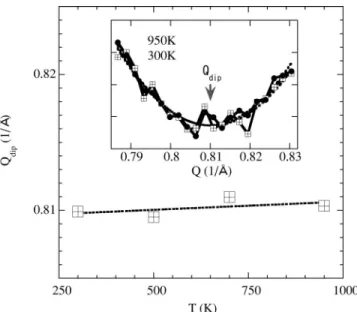
ob-served pattern, corresponding to the nodes of J0(RQ), can give us the mean diameter with an accuracy of⬃0.1%. Fig-ure 5 shows the T-dependence of Qdip, giving␣D⫽(⫺0.15
⫾0.20)⫻105 (1/K) for the thermal expansion coefficient of the tube diameter. This is compared with the in-plane values, (0⫾0.1)⫻105 (1/K) in multiwalled carbon nanotube11 in the same temperature domain, and also those for the in-plane thermal expansion in graphite.10
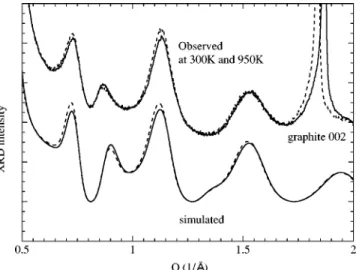
Assuming the zero thermal expansion for the tube diam-eter, we simulated the XRD patterns for several values for the thermal expansion coefficient for the triangular lattice constant. From the comparison with those taken at 300 K and 950 K experimentally, we obtained ␣L⫽(0.75⫾0.25)
⫻10⫺5 (1/K) as the most probable value for the averaged
thermal expansion coefficient between 300 K and 950 K. The comparison between the simulated patterns and the observed ones is shown in Fig. 6.
FIG. 2. The共10兲 peak intensity, normalized by the 共002兲 peak intensity of graphite contained in the sample as an impurity, as a function of the sample temperature.
FIG. 3. Temperature dependence of XRD patterns in SWNT bundle. The sample was sealed within a glass tube after well evacu-ated at⬃800 K. The x-ray wavelength is ⫽1.0002 Å. The mea-surements were performed with decreasing temperature.
FIG. 4. Demonstration how to construct the simulated XRD pattern. Dashed line shows the squared zeroth-Bessel function. Bot-tom is the Bragg peak broadened by an appropriate amount.
FIG. 5. Temperature dependence of the Qdip around Q ⫽0.8 (1/Å), corresponding to the node of the tube form factor, J0. Inset shows examples of the observed data around Q⫽0.8 (1/Å). The Qdipwas determined by a least-squared fit to the data.
RAPID COMMUNICATIONS
YUTAKA MANIWA et al. PHYSICAL REVIEW B 64 241402共R兲
The estimated absolute values for the tube diameter and lattice constant in this simulation are 2R⫽13.62⫾0.01 Å and a⫽16.6⫾0.1 Å at 300 K, respectively. The obtained tube diameter is consistent with a rough evaluation from the radial breathing mode in Raman spectra,⬃14 Å. The inter-tube gap, d⫽a⫺2R, is 3.0 Å. The corresponding thermal expansion for the gap is estimated to be ␣g⫽4.2
⫻10⫺5 (1/K), using a relation ␣
L⫽(2R␣D⫹d␣g)/(2R
⫹d)⬃d␣g/(2R⫹d). This value is substantially larger than
2.6⫻10⫺5 (1/K) along the c-axis of graphite. Because the thermal expansion is related to lattice anharmonicity, this result indicates that the anharmonicity in SWNT bundle is larger than that in graphite.
In the present analysis, it should be noted that the used values for the tube diameter and the lattice constant are ‘‘av-eraged’’ values over the sample and did not take account of the distribution.12 Thus, the simulated patterns could not completely reproduce the observed ones. For example, the fitting around Q⬃0.8 (1/Å) in Fig. 6 seems to be improved by taking into account the existence of the bundles with dif-ferent tube diameters and lattice constants. However, we be-lieve that such a more sophisticated treatment would give essentially the same thermal expansion coefficients as the present analysis.
In conclusion, the thermal expansion of the tube diameter and lattice constant were determined as (⫺0.15⫾0.20)
⫻10⫺5 (1/K) and (0.75⫾0.25)⫻10⫺5 (1/K), respectively.
The small coefficient for the tube diameter indicates the strong carbon-carbon bonds comparable to that of graphite. The thermal expansion coefficient for the intertubule gap is (4.2⫾1.4)⫻10⫺5 (1/K), which is much larger than that of graphite, indicating the larger lattice anharmonicity.
This work was supported in part by a Grant-in-Aid for Scientific Research on the Priority Area ‘‘Fullerenes and Nanotubes’’ by the Ministry of Education, Science, Sports and Culture of Japan, and by a grant from Japan Society for Promotion of Science, Research for the Future Program. H.K. acknowledges for a Grant-in-Aid for Scientific Re-search共A兲, 13304026 by the Ministry of Education, Science, Sports and Culture of Japan.
*Present address: SPring-8, 1-1-1 Kouto Mikazuki-cho Sayo-gun Hyogo 679-5198, Japan.
1For reviews, Carbon Nanotubes and Related Structures, by P.J.F. Harris共Cambrige University Press, Cambrige, 1999兲; Science of
Fullerlenes and Carbon Nanotubes, by M.S. Dresselhaus, G.
Dresselhaus, and P.C. Eklund 共Academic Press, New York, 1995兲.
2S. Iijima and T. Ichihashi, Nature共London兲 363, 603 共1993兲. 3D.S. Bethune, C.H. Kiang, M.S. de Vries, G. Gorman, R. Savoy,
J. Vazquez, and R. Beyers, Nature共London兲 363, 605 共1993兲. 4A. Thess, R. Lee, P. Nikolaev, H. Dai, P. Petit, J. Robert, C. Xu,
Y.H. Lee, S.G. Kim, A.G. Rinzler, D.T. Colbert, G.E. Scuseria, D. Tomanek, J.E. Fischer, and R.E. Smally, Science 273, 483 共1996兲.
5C. Journet, W.K. Maser, P. Bernier, A. Loiseau, M. Lamy de la Chapelle, S. Lefrant, P. Deniard, R. Lee, and J.E. Fischer, Nature 共London兲 388, 756 共1997兲.
6H. Kataura, Y. Kumazawa, Y. Maniwa, Y. Ohtsuka, R. Sen, S. Suzuki, and Y. Achiba, Carbon 38, 1691共2000兲.
7Y. Maniwa, Y. Kumazawa, Y. Saito, H. Tou, H. Kataura, H. Ishii, S. Suzuki, Y. Achiba, A. Fujiwara, and H. Suematsu, Jpn. J. Appl. Phys., Part 2 38, L668共1999兲.
8Y. Maniwa, Y. Kumazasa, Y. Saito, H. Tou, H. Kataura, H. Ishii, S. Suzuki, Y. Achiba, A. Fujiwara, and H. Suematsu, Mol. Cryst. Liq. Cryst. 340, 671共2000兲.
9A. Fujiwara, K. Ishii, H. Suematsu, H. Kataura, Y. Maniwa, S. Suzuki, and Y. Achiba, Chem. Phys. Lett. 336, 205共2001兲. 10A.C. Bailey and B. Yates, J. Appl. Phys. 41, 5088共1970兲. 11Y. Maniwa, R. Fujiwara, H. Kira, H. Tou, E. Nishibori, M. Takata,
M. Sakata, A. Fujiwara, X. Zhao, S. Iijima, and Y. Ando, Phys. Rev. B 64, 073105共2001兲.
12E. Anglaret, S. Rols, and J.L. Sauvajol, Phys. Rev. Lett. 81, 4780 共1998兲.
FIG. 6. Comparison of the observed data at 300 K and 950 K with simulated patterns, where the thermal expansion of the tube diameter and lattice constant were chosen as 0⫻10⫺5 (1/K) and 0.75⫻10⫺5 (1/K), and the lattice constant and the tube diameter are 16.60 Å and 13.62 Å at 300 K, respectively.
RAPID COMMUNICATIONS
THERMAL EXPANSION OF SINGLE-WALLED CARBON . . . PHYSICAL REVIEW B 64 241402共R兲