Japan Advanced Institute of Science and Technology
JAIST Repository
https://dspace.jaist.ac.jp/Title A Methodology for Archiving Technological Knowledge
Author(s) Yamashita, Yukihiro; Nakamori, Yoshiteru Citation
Issue Date 2007-11
Type Conference Paper
Text version publisher
URL http://hdl.handle.net/10119/4130
Rights
Description
The original publication is available at JAIST Press http://www.jaist.ac.jp/library/jaist-press/index.html, Proceedings of KSS'2007 : The Eighth International Symposium on Knowledge and Systems Sciences : November 5-7, 2007, [Ishikawa High-Tech Conference Center, Nomi, Ishikawa, JAPAN], Organized by: Japan Advanced Institute of Science and Technology
A Methodology for Archiving Technological Knowledge
Yukihiro Yamashita Yoshiteru Nakamori
School of Knowledge Science
Japan Advanced Institute of Science and Technology
{yukiyama, nakamori}@jaist.ac.jp
Abstract
There are signs of a trend towards passing down knowledge about past technological innovation to future generations. With this in mind, this pa-per proposes an approach for archiving techno-logical knowledge based on a methodology of knowledge integration and creation which was developed in Japan Advanced Institute of Science and Technology. As a concrete example, the paper briefly introduces the archiving technique for technological innovation in a traditional craft industry in Japan.
Keywords: knowledge archive, technological innovation, traditional craft industry
1 Instructions
For the miraculous economic growth in Japan after the Second World War, the role of techno-logical innovation has been very important [1]. Japan has got the position of a technol-ogy-oriented nation. More than half a century has passed since the war, and a huge number of technology developers who took part in the technological innovation have retired from active duty. This means that Japan has been losing much wisdom of forerunners.
A part of the wisdom of forerunners is saved by working papers or articles. But contents writ-ten in the working papers or the articles are small portion of the technological innovation. That is, there were various twists and turns that are not written in the working papers or the articles to lead technological innovation. It is important to pass the knowledge that is not written in the working papers and the articles to the future generations for technological innovation.
In recent years, there are signs of a trend to-wards collecting knowledge on technological innovation, and passing down it to the future generations [2], in the fields of optical industry
[3], electric industry [4], steel industry [5, 6], traditional craft industry [7], etc.
However, they do not focus on methodology of collection and organization of the information about the past technological innovation. This paper suggests an archive development method-ology to collect and organize the knowledge on technological innovation.
2 Knowledge Integration Methodology When transferring experience in technological innovation of the 20th century to the 21st century, the problem of “what kind of data, information and knowledge to collect, organize and transmit” arises. In this paper we use a knowledge integra-tion methodology called “the i-System” [8, 9] to the issue of collecting and organizing the infor-mation about the past technological innovation.
The i-System is a “methodology for synthe-sizing, integrating and creating knowledge”, which integrates the “structure-capability para-digm of the West” and the “dialectic thinking of the East”. It consists of the fronts of “cogni-tive-mental”, “social-relational” and “scien-tific-actual”. In each front there are actors with the capabilities of “intelligence”, “imagination” and “involvement”, respectively. The method-ology unifies “Intervention” and “Integration”; the abilities of leaders and analysts to take action and to integrate their knowledge are inseparable (see Figure 1).
As shown in Figure 1, the i-System consists of five subsystems:
• Intervention: For a problem to face, it is con-sidered to solve a problem (problem estab-lishment) that what kind of knowledge is necessary. Then, three subsystems (Imagina-tion, Involvement, Intelligence) are asked to collect those knowledge.
• Imagination: Personal feeling and experience for the problem create ideas and hints.
background and opinions of people are col-lected by meeting and interview.
• Intelligence: Findings of scientific problems solving is created by an objective data collec-tion and analysis.
• Integration: Findings of three capabilities (Imagination, Involvement, Intelligence) are integrated, and the result is evaluated
This paper proposes the methodology of col-lection and organization regarding the techno-logical innovation of information based on the
i-System.
3 Resource of Knowledge
We first investigate from what kind of resource we should collect knowledge with the use of the
i-System. In the following three subsystems:
Imagination, Involvement, Intelligence play a key role.
• Intervention: Here we collect information for problem establishment about the technological innovation.
• Imagination: We interview persons who have been involved in technical development for many years. They might tell us about what they have focused on while engaged in
tech-nical development, and their ideals and thoughts. This enables us to gather knowledge to carry out the technological innovation. • Involvement: To obtain information about
in-dividual technological innovations, previous research and case examples are investigated through the use of literature and interviews with people involved in the industry. The mutual relationship between society and cul-ture is also focused on.
• Intelligence: Here we collect information mainly from articles and working papers about the technological innovation. We collect and organize the information such as experiment contents or results.
• Integration: Here we summarize collected knowledge and information.
In each subsystem of the i-System, we con-sidered above from what kind of resource we should collect knowledge. However, just clearing up the target is not enough to solve the problem of “what kind of data, information and knowl-edge to collect, organize and transmit, and how to go about it.” That is to say, we have to investigate what kind of information we collect in each subsystem of the i-System.
4 Contents of Knowledge
For the case of archiving technological innova-tion in a tradiinnova-tional craft industry in Japan, we first carry out brain storming to look for concrete words. As a result of brain storming, 71 key-words were obtained in total. Table 1 shows the number of words in each subsystem.
Table 1. The number of keywords Subsystem The number of
key-words Intervention 16 words Imagination 13 words Involvement 15 words Intelligence 12 words Integration 15 words Total 71 words
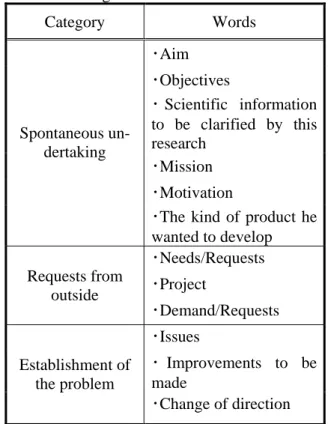
Then, we classified words obtained by brain storming with the KJ method [10]. According to the procedure of the KJ method, the close words are compiled in one place. We give a category name for the set of words collected in one place. • In the subsystem Intervention, 16 words were divided into three categories. We named them “Spontaneous undertaking,” “Requests from outside,” and “Establishment of the problem.” (see Table 2).
• In the subsystem Imagination, 13 words were divided into three categories. We named them “Hints/Ideas,” “Difficulties,” “Establishment of the problem.” (see Table 3).
• In the subsystem Involvement, 15 words were divided into four categories. We named them “Budget,” “Collaboration,” “Industry situa-tion,” “Social/Cultural background.” (see Ta-ble 4).
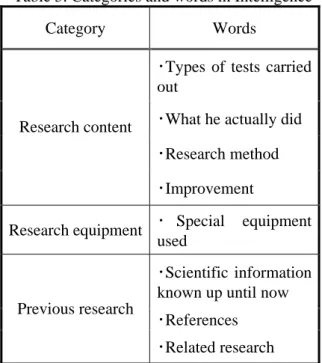
• In the subsystem Intelligence, 12 words were divided into three categories. We named them “Research content,” “Research equipment,” “Previous research.” (see Table 5).
• In the subsystem Integration, 15 words were divided into five categories. We named them “Research results,” “Discussion of results,” “Evaluation,” “Discontinuation,” “Practical application.” (see Table 6).
Table 2. Categories and words in Intervention Category Words ・Aim ・Objectives ・ Scientific information to be clarified by this research ・Mission ・Motivation Spontaneous un-dertaking
・The kind of product he wanted to develop ・Needs/Requests ・Project Requests from outside ・Demand/Requests ・Issues ・ Improvements to be made Establishment of the problem ・Change of direction
Table 3. Categories and words in Imagination
Category Words
・Brainstorming to solve the problem
・Hints/ideas obtained for solving the problem Hints/Ideas ・Brainstorming to solve the problem ・ Difficulties encoun-tered Difficulties
・Failures during the de-velopment process
・ Thoughts and ideals (objectives) pertaining to the research
・Enthusiasm
・ Changes in feelings during the research ・State of motivation Thoughts about
research and de-velopment
・ Thoughts about carry-ing out the research
Table 4. Categories and words in Involvement Category Words ・Budget/Support Budget ・Financial aid ・ Collaborating com-panies/organizations/in dividuals ・Collaborating institu-tions / people involved Collaboration
・Relationship with the production area
・Situation of the pro-duction area
・ Situation of other production areas
Industry situation
・Financial situation ・ Social and cultural background of the re-search
Social/Cultural background
・Trends
Table 5. Categories and words in Intelligence
Category Words
・Types of tests carried out
・What he actually did ・Research method Research content
・Improvement
Research equipment ・ Special equipment used
・Scientific information known up until now ・References
Previous research
・Related research
Table 6. Categories and words in Integration
Category Words
・Contents of presentation ・Results obtained through tests
・Discoveries ・Results created
・ Achievements resulting from this research
Research results
・Influence of the research results
・New issues raised by the tests
Discussion of results
・Failures
・Outside evaluation of the results (production area) Evaluation ・Self-evaluation Discontinuation ・Discontinuation ・Commercialization ・Transfer of technology Practical appli-cation ・Patents 5 Interview Survey
We carried out interview survey to technology developers based on the i-System in order to collect and organize technological knowledge.
The interview started with basic, easy ques-tions pertaining to the person’s personal history (number of years of work experience, job de-scription, area of specialization), the trigger for starting the research, the production area’s needs in terms of research, information on the produc-tion area and the flow of the research. It contin-ued with questions that gradually zeroed in on the essence of the research-about ways of solving problems that arise, the situation in terms of
collaborators and cooperating organizations, the influence of research results on the production area, and thoughts about the research and changes in feelings at various stages. Questions tailored to each research project were added to these basic questions.
The subjects of the survey were eight people involved with technical development in the Kutani ware industry, who belonged to public organizations in Ishikawa Prefecture.
6 An Example of organizing knowledge Part of result collection and organizing pertaining to knowledge of technological innovation in Kutani ware industry based on the i-System is shown in Figure 2 and Figure 3. Collection and organizing pertaining to knowledge of technological innovation is part of “the development of translucent porcelain” here.
Figure 2. Trigger for development of translucent porcelain
Figure 3. Research and development of translucent porcelain
7 Conclusion
There are signs of a trend towards passing down the knowledge about technological innovation to future generations. For this to develop a meth-odology of “what kind of knowledge to collect, and how to pass it down the generations” is very important. This paper applied the i-System to the issue of collecting and organizing the knowledge. First, to let the i-System apply to this problem, we investigated from what kind of target we collect information and knowledge concretely. Second, in five subsystems of the i-System, we tried to find more concrete words for carrying out collection and organization of the information easily. As a result, it became easy to collect and organize the information about the technological innovation.
In the future, based on these findings, it is necessary to test the availability of this study by collecting and organizing information of the real technological innovation.
References
[1]. A. Sakanishi, “Industrial R&D in Japan: the Relation with Postwar Innovation and Market Structure”, The journal of economic
studies (Osaka prefecture university),
Vol.41, No.4, pp. 175-197, 1996.
[2]. Japanese Technological Innovations - Compiling Experience and Forming a
Knowledge Base, http://sts.kahaku.go.jp/tokutei/.
[3]. K. Saijo, “Study on the development of bin-oculars and its manufacturing industry in Japan”, Japanese Technological
Inno-vations - Compiling Experience (2nd forum
report), pp.13-16, 2006.
[4]. S. Ishihara, and Y. Hayashibara, “Study on the Development Process of the Domestic Electrical Appliance in Japan”, Japanese
Technological Innovations - Compiling Experience (2nd forum report), pp.21-24,
2006.
[5]. K. Nishio, T. Yamaguchi, H. Masumoto, and A. Okazaki, “Analysis of Technologi-cal on Modern Steel Manufacturing in Ja-pan”, Japanese Technological Innovations
- Compiling Experience (2nd forum report),
pp.37-40, 2006.
[6]. K. Kuroda, “Innovation of Steel Making Technology after World War II in Japan”,
Japanese Technological Innovations - Compiling Experience (2nd forum report),
pp.41-44, 2006.
[7]. Y. Nakamori, Y. Yamashita, and Y. Yamatogi, “Knowledge Base of Technological Innovation in Traditional Industry”, Japanese Technological Innovations - Compiling Experience (2nd
forum report), pp.113-116, 2006.
[8]. Y. Nakamori, “Systems Methodology and Mathematical Models for knowledge Management”, Journal of Systems Science
and Systems Engineering, Vol.12, No.1,
pp.49-72, 2003.
[9]. Y. Nakamori, and Z. Zhu, “Exploring a Sociologist Understanding for the
i-System”, International Journal of Knowledge and System Sciences, Vol.1,
No.1, pp.1-8, 2004.
[10]. J. Kawakita, “Abduction method -for crea-tivity development-”, Chuokoron-shinsha, 2003 (pl.78).
[11]. T. Nakamichi, “Research on the Develop-ment of Translucent Porcelain (Vol. 2)”,
Fiscal 1987 Business Report, Ishikawa Prefectural Kutani Ware Research Institute,
pp.10-12, 1988.
[12]. T. Nakamichi, S. Nakayama, T. Yokoyama, R. Satomi, T. Kawauchi, and H. Taka, “Research on the Development of Trans-lucent Porcelain Containing Ishikawa Por-celain Stone”, Fiscal 1988 Business Report,
Ishikawa Prefectural Kutani Ware Research Institute, pp.5-24, 1989.