Stepwise Synthesis of Partial
Specifications
preserving Strong
$(\Omega_{1}, \Omega_{2})$-Equivalence
電子技術総合研究所 磯部祥尚 (Yoshinao Isobe)
電子技術総合研究所 中田秀基 (Hidemoto Nakada)
電子技術総合研究所 佐藤豊 (Yutaka Sato)
電子技術総合研究所 大蒔和仁 (Kazuhito Ohmaki)
abstract
:
In this paperwe
presenta
partial equality called strong $(\Omega_{1}, \Omega_{2})$-equivalencebetween two partial specifications $SP_{1}$ and $SP_{2}$, denoted by $SP_{1}\Omega_{1^{\sim}}\Omega_{2}SP_{2}$, based
on an
extended bisimulation relation. The parameters $\Omega_{1}$ and $\Omega_{2}$
are
the sets of available actionsin $SP_{1}$ and $SP_{2}$, respectively. Furthermore
we
presenta
synthesis method of the twopar-tial specifications $SP_{1}$ and $SP_{2}$ into
a
specification $SP_{12}$ such that $SP_{12}\Omega_{1}\cup\Omega_{2}\sim_{\Omega_{1}}SP_{1}$ and$SP_{12}\Omega_{1}\cup\Omega_{2}\sim_{\Omega_{2}}SP_{2}$. $SP_{12}$ is called the principal strong $(\Omega_{1}, \Omega_{2})$-synthetic specificationof$SP_{1}$
and $SP_{2}$, and it is denoted by $SP_{12} \simeq(SP_{1\Omega_{1}}\prod_{\Omega_{2}}SP_{2})$. For example, this synthesis method is
used for stepwise refinement of partial specifications preserving strong $(\Omega_{1}, \Omega_{2})$-equivalence.
1
Introduction
A specification of
a
large system is generally too complex forusers
(and also designers) tounderstand, and
users are
often interested insome
actions. Therefore it is useful forusers
toextract partial specifications about their interesting actions from the complete specification
by hiding uninteresting actions. On the other hand, it is also needed to stepwise synthesize
partial specifications required by many designers.
In this paper,
we
proposea
partial analysis method in models basedon
labeled transitionsystems (LTS). A set of interesting actions is called
a
filter
rangedover
by $\Omega$. An actionobserved through the filter is changed into
an
internal action $\tau$, if the action is not includedin the filter.
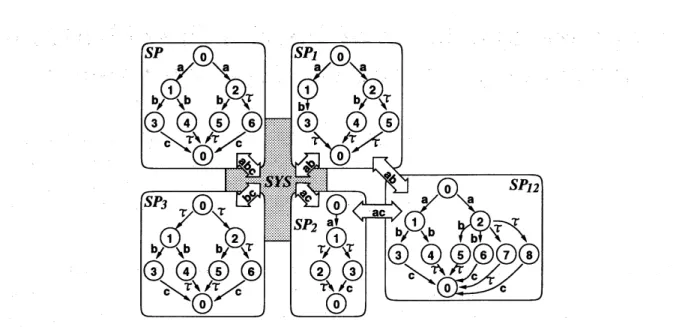
We explain the partial analysis by using Figure 1. The transition graph $SP$ shows the
specification of
a
system SYS. Each node representsa
state and each labeledarrow
representsa
transition by the label which corresponds toan
action. In this paperwe use
the sequentialprocess expressions of
a
fundamental process algebra CCS [1] for describing specificationsas
follows:
$SP^{\mathrm{d}}=^{\mathrm{e}\mathrm{f}}a.(b.c.SP+b_{\mathcal{T}}..sP)+a.(b.\mathcal{T}.SP+\tau.c.SP)$
where the period ‘.’ is
a
sequential combinator and $‘+$’ isa
choice combinator. $\mathrm{d}\mathrm{e}\mathrm{f}=$is used for
defining the left side specification constant
as
the right side specification, thus it isa
recursivedefinition.
$SP_{1}$ is
a
partial specification of $S\mathrm{Y}S$ observed through the filter $\{a, b\}$. In thiscase
the twostates (3) and (4) in $SP$
are
not distinct in $SP_{1}$, because $c$ is changed into $\tau$ through $\{a, b\}$.Although it is expected that two sequential transitions by $\tau$ from (2) to (0) via (5) in $SP_{1}$ is
reduced to
one
transition by $\tau$, the reduction is not considered in this paper. The reductionFigure 1: Partial specifications $(SP_{1}, SP2, sP_{3})$ and
a
synthetic specification $SP_{12}$the effect of the filter based
on
strong equivalence. $SP_{2}$ and $SP_{3}$are
partial specificationsobserved through $\{a, c\}$ and $\{b, c\}$, respectively.
We give
a
partialequality called strong $(\Omega_{1}, \Omega_{2})$-equivalencedenoted by $\Omega_{1}\sim\Omega_{2}$, for relatingsuch partial specifications, where $\Omega_{1}$ and $\Omega_{2}$
are
filters used for getting the left side partialspecification and the right side one, respectively. For example, $SP_{1}$ and $SP_{2}$
are
strongly$(\{a, b\}, \{a, c\})$-equivalent and it is denoted by
$SP_{1}\{a,b\}\sim\{a,C\}SP_{2}$.
Braces and
commas
offiltersare
often omitted such that $\{a, b\}$ is writtenas
$ab$.Next,
we
discuss howto reconstruct the complete specification by synthesizing partialspeci-fications. For the example of Figure 1, it is expected to produce
a
synthetic specification $SP_{12}$such that
$SP_{12}abcab\sim SP1$ and $SP_{12}abcac\sim SP2$. $(*_{1})$
In this case, it is
a
problem that thereare
many synthetic specifications satisfying $(*_{1})$ andthey
are
always not strongly $(abc, abc)$-equivalent. For example, the following specificationssatisfy $(*_{1})$, but $SP_{12b\mathrm{c}}’ \oint_{a}ab_{C}SP_{12}’$.
$SP_{12}=a\mathrm{d}\mathrm{e}\mathrm{f}.(b.c.SP_{12}+b.\tau.SP_{12})+a.(b_{\mathcal{T}}..SP_{12}+\tau.c.SP_{1}2+b.c.SP_{1}2+\tau.\tau.SP12)$
$SP_{1}’=a2\mathrm{d}\mathrm{e}\mathrm{f}.(b.C.SP^{J}12+b.\tau.SP_{1’})2+a.(b_{C}..SP_{1}/2+\tau.\tau.SP_{12}/)$
It is also important to notice that $SP_{12ab} \oint_{b}cCSP_{3}$ and $SP_{12ab}’ \oint cbCSP_{3}$. This inequality
complicates the next synthesis of $SP_{12}$ and $SP_{3}$, thus stepwise synthesis of specifications is
difficul,$\mathrm{t}$.
In order to
overcome
this problem,we
attempt to describea
comprehensive specificationwhich includes all the synthetic specifications satisfying $(*_{1})$. Thus
a
syntheticspecifica-tion satisfying $(*_{1})$
can
be selected form the comprehensive specification. For describing thecomprehensive specification,
we
presenta
multi-labeled transition system abbreviated toa
multi-LTS. A transition ofthe multi-LTS has the following form
Figure 2: A transition in the multi-labeled transition system (multi-LTS)
and its transition graph is written
as
shown in Figure 2. It intuitivelymeans
that $P$can
perform
an
action $\alpha_{1}$ then behaves like $P_{1},$ $P$can
performan
action $\alpha_{2}$ then behaves like $P_{2}$,$\ldots,$ $and/orP$
can
performan
action $\alpha_{n}$ then$\mathrm{b}..\mathrm{e}$haves like $P_{n}.$
T.
$\mathrm{h}..\mathrm{e}$‘
$and/or.$’ is important. For
example, the following specification $AB$
$ABarrow\langle a,b\rangle\langle 0,0\rangle$
can
perform $a$ then stops $\mathrm{a}\mathrm{n}\mathrm{d}/\mathrm{o}\mathrm{r}$can
perform $b$ then stops.We present
a
specification language $SPEC^{\vee}$ basedon
the multi-LTS.SPECv
consists ofthe sequential combinators of CCS and
a new
combinator V calledan
Andor combinator.Intuitively $PQ$ behaves $P$
or
$Q$or
$P+Q$. We often say that $PQ$ includes $P,$ $Q$, and$P+Q$. For example, the above $AB$
can
be describedas
follows:AB $\mathrm{d}\mathrm{f}=^{\mathrm{e}}(a.\mathrm{o})\vee(b.\mathrm{o})$
The important difference between V $\mathrm{a}\mathrm{n}\mathrm{d}+\mathrm{i}\mathrm{s}$ explained
as
follows:$\bullet$ $(a.\mathrm{O})(b.\mathrm{O})$
can
perform a $\mathrm{a}\mathrm{n}\mathrm{d}/\mathrm{o}\mathrm{r}b$.$\bullet$ $(a.\mathrm{O})+(b.\mathrm{O})$
can
perform $a$ and $b$.If
a
specification containsno
Andor combinators, then it is calleda
ground specification.Thus ground specification
can
be described in CCS. For example, $(a.\mathrm{O})+(b.\mathrm{O})$ isa
groundspecification. A specification of
a
practical system is alwaysa
ground specification.Specifi-cations containing Andor combinators
are
used for describing medium specifications duringdesign process.
Strong $(\Omega_{1}, \Omega_{2})$-equivalence previously introduced for ground specifications is extended to
$SPEC^{\mathrm{v}}$. Intuitively, two specifications
$P$ and $Q$
are
strongly $(\Omega_{1}, \Omega_{2})$-equivalent, denoted by$P_{\Omega_{1}}\sim_{\Omega_{2}}Q$, if $P_{0}\Omega_{1}\sim\Omega_{2}Q_{0}$ for
some
ground specifications $P_{0}$ and $Q_{0}$ included in $P$ and $Q$,respectively. For example,
$(a.0)\vee(b.\mathrm{o})abcab\sim c(a.0)\mathrm{v}(_{C}.0)$,
because both ofthem include
a
ground specification $(a.\mathrm{O})$.Another equality called strong $(\Omega_{1}, \Omega_{2})$-full-equivalenceis alsogiven. Intuitively, two
specifi-cations $P$ and $Q$
are
strongly $(\Omega_{1}, \Omega_{2})$-full-equivalent, denoted by $P\Omega_{1}\simeq\Omega_{2}Q$, if $P_{0}\Omega_{1}\sim\Omega_{2}Q_{0}$for any ground specifications $P_{0}$ and $Q_{0}$ included in $P$ and $Q,$Tespectively. For example,
$(a.0)\vee(b.\mathrm{o})abcab\simeq c(b.0)\vee(a.\mathrm{o})$,
$(a.0)\vee(b.\mathrm{o})abc\not\simeq_{abc}(a.0)\mathrm{v}(_{C}.0)$,
$(a.\mathrm{O})(b.\mathrm{O})abc\not\simeq_{ab_{\mathbb{C}}}((a.\mathrm{O})(b.\mathrm{O}))+(a.\mathrm{O})$.
The
reason
ofthe last inequality isthat $(a.\mathrm{O})(b.\mathrm{O})$ includesa
ground specification $(b.\mathrm{O})$ but$((a.\mathrm{O})(b.\mathrm{O}))+(a.\mathrm{O})$ does not include $(b.\mathrm{O})$.
Then
we
presenta
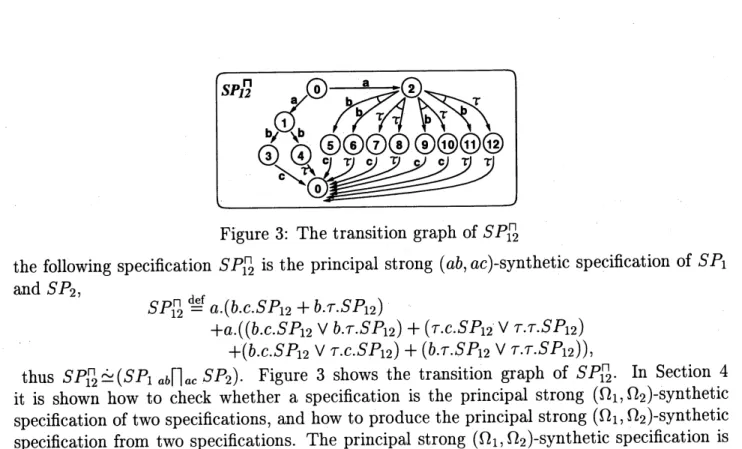
relation called the principal strong $(\Omega_{1}, \Omega_{2})$-synthetic specification $P$ ofFigure 3: The transition graph of$SP_{\mathrm{l}}^{\mathrm{n}_{2}}$
the following specification $SP_{\mathrm{l}}^{\mathrm{n}_{2}}$ is the principal strong (ab,$ac$)-synthetic specification of $SP_{1}$
and $SP_{2}$,
$SP_{12}^{\cap}\mathrm{d}\mathrm{e}=^{\mathrm{f}}a.(b.C.SP12+b.\mathcal{T}.SP_{1}2)$
$+a.((b_{C}..SP12^{\vee}b.\mathcal{T}.SP_{1}2)+(_{\mathcal{T}}.C.sP12\vee \mathcal{T}.\tau.SP_{1}2)$
$+(b.c.SP12\mathrm{v}\tau.C.sP_{1}2)+(b.\mathcal{T}.SP12^{}\mathcal{T}.\tau.sP_{1}2))$,
thus $SP_{\mathrm{l}}^{\mathrm{n}_{2}}\simeq(SP_{1}ab\cap acSP_{2})$. Figure 3 shows the transition graph of $SP_{\mathrm{l}}^{\mathrm{n}_{2}}$. In Section 4
it is shown how to check whether
a
specification is the principal strong $(\Omega_{1}, \Omega_{2})$-syntheticspecification oftwo specifications, and how to produce the principal strong $(\Omega_{1}, \Omega_{2})$-synthetic
specification from two specifications. The principal strong $(\Omega_{1}, \Omega_{2})$-synthetic specification is
uniquelydecided.
The mainpropertyofthe principal strong $(\Omega_{1}, \Omega_{2})$-synthetic specificationis shown in
Propo-sition 4.1. For the example of Figure 1, the following relation holds by Proposition 4.1. For
any ground specification $SP_{0}$,
$SP_{0}abcab_{C}\sim sp_{12}\cap$ iff $SP_{0}abcab\sim SP_{1}$ and $SP_{0}abca\mathrm{c}\sim sP2$.
Thus, allthe groundspecificationsincludedin $SP_{\mathrm{l}}^{\mathrm{n}_{2}}$ satisfyboth$SP_{1}$ and $SP_{2}$, andthey
are
allthe ground specificationssatisfyingboth $SP_{1}$ and $SP_{2}$. Furthermore $SP_{3}$
can
besynthesizedto$SP_{12}\cap$ by $SP_{123}^{\cap}\simeq(SP_{\mathrm{l}2a}^{\mathrm{n}}b\mathrm{c}\lceil\rceil_{b3}c)SP$. Then the following relation holds by Theorem 4.4, because
$SP_{\mathrm{l}}^{\mathrm{n}_{2}}abc^{\sim_{b}SP_{3}}c$. For any ground specification $SP_{0}$,
$SP_{0ab}ca\sim bcSP_{\mathrm{l}23}^{\mathrm{n}}$ iff $SP_{0}abcab\sim SP_{1},$ $SP_{0}abc^{\sim}acSP_{2}$, and $SP_{0}abcb\sim csP3$.
Thus stepwise refinement of specifications is possible.
The outline ofthis paper is
as
follows: In Section 2,we
define the syntax and the semanticsof$SPEC^{}$. In Section 3, strong $(\Omega_{1}, \Omega_{2})$-equivalence is defined. In Section 4, principal strong
$(\Omega_{1}, \Omega_{2})$-synthetic specifications
are
defined. In Section 5,we
discuss partial analysis andsynthesis methods already proposed. In Section 6,
we
conclude this paper.2
Definition
of
specifications
We
use
expressions like CCS for describing behavior of specifications. Theyare
sequentialprocesses
of CCS with Andor combinators introduced in Section 1. We call the specificationlanguage
SPECv.
In this section,we
define the syntax and the semantics of $SPEC^{\vee}$.We
assume
thatan
infinite set ofnamesN
rangedover
by$a,$$b,$$\cdots$, is given. Theset of actionsAct ranged
over
by $\alpha,$$\beta,$$\cdots$, is definedas
$Act=N\cup\{\tau\}$, where$\tau$ is
a
special action calledan
internal action not included in $N$. We also
assume
thata
set of specificationconstants
(alsoDefinition 2.1 The set
of
specifications $P$ is the smallest set including the followingexpres-sions: $A$ : Constant $(A\in \mathcal{K})$
$0$ : Inaction
$\alpha.P$ :
Prefix
$(\alpha\in Act)$$P+Q$ : Choice
$PQ$ : Andor
where $P$ and $Q$ are already in$P$. 1
A Constant is
a
specification whose meaning is given bya
defining equation. In fact,we
assume
that for every Constant $A\in \mathcal{K}$, there isa
defining equation ofthe form A$\mathrm{d}=^{\mathrm{e}\mathrm{f}}P$
, where
$P\in P$. To avoid too
many
parentheses, combinators have binding power in the followingorder: Prefix $>$ Choice $>\mathrm{A}\mathrm{n}\mathrm{d}\mathrm{o}\mathrm{r}$.
We also define ground specifications $P_{0}$ with the following syntax:
$P_{0}$ $::=$ $A_{0}|0|\alpha.P_{0}|P_{0}+P_{0}$
where $A_{0}\in \mathcal{K}_{0}\subseteq \mathcal{K}$ and $\alpha\in Act.$ The set of ground specifications is denoted by $\mathcal{P}_{0}$. We
assume
that for every Constant $A_{0}\in \mathcal{K}_{0}$, there isa
defining equation of the form$A_{0^{\mathrm{d}\mathrm{f}}}=^{\mathrm{e}}P_{0}$,
where $P_{0}\in P_{0}$.
We
use
the followingshort notations:$\sum\{P_{i} : i\in I\}\equiv\{$
$0$ $(I=\emptyset)$
$P_{1}+P_{2}+\cdots+P_{n}(I=\{1,2, \cdot\cdot\vee, n\})$
$\mathrm{V}\{P_{i} : i\in I\}\equiv\{$
$0$ $(I=\emptyset)$
$P_{1}P_{2}\vee\cdots\vee P_{n}(I=\{1,2, \cdots, n\})$
Next, in order to define the multi-labeled transition system introduced in Section 1,
an
operator $\langle\rangle$ for any set $S$ is defined
as
$\langle S\rangle=\{\langle e_{1}, e_{2}, \cdots, e_{n}\rangle : e_{i}\in S, n\geq 1\}$.
$\langle S\rangle$ is called the multi-set of$S$. Three functions
over a
multi-set $\langle S\rangle$are
defined.Definition 2.2 Let $s,$$s’\in\langle S\rangle,$ $e_{i},$$e_{i}’\in S$, and $n,$$i\in\{1,2,3, \cdots\}$.
$\bullet$ $(\neq s)$ is the length
of
$s$. $Thus\neq\langle e1, e2, \cdots, en\rangle=n$.$\bullet$ $(s\triangleleft i)$ is the $i$ th element
of
8 $(i\in[1, \neq s])$. Thus $\langle e_{1}, e_{2}, \cdots, e_{n}\rangle\triangleleft i=e_{i}$.$\bullet$ $(s;s’)$ is the concatenation
of
$s$ and$s’$.Thus $\langle e_{1}, e_{2,n}\ldots, e\rangle;\langle e_{1}’’, e_{2}, \cdots, e_{m}\rangle/=\langle$$e_{1},$$e_{2,}\ldots,$
e
$e_{1’ 2}’e,\cdot,$$e_{m}\rangle’\cdot\cdot/$.where $[1, n]$ is
an
abbreviationof
an
integer set $\{1, 2, \cdots, n\}$.Then
we
define multi-labeled transition systems (multi-LTS).Definition 2.3 A multi-LTSis
a
triple $(S, L, arrow)$ where1. $S$ is
a
setof
states,2. $L$ is
a
setof
labels,$\mathit{3}$. $arrow is$
a
setof
transition relations such that$arrow\subseteq\{(e, u, S) : e\in S, u\in\langle L\rangle, s\in\langle S\rangle, \# u=\neq s\}$
The semantics of
SPECv
is given by the multi-LTS $(P, Act,$$arrow)$, $\mathrm{w}\mathrm{h}\mathrm{e}\mathrm{r}\mathrm{e}arrow \mathrm{i}\mathrm{s}$ defined inDefinition 2.4. The set of multi-specifications $\langle P\rangle$ is ranged
over
by $M,$$N,$ $\cdot*\cdot$ and the set ofmulti-actions $\langle Act\rangle$ is ranged
over
by $\mu,$$\nu,$$\cdot,$$.$.
Definition 2.4 The transition $relationarrow$ between
a
specification $P$,a
multi-action $\mu$, anda
multi-specification $M$ is the smallest relation satisfying the followinginference
rules. Eachrule is to be read
as
follows: if
the transition relation$(s)$ above the lineare
inferred
and theside condition$(s)$
are
satisfied, then the transition relation below the linecan
be alsoinferred.
$\mathrm{A}\mathrm{c}\mathrm{t}\alpha.\overline{Parrow\langle P\langle\alpha)\rangle}$
$\mathrm{C}\mathrm{h}\mathrm{o}\mathrm{i}_{\mathrm{C}}\mathrm{e}_{1}\frac{P\muarrow M}{P+Q\muarrow M}$
$\mathrm{c}_{\mathrm{o}\mathrm{n}}\frac{P\muarrow M}{A\muarrow M}$(A $=P$)
$\mathrm{d}\mathrm{e}\mathrm{f}$
$\mathrm{C}\mathrm{h}_{0}\mathrm{i}\mathrm{c}\mathrm{e}_{2}\frac{Q\muarrow N}{P+Q\muarrow N}$
$\mathrm{A}\mathrm{n}\mathrm{d}\mathrm{o}\mathrm{r}\frac{Parrow M\mu Q\nuarrow N}{P\vee Q\muarrow M\cdot N;\nu}$
,
where ‘;’ used in Andor is the concatenation
function
given above. 13
Partial equalities
In this section two kinds ofpartial equalities in SPEC
are
defined basedon
extentedbisim-ulation relations.
First,
we
definea
function for filtering actions.Definition 3.1 Filter
function
$(/ : Act\cross 2^{N}arrow Act)$ isdefined
as
follows:
For any$\alpha\in Act$and $\Omega\subseteq N_{f}$
$\alpha/_{\Omega}=\{$
$\alpha$ $(\alpha\in\Omega)$ $\tau$ (otherwise)
If $\alpha\in\Omega$, then $\alpha$ is called
a
valid action for $\Omega$, otherwise $\alpha$ is calledan
invalid actionfor $\Omega$.Next
we
definea
$\mathrm{f}\mathrm{u}.\mathrm{n}\mathrm{c}\mathrm{t}\mathrm{i}_{\mathrm{o}\mathrm{n}}$ called Selectivefunction
to select the valid action from two actionsobserved through two filters. If two actions
are
inconsistent with each other, then Selectivefunction returns the symbol $\perp(\not\in Act)$.
Definition 3.2 Selective
function
$\bullet$ : $Act\cross 2^{N}\cross Act\cross 2^{N}arrow Act\cup\{\perp\}$ isdefined
as
follows:
For any $\alpha_{i}\in Act$ and $\Omega_{i}\subseteq N_{f}$
$(\alpha_{1}, \Omega_{1})\bullet(\alpha_{2}, \Omega 2)=\{$
$\alpha_{1}/\Omega_{1}$ $(\alpha_{1}/\Omega_{1}=\alpha_{2}/\Omega_{2})$ $(C1)$
$\alpha_{1}$ $(\alpha_{1}\in\Omega_{1}-\Omega_{2}, \alpha_{2}\not\in\Omega_{2})$ $(C2)$ $\alpha_{2}$ $(\alpha_{2}\in\Omega_{2}-\Omega_{1}, \alpha_{1}\not\in\Omega_{1})$ $(C3)$
$\perp$ (otherwise) $(C4)$
$(C2)$ represents
a
selection of the valid action $\alpha_{1}$. The condition $(\alpha_{1}\in\Omega_{1}-\Omega_{2})$ of $(C2)$to $\alpha_{1}$ if $\alpha_{1}\in\Omega_{2}$. $(C4)$ represents the three
cases
that (1) $\alpha_{1}\in\Omega_{1}\cap\Omega_{2}$ and $\alpha_{1}\neq\alpha_{2}$or
(2)$\alpha_{2}\in\Omega_{1}\cap\Omega_{2}$ and $\alpha_{1}\neq\alpha_{2}$
or
(3) $\alpha_{1}\in\Omega_{1},$ $\alpha_{2}\in\Omega_{2}$, and $\alpha_{1}\neq\alpha_{2}$.For example, the following applications show properties of Selective function.
$(a,ab(d,ab(\tau,ab)\bullet(e,ac)=\mathcal{T})\bullet(a,a)\bullet(e,aC)=\tau c)=a\mathrm{b}\mathrm{y}(C1)\mathrm{b}\mathrm{y}(C1\mathrm{b}\mathrm{y}(c1))$ $|$ $(a,a(b,a_{b)}b)\bullet(e,a(b,ab)\bullet(\mathcal{T},ac)=\perp\bullet(c,ac)c)==\perp b\mathrm{b}\mathrm{y}(c4\mathrm{b}\mathrm{y}(c4)\mathrm{b}\mathrm{y}(c2))$
Then, $(\Omega_{1}, \Omega_{2})$-consistency about actions is defined
as
follows. If two actions $\alpha_{1}$ and $\alpha_{2}$observed through two filters $\Omega_{1}$ and $\Omega_{2}$, respectively,
are
consistent with each other bymeans
of Selective function, then they
are
$(\Omega_{1}, \Omega_{2})$-consistent and it is denoted by $(\alpha_{1}\Omega_{1}=\Omega_{2}\alpha_{2})$,thus
$\Omega_{1^{=}}^{\cdot}\Omega_{2}=\{(\alpha_{1}, \alpha_{2}):(\alpha 1, \Omega_{1})\bullet(\alpha 2, \Omega 2)\neq\perp\}$
We show several properties of Synthetic function.
Proposition 3.1 For any $\alpha_{i}\in Act_{\mathrm{Z}}\Omega_{i}\subseteq N$,
(1)
If
$(\alpha_{1}, \Omega_{1})$ $\bullet$ $(\alpha_{2}, \Omega_{2})=\alpha$, then $(\alpha_{1}, \Omega_{1})$ $\bullet$ $(\alpha, \Omega_{12})--\alpha$.(2)
If
$(\alpha_{1}\Omega_{1^{=_{\Omega}\alpha),(\alpha}}\Omega^{=}\Omega_{2}\alpha_{2})$,and $\Omega_{1}\subseteq\Omega$, then $(\alpha_{1}\Omega_{1^{=}}\Omega_{2}\alpha_{2})$.(3)
If
$(\alpha_{1}\Omega_{1^{=_{\Omega}\alpha),(\alpha}}\Omega^{=}\Omega_{2}\alpha_{2})$,and $\Omega_{12}\subseteq\Omega$, then $(\alpha_{1}, \Omega_{1})$ $\bullet$ $(\alpha_{2}, \Omega_{2})=\alpha/\Omega_{12}$.(4) $((\alpha_{1}, \Omega_{1})\bullet(\alpha 2, \Omega_{2}),$$\Omega_{1}2)\bullet(\alpha_{3}, \Omega_{3})=(\alpha_{1}, \Omega_{1})\bullet((\alpha_{2}\Omega 2))(\bullet\alpha 3, \Omega_{3}),$ $\Omega_{23})$
where $\Omega_{12}=\Omega_{1}\cup\Omega_{2}$ and $\Omega_{23}=\Omega_{2}\cup\Omega_{3}$. 1
(1)
means
that the selected action $\alpha$ is consistent with $\alpha_{1}$. (2) is conditional transitivity.(3) is useful for synthesis oftwo partial specifications. (4)
means
that the selected action doesnot depend
on
the order ofthe selections.Now
we
define two kinds of partial equalities byusing $(\Omega_{1}, \Omega_{2})$-consistency.Definition 3.3 Let $\Omega_{1},$$\Omega_{2}\subseteq N.$ A binary relation$S\subseteq P\cross P$
over
specifications is $a$ strong$(\Omega_{1}, \Omega_{2})$-bisimulation,
if
$(P, Q)\in S$ implies that(i) whenever $P\muarrow M$ then,
for
some
$N$ and $\nu,$ $Qarrow N\nu$ andfor
some
$i$ and$j,$ $(\mu\triangleleft i\Omega_{1^{=}}\Omega_{2}\nu\triangleleft j)$ and $(M\triangleleft i, N\triangleleft j)\in S$,(ii) whenever $Qarrow N\nu$ then,
for
some
$M$ and $\mu,$ $P\muarrow M$ andfor
some
$i$ and$j,$ $(\mu\triangleleft i\Omega_{1^{=}}\Omega_{2}\nu\triangleleft j)$ and $(M\triangleleft i, N\triangleleft j)\in S$.1
Definition 3.4 Let $\Omega_{1},$$\Omega_{2}\subseteq N$. $P$ and $Q$
are
strongly $(\Omega_{1}, \Omega_{2})$-equivalent,writte.n
$P\Omega_{1^{\sim}}\Omega_{2}$$Q$,
if
$(P, Q)\in S$for
some
strong $(\Omega_{1}, \Omega_{2})$-bisimulation$S$. 1Definition 3.5 Let $\Omega_{1},$$\Omega_{2}\subseteq N.$ A binary relation$S\subseteq P\cross P$
over
specifications is $a$ strong$(\Omega_{1}, \Omega_{2})$-full-bisimulation,
if
$(P, Q)\in S$ implies that(i) whenever $P\muarrow M$ then,
for
some
$N$ and $\nu,$ $Qarrow N\nu$ and$(a)$
for
all $i\in[1, \neq\mu]$,for
some
$j,$ $(\mu\triangleleft i\Omega_{1^{=}}\Omega_{2}\nu\triangleleft j)$ and $(M\triangleleft i, N\triangleleft j)\in S$,$(b)$
for
all $j\in[1, \neq\nu]$,for
some
$i,$ $(\mu\triangleleft i\Omega_{1^{=}}\Omega_{2}\nu\triangleleft j)$ and $(M\triangleleft i, N\triangleleft j)\in S$,(ii) whenever $Qarrow N\nu$ then,
for
some
$M$ and $\mu,$ $P\muarrow M$ and$(a)$
for
all $i\in[1, \neq\mu]$,for
some
$j,$ $(\mu\triangleleft i\Omega_{1^{=}}\Omega_{2}\nu\triangleleft j)$ and $(M\triangleleft i, N\triangleleft j)\in S$,Definition
3.6
Let $\Omega_{1},$ $\Omega_{2}\subseteq N.$ $P$ and $Q$are
strongly $(\Omega_{1}, \Omega_{2})$-full-equivalent, written$P_{\Omega_{1}}\simeq_{\Omega_{2}Q}$,
if
$(P, Q)\in S$for
some
strong $(\Omega_{1}, \Omega_{2})$-full-bisimulation
$S$. 1The following relations clearly hold from the definitions.
$\bullet$ For any $P,$$Q\in P,$ $P\Omega_{1}\simeq\Omega_{2}Q\Rightarrow P_{\Omega_{1}}\sim_{\Omega_{2}}Q$ $\bullet$ For any $P_{0},$$Q_{0}\in P_{0},$ $P_{0}\Omega_{1}\simeq\Omega_{2}Q_{0}\Leftrightarrow P_{0\Omega_{1}\Omega_{2}}\sim Q_{0}$
$\bullet$ For any $P_{0},$$Q_{0}\in P_{0},$ $P_{0N}\sim_{NQ_{0}}\Leftrightarrow P_{0}\sim Q_{0}$
where $\sim$ is strong equivalence defined in [1]. Although neither $\Omega_{1}\sim_{\Omega_{2}}$
nor
$\Omega_{1}\simeq_{\Omega_{2}}$ isan
equivalence relation, the following conditional reflexive, symmetric, and transitive laws hold
for $\Omega_{1^{\sim}}\Omega_{2}$.
Proposition 3.2 For any $P,$$Q\in P,$ $\Omega_{i}\subseteq N$, and $R_{0}\in P_{0}$,
(1) $P_{\Omega_{1}}\sim_{\Omega_{2}}P$
(2)
If
$P_{\Omega_{1}}\sim_{\Omega_{2}}Q_{f}$ then $Q\Omega_{2^{\sim}}\Omega_{1}P$(3)
If
$P_{\Omega_{1}}\sim_{\Omega}R_{0},$ $R_{0}\Omega^{\sim}\Omega_{2}Q_{f}$ and $\Omega_{1}\subseteq\Omega$, then $P\Omega_{1^{\sim}}\Omega_{2}$ $Q$.1
Proposition 3.2 also holds if $\Omega_{1^{\sim}}\Omega_{2}$ is replaced to $\Omega_{1}\simeq\Omega_{2}$. Furthermore
a
medium $R_{0}$ of (3)does not have to be
a
ground specification for $\Omega_{1}\simeq_{\Omega_{2}}$, thus for any $R\in \mathcal{P}$, if $P_{\Omega_{1}}\simeq_{\Omega}R$,$R_{\Omega}\simeq_{\Omega_{2}}Q$, and $\Omega_{1}\subseteq\Omega$, then $P_{\Omega_{1}}\simeq_{\Omega_{2}}Q$.
4
Synthetic specification
In this section,
we
givea
synthesis method of specifications preserving $\Omega_{1}\sim_{\Omega_{2}}$. We explainhow to synthesize specifications by using the following example.
$A_{c}\equiv a.\tau.0+b.\tau.0+\tau.c.0$ $B_{2}\equiv a.\tau.0+\tau.\tau.0+\tau.c.0$
$(*_{2})$
$B_{1}\equiv a.\tau.0+b.\tau.0+\tau.\tau.0$ $\cdot B_{3}\equiv\tau.\tau.0+b.\tau.0+\tau.c.0$
where$\equiv \mathrm{r}\mathrm{e}\mathrm{p}\mathrm{r}\mathrm{e}\mathrm{s}\mathrm{e}\mathrm{n}\mathrm{t}_{\mathrm{S}}$syntactic identity. $B_{1},$ $B_{2}$, and $B_{3}$
are
partial specificationsofthe completespecification $A_{c}$, thus for any$i,j\in\{1,2,3\}$,
$A_{c}\Omega^{\sim}\Omega:B_{i}$ and$B_{i}\Omega_{:^{\sim}}\Omega_{j}B_{j}$
where $\Omega=\{a, b, c\},$ $\Omega_{1}=\{a, b\},$ $\Omega_{2}=\{a, c\}$, and $\Omega_{3}=\{b, c\}$.
At first,
we
consider onlyground specifications for simplicity. A simple synthesis method isto
use
the following combinator.$\mathrm{S}\mathrm{Y}\mathrm{N}\frac{Q_{1}arrow\langle\langle\alpha_{1})\langle\alpha_{2}\rangle Q’1\rangle Q2arrow\langle Q’2\rangle}{Q_{1\Omega_{1}}||_{\Omega}2Q_{2^{arrow\langle Q1\Omega}}(\alpha\rangle,1||_{\Omega_{2}}Q_{2}\rangle},((\alpha_{1}, \Omega 1)\bullet(\alpha_{22}, \Omega)=\alpha)$
Thissynthetic specification $Q_{1\Omega_{1}}||_{\Omega_{2}}Q_{2}$ performs valid actions of$Q_{1}$ and $Q_{2}$, but thefollowing
expected equation does not always hold.
$Q_{1\Omega_{1}}||_{\Omega_{2}}Q_{2}\Omega_{12^{\sim}}\Omega:Q_{i}$ $(i\in\{1,2\})$ $(*_{3})$
where $\Omega_{12}=\Omega_{1}\cup\Omega_{2}$. For the example $(*_{2})$, the result of synthesis of $B_{1}$ and $B_{2}$ by $\Omega_{1}||_{\Omega_{2}}$ is
$B_{1ab}||_{ac}B_{2}\sim a.\tau.0+b.\tau.0+\tau.c.\mathrm{O}+b.c.\mathrm{O}+\tau.\tau.\mathrm{O}+b.\mathrm{O}+\tau.0$
The last part $(b.\mathrm{O}+\tau.\mathrm{O})$ is important and breaks the expected equation $(*_{3})$.
An
easy
method to guarantee $(*_{3})$may
be to $\mathrm{m}\mathrm{o}\mathrm{d}\mathrm{i}\mathfrak{h}$ the combinator $\Omega_{1}||_{\Omega_{2}}$as
follows:$\mathrm{G}\mathrm{L}\mathrm{B}\frac{Q_{1}arrow\langle\langle\alpha_{1}\rangle\prime Q2^{arrow}(Q1\rangle\alpha_{2}\rangle\langle Q’2\rangle}{Q_{1\Omega_{1}}[]_{\Omega}2Q_{2}arrow\langle Q_{1^{\Omega}}1[\langle\alpha\rangle,]_{\Omega}2Q_{2}\rangle},$,
but this definition circulates, because $\Omega_{1}\sim_{\Omega_{2}}$ should be defined in terms of
our
transitionrelations. Therefore,
a
relation is defined instead ofthe combinator.Definition 4.1 Let $\Omega_{1},$$\Omega_{2}\subseteq N.$ A triadic relation $\mathcal{T}$
over
ground specifications is$a$ strong
$(\Omega_{1}, \Omega_{2})$-GLB relation,
if
$(P, Q_{1}, Q_{2})\in \mathcal{T}$ implies that(i) whenever $Parrow\langle\alpha\rangle\langle P’\rangle$ then,
for
some
$Q_{1}’,$ $Q_{2}’,$$\alpha 1_{2}$ and $\alpha_{2}$,$Q_{1}arrow(\alpha_{1}\rangle$
$\langle Q_{1}’\rangle,$
$Q_{2}arrow(\alpha_{2}\rangle$
$\langle Q_{2}’\rangle,$ $(\alpha_{1}, \Omega_{1})$ $\bullet$ $(\alpha_{2}, \Omega_{2})=\alpha,$ $Q_{1}’\Omega_{1^{\sim}}\Omega_{2}Q_{2}’$, and $(P’, Q_{1}/, Q_{2}’)\in \mathcal{T}$,
(ii) whenever $Q_{1}arrow\langle\alpha_{1}$)
$\langle Q_{1}’\rangle,$ $Q_{2}arrow\langle\alpha_{2}\rangle\langle Q_{2}’\rangle,$ $(\alpha_{1}, \Omega_{1})$$\bullet$ $(\alpha_{2}, \Omega_{2})=\alpha\neq\perp$, and $Q_{1}’\Omega_{1}\sim\Omega_{2}Q_{2}’$,
$then_{f}$
for
some
$P_{f}’Parrow\langle\alpha\rangle\langle P’\rangle$ and$(P’, Q_{1}’, Q’2)\in \mathcal{T}$.
Definition 4.2 Let $\Omega_{1},$$\Omega_{2}\subseteq N$. $P$ is the strong $(\Omega_{1}, \Omega_{2})- cLB$ specification
of
$Q_{1}$ and $Q_{2}$,written$P\sim(Q_{1\Omega_{1}}[]_{\Omega_{2}}Q_{2})_{2}$
if
$(P, Q_{1}, Q_{2})\in \mathcal{T}$for
some
strong $(\Omega_{1}, \Omega 2)- GLB$ relation$\mathcal{T}$.1
The strong $(\Omega_{1}, \Omega_{2})$-GLB specification $P$ of $Q_{1}$ and $Q_{2}$ is uniquely decided from $Q_{1}$ and $Q_{2}$
up to $N^{\sim}N$, and the following relation holds.
If $P\sim(Q_{1\Omega_{1}}[]_{\Omega_{2}}Q_{2})$ and $Q_{1}\Omega_{1^{\sim}}\Omega_{2}Q_{2}$, then $P\Omega_{1}\cup\Omega 2^{\sim_{\Omega}}:Q_{i}(i\in\{1,2\})(*_{4})$
For the example $(*_{2})$,
we can
obtain the strong (ab,$ac$)-GLB specification $A_{12}$ such that$A_{12}\sim(B_{1ab}[]_{aC2}B)$, considering Definition 4.2.
$A_{12}\equiv a.\tau.0+b.\tau.0+\tau.c.0+b.c.0+\tau.\tau.0$
Then $A_{12}ab\mathrm{c}^{\sim_{ab}B_{1}}$ and $A_{12}abcac2\sim B$ by $(*_{4})$.
Unfortunately strong $(\Omega_{1}, \Omega_{2})$-GLB specifications
are
not useful for synthesis of threeor
more
specifications, namely stepwise refinement. For example, $(*_{4})$can
not be used for thesynthesis of$A_{12}$ and $B_{3}$, because $A_{12abc}kbcB_{3}$.
The problem is that there
are
many
synthetic specifications like $A’$ satisfying $A’abcab\sim B_{1}$and $A’abc\sim_{ac}B_{2}$. The complete specification $A_{c}$ is
one
of them. Therefore it is expected toproduce
a
comprehensive specification which includes all the synthetic specifications like $A’$.For the purpose
a
multi-LTS is needed and $SPEC^{\vee}$ is used.Now
we
define principal strong $(\Omega_{1}, \Omega_{2})$-synthetic specifications in $SPEC^{}$.Definition 4.3 Let $\Omega_{1},$$\Omega_{2}\subseteq N.$ A triple relation $\mathcal{T}\subseteq P^{3}$
over
specifications is $a$ principal(i)
for
all $M$ and $\mu$, whenever $P\muarrow Mthen_{f}$(1)
for
some
$(N_{1}, \nu_{1}),$ $Q_{1}arrow\nu_{1}N_{1}$ and$(a)$
for
all$(N_{2’ 2 ,\nu_{2}}’\nu’,’ j’2k’)$,
whenever $Q_{2}arrow N_{2}’,$ $\nu_{1}\triangleleft j’\Omega_{1^{=}}\Omega_{2}\nu_{2}’\triangleleft k’$, and$N_{1}\triangleleft j’\Omega_{1^{\sim}}\Omega_{2}N_{2}’\triangleleft k’$, then
for
some
$i,$ $(\nu_{1}\triangleleft j’, \Omega_{1})$$\bullet$ $(\nu_{2}’\triangleleft k’, \Omega_{2})=\mu\triangleleft i$ and $(M\triangleleft i, N_{1}\triangleleft j’, N_{2}’\triangleleft k/)\in \mathcal{T}$,and
$(b)f_{\mathit{0}}r\nu_{2}$
’
all $i’\in[1, \#\mu]f$
for
some
$(N_{2}’, \nu_{2}’, j’, k’),$ $N_{1}\triangleleft j’\Omega_{1^{\sim}}\Omega_{2}N_{2}’\triangleleft k’$,$Q_{2}arrow N_{2}’,$ $(\nu_{1}\triangleleft j’, \Omega_{1})$ $\bullet$ $(\nu_{2}’\triangleleft k’, \Omega_{2})=\mu\triangleleft i’$, and $(M\triangleleft i’, N_{1}\triangleleft j’, N_{2’}\triangleleft k’)\in \mathcal{T}$,
or
(2)
for
some
$(N_{2}, \nu_{1}),$ $Q_{2}arrow\nu_{2}N_{2}$ and$(a)$
for
all $(N_{1’ 1}^{\prime/}\nu,’ j’, k’)$,whenever $Q_{1}arrow N_{1}’,$ $\nu_{1}’\triangleleft j’\Omega_{1^{=}}\Omega_{2}\nu_{2}\triangleleft k’$, and $N_{1}’\triangleleft j’\Omega_{1^{\sim}}\Omega_{2}N_{2}\triangleleft k’$, then
for
some
$i,$ $(\nu_{1}’\triangleleft j’, \Omega_{1})$ $\bullet$ $(\nu_{2}\triangleleft k’, \Omega_{2})=\mu\triangleleft i$ and $(M\triangleleft i, N_{1}’\triangleleft j’, N_{2}\triangleleft k’)\in \mathcal{T}$,and
$(b)f_{\mathit{0}}r\nu_{1}$
’
all $i’\in[1, \#\mu]$,
for
some
$(N_{1}’, \nu_{12}’j/, k’),$ $N_{1}’\triangleleft j’\Omega_{1^{\sim}}\Omega_{2}N_{2}\triangleleft k’$,$Q_{1}arrow N_{1}’,$ $(\nu_{1}’\triangleleft j’, \Omega_{1})$ $\bullet$ $(\nu_{2}\triangleleft k’, \Omega_{2})=\mu\triangleleft i’$, and $(M\triangleleft i’, N_{1}’\triangleleft j’, N_{2}\triangleleft k’)\in \mathcal{T}$, and
(ii)
for
all $(N_{1}, N_{2}, \nu_{1}, \nu_{2}, j, k)$,whenever $Q_{1}arrow N_{1}\nu_{1},$ $Q_{2}arrow N_{2}\nu_{2},$ $\nu_{1}\triangleleft j\Omega_{1^{=}}\Omega_{2}\nu_{2}\triangleleft k,$$N_{1}\triangleleft j\Omega_{1^{\sim}}\Omega_{2}N_{2}\triangleleft k$, then (1)
for
some $(M, \mu),$ $P\muarrow M$ and$(a)$
for
all$(N_{2}’,\nu_{2}^{r},’ j\nu_{2}’, k’)$,
whenever $Q_{2}arrow N_{2}’,$ $\nu_{1}\triangleleft j’\Omega_{1^{=}}\Omega_{2}\nu_{2}’\triangleleft k_{f}’$ and $N_{1}\triangleleft j’\Omega_{1^{\sim}}\Omega_{2}N_{2}’\triangleleft k’$, then
for
some
$i,$ $(\nu_{1}\triangleleft j’, \Omega_{1})$$\bullet$ $(\nu_{2}’\triangleleft k’, \Omega_{2})=\mu\triangleleft i$ and $(M\triangleleft i, N_{1}\triangleleft j’, N_{2}’\triangleleft k’)\in \mathcal{T}$,and
$(b)f_{\mathit{0}}r\nu_{2}$
’
all $i’\in[1, \neq\mu]$,
for
some
$(N_{2}’, \nu_{2}’ j’,, k’),$
$N_{1}\triangleleft j’\Omega_{1^{\sim}}\Omega_{2}N_{2}’\triangleleft k’$,
$Q_{2}arrow N_{2’}2(\nu_{1}\triangleleft j’, \Omega_{1})$ $\bullet$ $(\nu_{2}’\triangleleft k’, \Omega_{2})=\mu\triangleleft i’$, and $(M\triangleleft i’, N_{1}\triangleleft j’, N_{2}’\triangleleft k’)\in \mathcal{T}$, and
(2)
for
some
$(M_{f}\mu),$ $P\muarrow M$ and $(a)$for
all$(N_{1}’,\nu_{1},’ j’\nu_{1}/, k’)$,
whenever $Q_{1}arrow N_{1’f}\nu_{1}’\triangleleft j’\Omega_{1^{=}}\Omega_{2}\nu_{2}\triangleleft k’$, and $N_{1}’\triangleleft j’\Omega_{1}\sim\Omega_{2}N_{2}\triangleleft k’$, then
for
some
$i,$ $(\nu_{1}’\triangleleft j’, \Omega_{1})$ $\bullet$ $(\nu_{2}\triangleleft k’, \Omega 2)=\mu\triangleleft i$ and $(M\triangleleft i, N_{1}’\triangleleft j’, N_{2}\triangleleft k’)\in \mathcal{T}$,and
$(b)f_{\mathit{0}}r\nu_{1}$
’
all $i’\in[1, \neq\mu]$,
for
some
$(N_{1f}’\nu_{1}’, j’, k’),$ $N_{1}’\triangleleft j’\Omega_{1^{\sim}}\Omega_{2}N_{2}\triangleleft k’$,$Q_{1}arrow N_{1}’,$ $(\nu_{1}’\triangleleft j’, \Omega_{1})$ $\bullet$ $(\nu_{2}\triangleleft k’, \Omega_{2})=\mu\triangleleft i’$, and $(M\triangleleft i’, N_{1}’\triangleleft j’)N_{2^{\triangleleft}}k’)\in \mathcal{T}$.
Definition 4.4 Let $\Omega_{1},$ $\Omega_{2}\subseteq N$. $P$ is the principal strong $(\Omega_{1}, \Omega_{2})$-synthetic specification
of
$Q_{1}$ and $Q_{2}$, written $P\simeq(Q_{1\Omega}1\mathrm{r}\rceil_{\Omega_{2}}Q_{2})$,
if
$(P, Q_{1}, Q_{2})\in \mathcal{T}$for
some
principal strong $(\Omega_{1}, \Omega_{2})-$synthetic relation $\mathcal{T}$.
Definition
4.3
baseson
the idea of Definition 4.1, thus selection of valid actions andpreser-vation of $\Omega_{1}\sim\Omega_{2}$.
Proposition 4.1 Let $P\simeq(Q_{1\Omega_{1}}\lceil\rceil_{\Omega_{2}}Q_{2}),$ $Q_{1}\Omega_{1^{\sim}}\Omega_{2}Q_{2}$, and $\Omega_{12}=\Omega_{1}\cup\Omega_{2}$.
For any ground specifications $P_{0}\in P_{0}$,
$P_{0}\Omega_{12^{\sim}}\Omega_{12}P$ iff $P_{0}\Omega_{12^{\sim}}\Omega_{1}Q_{1}$ and $P_{0}\Omega_{12^{\sim}}\Omega_{2}Q_{2}$. Proof
$(\Rightarrow)$ We show that the following $S$ is
a
strong $(\Omega_{12}, \Omega_{1})$-bisimulation.$S=\{(P_{0}, Q_{1}) : P_{0}\in P_{0}, \exists P, Q_{2}\in P, P\simeq. (Q1\Omega \mathrm{l}\mathrm{n}_{\Omega}2Q_{2}), Q_{1}\Omega_{1^{\sim}}\Omega_{2}Q_{2}, P_{0}\Omega_{12^{\sim}}\Omega_{12}P\}$
Let $(P_{0}, Q_{1})\in S$. Thus, $P_{0}$ is
a
ground specification, and forsome
$P$ and $Q_{2},$ $Q_{1}\Omega_{1}\sim\Omega_{2}Q_{2}$, $P_{0\Omega_{12}}\sim\Omega_{12}P$, and $P\simeq(Q_{1\Omega_{1}}\mathrm{r}1_{\Omega_{2}}Q_{2})$.$\bullet$ (i) Let
$P_{0}arrow\langle\alpha$)
$\langle P_{0}’\rangle$. Since $P_{0}\Omega_{12^{\sim}}\Omega_{12}P$, for
some
$M$ and $\mu$,we
have that $Parrow M\mu$, forsome
$i,$ $(\alpha\Omega_{12^{=}}\Omega_{12}\mu\triangleleft i)$ and $P_{0}’\Omega_{12^{\sim}}\Omega_{12}M\triangleleft i$. This implies the followingeithercase.
-By Definition $4.3(\mathrm{i})(1)(\mathrm{b})$, since $P\simeq(Q_{1\Omega_{1\mathrm{r}1_{\Omega_{2}}}}Q_{2})$, for
some
$N_{1}$ and $\nu_{1}$,we
have$Q_{1}arrow N_{1}\nu_{1}$ and for
some
$N_{2},$ $\nu_{2},$ $j$, and $k,$ $Q_{2}arrow N_{2}\nu_{2},$ $(\nu_{1}\triangleleft j, \Omega_{1})$$\bullet$$(\nu_{2}\triangleleft k, \Omega_{2})=\mu\triangleleft i$,$N_{1}\triangleleft j\Omega_{1}\sim_{\Omega_{2}}N_{2}\triangleleft k$, and $M\triangleleft i\simeq(N_{1}\triangleleft j_{\Omega_{1}}\lceil\rceil\Omega_{2}N2\triangleleft k)$ . Thus $(P_{0}’, N_{1}\triangleleft j)\in S$,
Here, by Proposition 3.1(1), $(\nu_{1}\triangleleft j\Omega_{1}=_{\Omega_{12}}\mu\triangleleft i)$. Hence, by Proposition 3.1(2),
$(\alpha\Omega_{12^{=}}^{\cdot}\Omega_{1}\nu_{1}\triangleleft j)$.
-The
case
by Definition $4.3(\mathrm{i})(2)(\mathrm{b})$can
be shown by thesame
argumentas
theabove
case.
$\bullet$ (ii) Let $Q_{1}arrow\nu_{1}N_{1}$. Since $Q_{1}\Omega_{1}\sim\Omega_{2}Q_{2}$, for
some
$N_{2}$ and $\nu_{2}$,we
have that $Q_{2}arrow\nu_{2}N_{2}$,for
some
$j$ and $k,$ $(\nu_{1}\triangleleft j\Omega_{1^{=}}\Omega_{2}\nu_{2}\triangleleft k)$ and $N_{1}\triangleleft j\Omega_{1^{\sim}}\Omega_{2}N_{2}\triangleleft k$. By Definition $4.3(\mathrm{i}\mathrm{i})(1)$,since $P\simeq(Q_{1\Omega_{1}}\cap\Omega_{2}Q_{2})$, for
some
$M$ and $\mu$,we
have $Parrow M\mu$. Since $P_{0}\Omega_{12^{\sim}}\Omega_{12}P$, forsome
$P_{0}’$ and $\alpha$,we
have that$P_{0}arrow\langle\alpha\rangle\langle P_{0}’\rangle$
, for
some
$i\in[1, \neq\mu],$$(\alpha\Omega_{12^{=}}\Omega_{12}\mu\triangleleft i,)\nu_{2}$ and
$P_{0}’\Omega_{12^{\sim}}\Omega_{12}M\triangleleft i$. By Definition $4.3(\mathrm{i}\mathrm{i})(1)(\mathrm{b})$, for
some
$N_{2}’$ and $\nu_{2}’,$ $j’$, and $k’,$ $Q_{2}arrow N_{2}’$,$(\nu_{1}\triangleleft j’, \Omega_{1})$$\bullet$$(\nu_{2}’\triangleleft k’, \Omega_{2})=\mu\triangleleft i,$ $N_{1}\triangleleft j’\Omega_{1^{\sim}}\Omega_{2}N_{2}’\triangleleft k’$, and $M\triangleleft i\simeq(N_{1}\triangleleft j’\Omega_{1}\lceil\rceil\Omega 2N_{2}’\triangleleft k’)$.
Thus, $(P_{0}’, N1\triangleleft j’)\in S$. Here, by
ProPosition
3.1(1), $(\nu_{1}\triangleleft j’\Omega_{1}=\Omega_{12}\mu\triangleleft i)$. Hence, byProposition 3.1(2), $(\alpha\Omega_{12^{=}}\Omega_{1}\nu_{1}\triangleleft j’)$.
$(\Leftarrow)$ We show that the following $S$ is
a
strong $(\Omega_{12}, \Omega_{12})$-bisimulation.$S=\{(P_{0}, P) : P_{0}\in P_{0}, \exists Q1, Q_{2}\in P, P\simeq(Q_{1\Omega_{1}}\mathrm{r}1_{\Omega_{2}}Q_{2}), P_{0}\Omega_{12^{\sim}}\Omega_{1}Q_{1}, P_{0}\Omega_{12^{\sim}}\Omega_{2}Q_{2}\}$
Let $(P_{0}, P)\in S$. Thus, $P_{0}$ is
a
ground specification, and forsome
$Q_{1}$ and $Q_{2},$ $P_{0}\Omega_{12^{\sim}}\Omega_{1}Q_{1}$,$P_{0\Omega_{12}\Omega_{2}}\sim Q_{2}$, and $P\simeq(Q_{1\Omega_{1}}\mathrm{r}1_{\Omega_{2}}Q_{2})$.
$\bullet$ (i) Let
$P_{0}arrow\langle\alpha\rangle\langle P_{0}’\rangle$
. For each $n\in\{1,2\}$, since $P_{0}\Omega_{12}\sim\Omega_{n}Q_{n}$, for
some
$N_{n}$ and $\nu_{n}$,we
have that $Q_{n}arrow\nu_{n}N_{n}$, for
some
$j$ and $k,$ $(\alpha\Omega_{12^{=}}\Omega_{1}\nu_{1}\triangleleft j),$ $(\alpha\Omega_{12^{=}}\Omega_{2}\nu_{2}\triangleleft k),$ $P_{0}’\Omega_{12^{\sim}}\Omega_{1}$$N_{1}\triangleleft j$, and $P_{0}’\Omega_{12^{\sim}}\Omega_{2}N_{2}\triangleleft k$. By Proposition 3.1(2), $(\nu_{1}\triangleleft j\Omega_{1^{=}}\Omega_{2}\nu_{2}\triangleleft k)$. By Proposition
3.2(3), $N_{1}\triangleleft j\Omega_{1}\sim\Omega_{2}N_{2}\triangleleft k$. Thus, by Definition $4.3(\mathrm{i}\mathrm{i})(1)(\mathrm{a})$, since $P\simeq(Q_{1\Omega_{1}}\mathrm{r}1_{\Omega_{2}}Q_{2})$,
for
some
$M$ and $\mu$,we
have $Parrow\mu M$ and forsome
$i,$ $(\nu_{1}\triangleleft j, \Omega_{1})$ $\bullet$ $(\nu_{2}\triangleleft k, \Omega_{2})=\mu\triangleleft i$and $M\triangleleft i\simeq(N_{1}\triangleleft j_{\Omega_{1}}\lceil\rceil_{\Omega_{2}}N_{2}\triangleleft k)$. Thus $(P_{0}’, M\triangleleft i)\in S$. Here, by Proposition 3.1(3),
$(\nu_{1}\triangleleft j, \Omega_{1})$$\bullet$ $(\nu_{2}\triangleleft k, \Omega_{2})=\alpha/\Omega_{12}$. Hence, $(\alpha\Omega_{12^{=}}\Omega_{12}\mu\triangleleft i)$, because $\alpha/\Omega_{12}=\mu\triangleleft i$.
-By Definition $4.3(\mathrm{i})(1)$, since $P \simeq(Q_{1\Omega_{1}}\bigcap_{\Omega Q)}22$, for
some
$N_{1}$ and $\nu_{1}$,we
have $Q_{1}arrow\nu_{1}N_{1}$. Since $P_{0}\Omega_{12}\sim_{\Omega_{1}}Q_{1}$, forsome
$\alpha$ and $P_{0}’$,we
have that $P_{0}arrow(\alpha)\langle P_{0}’\rangle$,for
some
$j,$ $(\alpha_{\Omega_{12}}=_{\Omega_{1}}\nu_{1}\triangleleft j)$ and $P_{0}’\Omega_{12}\sim_{\Omega_{1}}N_{1}\triangleleft j$. Since $P_{0\Omega_{12}}\sim_{\Omega_{2}}Q_{2}$, forsome
$N_{2}$ and $\nu_{2}$,we
have that $Q_{2}arrow\nu_{2}N_{2}$, forsome
$k,$ $(\alpha_{\Omega_{12}}=_{\Omega_{2}}\nu_{2}\triangleleft k)$. and
$P_{0}’\Omega_{12}\sim_{\Omega_{2}}N_{2}\triangleleft k$. By Proposition 3.1(3), $(\nu_{1}\triangleleft j, \Omega_{1})$ $\bullet$ $(\nu_{2}\triangleleft k, \Omega_{2})=\alpha/\Omega_{12}$ . By
Proposition 3.2(3), $N_{1}\triangleleft j\Omega_{1}\sim\Omega_{2}N_{2}\triangleleft k$. By Definition $4.3(\mathrm{i})(1)(\mathrm{a})$, for
some
$i$,$(\nu_{1}\triangleleft j, \Omega_{1})\bullet(\nu_{2}\triangleleft k, \Omega_{2})=\mu\triangleleft i$and $M\triangleleft i\simeq(N_{1}\triangleleft j_{\Omega_{1}}\cap\Omega_{2}N_{2}\triangleleft k)$. Thus, $(P_{0}’, M\triangleleft i)\in S$
and $(\alpha\Omega_{12^{=}}\Omega_{12}\mu\triangleleft i)$.
-The
case
by Definition $4.3(\mathrm{i})(2)$can
be shown bya
symmetric argument with theabove
case.
1Next,
we
give two important propositions. Proposition 4.2 shows that the principal strong$(\Omega_{1}, \Omega_{2})$-synthetic specification $P$ oftwo specifications $Q_{1}$ and $Q_{2}$ is uniquelydecided from $Q_{1}$
and $Q_{2}$ up to $N\simeq N$.
Proposition 4.2 Let $P_{12}\simeq(Q_{1\Omega_{1}}\mathrm{r}1_{\Omega_{2}}Q_{2})$. For any specification $P\in P$,
$P_{12N}\simeq_{N}P$ iff $P\simeq$. $(Q1\Omega_{1}\mathrm{r}1_{\Omega_{2}}Q_{2})$.
ProofWe show that the following $\mathcal{T}$ is
a
principal strong $(\Omega_{1}, \Omega_{2})$-synthetic relation and $S$ isa
strong $(N,N)$-full-bisimulation.$\tau=\{(P, Q_{1Q)},2 : \exists P_{12}\in P, P_{12NN2}\simeq P, P1\simeq. (Q_{1\Omega_{1}}\bigcap_{\Omega_{2}}Q_{2})\}$
$S=\{(P_{1}2, P):\exists Q_{1}, Q_{2}\in \mathcal{P}, P\simeq. (Q_{1\Omega}1\lceil\rceil_{\Omega_{2}}Q2), P12\simeq. (Q1\Omega 1\mathrm{r}1_{\Omega_{2}}Q_{2})\}$
The proofis omitted because oflack of space.
Proposition 4.3 shows how to produce the principal strong $(\Omega_{1}, \Omega_{2})$-synthetic specification
of$Q_{1}$ and $Q_{2}$. In fact, $SPS_{\Omega}^{\Omega}1(2Q1, Q2)$
can
be efficiently produced from $Q_{1}$ and $Q_{2}$, if$Q_{1}$ and$Q_{2}$ have finite states.
Proposition 4.3 $SPs_{\Omega_{2}}^{\Omega_{1}}(Q_{1}, Q2)$ is
defined
as
follows:
$s\mathrm{p}s_{\Omega_{2}}\Omega_{1}(Q_{1Q2},)\equiv$ $\Sigma\{\mathrm{V}\{\alpha.SPS_{\Omega}\Omega 1(2Q’1’ Q’2) : (\alpha, Q_{1}’, Q’2)\in E_{\Omega_{2}}^{\Omega}1(\nu_{1}, N1, Q_{2})\}$
:
$(\nu_{1}, N_{1})\in D(Q_{1})\}$$+\Sigma\{\mathrm{V}\{\alpha.sPS\Omega 2(\Omega 1Q/1’ Q’2) : (\alpha, Q_{2}’, Q_{1}/)\in E_{\Omega_{2}}^{\Omega_{1}}(\nu_{2}, N2, Q1)\}$
:
$(\nu_{2}, N_{2})\in D(Q_{2})\}$where
$D(P)=\{(\mu, M) : P\muarrow M\}$
$E_{\Omega_{2}}^{\Omega_{1}}(\mu, M, Q)=\{(\alpha, P’, Q/)$
:
$\exists(\nu, N, i,j),$ $Qarrow N\mathcal{U},$ $(\mu\triangleleft i, \Omega_{1})\bullet(\nu\triangleleft j, \Omega 2)=\alpha$,$M\triangleleft i\Omega_{1^{\sim}}\Omega_{2}N\triangleleft j,$ $P’\equiv M\triangleleft i,$ $Q’\equiv N\triangleleft j\}$
Then, $SPs_{\Omega_{2}}^{\Omega_{1}}(Q1, Q_{2})\simeq(Q_{1\Omega_{1\mathrm{r}1_{\Omega}}}2Q_{2})$ .
Proof We show that the following $\mathcal{T}$ is
a
principal strong $(\Omega_{1}, \Omega_{2})$-synthetic relation.$\mathcal{T}=\{(sPS^{\Omega}1(\Omega_{2}Q1, Q2), Q_{1}, Q2):Q_{1}, Q_{2}\in P\}$
Let $(P, Q_{1}, Q_{2})\in \mathcal{T}$. Thus $P\equiv SPs^{\Omega}\Omega_{2}^{1}(Q_{1}, Q_{2})$.
(i) Let $SPS_{\Omega}^{\Omega}1(2Q1, Q2)arrow M\mu$. By $\mathrm{C}\mathrm{h}\mathrm{o}\mathrm{i}\mathbb{C}\mathrm{e}_{1,2}$, it implies the following either
case
(1)or
(2).(1) For
some
$(\nu_{1}, N_{1})\in D(Q_{1})$,$\mathrm{V}\{\alpha.S\mathrm{p}s\Omega\Omega 21(Q_{1}J, Q’2):(\alpha, Q’1’ Q’2)\in E_{\Omega_{2}}^{\Omega_{1}}(\nu_{1}, N_{1}, Q2)\}arrow M\mu$.
$\bullet$ (a) Let $N_{2}’,$
$\nu_{2},$$j’/$, and $k’$such that $Q_{2}arrow N_{2’},$
$\nu 1\triangleleft\nu_{2}’j’\Omega_{1^{=}}\Omega_{2}\nu_{2}’\triangleleft k’$, and
$N_{1}\triangleleft j’\Omega_{1}\sim\Omega_{2}N_{2}’\triangleleft k’$.
In this case, $(\alpha, N_{1}\triangleleft j’, N_{2}’\triangleleft k’)\in E_{\Omega_{2}}^{\Omega_{1}}(\nu_{1}, N_{1}, Q_{2})$ , where $(\nu_{1}\triangleleft j’, \Omega_{1})$$\bullet$ $(\nu_{2}’\triangleleft k’, \Omega_{2})=\alpha$.
Thus,by Andor andAct,for
some
$i\in[1, \neq\mu]$,we
have$\mu\triangleleft i=\alpha$ and$M\triangleleft i\equiv SPs_{\Omega_{2}^{1}}^{\Omega}(N_{1}\triangleleft$$j’,$$N_{2}’\triangleleft k’)$. Hence, $(\nu_{1}\triangleleft j’, \Omega_{1})$ $\bullet$$(\nu_{2}’\triangleleft k’, \Omega_{2})=\alpha=\mu\triangleleft i$ and $(M\triangleleft i, N_{1}\triangleleft j’, N_{2}’\triangleleft k’)\in \mathcal{T}$.
$\bullet$ (b) Let $i\in[1, \neq\mu]$. By Andor and Act, for
some
$(\alpha, Q_{1}’, Q_{2}’)\in E_{\Omega_{2}}^{\Omega_{1}}(\nu_{1}, N_{1}, Q_{2})$,we
have$\mu\triangleleft i=\alpha$ and $M\triangleleft i\equiv SPs_{\Omega_{2}}^{\Omega_{1}}(Q_{1}’, Q_{2}’)$. Thus, for
some
$N_{2}’,$ $\nu_{2’ j’}’$, and $k’$,we
have $Q_{2}arrow\nu_{2}’$$N_{2}’,$ $(\nu_{1}\triangleleft j’, \Omega_{1})$ $\bullet$$(\nu_{2}’\triangleleft k’,\Omega_{2})=\alpha,$ $N_{1}\triangleleft j’\Omega_{1^{\sim}}\Omega_{2}N_{2}’\triangleleft k’,$ $Q_{1}’\equiv N_{1}\triangleleft j’$, and $Q_{2}’\equiv N_{2}’\triangleleft k’$,
because $(\alpha, Q’1’ Q’2)\in E_{\Omega_{2}}^{\Omega_{1}}(\nu_{1}, N_{1}, Q_{2})$. Hence, $(\nu_{1}\triangleleft j’, \Omega_{1})$$\bullet$ $(\nu_{2}’\triangleleft k’, \Omega_{2})=\alpha=\mu\triangleleft i$ and
$(M\triangleleft i, N1^{\triangleleft}j’, N_{2}’\triangleleft k’)\in \mathcal{T}$.
(2) For
some
$(\nu_{2}, N_{2})\in D(Q_{2})$,$\mathrm{V}\{\alpha.S\mathrm{p}s_{\Omega}^{\Omega}21(Q_{1}’, Q_{2}’):(\alpha, Q_{2}’, Q_{1}’)\in E_{\Omega_{2}}^{\Omega}1(\nu_{2}, N2, Q_{1})\}arrow M\mu$.
This
case
is symmetric with thecase
$(\mathrm{i})(1)$.(ii) This
case can
be shown bya
similar argument to thecase
(i). 1We
can
check that $P\simeq(Q_{1\Omega_{1}}\lceil\rceil_{\Omega_{2}}Q_{2})$ byfindinga
principalstrong$(\Omega_{1}, \Omega_{2})$-syntheticrelation$\mathcal{T}$ such that $(P, Q_{1}, Q_{2})\in \mathcal{T}$, but Definition 4.3 is not easy. Proposition 4.2 and 4.3 imply
another method for the check. Thus,
we
can
check that $P\simeq(Q_{1\Omega}1\mathrm{r}\rceil_{\Omega_{2}}Q_{2})$ by checking that$P_{N}\simeq_{N}SP\mathrm{s}_{\Omega}\Omega_{1,2}(Q_{1}, Q2)$.
Finally
a
theorem for stepwise synthesizing $n$ specifications is given.Theorem 4.4 Assume that $n\geq 1$,
for
any ground specification $P_{0}\in P_{0}$,$P_{0}\Omega^{\sim_{\Omega}P_{n}}$ iff
for
any $i\in[1, n],$$P_{0}\Omega^{\sim}\Omega:Q_{i}$,$P_{n}\Omega^{\sim}\Omega_{\mathfrak{n}+1}Q_{n+1},$ $P_{n+1}\simeq(P_{n\Omega}\lceil\rceil_{\Omega_{\mathfrak{n}+1}}Q_{n+1})$, and $\Omega_{i}\subseteq\Omega(i\in[1, n])$.
Then,
for
any ground specification $P_{0}\in P_{0}$,$P_{0}\Omega’\sim_{\Omega^{l}}P_{n+1}$ iff
for
any $i\in[1, n+1],$$P_{0}\Omega’\sim_{\Omega_{:}}Q_{i}$where $\Omega’=\Omega\cup\Omega_{n+1}$.
Proof This result
can
be easily shown by Proposition 4.1.In Theorem 4.4, if$P_{n}\Omega\not\simeq_{\Omega_{n+1}}Q_{n+1}$, thenthereis
no
ground specification$P_{0}$ such that $P_{0}\Omega^{\prime\sim}\Omega_{i}$$Q_{i}$ for any $i\in[1, n+1]$ by Proposition 3.2(3). Therefore $P_{n}\Omega\sim_{\Omega_{n+1}}Q_{n+1}$ is needed.
For example, Theorem
4.4
is used for the following situations.1. Reconstruction ofthe complete ground specification $P_{0}$ from
many
partial specifications$Q_{i}(i\in I)$, such that $P_{0}\Omega\sim_{\Omega_{i}}Q_{i}$ and $\bigcup_{i\in I}\Omega_{i}=\Omega$. We produce
a
specification $P_{I}$ byrecursively using Theorem 4.4 and Proposition 3.2(3) like $P_{I}\Omega^{\sim_{\Omega}P_{0}}$ and $P_{I}\Omega^{\sim}\Omega_{i}Q_{i}$.
2. Refinement of
a
specification $P_{n}$, by synthesizinga new
requirement $Q_{n+1}$. Theorem 4.4guarantees that the refined specification $P_{n+1}$ satisfys allthe requirements $Q_{i}$ which $P_{n}$
Finally
we
applyour
synthesismethodto the example $(*_{2})$. By Proposition4.3, the principalstrong (ab,$ac$)-synthetic specification $A_{12}^{\cap}$ of$B_{1}$ and $B_{2}$ is produced
as
follows:$A_{12}^{\cap}\equiv SPS^{ab}ac(B_{1}, B2)\equiv a.\mathcal{T}.0+(b.\mathcal{T}.\mathrm{o}\vee b.c.0)+$ ($\tau.c.0\vee$ b.c.O) $+(b.\tau.0\tau.\tau.\mathrm{o})+(\mathcal{T}.C.0\vee\tau.\mathcal{T}.0)$
Proposition
4.1
guarantees that $A_{c}abcab\sim cA_{12}^{\cap}$, because $A_{c}abcab\sim B_{1}$ and $A_{c}abcac\sim B_{2}$.Furthermore by Proposition 4.3, the principal strong $(abc, bc)$-synthetic specification $A_{123}^{\cap}$ of
$A_{12}^{\cap}$ and $B_{3}$ is produced
as
follows:$A_{123}^{\cap c}\equiv S\mathrm{p}S^{a}abc(A^{\Pi}B_{3})12’\equiv a.\tau.0+b.\tau.0+\tau.c.0$
$+(a.\tau.\mathrm{o}\vee\tau.\mathcal{T}.\mathrm{o})+(b.\mathcal{T}.\mathrm{o}\tau.\mathcal{T}.\mathrm{o})+(\mathcal{T}.C.\mathrm{o}\vee\tau.\mathcal{T}.0)$
By Proposition 3.2(3),
we
have that $A_{12}^{\cap}abc\sim_{bc}B_{3}$. Thus, by Theorem 4.4, for any groundspecification $A_{0}$,
$A_{0}abc^{\sim_{ab_{C}}A_{12}^{\Pi}}3$ iff for any $i\in[1,3],$$A_{0}abc^{\sim}\Omega.\cdot B_{i}$. $(*_{5})$
The following two specifications
are
all the ground specifications $A_{0}$ up to $abc^{\sim}abc$ such that$A_{0}abc^{\sim_{ab_{\mathbb{C}}}A_{12}^{\Pi}}3$.
(1) $A_{01}\equiv a.\tau.0+b.\tau.0+\tau.c.0$
(2) $A_{02}\equiv a.\tau.0+b.\tau.0+\tau.c.\mathrm{O}+\tau.\tau.0$
The first specification $A_{01}$ corresponds to the complete specification $A_{c}$. The second
specifi-cation $A_{02}$ is also
a
candidate satisfying $B_{1},$ $B_{2}$, and $B_{3}$.5
Related
work
Decomposition and refinement methods ofspecifications have been proposed, for example in
$[2, 3]$. In [2], algorithms to decompose
a
specification into two parallelprocesses
are
presentedin LOTOS. The algorithms
are
useful for implementation. Our strong $(\Omega_{1}, \Omega_{2})$-equivalence isusedfor extracting partial specification about interesting actions, thus the
purpose
is differentfrom
one
of [2].In [3],
a
stepwise refinement ofspecifications is proposedbasedon a new
parallel combinatorin LOTOS. The synchronous rule of the combinator is
Sync$\frac{Q_{1}\muarrow Q_{1}1/Q_{2}\muarrow 2Q’2}{Q_{1}|_{A}Q2arrow Q1|_{A}Q_{2}\mu 1^{\cup\mu}2},,(\mu_{1}\cap\mu_{2}=\mu_{1}\cap A=\mu_{2^{\cap A}})$ .
The labels $\mu$
on
the transitionsare
sets of actions $\{a_{1}, \cdots, a_{n}\}$. It increases greatly thesimplicity and modularity of refined specifications. Our refinement intuitively bases
on
GLBrule introduced in Section 4. The most important difference between GLB and Sync is
that GLB has the condition $Q_{1}’\Omega_{1}\sim\Omega_{2}Q_{2}’$. The condition is available for specifications with
indeterminate choices and produces
a
refined specification $P$ such that $P\Omega_{1}\cup\Omega 2^{\sim_{\Omega}}:Q_{i}$.In order to partially analyze
processes,
we
already proposeda
process algebra $CCSG[4]$.In CCSG
we
approximately analyze processes by neglecting unimportant distant actions. Adisadvantage of CCSG is used for only specific systems, where actions has information about
the importance and the position. $SPEC^{\vee}$ presented in this paper is widely applicable to
6
Conclusion
In this
paper
we
have presented strong $(\Omega_{1}, \Omega_{2})$-equivalence $\Omega_{1}\sim_{\Omega_{2}}$ to relate partialspeci-fications and have presented principal strong $(\Omega_{1}, \Omega_{2})$-synthetic specifications to synthesize
partial specifications preserving $\Omega_{1}\sim\Omega_{2}$. Theorem 4.4 is used for stepwise refinement of
speci-fications and it guarantees that
a
new
requirement does not break previous requirements. If$P$ is the principal strong $(\Omega_{1}, \Omega_{2})$-synthetic specifications of $Q_{1}$ and $Q_{2}$, then all the ground
specifications included in $P$ satisfy both $Q_{1}$ and $Q_{2}$, and they
are
all the ground specificationssatisfying both $Q_{1}$ and $Q_{2}$.
We have future works
as
follows:1. The most important futurework is to develop
a
weakversionofprincipal strong$(\Omega_{1}, \Omega_{2})-$synthetic specifications, by neglecting internal actions
as
faras
possible. Interestingexamples will be shown by using the weak version.
2. We should clarify
more
properties of principal strong $(\Omega_{1}, \Omega_{2})$-synthetic specifications.For example, it is expected that Definition
4.3
of principal strong $(\Omega_{1}, \Omega_{2})$-syntheticspecifications is slightly weakened, because there
are
synthetic specifications $P$ suchthat, for
any
ground specifications $P_{0}$,$P_{0}\Omega_{1}\cup\Omega_{2^{\sim}}\Omega_{1^{\cup\Omega}}2P$ iff $P_{0}\Omega_{1}\cup\Omega_{2}\sim_{\Omega_{1}}Q_{1}$ and $P_{0}\Omega_{1\cup}\Omega_{2}\sim_{\Omega_{2}}Q_{2}$
and $P\not\simeq(Q_{1\Omega_{1}}\lceil 1\Omega 2Q_{2})$. The example $(*_{2})$ in Section 4is used here again. Thefollowing
specification $A_{123}^{\mathrm{n}’}$ satisfys $(*_{5})$, but $A_{123}^{\mathrm{n}\prime}\not\simeq(A_{1}^{\mathrm{n}_{2abc}}\lceil\rceil_{bc3}B)$.
$A_{123}^{\mathrm{n}’}\equiv a.\tau.0+b.\tau.0+\tau.c.0+(a.\tau.0\vee\tau.\tau.0)$
3. We will develop
a
verificationtoolforstrong $(\Omega_{1}, \Omega_{2})$-equivalence suchas
theconcurrencyworkbench [5] and
a
synthesis tool for producing principal strong $(\Omega_{1}, \Omega_{2})$-synthesisspecifications.
Acknowledgement
The authors wish toexpress
our
gratitudeto Dr. Kimihiro Ohta, DirectorofComputer ScienceDivision, ETL. They also thank all
our
colleagues inInformation Base Section fortheir helpfuldiscussions.
References
[1] R.Milner, “Communication and Concurrency”, Prentice-Hall, 1989.
[2] R.Langerak, ((
$\mathrm{D}\mathrm{e}\mathrm{C}\mathrm{o}\mathrm{m}_{\mathrm{P}}\mathrm{o}\mathrm{S}\mathrm{i}\mathrm{t}\mathrm{i}_{0}\mathrm{n}$ offunctionality:
a
correctness preserving LOTOStransfor-mation”, Proceedings of the Tenth International IFIP WG 6.1 Symposium
on
ProtocolSpecification, Testing, and Verification, pp.203-218, 1990.
[3] E.Brinksma, “Constraint-oriented specification in
a
constructive formal descriptiontech-nique”, LNCS 430, Springer-Verlag, pp.130-152, 1989.
[4] Y.Isobe, Y.Sato, and, K.Ohmaki, “Approximative Analysis by Process Algebra with
Graded Spatial Actions”, AMAST’96, LNCS 1101, Springer-Verlag, pp.336-350, 1996.
[5] R.Cleaveland, J.Parrow, and B.Steffen, “The Concurrency Workbench”, LNCS 407,