13
Haj\’os
Calculus
on
Planar Graphs
京都大学大学院情報学研究科 花谷 陽一 (YoichiHanatani)
堀山 貴史 (TakashiHoriyama)
岩間 一雄 (Kazuo Iwama)
Graduate SchoolofInformatics,Kyoto University
Abstract: TheHajoscalculus isanondeterministic procedure whichgeneratestheclassof
non-3-colorablegraphs [3]. Ifallnon-3-co1orab1e graphscan be constructedin polynomial steps by the
calculus, NP$=$ co-NPholds.
UP
todate, however,it remains openwhether thereexists afamilyof graphs that can be generatedin polynomial steps. To attackthis problem, we proposetwo
graphcalculi $VHC$ and$P\mathcal{H}C^{*}$ that generate non-3-co1orab1eplanar graphs,whereintermediate
graphs inthe calculi arealso restricted to be planar. Then
we
prove that $P’HC$ and$PHC^{*}$ aresound and complete. We also showthat$PHC^{*}$
can
polynomialiysimulate$PHC$.
Keywords: Hajos calculus, Planar graph, Coloring, Proofsystems
1
Introduction
Graph$k$-coloring problem isthe problemto decide whetherwe can assignoneof$k$ colorstoeachvertexso
that adjacentpairsof verticesareassigneddifferent colors [15]. This problemisoneof themostfundamental
$\mathrm{N}\mathrm{P}$-complete problems $[5, 9]$. Even when $k\geq 3$, it is
$\mathrm{N}\mathrm{P}$complete. When $k\leq 2$, we
can
solve the problemin polynomial time. If graphs are restricted to be planar, it is believed for along time that every graph
is 4-colorable [10]. Appel and Haken finally proved the Four-Color Theorem, i.e., every planar graph is
4-colorable $[7_{7}8,12, 19]$
.
Therefore, when $k\geq 4$, we can decide whether given planar graph is $karrow \mathrm{c}\mathrm{o}\mathrm{l}\mathrm{o}\mathrm{r}\mathrm{a}\mathrm{b}\mathrm{l}\mathrm{e}$inpolynomialtime. When $k=3$, the problem is still NP-complete.
In order to characterize $k$-colorable graphs, many approaches have been attempted. The most typical
oneisHadwiger’sconjecturetorelatethenon-&-colorabilityand the$(k+1)$-cliques [1]. Let $k$be the fewest
numberofcolors necessary to color verticesinagivengraph. Then,wecan obtaina$k$-cliqueby contracting
adjacentvertices. This conjecture istrue for $k$$\leq 5[1,2, 4]$.
Anotherapproachis theHajoscalculus. The calculusisanondeterministicprocedurethatconstructsall
non-fc-colorablegraphsfrom a $(k+1)$-clique [3]. A graph calculus is acollection of initial graphs, together
with
a
finite set of rules which allowsustoderivenew graphs. Aconstruction ofagraph$G$isasequence ofgraphs $(G_{1}, G_{2}, \ldots, G_{l})$ such that the sequence ends with $G$ (i.e., $G_{t}=G$) and every graphinthe sequence
is
one
of the initial graphs, orfollows from itsprevious graphsby applying oneofthe rules.The complexity oftheHaj\’os calculuswasfirst studiedbyMansfield andWelsh [11]: If allnon-3-co1orab1e
graphshavepolynomial sizeHajos constructionsthen, NP$=$ co-NPholds,thus there mayexistgraphs that
cannot beconstructed in polynomialsteps. A construction of
a
graph in theHajos calculusgivesthe proofof the non-k-colorability of the graph.
Our Contribution: Our motivation is to give intermediate subsystemsthat
are
more powerful thanbounded-depth Frege system and yet we
can
prove super-polynomial lower bounds. For this purpose,we
considerthecalculus onplanar graphs,
more
precisely, thecalculusthat generates theclassofnon-3-co1orab1eplanar graphs, where intermediate graphs in the calculus are also restricted to be planar. Although the
Haj\’oscalculus
can
generate all$\mathrm{n}\mathrm{o}\mathrm{n}rightarrow 3$-colorableplanar graphs, intermediate graphsare
not guaranteed tobe planar. When restrictingthe intermediate graphs to be planar, by adding only one
new
rule, we canobtain a sound and complete calculus $PHC$. By modifying thesecond rule (edgeelimination rule) in the
Haj\’oscalculus, we
can
obtain another sound and complete calculusP7{C*. Wecomparethe powers of thetwo calculi.
Previous work: It is knownthat the Hajoscalculusis polynomialiy bounded if and only ifExtended
Fregeproofsystems arepolynomialiybounded [16]. This result links an open problem ingraph theory to
an
important open problem in thecomplexity ofpropositional proof systems: Is therea strong system tobounds on the subsystemsofthe Haj\’os calculus $[16, 17]$.
2
Haj\’os
Calculus
We describe the Haj\’os calculus for $k=3$. The set ofinitial graphs inHaj\’os calculus contains all graphs
isomorphictocomplete graph$K_{4}$. There
are
three rules for generatingnewgraphs:1. $\mathrm{V}\mathrm{e}\mathrm{r}\mathrm{t}\mathrm{e}\mathrm{x}/\mathrm{e}\mathrm{d}\mathrm{g}\mathrm{e}$ introduction rule: Add (any numberof) vertices and edges,
2. Join rule: Let$G_{1}$ and$G_{2}$ be disjoint graphs,$a_{\mathrm{I}}$ and$b_{1}$ adjacent verticesin
$G_{1}$, anda2and$b_{2}$ adjacent
vertices in$G_{2}$. Constrcta graph$G_{3}$ from$G_{1}\cup G_{2}$ asfollows. First,
remove
edges (al, bl) and (a2,$b_{2}$) ;then add
an
edge $(b_{1}, b_{2})$; lastly, contractvertices$a_{1}$ and a2 intoasingle vertex, named $a_{1}$.3. Contraction rule: Contract two nonadjacent vertices intoasinglevertex, and
remove
any resultingduplicated edges,
$\mathrm{V}\mathrm{e}\mathrm{r}\mathrm{t}\mathrm{e}\mathrm{x}/\mathrm{e}\mathrm{d}\mathrm{g}\mathrm{e}$introductionruleimplies that ifasubgraphof$G$hasaconstruction, $G$also has aconstruction.
Rules 1 and 2 increase vertices$\mathrm{a}\mathrm{n}\mathrm{d}/\mathrm{o}\mathrm{r}$ edges,but Rule 3reduces vertices and edges, thus theconstruction
maynot be polynomially bounded.
We consider a minor revision of the Hajos calculus, $?tC$
.
The system HC has the same set ofinitialgraphs, aswell as Rules 1 and 3 of the Hajos calculus, but now Rule 2 of the Hajos calculusisreplaced by
the following rule:
2. Edge elimination rule: Let $G_{1}$ and $G_{2}$ be two graphs with
common
vertexset $\{v_{1},$\ldots ,$v_{n}\}$which
are identicalexceptthat $G_{1}$ contains edges $(v_{1}, v_{2})$ and $(v_{2}, v_{3})$ and not $(v_{1}, v_{3})$, whereas$G_{2}$ contains
edges $(v_{1}, v_{2})$ and $(v_{1}, v_{3})$ and not $(v_{2}, v_{3})$. Then from$G_{1}$ and$G_{2}$,we
can
construct a graph$G_{3}$ thatis identical to $G_{1}$ but does not contain $(v_{2}, v_{3})$.
To associate twocalculi, Haj\’os calculus and$\mathcal{H}C$,wedefineabinaryrelation: Let$C$ and$C’$ be two graph
calculus systems, then$Cp$-simulates $C’$ if thereis a polynom ial-tim $\mathrm{e}$computable function $f$
so
that for allgraphs$G$, if$s$ isagraph construction of$G$in$C’$, then $f(s)$ isagraphconstructionof$G$ in C. $C$ and$C’$
are
$p$-equivalent if$C$psimulates $C’$and $C’p$-simulates $C$.
Fact 1 $\mathcal{H}C$ is
$p$-equivalent tothe Haj\’os calculus.
3
Planar Calculus
$P\mathcal{H}\mathrm{C}$First, we propose planar calculus $P\mathcal{H}C$
.
The set ofinitial graphs in P7{Ccontains all graphs isomorphicto $K_{4}$
.
Thereare
four rules, whereRules 1 to3are same
as thesystem $\prime HC$, but edgeaddition and vertexcontraction
are
restrictedso
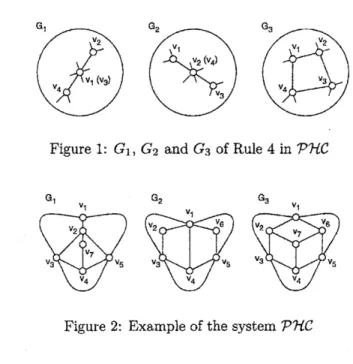
that theresulting graphsareplanar. Rule 4 isas follows:4. Quadrilateral rule: Let $G_{3}$ beagraphwith vertex set $\{v_{1},$
\ldots ,$v_{n}\}$thatcontainsaface$v_{1}$,$v_{2}$,$v_{3}$,$v_{4}$
.
Let $G_{1}$ be a graphobtained by contracting vertices $v_{1}$ and $v_{3}$ of $G_{3}$. Let $G_{2}$ be a graph obtained by contracting vertices$v_{2}$ and $v_{4}$of $G_{3}$
.
Then fromG}
and $G_{2}$, we can construct the graph$G_{3}$ (SeeFigure 1).
Rule4is important when given graph consists of only triangle and quadrilateral faces.
For example,
we
show that the graph $G_{3}$ ofFigure 2 hasa
construction in P7{C. Let $G_{1}$ and $G_{2}$ bethegraphs shownin Figure 2. $G_{1}$ contains$K_{4}$
as
asubgraph induced by $\{v_{1},v_{2},v_{3},v_{5}\}$.
$G_{2}$ also contains15
Figure 1: $G_{1}$, $G_{2}$ and$G_{3}$ ofRule4 in$VHC$
Figure 2: Exampleof the system$P’HC$
constructedfrom $G_{1}$ and $G_{2}$ by Rule4, since$v_{1}$,$v_{2},v_{7},v_{6}$ is aquadrilateralfaceand $G_{1}$ is identical to $G_{3}$
with$v_{2}$ and$v_{6}$ contracted and$G_{2}$ isidentical to$G_{3}$ with $v_{1}$ and$v_{7}$ contracted.
Since$G_{3}$ isedgeminimalwith respectto the 3-colorability,$G_{3}$ cannotbeconstructeddirectlybyRule1.
Each face of$G_{3}$ is triangleorquadrilateral, thus there is not a triplet ofvertices$v$,$v’$,$v’$ of satisfying the
condition of Rule 2. Thismeansthat$G_{3}$ cannot be constructed directly by Rule 2. Contraction rulecannot
break the structure of non-3-co1orab1i1ity. Therefore, probably $G_{3}$ is anexampleof graphs that essentially
needRule 4 in$P\mathcal{H}C$
.
In therest of this section,weprove thesoundness andthe completeness of$PHC$
.
Theorem 2
VHC
is sound.Proof: We only need to showthat Rule4issoundsinceotherrules alsoappearin$HC$and
are
showntobesound[3]. Assume that there existsa3-colorable graph$G_{3}$ generatedby Rule4. Then, itsface $v_{1}$,$v2,$$v3$,$v_{4}$
has acoloring satisfyingoneofthefollowingcases:
Case 1: $\mathrm{c}\mathrm{o}1\mathrm{o}\mathrm{r}(v_{1})=\mathrm{c}\mathrm{o}1\mathrm{o}\mathrm{r}(v_{3})$.
Case2: $\mathrm{c}\mathrm{o}1\mathrm{o}\mathrm{r}(v_{2})=$color(v4).
Note that, if neither of the
cases are
satisfied, wehave color$(v_{1})\neq \mathrm{c}\mathrm{o}1\mathrm{o}\mathrm{r}(v_{3})$and $\mathrm{c}\mathrm{o}1\mathrm{o}\mathrm{r}(v_{2})\neq$color(v4).In this case,
we
needmore
than four colorsto the face, which contradictsthe $3$-colorabilityof$G_{3}$. Cases1(Case 2, respectively) implies that $G_{1}$ ($G_{2}$, respectively) is 3-colorable. Therefore, only non-3-c1orab1e
graphs
are
generated. $\square$Theorem 3
VHC
is complete.Proof: We prove this theorem by induction
on
the size $n$ of the graph. Incase
$n<4$, all graphsare
colorablebyat most 3 colors. In
case
$n=4$, $K_{4}$ is the initial graph of$P\mathcal{H}C$. Other graphs of size4are
all3-colorable,so wedo notcarethem.
Assumethat allnon-3-co1orab1egraphsofsize n-l
can
beconstructed inP7{C. Weassume
that thereexists
a
nonempty set $\mathcal{G}$ofnon-3-co1orab1egraphs of size $n$that cannot be constructedin $PHC$.
Thenwelead
a
contradiction that edge maximal graph $G\in Ci$ can beconstructed. By consideringthe size of thefaces in$G$,
we
havethefollowingthreecases.
Case 1: All faces
are
triangle. According to Theorem 5 (we prove this theorem later), $G$ can beconstructed in$P\mathcal{H}C$
.
Case 2: Thereisa face$f$of size$k\geq 5$. Let$v_{1},v_{2},v_{3},v_{4}$,$\ldots$,$vk$bethevertices offace$f$
.
$G’=G+(v_{1},v\mathrm{s})$and$G’=G+(v_{1}$,$v_{4}\rangle$canbe constructed, since$G$isaedge maximal graphin
$\mathcal{G}$
.
Thereforewe can
constructFigure 3: $G_{n}$
Case 3: $G$is composed of triangle
or
quadrilateral faces. Let $f=v_{1}$,$v_{2}$,$v\mathrm{s}$,v4 be a quadrilateral faceof$G$
.
Let $G’$ be a graph obtained by contracting vertices$v_{1}$ and$v_{3}$ of$G$. Let $G’$ be agraphobtained bycontracting vertices $v_{2}$ and $v_{4}$ of G. $G’$ and $G’$ can be constructed in $P’HC$ because of the assumption.
Thereforewe canconstruct $G$ from $G’$ and $G’$ aPPlying the Rule4.
In any case, $G(\in \mathcal{G})$ can be constructed in$PHC$, which contradict to the definition of $\mathcal{G}$. Thus, any
non-3-co1orab1egraphcanbe constructed in$PHC$. $\square$
Now, we prove that any triangulate non-3-co1orab1e planar graph can be constructed in polynomial
number ofsteps. Firstweprove the followinglemma,whichconstruct anessential component of triangulate
planargraphs.
Lemma 4 Lei$G_{n}=(V,$E) be a graph
of
3n$+1$ vertices, wheren$\geq 1$,$V=\{a\mathrm{o}\}\cup$ $\{a_{i}, b_{t}, c_{i}|\mathrm{i}\in\{1, \ldots, n\}\}$,
$E=\{(a_{\mathit{0}}, a_{n})\}\cup\{(a_{\mathrm{i}-1}, b_{i}), (a_{i-1}, \mathrm{c}_{l}), (a_{i}, b_{i}), (a_{i},c_{i}), (b:, c_{l})|\mathrm{i}\in\{1, \ldots, n\}\}$
then, $G$ has a linearsize constr uction in $PHC$.
PROOF: We prove this lemma byinduction
on
$n$.
Incase
$n=1$, the lemma obviously holds since $G_{1}$ isisomorphictoan initialgraph$K_{4}$
.
We prove that $G_{n}$ can be constructed by the assumptionthat $G_{n-1}$ can be constructed. $G’=G_{n}+$
$(a_{0},a_{n-1})$ canbeconstructedin$VHC$since$G_{n-1}$is subgraph of$G’$. $G’=G_{n}+(a_{n-1},a_{n})$canbeconstructed
in$PHC$sincesubgraphof$G’$induced by$\{a_{n-1}, a_{n}, b_{n}, c_{n}\}$ isisomorphic to $K_{4}$
.
Therefore we can construct $G_{n}$ by applyingRule 2 to $G’$ and$G’$. Sincewe
applyRule 1 twiceand Rule 2 once at each inductionstep,the whole construction is linearly bounded. $[]$
Theorem 5 fflangutate non-3-colorableplanargraphs have apolynomial size construction in PHC.
Proof: Ourgoalisto finda structure$G_{n}$ of Lemma4
as
a subgraph of a givengraph$G$. We try to assigncolorsto verticesof$G$
.
Initially, we choose atriangle face$\mathrm{u}\mathrm{i}$,$v_{2}$,$v_{3}$ andassigndifferent color toeachvertex, color$(v_{1})$ $=R$, $\mathrm{c}\mathrm{o}1\mathrm{o}\mathrm{r}(v_{3})=G$ and$\mathrm{c}\mathrm{o}1\mathrm{o}\mathrm{r}(v_{3})=B$
.
We introduce three trees $T_{R}$,$Tc$,$T_{B}$.
The root node ofeach tree is one of the vertices $\mathrm{u}\mathrm{i}$,
$v_{2}$,$v_{3}$. The face that its vertices
are
already assigned a color is calleda colored face. Next, we repeat the following procedure until allvertices
are
assigned acoloror
adjacentvertices are assignedthe
same
color. Choosea
non-colored triangle face$f’$ adjacent to coloredface $f$.
Weneed not to think about thecase that non-coloredfaces exist but
are
not adjacentto colored facebecausethegiven graphisconnectedandtrianglate. Let$v$ be avertex that belongs to$f$ anddoesnot belongto $f’$.
Let$v’$ be avertexthat belongsto $f’$and does not belong to $f$
.
Vertices $v$and $v’$are
uniquely determined.Thenweassign$c=$color(v) to$v’$ and addthevertex$v’$to thetree$T_{\mathrm{c}}$as a child node of$v$
.
Thisreplicationstopsbefore all vertices assigned acolor because $G$ is non-3-co1orab1e. When the repetition stops,
we
findadjacent vertices $v’$ and$v’$
on
$G$that areassigned thesame
color$c$.
The tree$T_{c}$includes$v’$ and $v’$so
thatthere is
a
path$p$from$v’$ to $v’$in$T_{c}$. AnEdge $(v_{i},v_{j})\in T_{\mathrm{c}}$corresponds to a subgraphof$G$asthe Figure4.Let $G’$ beasubgraphof$G$that corresponds to path$p$ ($G’$ ofFigure 5 isan example) that correspondsto
path$p$ (dotted line ofthefigure). Let $G’$ beagraph$G|p|$ ofLemma 4. $G’$ can beconstructed because of
Lemma 4. $G’$
can
be constructed from$G’$ withsome
vertices contracted. $G$can
be constructedfrom$G’$ by17
Figure4: Relationbetween$v_{i}$ and$v_{g}$ in $G$
Figure 5: Subgraph of$G$and itsstructure
4
Planar
Calculus
PHC’
Inthis section,
we
propose another planarcalculus $P\mathcal{H}C^{*}$. The set ofinitial graphs in $PHC^{*}$ contains allgraphs isomorphic to $K_{4}$. Therearethreerules for generating newgraphs. Rule 1 and Rule 3are same as
thesystem$P?\{C$. Our new Rule2 isas follows:
2. Vertex $\mathrm{d}\mathrm{i}\mathrm{v}\mathrm{i}\mathrm{s}\mathrm{i}\mathrm{o}\mathrm{n}/\mathrm{e}\mathrm{d}\mathrm{g}\mathrm{e}$ elimination rule: Let $G_{1}$ be a graph with $n$ vertices $\{v_{1}, \ldots, v_{n}\}$ that
contains anedge $(v_{1},v_{2})$, and$G_{2}$ be thegraphobtainedby contracting$v_{1}$ and$v_{2}$of$G_{1}$.Then from$G_{1}$
and$G_{2}$, we
can
construct agraph$G_{3}$ graphthatare
identical to$G_{1}$ but does not contain $(v_{1}, v_{2})$.
Rule 2 is simple but powerful $|\mathrm{t}\mathrm{o}$ generate non-3-co1orab1e graphs. This rule
means
that none adjacentvertices$v1$ and$v_{2}$
can
be assigned the same coloror
different colors.In the rest ofthissection, weprove thesoundness and the completeness of$P\mathcal{H}C^{*}$.
Theorem 6 $PHC^{*}$ is sound.
Proof: We onlyneedto show the soundness ofRule 2 since other rules also appearin$HC$ and areshown
to besound [3], Assumethatthere exists
a
3-colorable graph$G_{3}$ generatedbyRule 2. Then,itsvertices$v_{1}$and $v_{2}$ has acoloring satisfyingoneof thefollowing twocases:
Case1: $\mathrm{c}\mathrm{o}1\mathrm{o}\mathrm{r}(v_{1})\neq \mathrm{c}\mathrm{o}1\mathrm{o}\mathrm{r}(v_{2})$
.
Case2: $\mathrm{c}\mathrm{o}1\mathrm{o}\mathrm{r}(v_{1})=\mathrm{c}\mathrm{o}1\mathrm{o}\mathrm{r}(v_{2})$
.
In Case 1, the coloring is also valid for$G_{1}$, i.e., $G_{1}$ is 3-colorable. In Case 2, wecan contract vertices
$v_{1}$ and $v_{2}$ in $G_{3}$, i.e., $G_{2}$ is also 3-colorable. Therfore, in $VHC$ , all graphs generated by Rule 2
are
non-3-co1orab1e $\square$
Theorem 7 $PHC^{*}$ is complete.
Proof: All non-3-co1orab1e planar graphscan be constructed in $VHC$
.
Wecan
simulate $P\mathcal{H}C$ by$P\mathcal{H}\mathrm{C}^{*}$,so that$P\mathcal{H}C^{*}$ is complete. $\square$
5
Polynomial-Time Simulation
We show the relationship betweenP7{C and P7{C*. First directionis thatwe simulate
VHC
by$P\mathcal{H}C^{*}$.
Theorem 8 $PHC^{*}p$-simulatesVHC.
Proof: Rules 1 and 3 are
common
in $P\mathcal{H}C^{*}$ and $PHC$.
We only need to simulate Rule 2 and Rule4 in$PHC$ by$P$}$tC^{*}$. Accordingto Lemma 9 Rule 2 canbesimulated. According toLemma 10, Rule4 canbe
simulated. In each case the series of simulating steps
can
be constructed in polynomial time. Therefore,$PHC$’
$P$-simulates$VHC$
.
$\square$
Lemma 9 $PHC^{*}p$-sirnulates Rule 2
of
PHC.Proof: We prove that agraph$G_{3}$
can
be constructed from $G_{1}$ and $G_{2}$ in$PHC^{*}$. Let $G_{1}$ and $G_{2}$ be twographswith
common
vertexset $\{v_{1}, \ldots, v_{n}\}$ which are identicalexcept that $G_{1}$ contains edges $(v1, v2)$ and$(v_{2}, v_{3})$ andnot $(v_{1},v_{3})$, whereas$G_{2}$ contains edges $(v_{1}, v_{2})$ and $(v_{1},v_{3})$ andnot $(v_{2},v_{3})$
.
$G_{3}$ isidenticalto$G_{1}$ but does not contain $(v_{2}, v_{3})$. Let$G_{1}’$ beagraph identicalto$G_{1}$ withvertices$v_{1}$ and$v_{3}$
are
contracted.$(G_{1}, G_{1}’, G_{2}, G_{3})$ isasubsequenceofaconstructionin$P?t\mathrm{C}^{*}$ since$G_{1}’$
can
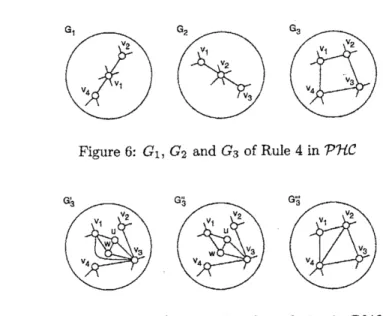
beconstructedfrom$G_{1}$ byRule3 and $G_{3}$ can beconstructed from$G_{1}’$ and$G_{2}$ by Rule 2 with paticular vertices$v_{1}$ and$v_{3}$. [IlFigure6: $G_{1}$, $G_{2}$ and$G_{3}$ of Rule4in$P\mathcal{H}C$
Figure 7: Intermediategraphs of simulation in $PHC^{*}$
Lemma 10 $P\mathcal{H}C$” $p$-sirrvulates Rule
4
of
PHC.
PROOF: Let Gi,$G_{2}$ and $G_{3}$ be graphs
as
Figure6. $G_{3}$ isagraph withvertex set $\{v_{1}, \ldots,v_{n}\}$that containsaface$v1$,$v_{2}$,$v_{3}$,$v_{4}$. $G_{1}$ is agraph obtained bycontractingvertices$v_{1}$ and$v3$ of$G_{3}$
.
$G_{2}$ isagraphobtained by contractingvertices$v_{2}$ and$v_{4}$ of$G_{3}$. We prove that agraph$G\mathrm{s}$canbe constructed from $G_{1}$ and $G_{2}$ in$PHC^{*}$
.
Let $G_{1}’$ be the graph as Figure 7. $G_{1}’$ is identical to $G_{1}$, but has two additionalvertices $u$ and $w$andthree additional edges $(v_{1}, u)$,$(v_{1}, w)$,$(u, w)$
.
$G_{1}’$can
beconstructed ffom $G_{1}$ by Rule 1, since $G_{1}’$ is asubgraph of$G_{3}’$
.
Let $G_{3}’$, $G_{3}’$ and $G_{3}’$ be graphs asFigure 7 that are identical to $G_{3}$ but someverticesandedgesinthe figureisdifferent from$G_{3}$. $G_{3}’$canbe constructed from$K_{4}$byRule 1 sinceasubgraphinduced
by $\{v_{1}, v_{3}, u, w\}$ is isomorphic to $K_{4}$
.
$G_{3}’$can
be constructed from $G_{1}’$ and $G_{3}’$ by Rule 2 in $PHC^{*}$ withpaticularvertices$v_{1}$ and$v_{3}$ ($G_{3}’$ has
an
edge ($v_{1}$,$v_{3}$) and $G_{1}’$ is identical to $G_{3}’$ with $v_{1}$ and$v_{3}$ contracted).$G_{3}’$
can
be constructed from $G_{3}’$by contractingtwo pairs of vertices $(v_{2}, u)$ and$(v_{4}, w)$.
This constructionneeds twice of applying Rule3in$P\mathcal{H}C^{*}$
.
Then $G_{3}$ can beconstructed from$G_{3}’$and $G_{2}$ byRule 2in$P\mathcal{H}C^{*}$with paticularvertices u2 and $v_{4}$. Thus Rule4 in$PHC$canbepsimulated by$P\mathcal{H}C^{*}$.
$\square$
Theorem 8implies thatthe modifiedrule (Rule 2) isat least
as
powerfulas the originalone
in $HC$.
Corollary 11 $\mathcal{H}C$ can bep simulate by$PHC^{*}$ without planarity ristiction on the inter mediate graphs.
It is difficultto show that$VHC$psimulates$PHC^{*}$
.
For example,as shown in Figure 8, Rule2 in$PHC$”cangeneratea newquadrilateral of$G_{3}$ from $G_{1}$ and $G_{2}$. To simulatethis construction we must
remove an
edge$(v_{2}, v_{4})$ of$G_{1}$ by rulesin$VHC$, but edge elimination rulecannotbeappliedsince ($v_{2}$,V4)
are
sandwichedbetween triangle faces andtheother rules cannotelim inate edges.
19
6
Concluding Remarks
We showthat there existasystem of generatingnon-3-co1orabIeplanar graphs,where intermediate graphs
in the system
are
restricted to be planar. Two calculi $PHC$ and $P\mathcal{H}C^{*}$ are sound and complete graphconstruction system thatgeneratesthe class of non-3-co1orab1eplanargraphs. $PHC^{*}$is simple butpowerful
calculus, since$PHC$”psimulates$VHC$
.
Relationship between construction in planar graph calculus and general graph calculus may be
inter-esting. There is a structure that can replace crossing edges keeping the colorability condition,
so
thatnon-planar graphs
can
be mapped to planar graphs. Thus a class ofgraphs that have super-polynomiallower bound in $HC$ may be associated with a class of graphs in a planar calculus. For future discussion,
wewouldliketo considerpolynomial-time simulation of$P\mathcal{H}C^{*}$ by$PHC$. Also lowerbound of planar graph
calculusis
an
interestingwork.References
[1] H. HADWIGER, “Uber eine Klassifikation der Streckenkomplexe,” Vierteljahrsschr Naturforsch, Ges.
Zurich, 88, PP.133-142 (1943)
[2] G. A. DiRAC, “A propertyof 4-chromatic graphs and some remarks
on
critical graphs,” J. LondonMath. Soc, 27, PP.85-92, (1952)
[3] G. HAJO’S, $”\ddot{\mathrm{U}}$ver
eine Konstruktionnicht $n$-f\"arbbarer Graphen,” Wiss. ZeitschrMartin LutherUniv.
Halle-Wittenberg, A 10 (1961)
[4] K. WAGNER, “Beweis einer Abschwichung der Hadwiger Vermutung,” Math. Ann., 153, pp.139-141
(1964)
[5] R. M. KARP, “Reducibilityamong CombinatorialProblems,” Proc. Symp. Complexity of Computer
Computations, Ed. R. E. MILLER, J. W. THATCHER, pp.85-103 (1972)
[6] S. A. Cook AND R. A. RECKHOW, “Time bounded random
access
machines,” Journal of Computerand System Sciences, 7 (4),
PP.354-375
(1973)[7] K. APPELANDW. HAKEN, “Every planarmapisfourcolorable,” Part I: Discharging, Illinois J.Math.,
21, pp.429-490 (i977)
[8] K. APPEL, W. HAKEN, AND J. Koch, “Every planar map is four colorable,” Part II: Reducibility,
Illinois J. Math., 21, pp.491-567 (1977)
[9] M. R. GAREY AND D. S. JOHNSON, “Computers and Intractability: A guide to the theory of
NP-Completeness,” W. H. FREEMAN, (1979)
[10] F. GUTHRIE, “Noteon the colouringof maps,” Proc. R. Soc. Edinb., 10, pp.727-728 (1980)
[11] A. J. MANSFIELD, D. J. A. Welsh, “Some coloring problems and their complexity,” Annals of
Discrete Mathematics, 13 (1982)
[12] K. APPEL AND W. HAKEN, “EveryPlanar Mapis FourColorable, Providence,” RhodeIsland,AMS,
(1989)
[13] T. PiTASSl, P. W. BEAME, AND R. IMPAGLIAZZO, “Exponential lower bounds for the pigeonhole
principle,” Computational Complexity, 3 (2), pp.97-140 (1993)
[14] M. AJTAI, “The complexity of the pigeonhole principle,” Combinatorica,14 (4), pp.417-433 (1994)
[15] T. R. JENSEN AND B. Toft, “Graph Coloring Problems”, Wiley (1995)
[16] T. PITTASI AND A. URQUHART, “The complexity of the Hajos Calculus,”
SIAM
Journal on DiscreteMathematics, Vol. 8 (1995)
[17] K. IWAMA$\Lambda \mathrm{N}\mathrm{D}$T. PITASSIRT,
$\iota$‘
Exponentiallower bounds for the treelikeHajosCalculus” Information
Processing Letters, Vol. 54, PP. 289-294 (1995)
[18] J. $\mathrm{K}\mathrm{R}\mathrm{A}\mathrm{J}\acute{\mathrm{I}}\check{\mathrm{C}}\mathrm{E}\mathrm{K}$, P.
PUDL\’AK,
AND A. Woods, “Exponentiallower bounds to thesizeof bounded depthFrege proofs of the pigeonhole principle,” Random Structures and Algorithms, 7 (1) (1995)
[19] N. ROBERTSON, D. SANDERS, P. D. SEYMOUR,ANDR.Thomas, “The four-colourtheorem,” J.