On
a free
boundary problem
related to
the
motion
of
an
amoeba
Harunori Monobe
Mathematical
Institute,
Tohoku
University
1
Introduction
Amoeba motion is
one
of cellular motions. and is common among many cells. forexample, white blood cell,
cancer
cells, slime mold, keratocyte and so on. Thelocomotionis caused by
some
chemical reactions within acell and substances outsidethe cell. However the detailed mechanism to produce such motion structure is not
well understood so that its mathematical study is an interesting question.
Meanwhile, there are some mathematical models proposed by a lot of biologist
and physicist who desire to understand thelocomotion. In this paper we consider a
mathematical model. which is proposed by T. Umeda [6], of them.
We consider the following free boundary problem:
(P) $\{\begin{array}{ll}u_{t}=\triangle u+k_{1}(C_{0}-\int_{\Omega(t)}udx)-u+k_{2} in Q. \cdot\cdot\cdot (i)u=1+A\kappa+BV on \Gamma, \cdots(ii)V=-\epsilon\nabla u\cdot n+g(C_{0}-\int_{\Omega(t)}udx)-u on \Gamma, \cdots(iii)u=\phi\geq k_{2} in \Omega(0),\end{array}$
where $\Omega(t)$ is anunknown bounded domain in$\mathbb{R}^{2}$ at time
$t$ with the boundary$\partial\Omega(t)$,
$Q$ and $\Gamma$
are a
non-cylindricaldomain and
a
non-cylindrical surface, respectively.defined by
$Q:= \bigcup_{t>0}\Omega(t)\cross\{t\}_{\dot{\pi}}$ $\Gamma:=\bigcup_{t>0}\partial\Omega(t)\cross\{t\}$,
$\kappa=\kappa(x, t)$ is an inward curvature at $x\in\partial\Omega(t),\cdot V=V(x, t)$ is a scalar function
representing the outer normal velocity of$\partial\Omega(t),$ $n=n(x, t)$ is anouter normal unit
vector at $x\in\partial\Omega(t)$. Coefficients $k_{1},$ $k_{2},$$C_{0}$,A.$g$
are
positive constants and B.$\epsilon$ arenon-negative constants.
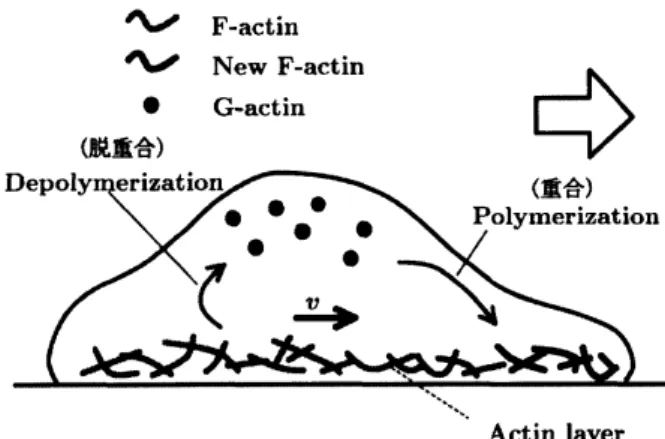
(P) is related to a mathematical model describing the motion of an amoeba,
which is based on the density of F-actin $u(x, t)$ and actin layer $\Omega(t)$ contained in a
$\sim$ F-actin
Actin layer
Figure 1:
Cross
section ofa
cellcan
regard the domainas
the shape ofthe cell.Onthe otherhand, (P) is regarded mathematicallyas aone-phaseStefan problem
with reaction terms. In terms of Stefan problems, the interior condition (i) and
boundary conditions (ii), (iii) correspond to the heat equation, the Gibbs-Thomson
effect and the
Stefan
condition, respectively. Ingeneral, for free boundary problems,the topoloy
of domains may
change ata
finite timeso
that the existence timeof
classical solutions is local. Therefore,
some
additional conditionsare
necessary forthe existence ofthe time global classical solutions. In what follows,
we
consider thetime local and time global existence ofsolutions for (P) under some assumptions.
Assumption 1. The initial domain $\partial\Omega(0)\dot{h}9$ a Jordan
curve
such that $\partial\Omega(0)\in$$C^{3+a},$ $\partial\Omega(0)=\{X^{0}(s)+\Lambda_{0}(s)N(s)|s\in[0, l]\}$ , where $\alpha$ is a Holder index $(0<$
$\alpha<1),$ $X^{0}$ is a regular Jordan curve, in $\mathbb{R}^{2}$, parameterized by
$s$
.
Here $N(s)$ is theouter nomal unit vector at $X^{0}(s)$, and $\Lambda_{0}\in C^{3+\alpha}([0, l])$.
Definition 1. In the
case
of
$\epsilon>0$, we call (P) hasa
time local solution”,if
thereexists
a
finite
time $T>0$ such that $(u, \Omega(t))$satisfies
(P) and have a regularity$u\in C^{2+\alpha,(2+\alpha)/2}(\overline{Q_{T}})$, $\Gamma_{T}\in C^{3+\alpha,(3+\alpha)/2}$,
where $Q_{T}= \bigcup_{0<t<T}\Omega(t)\cross\{t\}$ and $\Gamma_{T}=\bigcup_{0<t<T}\partial\Omega(t)\cross\{t\}$
.
Also,if
$T=\infty$, wecall “(P) has a unique time globalsolution ”.
Considering the viscosity effect $(B>0)$,
we
have the following result:Theorem 1. Let$B,$$\epsilon>0$. Suppose that$\partial\Omega(0)$
satisfies
Assumption 1.If
the initialdatum$\phi$ belongs to $C^{2+\alpha}$(St(0)) and
satisfies
a
compatibility condition, then (P) hasa unique time local classical solution.
In Theorem 1,
as
in X. Chen and F. Reitch [1], W. Merz and P. Rybka [4],we
regard the boundary condition (ii)as a
parabolic problemon a
curve, andan
approximate sequence of the boundary
can
be found by solving the problem. Asa
result,we
havea
unique solution with the aid of the Hanzawa diffemophism (E.Hanzawa [2]$)$ and Banach$s$ fixed point theorem. On the other hand, in the
case
ofan approximate sequence of the boundary with the time evolution. However, under
the special condition (spherically symmetric case). we can show the existence of
classical solutions since we
can
construct an approximate sequence of the boundaryby the boundary condition (iii). From now on, we consider the case where $(\phi, \Omega(0))$
is spherically symmetric.
Assumption 2. Initial data are spherically symmetric, $i.e$.
$\Omega(0)=\{x\in \mathbb{R}^{2}|0\leq|x|<s_{0}\}$, $\phi(x)=\psi(|x|)$.
where $s_{0}$ is apositive constant and $\psi\in C^{2+\alpha}([0.s_{0}])$ with $\psi_{r}(0)=0$.
From now on, we suppose that initial data satisfy Assumption 2.
Definition 2. In the case
of
$\epsilon=0$, we call “(P) has a time local classical solution“,if
there exists $T>0$ such that $(u, \Omega(t))$satisfies
(P) and have a regularity$u\in C^{2+\alpha\prime}(2+\alpha)/2(\overline{Q_{T}})$, $\Gamma_{T}\in C^{4+\alpha.(4+\alpha)/2}$.
Also,
if
$T_{*}=$ oo, we call “(P) has a unique time global solution “.Theorem 2. Let $B=0$ and $\epsilon\geq 0$.
If
the initial datum $\phi$satisfies
Assumption 2and compatibility conditions, then (P) has a unique time local classical solution.
From the viewpoint of mathematical modeling, it is preferable that $u$ and $C_{0}-$
$\int_{\Omega(t)}udx$are positive. With this view in mind, weconsider the time global existence
of solutions in the case of$\epsilon=0$.
Assumption 3.
Coefficients
satisfy the following condition:$k_{1}C_{0}-(1-A\pi g)(1-k_{2})<0$. $1-k_{2}>0$.
Assumption 4. There exists $\alpha_{1},$$\alpha_{2},$$\beta_{1}.\beta_{2}\in(0, (-A+\sqrt{A^{2}+4C_{0}}/\pi)/2]$ such that
following conditions hold:
$g(C_{0}- \pi\alpha_{i}(A+\alpha_{i}))=1+\frac{A}{\alpha_{i}}$, $g(C_{0}- \pi k_{2}\beta_{i}^{2})=1+\frac{A}{\beta_{i}}$, $(i=1,2)$.
where $\alpha_{1}<\alpha_{2}$ and$\beta_{1}<\beta_{2}$.
Theorem 3. Let $B=0$ and$\epsilon=0$. Suppose that initial data and
coefficients
satisfyAssumption 2, 3,
4. If
initial data satisfy compatibility conditions and$k_{2}<\phi|_{\Omega(0)}<\phi|_{\partial\Omega(0)}$, $C_{0}- \int_{\Omega(0)}\phi dx>0$, $\alpha_{2}\leq s_{0}\leq\beta_{2}$,
then (P) has a unique time global solution $(u, \Omega(t))$ such that
$k_{2}<u|_{\Omega(t)}<u|_{\partial\Omega(t)}$. $C_{0}- \int_{\Omega(t)}u(t, \cdot)dx>0$, $\alpha_{2}\leq s(t)\leq\beta_{2}$,
2
Positive
invariant
region
Local existence of
a
classical solution for (P) is shown by Hanzawa diffe.[2],a
parabolic standard existence theory [3] and $Banach\prime s$ fixed point theorem (see [5]).
The proof is based on the paper ofChen and Reitch [1].
In this section.
we
prove the existence of a positive invariant region, for $\partial\Omega(t)$,to show the existence of a time global classical solution. To this end,
we
examinesome
properties such that$\phi>k_{2}(>0)$, $C_{0}- \int_{\Omega(0)}\phi dx>0\Rightarrow$ $u>k_{2}$, $C_{0}- \int_{\Omega(t)}udx>0$.
These properties
come
from the fact thatarea
densityof F-actin and concentrationof G-actin are positive in the biological view point. Likewise, they
are
of help toprove the boundedness of $u$ and $\Omega(t)$. As
a
result. wecan
find global solutions withthe help ofthese properties and initial conditions.
Here, for simplicity,
we
rewrite (P) asan
one-dimensional problem(SP) $\{\begin{array}{ll}v_{t}=v_{rr}+\frac{v_{r}}{r}+k_{1}(C_{0}-2\pi\int_{0}^{s(t)}rvdr)-v+k_{2} in Q((0, T);s(t)),v=1+\frac{A}{s(t)} on \Gamma((0.T);s(t)),\dot{s}(t)=g(C_{0}-2\pi\int_{0}^{s(t)}rvdr)-v on \Gamma((0.T);s(t)),v_{r}=0 on \{0\}\cross[0, T],v=\psi>k_{2} in (0, s_{0}),\end{array}$
where $T$ is a positive constant,
$Q((a.b);s(t)):= \bigcup_{a<t<b}[0, s(t))\cross\{t\}$, $\Gamma((a, b);s(t)):=\bigcup_{a<t<b}\{s(t)\}\cross\{t\}$
and $v(r, t)$ is equal to $u(x, t)$ for (P) with $r=|x|$.
2.1
Boundedness
of
$s(t)$and
$v(r, t)$To prove Theorem 3, we prepare some Lemmas. From
now
on,we
suppose that $T$is a time such that (SP) has the unique time local solution $(v, s(t))$ in $[0, T]$.
Lemma 1. Assume that $\dot{s}(t)\leq 0$
for
any $t\in[t_{0}, t_{1}]\subset[0, T]$.
If
$k_{2}<v(r, t_{0})<$$v(s(t_{0}), t_{0})$
for
any $r\in[0, s(t_{0}))$ and $C_{0}-\pi(A+s(t_{0}))s(t_{0})>0$, then$k_{2}<v(r, t)<v(s(t).t)$, $C_{0}-2 \pi\int_{0}^{s(t)}rvdr>0$
Proof.
It is clear in thecase
of$t_{0}=t_{1_{\dot{}}}$so we
consider thecase
of$t_{0}\neq t_{1}$. Supposethat there exists a point $(r^{*}, t^{*})\in Q((t_{0}. t_{1}];s(t))$ such that $v(r^{*}, t^{*})=k_{2}$ and $k_{2}<$
$v(r.t)<v(s(t), t)$ in $Q((t_{0}.t_{1});s(t))$. where $Q((a.b];s(t))$ $:= \bigcup_{a<t\leq b}[0.s(t))\cross\{t\}$.
Since $\dot{s}(t)\leq 0$ and $v\leq v(s(t), t)$ for $t\in[t_{0}, t^{*}]$,
$C_{0}-2 \pi\int_{0}^{s(t)}rvdr>C_{0}-\pi(A+s(t))s(t)>C_{0}-\pi(A+s(t_{0}))s(t_{0})>0$.
Then, from the interior condition of (SP),
$0\geq v_{t}(r^{*}, t^{*})$
$=v_{rr}(r^{*}.t^{*})+ \frac{v_{r}(r^{*},t^{*})}{r}*+k_{1}(C_{0}-2\pi\int_{0}^{s(t^{*})}rvdr)-v(r^{*}.t^{*})+k_{2}>0$.
This is
a
contradiction. and wesee
that $v>k_{2}$ for $t\in[t_{0}.t_{1}]$. On the other hand,suppose that there exists a point $(r^{*}, t^{*})\in Q((t_{0}, t_{1}];s(t))$ such that $v(r^{*}, t^{*})=$
$1+A/s(t^{*})$ and $k_{2}<v(r, t)<1+A/s(t)$ in $Q((t_{0}, t_{1});s(t))$. From easycalculations,
$C_{0}-2 \pi\int_{0}^{s(t)}rvdr$ and $\int_{0}^{s(t)}rvdr$ are positive for $t\in[t_{0}.t^{*}]$. Then
$0 \leq v_{t}(r^{*}, t^{*})\leq k_{1}C_{0}-2k_{1}\pi\int_{0}^{s(t^{*})}rvdr-(1-k_{2})-\frac{A}{s(t^{*})}<0$
from Assumption 4. This is a contradiction, and we see that $v<v(s(t), t)$ for
$t\in[t_{0}, t_{1}]$.
$\square$
Similarly. for the
case
of $\dot{s}(t)\geq 0$. we will show the boundedness. Here weremarkthat the assumption of boundedness for $s(t)$ differ slightly between $\dot{s}(t)\geq 0$
and $\dot{s}(t)\leq 0$.
Lemma 2. Assume that $\dot{s}(t)\geq 0$
for
$t\in[t_{0}, t_{1}]\subset[0.T]$, and $s(t_{0})\geq\alpha_{2}$.If
$k_{2}<v(r, t_{0})<v(s(t_{0}), t_{0})$
for
any $r\in[0, s(t_{0}))$ and $C_{0}-\pi(A+s(t_{i}))s(t_{i})>0$for
$i=0_{:}1$, then
$k_{2}<v<v(s(t).t)$, $C_{0}-2 \pi\oint_{0}^{s(t)}rvdr>0$
for
any $t\in[t_{0}, t_{1}]$ and $r\in[0.s(t))$.Proof.
We show this Lemmainthecaseof$t_{0}\neq t_{1}$ only. Fromthe boundary condition(iii) and $\dot{s}(t)\geq 0$, it follows that $C_{0}-2 \pi\int_{0}^{s(t)}rvdr>0$ for any $t\in[t_{0}, t_{1}]$. As the
argument ofLemma 1, we have the property $v>k_{2}$. To prove that $v<v(s(t), t)$ in
$(0, s(t))$. we use
a
super-solution $1+A/s(t)$.Let$X(r, t)=1+A/s(t)-v(r, t)$. From directly calculations, $X(r.t)$ satisfies the
following problem:
$\{\begin{array}{ll}X_{t}=X_{rr}+\frac{X_{r}}{r}-k_{1}(C_{0}-2\pi\int_{0}^{s(t)}rvdr)-X -k_{2}+(-\frac{A\dot{s}(t)}{s^{2}(t)}+1+\frac{A}{s(t)}) in Q((t_{0}, t_{1});s(t)),X(s(t), t)=0.X_{r}(0, t)=0, X(r,\cdot 0)\geq 0 in (0, s_{0}).\end{array}$
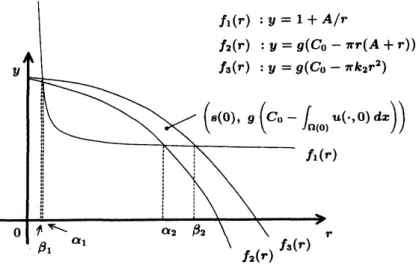
Figure 2: Assumption 4
Suppose that there exists a point $(r^{*}, t^{*})\in Q((t_{0}, t_{1}];s(t))$ such that $X(r^{*}, t^{*})=0$
and $X(r.t)>0$ in $Q((t_{0}.t^{*});s(t))$
.
The left hand side $X_{t}(r^{*}, t^{*})\leq 0$. On the otherhand, since $\dot{s}(t)\geq 0,$ $s(t_{0})\geq\alpha_{2}$ and $C_{0}-\pi(A+s(t_{1}))s(t_{1})>0$,
$0 \leq g(C_{0}-2\pi\int_{0}^{s(t)}rvdr)-1-A/s(t)$
$<g(C_{0}-2 \pi\int_{0}^{s(t)}rvdr)-g(C_{0}-\pi s(t)(A+s(t)))$ (2)
for any $t\in[t_{0}, t_{1}]$ (see Figure 2). Moreover, by normalizing free boundary,
$2 \pi\int_{0}^{s(t)}rvdr>k_{2}\pi s^{2}(t)$ (3)
for any $t\in[t_{0}, t_{1}]$, where $v(r, t)=w(\rho, t)$ and $r=\rho s(t)$. By (2), (3) and Assumption
3, we see that
$\{-k_{1}(C_{0}-2\pi\int_{0}^{s(t)}rvdr)+1-k_{2}\}s^{2}(t)$
$+A \{s(t)-g(C_{0}-2\pi\int_{0}^{s(t)}rvdr)+1+A/s(t)\}$
$>\{-k_{1}C_{0}+(1-Ag\pi)(1-k_{2})\}s^{2}(t)+A(1-Ag\pi)s(t)>0$.
Hence we
see
that the right hand side of interior condition is positive at the point$(r^{*}, t^{*})$
.
This is a contradiction for the assumption of $(r^{*}, t^{*})$, and we have theLemma. $\square$
Remark 2.1. Assumption
4
justmeans
that, in Figure 2, $f_{1}(r)$ and$f_{2}(r)$ have twointersections in the interval $(0, r_{*})$, where $f_{2}(r_{*})=0$. This relation
of
$f_{1}(r)$ andFigure 3: Cross section ofa cell
Rom these Lemmas 1, 2, we see that
$\alpha_{2}\leq s(t)\leq\beta_{2}$
.
Lemma 3. Initial data satisfy following conditions:
$k_{2}<\psi|_{[0,so)}<\psi(s_{0})$, $\alpha_{2}\leq s_{0}\leq\beta_{2}$, $C_{0}-2 \pi\int_{0}^{s_{0}}r\psi dr>0$,
then
$k_{2}<v<v(s(t), t)$. $\alpha_{2}\leq s(t)\leq\beta_{2_{\dot{\text{ノ}}}}$ $C_{0}-2 \pi\int_{0}^{s(t)}rvdr>0$,
for
any $t\in[0, T]$ and $r\in[0, s(t))$.By using the result of boundedness for $u$ and $s(t)$, we obtain the boundedness
for the H\"older norm of $s(t)$, As a result, we have the exsictence of the time global
solution for (P). Here
we
remark that the profile of$u$ is that the value in aneigh-borhood of the boundary is larger than one of the inside (see Figure 3). Actually,
we can make sure of the truth that there exists some livin$g$ things such that the
density of F-actin in the cell is similar to the solution for (P).
Acknowledgment
The author would like to thank Prof. Toyohiko Aiki for giving me an opportunity
to have a talk in this RIMS workshop, “Nonlinear evolution equations and related
topics to mathematical analysis of phenomena” Also I want to thank Prof. Eiji
Yanagida for encouraging the author to analyze this problem and several helpful
comments, and Professor Tamiki Umeda for valuable suggestions to this biological model.
References
[1] X. Chen and F. Reitch, Local existence and uniqueness ofthe stefan problem
with surfacetension and kinetic undercooling, J. Math. Anal. Appl. 164 (1992),
350-362.
[2] E. Hanzawa, Classical solution of stefan problem, Tohoku Math. J. 33 (1981).
297-335.
[3] O. A. Lady\v{z}enskaja, V. A. Solonnikov
and
N. N. Ural‘ceva, Linear andquasi-linear equations of parabolic type, Traslations of mathematical monographs
Amer. Math. Soc, Providence, R. I, 1968.
[4] W. Merz and P. Rybka, A free boundary problem describing
reaction-diffusion
problem in
chemical
vaporinfiltration
of pyrolyticcarbon, J. Math. Anal. Appl.292 (2004), 571-588.
[5] H. Monobe, Existence of solutions for a mathematical model related to the
motion of an amoeba, to appear, in Adv. Math. Sci. Appl. 2 of Vol. 20 (2010).
[6] T. Umeda, A chemo-mechanical model for amoeboid cell movement (in