Approximating
the
path-distance-width for
$k$-cocomparability graphs
Yota
Otachi
’Toshiki Saitoh
\daggerKatsuhisa Yamanaka
\daggerShuji Kijima
\SYoshio okamoto
lIHirotaka Ono
iiYushi
Uno
**Koichi Yamazaki
\dagger\dagger1
Introduction
The path-distance-width is
a
graph parametertomea-sure
how closea
graph is toa
path [20, 19]. Thereare
several othersuch graph parameters including path-width and bandpath-width. Roughly speaking, theclassesof graphs ofboundedpath-distance-width,bounded band-width, and bounded pathwidth have chain-like struc-tures. It is known that for any connected graph, pathwidth $\leq$ bandwidth $<2$.
path-distance-width[13,20]. By this relation, many usehl properties for bounded pathwidth graphs and bounded bandwidth graphs also hold for bounded path-distance-width graphs. There
are
othergraphclasses which also have chain-like structures, suchas
interval graphs, AT-ffee graphs,and$karrow cocomparability$graphs. Itisknown thatthere
are
relationships among those graph parameters and graph classes[13,20, 2,4].This study is motivated by the research
on
bandwidth ofAT-ffee graphs[14, 10].Tosee
themotivation,letus
brieflyreviewthe historyofthe research
on
bandwidth forintervalgraphs and AT-ffee graphs. Onemayexpect that ifwe
restrictour
input graphs to interval graphsor
AT-ffee graphs, thenwe
would be abletofindeas-ilyits chain-likestructure(such
as
its interval represen-tationor adominatingpair), andthen ffom thechain-like $s\alpha ucmre$
we
might be able to compute theband-width. It had notbeen known, however, whether the bandwidth
can
becomputedfor intervalgraphsin poly-nomialtime[12].Butthenittumed out thatthedecision problem canbe solved in polynomial time (see [18]).Since interval graphs
are
AT-free graphs, it would be natural to ask whetheror
not the bandwidth decision problemfor$ATarrow ffee$graphscan
be solved in polynomial’GraduateSchoolofInformationSciences,Tohoku University.
\dagger ERATO MINATO Discrete Sbucture Manipulation System
Project,JapanScience and TechnologyAgency.
$CraduateSchool ofInformationSystems,University of Electro-Communications.
$\S_{Graduate}$School of Information Science andElectrical Engineer-ing, Kyushu University,
$1_{Center}$for GraduateEducationInitiative, JAIST,
$||Depament$ofEconomicEngineering,Kyushu University.
”Departmentof MathematicsandInformationSciences,Graduate
SchoolofScience,OsakaPrefecture University.
\dagger \dagger Departmentof ComputerScience,GunmaUniversity.
time.
Unfortunately, the bandwidth decision problemfor AT-ffeegraphs is NP-complete [16, 14]. However, itis known that for AT-free graphs, thebandwidth
can
beapproximated within
a
factor 2in$O(mn)$time[14], where$m$and$n$denote the number ofedges and thenum-ber ofvertices,respectively.
In
a
sense, bandwidth and path-distance-width havesome
common
features. In fact, there isa
similaritybetween the problem of computing the path-distance-width and the problem of computing the bandwidth: both problems donotadmitanyPTAS
even
fortrees[1,19]. Hence,it would bereasonabletoaskthe computa-tionalcomplexityofcomputingthepath-distance-width forAT-Ree graphs. Unfortunately,
as we
willprovein thispaper,the path-distance-width decision problem for AT-free graphs is also NP-complete. More precisely,we
willshow that the problemisNP-complete for cobipar-tite graphs. Thus
we
consider the problem of approxi-matingthepath-distance-width.Althoughsometechniquesdeveloped in the research
on
bandwidthcan
becarriedover
into the researchon
path-distance-width, the path-distance-width problem has
a
serious drawback which the bandwidth problem does not have: path-distance-width is not closedun-der the edge deletion. Inmany cases, thisdrawback makes the design and analysis of algorithms
very
dif-ficult. Inthis smdy, however, ittums out that the re-strictionto AT-ffee graphs is enough toovercome
the drawback for achievinga
constant factor approxima-tion. Inthispaper,we
first presentapproximation algo-rithms with constantapproximation ratiosfor the path-distance-widthon
asuperclass ofAT-ffee graphs, which is knownas
k-cocomparability graphs. Although this is alreadya constantfactor approximation for AT-ffee graphs,we
presentanotherapproximationalgorithm for AT-ffee graphs, which has a better running time anda
better approximation ratio. We also show that the problem is solvable in linear-time for cochain graphs. The complexity for intervalgraphsandproper
interval graphs remainsopen.
2 Preliminaries
Inthis
paper,
graphsare
finite, simple, and connected.Let$G$beagraph. We denote by $\nabla(G)$and$E(G)$the
vertex setand the edgesetof$G$,respectively. The
dis-tancebetweentwovertices$u,$$v\in V(G)$in$G$,denoted by
$d_{G}(u, v)$,is the length ofa shortest$u-v$pathin$G$. We
de-fine the distance betweenavertexsubset$S\subseteq\nabla(G)$and
a vertex$v\in V(G)$ in$G$
as
$d_{G}(S, v)= \min_{u\epsilon S}d_{G}(u, v)$.
For$S\subseteq\nabla(G)$,
we
define the diameterof
$S$ in $G$as
$di_{\mathfrak{W}1_{G}(S)=\max_{u,v\in S}d_{G}(u,v)}$
.
The diameterof
a graph$G$is defined
as
diam$(G)=diam_{G}(\nabla(G))$.
The (open) neighborhood of
a
vertex $v$ in $G$,de-noted by $N_{G}(v)$, is the set ofvertices adjacent to $v$;
that is $N_{G}(v)=\{u|\{u, v\}\in E(G)\}$
.
The closedneighborhood of$v$ in$G$, denoted by$N_{G}(v)$, is the set $\{v\}\cup N_{G}(v)$
.
The (open) neighborhoodofa
vertex set$S\subseteq\nabla(G)$ in$G$, denoted by$N_{G}(S)$, isthe set of
ver-ticesnotin$S$ andadjacent to
some
vertex$u\in S$;thatis $N_{G}(S)= \bigcup_{v\in S}N_{G}(v)\backslash S$.
Thecompliment$ofa$graph$G$isthegraph$\overline{G}$suchthat
$\nabla(\overline{G})=V(G)$and twodistinct vertices are adjacentin
$\overline{G}$
ifand onlyifthey
are
notadjacentin$G$.
A sequence $(L_{1},L_{2}, \ldots,L_{t})$ of subsets ofvertices is
a
distance structureofa
graph$G$if$\bigcup_{1\leq i\leq t}L_{i}=\nabla(G)$and $L_{i}=\{v\in\nabla(G)|d_{G}(v,L_{1})=i-1\}$ for each
1 $\leq i\leq t$. Each$L_{i}$ is calleda level and specially$L_{1}$
is calledthe initialset. The width of$(L_{1},L_{2}, \ldots,L_{t})$,
denoted by $pdw_{L_{1}}(G)$, is defined
as
$\max_{1\leq i\leq t}|L_{i}|$.
Thepath-distance-width of$G$, denoted by $pdw(G)$, is
de-fined
as
$\min_{S\subseteq V(G)}pdw_{S}(G)$.
If the initial set of a distance structure of$G$ is a
setconsists of only
one
vertex, then we saythat it isa
rooted distance structure of $G$.
The rootedpath-distance-width of$G$, denoted by ipdw$(G)$, is the
min-imum
widthover
allits rooted distancestructures; that is, rpdw$(G)= \min_{v\in V(G)}pdw_{\{v|}(G)$.
Obviously, therooted path-distance-width
can
be computedin polyno-mialtime(seeLemma2.1 formore
details).The all-pairs shortestpaths problem is literally the problemoffinding
a
shortest path between eachpairof $j$vertices inagraph with$n$verticesand$m$edges.Insome $|$
cases, all-pairs distances
are
needed instead ofactual shortest paths. We consider this variant here; that is, $l$we
want to compute$d_{G}(u, v)$for allpairs $u,$$v\in\nabla(G)$.
$Clearly, byrunningbreadth-firstsearch ffomevery
ver-
‘tex, the problem can be solved in $O(mn)$ time. The 1
problem has been studied extensively, and there are ]
some
nontrivial improvements (see [3] and the refer- ‘ences
therein). Seidel[17]provedthat theproblemcan
a be solved in $O(M(n)\log n)$ time by using fast matrix $($multiplication, where $M(n)$ is the time complexity to
multiply two $n\cross n$ matrices. The current fastest al- $i$
gorithm formatrix multiplication by Coppersmith and $i$
Winograd [5] implies that Seidel’s algorithm
runs
in I$O(n^{2.376})$time. Recently, Chan[3]has presented
a new
algorithm for the all-pairs shortest path problem that
runs
in$o(mn)$time.For
a
graph $G$ with $n$ vertices and $m$ edges, let$apd(m,n)$be thetime complexity for computing the
all-pairs distances andoutputtingthedistance for each ver-texpair. We
can
use
anyone
of theabove algorithms for the all-pairs distances. Note that$apd(m,n)=\Omega(n^{2})$since
we
mustoutputthe distancesfor all$(\begin{array}{l}n2\end{array})$pairs.Lemma2.1. The rootedpath-distance-width
of
a con-nectedgraph$G$with$n$verticesandm edgescanbecom-putedin $O(apd(m,n))$time.
Proof.
First, we compute $d_{G}(u, v)$ for all pairs $u,$$v\in$$\nabla(G)$ in $O(apd(m,n))$ time. By using the distance
matrix $d_{G}$,
we can
compute ipdw$(G)$ in $O(n^{2})$ time.Since $apd(m,n)=\Omega(n^{2})$, the total running time is
$O(apd(m,n))$
.
$\square$An interval graph is
a
graph whose verticescan
be mapped to distinct intervals in the real line such that twoverticesare
adjacentin the graph ifand only iftheir corresponding intervals overlap. We call the setof in-tervals representinga
graphan
interval representation of the graph. An interval representationis properifno interval properlycontainsotherintervalsinit. Agraph isa
properimerval graph if it hasa proper
interval rep-resentation.Anindependentsetofthree verticesis called
an
as-teroidal triple ifeverytwoofthemare
connected bya
pathavoiding the neighborhood of the third. A graph is asteroidal triple-free(AT-freeforshort),ifitcontains noasteroidal triple.
Agraph$G$is
a
comparabilitygraph ifthereexistsa
linear ordering$<$ on $V(G)$such that for anythree
ver-tices$u<v<w,$$\{u,v\}\in E(G)$and$\{v, w\}\in E(G)$implies $\{u, w\}\in E(G)$
.
A graph$G$is acocomparability graphif$G$is the compliment of
a
comparability graph. Itisknown that$G$is
a
cocomparability graphifand onlyifit has
a
cocomparability ordering; thatis,thereexistsa
$1_{1}near$order$<$on $V(G)$suchthat foranythreevertices
$u<v<w,$
$\{u,w\}\in E(G)$ implies $\{u, v\}\in E(G)$ or $\{v,w\}\in E(G)$.Chang, Ho,andKo [4] generalizedcocomparability graphs tok-cocomparability graphs. Let$G$be
a
graph,and let$k$be
a
positiveinteger. A k-cocomparabilityor-dering(k-CCPO)of$G$is
an
orderingon
$\nabla(G)$suchthatfor any three vertices
$u<v<w,$
$d_{G}(u, w)\leq k$im-plies$d_{G}(u, v)\leq k$ or $d_{G}(v, w)\leq k$
.
A graph is ak-cocomparability graph if it admitsak-CCPO. Note that a l-cocomparability orderingis just
a
cocomparability ordering.Agraph$G=(U, V;E)$is
a
cobipartite graph if$(U, \nabla)$is a nonempty partition of $V(G)$ and both $U$ and $\nabla$
induce cliques. Thus
a
cobipartite graph is theco-bipartite graphs
are
cocomparability graphs, since bi-partite graphsare
comparabilitygraphs. Acobipartite graph $H=(X, Y;E)$ isa
cochain graph if the ele-ments of$X$and$Y$can
beorderedas
$x_{1},x_{2},$ $\ldots,x_{|X|}$and $y_{1},y_{2},$ $\ldots,y_{|Y|}$,respectively,so
that$N_{G}[x_{1}]\subset N_{G}[x_{2}]\subset$$...\subseteq N_{G}[x_{|X|}]$and$N_{G}[y_{1}]\subseteq N_{G}|y_{2}]\subseteq\cdots\subseteq N_{G}D\eta_{Y|}]$
.
It is known that cochain graphs $\subset$ proper interval
graphs $\subset$ interval graphs $\subset$ cocompalability graphs $\subset$ AT-Ree graphs $\subset$ 2-cocomparability graphs, and
k-cocomparability graphs $\subset(k+1)$-cocomparability
graphs forany$k$(see [2, 4]). Itis easyto
see
thatany
graph$G$ is
a
$k_{G}$-cocomparability graph forsome
largeenough$k_{G}\leq diam(G)$
.
In this paper,
we
presentsome
algorithmsapprox-imating thepath-distance-width for k-cocomparability graphs and their subclasses such
as
AT-ffeegraphsandproper
interval graphs. Everyalgorithm hasa
constantapproximation ratio(if$k$is
a
fixedconstant), andruns
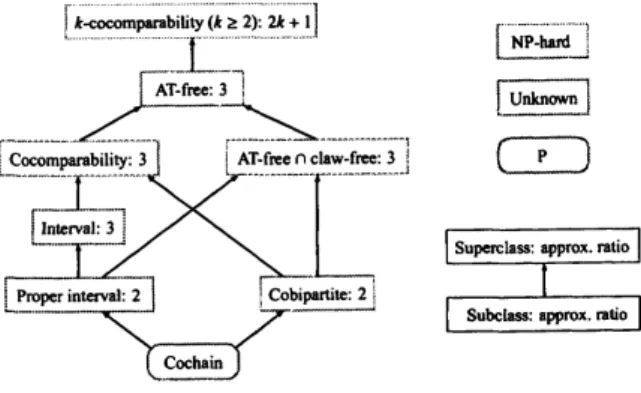
in$O(apd(m, n))$
or
$O(m+n)$time. See Figure 1.$1\overline{NP-luld})arrow$
$\frac{Unknwn}{}]$
CD
Figure 1: Summaryofresults.
3
Hardness
for cobipartite graphs
Before
we
presentapproximationalgorithms,we
show that the problem for determining the path-distance width is NP-hardeven
fora veryrestrictedgraphclass, the class of cobipartite graphs. To this end, wefirst provethe NP-completeness ofan
intermediate problem, by constructing a polynomialtime reduction from the following well-known NP-complete problem.Problem: SETCOVER[9, SP5]
Instance: Set $C$ $=$ $\{c_{1}, \ldots,c_{n}\}$, family $\mathcal{F}$ $=$
$\{F_{1}, \ldots,F_{m}\}\subseteq 2^{c}$,positive integer$h\leq n$
.
Question: Isthere$X\subset F$such that$\bigcup_{F_{i}\epsilon X}F_{i}=C$and
$|X|=h$?
Inany instanceof$S\epsilon r$COVER,
we
can
assume
withoutloss of generality that forevery$c_{i}\in C$,there is
a
subset$F_{j}\in \mathcal{F}$ such that$c_{i}\in F_{j}$,since otherwise the instance
has
no cover.
Wealsoassume
$n>1$ and$h<m$, sinceotherwise the problem is trivial.
Our intermediate problemis
as
follows. Problem: PARTIAL COVERlNBIGRAPHS(PCB)Instance: Bipartite graph$G=(U, V;E)$,positive
inte-ger
$k\leq|V|$.
Question: Is there $Y\subseteq U$such that$|N_{G}(Y)|=k$?
Kobayashi[15]pointedoutthatPCBis NP-complete. Here,
we
providea
hll proof.Lemma3.1. $PCB$isNP-complete
even
$if|\nabla|>k+2$and$G$hasnoisolatedvertex.
Proof.
Froman
instance $(C,F,h)$ of SET COVER,we
first construct
a
bipartite graph $G=(U, \nabla;E)$as
fol-lows: $U=\{u_{1}, \ldots, u_{m}\},$ $V=\{v_{1}, \ldots, v_{n}\}$, and $E=$ $\{[u_{i}, v_{j}\}|c_{j}\in F_{i}\}$
.
The vertex sets $U$and $\nabla$corre-sponds to the family$\mathcal{F}’$ and theground set$C$,
respec-tively. The edgeset$E$represents thecontainment
rela-tion between the elements of$C$and the subsets in$F$
.
Next,by adding$n+1$ pendantverticesto each$u_{i}\in U$,we
constructa
bipartite graph$H=(U, V’;E’)$.
Clearly, thisconstructioncan
bedone inpolynomialtime. Note that $|V’|=n+(n+1)m>n+(n+1)h+2$ since$n>1$and$m>h$
.
Also note that$H$hasno
isolatedvertex.Let$k=n+(n+1)h$
.
Weshallprove
that$C$hasa
cover
$X\subseteq \mathcal{F}$of size$|X|=h$ifand only if there is
a
set$Y\subseteq U$such that$|N_{H}(Y)|=k$
.
$( \Rightarrow )$ Assume that there is $X\subset F$ such that $\bigcup_{F_{i}\epsilon X}F_{i}=C$ and $|X|=h$
.
We set$Y=\{u_{i}|F_{i}\in X\}$.
Since$X$is
a
cover
of$C,$ $|N_{H}(Y)\cap V|=|V|=n$.
Since$|N_{H}(Y)\backslash V|=(n+1)h$,
$|N_{H}(Y)|=|N_{H}(Y)\cap V|+|N_{H}(Y)\backslash V|=n+(n+1)h=k$
.
$(\Leftarrow)$ Assume that there exists $Y\subset U$such that
$|N_{H}(Y)|=k$
.
Wefirstprove$|Y|=h$.
If$|Y|\geq h+1$,then$|N_{H}(Y)|\geq|N_{H}(Y)\backslash V|\geq(n+1)(h+1)>k$
.
If$|Y|\leq h-1$,then$|N_{H}(Y)|\leq|V|+|N_{H}(Y)|\backslash V|\leq n+(n+1)(h-1)<k$
.
Thus$|\eta=h$
.
Nowwe
have$|N_{H}(Y)\cap\nabla|=|N_{H}(Y)|-|N_{H}(Y)\backslash V|=k-(n+1)h=n$
.
Therefore,ifweset$X=\{F_{i}|u_{i}\in Y\}$,then$|X|=h$and
$X$
covers
the groundset$C$.
From the above observation the problem is NP-hard. Since the problem clearly belongs to NP, the lemma
holds. $\square$
Nowwe provetheNP-hardnessofthe path-distance-width problem for cobipartite graphs, by constructing a polynomial time reduction ffom PCB. We acmally provethat deciding whether$pdw(G)=|V(G)|/3$is
NP-complete for cobipartite graphs withdiameter2. Theorem
3.2.
Given cobipartite graph $H$ withdiam$(H)=2$, it is NP-complete to decide whether
Proof.
Clearly, the problem is in NP. Thuswe
prove the NP-hardness. Froman
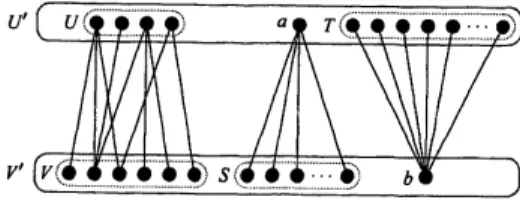
instance$(G=(U, V;E),k)$ of PCB satis$\theta ing$ the conditions in Lemna 3.1, weconstructa cobipartite graph $H=(U’, V’;E’)$
as
fol-lows(seeFigure 2). Let$S$ and$T$ be two sets ofsizes$|S|=|U|+k$and$|T|=|U|+2|V|-k-2$,where$S,$$T,$ $U$,
and $\nabla$
are
pairwisenon-intersecting.Wesetthevertex
sets
as
$U’=U\cup T\cup\{a\}$ and$V’=\nabla US\cup\{b\}$,where$a$and$b$are
new
vertices. In$H$, both $U’$and $V’$inducecliques. Every edge in$G$is also in$H$
.
Additionally,$a$isadjacent to all
vertices
in$S$,and$b$isadjacent to allver-ticesin$T$
.
Thisconstructioncan
bedone in polynomialtime.
Thisimplies$N_{G}(\Gamma)=k$,andcompletesthe proof $\square$
Here,
we
notethat there isa trivial factor 2 approx-imationalgorithm for cobipartite graphs. Itis easytosee
thata
connected cobipartite graph$G$hasdiameter 3,andthus$pdw(G)\geq\lceil|V(G)|/4\rceil$. Forany$S\subseteq V(G)$ with $|S|=\lceil|\nabla(G)|/2\rceil,$ $pdw_{S}(G)=\lceil|\nabla(G)|/2\rceil$
.
Therefore,$pdw_{s}(G)\leq\lceil|V(G)|/2\rceil\leq 2\lceil|V(G)|/4\rceil\leq 2pdw(G)$
.
Proposition 3.3. For a cobipartite graph with $n$
ver-tices and$m$ edges, the path-distance-width
can
beap-proximated withina
factor
2in$O(m+n)$time.4 Approximating PDW
Figure2: Cobipartite graph$H=(U’, V’;E’)$
.
Since $G$hasno
isolatedvertex, diam$(H)=2$.
Itiseasy
tosee
that$|U’|=2|U|+2|\nabla|-k-1$ and$|V’|=$$|V|+|U|+k+1$.Hence,$|\nabla(H)|=|U’|+|\nabla’|=3(|U|+|\nabla|)$.
We shall show that $(G,k)$ is
a
yes instance ofPCB ifand onlyif$pdw(H)=|U|+|\nabla|$
.
Note that$pdw(H)\geq$$|V(H)|/(diam(H)+1)=|U|+|\nabla|$.
$(\Rightarrow)$ Assume that there exists $Y\subseteq U$ suchthat
$|N_{G}(Y)|=k$
.
Let$X=Y\cup T’$,where$T’$ isanysubset of$T$suchthat
$|T’|=|U|+|\nabla|-|Y|$
.
Let$(L_{1}=X,L_{2},L_{3})$be$1$
the level structure with the initialset$X$
.
Clearly, $|L_{1}|=$$|X|=|U|+|\nabla|$
.
Thesizeofthesecondlevel is$1$
$|L_{2}|=|U’\backslash X|+|N_{H}(Y)\cap V’|+|N_{H}(T’)\cap\nabla’|=|U|+|V|$
.
$]$(1) $|$
This also implies$|L_{3}|=|\nabla(H)|-|L_{1}|-|L_{2}|=|U|+|\nabla|$
.
Therefore,$pdw_{x}(H)=|U|+|\nabla|$
.
$\rfloor$$(\Leftarrow)$ Assumethat$pdw_{x}(H)=|U|+|\nabla|$for
some
$($$X\subseteq$ $V(H)$. If$X$
intersects
both $U’$ and $\nabla’$, then $($the distance structure hasat most two levels, and thus $t$
$pdw_{x}(H)\geq|\nabla(H)|/2>|U|+|V|$
.
Hence, $X$is in- ]cluded in either $U’$
or
$\nabla’$.
Suppose$X\subseteq\nabla’$.
Since $t$$N_{H}(T)\cap\nabla’=\{b\}$,allvertices in $T$belongtothe
same
{level. Since$|\nabla|>k+2$,this implies$pdw_{X}(H)\geq|T|=$ $i$
$|U|+2|\nabla|-k-2>|U|+|V|$,whichisacontradiction. ]
Thus
we
can
conclude that$X\subseteq U’$.
$|_{y}$Let $(L_{1}=X,L_{2},L_{3})$ be the levelstructure with the
initialset$X$
.
Since$|V(H)|=3(|U|+|V|)$and$pdw_{X}(H)=$4
$|U|+|\nabla|$,eachlevel$L_{i}$hassize$|L_{i}|=|U|+|\nabla|$
.
If$a\in X$,then$S\subseteq L_{2}$
.
This implies$|L_{3}|\leq|\nabla’\backslash S|=|V|+1<|U|+$ $|\nabla|$,a contradiction. Hence,$X\subseteq U\cup T$.
Let$Y=X\cap U$ $B$and $T’=X^{\cdot}\cap T$
.
Clearly, $|N_{H}(T’)\cap\nabla’|=|\{b\}|=1$.
$d$Since$|X|=|U|+|V|$,
we
have$|U’\backslash X|=|U|+|\nabla|-k-1$.
$c$Since Eq.(1)also holdshere,
we
have$|N_{H}(Y)\cap\nabla’|=k$.
$g$Inthis section,
we
presentour
main results. Namely, approximation algorithms for the path-distance-width. Our algorithmsare
basedon a
common
idea: bounding the diameterof each level in distancestructures. This yields the approximationguarantees. The algorithms alsohaveaspecial feature:we
use
rooteddistance struc-tures only. Thus, our algorithmsare
very simple, and clearlyrun
in polynomial time.Wefirst establish
a
generallower bound, which will bethemaintool toguaranteetheapproximation ratios. Proposition 4.1. Let $(L_{1}, \ldots,L_{t})$ bea distancestruc-ture
of
G.If
$u\in L_{i}$and$v\in L_{\dot{j}}$, then$d_{G}(u, v)\geq|i-j|$.Proof.
Assume $i\leq j$without loss of generality. Let$(p_{0},p_{1}, \ldots,p_{I})$ be a shortest $u-v$path, where$p_{0}=u$
and$p_{t}=v$
.
From the definition of distancestructures,if$p_{k}\in L_{h}$, then$p_{k+1}\in L_{h-1}\cup L_{h}\cup L_{h+1}$. Since$p_{0}\in L_{i}$, $p_{\ell}\in L_{j}$,and$i\leq j$,weneedatleast$j-i$indices$k$such
that$p_{k}\in L_{h}$and$p_{k+1}\in L_{h+1}$
.
Thus$f\geq j-i$.
$\square$Lemma 4.2. Let $S$ $\subseteq$ $\nabla(G)$. Then, $pdw(G)$ $\geq$
$|S|/(diam_{G}(S)+1)$.
Proof.
Let$(L_{1}, \ldots,L_{t})$bean
optimal distance structureof$G$; that is,$pdw_{L_{1}}(G)=pdw(G)$
.
Denote by$I$thesetofthe indices of levels havingnon-empty intersection with$S$; thatis, $I=\{i\in\{1, \ldots,t\}|L_{i}\cap S\neq\emptyset\}$
.
ByProposition4.1,$\max I-\min I\leq diam_{G}(S)$
.
Thus, thevertices of$S$
are
includedinatmost$diam_{G}(S)+1$ levels $\{L_{\min J},L_{\min 1+1}, \ldots,L_{\max l}\}$.
This implies that thereex-ists
a
level$L_{i},$$i\in I$,suchthat$|L_{i}\cap S|\geq|S|/(diam_{G}(S)+$1$)$
.
Hence, we have$pdw(G)=pdw_{L_{1}}(G)\geq|L_{i}|0\geq$ $|L_{i}\cap S|\geq|S|/(diam_{G}(S)+1)$,
as
required.4.1
Approximating
the
path-distance-width for
k-cocomparability
graphs
Bythe property ofk-CCPO,
we
are
ableto bound the diameterof eachlevelinsome
distance structure ofa k-cocomparability graph. Thuswe
havean
approximation guaranteeas
follows.Lemma4.3. Let$G$be
a
connected k-cocomparabilitygraph and$x$be the
first
vertex inak-CCPOof
G. Let $(L_{1}, \ldots,L_{t})$be thedistance structureof
$G$with theini-tialset$L_{1}=\{x\}$
.
Then,$dir_{G}(L_{i})\leq 2k$for
all$i$.
Proof.
Let$y,z\in L_{i}$forsome
$i$.
Without loss ofgener-ality, wemay
assume
that$x<y<z$
in the k-CCPO. We show that $d_{G}(y,z)\leq 2k$.
Obviously, $d_{G}(x,y)=$$d_{G}(x,z)$
.
Let $P$bea
shortest $x-z$ path in $G$.
Since$d_{G}(x,y)=d_{G}(x,z),$ $y$ is not in $P$
.
Clearly, thereex-ists
an
edge $\{v,w\}$ in$P$such that$v<y<w$
.
Since$d_{G}(v,w)=1\leq k$,
we
have$d_{G}(v,y)\leq k$or
$d_{G}(y,w)\leq k$.
If$d_{G}(v,y)\leq k$,then$d_{G}(x,y)\leq d_{G}(x, v)+k$and$d_{G}(y,z)\leq$
$d_{G}(v,z)+k$
.
This implies$d_{G}(x,y)+d_{G}(y,z)\leq d_{G}(x, v)+$$d_{G}(v,z)+2k=d_{G}(x,z)+2k$
.
Then$d_{G}(y,z)\leq 2k$,since$thesamed_{G}(x,y)=d_{G}(x,z)$
.
Thecase
of$d_{G}(y,w)\leq k$is
$almost\square$
Combining Lemmas 2.1, 4.2, and4.3,
we
have the following generalapproximationresult.Theorem 4.4. For a connected k-cocomparabilily graph$G$with$n$vertices andm edges, the
path-distance-width
can
be approximated within afactor
$2k+1$ in$O(apd(m,n))$time.
4.2
Approximating
the
path-distance-width for AT-free
graphs
Chang,Ho,andKo[4]showed that AT-ffee graphs
are
2-cocomparability graphs. Hence,by Theorem4.4,the path-distance-width ofa
connected AT-ffee graph with$n$ verticesand$m$ edges
can
be approximated withina
factor 5 in $O(apd(m,n))$ time. The aim of this
sub-section is to provide
a
betterapproximation
algorithm for AT-ffee graphs by usingsome
properties of AT-ffee graphs. More precisely,we
presentan
$O(m+n)$time 3-approximation algorithm for AT-ffee graphs. A dominatingpair $(u, v)$ of
a
graph $G$ isa
pair ofver-tices $u,$$v\in\nabla(G)$ such that for any $u-v$path $P$ in $G$,
$V(P)$
is
a
dominatingset of$V(G)$; thatis, eachvertex$v\in V(G)\backslash V(P)$has
a
neighbor in $V(P)$.
Theorem4.5([7, 8]). Any
connectedAT-free
graph has a dominatingpair. A dominating pairof
aconnectedAT-free
graphcanbefound
inlineartime.Lemma4.6. Let$(u,v)$beadominatingpair
of
anAT-free
graph $G$, and let $(L_{1}=\{u\}, \ldots,L_{t})$ be thedis-tance$stn/cture$ rootedatthe vertex $u$
.
Then,for
any$i,$$diam_{G}(L_{i})\leq 2$.
Proof.
Let $(p_{1}, \ldots,p_{C})$ be a shortest $u-v$ path in $G$,where$p_{1}=u$and$p,$ $=v$
.
Clearly, $p_{j}\in L_{j}$forall$j$.
Fromthe definition of distance structures and dominat-ing pairs,
a
vertex ina
level$L_{i}$must be adjacentto atleast
one
of$p_{i-1},p_{i}$,and$p_{i+1}$,and cannotbe adjacent toanyother$p_{j},$$j\not\in\{i-1, i,i+1\}$
.
Let$x,y\in L_{i}$forsome
$i$
.
Weassume
$p_{i}\not\in\{x,y\}$since otherwise$d_{G}(x,y)\leq 2$.
Let$(q_{1}, \ldots,q_{i})$isashortest$u-x$path, where$q_{1}=u$and $q_{i}=x$. Obviously,$q_{j}\in L_{j}$forall$j$
.
Wenow
havethreecases
(seeFigure3).[Case 1] $\{\{x,p_{i+1}\}, \{\gamma,p_{i+1}\}\}\cap E(G)\neq\emptyset$
:
Bysym-metry,
we
mayassume
$\{x,p_{i+1}\}=|q_{i},p_{i+1}\}\in E(G)$.
Then, $(q_{1}, \ldots,q_{j},p_{i+1}, \ldots,p,)$ is a $u-v$path. Hence,
$y$ has
a
neighborin $\{q_{i-1},q_{i},p_{i+1}\}$.
Since $q_{i}=x$and $\{q_{i-1},q_{i}\},$$\{q_{i},p_{i+I}\}\in E(G)$,we
have$d_{G}(x,y)\leq 2$.
[Case 2] $\{\{x,p_{i}\}, \{y,p_{i}\}\}\cap E(G)\neq\emptyset$: By
symme-try,
we
may
assume
$\{x,p_{i}\}=\{q_{i},p_{i}\}\in E(G)$.
Then,$(q_{1}, \ldots,q_{i},p_{i},p_{i+1}, \ldots,p_{\ell})$
is
a
$u-v$path. Hence,$y$hasa
neighborin$\{q_{i-1},q_{i},p_{j},p_{i+1}\}$.
ByCase1,if$|y,p_{i+1}\}\in$$E(G)$,then$d_{G}(x,y)\leq 2$
.
Otherwise,$y$hasa
neighbor in$\{q_{i-1},q_{i},p_{i}\}$
.
Since$q_{i}=x$and$\{q_{i-1},q_{i}\},$$\{q_{i},p_{i}\}\in E(G)$,we
have$d_{G}(x,y)\leq 2$.
[Case 3] $\{\{x,p_{i-1}\},$$\{y,p_{i-1}II\cap E(G)$ $\neq$ $\emptyset$: By
Cases 1 and 2, it suffices to consider the
case
of$\{x,p_{i}\},$$\{x,p_{i+1}\},$$\{\gamma,p_{i}\},$$\{y,p_{i+1}\}\not\in E(G)$
.
Clearly, thisas-sumptionimplies$\{x,p_{i-1}\},$$\{y,p_{i-1}I\in E(G)$,andhence,
$d_{G}(x,y)\leq 2$
.
$0$$u\uparrow\cap$ $u\uparrow\cap$ $u\uparrow$
$v\downarrow$ Case1 $v\downarrow$ Case2 $v\downarrow$ Case3
Figure3: The
cases
in the proof of Lemma4.6.Theorem4.5 andLemmas4.2and4.6 implythe fol-lowingbetterapproximationresult for AT-ffee graphs. Theorem 4.7. For a connected
AT-free
graph with $n$vertices and$m$ edges, the path-distance-width can be
approximatedwithina
factor
3in$O(m+n)$time. Wenow
show that the factor3
is the best possibleeven
for interval graphs(thusforAT-ffeegraphs)ifweuse
rooted distance structures.Proposition4.8. The approximation ratio3 ofthepath-distance-width
for
interval graphs cannot be improvedif
we
select onlyone
vertexas
the initialset.Proof
The fiiendship graph $F_{d}$ is the graph with$V(F_{d})=\{c\}\cup\{u_{i},v_{i}|1\leq i\leq d\}$and$E(F_{d})=\{\{u_{i},v_{i}\}|$ $1\leq i\leq d\}\cup\{\{c,w\}|w\in V(F_{d})\backslash \{c\}\}$
.
Forany$d,$$F_{d}$isan
interval graph(seeFigure4).Let$c$bethecenterof$F_{3d}$,and let$w\in V(F_{3d})\backslash \{c\}$
.
Clearly, pdw$\{c|(F_{3d})=6d$and$pdw_{|w\}}(F_{3d})=6d-3$
.
On the otherhand,if$S=\{u_{j}|1\leq i\leq 2d\}$,then
Thus,ifwe
use
onlyone
vertex of$F_{3d}$as
an
initial set,then theapproximationratio is at least$(6d-3)/(2d+$
$1)=3-6/(2d+1)$
.
Since$6/(2d+1)$can
be$arbitrarily\square$ smallbyincreasing$d$,theproposition holds.$u_{1}$ $\mathcal{V}l$
$u1-$ $u2-$ $u3-$ $u_{4}-$ $v_{1}-$ $v2-$ $\nu 3-$ $v_{4}-$
$c_{-}$
$v3$ $u3$
Figure4: Friendship graph$F_{4}$andits representation.
4.3
Approximating
the
path-distance-width
for
proper
interval
graphs
Sinceproper interval graphs
are
AT-ffee, the result in the previous section providesan
approximation algo-rithm for properinterval graphsas
well. Fortunately,if
we
use
proper
intervalrepresentations, thenwe
geta
betterapproximationratio.
Comeil, Kim, Natarajan, Olariu, and Sprague [6, Proposition2.1(2)$]$ showed that in the rooted distance
structure of
a
properinterval graphs rooted at the left most interval,everylevel isaclique.Proposition4.9([6]). Let$G$beaconnectedproper
in-terval graph, andlet$u\in\nabla(G)$bethe vertexwiththe
left
moststarting point insome properinterval representa-tion
of
G. Let$L_{j}$bethesetof
verticesofdistance
$if^{r}om$$u$; thatis,$L_{i}=\{v\in V(G)|d_{G}(u, v)=i\}$. Then,
for
any$i,$$diam_{G}(L_{i})=1_{l}fL_{i}\neq\emptyset$.
Itis known that
a
proper intervalrepresentation ofa proper
intervalgraphcan
be computedinlinear time(see e.g. [6]). Thus the leftmost vertex$u$inthe above
proposition and the rooted distance structure rootedat$u$
can
be foundinlineartime. Therefore,by Lemma4.2, thenexttheoremholds.Theorem4.10. Foraconnectedproper interval graph
$G$with$n$verticesand$m$edges, the path-distance-width
canbeapproximated within
afactor
2in$O(m+n)$time.Since the complete graph $K_{2n}$ is
a
proper intervalgraph, $pdw(K_{2n})=n$, andlpdw$(K_{2n})=2n-1$,
we
canconcludethatthe factor 2in the abovetheorem can-notbe improved byanyalgorithmusing rooted distance structures only.
Proposition 4.11. The approximation ratio 2
of
the path-distance-widthfor
properinterval graphs cannot be improvedif
weselect onlyone
vertex as the initial set.5
Linear-time
algorithm
for
cochain graphs
Inthissection,wepresent
a
linear-time algorithmto de-termine the path-distance-width of cochain graphs. Re-callthateverycochaingraph isa properinterval graph. Theorem5.1([11]). Givencochain graph$G$with$n$ver-ticesand$m$ edges, its$bip\alpha\hslash tion(X, Y)$ and orderings
on$X$and$Y$(which
satisfies
thedefinition)canbecom-putedin$O(m+n)$time.
Theorem 5.2. The path-distance-width
of
aconnected cochain graph $G$ with $n$ vertices and$m$ edgescan becomputedin$O(m+n)$time.
Proof.
Assume $G$ isa
cochain graph with bipartition$(X, Y)$
.
By Theorem 5.1, such a bipartitioncan
becomputed in $O(m+n)$ time. For convenience, let
$pdw(G,X)=\min\{pdw_{S}(G)|S\subseteq X\}$and$pdw(G, Y)=$
$\min\{pdw_{S}(G)|S\subseteq Y\}$
.
If$S\subseteq\nabla(G)$ intersects both$X$and$Y$,then$pdw_{S}(G)\geq\lceil|\nabla(G)|/2\rceil$
.
Itiseasytoseethat$\min\{pdw(G,X),pdw(G, Y)\}\leq\lceil|\nabla(G)|/2\rceil$
.
Therefore,$pdw(G)=\min\{pdw(G,X),pdw(G, Y)|$
.
Bysymmetry, it issufficienttoshowthat$pdw(G,X)$
can
becomputed in$O(m+n)$time.
Let$X=\{x_{1}, \ldots,x_{p}\}$and$N_{G}[x_{1}]\subseteq N_{G}[x_{2}]\subseteq\cdots\subseteq$ $N_{G}[x_{p}]$
.
By Theorem 5.1, such an orderingcan
becomputed in linear time. We also compute in linear time $|X|,$ $|Y|$, and $degree_{G}(v)$ for each $v\in\nabla(G)$
.
Let$Y_{\emptyset}=\{\gamma\in Y|N_{G}(y)\cap X=\emptyset I$
.
Clearly, $Y_{\emptyset}=\{y\in Y|$$degree_{G}(\gamma)=|Y|-1\}$, andthus $|Y_{\emptyset}|$
can
be obtainedinlinear time.
To compute$pdw(G,X)$,wedefine$pdw(G,X, \iota)$
as
fol-lows: $pdw(G,X, \iota)=\min\{pdw_{s}(G)|S\subseteq X,$ $i=$
$\max\cup|x_{j}\in S\}\}$
.
For$x_{i}\in X$,we
denote$N_{G}(x_{i})\cap Y$by$N_{G}^{Y}(x_{i})$
.
Itiseasytosee
that$|N_{G}^{Y}(x_{i})|=degree_{G}(x_{i})-$$(|X|-1)$
.
If$i=maxU|x_{j}\in S\}$ forsome
$S\subseteq X$,then$N_{G}(x_{i})\cap Y=N_{G}(S)\cap Y$since $N_{G}[x_{j}]\subseteq N_{G}[x_{i}]$
for all $j<i$
.
Note that $N_{G}^{Y}(x_{i})$ may be empty. Weshall provethat$pdw(G,X, \iota)$
can
be computedincon-stant time by using$|X|,$ $|Y|,$$|Y_{\emptyset}|$,and$|N_{G}^{Y}(x_{i})|$
.
Thiswillimply$pdw(G,X)$
can
be computed in lineartime,since$pdw(G,X)=\min_{1\leq i\leq p}pdw(G,X,\iota)$
.
Let $S\subseteq\{x_{1}, \ldots,x_{i}\}$ and$x_{i}\in S$, and let$D$be the
distancestructurewith the initialset$S$
.
Wehavethreecases
in Figure 5. In any case, the average size of thefirst and second levels is$(|X|+|N_{G}^{Y}(x_{i})|)/2$. There-fore, by setting $|S|= \min\{i, \lceil(M+|N_{G}^{Y}(x_{i})|)/2\rceil\}$, wecan
minimize the difference. One possible solution is$S=\{x_{i}\}\cup\{x_{1}, \ldots,x_{|S|-1}\}$
.
Since$pdw_{S}(G)$can
becom-putedin constant time with$|S|,$ $|X|,$ $|Y|,$$|Y_{\emptyset}|$,and$|N_{G}^{Y}(x_{i})|$,
the theorem holds. Observe that, in any case, the 10-cation of the vertices in $Y$is solelydetermined by$x_{i}$
.
$L_{2}^{-\wedge-\frac{\mapsto_{:}^{\gamma}\overline s\prime-\lrcorner}{\square X\backslash S:\overline{(N\dot{\sum}_{G^{(X}}i}}}L_{1}|^{X}!^{\gamma}’)$
$\iota_{2_{\backslash }},\mapsto,!L_{\iota|,-\prec---\prec,,-}^{\prime’}\overline{s}\mapsto_{1}^{\backslash .\chi}$ $L_{1:}^{:}L_{2}(\underline{\overline{\mapsto}}|!-arrow!---\cdots\tau_{:}--:(\overline{s}\mapsto|^{X}\backslash$
$L_{3}\overline{\mapsto^{!}N}^{Y\prime}Y--t---\wedge----\backslash$
’ $L_{3}=Y-arrow---$
$L_{3,\overline{=}1}---:\succ-r_{Y\backslash Y_{\Phi}}\backslash$
$L_{4}<|_{\mapsto_{m}^{1}Y}\gamma_{l}$;
Figure5: Three
cases
intheproofof Theorem 5.2.$S$ arbitranilyfrom$\{$1,
$\ldots,$$i\}$
.
Obviously,minimizing thedifference ofsizesbetween the first and second levels is thebest solutionhere,since theverticesin$X$lie in these
levels. 口
6
Concluding remarks
We have considered the problem of determining the path-distance-width of graphs in important graph classes. It tumed out that the problem is NP-hard
even
for cobipartite graphs, and thus forcocompara-bility graphsand AT-ffeegraphs. However, using their chain-likestructures,
we
were
able to present constant-factor approximation algorithms. The algorithmsare
very simple and fast. We also present a polynomial time(exact)algorithm for cochain graphs. The compu-tational complexity of the problem for interval graphsand
proper
interval graphsremains open.References
[1] G.Blache,M. Kaipinski, and J. Wirtgen. On ap-proximationintractability of the bandwidth prob-lem, 1998. ECCC TR98-014.
[2] A.Brandstidt,V. B.Le,and J. P.Spinrad. Graph Classes:A$Surv\varphi$
.
SIAM, 1999.[3] T. M. Chan. All-pairs shortest paths for
un-weighted undirected graphs in $o(mn)$ time. In
SODA2006,pages514-523,2006.
[4] J.-M. Chang, C.-W.Ho,and M.-T.Ko. Powers of asteroidal triple-ffee graphs with applications. Ars Combin.,67:161-173,2003.
[5] D.Coppersmithand S. Winograd. Matrix multi-plicationvia arithmetic progressions. J Symbolic Comput., 9:251-280,1990.
[6] D. G.Comeil,H.Kim,S.Natarajan,S.Olariu,and A. P. Sprague. Simple linear time recognitionof unitinterval graphs.
Infom.
Process.Lett.,55:99-104, 1995.
[7] D. G. Comeil, S. Olariu, and L. Stewart. Aster-oidal triple-ffee graphs. SIAMJ DiscreteMath.,
10:399-430,1997.
[8] D. G. Comeil, S. Olariu, andL. Stewart. Linear time algorithmsfordominatingpairsin asteroidal
$triplearrow ffee$ graphs. SIAM J Comput., 28:
1284-1297,1999.
[9] M. R. Garey and D. S. Johnson. Computers and Intractability.. $\Lambda$ Guideto the Theo y
of
NP-Completeness.Freeman, 1979.
[10] P. Golovach, P. Heggemes, D. Kratsch, D. Lok-shtanov, D. Meister,and S. Saurabh. Bandwidth onAT-ffeegraphs. In ISAAC2009, volume5878 of Lecture Notes in Comput. Sci.,
pages
573-582. Springer-Verlag,2009.[11] P.HeggemesandD.Kratsch. Linear-time certi$\theta-$
ingrecognition algorithms and forbidden induced subgraphs. Nordic J. Comput., 14:87-108,2007. [12] D.S. Johnson. The NP-completeness column: An
ongoingguide. J. Algorithms, 6:434-451, 1985. [13] H.Kaplan and R. Shamir. Pathwidth, bandwidth,
and completion problemsto
proper
interval graphs withsmall cliques. SIAMJ Comput., 25:540-561,1996.
[14] T.Kloks,D.Kratsch,and H. Muller. Approximat-ing the bandwidth for asteroidal triple-ffee graphs. JAlgorithms, 32:41-57, 1999.
[15] Y.Kobayashi.Private
communication.
September 2010.[16] A. Parra andP. ScheMer. Characterizations and algorithmicapplicationsofchordalgraph embed-dings. DiscreteAppl.Math.,79:171-188, 1997. [17] R. Seidel. On theall-pairs-shortest-pathproblem
inunweightedundirected graphs. J Comput. Sys-tem Sci., 51:40OA03, 1995.
[lS] A. P. Sprague. An$O(n\log n)$algorithmfor
band-width ofinterval graphs. SIAMJ DiscreteMath., 7:213-220, 1994.
[19] K. Yamazaki. Onapproximationintractability of the path-distance-width problem. Discrete Appl. Math., 110:317-325,2001.
[20] K. Ymazaki, H. L. Bodlaender, B. de Fuiter, and D. M. Thilikos. Isomorphism for graphs of bounded distance width. Algorithmica, 24: