Enumeration
of
Graph
Sandwiches
Shuji
KijimaResearch Institute for Mathematical
Sciences, KyotoUniversity
Abstract
This paper is concemed with problems to list, sample, and count graphs with edge
con-straints. The objectswe look atare graph sandwiches; for aprescrIbedgraph property$\Pi_{I}$ given
apairofgraphs $\partial$
and $\underline{G}$satisfying$\underline{G}\subseteq\sigma$, a graph$H$ iscalled a graphsandwich of
i5
and$\underline{G}$
with $\Pi$ if$H$ satisfies $\Pi$ and $\underline{G}\subseteq H\subseteq\partial$
.
This paper mainly focuses on the classes ofchordalgraphs and intervalgraphs asthe property$\Pi$. It is knownthat both problems findingachordal
sandwich and finding anintervalsandwichare NP-completcfor ageneral input, and wc assume
arestrictionon theinput that
117
or$\underline{G}$satisfy thesamcproperty Il asobjects. This assumptionprovidesarccursivestructureonthe setofgraphsandwicheswith$\Pi$ and mayallow toconstruct
some effcctive algorithms forour problems. Note that, our objects arc anatural gcncralization
ofchordal/interval completions/deletions.
1
Introduction
For a pair of graphs $G$ and $H$ on a
common
vertex set $V$, we write $G\subseteq H$ $($and $G\subsetneq H)$ whentheir edge sets satisfies $E(G)\subseteq E(H)$ (and $E(G)\subsetneq E(H)$
,
respectively). Fora
prescribed graphproperty$\Pi$, thc graph sandwich problem for $\Pi$is, given a pair of graphs$\overline{G}$and
$\underline{G}$satisfying$\underline{G}\subseteq\overline{G}$,
to find agraph $H$ satisfying $\Pi$ and$\underline{G}\subseteq H\subseteq\partial$
.
Golumbic, Kaplan, and Shamir [6] proposedthe
graph sandwich problem, and showed NP-hardness ofthe problem for many properties $\Pi$, such
as
chordal, interval, proper interwal, and
so
on.Let $\Omega_{\Pi}(\overline{G}, \underline{G})$ denote the set ofgraphs defined by
$\Omega n(\overline{G}, \underline{G})$ $def=$
{
$G|G$ satisfies a property $\Pi,$ $\underline{G}\subseteq G\subseteq\overline{G}$
}.
(1)This paper is concerned with the following three types of problems: given apair of graphs $\overline{G}$ and
$\underline{G}$ with $\underline{G}\subseteq 5$
.
output all graphs in $\Omega_{\Pi}(\partial,\underline{G})$ (listing);.
output the number $|\Omega_{\Pi}(\overline{G}, \underline{G})|$ (counting);.
output a graph in $\Omega_{\Pi}(\overline{G}, Q)$ at random according to a prescribed distribution (sampling). Note that the graphs in $\Omega n(\partial,\underline{G})$are
assumed to be “labeled,” meaning thatwe
distinguish$G\in\Omega n(\sigma,\underline{c})$ from $G’\in\Omega_{\Pi}(\partial, \underline{G})$ whcn their edgc sets
are
differcnt even if thcyare
isomor-phic graphs. This paper mainly investigates chordal sandwiches and interval sandwiches, with
some
restricted inputs suchas
at leastone
ofthe input graphs satisfies thc prcscribed propcrty$\Pi$,i.e., chordal/interval, respectively. This assumption is
a
generalization ofchordal/interval2.1
BackgroundThe class of chordal graphs often appears
as a
tractablecase
of a lot of problems arising fromvarious
areas
suchas
statistics, optimization, numerical computation, etc. In those areas,we
of-ten approximate a given graph by a chordal graph and then apply efficient algorithms for chordal
graphs to the obtained graph. Evaluation criteria for chordal approximations depend on
applica-tions. For example, in the context of graphical modeling in statistics,
a
chordal approximation isdesired to minimize AIC (Akaike’s Information Criterion), BIC (Bayesian Information Criterion),
MDL (Minimum Description Length), etc. [20, 28, 32]; in the context of numerical computation,
a chordal approximation is desired to minimize the number of added edges (a.k.$a$
.
the minimumfill-in problem) [22, 23, 30, 3]; in the context of discrete optimization,
a
chordal approximation isdesired to minimize the size ofa largest clique (a.k.$a$
.
the treewidth problem) [21, 15, 16, 2].Since we
are
concerned with various sorts ofcriteria and often these computational problemsare NP-hard, listing algorithms and random-sampling algorithms can be useful universal
decision-support schemes. An exhaustive list found by
an
algorithm may providean
exact solution,whereasrandom samples may provide
an
approximative solution. Our goalis to provide efficient algorithmsfor listing problems and random-sampling problems ofgraphs, or to show the intractability ofthe
problems.
2.2
Graded poset ofchordal
graphsAs statcd previously, the chordal graph sandwich problem, if $\Omega_{C}(\overline{G}, \underline{G})\backslash \{\overline{G}, \underline{G}\}$ has
an
element,is NP-hard for general inputs $\sigma$ and
$\underline{G}$, whereas it ispolynomial time solvable if at least
one
of$\partial$and $\underline{G}$ is chordal. It is from the following by Rose, Tarjan, and Lueker [23].
Theorem 2.1 [23] For a graph $G=(V, E)$ and a chordal graph $G’=(V, E\cup F)$ with $E\cap F=\emptyset$,
the graph $G$‘ is a minimal chordal completion
of
$G(i.e., \Omega_{C}(G’, G)=\{G’\})$if
and onlyif
$G‘-f$is not chordal
for
each $f\in F$.
From the result by Rose, Tarjan, and Lueker [23], we have the following fact.
Proposition 2.2 [12] Suppose apair
of
chordalgraphs$\overline{G}=(V\rangle\overline{E})$ and$\underline{G}=(V,\underline{E})$satisfies
$\underline{G}\subseteq\overline{G}$,and let $k=|\overline{E}\backslash \underline{E}|$
.
Then there extsts a sequenceof
chordal graphs $G_{0},$ $G_{1},$$\ldots,$$G_{k}$ that
satisfies
Proof. Theproofis done by induction
on
$k$.
If$k=0$, then$\underline{G}=\partial$andwe aredone. Nowassume
that $k\geq 1$, and the proposition holds for all $k’<k$
.
In this case, $\overline{G}$is not
a
minimal chordalcompletion of$\underline{G}$ since $\underline{G}\neq\overline{G}$ and $\underline{G}$ is actually a minimal chordal completion of itself. By the
result of Rose, Tarjan, and Leuker above, there must exist
an
edge $f\in\overline{E}\backslash \underline{E}$such that $\overline{G}-f$ is chordal. Then, letting $G_{k-1}=\sigma-f$ and $e_{k-1}=f$, we have $\overline{G}=G_{k}=G_{karrow 1}+e_{k-1}$.
Further,by the induction hypothesis, there exists a sequence of chordal graphs$\underline{G}=G_{0},$ $G_{1},$$\ldots,$$G_{k-1}$ such that $G_{i+1}=G_{i}+e_{i}$ for
some
$e_{i}\in(\overline{E}\backslash \{e_{k-1}\})\backslash \underline{E}$.
$\square$Note that Proposition 2.2 implies that the set of chordal sandwiches forms
a
graded posetwithrespect to the inclusion relation of edge sets. For later reference,
we
write this assumptionas
a
condition.
Condition 1 A pair
of
gmphs$\overline{G}$ and(;satisfies
$(;\subsetneq\overline{G}$, and at least oneof Z7
and$\underline{G}$ is chordal.2.3
ListingOn the listing problemof$\Omega_{C}(\overline{G},\underline{G})$, Kiyomi and Uno [13] gave
a
constant time delay algorithm forchordal deletions, which corresponds the
case
that$\underline{G}$isemptygraph. Kiyomi, Kijima, andUno [14]gave an $O(n^{3})$ time delay algorithm for chordal deletions, where$n$ is the number ofvertices, and
this is the
case
corresponding to thecase
that$\overline{G}$is complete graph. Thosetwoalgorithmsare
based
on the
reverse
search technique devised by Avis and FMkuda [1].On Condition 1, Kijima, Kiyomi, Okamoto, and Uno [12] gave analgorithmbased
on
the binarypartition. Their algorithm
runs
$O(k\cdot\tau)$ time delay, where$k=|E(\partial)\backslash E(\underline{G})|$and$\tau$ denotes the timecomplexity for checking the chordality of
a
graph, hence their algorithmruns
$0(k(n+m))$ timedelay with an$O(n+m)$ time recognition algorithm by Rose, Tarjan, and Lueker [23]. The running
time
can
be improved by using Ibarra’s dynamic data structure [10] to $O(kn+n\log n)$ when $\sigma$is chordal, and to $0(k\log^{2}n+n)$ when $\underline{G}$ is chordal. See also Table 1 for the time complexity of
listing chordal sandwiches.
2.4
CountingOn the counting problem of $\Omega_{C}(\sigma, \underline{G})$, Wormald [33] gave
a
generating function for the numberof labeled chordal graphs with $n$ vertices, that corrcsponds to counting $\Omega_{C}(K_{n}, I_{n})$ where $K_{n}$
denotes the complete graph with $n$ vertices and $I_{n}$ denotes the empty graph with $n$ vertices.
Wormald [33] alsosaid that the numberof labelled chordal graphs with $n$vertices is asymptotically
$\sum_{r}(\begin{array}{l}nr\end{array})2^{r(n-r)}=2^{\Theta(n^{2})}$
.
Kijima, Kiyomi, Okamoto, and Uno [12] showed that counting chordal sandwiches is
#P-hard
meaning that the reduction preserves the
error
ratio of approximate counting. It is open if thereis a fully polynomial time randomized approstmation scheme (FPRAS) for counting forests.
Ki-jima, Kiyomi, Okamoto, and Uno [12] also showed the
#P-hardness
of counting chordal deletions,i.e., computation of $|\Omega_{C}(\overline{G}, I_{n})|$, by
a
Cook reduction from counting forests. For other cases, thecomplexity of counting is open (see Table 2).
2.5
Sampling
Hcrc, we consider a uniform sampling on $\Omega_{C}(\sigma, \underline{c})$ satis$\mathfrak{h}^{r}ing$ Condition 1. It is well-known that
approximate counting and uniformsampling is deeplyrelated (seee.g., [11]). From Proposition 2.2,
we liavc a simplc and natural Markov chain for uniform sampling
on
$fl_{C}(\sigma, \underline{c})$on
Condition 1.Let$\mathcal{M}$be aMarkov chainwithastate space $\Omega_{C}(\sigma, \underline{c})$withCondition 1. A transitionof$\mathcal{M}$from
a current state $G\in\Omega_{C}(\overline{G}, \underline{G})$ to a next state $G’$ is defined as follows; Choose an edge $e\in(\overline{E}\backslash \underline{E})$
uniformly at random. We consider the following three cases.
1. If$e\not\in E(G)$ and $G+e$ is chordal, then set $H=G+e$
.
2. If$e\in E(G)$ and $G-e$ is chordal, then set
$H=G-e$
.
3. Otherwiseset $H=G$
.
Let $G’=H$ with the probability 1/2, otherwise let $G’=G$
.
Clearly $G’\in\Omega_{C}(Z7, \underline{G})$.
Note thatthis $\mathcal{M}$ can be easily modified into ones for non-uniform distributions by a Metropolis-Hastings
method.
The Markov chain $\mathcal{M}$ is irreducible from Proposition 2.2. The chain $\mathcal{M}$ is clearly aperiodic,
and hence $\mathcal{M}$ is ergodic. The unique stationary distribution of $\mathcal{M}$ is the uniform distribution
on
$\Omega_{C}(\overline{G}, \underline{G})$, since the detailed balanced equation holds for any pair of $G\in\Omega_{C}(\sigma, \underline{c})$ and $G’\in$$\Omega_{C}(\overline{G}, \underline{G})$
.
From Proposition 2.2, the diameter of$\mathcal{M}$ is at most $2k$, where $k=|\overline{E}\backslash \underline{E}|$.
Now, we discuss the mixing time of the Markov chain. Let $\mu$ and $\nu$ be
a
pair ofdistributionson a common finite set $\Xi$
.
The total variation distance $d_{TV}(\mu,$$\nu)$ between$\mu$ and $\nu$ is defined by
$d_{TV}(\mu, \nu)^{def}=\pi 1_{\sum_{x\in\Xi}}|\mu(x)-\nu(x)|$
.
For an arbitrary positive $\epsilon$, the minng time $\tau(\epsilon)$ ofan ergodicMarkov chain$MC$with astate space$\Xi$ is defined by$\tau(\epsilon)^{def}=\max_{x\in\Xi}\min\{t|\forall s\geq t,$ $d_{TV}(P_{x}^{\epsilon}, \pi)\leq$
$\epsilon\}$ where $\pi$ is the unique stationary distribution of $MC$, and $P_{x}^{\delta}$ denotes
a
distributionof $MC$ attime $s$ starting from a state $x$
.
Unfortunately, the Markov chain $\mathcal{M}$ for uniform sampling
on
$\Omega_{C}(\sigma, \underline{c})$ is not rapidly mixingfor
some
inputs. Kijima, Kiyomi, Okamoto, and Uno [12] gave the following.Proposition 2.3 [12] There exist infinitelymanypairs
of
chordal$gmphs\overline{G}$ and$\underline{G}$satisfying$\underline{G}\subseteq\sigma$for
which the mixing timeof
$\mathcal{M}$ on $\Omega_{C}(\partial, \underline{G})$ is exponential in$n$, where$n$ is the numberof
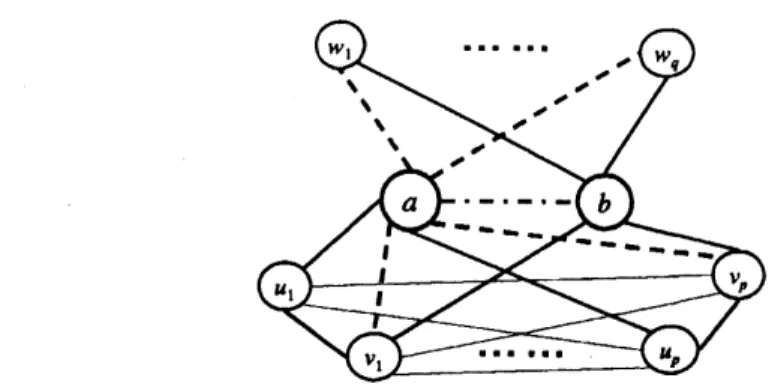
verticesFigure 1: Example of
an
input pairon
which the simple Markov chain $\mathcal{M}$ mixes slowly.Figure 1 shows
an
example. Let $V$ bea
set ofvertices $\{a, b, v_{1}, \ldots, v_{p}, u_{1}, \ldots, u_{p}, w_{1}\ldots, w_{q}\}$.
Let$\underline{G}=(V, E(\underline{G}))$ be a graph defined by
$E(\underline{G})$ $def=$
.
$\{\{a, u_{i}\}|i\in\{1, \ldots,p\}\}\cup\{\{b, v_{i}\}|i\in\{1, \ldots,p\}\}$$\cup\{\{b, w_{i}\}|i\in\{1, \ldots, q\}\}\cup\{\{u_{i}, v_{j}\}|(i,j)\in\{1, \ldots,p\}^{2}\}$
.
Let $\overline{G}=(V, E(\partial))$ be a graph defined by
$E(\sigma)$ $def=$
.
$E(\underline{G})\cup\{\{a, v_{i}\}|i\in\{1, \ldots,p\}\}\cup\{\{a, w_{i}\}|i\in\{1, \ldots, q\}\}\cup\{\{a, b\}\}$.
In Figure 1, $\underline{G}$ is described by solid lines, and$\partial$is
describedby solid lines and dashed lines. Note
that both $\underline{G}$ and$\overline{G}$
are
chordal.
3
Enumeration
of Interval Graph Sandwiches
A graph $G$ is interval if there is a one-to-one correspondence between its vertices and a set
of
intervals
on
the real line, such that two verticesare
adjacent iffthe corresponding intervals havean intersection. The set ofintervals is called
an
interval representationof $G$.
It is known that theclass ofinterval graphs is asubclassofchordalgraphs. Precisely, agraphis interval iff chordal and asteroidal triple
free
(AT-free), where three vertices ofa
graph forman
asteroidal triple (AT) ifforevery pair of them
are
connected bya
path avoiding the neighborhood ofthe remaining vertex.Given
a
pair ofgraphsZ7
and$\underline{G}$ satisfying$\underline{G}\subseteq\overline{G}$, let $\Omega_{I}(\overline{G}, \underline{G})$ be a set ofgraphs defined by$\Omega_{I}(\overline{G},\underline{G})^{def}=\{G|G$ is interval, $\underline{G}\subseteq G\subseteq\sigma\}$
.
The interval graph sandwich problem is known to be NP-hard due to Golumbic, Kaplan, and
Shamir [6]. The minimum interval completion is also NP-hard (seee.g., [4]). The minimality check
of interval completion, that is the problem if $\Omega_{I}(\overline{G},\underline{G})\backslash \{\overline{G},\underline{G}\}$ hasan element where
a
is interval,is polynomial time solvable due to Heggernes, Suchan, Todinca, and Villanger [9]. On the other
hand, the complexity of the minimality check ofinterval deletion i.e. if $\Omega_{I}(\partial,\underline{G})\backslash \{\overline{G},\underline{G}\}$ has
an
element in
case
that $\underline{G}$is interval, is open.3.1
Listing
Kiyomi, Kijima, and Uno [14] gave
a
listing algorithm forintervalcompletions anddeletions. TheirUnfortunately, the set of interval sandwiches does not form
a
graded poset in general, whilechordal graphs does. Figure 2 is an example both $\overline{G}$ and
$\underline{G}$
are
interval but no interval graphsbetween them. The complexity of listing interval sandwiches is open when $\overline{G}$ or
$\underline{G}$ is interval (see
Table 3).
3.2
Counting and
samplingOn counting interval graphs, Hanlon [7] gave a generating function for counting the number of
labeld interval graphs with $n$ vertices. Whereas Kijima, Kiyomi, Okamoto, and Uno [12] showed
that counting interval sandwiches is
#P-hard
even when$\underline{G}$isa connected interval graph. For othercases, the complexity is open (see Table 4).
Onsampling interval sandwiches, it is open if
we
havean
irreducible Markov chain on $\Omega_{I}(\sigma,\underline{c})$in which any transition
can
be handled efficiently. Note that for the instance in Fig 1, which isan example for slow mixing of
a
Markov chain on chordal sandwiches, $\sigma$ and$\underline{G}$
are
interval and$\Omega_{C}(\overline{G}, \underline{G})=\Omega_{I}(\overline{G},\underline{G})$
.
This implies that a “nearest neighbor” chain does not mix rapidly,even
ifwe have such aMarkov chain.
4
Other
Classes
4.1
Proper interval graphAn graph is proper interval graph if it is an interval graph that has
an
interval representation inwhichno interval properly contains another. The proper interval graphisequivalent to unitinterval
graph that is
an
interval graph which hasan
interval representation in which every interval hasa
unit length. The unit interval graph sandwich problem is known to be NP-hard due to Golumbic,
Kaplan, and Shamir [6]. The minimum proper interval graph completion is also NP-hard (see
e.g., [8]$)$
.
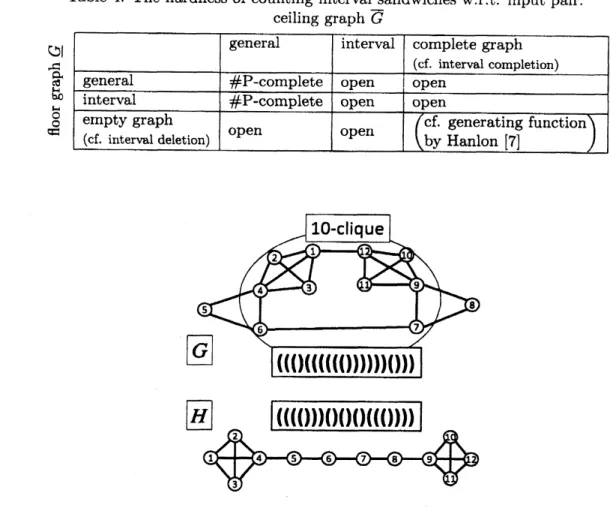
Figure 3: Example of
a
pair ofproper interval graphs $G$ and$H$ such that $H\subseteq G$.
has a representation by $n$ pairs of parentheses (see e.g., [24]). Saitoh, Yamanaka, Kiyomi, and
Uehara [24] gave algorithms for listing and sampling for the set of perfect interval graphs with $n$
vertices, where the graph is not labeled hence every pair in the set
are
not graph isomorphic. Wecan introduce a natural partial order $\preceq$ for a representation by
$n$ pairs of parentheses. If a pair
of proper interval graphs $G$ and $H$ satisfies $H\preceq G$, then $H\subseteq G$ holds. However, the
converse
isnot true; there is
a
pairof proper interval graph $G$ and $H$ satisfying $H\subseteq G$ but $H\not\leq G$.
Figure3 shows anexample, inwhich $H\subseteq G$ but $H\not\leq G$. The time complexity of subgraph isomorphism ofa
pair ofproper interval graphs is open.4.2
Perfect
graphA graph is perfectif the chromatic number is equal to the size ofmaximumclique for any induced
subgraphs. The class of perfect graphs is known to be a superclass of chordal graphs. The time
complexity ofperfect graphsandwich problem is open [6]. Perfect graphs does not form a graded
poset regarding to edge sets. Fig 4 shows an example that the graph $G$ is perfect though $G-e$
Figure 4: Example of
a
perfect graph $G$ for which no graph of $G-e$nor
$G+\{u, v\}$ are interval.complexity of listing, counting, and sampling of perfect graph sandwiches
are
open.5
Concluding
Remarks
Thispaperinvestigates listing, counting and sampling graph sandwiches for chordalsandwiches and
interval sandwiches. There still exists several open problems for enumeration of graph sandwiches
and related topics.
Acknowledgement
The author thank Masashi Kiyomi, Yoshio Okamoto, Takeaki Uno, Tomomi Matsui, Ryuhei
Ue-hara, and Toshiki Saito fordiscussing this topics.
References
[1] D. Avis and K. Fukuda, Reverse search for enumeration, Discrete Applied Mathematics, 65
(1996), 21-46.
[2] F. V. Fomin, D. Kratsch, and I. Todinca, Exact (exponential) algorithms for treewidth and
minimum fill-in, Lecture Notes in Computer Science, 3142 (2004), 568-580.
[3] M. Fukuda, M. Kojima, K. Murota, and K. Nakata, Exploiting sparsity in semidefinite
pro-gramming via matrix completion I: General framework, SIAM Journal
on
optimization, 11(2000), 647-674.
[4] M. R. Garey and D. S. Johnson, Computers and intractability: a guide to the theory of
NP-completeness, W. H. Freeman and Co., San Francisco, 1979.
[5] M. C. Golumbic, Algorithmic graph theory and perfect graphs, Academic Press, New York,
1980.
[6] M. C. Golumbic,H. Kaplan, and R. Shamir, Graphsandwichproblems, JournalofAlgorithms,
19 (1995), 449-473.
[7] P. Hanlon, Counting interval graphs, Transactions of theAmerican Mathematical Society, 272
(1982), 383-426.
[8] P. Heggemes, Minimal triangulations of graphs: A survey, Discrete Mathematics, 306 (2006),
[9] P. Heggernes, K. Suchan, I. Todinca, and Y. Villanger Minimal interval completions, Lecture
Notes in Computer Science, 3669 (2005), 403-414.
[10] L. Ibarra, Fully dynamic algorithms for chordal graphs, Proceedingsofthe 10thAnnual
ACM-SIAM Symposium
on
Discrete Algorithms (SODA 1999), 923-924.[11] M. Jerrum, Counting, Sampling and Integrating: Algorithms and Complexity, ETH Z\"urich,
Birkhauser, Basel, 2003.
[12] S. Kijima, M. Kiyomi, Y. Okamoto, and T. Uno, Oncounting, sampling, and listing of chordal
graphs with edge constrains, Lecture Notes in Computer Science, 5092 (2008), 458-467.
Preprint is available from
http:$//ww$
.
kurims.kyoto-u.ac.
jp/preprint/f ile$/RIMS1610$.
pdf[13] M. Kiyomi and T. Uno, Generating chordal graphs included in given graphs, IEICE
Transac-tions onInformation and Systems, E89-D (2006), 763-770.
[14] M. Kiyomi, S. Kijima, andT. Uno, Listing chordal graphs and interval graphs, Lecture Notes
in Computer Science, 4271 (2006), 68-77.
[15] T. Kloks, H. L. Bodlaender, H. M\"uller, and D. Kratsch, Computing treewidth and minimum
fill-in: All you need
arc
the minimal scparators, Lecture Notes in Computer Science,726
(1993),
260-271.
[16] T. Kloks, H. L. Bodlaender, H. M\"uller, andD. Kratsch, Erratum to the ESA’ 93 proceedings,
Lecture Notes in Computer Science, 855 (1994), 508.
[17] D. Marx, Chordal deletion is fixed-parameter tractable, Lecture Notes in Computer Science,
4271 (2006), 37-48.
[18] A. Natanzon, R. Shamir, and R. Sharan, A polynomial approximation algorithm for the
min-imum fill-in problem, SIAM Joumal
on
Computing, 30 (2000), 1067-1079.[19] A. Natanzon, R. Shamir, and R. Sharan, Complexity classification ofsomeedge modification
problems, Discrete Applied Mathematics, 113 (2001), 109-128.
[20] T. Pedersen, R. F. Bruce, J. Wiebe, Sequential Model Selection for Word Sense
Disambigua-tion, Proceedings of the Fifth Conference
on
Applied Natural Language Processing (ANLP1997), 388-395.
[21] N. Robertson and P. Seymour, Graph minors II. Algorithmic aspectsoftree-width, Journal of
Algorithms, 7 (1986), 309-322.
[22] D. J. Rosc, A graph-theorctic study of thc numerical solution of sparsepositivedefinitcsystems
of linear equations, in: R.C. Read (Ed.), Graph Theory and Computing, Academic Press, New
York, 1972, pp. 183-217.
[23] D. J. Rose, R. E. Tarjan, and G. S. Lueker, Algorithmic aspects of vertex elimination on
graphs, SIAM Journal
on
Computing, 5 (1976), 266-283.[24] T. Saitoh, K. Yamanaka, M. Kiyomi and R. Uehara, Random generation and enumeration of
proper interval graphs, Lecture Notes in Computer Science, 5431 (2009), 177-189.
[25] A. Sinclair, Algorithms for Random Generation and Counting: A Markov Chain Approach,
Birkh\"auser, Boston, 1993.
[26] K. Suchana and I. Todinca, Minimal interval completion through graph exploration,
Theoret-ical Computer Science, 410 (2009),
35-43.
[27] R. E. Tarjan and M. Yannakakis, Simple linear-time algorithms to test chordality of graphs,
test acyclicity of hypergraphs, and selectively reduce acyclic hypergraphs,
SIAM
Journalon
Computing, 13 (1984), 566-579.
[28] A. Takemura and Y. Endo, Evaluation of per-record identification risk and swappability of