GRASSMANN
GEOMETRIES
ANDINTEGRABLE
SYSTEMS
DAVID BRANDER
ABSTRACT. We describe how the loop group maps corresponding to
specialsubmanifolds associatedto integrable systemsmay bethoughtof ascertain Grassmannsubmanifoldsofinfinitedimensional$homogen\infty us$
spaces. In general, the associated families of special submanifolds are
certain Grassmann submanifolds. An example is given from the recent article [2].
1. INTRODUCTION
This article discusses
some
of the ideas in the article [2], where solutionsto
a
certain loop group problemwere
studied. The emphasis here ison
the geometric interpretation of the solutions, rather than the techniques for
producing solutions.
In 1996, Ferus and Pedit [5] defined
an
integrable system involving a3-involution loop group, solutions of which
are
isometric immersions betweenspace forms of different
non-zero
sectional curvature. They modified theAdler-Kostant-Symes (AKS) theory (described in [4])
to
show how topro-duce
many
solutions by solving commuting ODEson
a
finite dimensional vectorspace.
The present author later studied this system in [1] and [3]: it had several
interesting properties, including
a
relationship with pluriharmonic maps.Goal here: generalize the system
to
arbitrary commuting involutions ofany Lie group and identify the associated special submanifolds.
Results: briefly,
we
obtained:$\bullet$ Generalizations, to all reflective submanifolds, of results concerning isometric immersions of
space
forms;$\bullet$ In
case
of
previous results,new
proofs;$\bullet$ And other
new
specialsubmanifolds
as
integrable systems.1.1.
Motivation. Other
specialsubmanifolds
that have been studied withloop
groups,
(e.g. harmonic maps into symmetricspaces, CMC
surfaces,special Lagrangian surfaces etc), are
associated
to loop groups with only$\overline{2000}$Mathematics Subject
Classification.
Primary $53C42,53B25$; Secondary $37J35$,two involutions. Therefore, it seemed that
a
system ina
loopgroup
withthree involutions might have
some
interesting properties peculiar to thissituation.
One such property, studied in [1], is
as
follows: solutions to three distinctproblems
are
obtained from thesame
loop group map, by evaluating themap within different ranges of the loop parameter $\lambda$
.
This amounts toa
kind of Lawson correspondence between solutions of these problems, and
shows that the problems of obtaining complete immersions
are
equivalentfor the three
cases.
The table shows three different constant curvature Riemannian
subman-ifolds of three different space forms obtained by evaluating the
same
loopgroup
map for values ofthe spectral parameter in $R,$ $iR$ and $S^{1}[1]$.
2.
SPECIAL SUBMANIFOLDS
AND LOOPGROUPS
We first present
an
outline of how certain special submanifoldsare
asso-ciated to maps into loop
groups.
2.1. Moving Frame Method. The basic concept of the moving frame method is encapsulated
as
follows:$\bullet$ Given $f$ : $Marrow G/H$,
an
immersed submanifold ofa
homogeneous space.$\bullet$ Lift, $F:Marrow G$
, a
frame for $f$.
$\bullet$ Idea: Choose $F$ which is adapted in
some
way to the $g\infty metry$ of$f$
.
$G$
$\downarrow$
$M$
$arrow$
GIH$r$
Example: We illustrate this with
a
simple example.Special submanifold:
a
flat immersion,Adapted frame: $F:R^{2}arrow SO(4)$,
$F:=[e_{1} e_{2} n f]$
,
where $e_{i}$
are
an
orthonormal
basis for the tangentspace
to the immersion.2.2. The Maurer-Cartan Form.
Given
a
frame $F$ : $Marrow G$, for $f$ : $Marrow$$G/H$, the
Maurer-Cartan
form, $\alpha=F^{-1}dF\in \mathfrak{g}\otimes\Omega(M)$,
is the pull-backto
$M$of
theMauer-Cartan
fom of $G$.
It isnecessary
that $\alpha$ satisfies theMaurer-Cartan
equation(21) $d\alpha+\alpha\wedge\alpha=0$
.
Conversely, if any$\alpha\in \mathfrak{g}\otimes\Omega(M)$, satisfies (2.1) then it is
a
basic fact $\theta om$thetheory ofLie
groups
thatwe can
integrate $\alpha$ to obtaina
map
$F$ : $Marrow G$,
whose
Maurer-Cartan
form is $\alpha$.
The map $F$ is determined up toan
initialcondition $F_{0}\in G$
.
Changing this initial condition amounts to left multipli-cation byan
element of $G$, which is to sayan
isometry ofthe homogeneousspace
$G/H$, and consequentlywe
have theEindamental
point: $\alpha$ contains all $g\infty metric$ information about $f$.
Example: Retuming
to
our
previous example of flat surfaces in $S^{3}$,
we
compute the
Maurer-Cartan
fomof
$F:=[e_{1} e_{2} n f]$ ,$\alpha=F^{-1}dF$ $=$ $\{\begin{array}{l}n^{T}e_{1}^{T}e_{2}^{T}f^{T}\end{array}\}\cdot[de_{1} de_{2} dn df]$
$=$ $[-\beta^{t}-\theta^{t}\omega$ $\beta 00$ $0\theta 0]$ ,
where the $2\cross 2$ matrix $w$ is the connection on the tangent bundle for $f$, the $2\cross 1$
vector
$\beta$ is thesecond
fundamental
form, and the2
$x1$ vector$\theta$ is the
coframe.
Computing the
Maurer-Cartan
equation $d\alpha+\alpha\wedge\alpha=0$, the threecom-ponents above give the following three equations: (22) $d\omega+\omega\wedge\omega-\beta\wedge\beta^{t}-\theta\wedge\theta^{t}=0$,
(23) $d\beta+\omega\wedge\beta=0$,
(24) $d\theta+w\wedge\theta=0$
.
Theassumption that theinducedmetricis flatis givenbyafurther equation,
Flatness:
DAVID BRANDER
2.3. Parameterised Families of Erames. Now suppose
we
introducea
complex parameter $\lambda$ in
our
example by setting:$\alpha_{\lambda}=\{\begin{array}{lll}\omega \lambda\beta \lambda\theta-\lambda\beta^{t} 0 0-\lambda\theta^{t} 0 0\end{array}\}=a_{0}+a_{1}\lambda$
.
Then $d\alpha_{\lambda}+\alpha_{\lambda}\wedge\alpha_{\lambda}=0\Leftrightarrow d\omega+w\wedge w-\lambda^{2}(\beta\wedge\beta^{t}+\theta\wedge\theta^{t})=0$, plus (2.3)
and (2.4). It
follows
thatwe
have the followingequivalence:$d\alpha_{\lambda}+\alpha_{\lambda}\wedge\alpha_{\lambda}=0$ for all $\lambda$
$\Leftrightarrow$ (2.2), (2.3) and (2.4) plus flatness.
For each real value of $\lambda$
we can
integrate$\alpha_{\lambda}$ to obtain a
&ame
for a flatimmersion. Thus the flatness condition can be encoded by assuming that
we
have sucha
1-parameter famdy offrames.In general, let $G$ be
a
complex semisimple Liegroup,
andsupposewe
havethe
following
ingredients:(1) for $\lambda\in \mathbb{C}^{*}$,
a
l-parameter family of l-forms, $\alpha_{\lambda}\in \mathfrak{g}\otimes\Omega(M)$.
(2) $\alpha_{\lambda}$ is
a
Laurent polynomial in $\lambda$,$\alpha_{\lambda}=\sum_{i=a}^{b}a_{i}\lambda^{i}$, $a_{i}\in \mathfrak{g}\otimes\Omega(M)$
.
(3) $\alpha_{\lambda}$ satisfies the Maurer-Cartan equation for all $\lambda\in \mathbb{C}^{*}$
.
Then
we
can
integrate to obtain family $F_{\lambda}$ : $Marrow G$, and project to obtaina
family ofspecial submanifolds $f_{\lambda}$ : $Marrow G/H$, where $H$ issome
subgroup$ofG$
.
Interesting question: what
are
the special submanifolds correspondingtothe
projections $f_{\lambda}$?2.4.
The Connectionto
Special PDE. The existence ofa
l-parameterfamily of integrable Maurer-Cartan forms (corresponding to flat
connec-tions with values in
a
loop algebra) is well known to bean
essentialcharac-teristic of soliton equations and other so-called integrable systems. This
aspect manifests itself in the following way: given
a
family of l-forms$\alpha_{\lambda}=\sum_{i=a}^{b}a_{i}\lambda^{i},$ $a_{i}\in \mathfrak{g}\otimes\Omega(M)$
, as
above, it is easy tosee
that$d\alpha_{\lambda}+\alpha_{\lambda}\wedge\alpha_{\lambda}=0$, for all $\lambda$
if and only if
$da_{k}+\sum_{i+j=k}a_{i}\wedge a_{j}=0$
.
This is
a
system of PDE (after choosingsome
coordinates).Example: We return
once
more
to our example of flat immersions into$S^{3}$
.
The Gauss equation: $d\omega+w\wedge\omega-\beta$A $\beta^{t}-\theta\wedge\theta^{t}=0$, together withthe flatness condition $d\omega+\omega$ A$\omega=0$, turn
out to
reduce toone
equation,in special coordinates:
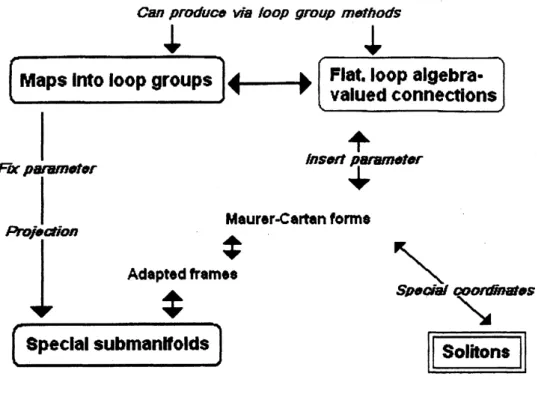
FIGURE 1. The relations betweenmaps intoloop groups, flat
connections, special submanifolds and special PDE.
namely, the
wave
equation.3. GRASSMANN GEOMETRIES
The methods$hom$loop
groups
used here producesubmanifolds whichare,or are
related to, Grassmannsubmanifolds
in homogenmusspaces.
Thispoint has perhaps notbeen emphasized in the past, because the majority of
applicationsstudied
were
inspace
forms, where theGrassmrn
submanifoldcondition (arising bom orbits of the action of the isometry group in the symmetric space representation) is satisfied by any submtifold.
The concept of aGrassmrn
submanifold was
introduced by Harveyand Lawson in [6],
as
follows: let $\overline{N}$be
amanifold
and take anysub-set, $\mathcal{V}$, of the
Grassmrn
bundleover
$\overline{N}$ consisting of tangential $s- plan\infty$
,
$Gr_{s}(T \overline{N})=\bigcup_{x\in\overline{N}}Gr_{\epsilon}(T_{x}\overline{N})$
.
A $\mathcal{V}$-submanifold, $N$, of$\overline{N}$, is
an
$\epsilon$
-dimensional
connected
submtifold
such that $T_{x}N\in \mathcal{V}$ foreai
$x\in N$.
Theset
of suchsubmtifolds, $N$
,
iscalled
the $\mathcal{V}$-geometry.In this article, $\overline{N}$ will always be ahomogenmus space, $G/H,$ with $G$
a
connected
Liegroup,
and$\mathcal{V}$an
orbit of theaction of$G$on
$Gr_{\epsilon}(T\overline{N})$.
In such acase, the gmmetry $\mathcal{V}$ isdetermined
byan
$s$-dimensional vector subspace of the tangentspace
at the origin, $H$, of of $G/H$.
Aspecialcase
is whenofthe Lie algebra $\overline{u}=\overline{t}\oplus\overline{\mathfrak{p}}$
,
and the tangent space at theorigin is $T_{0}\overline{N}=\overline{\mathfrak{p}}$
.
So
for symmetric spaceswe
have the correspondence:{s-Dim
$\mathcal{V}-geometries$}
$rightarrow${
$s$-Dim subspaces $\mathfrak{p}\subset\overline{\mathfrak{p}}$}.
Given $\mathfrak{p}\subset\overline{\mathfrak{p}}$,we
will call theas
sociated geometry the$\mathcal{V}_{P}$-geometry.
If $Ad_{\overline{K}}\mathfrak{p}\subset \mathfrak{p}$ then the $\mathcal{V}_{\mathfrak{p}}$-geometry consists ofintegral submanifolds of
a
distribution determined by $\mathfrak{p}$,
but otherwise it isa more
general concept.3.1.
Examples. For space forms, any s-dimensional submanifold isa
$\mathcal{V}_{\mathfrak{p}^{-}}$submanifold for
any
s-dim subspace $p\subset\overline{\mathfrak{p}}$.
We demonstrate this forcurves
in $\overline{N}=SO(3)/SO(2)=S^{2}$
.
We have the canonical decomposition:$\mathfrak{s}o(3)=\overline{f}\oplus\overline{\mathfrak{p}}=\{\{\begin{array}{ll}* *0* *00 00\end{array}\}\}\oplus\{$ $\{\begin{array}{ll}0 0*0 0** *0\end{array}\}\}$
.
For
a
$\mathfrak{p}=\{\begin{array}{l}\mathfrak{p}\subset\overline{\mathfrak{p}}[Matrix]\}\end{array}$
Let $f$ : $Rarrow S^{2}$ be any
curve.
The $V_{\mathfrak{p}}$-geometry is determined by theleft action of $SO(3)$ on $Gr_{1}(TS^{2})$, and to show that a curve in $S^{3}$ is a
$\mathcal{V}_{\mathfrak{p}^{-}}$
submanifold,
we
need to show there exists hame $F\in SO(3)$ for $f$, such thatthe projection
onto
$\overline{\mathfrak{p}}$ of $F^{-1}dF$ lies in $\mathfrak{p}$.
This is achieved by choosingan
adapted
ffame
$F$ : $Rarrow SO(3)$,
$F=[e, n, f]$, $e$ tangent, $n$ normal,
$F^{-1}dF=\{\begin{array}{l}e^{t}n^{t}f^{t}\end{array}\}$
[de
$dn$ $df$]
$=\{\begin{array}{lll}0 e^{t}dn e^{t}dfn^{t}de 0 n^{t}dff^{t}de f^{t}dn 0\end{array}\}$.
The $\overline{\mathfrak{p}}$ part is $\{\begin{array}{lll}0 0 e^{t}df0 0 n^{t}dff^{t}de f^{t}dn 0\end{array}\}=\{\begin{array}{lll}0 0 e^{t}df0 0 0f^{t}de 0 0\end{array}\}\in \mathfrak{p}$
.
More
meaningfulexamplesofGrassman submanifolds
are
Lagrangian sub-manifoldsof
$CP^{n}$ and almost complex and totally realsubmanifolds
of $S^{6}$.
The latter arise with respect to the action of $G_{2}$
on
the homogeneous space $S^{6}=G_{2}/SU(3)$, which is nota
symmetricspace representationof $S^{6}$; hencethere is no conflict with the above
comment
concerning space forms.4.
GRASSMANN
GEOMETRIES ASSOCIATED TO LOOP GROUPSLoop grouptechniques (AKS-theory, DPW, etc) produce mapsinto
a
sub-group of
a
loop group whichare characterized
by the fact that theMaurer-Cartan form is a Laurent polynomial of fixed degree in the loop parameter,
$\lambda$
.
Solutionsare
determined modulo the action of theconstant
subgroupWe
formulate
this in the language ofGrassmann
geometries: Let $G$ bea
complex semisimple Lie group, and define the loop group
$\Lambda G$ $:=\{\gamma:S^{1}arrow G\}$,
where the maps have
some
convergence
condition, suchas
the Wienertopol-ogy, which makes $\Lambda G$
a
Banach Liegroup.
Let $\mathcal{H}$ bea
Banach subgroup of$\Lambda G$, and denote by $\mathcal{H}^{0}$ $:=\mathcal{H}\cap G$, the subgroup
of
constant
loops. Then the left coset spaoe $\mathcal{H}/\mathcal{H}^{0}$ isa
homogeneous spaceon
which $\mathcal{H}$ actson
the left.To define Grassmanngeometries
on
$\mathcal{H}/\mathcal{H}^{0}$,we
need to describe its tangentspace at the origin. The Liealgebraof$\Lambda G$ is$\Lambda g=\{\sum_{i-\infty}^{\infty}a_{i}\lambda^{i}|a_{i}\in g\}$, and
Lie
$(\mathcal{H})$is
a
vector
subspaoe of Ag. Clearly Lie$(\mathcal{H}^{0})=${constant
polynomialsin Lie$(\mathcal{H})$
},
from
which
itfollows
that$T_{0} \frac{\mathcal{H}}{\mathcal{H}^{0}}=\{\sum_{i\neq 0}a_{i}\lambda^{i}\}\subset Lie(\mathcal{H})$
.
For integers $a<b$, deflne $W_{a}^{b}\subset\tau_{0\pi}^{\mathcal{H}}$ by
$W_{a}^{b}= \{x\in T_{0}\frac{\mathcal{H}}{\mathcal{H}^{0}}|\sum_{i=a}^{b}a_{i}\lambda^{i}\}$
.
Now
set
$\mathcal{V}_{a}^{b}$ to be the distribution given by the orbit of$W_{a}^{b}$ under the actionof $\mathcal{H}$
on
$Gr_{b-a}(T\mathcal{H}*)$
.
The basic object
we can
construct, using the techniquesdescribed
here,are $\mathcal{V}_{a}^{b}$-compatible (immersed) submanifolds of $\mathcal{H}/\mathcal{H}^{0}$, i.e. maps $f$ : $Marrow$ $\mathcal{H}/\mathcal{H}^{0}$ for which there exists frames $F:Marrow \mathcal{H}$ with $F^{-1} dF=\sum_{i=a}^{b}\alpha_{i}\lambda^{i}$
.
5.
SPECIAL
SUBMANIFOLDS FROM LOOP GROUP MAPSA $\mathcal{V}_{a}^{b}$-immersion $f$
:
$Marrow \mathcal{H}/\mathcal{H}^{0}$, leads naturally to families of special submanifoldsas
follows: Evaluate $f$ atsome
$\lambda_{0}$, to geta
map $f_{\lambda 0}$ : $Marrow$$G/\mathcal{H}^{0}$
.
The subgroup $\mathcal{H}$ together with the $\mathcal{V}_{a}^{b}$ condition make $f_{\lambda_{0}}$a
certainGrassman
submanifold.
Since $f$ is
a
$\mathcal{V}_{a}^{b}$-immersion, by definition, there exists a lft $F$ : $Marrow \mathcal{H}$,such that $\alpha$ $:=F^{-1} dF=\sum_{i=a}^{b}\alpha_{1}\lambda^{i}$
.
An essential point is: $\alpha$ must satisfythe
Maurer-Cartan
equation,$d\alpha+\alpha\wedge\alpha=0$
,
for all values of $\lambda$
.
This is equivalent tosome
conditionson
$\alpha_{i}$,(51) $d\alpha_{k}+\sum_{i+j=k}\alpha_{i}\wedge\alpha_{j}=0$,
independent of $\lambda$
.
The equations (5.1) give
some
extra conditions, usuallyon
the (tangentand normal) curvature
of
thesubmanifold.
This will be illustrated byour
DAVID BRANDER
6. THB THREE INVOLUTION LOOP GROUP
Now we
definethe generalization of the loop group construction of [5]. Let$G$ be
a
complex semisimple Lie group and $\overline{\tau},\hat{\sigma},$$\rho$ commuting involutions
of $G$, where
$\rho$ is C-antihinear. The fixed point subgroup with respect
to
$\rho$,
$\overline{U}$
$:=G_{\rho}$, is
a
realform
ofthe
group.
We extend the involutions to $\Lambda G$ by the rules: $(\rho X)(\lambda)=\rho(X(\overline{\lambda}))$,
$(\hat{\sigma}X)(\lambda)=\hat{\sigma}(X(-\lambda))$, $(\overline{\tau}X)(\lambda)=\overline{\tau}(X(-1/\lambda))$,
and consider the subgroup fixed by all three involutions:
$\mathcal{H}=\Lambda G_{\rho\overline{\tau}\hat{\sigma}}$
.
Consider
a
$\mathcal{V}_{-1}^{1}$-immersion
$f$:
$Marrow \mathcal{H}/\mathcal{H}^{0}$.
For $\lambda\in R^{*}$,$f_{\lambda}$ : $Marrow\overline{U}/\overline{U}_{\overline{\tau}\hat{\sigma}}$
,
sinoe $\mathcal{H}^{0}=\overline{U}_{\overline{\tau}\hat{\sigma}}=\overline{U}_{\overline{\tau}}\cap\overline{U}_{\hat{\sigma}}$
.
$We_{-}$
can
also project to obtain maps into the symmetric spaces $\overline{U}/\overline{U}_{\overline{\tau}}$ and $U/\overline{U}_{\hat{\sigma}}$,or more
generally, intoany
homogeneous spaoe $\overline{U}/H$, where
$\overline{U}_{\overline{\tau}}\cap\overline{U}_{\hat{\sigma}}\subset H$
.
What
are
the special submanifoldsso
obtained?7.
REFLECTIVE SUBMANIFOLDSWe
are
primarily interested in the projection to $\overline{U}/\overline{U}_{\overline{\tau}}$, as this
generalizesthe isometric immersions of
space
forms studied in [5]. To describe thepro-jections,
we
first need to define reflective submanifolds.Examples In space forms, these
are
just the complete totally $g\infty desic$submanifolds. Other examples
are
Lagrangian embeddings of$RP^{n}\subset CP^{n}$and $RH^{n}\subset CH^{n}$
.
Definition: A
reflective
submanifold, $N$, ofa
Riemannian manifold, $\overline{N}$,is
a
totally $g\infty desic$ symmetric submanifold.For
a
connected symmetricspace
$\overline{N}=\overline{U}/\overline{K}$,we
can
characterizea
reflec-tive submanifold $N$ of$\overline{N}$, by the existenoe of
a
second involutionon
the Liealgebra of $\overline{U}$
.
Specifically, $N\subset\overline{N}$ is
characterized
bya
$p\underline{a}ir$ of commuting
involutions, $\overline{\tau}$ and $\hat{\sigma}$
,
of the Lie algebra $\overline{u}$ of $\overline{U}$, and $K=U_{\overline{\tau}}$
.
That is:We have two canonical decompositions of the Lie algebra $\overline{u}=\overline{\mathfrak{k}}\oplus\overline{\mathfrak{p}}=\hat{\mathfrak{k}}\oplus\hat{\mathfrak{p}}$,
into $the+1$ and-l eigenspaces of the two involutions. Setting
$\mathfrak{p}$ $;=\overline{\mathfrak{p}}n\hat{\mathfrak{p}}$,
the reflective
submanifold
is given by: $N=\pi_{\overline{N}}\exp(\mathfrak{p})$.
Reflective submanifolds
of symmetric spaceswere classified
byDSP Leung(1974-1979), and there
are
clearlymany
cases.
8.
ISOMETRIC IMMERSIONS OF SPACE FORMSThe three involutionloop
group
leads naturally toa
generalization ofthefollowing $results/conjectures$:
Anisometricimmersion $f$ : $M^{k}(c)arrow M^{n}(\overline{c})$, ofspace formswithconstant
sectional curvature $c$ and $\tilde{c}$ respectively, has negative extrinsic
curvature
if$c<\tilde{c}$
.
Thereare
two basic questions: existence ofa
local solution, andexistenoe of
a
complete solution. Forthese
it is known:(1) Local solutions exist iff$n\geq 2k-1$ (Cartan).
(2) Theorem (JD Moore): If
$0<c<1$
, there isno
complete isometricimmersion with flat normal bundle of $S^{k}(c)$ into $S^{n}$ for any $k>1$
and any $n$
.
(3) Plausible conjecture: If $c<-1$ there is
no
complete isometricim-mersionwithflat normal bundle of$H^{k}(c)$ into$H^{n}(-1)$ for any $k>1$
and any $n$
.
For the
case $n=2k-1$
, this is equivalent to the conjecturedgeneralization of Hilberts’s non-immersibility of $H^{2}$ into $E^{3}$
.
9.
THE GENERALIZATION TO OTHER REFLECTIVE SUBMANIFOLDS$M$
a
Riemannian manifold, let $M_{R}$ denote thesame
manifold with themetric scaled by a factor $R>0$
.
Problem
$A$:
Suppose givena
reflective submanifold$N\subset\overline{N}$
of
a
symmetricspace. Thus, $N_{R}\subset\overline{N}_{R}$ is alsoa
reflective submanifold. Doesthere exist
a
(localor
global) isometric immersion$N_{R}arrow\overline{N}$,
satisfying
condition X?
That is,can we
$shrink/stretchN$ within $\overline{N}$? More
specifically,
we
ask this for:(1) $R>1$, if$\overline{N}$ is of compact type,
(2) $R<1$, if $\overline{N}$
Reflective submanifolds
in other symmetric spaces donot
generally haveflat normal bundle. Thus, we need to replace the flat normal bundle
condi-tion with
an
appropriate one, whichwe
call here condition $X$Condition X just
says:
(1) $N_{R}arrow\overline{N}$ is
a
$\mathcal{V}_{\mathfrak{p}}$-submanifold, where $N=\exp(\mathfrak{p})$.
(2) The normal
bundle
of $N_{R}arrow\overline{N}$ is isomorphic (as an affine vectorbundle
$/connection$ pair) with the normal bundle of $N_{R}\subset\overline{N}_{R}$.
10. PROJECTIONS
TO $\overline{U}/\overline{U}_{\overline{\tau}}$AND $\overline{U}/\overline{U}_{\hat{\sigma}}$
Here we summarize
resultsfrom
[2].In fact
Proposition10.2
is statedincorrectly in [2] - the limit
as
$\lambdaarrow\infty$or
$\lambdaarrow 0$ must be taken beforea
curved flat is obtained.
Set $\overline{K}$
$:=\overline{U}_{\overline{\tau}}$
,
and $\hat{K}:=\overline{U}_{\hat{\sigma}}$.
Take$f$ : $Marrow \mathcal{H}/\mathcal{H}^{0}$
a
$\mathcal{V}_{-1}^{1}$-immersion.Recall $f_{\lambda}$ : $Marrow\overline{U}/(\overline{K}\cap\hat{K})$, for $\lambda\in R$
.
$P_{-}roposition10.1.\underline{L}et\overline{f}_{\lambda}$
:
$Marrow\overline{U}/\overline{K}$ be the projectionof
$f_{\lambda}$.
Suppose that $f_{\lambda}$ is regular. Then $f_{\lambda}$ is a solutionof
Problem $A$ (for $R>1$). Conversely,any solution
of
Problem $A$, corresponds to such a $\mathcal{V}_{-1}^{1}$-immersion.Proposition 10.2. Let $\hat{f}_{\lambda}$ : $Marrow\overline{U}/\hat{K}$ be
the projection
of
$f_{\lambda}$.
Then:$\bullet$ $\hat{f}_{\lambda}$ is asymptotic to
a curved
flat
in $\overline{U}/\hat{K}$,as
$\lambdaarrow\infty$, or $\lambdaarrow 0$.
$\bullet$
If
$\overline{f}_{\lambda}$ is regular then
so
is $\hat{f}_{\lambda}$ (but not conversely).
Hence,
if
$\overline{U}/\overline{K}$ compact then:(1) Local regular solutions to Problem $A$ enist $\Rightarrow Dim(\mathfrak{p})\leq Rank(\overline{U}/\hat{K})$
.
(2) Globalregular
solutions
to Problem$A$ do not$e\dot{r}st$for
$Dim(N)>$1.
11. CONSEQUENCES
Theorem 11.1. (Compa$ct$ Case) The following list contains the
geomet-ric interpretations
of
all possible solutions to Problem $A$for
thecase
$R>1$and $\overline{N}$
is
a
simply connected, compact, irreducible, Riemannian symmetricspace.
In all $case8$
,
local solutions evist andcan
be constructed by loop grvupmethods. In all
cases
where $Dim(N_{R})>1$, there is no solution which isgeodesically complete.
(1) $N_{R}=S_{R}^{k}$ is
an
$isomet7\dot{Y}C$ immersion withflat
normal bundleof
ak-sphere
of
radius $\sqrt{R}$ into the unit sphere $S^{n}$, with$0<k\leq(n+1)/2$,and $n\geq 2$
.
(2) $N_{R}=S_{R}^{n}$ is
an
isometric totally real immersionof
an
n-sphereof
Note: Lagrangian immersions of
a
sphere into $CP^{n}$ isa new
example ofa
submanifold
as an
integrable system.Theorem 11.2. (Non-Compact Case) The analogue-except
we
do notobtain the global non-existence result, which remains
an
open problem.REFERENCES
[1] D.Brander. Curvedflats, pluriharmonicmap8 andconstantcurvatureimmersions into
pseudo-Riemannian space forms. Ann. Global Anat. Geom., 32:253-275, 2007. DOI
10.1007/sl0455-007-9063-y.
[2] D. Brander. Grassmann geometries in infinite dimensional homogeneous spaces andan
application to reflective submanifolds. Int. Math. Res. Not., pages rnm092-38, 2007.
DOI: 10.$1093/imm/rnm092$
.
[3] D. Brander and W. Rossman. A loop group formulation for constant curvature $suk$
manifoldsof pseudo-Euclidean space. Taiwanese J. Math. -to appear.
[4]‘F. E. Burstalland F. Pedit. Harmonicmaps viaAdler-Kostant-Symes theory. In
Har-monic maps and integmble systems, number E23 in $Asp\infty ts$ ofMathematics. Vieweg,
1994.
[5] D. Ferus and F. Pedit. Isometric immersions ofspaceforms and solitontheory. Math.
Ann., 305:329-342, 1996.
[6] R. Harvey and H. B. Lawson. Calibrated geometries. Acta Math., 148:47-157, 1982.
DEPARTMENTOFMATHEMATICS, FACULTYOFSCIBNCE,KOBEUNIVERSITY, 1-1, $RoKKO-$
DAI, $NADA-KU$, KOBE 657-8501, JAPAN