Dissipative
Schemes for the Ginzburg-Landau Equations
Takayasu
Matsuo and
Eitaro Torii
1Abstract
Twoexisting and
one
new Galerkin schemes for the Time-DependentGinzburg-Landau (TDGL) equations
are
presented. The schemes havean
welcome featurein common that each keeps a discrete counterpart of the original energy
dissipa-tion property of the TDGL. Based on the Lyapunov theory, asymptotic behavior
of the solutions ofthe schemes are discussed, whichis then confirmed by numerical
experiments.
1
Introduction
The phenomelogical behavior ofsuperconductivity is governed by the so-called
Ginzburg-Landau model. The model in the so-called “zero electric potential gauge” is described
as
the following time-dependent Ginzburg-Landau (TDGL) equations:
$\eta\frac{\partial\psi}{\partial t}+\frac{1}{2}\{(\frac{i}{\kappa}\nabla+A)^{2}\psi+(|\psi|^{2}-1)\psi\}=0$ in $\Omega$, (la)
$\frac{\partial A}{\partial t}+{\rm Re}[\overline{\psi}(\frac{i}{\kappa}\nabla+A)\psi]+\nabla\cross(\nabla\cross A-H)=0$ $i_{l1}\Omega$, (lb)
where $\Omega\subset \mathbb{R}^{d}$ is
a
bounded subdomain with smooth boundary, $\kappa>0$is the material
constant called the Ginzburg-Landau parameter, $\eta>0$ is the friction coefficient, $H\in \mathbb{R}^{d}$
is the applied magnetic field, $\psi$ : $\Omega\cross[0, T]arrow \mathbb{C}$ is the complex-valued order parameter
which denotes the conducting state of the material, and $A$ : $\Omega\cross[0, T]arrow \mathbb{R}^{d}$ is the
magnetic potential. By $\overline{\psi}$
we
mean
the complex conjugateof
$\psi$
.
The associated boundaryconditions
are:
$\nabla\psi\cdot n=0$, $A\cdot n=0$, $n\cross(\nabla\cross A-H)=0$
on
$\partial\Omega$. (lc)where $n$ is the exterior unit normal of the boundary $\partial\Omega$. For this gauge choice and the
well-posedness of the associated Cauchy problem,
see
[2].The advantage of this particular gauge choice is that the problem
can
be viewedas
a
gradient-flow of the Ginzburg-Landau energy functional:
$E( \psi, A)=\int_{\Omega}\{\frac{1}{2}|(\frac{i}{\kappa}\nabla+A)\psi|^{2}+\frac{1}{4}(1-|\psi|^{2})^{2}+\frac{1}{2}|\nabla\cross A-H|^{2}\}dx$, (2)
$\eta\frac{\partial\psi}{\partial t}=-\frac{\overline{\delta}E}{\delta\overline{\psi}}$, $\frac{\partial A}{\partial t}=-\frac{\delta E}{\delta A}$, (3)
lGraduate School of Information Science and Technology, The University of Tokyo, Hongo 7-3-1,
where $\delta E/\delta\overline{\psi}$and $\delta E/\delta A$denote variationalderivatives. This energyin otherwords
serves
as a
Lyapunov functional ofthesystem, and this suggestsus
to employnumerical schemeshaving
some
discrete counterpart of this propertyfor
stability and correct asymptoticbehavior. So far several fully-implicit schemes having discrete Lyapunov functional have
been proposed [3, 10], but due to their nonlinearity
some
iterative solver was necessarilyrequired, andthus they were relatively expensive. A remedy to overcome this difficulty is
to introduce
some
linearization technique, such as the one proposed in [9], which enablesus
to design a linearly-implicit scheme that still keeps discrete dissipation property insome
sense.
As
its price, however, theresulting schemecan
be unstable, since the discreteenergy function in this
case
does not necessarilyserve
as Lyapunov functional.In the present paper, after briefly reviewing the existing fully-implicit schemes [3, 10],
we
presenta
linearly-implicit scheme with the linearization technique [9]. Then thequal-itative behavior of discrete solutions for each scheme is discussed based
on
the Lyapunov theory. In order to simplify the discussion, in what followswe
limit ourselves to thesimplified model ignoring all the magnetic effects:
$\eta\frac{\partial\psi}{\partial t}=\frac{1}{2}\{\frac{\triangle\psi}{\kappa^{2}}+(1-|\psi|^{2})\psi\}$ in $\Omega$, $\nabla\psi\cdot n=0$
on
$\partial\Omega$. (4)This still deserves investigation since it still keeps interesting physical solutions such
as
vortices, and
a
Lyapunov functional:$E( \psi)=\int_{\Omega}\{\frac{1}{2}|\frac{\nabla\psi}{\kappa}|^{2}+\frac{1}{4}(1-|\psi|^{2})^{2}\}dx$. (5)
The simplified equation (4) is formally agradient flow with respect to the energy:
$\eta\frac{\partial\psi}{\partial t}=-\frac{\delta E}{\delta\overline{\psi}}$. (6)
Wealso
assume
$d=2$for brevity (we consider, say, aunit disk). Let $H_{c}^{1}(\Omega)$ be thestandardSobolev space ofcomplex-valuedfunctions and $(\cdot,$ $\cdot)$ be itsassociated inner product. Let $S_{d}$
and $W_{d}$ be thefinite-dimensionalsubspaces in $H_{c}^{1}(\Omega)$ for trial and test functions satisfying
$S_{d}\subseteq W_{d}$ (in most
cases we
simplytake $S_{d}=W_{d}$, in particular to the standard piecewiselinear function space).
2
Fully-implicit Schemes for the simplified
GL
equa-tion
Amethod for designing Galerkinschemes preserving energydissipation property hasbeen
proposed in [8]. By applying the method, we reach the following fully-implicit scheme
as
Scheme 1 (Fully-implicitscheme 1 [10]). Suppose
an
initial data$\psi^{(0)}\in S_{d}$ is given. Find$\psi^{(m)}\in S_{d}(m=1,2, \ldots)$ such that
for
any $\phi\in W_{d}$$\eta(\frac{\psi^{(m+1)}-\psi^{(m)}}{\Delta t},$ $\phi)=-(\frac{\partial E_{d}}{\partial(\nabla\overline{\psi}^{(m+1)},\nabla\overline{\psi}^{(m)})},$$\nabla\phi)-(\frac{\partial E_{d}}{\partial(\overline{\psi}^{(m+1)},\overline{\psi}^{(m)})},$$\phi)$ , where
$\frac{\partial E_{d}}{\partial(\nabla\overline{\psi}^{(m+1)},\nabla\overline{\psi}^{(m)})}$ $=$ $\frac{1}{2\kappa^{2}}(\frac{\nabla\psi^{(m+1)}+\nabla\psi^{(m)}}{2})$,
$\frac{\partial E_{d}}{\partial(\overline{\psi}^{(m+1)},\overline{\psi}^{(m)})}$ $=$ $- \frac{1}{2}(1-\frac{|\psi^{(m+1)}|^{2}+|\psi^{(m)}|^{2}}{2})(\frac{\psi^{(m+1)}+\psi^{(m)}}{2})$ .
This scheme has
a
desired dissipation property.Proposition 1 (Dissipation property
of Scheme 1
[10]).Let
$\psi^{(m)}(m=1,2, \ldots)$ bethe
solutions
of
Scheme
1. Then thefollowing discrete dissipationproperty holds:$\frac{1}{\triangle t}\int_{\Omega}E(\psi^{(m+1)})-E(\psi^{(m)})dx=-2\eta\int_{\Omega}|\frac{\psi^{(m+1)}-\psi^{(m)}}{\triangle t}|^{2}dx\leq 0$.
That is, in
Scheme
1 the originalenergy
$E$ dissipatesas
in the continuouscase.
Thisimplies that the asymptotic behavior of the approximate solutions must be quite similar
to that ofthe originalTDGL (strictlyspeaking, tothat ofthe corresponding ODE derived
by discretizing the space variable).
In [3],
an
implicit Euler type scheme is derived from theenergy functional
basedon
minimization
theory.Here
onlythe resultingscheme
is shown.Scheme 2 (Fully-implicit scheme 2 [3]). Suppose
an
initial data $\psi^{(0)}\in S_{d}$ is given. Find$\psi^{(m)}\in S_{d}(m=1,2, \ldots)$ such that
for
any $\phi\in W_{d}$$\eta(\frac{\psi^{(m+1)}-\psi^{(m)}}{\triangle t},$$\phi)=-\frac{1}{2\kappa^{2}}(\nabla\psi^{(m+1)}, \nabla\phi)-\frac{1}{2}((|\psi^{(m+1)}|^{2}-1)\psi^{(m+1)}, \phi)$ .
Proposition 2 (Dissipation property
of
Scheme 2
[3]).Let
$\psi^{(m)}(m=1,2, \ldots)$ be thesolutions
of
Scheme 2. Then the following discrete dissipation property holds:$\frac{1}{\triangle t}\int_{\Omega}E(\psi^{(m+1)})-E(\psi^{(m)})dx\leq-2\eta\int_{\Omega}|\frac{\psi^{(m+1)}-\psi^{(m)}}{\triangle t}|^{2}dx\leq 0$ .
Thus the scheme should have similar asymptotic behavior
as
above; in fact, in [3],a
detailed discussion
on
the asymptotic behavior is given for the full TDGL (1).In these two silnilar schelnes, however, we find several cssential differences. First,
notice that the first equality in Prop. 1 is replaced with an inequality in Prop. 2, whose
equalitydoesnotholdsin general (this
can
be understood by carefully inspectingits proof;interested readers may refer to [3]$)$
.
Since
in the continuous case, the equality holds: $( d/dt)\int Edx=-2\eta\int|\psi_{t}|^{2}dx$,we can
say thatScheme
1 is closer to the originalTDGL.
Although the implicit Euler
scheme
happily keeps the Lyapunovfunctional, thedissipation(how
the energy
is dissipated) is slightly strongerthere than
itshould be.
Second,Scheme 1
should be second order with respect to $\triangle t$ due to its temporal symmetry, while Scheme 2
is only first order.
Both schemes have
an
unwelcome feature incommon:
theyare
fully-implicit, andnecessarily require time-consuming iterative solver. This disadvantage becomes
even
more
crucial, if
we
consider the full TDGL,or
like to proceed to the $d=3$cases.
In the nextsection,
we
considera
linearly-implicit scheme in order toovercome
this disadvantage.3
A Linearly-Implicit
Scheme
for the simplified
GL
equation
By combining the method [8] and the linearization technique [9],
we
can
derive thefollow-ing linearly-implicit scheme.
Scheme 3 (Linearly-implicit scheme). Suppose an initial data $\psi^{(0)}\in S_{d}$ and a starting
value $\psi^{(1)}$
are
given. Find $\psi^{(m)}\in S_{d}(m=2,3, \ldots)$ such thatfor
any $\phi\in W_{d}$$\eta(\frac{\psi^{(m+1)}-\psi^{(m-1)}}{2\triangle t},$$\phi)=-(\frac{\partial E_{d}}{\partial(\nabla\overline{\psi}^{(m+1)},\nabla\overline{\psi}^{(m)},\nabla\overline{\psi}^{(m-1)})},$ $\nabla\phi)-(\frac{\partial E_{d}}{\partial(\overline{\psi}^{(m+1)},\overline{\psi}^{(m)},\overline{\psi}^{(m-1)})},$$\phi)$
where
$\frac{\partial E_{d}}{\partial(\nabla\overline{\psi}^{(m+1)},\nabla\overline{\psi}^{(m)},\nabla\overline{\psi}^{(m-1)})}$ $=$ $\frac{1}{2\kappa^{2}}\{b\nabla\psi^{(m)}+(1-b)\frac{\nabla\psi^{(m+1)}+\nabla\psi^{(m-1)}}{2}\}$ ,
$\frac{\partial E_{d}}{\partial(\overline{\psi}^{(m+1)}.\overline{\psi}^{(m)},\overline{\psi}^{(m-1)})}$ $=$
$\frac{a}{2}(-1+\frac{\psi^{(m+1)}+\psi^{(m-1)}}{2}\overline{\psi}^{(m)})\psi^{(m)}$
$+ \frac{1-a}{2}(-1+|\psi^{(m)}|^{2})(\frac{\psi^{(m+1)}+\psi^{(m-1)}}{2})$ ,
and $a,$$b\in \mathbb{R}$
are
scheme parameters.The scheme parameters $a,$$b$ should be chosen carefully, since they severely affect the
stability of the resulting scheme as will be shown below. Observe that the scheme is
linear withrespect to thelatest value$\psi^{(m+1)}$
.
This schemeenjoys the following dissipationproperty.
Theorem 1 (Dissipation property of Scheme 3). Let $\psi^{(m)}(m=2,3, \ldots)$ be the solutions
of
Scheme 1. Then the following discrete dissipation property holds:where
$E_{d}(\psi^{(m+1)}, \psi^{(m)})$
$=$ $\frac{1}{4}\{a(1-\psi^{(m+1)}\overline{\psi}^{(m)})(1-\overline{\psi}^{(m+1)}\psi^{(m)})+(1-a)(1-|\psi^{(m+1)}|^{2})(1-|\psi^{(m)}|^{2})\}$
$+ \frac{1}{2\kappa^{2}}\{b(\frac{\nabla\psi^{(m)}\cdot\nabla\overline{\psi}^{(m+1)}+\nabla\overline{\psi}^{(m)}\cdot\nabla\psi^{(m)}}{2}I+(1-b)(\frac{|\nabla\psi^{(m+1)}|^{2}+|\nabla\psi^{(m)}|^{2}}{2})\}\cdot$
(7)
Note that
now
the discrete energy function (7) dependson
two consecutive numericalsolutions (i.e. it is “multistep”), and quadratic with respect to the latest value $\psi^{(m+1)}$;
this is the key for the linearization. The scheme parameters $a,$$b$ appear as thecoefficients
of the linear combination of the quadratic approximations. The theorem states that for
any
choice of $a,$$b$, thediscrete
dissipation propertyholds
in theabove
sense.
Thedis-crete energy function (7) is, however, totally different from the original one (5), and as
a
consequence the discrete dissipation property does not immediately imply the correctasymptotic behavior,
as
was
thecase
in the fully-implicit schemes.Still, thediscreteenergy functiongives
us
useful information for designinggood (stable)schemes;
more
specifically, for the choice ofappropriate scheme parameters $a,$$b$. Belowwe
demonstrate this. The first step is to rewrite the energy function
as
follows.$E_{d}(\psi^{(m+1)}, \psi^{(m)})$ $=$ $\frac{1}{4}\{|1-\psi^{(m+1)}\overline{\psi}^{(m)}|^{2}+(0-1)|\psi^{(m+1)}-\psi^{(m)}|^{2}\}$
$\frac{1}{2\kappa^{2}}\{|\frac{\nabla\psi^{(m+1)}+\nabla\psi^{(m)}}{2}|^{2}+(1-2b)|\frac{\nabla\psi^{(m+1)}-\nabla\psi^{(m)}}{2}|^{2}\}.(8)$
Let
us
then considera
“doubled” phase space $(\psi^{(m+1)}.\psi^{(m)})$, and regard that Scheme3
defines a discrete map on the doubled space: $(\psi^{(m-1)}, \psi^{(m-2)})\mapsto(\psi^{(m+1)}, \psi^{(m)})$. We then
observe that depending
on
the parameters $a,$$b$ the dynamical systemcan
behave in thefollowing three ways.
1. When $a<1$
or
$b>1/2,$ $E_{d}(\psi^{(m+1)}, \psi^{(m)})$ obviously is not bounded from below, andthus it can
never
serve as Lyapunovfunctional. In this case, bylosing the Lyapunovproperty the system can be unstable.
2. When $a=1$ and $b=1/2$, which here
we
call the “critical” case, theenergy
functionis bounded and
can serve as
Lyapunovfunctional.
By the Lyapunov theory, thedynamical systemit governsasymptoticallytends to the minimizers. Butby
a
carefulglance we notice that the dynamics is a bit different from the original one. Let us
consider the global minimizers $\int F_{d}\lrcorner(\psi^{(m+1)}, \psi^{(m)})dx=0$. In viewof(8),
we see
thattheglobal minimizers
are
such points that $\psi^{(m+1)}\overline{\psi}^{(m)}=1$ and $\nabla(\psi^{(m+1)}+\psi^{(m)})=0$.This allows
an
oscillatory (steady state” solution $\psi^{(m)}=c,$ $\psi^{(m+1)}=1/\overline{c}$ where$c\in \mathbb{C}$ is
an
arbitrary constant. This is in fact “steady state” in that in the doubledoriginal
undoubled space,
however, it representsan
oscillatorysolution
$carrow 1/\overline{c}arrow$$carrow 1/\overline{c}arrow\cdots$. Thus
we
conclude that in the critical case, the system is equippedwith aLyapunov functional, but the dynamics isdifferent such that it allows spurious
fixed points (in the doubled space).
3. When $a>1$ and $b\leq 1/2$, the spurious fixed points vanish, and the Lyapunov
functional allows only original steady state solutions as its fixed points.
In the last case, the dynamical system is expected to behave the
same
wayas
thefully-implicit cases, although the corresponding linearly-implicit scheme is far cheaper.
We like to generalize the above observation
as
follows: as an unavoidable consequence ofthe linearization, theresulting scheme should be necessarily multistep, and the associated
dynamical system should be understood in the
doubled
(ormore
higher) phase space.There are often degrees of freedom in the definition of multistep energy functions, and it
crucially determines the dynamics, which is then observed as its (numerical) stability. In
some
happy cases, such as the above, by carefully choosing the free (scheme) parameterswe can enforce the scheme (the dynamical system) to behave the same as the original
system. A question, however, still remains that in which circumstances we can find such
“happy”
cases.
Inparticular, whetheror
notwe
can
do that for any PDEs isan
importantopen problem to be answered.
4
Numerical Examples
In this section wepresent numericalexamples thatillustratethe discussionin theprevious
section. We here test Scheme 3, with two parameter sets $(a.b)=(0.9,0.5)$ and $(2. -0.5)$,
each ofwhich corresponds to the first and third patterns described above. For comparison,
we also test the standard semi-implicit scheme, where the diffusion term is discretized in
time by the implicit Euler, and the nonlinear term by the explicit Euler. Weset theTDGL
parameters to be $\eta=1,$ $\kappa=15$, and solved the simplified TDGL
on
the unit disk with atriangulation of 9,375 elements by FreeFEM. As the initial data,
we
set the two vorticesofindices $+1$ and $-1$. With this setting, it is known that the annihilation (disappearing
by merging) ofvortices should
occur.
First we show a result with a fine time mesh $\triangle t=0.1$. We tested the semi-implicit
scheme and Scheme 3 with $(a, b)=(2, -0.5)$. and found no difference; both schemes run
quite happily inthis
case.
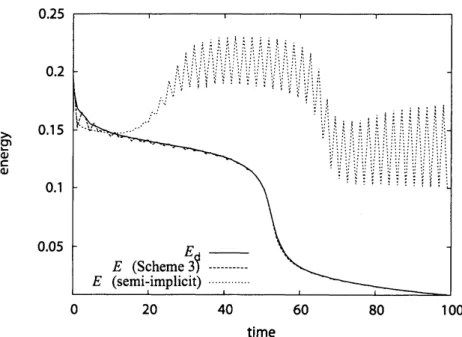
We show the result in Fig. 1.The corresponding energy profiles are shown in Fig. 2. For Scheme 3, we calculated
$E_{d}$ (the multistep energy function (7)) and $E$ (the original energy function (5)). For the
semi-implicit scheme,
we
calculated only the latter. Inthis setting, all the three lines wellagree.
The semi-implicit scheme, however, becomes unst able as$\triangle t$ increases. We demonstrate
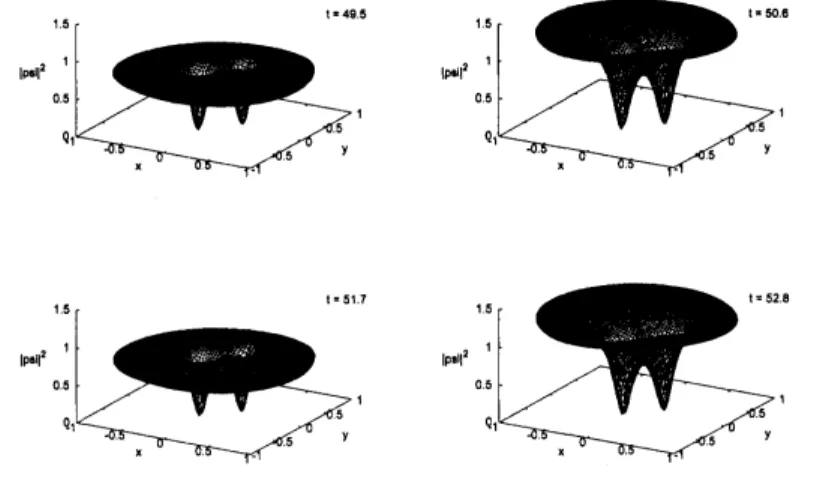
itby setting$\triangle t=1.1$in Fig. 3; theyarethe snapshots offourconsecutivetimestepsaround
$t\cdot 0D$ $t\cdot un$ $\iota\cdot 473$
t.n2 $s\iota$ ,.$1\infty D$
Figure 1: Evolution of the solution with $\triangle t=0.1$: the semi-implicit scheme and Scheme 3
with $(a.b)=(2, -0.5)$
$\omega\subset\frac{O\lambda}{\omega})$
$0$ 20 4) 60 80 100
time
Figure 2: Evolution of the energies with $\triangle t=0.1$: the semi-implicit scheme and Scheme
3
out with the
same
coarse
time stepas
shown in Fig. 4. Theenergy
profilesare
shown inFig. 5, where
we
can
observe oscillation in the semi-implicit scheme.Figure 3: Evolution of the solution with $\triangle t=1.1$: thesemi-implicit scheme
$t=0D$ $t=ua$ $t\cdot 473$
$t=517$ $t=55D$ $t=\infty 9$
Figure 4: Evolution of the solution with $\triangle t=1.1$: Scheme
3
Finally
we
test Scheme 3 with the parameters $(a, b)=(0,9,0.5)$ with $\triangle t=0.5$.
Asshownin Fig. 6, theresult is catastrophic. This agrees withthe discussion in the previous section.
5
Concluding
Remarks
In this paper,
we
presenteda
new
linearly-implicit dissipativescheme for thetime-dependent Ginzburg-Landau (TDGL) equations without magnetic effects. and discussed itsasymp-$\mathring{\omega\subset\frac{\lambda}{\Phi}})$
$0$ 20 40 60 80 100
time
Figure 5: Evolution of the energies with$\triangle t=1.1$: the semi-implicit scheme and Scheme 3
with $(a.b)=(2, -0.5)$
$t\cdot 0$ $t\cdot u$ $\iota\cdot us$
$\iota\cdot \mathcal{B}$ $t\cdot 32s$ ts41
$|\mu\cup^{\wedge}2$
totic behavior from the perspective of the Lyapunov theory. Two existing fully-implicit
schemes
were
also shown and discussed.It is possible to construct linearly-implicit dissipative scheme for the full
TDGL
(withmagnetic effects) based on the same idea employed in this paper. That will be reported
elsewhere
soon.
Ackowledgements
This work
was
supported by a Grant-in-Aid for Encouragement of Young Scientists (B)of the Japan Society for the Promotion ofScience.
References
[1] Arnold, D. N., Bochev, P. B., Lehoucq, R. B., Nicolaides, R. A., and Shashkov, M.
(eds.), Compatible Spatial Discretizations, Springer, New York, 2006.
[2] Du, Q., Global Existence and Uniqueness of Solutions of the Time-Dependent
Ginzburg-Landau Model for Superconductivity, Appl. Anal., 53 (1994),
1-17.
[3] Du, Q., Finite Element Methods for the Time-Dependent Ginzburg-Landau Model
ofSuperconductivity, Comput. Math. Appl., 27 (1994), 119-133.
[4] Furihata, D., Finite Difference Schemes for $\frac{\partial u}{\partial t}=(\frac{\partial}{\partial x})^{\alpha}\frac{\overline{6}G}{\delta v}$ That Inherit Energy
Con-servation
or
Dissipation Property, J. Comput. Phys., 156 (1999),181-205.
[5] Furihata, D. and Matsuo, T., A Stable, Convergent, Conservative and Linear Finite
Difference Scheme for the Cahn-Hilliard Equation, Japan J. Indust. Appl. Math., 20
(2003), 65-85.
[6] Hairer, E., Lubich, C., and Wanner, G., Geometric Numerical Integration, Springer,
Heidelberg, 2006.
[7] Leimkuhler, B. and Reich, S., Simulating Hamiltonian Dynamics, Cambridge,
Cam-bridge, 2004.
[8] Matsuo, T., Dissipative/ConservativeGalerkin MethodUsingDiscretePartial
Deriva-tivefor Nonlinear EvolutionEquations, J. Comput. Appl. Math., 218 (2008),
506-521.
[9] Matsuo, T. and Furihata, D., Dissipative or Conservative Finite-Difference Schemes
for Complex-Valued Nonlinear Partial Differential Equations, J. Comput. Phys.,
171
(2001), 425-447.
[10] Mori, S., Numreical Schemes Perserving the Dissipation Property of the
Ginzburg-Landau Equations (in Japanese), masters thesis, the Universityof Tokyo,
2008.
[11] F.-Pell\’e, J., Kaper, H. G.. and Tak\’a\v{c}, P., Dynamics of the Ginzburg-Landau