COHOMOLOGY OF TORIC ORIGAMI MANIFOLDS
HAOZHI ZENG
DEPARTMENT OF MATHEMATICS, OSAKA CITY UNIVERSITY
ABSTRACT. Toric origami manifolds, introduced in [2], aregeneralizations of
symplectic toric manifolds. In this note, westudy the topology of orientable toric origami manifolds with acyclic proper faces. This note isbased on the
joint work with Anton Ayzenberg, MikiyaMasuda and Seonjeong Park, and
moredetailscanbe found inour paper [1].
1. TORIC ORIGAMI MANIFOLDS
Inthis sectionwe recall the definitions and properties of toricorigami manifolds
and origami templates. Details
can
be found in [2], [8] or [5].A foldedsymplectic form
on
a
$2n$-dimensional manifold $M$ isa
closed 2-form $\omega$whose top power $\omega^{n}$ vanishes transversally
on a
subset $W$ and whose restrictionto points in $W$ has maximal rank. Then $W$ is
a
codimension-one submanifold of$M$ and is called the fold. If $W$ is empty, $\omega$ is a genuine symplectic form. The
pair $(M, \omega)$ is called
a
folded symplectic manifold. Since the restriction of $\omega$ to$W$ has maximal rank, it has a one-dimensional kernel at each point of $W$. This
determines a line field on $W$ called the null foliation. If the null foliation is the
vertical bundle of
some
principal$S^{1}$-fibration$Warrow X$over a
compactbase$X$, thenthe foldedsymplectic form$\omega$is called
an
origami form and thepair $(M,\omega)$ is calledan
origami manifold. The action ofa
torus $T$on an
origami manifold $(M, \omega)$ isHamiltonian ifit admits a moment map $\mu:Marrow t^{*}$ to the dual Lie algebra ofthe
torus, which satisfies the conditions: (1) $\mu$ is equivariant with respect to thegiven
action of$T$on $M$and the coadjointaction of$T$on the vector space$t^{*}$ (thisaction is
trivial for the torus); (2) $\mu$ collects Hamiltonian functions, that is, $d\langle\mu,$$V\rangle=\iota_{V\#}\omega$
for any $V\in t$, where $V\#$ is the vector field on$M$ generated by $V.$
Definition. Atoric origamimanifold $(M, \omega, T, \mu)$, abbreviated
as
$M$, isa
compactconnected origami manifold $(M, \omega)$ equipped with
an
effective Hamiltonian actionofa torus $T$with $\dim T=\frac{1}{2}\dim M$ and with a choice ofa corresponding moment
map $\mu.$
When the fold $W$ is empty,
a
toric origami manifold isa
symplectic toricman-ifold. A theorem of Delzant [3] says that symplectic toric manifolds are classified
bytheir moment images called Delzant polytopes. Recall that
a
Delzant polytopein $\mathbb{R}$“ is
a
simpleconvex
polytope, whose normal fan is smooth (with respect tosome
given lattice$\mathbb{Z}^{n}\subset \mathbb{R}^{n}$). In other words, all normal vectors to facetsof$P$haverational coordinates, and, whenever facets $F_{1}$,
. .
. ,$F_{n}$ meet in a vertex of$P$, theprimitive normal vectors $\nu(F_{1})$, . .. ,$\nu(F_{n})$ form a basis ofthe lattice $\mathbb{Z}^{n}$
.
Let $\mathcal{D}_{n}$denote the set of all Delzant polytopes in $\mathbb{R}^{n}$ (w.r.t. agiven lattice) and $\mathcal{F}_{n}$ be the
set of all their facets.
The moment data of
a
toric origami manifoldcan
be encoded into an origamitemplate $(G, \Psi_{V}, \Psi_{E})$, where
$\bullet$ $G$ is
a
connected graph (loops and multiple edgesare
allowed) with the$\bullet\Psi_{V}:Varrow \mathcal{D}_{n\rangle}$
$\bullet\Psi_{E}:Earrow \mathcal{F}_{n}$;
subject to the following conditions:
$\bullet$ If $e\in E$ is
an
edge of$G$ with endpoints$v_{1},$$v_{2}\in V$
,
then $\Psi_{E}(e)$ isa
facetofboth polytopes $\Psi_{V}(v_{1})$ and $\Psi_{V}(v_{2})$, and these polytopes coincide
near
$\Psi_{E}(e)$ (this
means
there existsan
open neighborhood $U$ of $\Psi_{E}(e)$ in $\mathbb{R}^{n}$ such that $U\cap\Psi_{V}(v_{1})=U\cap\Psi_{V}(v_{2})$).$\bullet$ If
$e_{1},$$e_{2}\in E$
are
twoedgesof$G$adjacentto$v\in V$, then$\Psi_{E}(e_{1})$ and $\Psi_{E}(e_{2})$are disjoint facets of$\Psi(v)$
.
The facets of the form $\Psi_{E}(e)$ for $e\in E$
are
calledthe fold facets of the origamitemplate.
Example. The following picture is
an
example oforigami templates.FIGURE 1. The origami template with twocopies ofisosceles right triangles
The following is
a
generalization of the theorem by Delzant to toric origamimanifolds.
Theorem 1.1 ([2]). Assigning the moment data
of
a toricorigamimanifold
induces$a$
one
toone
correspondence{toric
origamimanifolds}
$\langlerightarrow${
origamitemplates}
up to equivariant origami symplectomorphism on the
left-hand
side, andaffine
equivalence
on
the right-handside.Denote by $|(G, \Psi_{V}, \Psi_{E})|$ the topological space constructed from the disjoint
union $\sqcup_{v\in V}\Psi_{V}(v)$ by identifying facets $\Psi_{E}(e)\subset\Psi_{V}(v_{1})$ and $\Psi_{E}(e)\subset\Psi_{V}(v_{2})$
for any edge $e\in E$ withendpoints $v_{1},$ $v_{2}.$
An origami template $(G, \Psi_{V}, \Psi_{E})$ is called co\"orientable if the graph $G$ has no
loops (this means all edges have different endpoints). Then the corresponding toric origami manifold is also called co\"orientable. If $M$ is orientable, then $M$ is
co\"orientable[5]. If$M$is co\"orientable, then the action of$T^{n}$
on
$M$islocallystandard [5, lemma 5.1].Let $(G, \Psi_{V}, \Psi_{E})$ be
an
origami template and $M$ the associated toric origamimanifoldwhichis supposed to be orientable in the following. The topologicalspace $|(G, \Psi_{V}, \Psi_{E})|$ is
a
manifold withcorners
with the face structure induced from theface structures
on
polytopes $\Psi_{V}(v)$, and $|(G, \Psi_{V}, \Psi_{E})|$ is homeomorphic to $M/T$as a
manifold withcorners.
The space $|(G, \Psi_{V}, \Psi_{E})|$ has thesame
homotopy typeas
the graph $G$, thus $M/T\cong|(G, \Psi_{V}, \Psi_{E})|$ is either contractibleor
homotopyequivalent to
a
wedge of circles.Underthe correspondenceofTheorem 1.1 the fold facetsoftheorigamitemplate
facet of thetemplate $(G, \Psi_{V}, \Psi_{E})$, then thecorrespondingcomponent $Z=\mu^{-1}(F)$
of the fold $W\subset M$ is
a
principal $S^{1}$-bundleover a
compact space $B$.
The space $B$is $a(2n-2)$ -dimensional symplectic toric manifold corresponding to the Delzant
polytope $F.$
2. BETTI NUMBERS OF TORIC ORIGAMI MANIFOLDS
FYom the classifying Theorem 1.1,
a
natural question is how to describe thecohomology ring and $T$-equivariant cohomology ring of atoric origamimanifold $M$
in terms of its corresponding origami template. If$M$ is simply connected, i.e. the
associated graph $G$ isatree, this question is answeredby Masuda and Panov in [7]
and Holm and Pires in [5]. However, if$M$ is non-simply connected, this question is
still open in general,
even
for the betti numbers unless thecase
where $\dim M=4$is solved byHolm and Pires in [6]. In this section,
we
will givean
explicit formula for the betti numbers of$M$ when $M$ isorientable andevery proper face of$M/T$ isacyclic. Our first main result is the following.
Theorem 2.1. Let $M$ be an orientable toric origami
manifold of
dimension $2n$$(n\geq 2)$ such that every proper
face
of
$M/T$ is acyclic. Then$b_{2i+1}(M)=0$
for
$1\leq i\leq n-2,$$b_{1}(M)=b_{2n-1}(M)=b_{1}(M/T)$
.
Moreover, $H^{*}(M)$ is torsion
free.
We can describe $b_{2i}(M)$ in terms of the face numbers of$M/T$ and $b_{1}(M)$
.
Let$\mathcal{P}$be the simplicial poset dual to$\partial(M/T)$. As usual, we define
$f_{i}=$ the number of
$(n-1-i)$
-faces of $M/T$$=$ the number of$i$-simplices in $\mathcal{P}$ for $i=0$, 1,
. . .
,$n-1$andthe $h$-vector $(h_{0}, h_{1}, \ldots, h_{n})$ by
(2.1) $\sum_{i=0}^{n}h_{i}t^{n-i}=(t-1)^{n}+\sum_{i=0}^{n-1}f_{i}(t-1)^{n-1-i}.$
Theorem 2.2. Let $M$ be an orientable toric origami
manifold
of
dimension $2n$such that every proper
face
of
$M/T$ is acyclic. Let $b_{j}$ be the j-th Betti numberof
$M$ and$(h_{0}, h_{1}, \ldots, h_{n})$ be the $h$-vector
of
$M/T$. Then$\sum_{i=0}^{n}b_{2i}t^{i}=\sum_{i=0}^{n}h_{i}t^{i}+b_{1}(1+t^{n}-(1-t)^{n})$,
in other words, $b_{0}=h_{0}=1$ and
$b_{2i}=h_{i}-(-1)^{i}(\begin{array}{l}ni\end{array})b_{1}$
for
$1\leq i\leq n-1,$ $b_{2n}=h_{n}+(1-(-1)^{n})b_{1}.$Example. Let $M$ be the 4–dimensional toric origami manifold corresponding to
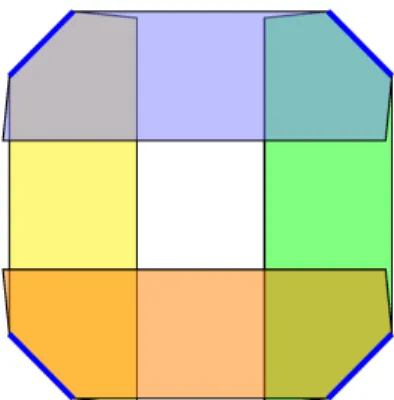
the origami template shown on fig.2 (Example 3.15 of [2]). It is easy to check that
$M$ satisfiesthe condition ofour theorems fromfig.2. The $f$-vector $(f_{0}, f_{1})=(8,8)$,
so
the $h$-vector $(h_{0}, h_{1}, h_{2})=(1,6,1)$.
Then applying Theorem 2.1 and TheoremFIGURE 2. The origamitemplate with four polygons
3.
TOWARDS THE RING STRUCTUREA torus manifold $M$ of dimension $2n$ is
an
orientable connected closed smoothmanifold with
an
effective smoothactionof an $n$-dimensionaltorus$T$havingafixedpoint ([4]). An orientable toric origami manifold with acyclic proper faces in the
orbit space has a fixed point,
so
it is a torus manifold. The action of $T$on
$M$ iscalled locally standard if every point of $M$ has
a
$T$-invariant open neighborhoodequivariantly diffeomorphic to a $T$-invariant open set of a faithful representation
space of$T$
.
Then the orbit space $M/T$ isa
nice manifoldwithcorners.
The torusaction
on an
orientable toric origami manifold is locally standard. In this section,we study the cohomology ring structure of an orientable toric origami manifold
with acyclic proper faces ofthe orbit space.
Let $\mathcal{P}$ be the poset dual to the faceposet of$M/T$
as
before.Proposition3.1. Let$M$ be alocallystandardtorus
manifold
such that everyproperface
of
$M/T$ is acyclic, andthefree
partof
the action gives atrivial principalbundle$M^{o}arrow M^{o}/T$
.
Then $H_{T}^{*}(M)\cong \mathbb{Z}[\mathcal{P}]\oplus\tilde{H}^{*}(M/T)$ as graded rings.Let $\pi:ET\cross\tau^{M}arrow BT$ be the projection. Since $\pi^{*}(H^{2}(BT))$ maps to
zero
by the restriction homomorphism $\iota^{*}:H_{T}^{*}(M)arrow H^{*}(M)$, $\iota^{*}$ induces
a
graded ringhomomorphism
(3.1) $arrow\iota$: $H_{T}^{*}(M)/(\pi^{*}(H^{2}(BT)))arrow H^{*}(M)$
.
Proposition 3.2. Let$M$ be an orientable toric origami
manifold
of
dimension$2n$such that every proper
face
of
$M/T$ is acyclic, then $\iota^{arrow}in$ (3.1) is an isomorphismexcept in degrees 2, 4 and$2n-1$. Moreover, the rank
of
the cokernelof
$\iota^{arrow}in$ degree2 is $nb_{1}(M)$ and the rank
of
the kernel $ofarrow\iota$ in degree 4 is $(\begin{array}{l}n2\end{array})b_{1}(M)$.
Example. Let $M$bethetoric origamimanifold correspondingto the origami
tem-plate shown on fig.2. Topologically $M/T$ is homeomorphic to $S^{1}\cross[0$,1$]$ and the
boundaryof $M/T$
as a
manifold withcorners
consists oftwo boundariesof -gons.The multi-fan of $M$ is the union of two copies of the fan of $\mathbb{C}P^{1}\cross \mathbb{C}P^{1}$ with
the product torus action. Indeed, if$v_{1},$$v_{2}$
are
primitive edge vectors in the fan of$\mathbb{C}P^{1}\cross \mathbb{C}P^{1}$ whichspans a 2-dimensionalcone, then the other primitive edge vectors $v_{3}$,
.
. .
,$v_{8}$ in the multi-fan of$M$are
$v_{3}=-v_{1},$ $v_{4}=-v_{2}$, and $v_{i}=v_{i-4}$ for $i=5$, . . .,8
and the 2-dimensional
cones
in the multi-fanare$\angle v_{1}v_{2}, \angle v_{2}v_{3}, \angle v_{3}v_{4}, \angle v_{4}v_{1},$
where $\angle vv’$ denotes the 2-dimensional
cone
spanned by vectors $v,$$v’$. Note that(3.2) $\tau_{i}\tau_{j}=0$ if$v_{i},$$v_{j}$ do not span a2-dimensional
cone.
We have
(3.3) $\pi^{*}(u)=\sum_{i=1}^{8}\langle u,$$v_{i}\rangle\tau_{i}$ for any $u\in H^{2}(BT)$
.
Let $v_{1}^{*},$$v_{2}^{*}$ be the dual basis of
$v_{1},$$v_{2}$
.
Taking$u=v_{1}^{*}$ or $v_{2}^{*}$ ,we see
that(3.4) $\tau_{1}+\tau_{5}=\tau_{3}+\tau_{7},$ $\tau_{2}+\tau_{6}=\tau_{4}+\tau_{8}$ in $H_{T}^{*}(M)/(\pi^{*}(H^{2}(BT)))$
.
Sincewe
applied (3.3) for the basis $v_{1}^{*},$$v_{2}^{*}$ of$H^{2}(BT)$, there isno
other essentiallynew
linear relation among $\tau_{i}’ s.$Now, multiply the equations (3.4) by$\tau_{i}$ and
use
(3.2). Thenwe
obtain$\tau_{i}^{2}=0$ for any $i,$
$(\mu_{1}:=)\tau_{1}\tau_{2}=\tau_{2}\tau_{3}=\tau_{3}\tau_{4}=\tau_{4}\tau_{1},$
$(\mu_{2}:=)\tau_{5}\tau_{6}=\tau_{6}\tau_{7}=\tau_{7}\tau_{8}=\tau_{8}\tau_{5}$ in $H_{T}^{*}(M)/(\pi^{*}(H^{2}(BT)))$
.
Our argument shows thatthese together with (3.2)
are
the only degree tworelations among $\tau_{i}$’s in $H_{T}^{*}(M)/(\pi^{*}(H^{2}(BT)))$.
The kernel of$\overline{\iota}^{*}:H_{T}^{even}(M;\mathbb{Q})/(\pi^{*}(H^{2}(BT;\mathbb{Q} arrow H^{even}(M;\mathbb{Q})$
in degree 4 is spanned by $\mu_{1}-\mu_{2}.$
REFERENCES
[1] A.Ayzenberg, M.$Masuda_{\}}$S. Park andH. Zeng, Cohomologyof$tor\iota cor\iota gami$manifoldswith
acyclic proper faces, arXiv:1407.0764.
[2] A. Cannas daSilva, V. Guilleminand A. R. Pires, Symplectic Origami, IMRN2011 (2011), 4252-4293, arXiv:0909.4065.
[3] T. Delzant, Hamiltoniens$per\iota$odiques et image convex de l’application moment, Bull. Soc.
Math. France 116(1988), 315-339.
[4] A.Hattori and M. Masuda, Theory ofmulti-fans, OsakaJ. Math. 40 (2003), 1-68.
[5] T. Holm and A. R. Pires, The topology oftoric origamimanifolds, Math. Research Letters
20 (2013),S85-906, arXiv:1211.6435.
[6] T. Holm and A. R. Pires, Thefundamentalgroup and Betti numbersoftomc $or\iota gami$
mani-folds, arXiv:1407.4737.
[7] M.Masuda and T. Panov, On the cohomologyoftorus manifolds, Osaka J. Math. 43 (2006),
711-746.
[8] M. Masuda and S. Park, Tomc origami manifolds and multi-fans, to appear in Proc. of