COMPUTING
$S$-INTEGRAL POINTS ON ELLIPTIC
CURVES OF
RANK
ATLEAST
3
N. HIRATA-KOHNO AND T. KOV\’ACS
ABSTRACT. We give all the $S$-integral points of elliptic curves via considering
linear forms in elliptic logarithms both the complex and the $p$-adic case. We
apply a lower bound for linear forms in $p$-adic elliptic logarithms in arbitrary number of terms.
1.
INTRODUCTIONIt is well-known Siegel [20] proved in
1929
that the number of the integral pointson an
ellipticcurve
$E$over an
algebraic number field $\mathbb{K}$ is finite and Mahler [17]generalized this result to the$S$-integral points where $S$ is
a
finite set ofplaces definedover
$\mathbb{K}$.
Relying upon thegroup
structure of$E(\mathbb{Q})$ and properties ofordinary ellipticlogarithms,
a
different method for proving the finiteness ofordinary integral pointswas
proposed by Lang [14], Masser [18] and Zagier [27]. Using the explicit lowerbound for linear forms in ordinary elliptic logarithms by David [4], the argument
by Lang, Masser and Zagier could be transformed into
an
algorithm for computingthe integer points
on
ellipticcurves
whichwas
done by Gebel, Peth\’o, Zimmer [6],Stroeker, Tzanakis [24],
Smart
[22]. However, the approach dependson
an
unprovedlower bound for linear forms in -adic
elliptic logarithms.In
1996, R\’emondand
Urfels proved such
a
bound for linear forms in two terms. Using this bound and followingSmart’s
line of thought, Gebel, Peth\’o and Zimmer in [7], [8], found all$S$-integral points
on
Mordell’scurves
$y^{2}=x^{3}+k$, with $|k|\leq 10^{4}$ and such that therank of the
curve
$<3$.
In [9], Gebel, Herrmann, Peth\’o and Zimmer couldovercome
the absence of
an
explicit lower bound for linear forms in p–adic elliptic logarithmsby using the completely explicit upper bound for the $S$-integral solutions ofelliptic
equations established by Hajdu and Herendi [10]. They determined the $S$-integral
solutionsof several elliptic
curves
of various ranks up to8
and compared their resultswith earlier estimates. As of rank at most 2 elliptic curves, their method gives only
a
larger upper bound for the $S$-integral points than using the estimate of R\’emondand Urfels. This suggests that
the
existence ofa
similar bound to thatof
R\’emondand
Urfels for
higher rankcurves
would lead toa
similar lessening in the size of the upper bound of the $S$-integral points. This is important in particular if the rank ofthe elliptic
curve
is large,as
then already a small improvement ofthe final boundcan
considerably shrink the region of possible solutions, and hence the final searchcan
be done much faster.2000 Mathematics Subject
Cassification.
Primary llG05, secondary llY50.Key words and phrases. Elliptic curves, $S$-integral points, linear forms in elliptic logarithms,
LLL-algorithm.
Researchsupported in part bytheOTKA grant 100339 and by JSPS, Funding Program for
We show
herean
algorithmto find all
$S$-integral pointsof
ellipticcurves
of
rank greater than 2.As
itwas
pointed out inSmart
[23], the previous methods couldbe extended to do so, however the theory of lower bounds for linear forms in$p$-adic
elliptic logarithms
was
not developed enough. Asa new
lower bound for linearforms in $p$-adic elliptic logarithms has been proved [11],
we
could extend the very efficient method using ordinary and p–adic elliptic logarithms firstestablished
byGebel, Peth\’o and Zimmer in [7], [8], to the
case
of ellipticcurves
of arbitrary rank.In
Section
2we
give the necessary notation and describeour
method in detail. In Section 3 we givean
example. We include larger prime numbers in the set $S$ whichis a
new
feature compared to the previously solved elliptic equations.2. BOUNDING
THE $S$-INTEGRAL POINTS OF ELLIPTIC CURVESWe describe the method of finding the $S$-integral points
on
ellipticcurves
ina
most detailed way. We shall refer to the papers [7], [8], [9], [22]. Let $E$ be
a
givenelliptic
curve
defined by the equation$E$ : $y^{2}=x^{3}+ax+b:=q(x)$.
Here $a,$ $b\in \mathbb{Z}$ and the discriminant of$q(x)$, i.e. $4a^{3}+27b^{2}$ is
non-zero.
By Mordell’stheorem, the group $E(\mathbb{Q})$ of rational points on $E$ is finitely generated. More
pre-cisely,
$E(\mathbb{Q})\cong E_{tors}(\mathbb{Q})\cross \mathbb{Z}^{r},$
where $E_{tors}(\mathbb{Q})$ isthe torsion
group,
and$r$ isthe rank of$E(\mathbb{Q})$.
Let $P_{1},$$\ldots,$
$P_{r}$ denote
a
Mordell-Weil basis of $E(\mathbb{Q})$.
Then each rational point $P\in E(\mathbb{Q})$ hasa
uniquerepresentation of the form
(1) $P=P_{0}+n_{1}P_{1}+\ldots+n_{r}P_{r},$
where $P_{0}\in E_{tors}(\mathbb{Q})$ is
a
torsion point and $n_{i}\in \mathbb{Z}(i=1, \ldots, r)$.We fix
an
arbitrary finite set $S$ ofplaces of $\mathbb{Q}$ (including the infinite one) to be$S:=\{p_{1}, \ldots,p_{s-1}, \infty\}.$ Let $E(\mathbb{Z}_{S})$ denote the set of $S$-integral points of $E(\mathbb{Q})$, i.e.
$E(\mathbb{Z}_{S})=\{P=(x, y)\in E(\mathbb{Q})|H_{S}(P)\leq 1\},$ where
$H_{S}(P)= \prod_{q\not\in S}\max\{1, |x|_{q}\}$
with $|x|_{q}$ being the normalized multiplicative absolute value of $\mathbb{Q}$ corresponding to
the place $q$. Put $N$ $:= \max_{1\leq i\leq r}|n_{i}|_{\infty}$. If
one
searches for the set $E(\mathbb{Z}_{S})$ then firstan
upper bound for $N$ has to be found and then this bound has to be graduallydecreased to asizewhere the actual points
can
already be identifiedbyan
exhaustivesearch. To get the final bound $N_{final}$ for $N$, the LLL-algorithm is applied. In the
2.1.
Height.The
multiplicative heightof
a
rational
point $P=(x, y)\in E(\mathbb{Q})$ is definedas
the
following productover
all
primes$p$of
$\mathbb{Q}$ (including$p=\infty$):
$H(P):= \prod_{p}\max\{1, |x|_{p}\}.$ Here
we
define the ordinary additive heightas
(2) $h(P):= \frac{1}{2}\log H(P)$
and the N\’eron-Tate height is
$\hat{h}(P):=\frac{1}{2}\lim_{narrow\infty}\frac{h(2^{n}P)}{2^{2n}}.$
It is well-known
(seefor
example [3]),that for all
$P=(x, y)\in E(\mathbb{Q})$we
have
$\hat{h}(P)-h(P)\leq c_{1},$where $c_{1}$ is
an
exphcitly computable positive constant depending onlyon
thepa-rameters of the
curve.
(Later $c_{2},$ $c_{3}$, etc. will be also explicitly computable positiveconstants dependingonly
on
the parameters of thecurve
and sometimeson
thecho-sen
Mordell-Weil basis of the curve.) Furthermore, since $\hat{h}$is
a
positive semidefinitequadratic form
on
$E(\mathbb{R})$,we
obtain the lower estimate$\hat{h}(P)\geq\lambda_{1}N^{2},$
where $\lambda_{1}>0$ is the smallest eigenvalue of the height-pairing matrix with respect to
the basis $P_{1},$
$\ldots,$$P_{r}$ of $E(\mathbb{Q})$
. On
combining the latter two inequalities,we
get theestimate
(3) $h(P)\geq\lambda_{1}N^{2}-c_{1}.$
Let
now
$P=(x, y)\in E(\mathbb{Q})$ bean
$S$-integral point and choose$p\in S$ such that(4) $|x|_{p}= \max\{|x|_{p_{1}}, \ldots, |x|_{p_{s-1}}, |x|_{\infty}\}.$
Then
we
conclude that$H(P)\leq|x|_{p}^{s}$, with $s:=\# S,$
hence that
(5) $h(P) \leq\frac{s}{2}\log|x|_{p}.$
Combining (3) and (5) yields the upper bound
(6) $\frac{1}{|x|_{p}^{1/2}}\leq c_{2}\exp(-c_{3}N^{2})$
with
$c_{2}=\exp(\begin{array}{l}\lrcorner cs\end{array}), c_{3}=_{s}^{\lambda}\lrcorner.$
2.2. Elliptic logarithms. $A$ lower bound for $|x|_{p}^{-1/2}$
can
beobtainedby estimatinglinear forms in elhptic logarithms. Here two
cases
are
to be distinguished, the2.2.1.
Case 1: $p=\infty\in S$.
We shalluse
the Weierstrass-parametrization ofour
elliptic
curve
$E$.
There exists a lattice $\Omega\subseteq \mathbb{C}$ such that the group ofcomplex pointsis
$E(\mathbb{C})\cong \mathbb{C}/\Omega,$
where $\Omega=\langle\omega_{1},$$\omega_{2}\rangle$ isgenerated bythe two
fundamental
periods$\omega_{1}$ and$\omega_{2}$, where$\omega_{1}$
is real and $\omega_{2}$ is complex. We put $\tau=\omega_{2}/\omega_{1}$ and
assume
without loss ofgeneralitythat $\Im\tau>0$. The above isomorphism is defined by Weierstrass’
$\wp$-function with
respect to $\Omega$ and its derivative
$\wp’$ according to the assignment
$P=(\wp(u), \wp’(u))arrow umod \Omega,$
so
that thecoordinates
ofan
integral point $P=(x, y)\in E(\mathbb{Q})$are
given by$x=\wp(u), y=\wp’(u)$.
The elliptic logarithm of $P$ is then (see e.g. [27])
$u=u(P) \equiv\int_{x}^{\infty}\frac{dt}{\sqrt{t^{3}+at+b}}(mod \Omega)$.
Also, for later
use
define$\phi(P):=u(P)/\omega_{1}.$
Actually, we have
$u=u(P)\equiv n_{1}u_{1}+n_{r}u_{r}+u_{r+1}(mod \Omega)$,
where $u_{i}\in \mathbb{R}$
are
the (complex) elliptic logarithm of the generating points$P_{i}$ of
$E(\mathbb{Q})$. Equivalently,
we
have$\phi(P)\equiv n_{1}\phi(P_{1})+n_{r}\phi(P_{r})+\phi(P_{r+1})(mod 1)$. Hence
an
integer $n_{0}$ exists such that$\phi(P)=n_{0}+n_{1}\phi(P_{1})+n_{r}\phi(P_{r})+\phi(P_{r+1})$,
so that assuming all $\phi$-values belong to $[0,1)$,
$|n_{0}|<rN+1.$
Let $t$ be the order of the torsion point
$P_{r+1}$
.
Then $t\phi(P_{r+1})\equiv\phi(\mathcal{O})\equiv 0(mod 1)$,and hence $\phi(P_{r+1})=s/t$, for
some
non-negative integer $s<t$.
Thus, $\phi(P)=(n_{0}+\frac{s}{t})+n_{1}\phi(P_{1})+\ldots+n_{r}\phi(P_{r})$.Now let
(7) $\Lambda:=u(P)=(n_{0}+\frac{s}{t})\omega_{1}+n_{1}u_{1}+\ldots+n_{r}u_{r}.$
In
1995,
David [4] computeda
lowerbound
for linear forms in complex ellipticlogarithms of shape (7). His bound involves the following quantities:
$g:=|E_{tors}(\mathbb{Q})|, c_{4}:=2.9\cdot 10^{6r+6}\cdot 4^{2r^{2}}(r+1)^{2r^{2}+9r+12.3},$
where $r$ is the rank ofthe curve,
where
$j:=j_{1}/j_{2}$is the
$j$-invariant of the
curve,and
some
numbers
$V_{i}\in \mathbb{R}$ satisfying$\log V_{i}\geq\max\{\hat{h}(P_{i}), h, \frac{3\pi.|u_{i}|^{2}}{\omega_{1}^{2}\Im(\tau)}\}, (i=1, \ldots, r)$
.
Using David’s result, the desired lower bound for $|x|_{\infty}^{-1/2}$ is given in the following
lemma.
Lemma
2.1.
With the above notationwe
have(8)
$\frac{\omega_{1}}{g\sqrt{8}}\exp(-c_{4}h^{r+1}(\log(\frac{r+1}{2}gN)+1)(\log\log(\frac{r+1}{2}gN)+1)^{r+1}\cdot\prod_{i=1}^{r}\log V_{i})$
$\leq\frac{1}{|x|_{\infty}^{1/2}}.$
Comparing the inequalities (6) and (8),
we can
derivean
upper bound for $N$ inthe complex
case.
2.2.2.
Case 2:
$p=p_{i}\in S$ (forsome
$i\in \mathbb{N}$ such that $1\leq i\leq s-1$). Up tonow
there
were
only partial results in thiscase
due to the lack ofa
$p$-adic analogue ofDavid’s lower bound for linear forms ofarbitrary number of terms. Indeed,
a
lowerbound for linear forms in two terms
was
proved by R\’emond andUrfels
[19] in1996.
Recently,
a
generalizationof
this result to arbitrary number of termswas
given by the first author. Using the bound,we can
getan
analogue of (8).We
explain indetail how
one
proceeds in the p–adiccase.
Let $\mathbb{Q}_{p}$ be the $p-$-adic completion of $\mathbb{Q}$ and $\mathbb{Z}_{p}$ its ring ofp–adic integers. Denote
by
$E_{0}(\mathbb{Q}_{p})$ $:=$
{
$P\in E(\mathbb{Q}_{p})|\tilde{P}$ isnon-singular},
as
wellas
by$E_{1}(\mathbb{Q}_{p}):=\{P\in E(\mathbb{Q}_{p})|\tilde{P}=\tilde{\mathcal{O}}\}$
the kernel of the reduction map modulo $p$, where $E$ is regarded
as a curve over
$\mathbb{Q}_{p}$and $\tilde{P},\tilde{\mathcal{O}}$
are
the reduced points$P,$$\mathcal{O}$ modulo
$p$. It is known that if $E$ is minimal
at$p$, then $[E(\mathbb{Q}_{p}) :E_{0}(\mathbb{Q}_{p})]$ is finite and equal to the Tamagawa number $c_{q}.$
Designate by $\mathcal{E}(p\mathbb{Z}_{p})$ the formal groupassociated to $E$ (see e.g. [21]). We consider
the isomorphism
$\mathcal{E}(p\mathbb{Z}_{p})arrow E_{1}(\mathbb{Q}_{p})$, $z\mapsto\{\begin{array}{ll}0, if z=0,(\frac{z}{w(z)}, -\frac{1}{w(z)}) , if z\neq 0,\end{array}$
where
$z=- \frac{x}{y}, w(z)=-\frac{1}{y}.$
The equation for $w=w(z)$ inferred from the long Weierstrass equation for $E(\mathbb{Q})$
(i.e. of the shape $y^{2}+a_{1}xy+a_{3}y=x^{3}+a_{2}x^{2}+a_{4}x+a_{6}$) becomes
A recursive procedure based
on
this equation (see $[21]$) leads to the power series $w=z^{3}+a_{1}z^{4}+(a_{1}^{2}+a_{2})z^{5}+(a_{1}^{3}+2a_{1}a_{2}+a_{3})z^{6}$$+(a_{1}^{4}+3a_{1}^{2}a_{2}+3a_{1}a_{3}+a_{2}^{2}+a_{4})z^{7}+\ldots\in \mathbb{Z}[a_{1}, a_{2}, a_{3}, a_{4}, a_{6}][[z]].$
This is the unique power series in $z$ satisfying the relation
$w(z)=f(z, w(z))$.
$\mathbb{R}om$ it
we
also get the Laurentseries
for$x$ and $y$, respectively.
$x(z)= \frac{z}{w(z)}=\frac{1}{z^{2}}-\frac{a_{1}}{z}-a_{2}-a_{3}z-(a_{4}+a_{1}a_{3})z^{2}-\ldots,$ (9)
$y(z)=- \frac{1}{w(z)}=-\frac{1}{z^{3}}+\frac{a_{1}}{z^{2}}+\frac{a_{2}}{z}+a_{3}+(a_{4}+a_{1}a_{3})z+\ldots.$
The invariant differential has the expansion
$w(z)=(1+a_{1}z+(a_{1}^{2}+a_{2})z^{2}+(a_{1}^{3}+2a_{1}a_{2}+a_{3})z^{3}$
$+(a_{1}^{4}+3a_{1}^{2}a_{2}+6a_{1}a_{3}+a_{2}^{2}+2a_{4})z^{4}+\ldots)dz.$
Note that in these expansions the coefficients of the powers of$z$ each have the
same
weight depending
on
the exponent of $z.$The $p$-adic elliptic logarithm is
now
the image under the homomorphism to theadditive
group
$G_{a}$ (over the completion $\mathbb{C}_{p}$ of the algebraic closure of $\mathbb{Q}_{p}$)defined
as follows:$\psi_{p}:E_{1}(\mathbb{Q}_{p})arrow\hat{G}_{a},$ $P=(x, y) \mapsto\psi_{p}(P)=\int w(z)=z+\frac{d_{2}}{2}z^{2}+\frac{d_{3}}{3}z^{3}+\ldots.$
In particular, the $p$-adic logarithm $\psi_{p}$ has the properties
$\psi_{p}(P+Q)=\psi_{p}(P)+\psi_{p}(Q)$
and
$| \psi_{p}(P)|_{p}=|z|_{p}=|-\frac{x}{y}|_{p}$
Nowlet $\tilde{E}$
be thereduced
curve
$E$modulo$p$and denote by$\mathcal{N}_{p}=\#\tilde{E}(\mathbb{F}_{p})$ thenumberof rational points
on
$\tilde{E}/(\mathbb{F}_{p})$ and let$c_{p}$ denote the Tamagawa number with respect
to$p$
.
With the order $g$ of the torsion subgroup of $E$introduced
earlier,we define
$m:=m_{p}=lcm(g, c_{p}\cdot \mathcal{N}_{p})$.
Then,
we
have from the Lutz filtration of $E$,see
e.g. [16],$mP_{i}=:P_{i}’\in E_{1}(\mathbb{Q}_{p}) (i=1, \ldots, r)$ for the generating points $P_{i}$ of $E(\mathbb{Q})$ and
$mP_{0}=\mathcal{O}$ for the torsion points $P_{0}\in E_{tors}(\mathbb{Q})$.
The representation (1) of
an
$S$-integral point $P=(x, y)\in E(\mathbb{Q})$ gives rise to therepresentation
of
its $m$-multiple $P’=(x’, y’)=mP\in E_{1}(\mathbb{Q}_{p})$. In analogy to
(9),we
have the
Laurent
series$x’= \frac{z’}{w(z’)}=\frac{1}{z^{2}}-\frac{a_{1}}{z}-a_{2}-a_{3}z’-(a_{4}+a_{1}a_{3})z^{\prime 2}-\ldots,$
and this expansion entails the estimate
(11) $|x’|_{p} \leq\frac{1}{|z|_{p}^{2}}=\frac{1}{|t’|_{p}^{2}},$
where
we use
the abbreviating notation $t’$ $:=\psi_{p}(P’)$ for the p–adic elliptic logarithmof $P’.$
Combining inequalities (6)
and
(11)and
observingthat
$|x’|_{p}\geq|x|_{p}$,we
obtain the
(12) $|t’|_{p} \leq\frac{1}{|x’|_{p}^{1/2}}\leq\frac{1}{|x|_{p}^{1/2}}\leq c_{2}\exp(-c_{3}N^{2})$
upper bound for the $p$-adic elliptic logarithm $t’=\psi(P’)$ of the point $P’=(x’, y’)=$
$mP$
.
Therefore, whatwe
need isa
lower estimate for the$p$-valueofthe$p$-adic ellipticlogarithm $t’$ of$P’.$
Fkom the additive property of the p–adic elliptic logarithm and (10),
we
have the relation$t’=n_{1}’t_{1}+\ldots+n_{r}’t_{r}=n_{1}t_{1}’+\ldots+n_{r}t_{r}’=:\Lambda$
between the elliptic logarithms $t’=\psi_{p}(P’)$ of $P’,$ $t_{i}=\psi_{p}(P_{i})$ of the generating
points $P_{i}$ and $t_{i}’=\psi_{p}(P_{i}’)$ of their $m$-multiples $P_{i}’=mP_{i}\in E(\mathbb{Q})$
.
Let$C_{5}:=2^{4r^{2}+3r}\cdot(r+1)^{2r^{2}+9r+4},$
$h’$ $:=$ log
max
$(1, |a|_{\infty}, |b|_{\infty})$,$a_{i} := \max(1,\hat{h}(P_{i}’), h’) (1\leq i\leq k)$, $\beta :=\max(1,2h(n_{1}), \ldots, 2h(n_{r}))$,
$\rho$ $:=p^{-\lambda_{p}}$ for $\lambda_{p}$ $:=\{\begin{array}{ll}\frac{1}{p-1} if p>2,3 if p=2,\end{array}$ $\sigma:=\rho/\max(|t_{1}’|_{p}, \ldots, |t_{r}’|_{p})$,
$\delta:=\max(1, (\log\sigma)^{-1})$,
$\gamma :=\max(1, h’, \log a_{1}, \ldots, \log a_{r}, \log\delta)$
.
Then
we
have the following result.Lemma 2.2. With the above notation, whenever
we
have $\Lambda\neq 0$,we
obtain$| \Lambda|_{p}>\exp(-c_{5}\cdot\delta^{2r+2}\cdot\max(\beta, \gamma)\cdot\gamma^{r+1}\cdot a_{1}\cdots a_{r}\cdot\log\sigma)$
.
Remark 2.1. The dependance on the prime$p$ appears in the
definition of
$\sigma.$Remark 2.2. Note that the
definition of
additive height in [11]differs
by afactor
2
from
(2),therefore
thisdifference
alsooccurs
in thedefinition
of
$\beta$ comparing tothe corresponding parameter$\log B$
of
[11].For any sufficiently large $N$, the inequality ofLemma 2.2
can
be turned into (13) $\exp(-c_{6}\cdot\log N)\leq|t’|_{p},$Remark 2.3. Note that in contrast to the lower bound
of
David and thatof
R\’emondand Urfels, estimation (13) does not contain the
factor
loglog$N.$Comparing
the inequalities (12) and (13),we
can
derivean
upper bound for $N$in the $p$-adic case,
as
well.2.3.
LLL-reduction.
Comparing the inequalities (6) and (8),we
get$c_{3}N^{2} \leq c_{4}h^{r+1}\prod_{i=1}^{r}\log V_{i}(\log(\frac{r+1}{2}gN)+1)(\log\log(\frac{r+1}{2}gN)+1)^{r+1}+$
$+ \log c_{2}-\log(\frac{\omega_{1}}{g\sqrt{8}})$
in the complex
case
and comparing the inequalities (12) and (13),we
get$c_{3}N^{2}\leq c_{6}\log N+\log c_{2}$
in the$p$-adic $c$
ase.
In both cases, for sufficiently large $N$, the left hand side exceedsthe righthand side. Hence
we
obtainan
initial upper bound $N\leq N_{0,p}$ for all$p\in S.$However, this initial bound is too large to determine all $S$-integer solutions of the
given equation. Therefore
we
have to reduce it somehow. Actually, weuse
the$LLL$-algorithm to do that. Again, we have to distinguish between the complex and
the $p$-adic
case.
Aswe
do not know which $p$ satisfiesour
assumption (4),we
need to consider all possibilities. For the application ofthe
$LLL$-algorithm,we refer
tothe paper of
Smart
[22].After carrying out the $LLL$ reduction as many times as it improves the upper
bound for $N$, in
case
of all $p\in S$, we have to choose the worst of them to be$N_{final}.$
Then
we
have to check the $(2N_{final}+1)^{r}$ possible points whose coordinates satisfy$|n_{i}|\leq N_{final},$ $(i=1, \ldots, r)$, whether they
are
$S$-integral points.3.
EXAMPLEWe illustrate the efficiency of
our
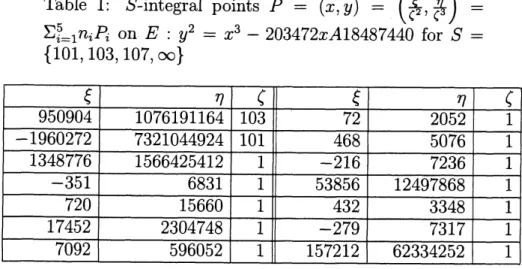
method through an example.Theorem 3.1. All $\{$101, 103, 107,$\infty\}$-integral solutions
of
the equation $y^{2}=x^{3}-$$203472x+18487440$
are
contained in Table 1.Table 1: $S$-integral points $P=(x, y)=(_{\zeta}4_{2}, \not\in_{\zeta})=$ $\Sigma_{i=1}^{5}n_{i}P_{i}$
on
$E$ : $y^{2}=x^{3}-203472xA18487440$ for $S=$Table 1–continued from
previous pageRemark
3.1.
For every $S$-integral point $P=(x, y)$on
$E$,of
course
-$P=(x, -y)$is an $S$-integralpoint, too. Because
of
the large numberof
$S$-integral point pairs, $we$listed only one
from
each pair in Table 1, in particular theone
with positive secondcoordinate.
Proof of
Theorem3.1.
Let $E$ denote the curve
$E$ : $y^{2}=x^{3}-203472x+18487440$ and set
$S=\{101,103,107, \infty\}.$
The rank of $E$ is 5 and a basis ofthe Mordell-Weil group is
$P_{1}=(36,3348) , P_{2}=(-36,5076) , P_{3}=(432,3348)$, $P_{4}=(-216,7236) , P_{5}=(468,5076)$.
First
we
compute the basic data ofour curve.
We find that the torsion subgroup istrivial, therefore (1) reads
as
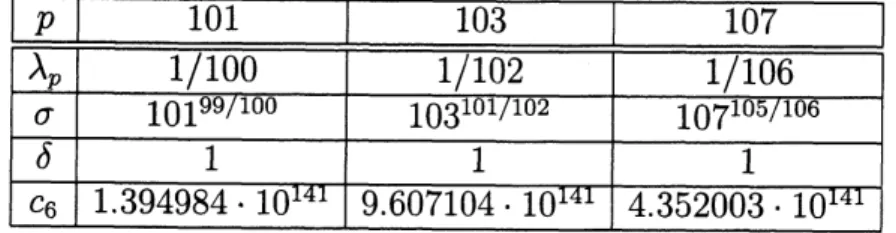
TABLE
2. The data computed to getan
initial upper bound for $N$ in the$p$-adiccase
for $p\in\{101,103,107\}.$TABLE 3. The
new
bound for
$N$ in eachcase
of
$p$after
the ith step ofreduction is $N_{i,p}.$As usual, let $N= \max(|n_{1}|, \ldots|n_{5}|)$. We compute the Tamagawa numbers $c_{101}=$
$c_{103}=c_{107}=1$ and
$\mathcal{N}_{101}=108, \mathcal{N}_{103}=104, \mathcal{N}_{107}=96.$
Using
thesedata
we
can
compute the numbers $m_{p}$ and obtain that $m_{p}=\mathcal{N}_{p}$for
$p\in\{101,103,107\}.$
Next we derive
an
upper bound of shape (6). We find that $c_{1}=3.575681\ldots,$$\lambda_{1}=0.464930\ldots$ and $s=4$. Therefore
we
arrive at the estimate$\frac{1}{|x|_{p}^{1/2}}\leq 2.444694\cdot\exp(-0.11623263\cdot N^{2})$.
Now
we
need to computea
lower bound for each value of$p$. For$p=\infty$,we
get$\frac{1}{|x|_{\infty}^{1/2}}\geq 0.09598\cdot\exp(-2.125933\cdot 10^{167}\cdot(\log 3N+1)(\log\log 3N+1)^{6})$
.
Comparing
the latter two estimates,we
get $N\leq N_{0,\infty}=4.860551\cdot 10^{8}7$.
In the$p$-adic
case
we
compute alldata
contained in Table2.
Therefore
we
get$N_{0,101}=4.4807\cdot 10^{72}, N_{0,103}=3.7164\cdot 10^{72}, N_{0,107}\leq 2.4984\cdot 10^{92}.$
The results obtained after each step of LLL-reduction
are
contained in Table3.
Recall, that
we
start the reduction with $N_{0,p}$ in the lst step and then in everyfurther step
we
repeat the reduction with using the value obtained in the previousstep for every $p\in S$. It turns out that
15
cannot be improved further. Thereforewe have to check $(2\cdot 15+1)^{5}=31^{5}$ points whether they
are
$S$-integral points. Wefind exactly those
ones
contained in Table 1.REFERENCES
[1] A. BAKER, Transcendental Number Theory, Cambridge Univ. Press, (1975).
[2] J. COATES, An
effective
$p$-adic analogueof
a theoremof
Thue III,. the diophantine equation[3] J. E. CREMONA, M. PRICKETTAND S. SIKSEK, Height
Difference
Bounds ForElliptic Curvesover Number Fields, J. Number Theory 116 (2006), 42-68.
[4] S. DAVID, Minorations de
formes
lin\’eairesde logarithmes elliptiques, M\’em. Soc. Math. France 62 (1995), 143pp.[5] S. DAVID AND N. HIRATA-KOHNO, Linear Forms in Elliptic Logarithms, J. f\"ur die reine angew. Math. 628, (2009), 37-89.
[6] J. GEBEL, A. PETH\’oAND H. G. ZIMMER, Computing integralpoints on elliptic curves,Acta Arith. 68 (1994), 171-192.
[7] J. GEBEL, A. PETH\’o AND H. G. ZIMMER, Computing $S$-integral points on elliptic curves,
In Algorithmic Number Theory, Second International Symposium, ANTS-II, Talence, France,
May 1996 (Ed. H. Cohen), Lect. Notes in Comp. Sci., vol. 1122 (Springer Verlag, 1996), pp.
157-171.
[8] J. GEBEL, A. PETH\’o AND H. G. ZIMMER, Computing integralpoints on Mordell’s elliptic curves, Collect. Math. 48 (1997), 115-136.
[9] J. GEBEL, E. HERRMANN, A. PETH\’o AND H. G. ZIMMER, Computing all $S$-integral points on elliptic curves, Math. Proc. Camb. Phil. Soc. 127 (1999), 383-402.
[10] L. HAJDU AND T. HERENDI, Explicit boundsfor the solutions
of
elliptic equations withra-tional coefficients, J. Symbolic Comp. 25 (1998), 361-366.
[11] N. HIRATA-KOHNO, Linear
forms
in$p$-adic elliptic logarithms, manuscript.[12] N. HIRATA-KOHNO AND RINATAKADA, Linear
forms
intwo elliptic logarithms in the$p$-adiccase, Kyushu Journal ofMathematics 64, no. 2, (2010), 239-260.
[13] S. LANG, Diophantine approximation on toruses, Amer. J. Math. 86, (1964), 521-533.
[14] S. LANG, Elliptic curves: diophantine analysis, Grundl. Math. Wiss. 231 Springer-Verlag, 1978.
[15] A. K. LENSTRA, H. W. LENSTRA AND L. Lov\’Asz, Factoring Polynomials with Rational Coefficients, Math. Ann. 261 (1982), 515-534.
[16] E. LUTZ, Surl’\’equation $y^{2}=x^{3}-Ax-B$ dans les corps$p$-adiques, J. reine angew. Math. 177 (1937), 238-244.
[17] K. MAHLER, Uber die rationalen Punkte
auf
Kurven vom Geschlecht Eins, J. reine angew. Math. 170 (1934), 168-178.[18] D. W. MASSER, Linear
forms
in algebraic pointsof
Abelianfunctions
III,Proc. LondonMath.Soc. 33, (1976), 549-564.
[19] G. R\’EMOND AND F. URFELS, Approximation diophantienne de logarithmes elliptiques
p-adiques, J. Number Theory 57 (1996), 133-169.
[20] C. L. SIEGEL, \"Uber einige Anwendungen diophantischer $Approx\iota$mationen, Abh. Preuss.
Akad. Wiss. (1929), 1-41.
[21] J. H. SILVERMAN, The Arithmetic
of
Elliptic Curues, Graduate Texts in Mathematics, 106,Springer Verlag, New York, 1986., xii$+400$ pp.
[22] N. SMART, $S$-integral points on elliptic curves, Math. Proc. Camb. Phil. Soc. 116 (1994), 391-399.
[23] N. SMART, The algorithmic resolution ofDiophantine equations, LondonMath. Soc. Student Texts, 41, Cambridge University Press, Cambridge, 1998., xvi$+243$ pp.
[24] R. J. STROEKER AND N. TZANAKIS, Solving elliptic diophantine equations by estimating
linear
forms
in elliptic logarithms, Acta Arith. 67 (1994), 177-196.[25] R. J. STROEKER AND N. TZANAKIS, Onthe Elliptic Logarithm Method
for
Elliptic Diophan-tine Equations:Reflections
and an Improvement, ExperimentalMath. 8 (1999), 135-149.[26] KUNRUI YU, Report on$p$-adic logarithmic forms, in: A Panorama ofNumber Theory, (ed. G.
W\"ustholz), Cambridge Univ. Press, (2002), 11-25.
[27] D. ZAGIER, Large integralpoints on elliptic curves, Math. Comp. 48 (1987), 425-436.
NIHON UNIVERSITY, COLLEGE OF SCIENCE AND TECHNOLOGY, DEPARTMENT OF
MATHE-MATICS, SURUGA-DAI, KANDA, CHIYODA, TOKYO 101-8308, JAPAN