ALTERNATING SIGN MATRIX ENUMERATION
INVOLVING NUMBERS OF INVERSIONS AND $-1$’s
AND POSITIONS OF BOUNDARY $1$’s
ROGER E. BEHREND
ABSTRACT. This isareview of results for theexactenumeration of alternating sign matrices
offixed size with prescribed values ofsomeor all of the following six statistics: the numbers
ofgeneralizedinversionsand$-1’ s$,and the positionsofthe $1$’s in thefirstand lastrowsand
columns. Many of these results areexpressedin terms of generating functions.
CONTENTS
1. Preliminaries 2
1.1, Irxtroduction 2
1.2. $Defir\backslash$itions
2
1.3. Structureofthe paper 6
2. Unrefined enumeration 7
2.1. Arbitrary bulk parameters 7
2.2. Bulk parameters$x=y=1$ 7
3. $Sin_{b}tYly$-refined enumeration 8
3.1. Arbitrary bulk parameters 8
3.2. Bulk$par\xi \mathfrak{U}$lieters x $=y=1$ 9
4. Opposit) $bo|.u\downarrow$dary doubly
refined $enumera_{)}t\cdot ion$ 10
4 Arbitra$ry|1p_{c(J}^{\Gamma}nlet_{1}er_{\fbox{Error::0x0000}}s^{-\fbox{Error::0x0000}}$ 10
4.2. Bulkparameters $;x\cdot=y=1$ 11
5. Adjacent boundary doubly-refined enumeration 12
5.1. Arbitrary bulk parameters 12
5.2. Bulk parameters $x$ $y$ 1 13
6. $r\rfloor$
refined enumeration 14
6. Arbitrary bulk par$<\lambda$XKleters
14
6.2. Bulk $par_{C^{-}}|.met_{\tau}ersx=1j=1$ 15
7. Quadruply refined enumeration 16
7. 1. $Art_{)}^{-}ifi\cdot ary$ bulk $pal\cdot ametel\cdot\overline{b}$ 16
7.2. Bulk parameters $x=y$ 1 17
8. Further results 18
$\}\mathfrak{i}_{j}efe1$
1. PRELIMINARIES
1.1. Introduction. This paper consists mainly ofasummary of certain results for the exact enumeration of alternating sign matrices (ASMs) of arbitrary fixed size with prescribed values ofsome or all of six specific statistics. These statistics are the numbers of generalized inversions and $-1$’s in an ASM, and the positions of the $1$’s in the first and last rows and
columns of an ASM. Many of the results are expressed in terms of polynomial generating functions whose variables are associated with these statistics, so that the actual numbers of ASMs with prescribedvalues of the statistics appear asthe coefficients in these polynomials. This is entirely areview paper, with all of the results which arepresented having already appeared elsewhere. Almost none of the details of the proofs of these results aregiven in the
paper, but full referencestoproofsintheliteratureareprovided. For otherreviews ofaspects
of alternating sign matrices, see, for example, Bressoud Bressoud and Propp [S], Di
Francesco $[]b$, Sec. 4], [I
4,
Hone $[^{j_{)}}\backslash ’$], Zeilberger [ or Zinn-Justin [i1].Much of the content of this paper is based on the author’s recent paper [2], although [2] includes more material and detail, and uses a different order of presentation. The paper is also based on a talk given by the author at the workshop Algebraic Combinatorics Related
to YoungDiagrams and Statistical Physics, held at the International Institute for Advanced
Study, Japan, from 6 to 12 August, 2012, and supported by the Research Institute for Mathematical Sciences (RIMS) at Kyoto University. The author is very grateful to the
workshop’s organizers, Masao Ishikawa and Soichi Okada, and to RIMS.
1.2. Definitions. Analternating sign matrix (ASM), as first definedby Mills, Robbins and
Rumsey $[_{\vee t}^{\rangle く}$), $\backslash$)
$く$
)], is a square matrix in which each entry is $0$, 1 or $-1$, and along each row and column the nonzero entries alternate in sign and have a sum of 1.
Itfollows that any permutation matrix is anASM, and that, for anyASM $A$, each partial
row sum $\sum_{j=1}^{j}A_{ij’}$ and each partial column sum $\sum_{i=1}^{i}A_{i’j}$ is $0$ or 1. Also, in any ASM, the first and last rows and columns each contain a single 1, which will be referred to as a
boundary 1, with all of their other entries being $0’ s.$
For each positive integer $n$, the set of all $n\cross n$ ASMs will be denoted as $ASM(n)$. For
example, for $n=1$,2, 3, these sets are
ASM(I) $=\{(1)\},$
ASM(2) $=\{(\begin{array}{l}1001\end{array}),$ $(\begin{array}{ll}0 110 \end{array})\},$
The six statisticson$ASM(n)$ which will beconsidered in thispaperwillnowbeintroduced. For any $A\in ASM(n)$, define statistics which depend on the bulk structure of$A$ as
$v(A)=1 \leq j’\leq j\leq n\sum_{1\leq i<i\leq n}A_{ij}A_{i’j’},$
$\mu(A)=$ number of -l’s in $A$, (2)
and define statistics which describe the configuration of$A$ at its top, right, bottom and left
boundaries as, respectively,
$\rho_{T}(A)=$ number of$0$’s to the left of the 1 in the top row of$A,$
$\rho_{R}(A)=$ number of$0$’s below the 1 in the right-most column of $A,$
$\rho_{B}(A)=$ number of $0$’s to the right of the 1 in the bottom row of$A,$
$\rho_{L}(A)=$ number of $0$’s above the 1 in the left-most column of A. (3)
The statistics of (3) can be depicted diagrammatically as
$<\rho_{T}(A)arrow$
$\rho_{L}(A)\uparrow|(\begin{array}{lll}0000 1 00000 00 01 00 A 10 00 00 00010 0 0000\end{array})|\downarrow$
(4)
$-\rho_{B}(A)arrow$
The statistic $\nu(A)$ in (2) is a nonnegative integer for any $A\in ASM(n)$, since it can be
written as $v(A)= \sum_{i,j=1}^{n}(\sum_{i=1}^{i-1}A_{i’j})(\sum_{j=1}^{j}A_{ij}$ where each factor in the summand (being
a partial row or column sum of an ASM) is $0$ or 1. This statistic can also be written as
$v(A)= \sum_{1\leq i\leq i’\leq n},$ $1 \leq j’<j\leq nA_{ij}A_{i’j’}=\sum_{i,j=1}^{n}(\sum_{i=1}^{i}A_{i’j})(\sum_{j=1}^{j-1}A_{ij}$
If $A$ is a permutation matrix, then it can be seen from (2) that $v(A)$ is the number of
inversions in the permutation $\pi$ given by $\delta_{\pi_{i},j}=A_{ij}$. Accordingly, for any ASM $A,$ $v(A)$ is
referred to as the number ofgeneralized inversions in $A$. This statistic was first defined and
used by Robbins and Rumsey $[^{J}=\rangle 1$, Eq. (18)], who referred to it as the number ofpositive
inversions in an ASM $[,$)
:,
p. 182]. A closely-related statistic, $\sum_{1\leq i<i\leq n},$ $1\leq j’<j\leq nA_{ij}A_{i’j’}=$ $v(A)+\mu(A)$ for each $A\in ASM(n)$, was previously defined and used by Mills, Robbins and Rumsey p. 344], and is sometimes also referred to in the literature as the number ofgeneralized inversions in $A.$
It can be seen that transposition or 90$\circ$
rotation of an ASM give another ASM with the
same number $of-1’ s$, and with the positions ofthe boundary $1$’s simply reflected or rotated.
under transpositionofan ASM,and that if$A$and $A’$
are
$n\cross n$ASMsrelated by90
$\circ$
rotation, then $v(A)+v(A’)= \frac{n(n-1)}{2}-m$, where $m$ is the number of $-1$’s in $A$
or
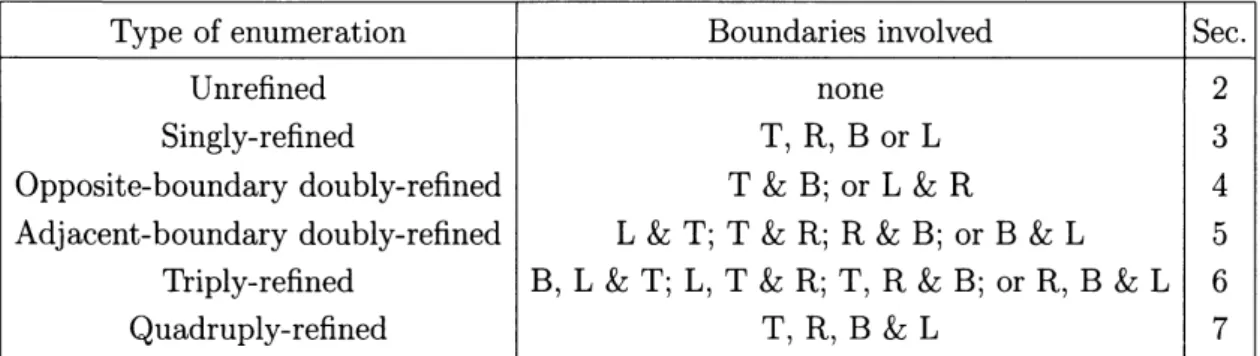
$A’.$It follows from these properties of transposition and rotation ofASMs that, with regards to the boundariesinvolved, there areessentially only six differenttypesofASMenumeration,
aslistedin Table 1, where $T,$ $R,$ $B$ and $L$denote thetop (first) row, right-most (last) column,
bottom (last) row and left-most (first) column, respectively. The sections of the paper in which these types of enumeration are considered are also listed in Table 1.
TABLE 1. Categorization ofASM enumeration according to the boundaries involved.
VariousASM generatingfunctionsinvolving thestatistics of (2) and (3) willnowbe intro-duced. Each of these generating functions will be labelledby a particulartype of boundary refinement, as described in Table 1. In addition to being associated with certain boundary statistics from (3), corresponding tothe boundaryrefinement label, each generatingfunction
will also be associated with the two bulk statistics of (2).
For each positive integer $n$, define a quadruply-refined ASM generating function, which
involves all sixstatistics of (2) and (3), and associated indeterminates $x,$ $y,$ $z_{1},$ $z_{2},$ $z_{3}$ and $z_{4},$
as
$Z_{n}^{quad}(x, y;z_{1}, z_{2}, z_{3}, z_{4})= \sum_{A\in ASM(n)}x^{\nu(A)}y^{\mu(A)}z_{1}^{\rho_{T}(A)}z_{2}^{\rho_{R}(A)}z_{3}^{\rho_{B}(A)}z_{4}^{\rho_{L}(A)}$. (5)
Therefore, $Z_{n}^{quad}(x, y;z_{1}, z_{2}, z_{3}, z_{4})$ is a polynomial in $x,$ $y,$ $z_{1},$ $z_{2},$ $z_{3}$ and $z_{4}$, in which, for
any nonnegative integers $p,$ $m,$ $k_{1},$ $k_{2},$ $k_{3}$ and $k_{4}$, the coeficient of$x^{p}y^{m}z_{1}^{k_{1}}z_{2}^{k_{2}}z_{3}^{k_{3}}z_{4}^{k_{4}}$ is the
number of$n\cross n$ ASMs $A$ with $\nu(A)=p,$ $\mu(A)=m,$ $\rho_{T}=k_{1},$ $\rho_{R}=k_{2},$ $\rho_{B}=k_{3}$ and $\rho_{L}=k_{4}.$
It also follows that $x$ and $y$ can be regarded as bulk parameters or weights, that $z_{1},$ $z_{2},$ $z_{3}$
and $z_{4}$ can be regarded as boundary parameters or weights, and $(see$ Behrend $[’i, Eq.$ (5)])
that $Z_{n}^{quad}(x, y;z_{1}, z_{2}, z_{3}, z_{4})$ has degree $\frac{n(n-1)}{2}$ in $x$, degree $\lfloor\frac{(n-1)^{2}}{4}\rfloor$ in
$y$, and degree $n-1$ in
Examples of the quadruply-refined ASM generating function (5), for $n=1$,2, 3, are
$Z_{1}^{quad}(x, y;z_{1}, z_{2}, z_{3}, z_{4})=1,$
$Z_{2}^{quad}(x, y;z_{1}, z_{2}, z_{3}, z_{4})=1+xz_{1}z_{2}z_{3}z_{4},$
$Z_{3}^{quad}(x, y;z_{1}, z_{2}, z_{3}, z_{4})=1+xz_{1}z_{4}+xz_{2}z_{3}+x^{2}z_{1}z_{2}z_{3}^{2}z_{4}^{2}+x^{2}z_{1}^{2}z_{2}^{2}z_{3}z_{4}+$
$x^{3}z_{1}^{2}z_{2}^{2}z_{3}^{2}z_{4}^{2}+xyz_{1}z_{2}z_{3}z_{4}$, (6)
where the terms are written in orders which correspond to those used in (1).
Riply-refined, adjacent-boundary doubly-refined, opposite-boundary doubly-refined, sing-ly-refined and unrefined ASM generating functions can now be defined as, respectively,
$Z_{n}^{tri}(x, y;z_{1}, z_{2}, z_{3})=Z_{n}^{quad}(x, y;z_{1},1, z_{2}, z_{3})=\sum_{A\in ASM(n)}x^{v(A)}y^{\mu(A)}z_{1}^{\rho_{T}(A)}z_{2}^{\rho_{B}(A)}z_{3}^{\rho_{L}(A)},$
$Z_{n}^{adj}(x, y;z_{1}, z_{2})=Z_{n}^{quad}(x, y;z_{1},1,1, z_{2})= \sum_{A\in ASM(n)}x^{v(A)}y^{\mu(A)}z_{1}^{\rho_{T}(A)}z_{2}^{\rho_{L}(A)},$
$Z_{n}^{opp}(x, y;z_{1}, z_{2})=Z_{n}^{quad}(x, y;z_{1},1, z_{2},1)= \sum_{A\in ASM(n)}x^{v(A)}y^{\mu(A)}z_{1}^{\rho_{T}(A)}z_{2}^{\rho B(A)},$
$Z_{n}(x, y;z)=Z_{n}^{quad}(x, y;z, 1,1,1)= \sum_{A\in ASM(n)}x^{v(A)}y^{\mu(A)}z^{\rho_{T}(A)},$
$Z_{n}(x, y)=Z_{n}^{quad}(x, y;1,1,1,1)= \sum_{A\in ASM(n)}x^{\nu(A)}y^{\mu(A)}$, (7)
where $z$ is a further indeterminate.
Finally, alternative quadruply-refined and alternative adjacent-boundary doubly-refined ASM generating functions are defined as, respectively,
$\tilde{Z}_{n}^{quad}(x, y;z_{1}, z_{2}, z_{3}, z_{4})=(z_{2}z_{4})^{n-1}Z_{n}^{quad}(x, y;z_{1}, \frac{1}{z_{2}}, z_{3}, \frac{1}{z_{4}})$
$= \sum_{A\in ASM(n)}x^{v(A)}y^{\mu(A)}z_{1}^{\rho_{T}(A)}z_{2}^{n-\rho R(A)-1}z_{3}^{\rho_{B}(A)}z_{4}^{n-\rho L(A)-1}$
$\tilde{Z}_{n}^{adj}(x, y;z_{1}, z_{2})=Z_{n}^{quad}(x, y;z_{1}, z_{2},1,1)=\sum_{A\in ASM(n)}x^{\nu(A)}y^{\mu(A)}z_{1}^{\rho_{T}(A)}z_{2}^{\rho_{R}(A)}$. (8)
Note that $\tilde{Z}_{n}^{quad}(x, y;z_{1}, z_{2}, z_{3}, z_{4})$ is a generating function in which the positions of the $1$’s
in the first and last columns of an ASM are measured relative to the opposite ends of the columns to those usedin (3) and (4), i.e., inthisgenerating function, the statistics associated
with$z_{2}$ and $z_{4}$ are, respectively, the numbersof$0$’s above the 1 in the right-most column, and
below the 1 in the left-most column of an ASM. Due to certain differences in the symmetry
properties of the quadruply-refined and alternative quadruply-refined ASM generating
func-tions $Z_{n}^{quad}(x, y;z_{1}, z_{2}, z_{3}, z_{4})$ and $\tilde{Z}_{n}^{quad}(x, y;z_{1}, z_{2}, z_{3}, z_{4})$ (see Behrend [1,
Eq. (12), first 4 lines it will be more convenient to use the former function for the case in which $x$ and $y$
are arbitrary, and the latter function forthe case $x=y=1.$
It follows fromthe properties of90$\circ$
rotation ofASMsthat the adjacent-boundary
doubly-refined and alternative adjacent-boundarydoubly-refined ASM generatingfunctions are re-lated by
It will sometimes be convenient to refer to the boundary parameter coefficients in the singly-refined ASM generating function. These will be denoted
$Z_{n}(x, y)_{k}=$ coefficient of$z^{k}$ in
$Z_{n}(x, y;z)$. (10)
It follows that $Z_{n}(x, y)_{k}= \sum_{A\in ASM(n)}x^{\nu(A)}y^{\mu(A)}$ for $0\leq k\leq n-1$, and that
$Z_{n}(x, y)= \sum_{k=0}^{n-1}Z_{n}(x, y)_{k}$. (11)
When considering ASM enumeration with $x=y=1$, it will be useful to refer to certain numbers of ASMs, in addition to the ASM generating functions. In particular, adjacent-boundary doubly-refined, opposite-adjacent-boundary doubly-refined, singly-refined and unrefined
ASM
numbersare
defined as, respectively,$\mathcal{A}_{n,k_{1},k_{2}}^{adj}=|\{A\in ASM(n)|A_{1,k_{1}+1}=A_{k_{2}+1,1}=1$
$\mathcal{A}_{n,k_{1},k_{2}}^{opp}=|\{A\in ASM(n)|A_{1,k_{1}+1}=A_{n,n-k_{2}}=1$
$\mathcal{A}_{n,k}=|\{A\in ASM(n)|A_{1,k+1}=1$
$\mathcal{A}_{n}=|ASM(n)|$, (12)
for $0\leq k,$$k_{1},$$k_{2}\leq n-1$, with the numbers being $0$ for $k,$ $k_{1}$ or $k_{2}$ outside this range. These
numbers are therefore related to functions of (7)$-(10)$ by $Z_{n}^{adj}(1,1, z_{1}, z_{2})= \sum_{k_{1},k_{2}=0}^{n-1}\mathcal{A}_{n,k_{1)}k_{2}}^{adj}z_{1}^{k_{1}}z_{2}^{k_{2}},$
$\tilde{Z}_{n}^{adj}(1,1, z_{1}, z_{2})=\sum_{k_{1},k_{2}=0}^{n-1}\mathcal{A}_{n,n-1-k_{1},n-1-k_{2}}^{adj}z_{1}^{k_{1}}z_{2}^{k_{2}},$
$Z_{n}^{opp}(1,1; z_{1}, z_{2})=\sum_{k_{1},k_{2}=0}^{n-1}\mathcal{A}_{n,k_{1)}k_{2}}^{opp}z_{1}^{k_{1}}z_{2}^{k_{2}},$
$Z_{n}(1,1;z)= \sum_{k=0}^{n-1}\mathcal{A}_{n,k}z^{k}, Z_{n}(1,1)_{k}=\mathcal{A}_{n,k}, Z_{n}(1,1)=\mathcal{A}_{n}$. (13)
Various simple identities satisfied by the functions (5)$-(10)$ and the numbers (12) can be obtained fromtheir definitions, andby considering the properties oftranspositionorrotation
of ASMs, the properties ofASMs with a 1 as a corner entry, or the properties ofASMs in which aboundary 1 is separated fromacorner byasinglezero. Summaries of such identities, and their derivations, are given by Behrend Secs. 2.$2$
&
3.3].1.3. Structure of the paper. The structure of the remaining sections of this paper will now be outlined. Theprimary currently-known results forunrefined, singly-refined,
opposite-boundary doubly-refined, adjacent-boundary doubly-refined, triply-refined and quadruply-refinedexact enumerationofASMs of arbitraryfixedsizearereviewed inSections 2, 3, .. ., 7,
respectively, as also indicated in Table 1. Hence, these sections are structured according to
which boundary statistics of (3) are included in the enumeration.
Each of the main sections is then divided into two subsections, with Sections 2.1, 3.1,
. . . , 7.1 concerned with enumeration which involves both of the bulk statistics of (2), i.e., in which the bulk parameters $x$ and $y$ are both arbitrary, and Sections 2.2, 3. .
.
., 7 concerned with enumeration which does not involve either of the bulk statistics of (2), i.e.,Some currently-known results which do not fall into this scheme are mentioned briefly in
the final Section 8.
It might seem that any result in Sections 2-6 could be obtained from a result in Section 7 by setting appropriate boundary parameters to 1, and that any result in Sections 1, 3.1,
. . . , 7.1 could be obtained from a result in Sections $\underline{\rangle}.2$
, 3.2, . . . , 7.2, respectively, by setting
thebulk parameters$x$ and$y$to 1. Unfortunately, however, only some derivations of this type
are currently known. For example, derivations of (21), (22), $(\underline{\rangle}8)$, (34), $(3^{-}\vee)$), (42) and (43)
inwhich boundary parameters are set to 1 in (46) are given by Behrend [2, Sec. 4.2]. On the other hand, for many of the results in Sections 2.2, 3.2, . .. , 7.2, derivations which involve setting $x$ and $y$ to 1 in results of Sections 2.1, 3.1, . . ., 7.1 are not currently known. For
all of the results in this paper, references to the currently-published proofs are given, so by
followingthese, thederivationsinwhich parameters in a moregeneralresultareset to1 could
be identified. Some derivations of this type are also identified explicitly in the subsequent
sections.
Finally, note that, in the subsequent sections, many of the identities willbe valid only for
all $n\geq 2$, or for all $n\geq 3$, where $n$ denotes the size of the associated ASMs. This will often
be due totheir containing terms $($such $as Z_{n-1}(x, y)$ or $Z_{n-2}(x, y)$) which are not defined if$n$
is taken to be 1 or 2.
2. UNREFINED ENUMERATION
2.1. Arbitrary bulk parameters. It was shown by Behrend, Di Francesco and Zinn-Justin Eq. (29)
&
Props. 1-3] that the unrefined ASM generating function is given bythe determinant formula
$Z_{n}(x, y)=0\leq i,j\leq n-1\det(K_{n}(x, y)_{ij})$, (14)
where
$K_{n}(x, y)_{ij}=- \delta_{i,j+1}+\sum_{k0}^{\min_{=}(i,j+1)}(\begin{array}{l}i-1i-k\end{array})(\begin{array}{l}j+1k\end{array})x^{k}y^{i-k}$. (15) For alternative versions of (14), involving transformations of the matrix $K_{n}(x, y)$, and
related to formulae of Colomo and Pronko [$\downarrow 0$, Eqs. (23)
&
(24)], $[$11, Eqs. $(4.3)-(4.7)],$Lalonde [$2\aleph$, Thm. 3.1] and Mills, Robbins and Rumsey $[3(\rangle$, p. 346], see Behrend, Di
Francesco and Zinn-Justin Eqs. (28), (65)
&
(66)].An alternative method for obtaining $Z_{n}(x, y)$, involving a recursive approach, will be
described in Section 3.1.
2.2. Bulk parameters $x=y=1$
.
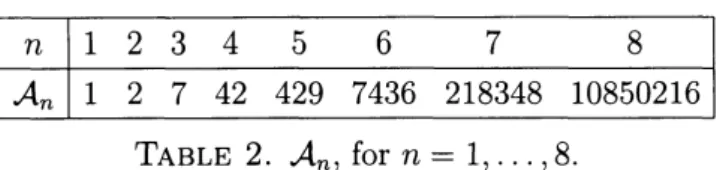
An explicit formula for the number of$n\cross n$ ASMs is$\mathcal{A}_{n}=\prod_{i=0}^{n-1}\frac{(3i+1)!}{(n+i)!}$. (16) These numbers, for $n=1$,. . . ,8, are given in Table 2.
Theproduct formula (16) was conjecturedbyMills, Robbins and Rumsey $[_{\sim^{J(}}t,$ $3$ Conj. 1],
and first proved by Zeilberger $[,3s]$ and, shortly thereafter, but using a different method, by
TABLE 2. $\mathcal{A}_{n}$, for $n=1$, . . . ,8.
Setting $x=y=1$ in (14) gives the determinant formula
$\mathcal{A}_{n}=\det(-\delta_{i,j+1}+0\leq i,j\leq n-1(\begin{array}{l}i+ji\end{array}))$, (17)
as also obtained by Gessel and Xin Rem. 5.2]. Alternative determinantal formulae for $\mathcal{A}_{n}$ can be obtained by setting $x=y=1$ in the alternative versions of (14) mentioned in Section }.
It was shown by Okada , Thm. 1.2 (A1)] that
$\mathcal{A}_{n}=3^{-n(n-1)/2}$ $\cross$
(number
ofsemistandard Young tableaux ofshape$(n-1, n-1, \ldots, 2,2,1,1)$ with entries from
{1,
. . . ,$2n$ (18)The equality between the RHS of (16) and the RHS of (18) can be obtained directly using the hook-content formula for semistandard Young tableaux.
3. SINGLY-REFINED ENUMERATION
3.1. Arbitrary bulk parameters. It was shown by Behrend, Di Francesco and
Zinn-Justin Eq. (74), Props. $4-6$
&
Eqs. (97)&
(98)] that the singly-refined ASM generatingfunction is given by the determinant formula
$Z_{n}(x, y;z)=0\leq i,j\leq n-1\det(K_{n}(x, y;z)_{ij})$, (19)
where
$K_{n}(x, y;z)_{ij}=-\delta_{i,j+1}+\{\begin{array}{ll}\sum_{k=0}^{\min(i,j+1)}[Matrix][Matrix] x^{k}y^{i-k}, j\leq n-2,\sum_{k=0}^{i}\sum_{l=0}^{k}[Matrix][Matrix] x^{k}y^{i-k_{Z}l}, j=n-1.\end{array}$ (20)
For alternative versions of (19), involving transformations of the matrix $K_{n}(x, y;z)$, and
related to formulae of Lalonde [$tJ*$, Thm. 3.1] and Mills, Robbins and Rumsey [ p. 346],
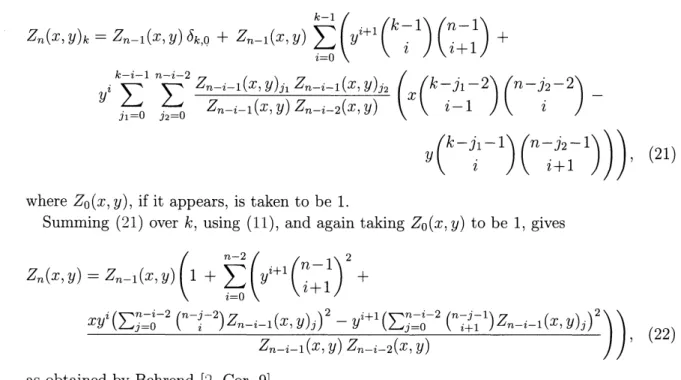
It was shown by Behrend [2, Cor. 8] that the boundary parameter coefficients in the singly-refined ASM generating function, as defined in (10), satisfy
$Z_{n}(x, y)_{k}=Z_{n-1}(x, y) \delta_{k,0}+Z_{n-1}(x, y)\sum_{i=0}^{k-1}(y^{i+1}(\begin{array}{l}k-1i\end{array})(\begin{array}{l}n-1i+1\end{array})+$
$y^{i} \sum_{j_{1}=0}^{k-i-1}\sum_{j_{2}=0}^{n-i-2}\frac{Z_{n-i-1}(x,y)_{j_{1}}Z_{n-i-1}(x,y)_{j_{2}}}{Z_{n-i-1}(x,y)Z_{n-i-2}(x,y)}(x(\begin{array}{l}k-j_{1}-2i-1\end{array})(\begin{array}{l}n-j_{2}-2i\end{array})-$
$y(\begin{array}{l}k-j_{1}-1i\end{array})(\begin{array}{l}n-j_{2}-1i+1\end{array})))$ , (21) where $Z_{0}(x, y)$, if it appears, is taken to be 1.
Summing (21) over $k$, using $(1 and$ again taking $Z_{0}(x, y)$ to be 1, gives
$Z_{n}(x, y)=Z_{n-1}(x, y)(1+ \sum_{i=0}^{n-2}(y^{i+1}(\begin{array}{l}n-1i+1\end{array})+$
$\frac{xy^{i}(\sum_{j=0}^{n-i-2}(\begin{array}{l}n-j-2i\end{array})Z_{n-i-1}(x,y)_{j})^{2}-y^{i+1}(\sum_{j=0}^{n-i-2}(\begin{array}{l}n-j-1i+1\end{array})Z_{n-i-1}(x,y)_{j})^{2}}{Z_{n-i-1}(x,y)Z_{n-i-2}(x,y)}))$, (22)
as obtained by Behrend [2, Cor. 9].
It can be seen that (21) and (22) give $Z_{n}(x, y)_{k}$ and $Z_{n}(x, y)$ in terms of $Z_{i}(x, y)_{k}$ and
$Z_{i}(x, y)$ for$i=1$, . . . ,$n-1$,thereby enablingthesingly-refinedand unrefinedASMgenerating
functions to be computed recursively, and providing an alternative method to that ofusing the determinantal formulae (14) and (i9).
3.2. Bulk parameters $x=y=1$
.
Anexplicit formula forthe singly-refined ASM numbersis
$\mathcal{A}_{n,k}=\{\begin{array}{ll}\frac{(n+k-1)’(2n-k-2)!}{k!(n-k-1)!(2n-2)}\prod_{i=0}^{n-2}\frac{(3i+1)!}{(n+i-1)!}, 0\leq k\leq n-1,0, otherwise.\end{array}$ (23)
Examples ofthese numbers, for $n=1$, . . . ,5, are given in Table 3.
The formula (23)
was
first proved by Zeilberger and confirms the validity of conjec-tures ofMills, Robbins and Rumsey 3 Conj. 2]. Alternative proofs of (23) have beengiven by Colomo and Pronko [$l/\cdot I$, Sec. 5.3], [$1_{\backslash }^{-})$
, Sec. 4.2], Fischer [I9], and Stroganov
Sec. 4]. See also Razumov and Stroganov [$\backslash )Z$, Sec. 2], [
$)J$, Sec. 2] for additional details
related to the third of these proofs.
The singly-refined ASM generating function at $x=y=1$ can be written explicitly us-ing (23) and the fourth equation of (13). Alternatively, it was observed by Colomo and Pronko [12, Eq. (2.16)], [14, Eq. (5.43)], [$1_{:)}^{r}$, Eq. (4.19)] that it can be expressed in terms
ofthe Gaussian hypergeometric function as
$Z_{n}(1,1;z)=\mathcal{A}_{n-1}{}_{2}F_{1}[^{1_{2^{-}-}n_{2n}n};z]$ (24)
Variousfurther expressions for $Z_{n}(1,1;z)$ canbe obtained by setting all but oneboundary
parameter to 1 in certain subsequent formulae, such as (33), for ASM generating functions
at $x=y=1.$
4. $0$PPOSITE BOUNDARY DOUBLY-REFINED ENUMERATION
4.1. Arbitrary bulk parameters. It was shown by Behrend, Di Francesco and
Zinn-Justin [4, Eqs. (21)
&
(22)] that the opposite-boundary doubly-refined ASM generating function is given by thedeterminant formula$Z_{n}^{opp}(x, y;z_{1}, z_{2})=0\leq i,j\leq n-1\det(K_{n}(x, y;z_{1}, z_{2})_{ij})$, (25)
where
$K_{n}(x, y;z_{1}, z_{2})_{ij}=$
$-\delta_{i,j+1}+\{\begin{array}{ll}\sum_{k0}^{\min_{=}(i,j+1)}[Matrix][Matrix] x^{k}y^{i-k}, j\leq n-3,\sum_{k=0}^{i}\sum_{l=0}^{k}[Matrix][Matrix] x^{k}y^{i-k}z_{2}^{l+1}, j=n-2, (26)\sum_{k=0}^{i}\sum_{l=0}^{k}\sum_{m=0}^{l}[Matrix][Matrix] x^{k}y^{i-k}z_{1}^{m}z_{2}^{l-m}, j=n-1.\end{array}$
Note that $K_{n}(x, y;z, 1)=K_{n}(x, y;z)$ and $K_{n}(x, y;1,1)=K_{n}(x, y)$ $($with $K_{n}(x, y;z)$ and
$K_{n}(x, y)$ defined in (20) and (15), respectively), and that setting $z_{2}=1$ or $z_{1}=z_{2}=1$
in (25) gives (19) or (14), respectively.
Foranalternative version of (25), involving atransformation of the matrix$K_{n}(x, y;z_{1}, z_{2})$,
see Behrend, Di Francesco and Zinn-Justin [I, Eqs. (65)
&
(66)].The opposite-boundary doubly-refined ASM generating function satisfies
$(Z_{1}-z_{2})(Z_{3}-z_{4})Z_{n}^{opp}(x, y|z_{1}, z_{2})Z_{n}^{opp}(x, y|z_{3},z_{4})-$
$(Z_{1}-z_{3})(Z_{2}-z_{4})Z_{n}^{opp}(x, y|z_{1}, z_{3})Z_{n}^{opp}(x, y|z_{2},z_{4})+$
and it can be expressed in terms of singly-refined and unrefined ASM generating functions as
$(z_{1}-z_{2})Z_{n}^{opp}(x, y;z_{1}, z_{2})Z_{n-1}(x, y)=(z_{1}-1)z_{2}Z_{n}(x,y;z_{1})Z_{n-1}(x, y;z_{2})-$
$z_{1}(z_{2}-1)Z_{n-1}(x, y;z_{1})Z_{n}(x, y;z_{2})$. (28)
Theidentities (27) and (28) areessentially equivalent, asdiscussed byBehrend, Di Francesco
and Zinn-Justin [4, p. 415] or Behrend [2, pp. 459-460].
A result which is equivalent to (28) with
$x=y=1$
was obtained by Stroganov $[3(_{\}}^{\backslash },$ Eq. (34)], and a result which is equivalent to (28) with arbitrary $x$ and $y$ was obtained by Colomo and Pronko [$t3$, Eq. (5.32)], [$1\check{o}$, Eq. (3.32)].Alternative proofsof (27) and (28) have
been given by Behrend, Di Francesco and Zinn-Justin [1, Sec. 5], and Behrend Cor. 5, or
Eqs. (72)
&
(73) with $m=2,$ $k_{1}=1,$ $k_{2}=n$].4.2. Bulk parameters
$x=y=1$
.
It was shown by Stroganov $[\backslash \ranglet\{\grave{},$, Eq. (34)]that the opposite-boundary doubly-refined, singly-refined and unrefined ASM numbers satisfy $(\mathcal{A}_{n,k_{1}-1,k_{2}}^{opp}-\mathcal{A}_{n,k_{1},k_{2}-1}^{opp})\mathcal{A}_{n-1}=\mathcal{A}_{n,k_{1}-1}\mathcal{A}_{n-1,k_{2}-1}-\mathcal{A}_{n,k_{1}}\mathcal{A}_{n-1,k_{2}-1}-$
$\mathcal{A}_{n-1,k_{1}-1}\mathcal{A}_{n,k_{2}-1}+\mathcal{A}_{n-1,k_{1}-1}\mathcal{A}_{n,k_{2}}$. (29)
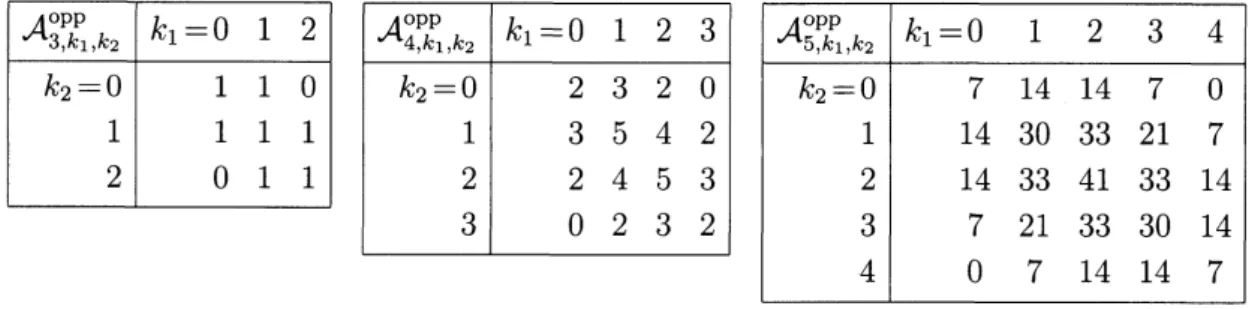
Examples ofopposite-boundary doubly-refined ASM numbers, for $n=3$, 4, 5, are given in
Table 4.
TABLE 4. $\mathcal{A}_{n,k_{1},k_{2}}^{opp}$, for $n=3$,4, 5 and $k_{1},$$k_{2}=0$,. . . ,$n-1.$
It can be seen, using (13), that (29) is equivalent to (L8) at $x=y=1$ , i.e., to
$(z_{1}-z_{2})Z_{n}^{opp}(1,1;z_{1}, z_{2})\mathcal{A}_{n-1}=(z_{1}-1)z_{2}Z_{n}(1,1;z_{1})Z_{n-1}(1,1;z_{2})-$
$z_{1}(z_{2}-1)Z_{n-1}(1,1;z_{1})Z_{n}(1,1;z_{2})$. (30)
The relation (29) can easily be solved for the opposite-boundary doubly-refined ASM
numbers, giving
$\mathcal{A}_{n,k_{1},k_{2}}^{opp}=\frac{1}{\mathcal{A}_{n-1}}\sum_{i=0}^{\min(k_{1},n-k_{2}-1)}(\mathcal{A}_{n,k_{1}-i}\mathcal{A}_{n-1,k_{2}+i}+\mathcal{A}_{n-1,k_{1}-i-1}\mathcal{A}_{n,k_{2}+i}-$
$\mathcal{A}_{n,k_{1}-i-1}\mathcal{A}_{n-1,k_{2}+i}-\mathcal{A}_{n-1,k_{1}-i-1}\mathcal{A}_{n,k_{2}+i+1})$. (31)
It was shown by Biane, Cantini and Sportiello [$rJ$, Thm. 1] that the opposite-boundary
doubly-refined and unrefined ASM numbers also satisfy
$0\leq k_{1)}k_{2}\leq n-1\det(\mathcal{A}_{n,k_{1_{\rangle}}k_{2}}^{opp})=(-1)^{n(n+1)/2+1}(\mathcal{A}_{n-1})^{n-3}$. (32)
The opposite-boundary doubly-refined ASM generating function $Z_{n}^{opp}(1,1;z_{1}, z_{2})$ can be
computed using (30) or (31), together with (13), (16) and (23).
This function can also be expressed as
$Z_{n}^{opp}(1,1;z_{1}, z_{2})=3^{-n(n-1)/2}(q^{2}(z_{1}+q)(z_{2}+q))^{n-1}\cross$
$s_{(n-1,n-1,\ldots,2,2,1,1)}( \frac{qz_{1}+1}{z_{1}+q}, \frac{qz_{2}+1}{z_{2}+q},1_{\tilde{2n-2}},1)|_{q=e^{\pm 2\pi i/3}}$, (33)
where $s_{(n-1,n-1,\ldots,2,2,1,1)}$$( \frac{qz_{1}+1}{z_{1}+q}, \frac{qz_{2}+1}{z_{2}+q},1, \ldots, 1)$ is the Schur function indexed by the double-staircase partition $(n-1, n-1, \ldots, 2,2,1,1)$, evaluated at the $2n$ parameters $\frac{qz_{1}+1}{z_{1}+q},$ $\frac{qz_{2}+1}{z_{2}+q},$
1, . . . ,1. The expression (33) was obtained by Di Francesco and Zinn-Justin [18, Eqs. (2.2)
&
(2.4)], using aresult of Okada I, Thm. 2.4(1), second equation].Finally, it should be noted that certain further expressions for the ASM numbers or
ASM generating functions of Sections 2.2, 3.2 and 4.2, i.e., $\mathcal{A}_{n},$ $\mathcal{A}_{n,k},$ $Z_{n}(1,1;z)$, $\mathcal{A}_{n,k_{1},k_{2}}^{opp}$
or $Z_{n}^{opp}(1,1;z_{1}, z_{2})$, follow from results obtained in the context of totally symmetric
self-complementaryplanepartitions, together witharesultof Fonseca and Zinn-Justin $[’k$],Thm.]
that $Z_{n}^{opp}(1,1;z_{1}, z_{2})$ is equal toacertain doubly-refined generatingfor such planepartitions.
For example, for $\mathcal{A}_{n},$ $Z_{n}(1,1;z)$ or $Z_{n}^{opp}(1,1;z_{1}, z_{2})$, Pfaffian expressions follow from results
of Ishikawa [$21$, Thms. 1.$2$
&
1.4,&
Sec. 7] and Stembridge [$\backslash i_{(\}}^{r}$, Thm. 8.3], constant-term
expressions follow from results of Ishikawa [24, Sec. 8], Krattenthaler Thm.] and
Zeil-berger [37], [$\backslash {\}\aleph$
, Sublems. 1.$1$
&
1.2], and integralexpressions (which caneasilybe convertedto constant-term expressions) follow from results of Fonseca and Zinn-Justin $[_{\sim}\rangle 1$, Eqs. (4.9)
&
(4.14)] and Zinn-Justin and Di Francesco [$4_{-}^{\backslash }\rangle$, Eqs. (37)
&
(39)]. Note that someof theseresults are expressed in terms ofcertain triangles ofpositive integers (specifically, monotone or Gog triangles for ASMs, and Magog triangles for totally symmetric self-complementary
plane partitions), or closely related integer arrays. Also, many such results are stated in more general forms, which involve certain entries of such arrays being prescribed to take certain values, or being bounded by certain values.
5. ADJACENT BOUNDARY DOUBLY-REFINED ENUMERATION
5.1. Arbitrary bulk parameters. Itwas shown by Behrend [2, Cor. 3] thatthe
adjacent-boundary doubly-refined and alternative adjacent-adjacent-boundary doubly-refined ASM generating functions satisfy the recursion relations
$(z_{1}-1)(z_{2}-1)Z_{n}^{adj}(x, y;z_{1}, z_{2})Z_{n-2}(x, y)=yz_{1}z_{2}Z_{n-1}^{adj}(x, y;z_{1}, z_{2})Z_{n-1}(x, y)+$
$(x(z_{1}-1)(z_{2}-1)-y)z_{1}z_{2}Z_{n-1}(x, y;z_{1})Z_{n-1}(x, y;z_{2})+$
$(z_{1}-1)(z_{2}-1)Z_{n-1}(x, y)Z_{n-2}(x, y)$, (34)
$(z_{1}-1)(z_{2}-1)\tilde{Z}_{n}^{adj}(x, y;z_{1}, z_{2})Z_{n-2}(x, y)=yz_{1}z_{2}\tilde{Z}_{n-1}^{adj}(x, y;z_{1}, z_{2})Z_{n-1}(x, y)+$
$((z_{1}-1)(z_{2}-1)-yz_{1}z_{2})Z_{n-1}(x, y;z_{1})Z_{n-1}(x, y;z_{2})+$
$(z_{1}-1)(z_{2}-1)(xz_{1}z_{2})^{n-1}Z_{n-1}(x, y)Z_{n-2}(x, y)$. (35)
If $Z_{0}(x, y)$ is taken to be 1, then (34) and (35) hold for all $n\geq 2.$
Itwas also shownby Behrend [2, Cor. 6] that (34) and $(\backslash 3_{\dot{c}\supset}’)$ canbesolved forthe adjacent-boundary doubly-refined ASM generating functions, giving
$Z_{n}^{adj}(x, y;z_{1}, z_{2})=Z_{n-1}(x, y)(1+ \sum_{i=1}^{n-1}(\frac{yz_{1}z_{2}}{(z_{1}-1)(z_{2}-1)})^{n-i}\cross$
$(1+ \frac{(x(z_{1}-1)(z_{2}-1)-y)Z_{i}(x,y;z_{1})Z_{i}(x,y;z_{2})}{yZ_{i-1}(x,y)Z_{i}(x,y)}))$, (36)
$\tilde{Z}_{n}^{adj}(x, y;z_{1}, z_{2})=Z_{n-1}(x, y)((xz_{1}z_{2})^{n-1}+\sum_{i=1}^{n-1}(\frac{y}{(z_{1}-1)(z_{2}-1)})^{n-i}\cross$
$(x^{i-1}(z_{1}z_{2})^{n-1}+ \frac{(z_{1}z_{2})^{n-i-1}((z_{1}-1)(z_{2}-1)-yz_{1}z_{2})Z_{i}(x,y;z_{1})Z_{i}(x,y;z_{2})}{yZ_{i-1}(x,y)Z_{i}(x,y)}))$, (37)
where, in the sums over $i,$ $Z_{0}(x, y)$ is taken to be 1.
Using (36)and (37), or(34) and (35),it followsthat,inadditionto beingrelatedby (9), the adjacent-boundary doubly-refined and alternative adjacent-boundary doubly-refined ASM
generating functions are also related by
$((z_{1}-1)(z_{2}-1)-yz_{1}z_{2})Z_{n}^{adj}(x, y;z_{1}, z_{2})-(x(z_{1}-1)(z_{2}-1)-y)z_{1}z_{2}\tilde{Z}_{n}^{adj}(x, y;z_{1}, z_{2})$
$=(z_{1}-1)(z_{2}-1)(1-(xz_{1}z_{2})^{n})Z_{n-1}(x, y)$, (38)
as shown by Behrend [2, Cor. 7].
Itcan be seen that the adjacent-boundary doubly-refined ASMgeneratingfunctionscanbe
computed using relations from this section, together with themethods given in Sections 2. 1
and 3.1 for obtaining the unrefined and singly-refined ASM generating functions.
5.2. Bulk parameters $x=y=1$
.
Itwas shownby Stroganov $[3(\backslash \}, p.61]$ that the adjacent-boundary doubly-refined, opposite-adjacent-boundary doubly-refined and unrefined ASM numbers satisfy$\mathcal{A}_{n,k_{1}-1,k_{2}}^{adj}+\mathcal{A}_{n,k_{1},k_{2}-1}^{adj}-\mathcal{A}_{n,k_{1},k_{2}}^{adj}=\mathcal{A}_{n,k_{1}-1,n-k_{2}}^{opp}-(\delta_{k_{1},1}-\delta_{k_{1},0})(\delta_{k_{2},1}-\delta_{k_{2},0})\mathcal{A}_{n-1}$. (39) This relation is also a special case ofa formula obtained by Fischer $[_{\sim}^{\rangle}t$
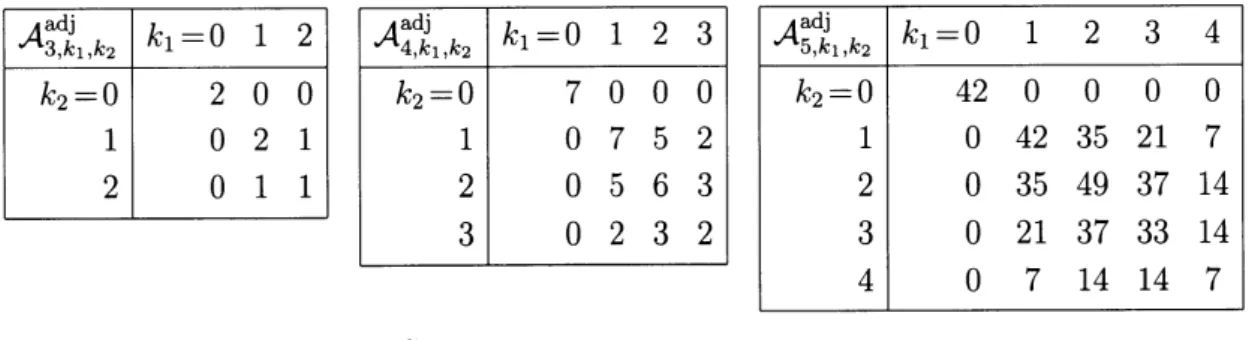
Examples of adjacent-boundary doubly-refined ASM numbers, for$n=3$,4, 5, aregiven in Table 5.
TABLE 5. $\mathcal{A}_{n,k_{1},k_{2}}^{adj}$, for $n=3$,4,5 and $k_{1},$$k_{2}=0$,. . .,$n-1.$
It can be seen, using (13), that (39) is equivalent to a relation satisfied by the
adjacent-boundary and opposite-boundary doubly-refined ASM generating functions at $x=y=1$
and the unrefined ASM numbers, specifically
$(z_{1}+z_{2}-1)Z_{n}^{adj}(1,1;z_{1}, z_{2})= z_{1}z_{2}^{n}Z_{n}^{opp}(1,1;z_{1}, \frac{1}{z_{2}})-(z_{1}-1)(z_{2}-1)\mathcal{A}_{n-1}$. (40)
The relations (i39) or $(4())$ can be solved for the adjacent-boundary doubly-refined ASM
numbers, giving
$\mathcal{A}_{n,k_{1},k_{2}}^{adj}=\{\begin{array}{ll}\mathcal{A}_{n-1}, k_{1}=k_{2}=0,{[}Matrix] \mathcal{A}_{n-1}-\sum_{i=1}^{k_{1}}\sum_{j=1}^{k_{2}}[Matrix] \mathcal{A}_{n,i-1,n-j}^{opp}, 1\leq k_{1}, k_{2}\leq n-1, (41)0, otherwise.\end{array}$
This formula was obtained by Fischer p. 570]. See also Ayyer and Romik [1, p. 164].
6. TRIPLY-REFINED ENUMERATION
6.1. Arbitrary bulk parameters. It was shown by Behrend Cors. $2$
&
4] that the triply-refined ASM generating function satisfies$(z_{2}-z_{1})(z_{3}-1)Z_{n}^{tri}(x, y;z_{1}, z_{2}, z_{3})Z_{n-2}(x, y)=$
$((z_{2}-1)(z_{3}-1)-yz_{2}z_{3})z_{1}Z_{n-1}^{adj}(x, y;z_{1}, z_{3})Z_{n-1}(x,y;z_{2})-$
$(x(z_{1}-1)(z_{3}-1)-y)z_{1}z_{2}z_{3}\tilde{Z}_{n-1}^{adj}(x, y;z_{2}, z_{3})Z_{n-1}(x, y;z_{1})-$
$(z_{1}-1)(z_{3}-1)z_{2}Z_{n-1}(x, y;z_{2})Z_{n-2}(x, y)+$
and
$y(z_{2}-z_{1})z_{3}Z_{n}^{tri}(x, y;z_{1}, z_{2}, z_{3})Z_{n-1}(x, y)=$
$(z_{1}-1)((z_{2}-1)(z_{3}-1)-yz_{2}z_{3})Z_{n}^{adj}(x, y;z_{1}, z_{3})Z_{n-1}(x, y;z_{2})-$
$(z_{2}-1)(x(z_{1}-1)(z_{3}-1)-y)z_{1}z_{3}\tilde{Z}_{n}^{adj}(x, y;z_{2}, z_{3})Z_{n-1}(x, y;z_{1})-$
$(z_{1}-1)(z_{2}-1)(z_{3}-1)Z_{n-1}(x, y;z_{2})Z_{n-1}(x, y)+$
$(z_{1}-1)(z_{2}-1)(z_{3}-1)z_{1}z_{2}^{n-1}(xz_{3})^{n}Z_{n-1}(x, y;z_{1})Z_{n-1}(x, y)$. (43)
The triply-refined ASM generating function can be computed using either (42) or (43),
together with the methods given in Sections 2.1, 3.1 and 5.1 for obtaining the unrefined,
singly-refined and adjacent-boundary doubly-refined ASM generating functions.
6.2. Bulk parameters $x=y=1$
.
The triply-refinedASMgeneratingfunction at $x=y=1$satisfies
$(z_{1}z_{3}-z_{3}+1)(z_{2}z_{3}-z_{2}+1)z_{3}^{n-1}Z_{n}^{tri}(1,1;z_{1}, z_{2}, \frac{1}{z_{3}})=$
$\frac{z_{1}z_{3}\det_{1\leq i,j\leq 3}(z_{i^{j-1}}(z_{i}-1)^{3-j}Z_{n-j+1}(1,1;z_{i}))}{\mathcal{A}_{n-1}\mathcal{A}_{n-2}\prod_{1\leq i<j\leq 3}(z_{i}-z_{j})}+$
$(z_{2}-1)(z_{3}-1)(z_{1}z_{3}-z_{3}+1)z_{1}z_{2}^{n-1}Z_{n-1}(1,1;z_{1})+$ $(z_{1}-1)(z_{3}-1)(z_{2}z_{3}-z_{2}+1)z_{3}^{n-1}Z_{n-1}(1,1;z_{2})$, (44) and $(z_{1}z_{3}- z_{3}+1)(z_{2}z_{3}-z_{2}+1)z_{3}^{n-1}Z_{n}^{tri}(1,1;z_{1}, z_{2}, \frac{1}{z_{3}})=$ $\frac{z_{1}z_{3}}{\mathcal{A}_{n-2}(z_{1}-z_{2})(z_{3}-1)}((z_{1}z_{3}-z_{1}+1)(z_{1}z_{3}-z_{3}+1)z_{2}Z_{n-1}(1,1;z_{1})Z_{n-1}^{opp}(1,1;z_{2}, z_{3})-$ $(z_{2}z_{3}-z_{2}+1)(z_{2}z_{3}-z_{3}+1)z_{1}Z_{n-1}(1,1;z_{2})Z_{n-1}^{opp}(1,1;z_{1}, z_{3}))+$ (z-1)$(z_{3}-1)(z_{1}z_{3}-z_{3}+1)z_{1}z_{2}^{n-1}Z_{n-1}(1,1;z_{1})+$ (z-1)$(z_{3}-1)(z_{2}z_{3}-z_{2}+1)z_{3}^{n-1}Z_{n-1}(1,1;z_{2})$. (45)
Note that (44) and $(/l5)$ differ only in the first terms on each RHS.
The relation (44) was obtained by Ayyer and Romik [1, Thms. $1$
&
3], with its formincorporating a suggestion of Colomo [9]. An alternative proof of (44) has been given by
Behrend [$f^{\zeta}$, Eqs. (49)
$-(50)$
&
Sec. 5.10]. The relation (4.5) was obtained by Behrend [2, Cor. 11].Itwasshown by Behrend Eqs. (70)& (75)] that the first term ontheRHSof either (44)
or (15) can also be expressed as
$3^{-n(n-1)/2_{Z_{1}Z_{3}}}(-(z_{1}+q)(z_{2}+q)(z_{3}+q))^{n-1}\cross$
where this
uses
thesame
notationas
(33).The triply-refined ASM generating function at
$x=y=1$
can be computed usingei-ther (44) or (45), together with (16) and the methods given in Sections 3.2 and 4.2 for
ob-taining the singly-refined and opposite-boundary doubly-refined ASM generating functions
at $x=y=1.$
It can be
seen
that the identities (30) and (40), satisfied by the doubly-refined ASM generating functions at $x=y=1$ , are specialcases
of (44). More specifically, setting $z_{3}=1$in (44) gives (30), while setting $z_{2}=1$ in (44), and using (30), gives (40).
7. QUADRUPLY-REFINED ENUMERATION
7.1. Arbitrary bulk parameters. It was shown by Behrend [2, Thm. 1] that the
quad-ruply-refined ASM generating function satisfies
$y(z_{4}-z_{2})(z_{1}-z_{3})Z_{n}^{quad}(x, y;z_{1}, z_{2}, Z3, z_{4})Z_{n-2}(x,y)=$
$((z_{1}-1)(z_{2}-1)-yz_{1}z_{2})((z_{3}-1)(z_{4}-1)-yz_{3}z_{4})Z_{n-1}^{adj}(x, y;z_{4}, z_{1})Z_{n-1}^{adj}(x, y;z_{2}, z_{3})-$
$(x(z_{4}-1)(z_{1}-1)-y)(x(z_{2}-1)(z_{3}-1)-y)z_{1}z_{2}z_{3}z_{4}\tilde{Z}_{n-1}^{adj}(x, y;z_{1}, z_{2})\tilde{Z}_{n-1}^{adj}(x, y;z_{3}, z_{4})-$
$(z_{2}-1)(z_{3}-1)((z_{4}-1)(z_{1}-1)-yz_{4}z_{1})Z_{n-1}^{adj}(x, y;z_{4}, z_{1})Z_{n-2}(x, y)+$
$(z_{3}-1)(z_{4}-1)(x(z_{1}-1)(z_{2}-1)-y)z_{1}z_{2}(xz_{3}z_{4})^{n-1}\tilde{Z}_{n-1}^{adj}(x, y;z_{1}, z_{2})Z_{n-2}(x, y)-$
(z-1)$(z_{1}-1)((z_{2}-1)(z_{3}-1)-yz_{2}z_{3})Z_{n-1}^{adj}(x, y;z_{2}, z_{3})Z_{n-2}(x, y)+$ $(z_{1}-1)(z_{2}-1)(x(z_{3}-1)(z_{4}-1)-y)z_{3}z_{4}(xz_{1}z_{2})^{n-1}\tilde{Z}_{n-1}^{adj}(x, y;z_{3}, z_{4})Z_{n-2}(x, y)+$
$(z_{1}-1)(z_{2}-1)(z_{3}-1)(z_{4}-1)(1-(x^{2}z_{1}z_{2}z_{3}z_{4})^{n-1})Z_{n-2}(x, y)^{2}$. (46)
If $Z_{0}(x, y)$ is taken to be 1, then $(4())$ holds for all $n\geq 2.$
It can be seen that (46) enables the quadruply-refined ASM generating function to be obtained recursively. More specifically, $Z_{n}^{quad}(x, y;z_{1}, z_{2}, z_{3}, z_{4})$ can be computed using the
initial conditions (from (6)) $Z_{1}^{quad}(x, y;z_{1}, z_{2}, z_{3}, z_{4})=1$ and $Z_{2}^{quad}(x, y;z_{1}, z_{2}, z_{3}, z_{4})=1+$ $xz_{1}z_{2}z_{3}z_{4}$, together with the definitions (from (7)$-(8)$) $Z_{n}^{adj}(x, y;z_{1}, z_{2})=Z_{n}^{quad}(x,$$y;z_{1},1,$
1,$z_{2})$, $\tilde{Z}_{n}^{adj}(x, y;z_{1}, z_{2})=Z_{n}^{quad}(x, y;z_{1}, z_{2}, 1, 1)$ and $Z_{n}(x, y)=Z_{n}^{quad}(x, y;1, 1, 1, 1)$.
Accordingly, for each $n\geq 3,$ $Z_{n}^{quad}(x, y;z_{1}, z_{2}, z_{3}, z_{4})$ and all of the ASM generating
func-tions of (7) and (8) which are defined in terms of $Z_{n}^{quad}(x, y;z_{1}, z_{2}, z_{3}, z_{4})$ are determined
by (46).
Note, however, that if the generating functions are obtained recursively inthis way, then,
foreach successive $n,$ $Z_{n}^{quad}(x, y;z_{1}, z_{2}, z_{3}, z_{4})$ shouldfirst becomputed forarbitrary $z_{1},$ $z_{2},$ $z_{3},$
and $z_{4}$, with thefactor $(z_{1}-z_{3})(z_{4}-z_{2})$ beingexplicitly cancelled from both sides of (46), so
that divisionbyzerois avoided when boundary parameters needtobe set to 1 insubsequent computations.
Alternatively, thequadruply-refined ASMgeneratingfunctioncanbe computed using (46),
together with the methods given in Sections 2.1 and,5.1 for obtaining the unrefined and
7.2. Bulk parameters
$x=y=1$
.
The alternative quadruply-refined ASM generating function at $x=y=1$ satisfies$(z_{4}z_{1}-z_{4}+1)(z_{1}z_{2}-z_{1}+1)(z_{2}z_{3}-z_{2}+1)(z_{3}z_{4}-z_{3}+1)\tilde{Z}_{n}^{quad}(1,1;z_{1}, z_{2}, z_{3}, z_{4})=$
$\frac{z_{1}z_{2}z_{3}z_{4}\det_{1\leq i,j\leq 4}(z_{i^{j-1}}(z_{i}-1)^{4-j}Z_{n-j+1}(1,1;z_{i}))}{\mathcal{A}_{n-1}\mathcal{A}_{n-2}\mathcal{A}_{n-3}\prod_{1\leq i<j\leq 4}(z_{i}-z_{j})}+$
(z-1)$(z_{3}-1)(z_{4}z_{1}-z_{4}+1)(z_{1}z_{2}-z_{1}+1)(z_{3}z_{4}-z_{3}+1)(z_{2}z_{4})^{n-1}Z_{n-1}^{adj}(1,1; \frac{1}{z_{4}}, z_{1})+$ $(z_{3}-1)(z_{4}-1)( z_{1}z_{2}-z_{1}+1)(z_{2}z_{3}-z_{2}+1)(z_{4}z_{1}-z_{4}+1)(z_{1}z_{3})^{n-1}Z_{n-1}^{adj}(1,1;\frac{1}{z_{1}}, z_{2})+$ $(z_{4}-1)(z_{1}-1)(z_{2}z_{3}-z_{2}+1)(z_{3}z_{4}-z_{3}+1)(z_{1}z_{2}-z_{1}+1)(z_{2}z_{4})^{n-1}Z_{n-1}^{adj}(1,1;\frac{1}{z_{2}}, z_{3})+$ $(z_{1}-1)(z_{2}-1)(z_{3}z_{4}-z_{3}+1)(z_{4} z_{1}-z_{4}+1)(z_{2}z_{3}-z_{2}+1)(z_{1}z_{3})^{n-1}Z_{n-1}^{adj}(1,1;\frac{1}{z_{3}}, z_{4})-$ $(z_{1}-1)(z_{2}-1)(z_{3}-1)(z_{4}-1)((z_{1}z_{2}-z_{1}+1)(z_{3}z_{4}-z_{3}+1)(z_{2}z_{4})^{n-1}+$ $(z_{2}z_{3}-z_{2}+1)(z_{4}z_{1}-z_{4}+1)(z_{1}z_{3})^{n-1})\mathcal{A}_{n-2}$, (47) and $(z_{4}z_{1}-z_{4}+1)(z_{1}z_{2}-z_{1}+1)(z_{2}z_{3}-z_{2}+1)(z_{3}z_{4}-z_{3}+1)\tilde{Z}_{n}^{quad}(1,1;z_{1}, z_{2}, z_{3}, z_{4})=$ $\frac{z_{1}z_{2}z_{3}z_{4}}{\mathcal{A}_{n-2}(z_{1}-z_{3})(z_{2}-z_{4})}\cross$ $((z_{1}z_{2}-z_{1}+1)(z_{1}z_{2}-z_{2}+1)(z_{3}z_{4}-z_{3}+1)(z_{3}z_{4}-z_{4}+1)Z_{n-1}^{opp}(1,1;z_{4}, z_{1})Z_{n-1}^{opp}(1,1;z_{2}, z_{3})-$ $(z_{4}z_{1}-z_{4}+1)(z_{4}z_{1}-z_{1}+1)(z_{2}z_{3}-z_{2}+1)(z_{2}z_{3}-z_{3}+1)Z_{n-1}^{opp}(1,1;z_{1}, z_{2})Z_{n-1}^{opp}(1,1;z_{3}, z_{4}))+$ (z-1)$(z_{3}-1)(z_{4}z_{1}-z_{4}+1)(z_{1}z_{2}-z_{1}+1)(z_{3}z_{4}-z_{3}+1)(z_{2}z_{4})^{n-1}Z_{n-1}^{adj}(1,1; \frac{1}{z4}, z_{1})+$ $(z_{3}-1)(z_{4}-1)(z_{1}z_{2}-z_{1}+1)(z_{2}z_{3}-z_{2}+1)( z_{4}z_{1}-z_{4}+1)(z_{1}z_{3})^{n-1}Z_{n-1}^{adj}(1,1;\frac{1}{z_{1}}, z_{2})+$ $(z_{4}-1)(z_{1}-1)(z_{2}z_{3}-z_{2}+1)(z_{3}z_{4}-z_{3}+1)(z_{1}z_{2}-z_{1}+1)(z_{2}z_{4})^{n-1}Z_{n-1}^{adj}(1,1; \frac{1}{z_{2}}, z_{3})+$ $(z_{1}-1)(z_{2}-1)(z_{3}z_{4}-z_{3}+1)(z_{4}z_{1}-z_{4}+1)(z_{2}z_{3}-z_{2}+1)(z_{1}z_{3})^{n-1}Z_{n-1}^{adj}(1,1; \frac{1}{z_{3}}, z_{4})-$ $(z_{1}-1)(z_{2}-1)(z_{3}-1)(z_{4}-1)((z_{1}z_{2}-z_{1}+1)(z_{3}z_{4}-z_{3}+1)(z_{2}z_{4})^{n-1}+$ $(z_{2}z_{3}-z_{2}+1)(z_{4}z_{1}-z_{4}+1)(z_{1}z_{3})^{n-1})\mathcal{A}_{n-2}$. (48)
Note that (17) and (t8) differ onlyin the first terms on each RHS.
Notealsothat (40) can beusedto replaceadjacent-boundary doubly-refinedASM
generat-ing functions in (47) or(48) by opposite-boundary doubly-refinedASM generatingfunctions.
For example, applying (40) to the last fiveterms on the RHS of $(4\overline{f})$ or (48) gives (z-1)$(z_{3}-1)(z_{4}z_{1}-z_{4}+1)(z_{1}z_{2}-z_{1}+1)( z_{3}z_{4}-z_{3}+1)(z_{2}z_{4})^{n-1}Z_{n-1}^{adj}(1,1;\frac{1}{z_{4}}, z_{1})+$
$(z_{3}-1)(z_{4}-1)(z_{1}z_{2}-z_{1}+1)(z_{2}z_{3}-z_{2}+1)(z_{4} z_{1}-z_{4}+1)(z_{1}z_{3})^{n-1}Z_{n-1}^{adj}(1,1;\frac{1}{z_{1}}, z_{2})+$
$(z_{4}-1)(z_{1}-1)(z_{2}z_{3}-z_{2}+1)(z_{3}z_{4}-z_{3}+1)(z_{1} z_{2}-z_{1}+1)(z_{2}z_{4})^{n-1}Z_{n-1}^{adj}(1,1;\frac{1}{z_{2}}, z_{3})+$
$(z_{1}-1)(z_{2}-1)(z_{3}-1)(z_{4}-1)((z_{1}z_{2}-z_{1}+1)(z_{3}z_{4}-z_{3}+1)(z_{2}z_{4})^{n-1}+$ $(z_{2}z_{3}-z_{2}+1)(z_{4}z_{1}-z_{4}+1)(z_{1}z_{3})^{n-1})\mathcal{A}_{n-2}$ $=(z_{2}-1)(z_{3}-1)(z_{1}z_{2}-z_{1}+1)(z_{3}z_{4}-z_{3}+1)z_{4}z_{1}z_{2}^{n-1}Z_{n-1}^{opp}(1,1;z_{4}, z_{1})+$ $(z_{3}-1)(z_{4}-1)(z_{2}z_{3}-z_{2}+1)(z_{4}z_{1}-z_{4}+1)z_{1}z_{2}z_{3}^{n-1}Z_{n-1}^{opp}(1,1;z_{1}, z_{2})+$ $(z_{4}-1)(z_{1}-1)(z_{3}z_{4}-z_{3}+1)(z_{1}z_{2}-z_{1}+1)z_{2}z_{3}z_{4}^{n-1}Z_{n-1}^{opp}(1,1;z_{2}, z_{3})+$ $(z_{1}-1)(z_{2}-1)(z_{4}z_{1}-z_{4}+1)(z_{2}z_{3}-z_{2}+1)z_{3}z_{4}z_{1}^{n-1}Z_{n-1}^{opp}(1,1;z_{3}, z_{4})+$ $(z_{1}-1)(z_{2}-1)(z_{3}-1)(z_{4}-1)((z_{1}z_{2}-z_{1}+1)(z_{3}z_{4}-z_{3}+1)(z_{2}z_{4})^{n-1}+$ $(z_{2}z_{3}-z_{2}+1)(z_{4}z_{1}-z_{4}+1)(z_{1}z_{3})^{n-1})\mathcal{A}_{n-2}$. (49)
The relation (I7)
was
obtained by Ayyer and Romik [}, Thms. $2$&
3], with its form incorporating a suggestion of Colomo [9]. An alternative proof of (47) has been given byBehrend Eq. (50)
&
Sec. 5.10]. The relation $(\prime 18)$ was obtained by Behrend [2, Cor. 10].Itwasshown byBehrend [2, Eqs. (70)& (75)] that the first termon the RHS ofeither $(\cdot\cdot 47)$
or (48) can also be expressed as
$3^{-n(n-1)/2}q^{4(n-1)}z_{1}z_{2}z_{3}z_{4}((z_{1}+q)\ldots(z_{4}+q))^{n-1}\cross$
$s_{(n-1,n-1,\ldots,2,2,1,1)}( \frac{qz_{1}+1}{z_{1}+q}, \ldots, \frac{qz_{4}+1}{z_{4}+q},1_{\tilde{2n-4}},1)|_{q=e^{\pm 2\pi i/3}},$
where this uses the same notation as (33).
The quadruply-refined ASM generating function at
$x=y=1$
can be computed using either (47) or (48), together with (16) and the methods given in Sections 3.2, 4.2 and 5 for obtaining the singly-refined and doubly-refined ASM generating functions at $x=y=1.$8. FURTHER RESULTS
Various further results for the exact enumeration of ASMs, and involving
some
of the statisticsof and (3), are reviewedor obtained by Behrend Sec. 3]. Thesecases
include the following, where full references to the literature can be obtained using the references to [2] given here.$\bullet$ Results which provide explicit expressions for all of the ASM generating functions of (5) and (7) for thecase $y=0$. See [2, Sec. 3.1].
$\bullet$ Results which provideexplicit expressions for all of the ASM generating functions of (5) and (7) for thecase $y=x+1$ . See [2, Sec. 3.2].
$\bullet$ Results for a certain ASM generating function associated with several rows (or several
columns) ofan ASM. (Thisgeneratingfunctionprovidesacertain generalizationof the
un-refined, singly-refined and opposite-boundary doubly-refinedASM generating functions.)
See Sec. 3.5].
$\bullet$ Results for the enumeration ofASMswith several rows orcolumns closest to two opposite boundaries prescribed. See $[^{く}\sim$), Sec. 3.6].
$\bullet$ Results for $Z_{n}(1,3)$ and $Z_{n}(1,3;z)$. See Sec. 3.7]. $\bullet$ Results for $Z_{n}(1,1;-1)$. See [2, Sec. 3.8].
$\bullet$ Results for $Z_{n}(x, 1)$, i.e., for the enumeration of ASMs with a prescribed number of
generalized inversions. See [2, Sec. 3.9].
$\bullet$ Results for $Z_{n}(1, y)$, i.e., for the enumeration of ASMs with aprescribed number $of-1’ s.$ See [2, Sec. 3.10].
$\bullet$ Results associated with descending plane partitions. See Sec. 3.12].
$\bullet$ Results associated with totally symmetric self-complementary plane partitions. See Sec. 3.13].
$\bullet$ Results associated with fully packed loop configurations and loop models. See $[d$, Sec.
3.14].
$\bullet$ Results for the enumeration of ASMs invariant under symmetry operations. See $[A,$ Sec. 3.15].
REFERENCES
[1] A.Ayyer and D. Romik, New enumerationformulas foralternating sign matrices and square ice partition
functions, Adv. Math. 235 (2013), 161-186,arXiv:1202.3651, doi. $l\vee IR30|(J0\overline{o}_{c}^{r_{)}}$
[2] R. Behrend,Multiply-refined enumerationofalternatingsign matrices,Adv. Math. 245(2013),439-499,
arXiv: 1203.3187,doi. MR30S4435
[3] R. Behrend, P. Di Francesco, and P. Zinn-Justin, On the weighted enumeration of alternating sign
matrices and descending plane partitions, J. Combin. Theory Ser. A119 (2012), no. 2, 331-363,
arXiv:1103. 1176, doi. MIt2S6059S
[4] –, A doubly-refined enumeration ofalternating sign matrices and descending plane partitions, J.
Combin. Theory Ser. A120 (2013), no. 2, 409-432,arXiv:1202. 1520, doi. MR2995049
[5] P. Biane, L. Cantini, and A. Sportiello, Doubly-refined enumeration of alternating sign matrices and
determinants of 2-staircase Schur functions, S\’em. Lothar. Combin. 65 (2010/12), Art. B65f, 25 pp.
(electronic), arXiv:1101. 3427. Mli97100S
[6] D. Bressoud, Proofs and confirmations. the story ofthe alternatingsign matrix conjecture, MAA
Spec-trum, Mathematical Association of America and Cambridge University Press, Washington, DC and Cambridge, 1999. $\backslash _{J}IR17.1.S3’ 0$
[7] –, Exploiting symmetries: alternating-sign matrices and the Weyl character formulas, Surveysin
number theory,Dev. Math., vol. 17, Springer, NewYork, 2008, pp. 43-55. Msj2
[8] D. Bressoud and J. Propp, How the alternatingsign matrix conjecture wassolved, Notices Amer.Math.
Soc. 46 (1999), no.6, 637-646. $MR1691^{r_{\rangle}}62$ [9] F. Colomo, Personal communication, 2012.
[10] F. Colomo and A. Pronko, On some representations ofthe six vertex modelpartitionfunction, Phys.
Lett. A315 (2003), no. 3-4, 231-236,doi. $\lambda IR_{\sim^{l}}’003060$
[11] –, On the partition function ofthe six-vertex model with domain wall boundary conditions, J.
Phys.A37 (2004), no. 6, 1987-2002, arXiv: $math-ph/0309064$, doi. $\backslash IR204590^{n}$
[12] –, On the refined 3-enumeration of alternating sign matrices, Adv. in Appl. Math. 34 (2005),
no.4, 798-811, arxiv:$math-ph/0404045$, doi. $1\backslash ,I1212S99S$
[13] –, On two-point boundary correlations in thesix-vertex model with domain wall boundary
condi-tions, J. Stat. Mech. Theory Exp. (2005), P05010, 21 pp. (electronic), arXiv:$math-ph/05(\rangle 3049$, doi.
[14] –, Square ice, alternating sign matrices, and classical orthogonal polynomials, J. Stat. Mech.
TheoryExp. (2005), P01005, 33pp. (electronic), arXiv:$math-ph/0411076$, doi. MR2114554
[15] –, The role oforthogonal polynomials in the six-vertex model and its combinatorial applications,
J. Phys. A39 (2006),no. 28, 9015-9033,arXiv:$math-ph/0602033$, doi. MR2210471
[16] P. DiFrancesco, Integrable combinatomcs, 2012, preprint,arXiv:1210.4514.
[17] –, Truncateddeterminants and therefinedenumerationofalternating sign matrices and descending
planepartitions, 2012, preprint, arXiv:1212.3006.
[1S] P. Di Francesco and P. Zinn-Justin, Around the Razumov Stroganov conjecture: proof of a
multi-parameter sum rule, Electron. J. Combin. 12 (2005), Research Paper 6, 27 pp. (electronic),
arXiv:$math-ph/0410061$. MR2134169
[19] I. Fischer, A newproofofthe refined alternating sign matrix theorem, J. Combin. TheorySer. A114
(2007), no. 2, 253-264, arxiv:$math/0507270$, doi. $MR2’\underline{)}93090$
[20] –, Linear relations of refinedenumerations ofalternating sign matrices, J. Combin. Theory Ser.
A119 (2012), no. 3, 556-578, arXiv:1008.0527, doi.
[21] T. Fonseca and P. Zinn-Justin, On the doubly refined enumeration of alternating sign $matr\iota ces$ and
totallysymmetricself-complementary planepartitions, Electron. J. Combin. 15 (2008), Research Paper
81, 35 pp. (electronic), arXiv:0803. 1595. MR24 45S
[22] I. Gessel and G. Xin, The generating function ofternary trees and continued fractions, Electron. J.
Combin. 13 (2006), Research Paper 53,48 pp. (electronic), arXiv:$math/0505217.$ J41R2240759
[23] A. Hone, Dodgson condensation, alternating signs and square ice, Philos. Trans. R. Soc. Lond. Ser. $A$
Math. Phys. Eng. Sci. 364 (2006),no. 1849, 3183-3198, doi. $MR23179(|1$
[24] M. Ishikawa, Onrefinedenumerations oftotallysymmetricself-complementary planepartitions I, 2006,
preprint, arXiv:$math/0602068.$
[25] M. Karklinsky and D. Romik,Aformula fora doubly refinedenumeration ofalternating sign matrices,
Adv. in Appl. Math. 45 (2010),no. 1, 28-35, arXiv:0906.3405,doi. $MR^{\underline{\prime)}}628^{-}84$
[26] C. Krattenthaler, Agog-magog conjecture, 1996,
http:$//www$.mat.univie.ac.$at/\sim kratt/artikel/$magog.html.
[27] G. Kuperberg, Another proofof the alternating-sign $matr\iota x$ conjecture, Internat. Math. Res. Notices
(1996), no. 3, 139-150, arXiv:$math/9712207.$ MR1383754
[28] P. Lalonde,$q$-enumeration ofalternating sign matrices with exactly one-1, Discrete Math. 256 (2002),
no. 3, 759-773, LaCIM 2000Conference on Combinatorics, Computer Science and Applications
(Mon-treal, QC), doi. MR1957S7
[29] W.Mills, D.Robbins, andH. Rumsey,Jr., Proof oftheMacdonald conjecture,Invent. Math. 66 (1982),
no. 1,73-87, doi. $MH6_{)}’264^{-},$
[30] –, Alternating sign matrices and descending planepartitions, J.Combin.TheorySer. A34(1983),
no. 3, 340-359,doi. lR700040
[31] S. Okada, Enumeration ofsymmetry classes ofalternating sign matrices and characters of classical
groups, J. Algebraic Combin. 23 (2006),no. 1, 43-69, arXiv:$math/0408234$, doi. MH1221SS49
[32] A. Razumov and Y. Stroganov,
Refined
enumerations ofsome symmetry classes of alternating-signmatmces, Theoret. and Math. Phys. 141 (2004), no. 3, 1609-1630, arXiv: $math-ph/0312071$, doi. $\searrow 1R2141132$
[33] –, A statistical model ofthree colors with boundary conditions ofdomain wall type: functional
equations, Theoret. and Math. Phys. 161 (2009), no. 1, 1325-1339, arXiv:0805.0669, doi. $A\backslash IR2664880$
[34] D. Robbins and H. Rumsey, Jr., Determinants and alternating sign matrices,Adv. in Math. 62 (1986),
no. 2, 169-184,doi. IRS65S37
[35] J. Stembridge, Nonintersecting paths, Pfaffians, and plane partitions, Adv. Math. 83 (1990), no. 1,
[36] Y. Stroganov, Izergin Korepin determinant at a third root of unity, Theoret. and Math. Phys. 146
(2006), no. 1, 53-62, arxiv: $nath-ph/0204042$, doi. $M\aleph^{\underline{\supset}}243403$
[37] D. Zeilberger, A constant term identity featuring the ubiquitous (and mysterious)
Andrews-Mills-Robbins-Rumsey numbers 1, 2, 7, 42, 429,$\cdots$, J. Combin. Theory Ser. A66 (1994), no. 1, 17-27, doi.
$-\vee 1R12732_{t}SS$
[38] –, Proof ofthe alternatingsign matrix conjecture, Electron. J. Combin. 3 (1996),no. 2, Research
Paper 13, 84pp. (electronic), The Foata Festschrift, arXiv:$math/9407211.$ $MR1392/1^{\{}$)$S$
[39] –, Proof ofthe refined alternating sign matrix conjecture, New York J. Math. 2 (1996), 59-68
(electronic), arxiv:$math/9606224.$ $MR13b3^{\vee}99$
[40] –, Dave Robbins’ art ofguessing, Adv. in Appl. Math. 34 (2005),no. 4,939-954, doi. $\fbox{Error::0x0000}\backslash lR21$29005
[41] P. Zinn-Justin, Six-vertex, loop and tiling models: integrability and combinatorics, Lambert Academic
Publishing, 2009, Habilitationthesis, arXiv:0901.0665.
[42] P. Zinn-Justin and P. Di Francesco, Quantum Knizhnik-Zamolodchikovequation, totallysymmetric
self-complementary plane partitions, and alternating-sign matrices, Theoret. and Math. Phys. 154 (2008),
no. 3, 331-348, arxiv:$math-ph/0703015$, doi. $\beta_{\lambda}IR_{\sim}^{J}431^{\prime r_{)}}$)$.4$
R. E. BEHREND, SCHOOL OF MATHEMATICS, CARDIFF UNIVERSITY, CARDIFF, CF244AG, UK