Development of a Cl circulation system through
dechlorination process of PVC wastes along
with simulation and ex-ante LCA
著者
陸 嘉麒
学位授与機関
Tohoku University
博 士 学 位 論 文 要 約
論文題目
Development of a Cl circulation system through
dechlorination process of PVC wastes along
with simulation and ex-ante LCA
(
廃 PVC 脱塩素プロセスと演繹的 LCA を
組み合わせた塩素循環システムの構築)
提 出 者 東北大学大学院環境科学研究科
先端環境創成学 専攻
学籍番号 B7GD3504
氏 名 陸 嘉麒
Chapter 1 Introduction
[Background]
The development of advanced technologies is the cornerstone of progress in the human society. In order to promote the sustainability of society, advanced recycling technology is necessary for reducing the final disposal of wastes and establishing the circulation of material. Commonly, the development criteria are formulated based on maximizing the targeted potential benefits, such as a higher production yield or a lower financial cost. Meanwhile, the application of new technologies is often accompanied with uncertainties because it may change the current ecology of related industries in terms of supply chain, environmental impacts, etc. To achieve the sustainable development goals 1, the consideration of life-cycle
environmental impacts should be integrated in the design of emerging technologies 2-4. The
process design of technologies at laboratory (lab) scale will decide most of life-cycle environmental impacts during industrial application 5. However, by the conventional life
cycle assessment (LCA), the environmental impacts are ex-post evaluated after the industrial application of technologies 6 because the inventory data for LCA should be obtained from the
industrial-scale production system 7. Ex-ante LCA, which is a method to model the potential
life-cycle environmental impacts of a technology under development, can be used to suggest the optimal process design in terms of environmental impacts for industrial production; meanwhile, the environmental hotspots can be identified as the future development direction. In this thesis, a sustainability strategy with nexus of fundamental experiment, computer simulation, and ex-ante LCA is conducted to support the development of a chlorine (Cl) recovery process for polyvinyl chloride (PVC) wastes to realize a Cl circulation system.
Globally, PVC is the third-largest produced plastic resin owing to its excellent properties. Since PVC consists of 56.8 wt.% of Cl, PVC production is the greatest consumer of Cl from the chlor-alkali industry. However, the Cl in PVC wastes is mostly unrecycled during the common thermal treatments, that entails the formation of undesired Cl-containing compounds. Thus, there is considerable potential to recycle Cl from PVC wastes. A Cl recovery process in Fig. 1(a) can recycle the embodied Cl in PVC wastes to produce salt and
valorize the utilization of hydrocarbon (Fig. 1(b)). First, the dechlorination (de-Cl) of PVC was performed in ethylene glycol (EG)/NaOH solution with ball milling at 190 °C. Then, the produced NaCl in EG was separated and recycled by electrodialysis (ED) with ion exchange membranes. This Cl recovery process not only allows for the realization of a Cl circulation system but also facilitates the recycling of the hydrocarbon in plastic wastes and prevents GHG emissions.
Fig. 1 (a) Schematic diagram of Cl recovery process by the de-Cl of PVC wastes 8 and the ED
for NaCl and EG recovery 9; (b) Proposed Cl circulation system through Cl recovery from
PVC wastes 10.
[Objectives]
To guide the environment-friendly design of Cl recovery process, a sustainability strategy was carried out with a nexus of fundamental experiments, computer simulation, and ex-ante LCA in this research. First, the current situation about the Cl and PVC as a case study in Japan were investigated to deduce the development benchmark of Cl recovery process. The current Cl flow associate with PVC was identified in Japan in 2012 using material flow analysis (MFA). With an analysis on the composition of PVC wastes, the potential flow through Cl recovery process was estimated based lab-scale experimental result. Then the cumulative energy consumption and GHG emissions of PVC waste treatments were determined as the benchmark for the development of Cl recovery process. Next, the potential environmental impacts of the Cl recovery process were predicted to obtain the target thresholds of variable values against the benchmarks.
Second, the practical study on the Cl recovery process was conducted to prove the effectiveness of treatment for real PVC wastes. At first step, an up-scale ball mill reactor was established for the de-Cl of real PVC wastes, including sealing strips (SS) from waste
refrigerators and crushed waste cable coverings (CC), under various chemical and mechanical conditions. Meanwhile, the ball milling process was simulated by discrete element method (DEM) to find the relationship between the apparent rate constant from experimental results and the specific impact energy by DEM simulations. Meanwhile, lab-scale ED experiments of Cl recovery from NaCl/EG solvent were carried out varying NaCl concentration (cNaCl) in
water to confirm the ability to prepare saturated saline for salt production. Moreover, the effects of cNaCl in EG and the electrode voltage were also investigated.
Then, the scaling up model of Cl recovery process was established and validated based on the experimental results to predict the industrial-scale inventory data under different operation conditions and process design. At first, the reaction kinetics and energy consumption of de-Cl process under different operation conditions were modeled. In terms of the ED process, a commercial-scale ED process was simulated based on a kinetic study of the experimental results. In real industry, the cNaCl in water will vary from zero to saturation based
on the production system of salt by ED 11. During this operation, the transported NaCl and
penetrated volume of solvents through the membranes were calculated. The additional consumption for handling solvent penetration were simulated by the Aspen Plus®.
Finally, the potential environmental impacts of potential PVC waste treatment with Cl recovery were predicted based on the simulated industrial-scale inventory data. First, the ED process along with the countermeasures for solvent penetration was investigated for simplified the whole Cl recovery process. The potential environmental impacts of recovering 1 kg NaCl by ED were calculated under various initial cNaCl in EG and electrode voltage. With
the fixed design of ED process, the potential environmental impacts of PVC waste treatment with the Cl recovery process were modeled with the change on the impact energy of ball milling and reaction temperature. Based on the LCA results, the necessary modification on the process design can be derived to reduce the potential environmental impacts during the industrial application.
Chapter 2 The development benchmark deduced based on the current
PVC waste treatment
A part of this chapter in thesis was published as follow:
Kumagai, S., Lu, J., Fukushima, Y., Ohno, H., Kameda, T., & Yoshioka, T. (2018).
Resour Conserv Recycl 133, 354-361
Lu, J., Kumagai, S., Ohno, H., Kameda, T., Saito, Y., Yoshioka, T., & Fukushima, Y. (2019). Resour Conserv Recycl 151, 104500
[Introduction]
In recent decades, the field of industrial ecology usually applies the systematic analysis on the material metabolism by MFA and environmental impacts associated with the anthroposphere by LCA 12. MFA is a systematic assessment of the flows and stocks of
materials within a system defined in space and time 13. The material flow of PVC from
production to the various fields of market and PVC wastes emission has been already studied a lot 14-17. Focusing the current PVC waste treatment,many studies have applied conventional
LCA methods to evaluate existent plastic waste treatment technologies 18-20. However, no
studies have applied conventional LCA methods to guide the development of emerging waste treatment technologies. Thus, an ex-ante assessment based on life cycle thinking should be carried out to understand the reasonable margin of the uncertain parts of the Cl recovery process compared with the current situation, which is defined as deductive LCA approach.
In this chapter, MFA is used to the determine the current Cl flow associated with the life cycle of PVC. Furthermore, the Cl recovery potential was calculated based on the estimation the flexible and rigid composition of PVC wastes. Then, to guide the development of Cl recovery process, the life-cycle energy consumption and GHG emissions of current PVC wastes are defined as the benchmark, which were derived based on the reports on the current plastic waste treatment provided by Japan plastic waste management institute (PWMI)
21. To estimate the potential impacts of Cl recovery process, an inventory model for the de-Cl
process was derived with two variables, de-Cl degree (Xde-Cl) and P/K (power/apparent rate
constant)8.Subsequently, the thresholds for the variables were estimated by comparing the net
[Summary]
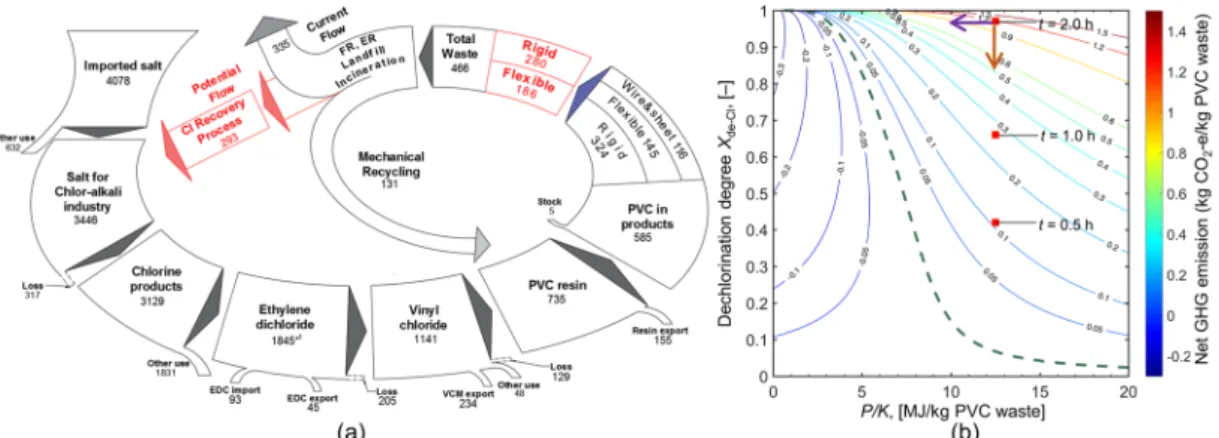
The current cradle-to-grave of Cl flow in Japan in 2012 was clarified by MFA, as shown in Fig. 2(a). 230 kt (131 kt-Cl) of PVC wastes was treated by MR and about 81% after treatment was exported as secondary PVC resin. The PVC wastes mixed in other wastes were treated together by energy recovery (ER), feedstock recycling (FR), and final disposal. Since all waste treatments except MR fails to recycle the Cl in PVC wastes 22, 335 kt-Cl was
emitted back to the environment in Japan in 2012. With the estimated composition of PVC wastes based on the production data of rigid and flexible PVC products with applying lifetime distribution model, the Cl recovery potential with an advanced process is calculated out. The estimated Cl recovery potential via the de-Cl and ED processes is 293 kt (482 kt as NaCl). This value is equal to 7% of imported salt, 9% of industrial salt for the chlor-alkali industry and 23% Cl demand for the PVC industry in Japan in 2012.
Fig. 2 (a) Potential material flow (unit: kt-Cl) of Cl circulation system with Cl recovery from PVC wastes based on the current situation in Japan in 2012 10; (b) Net GHG emissions of
potential PVC waste treatment as a function of Xde-Cl and P/K 23.
Focusing on the environmental impacts of the current waste treatment system, the net energy consumption and GHG emissions of current PVC waste treatments were calculated as −14.2 MJ/kg PVC waste and 0.003 kg CO2-e/kg PVC waste, respectively, based on the
derived inventory data from the reports of plastic waste treatments in Japan in 2012 from PWMI. The main energy and GHG emission offsets originate from MR, despite its relative minor occupation within the system. The more dominant thermal treatment processes (i.e., ER and FR) contribute somewhat to energy offsets but have high GHG emissions. Treatment of Cl in tail gas from thermal processes with slaked lime accounted for considerable
environmental burdens. The application of Cl recovery is expected to mitigate the issues caused by PVC wastes during the thermal processes.
Based on the revealed current situation of PVC waste treatment, the future development of Cl recovery process was guided based on an LCA model with two variables (Xde-Cl and P/K) for the de-Cl process under lab-scale experiment. The potential energy
consumption and GHG emissions of PVC waste treatment with Cl recovery were modeled. For example, the contour figure of net GHG emissions is shown in Fig. 2(b). Subsequently, the target thresholds of variable values were deduced by comparing the impacts against the net impacts of current PVC waste treatments as the benchmarks (green dashed line). For an assumed combination of variables as plots in Fig. 2(b), to reach an Xde-Cl value of 0.97 within
a 2-h treatment period, neither net energy consumption nor net GHG emissions could meet the benchmark. Under such conditions, the environmental impacts could be reduced in two manners, as illustrated by the purple (reduction along the x-axis) and orange (reduction along the y-axis) arrows. First, the P/K value could be improved by improving the energy efficiency of the apparatus (i.e., lower P value) or increasing the de-Cl reaction speed by optimizing the operating conditions (i.e., higher K value) (purple arrow). Second, the desired Xde-Cl value
could be reduced by shortening the treatment time (orange arrow); for example, setting a 0.5-h treatment time could reduce the environmental impacts and come closer to meeting the benchmark, although Xde-Cl would only be 0.44. To ensure the quality of de-Cl treatment of
PVC wastes and recycle more NaCl, priority should be placed on reducing the P/K value. This strategy can be used to suggest the development target setting for the Cl recovery process during the industrial application.In the next step, the reasonable and practical values of the variables should be carried out by experiments and simulation to identify the optimal process design and technical suggestion for the reduction of potential environmental impacts.
Chapter 3 Fundamental experiments of Cl recovery process
A part of this chapter in thesis was published as follow:
Lu, J., Borjigin, S., Kumagai, S., Kameda, T., Saito, Y., & Yoshioka, T. (2019). Waste
Manag, 99, 31-41.
[Introduction]
First of all, to avoid the formation of undesired Cl compounds during PVC wastes treatment and facilitate the recycling of valuable NaCl and dechlorinated hydrocarbons as feedstocks, an up-scale ball mill reactor was established for the de-Cl of real PVC wastes. In the lab-scale experiments, even if fresh flexible PVC powder was used as the input sample, the maximum Xde-Cl was 97% 8. Thus, it can be estimated that the Cl content of the solid
dechlorinated PVC residues after treatment (referred to hereafter as residues) was greater than 1.0 wt.% (10,000 ppm). According to some reports, to control HCl and dioxin formation during thermal treatments, such as incineration, the Cl content in the input materials must be lower than a threshold value of 1.0 wt.% 24-25. For efficient energy-recovery processes such as
the refuse-derived fuel process, the Cl content is limited to 0.5 wt.% 26. Therefore, optimal
conditions for a higher Xde-Cl and reaction rate should be investigated. In terms of the
treatment for the obtained NaCl/EG solvents from the de-Cl of PVC wastes, lab-scale ED experiments were carried out. ED with ion exchange membranes is a technology that can transport ion from one solution (dilute or desalinated solution) to another one (concentrate) by applying the electric potential difference 27. It has been widely used to remove salt for potable
water production and prepare brine from seawater 28.
In this chapter, the practical experiments for Cl recovery process were carried out to prove the effectiveness of de-Cl treatment for real PVC wastes. With the kinetic study and DEM simulation, the de-Cl mechanism of PVC wastes was suggested. Meanwhile, to predict the de-Cl behavior under various mechanical conditions, an advanced reaction model was established based on machine learning. On the other hand, for the Cl recovery from NaCl/EG solvent, cNaCl in water was varied to confirm the ability to prepare saturated saline for salt
were investigated under various cNaCl in EG and the electrode voltage as the fundamental base
for the scaling up model and LCA. The volume of penetrated solvents through the ion exchange membranes was also analyzed.
[Summary]
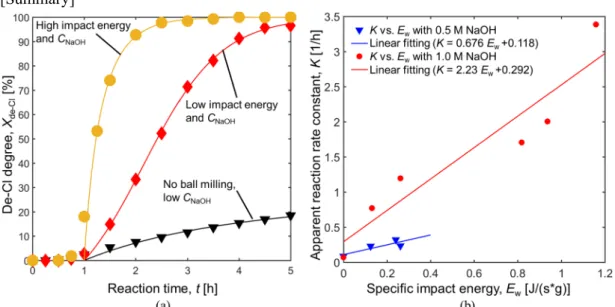
Fig. 3 (a) Xde-Cl vs. reaction time of the typical results from the de-Cl experiments of waste
PVC SS; (b) Linear fitting of K vs. Ew for de-Cl of waste PVC SS with 0.5 and 1.0 M NaOH.
First, the de-Cl behavior of real PVC wastes in EG/NaOH with ball milling was investigated with an up-scale ball mill reactor, which is exemplified in Fig. 3(a). Based on the de-Cl experiments for two kinds of PVC wastes, it was found that the overall Xde-Cl can reach
99% under various mechanical conditions in 1.0 M NaOH/EG for waste PVC SS and 92% with 1.27-cm balls at 45 rpm in 0.5 M NaOH/EG for waste PVC CC. A high NaOH concentration, a large number of balls, and higher rotation were the optimal conditions for SS, whereas moderate ball sizes and rotation speeds were favorable for CC. For the residues of both kinds of PVC wastes, the solid particles finer than 100 µm had low Cl contents, so that the risk of corrosive HCl and dioxin formation can be avoided and dechlorinated PVC can provide efficient feedstock recycling. A positive correlation between the apparent rate constant (K) from the experimental results and the corresponding specific impact energy (Ew)
from the DEM simulations was identified as shown in Fig. 3(b). Based on the results and simulation, the de-Cl mechanism for PVC in EG/NaOH with ball milling was proposed. The surface of the PVC particles was first dechlorinated by NaOH and then the dechlorinated
surface was crushed by ball milling to generate new unreacted surfaces in the particle core. Without NaOH or ball milling, PVC wastes cannot be completely dechlorinated and crushed into fine particles. Furthermore, PVC waste samples with in large sizes and small thicknesses are more sensitive to chemical factors than those with small sizes and large thicknesses, which require critical adjustments of the mechanical factors.
A discrete element reaction model for the de-Cl of PVC by ball milling in NaOH/EG solvent was established based on a machine learning algorithm. Using the ball-to-sample impact energy data from DEM simulations as the input, the model was trained and verified based on experimental data. For large PVC particles, the initial reactive area is low so that the generation of additional reactive area is essential for improving the de-Cl efficiency. The DEM simulations suggested that increasing the number of grinding balls used and their size can increase the ball-to-sample impact energy and hence improve the de-Cl efficiency; however, the effect of these increases is limited. Meanwhile, the impact energy is dispersed more effectively at higher rotational speeds. Thus, an optimal condition should be determined to balance the de-Cl efficiency and operation cost. The proposed model is not only capable of making predictions about the de-Cl reaction based on the input of ball-to-sample impact energy, but can also elucidate the de-Cl behavior under different operational conditions.
For the simultaneous recovery of EG and salt, the Cl recovery from the NaCl/EG solution by ED process was evaluated on lab scale. Over 90% of Cl recovery yield was achieved at cW0 = 40 g/L and Ve = 2.5 V with any cEG0. Varying the cW0 from 40 g/L to 240 g/L,
the Cl recovery efficiency was still high so that it is possible to prepare saturated saline from NaCl/EG solution by ED process. However, the whole procedure of concentrating NaCl from pure water to saturated saline should be simulated for LCA inventory data. Meanwhile, considerable volume of penetrated EG and water through the membranes was not negligible for the industrial application. The additional countermeasures for the solvent penetration should be included the calculation of environmental impacts.
After the effectiveness of Cl recovery process is verified by the practical experiments, the next step is to model the commercial-scale inventory data under different operation conditions and process design based on the experimental results.
Chapter 4 Scaling up model by simulation for predicting the
commercial-scale inventory data
[Introduction]
The inventory data, which describes the production system associated with the evaluation target, is one of the most important base for LCA 29. Conventional LCA evaluates
the environmental impacts associated with a product throughout its life cycle 7. For the
ex-ante LCA, the process inventory is unavailable because the process design is not fixed 30.
Thus, the core issue in the ex-ante LCA is the estimation of commercial-scale inventory data of emerging technologies based on the lab-scale experiment. The direct calculation with the lab-scale data is not recommended because the LCA results may have magnitude difference between the lab-scale experiment and industrial production system 31-32. This phenomenon is
common as the lab-scale process design is not optimized for the energy and material consumption. Thus, the scaling up of lab-scale process is necessary to derive the reasonable LCA results. In terms of uncertainty, the direct expansion of lab-scale apparatus into a pilot plant is favorable for accurate inventory data 33. While, for the high cost of building a pilot
plant, the scaling up of lab-scale process by simulation is a feasible choice 34.
To establish the scaling up simulation for Cl recovery process, first, the de-Cl process of PVC wastes was modeled. DEM has been applied to find the relationship between the kinetic behavior of lab-scale mechanochemical reaction and the simulated impact energy of ball milling 35-37. Because the de-Cl efficiency of PVC wastes is highly related with the
impact energy of ball milling 38 and the ball milling process commonly requires high power
consumption 39, it is necessary to balance the de-Cl efficiency and environmental impacts of
power consumption by investigating the effects of impact energy. In addition, the heat consumption of the de-Cl process is a main hotspot of environmental impacts 40 so that the
possibility of reduction on heat consumption by varying the temperature and improve reactor design should be determined. The heat consumed by the electric furnace and the kinetics of de-Cl reaction over temperature were considered by the Fourier’s Law and Arrhenius Equation, respectively.On the other hand, the scaling up of ED process for Cl recovery from
the NaCl/EG was carried out by the kinetic study on the experimental results. With the calculated volume of penetrated solvents, the additional energy consumption for the EG dewatering and saline evaporation was simulated by Aspen plus®.
[Summary]
First, based on the experimental results of the reaction kinetics and energy consumption, the operation conditions of mechanical factors and reaction temperature were modeled for the scaling up of de-Cl process. The DEM simulation can successfully predict the apparent rate constant of the de-Cl reaction and the energy consumption of ball milling. Under the 10-time increase of throughput, the de-Cl experiment of PVC wastes are still effective and efficient. The correlation between the experimental apparent rate constant and simulated specific impact energy of ball milling was strong even if the scaling up of throughput was included. Despite the error caused by the sampling interval of data monitor, the power of ball mill can be calculated based on the simulated energy dissipation. The kinetic parameters under different reaction temperature can be modeled by Arrhenius Equation; meanwhile, the heat loss can be calculated by the Fourie’s Law. Based on the models, the inventory data of the de-Cl process a virtual industrial-scale ball mill reactor can be predicted for calculating the potential cradle-to-grave environmental impacts.
In terms of the commercial-scale ED process, based on the kinetic study on the experimental results, the mass of transported NaCl and the volume of penetrated solvents were simulated under various cNaCl in EG and Ve. Compared with the lab-scale ED process,
the change of concentrate from pure water to saturated saline can significantly affect the transport rate of NaCl and solvents, especially at the mid-late stage of treatment. With the simulated volume of penetrated solvents, the additional heat consumption, as well as EG loss for the removal of penetrated water in the EG and the EG evaporation during the salt production was simulated by Aspen plus®.
Chapter 5 Potential environmental impacts of the PVC waste treatment
with Cl recovery versus process design
A part of this chapter in thesis was published as follow:
Lu, J., Borjigin, S., Kumagai, S., Fukushima, Y., Kameda, T., Saito, Y., & Yoshioka, T. (2020). J Mater Cycles and Waste Manag,
22(5), 1620-1629.
[Introduction]
The implementation of advanced technologies for waste treatment can alter the supply chains of the virgin material production and the environmental impacts of current waste management system. Therefore, it is important to model the potential life-cycle environmental impacts of new technologies at the development stage based on the current industry to guide the sustainable development direction of process design, and ultimately convince stakeholders of the advantages of the application of such new technologies. To support the sustainable development of technologies at the experimental stage, ex-ante LCA methods are recently becoming a topic of interest in the field of industrial ecology. However, the current case studies by ex-ante LCA mainly focused on the accurate prediction of potential environmental impacts and exploring the potential benefits 41-44, and no studies have applied ex-ante LCA
methods to guide the environmental-friendly design of the emerging technologies.
Here, the potential life-cycle environmental impacts of the advanced PVC waste treatment with Cl recovery were modeled based on the experiment and simulation to technically suggest the process design for the future development. Because the ED process for salt production is a mature process in the current industry, the ED process was first investigated to determine the fixed design and simplify the LCA model of Cl recovery process. Then, with the optimized design of ED process, the environmental impacts of PVC waste treatment with Cl recovery process were analyzed. With the change of specific impact energy of ball milling and reaction temperature (T) of the de-Cl process, the inventory data is calculated for predicting the environmental impacts and the corresponding contribution. The appropriate value of the operation conditions was suggested for balancing the environmental impacts and the effectiveness of de-Cl treatment. In addition, the potential development
direction for reducing the environmental impacts was also suggested based on the results compared with the current PVC waste treatment as the benchmark.
[Summary]
First, the ED process for Cl recovery from the NaCl/EG solution obtained from the de-Cl process of PVC wastes was evaluated by the ex-ante LCA based on the lab-scale experiment and up-scale simulation. The environmental impacts of the ED process were modeled under various operation conditions, which suggests that a higher NaCl concentration in EG can lead to lower impacts because it can increase the mass flow rate of NaCl through the ion exchange membranes and reduce the penetration of solvents. Meanwhile, as the higher applied electrode voltage will lead to the increase of electricity consumption per mass of transported NaCl and the penetration of EG solvent, a moderate voltage should be identified to balance the Cl recovery efficiency and the environmental impacts from electricity consumption. Based on these results, a continuous operation of ED process was suggested for the integration during the de-Cl process to keep the high concentration of NaCl in EG.
Then, the potential environmental impacts of the PVC waste treatment with the Cl recovery process was modeled with the fixed design of ED process. The changing behaviors of the total environmental impacts on the ecosystem quality, human health, and resources versus Ew and T were investigated with the corresponding contribution analysis. Higher Ew
and T are essential to reach a better de-Cl effect of PVC wastes. However, the increase of Ew
and T will significantly bring additional environmental impacts to the treatment, especially for the depletion of resources. Thus, a moderate value of Ew and T should be optimized. From
the results of contribution analysis, the main hotspot of resource depletion is always the heat consumption of the furnace during the de-Cl treatment when varying the Ew and T. Based on
the improvement of heat insulation system by an ideal design, there is great potential to reduce the heat consumption during the de-Cl treatment and the associated environmental impacts. On the other hand, the additional treatments for solvent penetration account for the major impacts on ecosystem quality and human health. Although the suggestions like the continuous operation of ED process are considered, the additional enhancement is still necessary to mitigate the impacts from the handling of solvent penetration.
Chapter 6 Summary and prospect
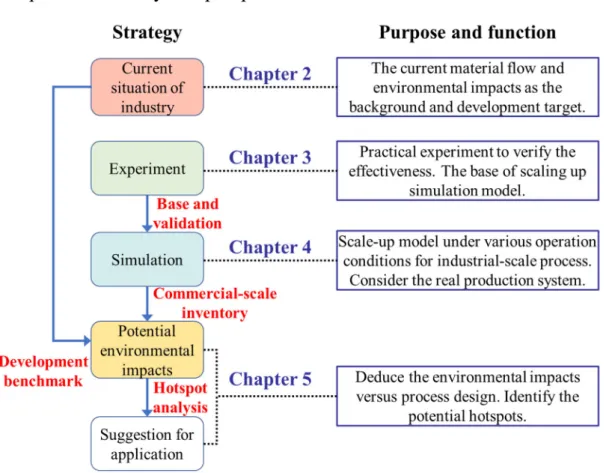
Fig. 4 Summarized sustainability strategy for the development of Cl recovery process with a nexus of experiment, simulation, and ex-ante LCA.
In this chapter, the main content and conclusion of this thesis are summarized based on the results presented in Chapter 2-5, which are shown in Fig. 4. To avoid the intractable issues caused by the Cl in PVC wastes and facilitate the material circulation system, the development of Cl recovery process was advanced through a sustainability strategy with a nexus of fundamental experiment, computer simulation, and ex-ante LCA in this thesis.
In Chapter 2, the current situation about the Cl associated with the life cycle of PVC was investigated to deduce the development benchmark of Cl recovery process. First, 293 kt of Cl recovery potential was clarified by the investigation on current life cycle material flow of Cl passing through the PVC industry in Japan in 2012. Focusing on the current PVC waste treatment, the net energy consumption and GHG emissions of current PVC waste treatment in Japan in 2012 were clarified as the benchmark for Cl recovery process. Next, the potential energy consumption and GHG emissions of the Cl recovery process were modeled based on two variables of the de-Cl process to guide the sustainable development.
In Chapter 3, the practical experiments of Cl recovery process were conducted to prove the effectiveness of treatment for real PVC wastes. Up to 99% of de-Cl degree was obtained from the de-Cl experiments with an up-scale ball mill reactor. DEM simulation was applied to analyze the de-Cl behavior. Moreover, Cl yield from NaCl/EG solvent by ED can reach up to 90% and the treatment was still effective when the NaCl/H2O solution was concentrated to
saturated saline. The penetration of EG and water through the membranes was determined. The scaling up model of Cl recovery process was established and validated by experiment to predict the commercial-scale inventory data in Chapter 4. The K of the de-Cl reaction and energy consumption of ball milling were modeled by DEM. Meanwhile, the heat consumed by the electric furnace and the reaction kinetics over temperature can be well fitted by the Fourier’s Law and Arrhenius Equation, respectively. The transported NaCl and penetrated volume of solvents were simulated for the commercial operation, in which the cNaCl
in water varies from zero to saturation. The additional heat consumption and EG loss of distillation and evaporation for solvent penetration were calculated by the Aspen Plus®.
In Chapter 5, the environmental impacts of potential PVC waste treatment with Cl recovery process modeled were investigated under various Ew and T of de-Cl process as well
as cNaCl in EG and Ve for ED. Moderate values of Ew and T should be optimized for the de-Cl
efficiency and environmental impacts. Based on the contribution analysis of the impacts, the main hotspot of resource depletion is the furnace for de-Cl process. Meanwhile, the additional treatments for solvent penetration account for the major impacts on ecosystem quality and human health. For industrial application, the heat insulation of de-Cl process needs improvement to reduce heat consumption. Meanwhile, high cNaCl in EG and moderate Ve
should be applied to increase the NaCl transport efficiency and reduce solvent penetration. To sum up, in this research, a sustainability strategy with a nexus of experiment, simulation, and ex-ante LCA was proposed for supporting the development of emerging technologies. Although the design of Cl recovery process should be furtherly improved for reducing environmental impacts with the proposed technical suggestions, there is great potential to realize a Cl circulation system associated with the life cycle of PVC by the implementation of Cl recovery process.
[References]
1. United Nations Sustainable development goals. https://sustainabledevelopment.un.org/
(accessed 2 April, 2020).
2. Silvestre, B. S.; Ţîrcă, D. M., Innovations for sustainable development: Moving toward a sustainable future. J. Clean. Prod. 2019, 208, 325-332.
3. Broman, G. I.; Robèrt, K.-H., A framework for strategic sustainable development. J.
Clean. Prod. 2017, 140, 17-31.
4. Weaver, P.; Jansen, L.; Van Grootveld, G.; Van Spiegel, E.; Vergragt, P., Sustainable
technology development. Routledge: 2017.
5. Villares, M.; Işıldar, A.; van der Giesen, C.; Guinée, J., Does ex ante application enhance the usefulness of LCA? A case study on an emerging technology for metal recovery from e-waste. Int. J. Life Cycle Assess. 2017, 22 (10), 1618-1633.
6. Cucurachi, S.; van der Giesen, C.; Guinée, J., Ex-ante LCA of emerging technologies.
Procedia CIRP 2018, 69, 463-468.
7. Finnveden, G.; Hauschild, M. Z.; Ekvall, T.; Guinée, J.; Heijungs, R.; Hellweg, S.; Koehler, A.; Pennington, D.; Suh, S., Recent developments in life cycle assessment. J.
Environ. Manag. 2009, 91 (1), 1-21.
8. Kameda, T.; Ono, M.; Grause, G.; Mizoguchi, T.; Yoshioka, T., Ball Mill-Assisted Dechlorination of Flexible and Rigid Poly(vinyl chloride) in NaOH/EG Solution. Ind. Eng.
Chem. Res. 2008, 47 (22), 8619-8624.
9. Kameda, T.; Fukushima, S.; Shoji, C.; Grause, G.; Yoshioka, T., Electrodialysis for NaCl/EG solution using ion-exchange membranes. J. Mater. Cycles Waste Manag. 2013, 15 (1), 111-114.
10. Kumagai, S.; Lu, J.; Fukushima, Y.; Ohno, H.; Kameda, T.; Yoshioka, T., Diagnosing chlorine industrial metabolism by evaluating the potential of chlorine recovery from polyvinyl chloride wastes—A case study in Japan. Resour. Conserv. Recycl. 2018, 133, 354-361.
11. Kim, D. H., A review of desalting process techniques and economic analysis of the recovery of salts from retentates. Desalination 2011, 270 (1-3), 1-8.
12. Ayres, R. U.; Ayres, L., A handbook of industrial ecology. Edward Elgar Publishing: 2002.
13. Brunner, P. H.; Rechberger, H., Practical handbook of material flow analysis. Int. J. Life
Cycle Assess. 2004, 9, 337-338.
14. Liu, Y.; Zhou, C.; Li, F.; Liu, H.; Yang, J., Stocks and flows of polyvinyl chloride (PVC) in China: 1980-2050. Resour. Conserv. Recycl. 2020, 154, 104584.
15. Nakamura, S.; Nakajima, K.; Yoshizawa, Y.; Matsubae‐Yokoyama, K.; Nagasaka, T., Analyzing polyvinyl chloride in Japan with the waste input− output material flow analysis model. J. Ind. Ecol. 2009, 13, 706-717.
16. Zhou, Y. C.; Yang, N.; Hu, S. Y., Industrial metabolism of PVC in China: A dynamic material flow analysis. Resour. Conserv. Recycl. 2013, 73, 33-40.
17. Ayers, R., The Life-Cycle of Chlorine, Part I: Chlorine Production and the Chlorine-Mercury Connection. J. Ind. Ecol. 1997, 1 (1), 81-94.
18. Perugini, F.; Mastellone, M. L.; Arena, U., A life cycle assessment of mechanical and feedstock recycling options for management of plastic packaging wastes. Environ. Prog. 2005,
24 (2), 137-154.
19. Lazarevic, D.; Aoustin, E.; Buclet, N.; Brandt, N., Plastic waste management in the context of a European recycling society: comparing results and uncertainties in a life cycle perspective. Resour. Conserv. Recycl. 2010, 55 (2), 246-259.
20. Sekine, Y.; Fukuda, K.; Kato, K.; Adachi, Y.; Matsuno, Y., CO2 reduction potentials by utilizing waste plastics in steel works. Int. J. Life Cycle Assess. 2009, 14 (2), 122-136.
21. Plastic Waste Management Institute, Plastic Products, Plastic Waste and Resource Recovery (1997-2014). 2015, http://www.pwmi.or.jp/ei/siryo/ei/ei.htm (accessed on 14 July, 2016).
22. Al-Salem, S. M.; Lettieri, P.; Baeyens, J., Recycling and recovery routes of plastic solid waste (PSW): A review. Waste Manag. 2009, 29, 2625-2643.
23. Lu, J.; Kumagai, S.; Ohno, H.; Kameda, T.; Saito, Y.; Yoshioka, T.; Fukushima, Y., Deducing targets of emerging technologies based on ex ante life cycle thinking: Case study on a chlorine recovery process for polyvinyl chloride wastes. Resour. Conserv. Recycl. 2019,
151, 104500.
24. Wey, M.; Liu, K.; Yu, W.; Lin, C.; Chang, F., Influences of chlorine content on emission of HCl and organic compounds in waste incineration using fluidized beds. Waste Manag.
2008, 28 (2), 406-415.
25. Wang, L.-C.; Lee, W.-J.; Lee, W.-S.; Chang-Chien, G.-P.; Tsai, P.-J., Effect of chlorine content in feeding wastes of incineration on the emission of polychlorinated dibenzo-p-dioxins/dibenzofurans. Sci. Total Environ. 2003, 302 (1-3), 185-198.
26. Chiemchaisri, C.; Charnnok, B.; Visvanathan, C., Recovery of plastic wastes from dumpsite as refuse-derived fuel and its utilization in small gasification system. Bioresour.
Technol. 2010, 101 (5), 1522-1527.
27. Sadrzadeh, M.; Mohammadi, T., Sea water desalination using electrodialysis.
Desalination 2008, 221 (1-3), 440-447.
28. Turek, M., Dual-purpose desalination-salt production electrodialysis. Desalination 2003,
153 (1-3), 377-381.
29. Guinée, J. B.; Lindeijer, E., Handbook on life cycle assessment: operational guide to the
ISO standards. Springer Science & Business Media: 2002; Vol. 7.
30. van der Giesen, C.; Cucurachi, S.; Guinée, J.; Kramer, G. J.; Tukker, A., A critical view on the current application of LCA for new technologies and recommendations for improved practice. J. Clean. Prod. 2020, 120904.
31. Villares, M.; Işıldar, A.; Beltran, A. M.; Guinee, J., Applying an ex-ante life cycle perspective to metal recovery from e-waste using bioleaching. J. Clean. Prod. 2016, 129, 315-328.
32. Yao, Y.; Hu, M.; Di Maio, F.; Cucurachi, S., Life cycle assessment of 3D printing geo‐ polymer concrete: An ex‐ante study. J. Ind. Ecol. 2019.
33. Parvatker, A. G.; Eckelman, M. J., Comparative Evaluation of Chemical Life Cycle Inventory Generation Methods and Implications for Life Cycle Assessment Results. ACS
Sustain. Chem. Eng. 2018, 7 (1), 350-367.
34. Thonemann, N.; Schulte, A., From Laboratory to Industrial Scale: A Prospective LCA for Electrochemical Reduction of CO2 to Formic Acid. Environ. Sci. Technol. 2019, 53 (21), 12320-12329.
35. Sui, H.; Rong, Y.; Song, J.; Zhang, D.; Li, H.; Wu, P.; Shen, Y.; Huang, Y., Mechanochemical destruction of DDTs with Fe-Zn bimetal in a high-energy planetary ball mill. J. Hazard. Mater. 2018, 342, 201-209.
36. Hirosawa, F.; Iwasaki, T.; Iwata, M., Kinetic analysis of mechanochemical reaction between zinc oxide and gamma ferric oxide based on the impact energy and collision frequency of particles. Powder Technol. 2019, 352, 360-368.
37. Mio, H.; Saeki, S.; Kano, J.; Saito, F., Estimation of mechanochemical dechlorination rate of poly (vinyl chloride). Environ. Sci. Technol. 2002, 36 (6), 1344-1348.
38. Lu, J.; Borjigin, S.; Kumagai, S.; Kameda, T.; Saito, Y.; Yoshioka, T., Practical dechlorination of polyvinyl chloride wastes in NaOH/ethylene glycol using an up-scale ball mill reactor and validation by discrete element method simulations. Waste Manag. 2019, 99, 31-41.
39. Data, A.; Mishra, B.; Rajamani, R., Analysis of power draw in ball mills by the discrete element method. Can. Metall. Q. 1999, 38 (2), 133-140.
40. Lu, J.; Borjigin, S.; Kumagai, S.; Kameda, T.; Saito, Y.; Fukushima, Y.; Yoshioka, T., Practical dehalogenation of automobile shredder residue in NaOH/ethylene glycol with an up‑scale ball mill reactor. J. Mater. Cycles Waste Manag. 2020.
41. Villares, M.; Isildar, A.; Beltran, A. M.; Guinee, J., Applying an ex-ante life cycle perspective to metal recovery from e-waste using bioleaching. J. Clean. Prod. 2016, 129, 315-328.
42. Schrijvers, D. L.; Leroux, F.; Verney, V.; Patel, M. K., Ex-ante life cycle assessment of polymer nanocomposites using organo-modified layered double hydroxides for potential application in agricultural films. Green Chem. 2014, 16 (12), 4969-4984.
43. Fernandez-Dacosta, C.; Wassenaar, P. N.; Dencic, I.; Zijp, M. C.; Morao, A.; Heugens, E. H.; Shen, L., Can we assess innovative bio-based chemicals in their early development stage? A comparison between early-stage and life cycle assessments. J. Clean. Prod. 2019, 230, 137-149.
44. Hesser, F., Environmental advantage by choice: Ex-ante LCA for a new Kraft pulp fibre reinforced polypropylene composite in comparison to reference materials. Compos. Part