Exploiting Background Knowledge and Inference
for Scientific Relation Extraction
著者
代 勤
学位授与機関
Tohoku University
学位授与番号
11301甲第19340号
Exploiting Background Knowledge and Inference
for Scientific Relation Extraction
背景知識
と推論を利用した科学文献からの
関係抽出
Qin Dai
Graduate School of Information Sciences
Tohoku University
A thesis submitted for the degree of Doctor of Information Sciences
List of Publications
Journal Paper (Refereed):
1. Qin Dai, Naoya Inoue, Paul Reisert, and Kentaro Inui. Leveraging Unannotated Texts for Scientific Relation Extraction. IEICE Transactions on Information and Systems, Vol. E101-D, No. 12, pp.3209-3217, December 2018.
International Conferences/Workshop Papers (Refereed):
1. Qin Dai, Naoya Inoue, Paul Reisert, Ryo Takahashi and Kentaro Inui. Incor-porating Chains of Reasoning over Knowledge Graph for Distantly Supervised Biomedical Knowledge Acquisition. In Proceedings of the 33nd Pacific Asia Conference on Language, Information and Computing (PACLIC33), September 2019.
2. Qin Dai, Naoya Inoue, Paul Reisert, Ryo Takahashi and Kentaro Inui. Distantly Supervised Biomedical Knowledge Acquisition via Knowledge Graph Based Attention. In Proceedings of First Workshop on Extracting Structured Knowledge from Scientific Publications (ESSP), June 2019.
3. Qin Dai, Naoya Inoue, Paul Reisert and Kentaro Inui. Scientific Knowledge Ac-quisition via the Interaction between Relation Extraction and Knowledge Graph
Completion. In Proceedings of Third International Workshop on SCIentific DOCument Analysis (SCIDOCA), November 2018.
4. Qin Dai, Naoya Inoue, Paul Reisert and Kentaro Inui. Improving Scientific Relation Classification with Task Specific Supersense. In Proceedings of the 32nd Pacific Asia Conference on Language, Information and Computing (PACLIC32), December 2018.
5. Qin Dai, Naoya Inoue, Paul Reisert, and Kentaro Inui. Leveraging Document-specific Information for Identifying Relations in Scientific Articles. In Pro-ceedings of Second International Workshop on SCIentific DOCument Analysis (SCIDOCA), November 2017.
Other Publications(Not refereed):
1. Qin Dai, Naoya Inoue, Paul Reisert, Kentaro Inui. End-to-End Scientific Knowl-edge Graph Completion via Word Embedding based Entity Type Classification. In Proceedings of The 25th Annual Meeting of the Association for Natural Lan-guage Processing, March 2019.
Abstract
A tremendous amount of knowledge is present in the ever-growing scientific literature. In order to efficiently acquire such scientific knowledge, various computational tasks are proposed that train machines to read and analyze scientific documents automatically. One of these tasks, scientific Relation Extraction (RE), aims at automatically capturing scientific semantic relationships among entities in scientific documents. Convention-ally, only a limited number of commonly used knowledge bases, such as Wikipedia, are used as a source of background knowledge for scientific RE. In this thesis, we hypoth-esize that unannotated scientific papers could also be utilized as a source of external background information for scientific RE. Based on the hypothesis, we propose several frameworks that are capable of extracting useful background information from unanno-tated scientific papers for scientific RE. Our experiments on different scientific corpus prove the effectiveness of the proposed frameworks on RE from scientific articles.
Although most RE frameworks, including ours, achieve reasonable performances, they require large and expensive manually annotated training data. To address this issue, distant supervision is proposed to automatically generate large amounts of la-belled sentences via leveraging the alignment between knowledge graphs and texts. In recent years, many distantly supervised RE (DS-RE) frameworks use neural networks
with attention mechanism to denoise the automatically labelled sentences and improve performances. To adjust the existing frameworks into scientific domain, we propose a new Knowledge Graph Completion model that significantly enhances our selected state-of-the-art DS-RE model on scientific dataset.
Beside the noise from distant supervision, the brevity of sentences in scientific papers could also hinder the performances of scientific DS-RE. Specifically, authors of scientific papers always omit the background elaboration that they assume is well known and easily inferred by their readers. However, the omitted background elaboration would be essential for a machine to identify relationships between entity pairs in scientific documents. To address this issue, in this thesis, we assume that the textual representation of reasoning paths (or inferences) between entity pairs over both scientific knowledge graph and multiple scientific documents could be utilized as the omitted explanation to fill the “gaps” in scientific documents and thus facilitate scientific DS-RE. Experimental results on biomedical datasets prove the effectiveness of our proposed model for scientific DS-RE, because the proposed model that incorporates the textual representation of reasoning paths achieves significant and consistent improvements as compared with state-of-the-art DS-RE baselines.
Acknowledgments
First and foremost, I would like to express my deepest gratitude to my advisor Prof. Kentaro Inui for giving me the precious opportunity to follow my passion and carry out this research. This work would not have been possible without his persistent support and critical feedback. I would also like to extend my heartful gratitude to Dr. Naoya Inoue for his patience and inspiring discussions of this research, as well as all other helpful and motivational members (including former members) of the NLP Lab. Tohoku University, for the great research environment they created.
Furthermore, I would like to be grateful for the love and support from my family and relatives, especially my father, Manibadara, who always has confidence in me and offers me tons of encouragement and support, my younger sister, Sorgog, who always cheers me up and teaches me “when there is a will, there is a way”, and my uncle Chaoketu Gao and his family, who always make me feel at home in the foreign land.
Finally, I dedicate this thesis as an acknowledgment to my late mother, Yulan Gao, who played an integral role in my life so far, my late grandfather, D. and my late grandmother, B. for their immeasurable love and blessings since my childhood. I miss you a lot.
This work was supported by JST CREST Grant Number JPMJCR1513, Japan and KAKENHI Grant Number 16H06614.
Contents
1 Introduction 1
1.1 The Importance of Unanotated Scientific Papers . . . 1
1.2 The Importance of Inferences . . . 3
1.3 Thesis Contributions . . . 4
1.4 Thesis Organization . . . 6
2 Background 9 2.1 Relation Extraction . . . 9
2.1.1 Supervised Relation Extraction . . . 11
2.1.2 Distantly Supervised Relation Extraction . . . 12
2.2 Deep Neural Networks . . . 13
2.2.1 Word Embeddings . . . 14
2.2.2 Convolutional Neural Networks . . . 14
2.3 Knowledge Graph Completion . . . 17
2.3.1 TransE . . . 19
2.3.2 TransD . . . 19
2.3.4 SimplE . . . 21
3 Improving Scientific Relation Extraction with Task Specific Supersense 22 3.1 Introduction . . . 22
3.2 Related Work . . . 24
3.3 Task Specific Supersense Embedding . . . 25
3.3.1 Preparing Seed TSS Instances . . . 25
3.3.2 Building TSS Embeddings . . . 26
3.3.3 Identifying TSS for Given Words . . . 27
3.4 Proposed Model . . . 28
3.4.1 Task Setting . . . 28
3.4.2 Base Model . . . 28
3.4.3 Incorporating TSS . . . 31
3.5 Data . . . 32
3.5.1 SemEval-2018 Task 7 dataset . . . 32
3.5.2 RANIS dataset . . . 32
3.6 Experiments . . . 34
3.6.1 Setup . . . 34
3.6.2 Result and Discussion . . . 34
3.7 Conclusion . . . 39
4 Leveraging Unannotated Texts for Scientific Relation Extraction 40 4.1 Introduction . . . 40
4.2 Related Work . . . 44
4.4 Proposed Model . . . 47
4.4.1 Retrieving Background Information from Unannotated Scien-tific Papers . . . 48
4.4.2 Architecture . . . 52
4.5 Experiments . . . 53
4.5.1 Setup . . . 53
4.5.2 Result . . . 54
4.5.3 Error Analysis and Discussion . . . 57
4.6 Conclusion . . . 59
5 Scientific Knowledge Acquisition via the Interaction between Relation Ex-traction and Knowledge Graph Completion 61 5.1 Introduction . . . 61
5.2 Proposed Model . . . 65
5.2.1 Framework Formulation . . . 65
5.2.2 Base Model for Scientific KGC . . . 66
5.2.3 Proposed Model for scientific KGC . . . 67
5.2.4 Base Model for Scientific RE . . . 68
5.2.5 Proposed Model for Scientific RE . . . 70
5.3 Experiments . . . 71
5.3.1 Data . . . 71
5.3.2 Setup . . . 72
5.3.3 Result and Discussion . . . 73
5.4 Related Work . . . 77
6 Distantly Supervised Biomedical Knowledge Acquisition via Knowledge
Graph Based Attention 79
6.1 Introduction . . . 79 6.2 Related Work . . . 82 6.3 Base Model . . . 84 6.3.1 KGC Part . . . 85 6.3.2 RE Part . . . 86 6.3.3 Optimization . . . 88 6.4 Extensions . . . 89
6.4.1 ComplEx based Attention . . . 89
6.4.2 SimplE based Attention . . . 90
6.4.3 SimplE_NER based Attention . . . 91
6.5 Experiments . . . 93
6.5.1 Data . . . 93
6.5.2 Parameter Settings . . . 95
6.5.3 Result and Discussion . . . 95
6.6 Conclusion and Future Work . . . 99
7 Incorporating Chains of Reasoning over Knowledge Graph for Distantly Supervised Biomedical Knowledge Acquisition 100 7.1 Introduction . . . 100
7.2 Related Work . . . 103
7.3 Proposed Model . . . 105
7.3.1 Architecture . . . 105
7.4 Experiments . . . 108
7.4.1 Data . . . 108
7.4.2 Parameter Settings . . . 110
7.4.3 Result and Discussion . . . 110
7.5 Conclusion and Future Work . . . 114
8 Reasoning across Multiple Documents for Distantly Supervised Biomedical Knowledge Acquisition 115 8.1 Introduction . . . 115
8.2 Related Work . . . 118
8.3 Proposed Model . . . 120
8.3.1 Reasoning Paths Generation . . . 120
8.3.2 Architecture . . . 121
8.4 Experiments . . . 123
8.4.1 Data and Parameter Settings . . . 123
8.4.2 Result and Discussion . . . 124
8.5 Conclusion . . . 126
9 Combination of Knowledge Graph based Inference and Cross-document Inference for Distantly Supervised Relation Extraction 128 9.1 Introduction . . . 128
9.2 Combination of KGI and CDI . . . 129
9.3 Evaluation and Result . . . 130
9.3.1 Evaluation on Scientific Dataset . . . 130
9.3.3 The Effect of Textual Representation of Inference . . . 132 9.4 The Effect of KG-based Attention Mechanism . . . 134 9.5 Conclusion . . . 136
List of Tables
2.1 Instances for Scientific KGC. . . 18
3.1 TSS and corresponding seed instances . . . 26
3.2 Example of original corpus (1) and alternative corpus (2) . . . 27
3.3 Top 10 most similar word embeddings for each TSS embedding . . . . 27
3.4 Hyperparameters for Relation Classification . . . 34
3.5 Performance on SemEval-2018 Task 7.1.1 . . . 36
3.6 Performance on SemEval-2018 Task 7.1.2 . . . 36
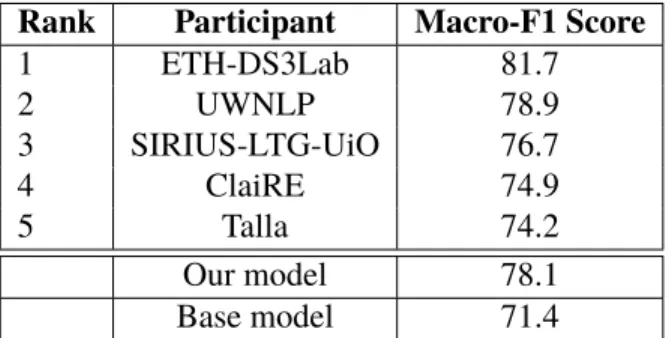
3.7 Performance comparison to Top 5 task participants (28 teams) for SemEval-2018 Task 7.1.1 . . . 38
3.8 Performance comparison to Top 5 task participants (20 teams) for SemEval-2018 Task 7.1.2 . . . 38
3.9 Performance on RANIS dataset . . . 38
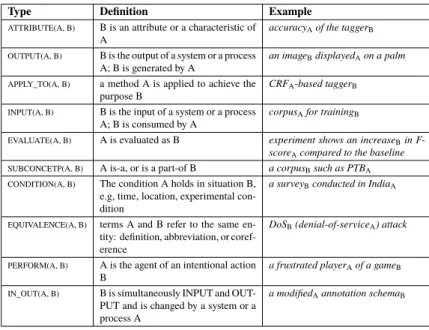
4.1 Frequently Appeared Relation Tags . . . 45
4.2 Distribution ofRELATEDentity pairs. . . 54
4.3 Hyperparameters for Relation Classification . . . 54
4.4 Performance of RE (mean ± standard deviation) . . . 56
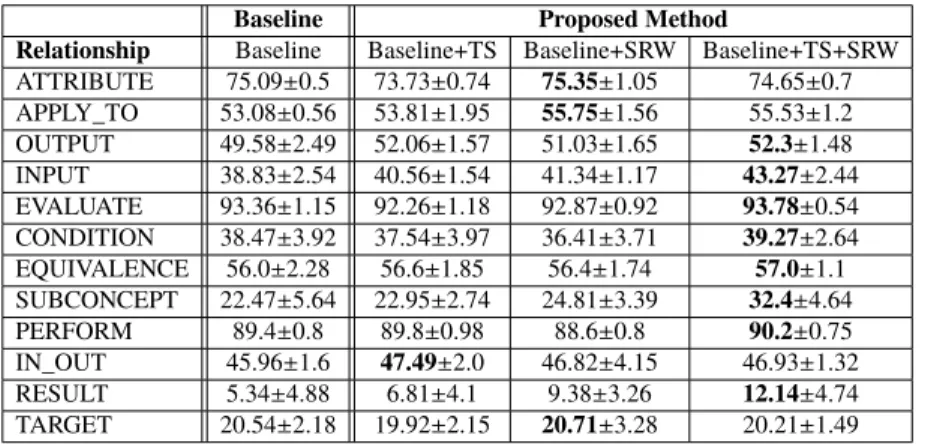
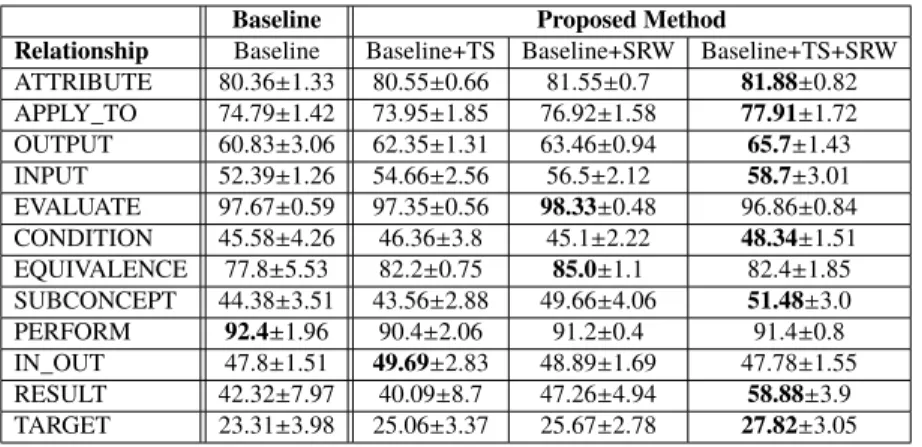
4.6 Performance of RE on the setting that excludesnon-relation . . . 56
4.7 Performance (F-score) over selected relationship on the setting that excludesnon-relation . . . . 57
4.8 Impact of using different SRW_c on RE . . . 57
5.1 Instances for Scientific KGC. . . 62
5.2 Comparison of statistics of KBs. . . 64
5.3 Hyperparameters for Scientific RE . . . 73
5.4 Link prediction result on RANIS dataset . . . 75
5.5 RE performance on RANIS dataset . . . 76
5.6 RE performance (F-score) over selected relationship . . . 76
6.1 Statistics of KG in this work. . . 94
6.2 Examples of textual data extracted from Medline corpus. . . 95
6.3 P@N for different RE models, where k=1000. . . 98
6.4 Link prediction results for different KGC models. . . 99
7.1 Statistics of KG in this work. . . 109
7.2 Examples of textual data extracted from Medline corpus. . . 110
7.3 P@N and AP for different DS-RE models, where k=1000. . . 112
7.4 Comparison of attention between base model and proposed model, where High (or Low) represents the highest (or lowest) attention. . . . 113
7.5 Some examples of attention distribution over reasoning paths from “JointE+KATT(TEXT+PATH)”. . . 113
8.1 An example of multiple relation expressions. . . 121
8.3 Some examples of attention distribution over reasoning paths from “JointE+KATT(Sent.+Cross)”. . . 126 9.1 P@N and AP on scientific dataset, where k=1000. . . 130 9.2 P@N and AP on the unified graph representation, where k=1000. . . . 131 9.3 P@N and AP on unit representation and textual representation, where
k=1000. . . 134 9.4 P@N and AP on the attention mechanism proposed by [13] and
List of Figures
1.1 An example of reasoning path. . . 4 2.1 Examples of gold relations. . . 11 2.2 CNNs architecture . . . 16 3.1 TSS identification example, where NONE means the word does not
belong to any TSS. SYSMETH and INPRO stand for SYSTEM or
METHOD and INPUT-PROCESS respectively. . . . 28 3.2 Base model architecture . . . 29 3.3 Annotation example shown in brat rapid annotation tool. To more
clearly illustrate the direction of relation, we add directional tag “L-” and “R-” before each relation tag. . . 33 3.4 Comparison between Base + all and Base in SemEval-2018 Task 7.1.1,
where red lines indicate the error from Base, while the green lines show the correctly identified relations (which end with “_p”) from TSS enhanced model. <e1>, <e2>, </e1> and </e2> are entity boundary marks. RESPRO stands for RESEARCH-PROCESS. . . . 37 3.5 Comparison between Base + SYSTEM or METHOD and Base in
3.6 Comparison between Base + INPUT-PROCESS + OUTPUT-PROCESS and Base in RANIS dataset, where OUTPRO stands for
OUTPUT-PROCESS. . . . 39
4.1 Annotation example shown in brat rapid annotation tool. To more clearly illustrate the direction of relation, we add directional tag “L-” (means left hand side is the argument B) and “R-” (means right hand side is the argument B) before each relation tag. . . 45
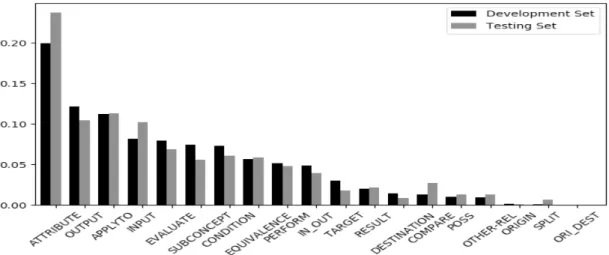
4.2 Distribution of relation types. . . 47
4.3 The architecture of the proposed model enhanced by LC (or TS) encoding. 50 4.4 Comparison between Baseline + SRW and Baseline, where red lines indicate the error from Baseline, while the green lines show the cor-rectly identified relations from Baseline + SRW. . . . 55
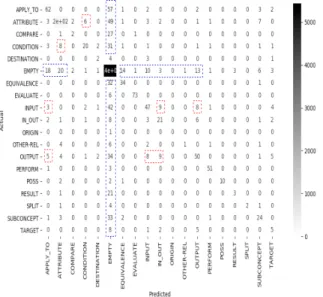
4.5 Confusion Matrix from Baseline + TS + SRW. . . . 58
4.6 Relationship identification error from Baseline + TS + SRW, where red lines indicate the error while the green line shows the gold standard relation. . . 58
5.1 Overview of the proposed pipeline architecture . . . 66
5.2 Overview of the proposed scientific KGC model . . . 68
5.3 Base model architecture . . . 69
5.4 Annotation example shown in brat rapid annotation tool. To more clearly illustrate the direction of relation, we add directional tag “L-” and “R-” before each relation tag. . . 72
5.5 Comparison between Base + KGC embedding (original+75%) and
Base in RE, where red lines indicate the error from Base, while the
green lines show the correctly identified relations (which end with “_p”)
from KGC embedding enhanced model. e1 and e2 are entity marks. . 76
6.1 Overview of the base model. . . 84
6.2 Overview of the proposed end-to-end KGC model. . . 93
6.3 Aggregate precision/recall curves for different RE models. . . 96
7.1 An example of reasoning path. . . 103
7.2 Overview of the proposed model. . . 106
7.3 Multiple reasoning paths between ketorolac_tromethamine and pain. . 108
7.4 Precision-Recall curves. . . 111
8.1 An example of reasoning path across 2 documents. . . 117
8.2 An example of reasoning path across 3 documents. . . 118
8.3 Multiple reasoning paths between aspirin and inflammation. . . . 121
8.4 Precision-Recall curves for different DS-RE models. . . 124
9.1 An example of KGI. . . 129
9.2 An example of CDI. . . 129
9.3 Precision-Recall curves on scientific dataset. . . 131
9.4 Unified graph representation. . . 132
9.5 Performance of the unified graph representation. . . 133
9.6 An example of middle context and surrounding context. . . 133
9.8 Performance of the attention mechanism proposed by [13] and KG-based attention mechanism. . . 136
Chapter 1
Introduction
In recent years, scientific publications have become the largest repository of scien-tific knowledge ever and continue to increase at an unprecedented rate [50]. With the tremendous increase in the number of scientific papers, it is prohibitively time-consuming and laborious for researchers to review and fully-comprehend all papers. To help researchers effectively and quickly access a large amount of scientific papers and acquire useful knowledge, we need a good and practical Relation Extraction (RE) system to automatically recognize and extract useful knowledge from the ever growing scientific papers. For enhancing the scientific RE system, this thesis hypothesizes that it is important to leverage unannotated scientific papers and background knowledge based inferences.
1.1
The Importance of Unanotated Scientific Papers
In order to understand the scientific text and extract knowledge, there is a need to leverage the information that is not written in the given sentence, which we call here
background knowledge. Suppose the following sentence1: (1)
entit y
RTMsXachieve top performance in automatic, accurate, and language indepen-dent
entit y
prediction
Y of sentence-level and word-level statistical machine translation
(SMT) quality.
A scientific RE system is expected to extract the knowledge (or relation)APPLY_TO(RTMs,
prediction), which means that RTMs is a system or method that is used for the task
of prediction. For notational convenience, we refer to a sentence where a relation is extracted from as a target sentence, and we refer to the related entity pair as a target
entity pair.
Without the support from background knowledge, such as “what the RTMs are” (e.g., “computational models” or “Research Team Members”), a scientific RE system may mistakenly identify the relation asPERFORM(RTMs, prediction), because if the target entity, RTMs, refers to “Research Team Members”, it would be the Performers who PERFORM the task of prediction, rather than the applied tool for the task.
To address the lack of necessary background knowledge, this thesis hypothesizes that unlabelled scientific papers could be utilized as the source of background knowledge for scientific RE. For instance, from the scientific paper where the target sentence 1 is collected, we could find the following sentence about the target entity RTMs:
(2) Referential translation machines (RTMs) provide a computational model for
quality and semantic similarity judgments using retrieval of relevant training
data ...
Example 1 explicitly describes that the concept RTMs refers to the machines that could act as a computational model. Therefore, it is essential for a scientific RE system to
exploit background knowledge (e.g., RTMs act as a computational model) from unla-belled scientific papers to disambiguate the relations (e.g., betweenPERFORM(RTMs,
prediction) andAPPLY_TO(RTMs, prediction)). There has been much previous work
addressing scientific RE. However, most scientific RE systems usually use Wikipedia as the source of background knowledge, despite the high potential of the large number of scientific literatures.
1.2
The Importance of Inferences
Authors of scientific papers always leave out the background elaboration that they assume is well known and easily inferred by their readers. Suppose the following sentence2:
(3) Efficacy and safety of single doses of intramuscular
entit y
ketorolac_tromethamine
X
compared with meperidine for postoperative
entit y
pain
Y.
Example 3 does not explain the background connection between ketorolac_tromethamine and pain, such as the mechanism or logical relationship between the target entity pair, and implicitly conveys that the former may_treat the latter. Scientific readers might easily make this assumption based on their inferences over the background knowledge about the target entity pair. However, for a machine, it would be extremely difficult to identify the relationship just from the given sentence without the important inference.
To address the issue of textual brevity in scientific documents, in this thesis, we assume that the inferences (or reasoning paths) between an entity pair over a collection
2This example is taken from PMID:2082312, MEDLINE corpus (http://https://www.nlm.nih. gov/databases/download/pubmed_medline.html).
ketorolac_tromethamine pain Sign_or_Symptom photophobia has_nichd_parent may_treat has_nichd_parent
Figure 1.1: An example of reasoning path.
of background knowledge could be applied as the inference to fill the “gaps” and thereby improve the performance of scientific DS-RE. For instance, one reasoning path between
ketorolac_tromethamine and pain is shown in Figure 7.1, where has_hichd_parent is
similar to the hypernym relationship, the dotted arrow represents the target relation to be identified. By observing the path, we may infer with some likelihood that
may_treat(ketorolac_tromethamine, pain), because ketorolac_tromethamine could be prescribed to treat some Sign_or_Symptom such as photophobia, and pain is a
Sign_or_Symptom, therefore ketorolac_tromethamine might be used to treat pain. By
comprehensively considering the path in Figure 7.1 and the sentence in Example 3, we could further prove the assumption. To this end, we propose a DS-RE model that not only encodes the target sentences, but also leverages the background knowledge based inferences, which are encoded as sequences of words.
1.3
Thesis Contributions
This thesis makes following main contributions.
• Exploiting the task specific supersense as a background knowledge for scientific RE, based on the distributional similarity learned from unannotated scientific papers. Experimental results prove the effectiveness of the task specific super-sense for scientific RE because the proposed model significantly outperforms a baseline model and achieves competitive results to the state-of-the-art scientific
RE models.
• Developing a comprehensive framework for scientific RE which is capable of identifying relation via automatically collecting background knowledge from un-labelled scientific papers. Results indicate that, without supervision, the proposed model could effectively capture useful background knowledge from unannotated scientific papers, and improve the performances of scientific RE.
• Proposing a new Knowledge Graph Completion (KGC) model for scientific RE, based on the hypothesis that entity type is essential for calculating the plausibility of scientific knowledge. This model not only achieves better performance than most of the existing KGC models on scientific dataset, but also significantly enhances a selected state-of-the-art DS-RE model.
• Exploring the textual representation of inferences over a knowledge graph for scientific RE. Given a knowledge graph, this approach collects multiple shortest paths between a target entity as the background inferences for scientific DS-RE. Evaluations show that the inferences over a knowledge graph significantly outperforms a selected state-of-the-art baseline model.
• Exploring the textual representation of the reasoning paths across multiple docu-ments for scientific RE. In this approach, textual docudocu-ments are represented as a graph where entities are nodes of this graph while edges encode the textual rela-tion between entity pairs. Shortest paths between a target entity pair are collected as the inferences (or reasoning paths) for scientific RE. Results not only indicate the effectiveness of the textual data based inferences for scientific DS-RE, but also prove the necessity of combining inferences over both knowledge base and
multiple texts.
• Developing a novel framework which incorporates the inferences into a state-of-the-art DS-RE model. The proposed model applies Convolutional Neural Network (CNN) and knowledge graph embedding based attention mechanism to encode the inferences, which are represented as sequences of words. Results indicate that the proposed model significantly outperforms the selected baseline model. Furthermore, manual case study shows the proposed model is more capable of recognizing informative target sentences and plausible inferences. To summarize, the contributions of this thesis are to study the methods for leveraging the large amount of unlabelled scientific publications and background knowledge based inferences for scientific knowledge acquisition.
1.4
Thesis Organization
The rest of the thesis is organized as follows:
• Chapter 2 provides a brief overview of the background in RE and neural networks based frameworks for knowledge acquisition, which includes word embeddings, KGC models and CNN.
• Chapter 3 introduces a new type of supersense (e.g., ANIMAL is a supersense of “dog”) called task specific supersense for facilitating scientific RE. The task specific supersense could be dynamically defined according to the property of RE task (e.g., “the definitions of target relations in the given task”), and automatically identified via using a small number of seed instances and unlabelled scientific papers.
• Chapter 4 proposes a novel neural networks based framework that enables joint training of scientific relation classification and background knowledge detection from unlabelled scientific papers. This chapter empirically proves the robustness of the proposed model, and also indicates that it is effective and promising for scientific RE to leverage unlabelled scientific papers as the source of background knowledge.
• Chapter 5 proposes a novel framework based on the relationship between RE and KGC. The proposed framework utilizes a RE model to extract KG from collections of unannotated scientific papers, and uses the extracted KG to train a KGC model to learn KG embeddings. Finally, the proposed model extends the selected RE model with the learned KG embeddings. Experiments in this chapter prove the effectiveness of the proposed model on both scientific RE and KGC. • Chapter 6 describes our work on applying a state-of-the-art Distantly Supervised
RE (DS-RE) model on scientific domain. In this work, we focus on adapting the select model to scientific domain. Moreover, we propose a new Knowledge Graph Completion (KGC) model that not only out outperforms most of the existing KGC models, but also significantly enhances the performances of the selected DS-RE model on scientific dataset.
• Chapter 7, 8, and 9 address the task of building a joint DS-RE framework that can extract scientific knowledge via comprehensively considering Knowledge Graph (KG) embedding, multiple target sentences and background knowledge based inferences. We demonstrates that incorporating textual representation of KG based inferences and multi-text based inferences could significantly improve
the performance of scientific RE. Moreover, we also observe that our proposed framework is not only capable of recognizing informative target sentences but plausible inferences.
Chapter 2
Background
This chapter introduces central concepts of this thesis for better understanding its task formulation, methodology and real world application. As the first major topic, Section 1 overviews the research on Relation Extraction (RE). I begin with the introduction of the task of Relation Extraction. I then presents the two commonly used RE methods: Supervised RE and Distantly Supervised RE. I conclude this section with an overview of the deep neural network models that recently boost the performances of RE. As the second major topic, Section 2 reviews the basics for Knowledge Graph Comple-tion (KGC) and introduces some representative KGC models, which includes TransE, TransD, ComplEx and SimplE.
2.1
Relation Extraction
Relation Extraction (RE) is the task of capturing predefined relations from text. A
relation is a semantic relationship that holds between two or more entities. This thesis focuses on the binary relations, i.e., the relation that holds between two entities. Thus,
the task of this thesis consists of the following: given a sentence that has been annotated with entity3 mentions, we aim towards extracting relations between entities. Suppose the following sentence4:
(4) entit y This paper entit y ex plor es entit y sever al entit y unsupervised approaches to entit y
automatic keyword extraction
using
entit y
meeting transcripts.
In Example 4, one of the scientific relations we aim to extract is the relation
IN-PUT(meeting transcripts, automatic keyword extraction), which means that meeting
transcripts is the input data of the task of automatic keyword extraction. The task of
RE for entity pairs can be seen as a classification task. Specifically, given all possible entity pair combinations from a target sentence, the task is to categorize each pair into relation types including predefined relations and non-relation. For example, in Exam-ple 4, given the pair (meeting transcripts, automatic keyword extraction), the output would beINPUT(meeting transcripts, automatic keyword extraction), while given the entity pair (several, automatic keyword extraction), it would be non-relation(several,
automatic keyword extraction), which means that they do not belong to any predefined
relations. With this level of fine-grained analysis, many applications, such as scientific question answering (QA) and scientific paper summarization, can benefit.
Evaluation Measures of RE includes precision, recall and F-score, which are
evaluated based on a gold standard dataset. These measures are used to evaluate whether the relation instances (e.g., INPUT(meeting transcripts, automatic keyword
extraction)) identified by a RE system are correct or incorrect. Precision, recall and
F-score are calculated via Equation 2.1, 2.2 and 2.3 respectively, where “gold relations”
3In this thesis, entity refers not merely to concepts denoted by noun or noun phrase, it could be actions denoted by verb or verb phrase, and evaluation denoted by adjective or adverb etc.
Figure 2.1: Examples of gold relations.
mean the annotated ground true relations as show in Figure 2.1, while “retrieved relations” represent the automatically identified relations.
precision = |{gold relations} ∩ {retrieved relations}|
|{retrieved relations}| (2.1)
recall = |{gold relations} ∩ {retrieved relations}|
|{gold relations}| (2.2) F-score = 2 · precision · recall
precision + recall (2.3)
2.1.1
Supervised Relation Extraction
The typical supervised relation extraction is fully supervised, which means that a classification model is trained using an fully annotated gold dataset. For example, the fully annotated scientific dataset used here contains the example as shown in Figure 2.1, where entities and the relations among them are marked by a human annotator. The trained classifier is then applied on unseen target entity pairs such as (bootstrapping
methods, event extraction) in Example 5, where the entity type (e.g., PLAN) of target
entity has been provided. Supervised relation extraction is a hot field in natural language processing since rich annotated corpus are released. However, manually annotating gold dataset is expensive and time-consuming. This would become worse especially when gold dataset needs to be created for a new domain of interest [63]. For instance, the
LOCATED_IN relation might be differently expressed in the newswire domain than the
biomedical domain. Due to the limitation, much research has focused on the methods of more inexpensively producing training data. One of the representative approaches is distantly supervised relation extraction.
(5) This paper investigates two kinds of
PL AN
bootstrapping methods
Xused for
PL AN
event extractionY...
2.1.2
Distantly Supervised Relation Extraction
As mentioned, one obstacle that is encountered when building a RE system is the generation of training instances. For coping with this difficulty, [48] proposes distant supervision to automatically generate training samples via leveraging the alignment between Knowledge Bases (KBs) and texts. They assumes that if two entities are connected by a relation in a KB, then all sentences that contain these entity pairs will express the relation. For instance, may_treat(aspirin, pain) is a relation in a biomedical KB. Distant supervision will automatically label all sentences, such as Example 6, Example 7 and Example 8, as positive instances for the relation may_treat and use the labelled examples to train a relation classifier as supervised learning. Although distant supervision could provide a large amount of training data at low cost, it always suffers from wrong labelling problem. For instance, comparing to Example 6, Example 7 and Example 8 should not be seen as the evidences to support the may_treat relationship between aspirin and pain, but will still be annotated as positive instances by the distant supervision.
(6) The clinical manifestations are generally typical nocturnal pain that prevents
(7) The tumor was remarkably large in size , and pain unrelieved by aspirin.
(8) The level of pain did not change significantly with either aspirin or pentoxifylline
, but the walking distance was farther with the pentoxifylline group .
To automatically alleviate the wrong labelling problem, [55, 28] apply multi-instance learning, which assumes that given a related entity pair (e.g., (aspirin, pain)), only at-least-one automatically-labelled sentence could express their relation in the KB. Recently, the deep neural networks with attention mechanism are applied to effectively extract features from all of the collected sentences by calculating their contribution (e.g., Example 7 contributes more to identify the relation may_treat(aspirin, pain) than Example 8) [41, 26, 17].
2.2
Deep Neural Networks
In recent years, Deep Neural Networks have revolutionized many application domains of Natural Language Processing (NLP), including machine translation, sentiment analysis and relation extraction. The advantage of deep neural networks is that they are capable of automatically learning representation from raw and complex data such as characters, words and sentences as features. Learned representations often perform much better than the handcrafted feature engineering. This section introduces the building blocks of deep neural networks that are prevalent in NLP: word embeddings and Convolutional Neural Networks (CNNs).
2.2.1
Word Embeddings
Word embeddings are utilized as the input of Deep Neural Networks in NLP, rather than the actual characters or words. The method of word embeddings projects per word in the vocabulary into a real-valued vector space with low dimensionality. The learning of word embeddings is inspired by the linguistic theory of distributional semantic that words appearing in similar contexts tend to have similar semantics. One popular algorithm of word embeddings is called skip-gram [46], which becomes the inspiration of other word embedding algorithms such as GloVe [52] and fasttext [6].
Skip-grap algorithm tries to predict context words (w) that appear around center word (c) within a window size of M. Specifically, skip-gram algorithm optimizes the log probability of observed data:
1 T T Õ i=1 Õ −M6m6M,m,0 log p(wi+m|wi) (2.4)
In Equation 2.4, T represents the number of tokens in training data, M denotes the number of context tokens around the target word wi. p(wi+m|wi) is modeled by the
softmax function (Equation 2.5), where uw and vw respectively denote the context and target vector for word w.
p(w |c)= exp(u T wvc) Ín i=1exp(uTivc) (2.5)
2.2.2
Convolutional Neural Networks
Convolutional neural networks (CNNs) are a type of feed forward artificial neural networks whose main components include convolution operation and pooling operation. Recently, with the prevalence of deep neural networks, CNNs has been effectively
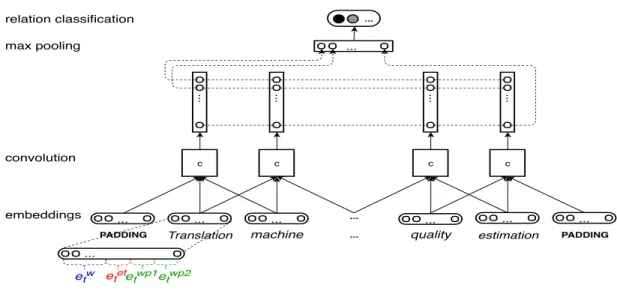
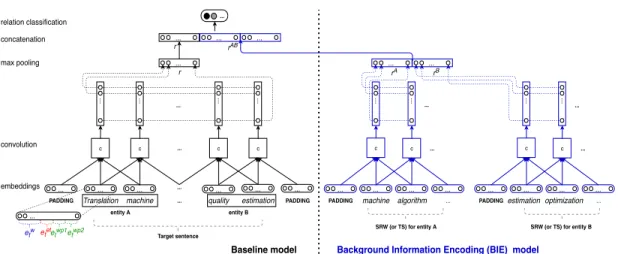
applied on RE. A representative CNNs for RE, as shown in Figure 2.2, consists of four main layers: (i) embeddings layer to encode words in sentences into real-valued vectors, (ii) the convolutional layer to generate n-gram level feature, (iii) the pooling layer to determine the most informative features and (iv) a logistic regression layer(a fully connected neural network with a softmax at the end) to perform relation classification.
Embedding layer is calculated via Equations 2.6-2.9, where Wembw is a word embed-ding projection matrix, Wembet is an entity type (ET) projection matrix, xtw is a one-hot
word representation, and xtetis a one-hot entity type representation. The position vector ewpt encodes the relative distance between the current word and the head of target entity pair. For instance, in Example 9, the relative distance of the word “for” is [-1, 2].
(9) entit y We entit y intr oduce entit y
referential translation machines
entit y (RTMA) for entit y quality estimation B ...
This relative distance will be encoded into position vectors ewp1t and e wp2
t , respectively,
via Equation 2.8, where Wembwp is a word position embedding projection matrix and xtwp is a one-hot representation of the relative distance. Word embedding ewt , entity type embedding eett and word position embedding etwp1and etwp1are concatenated to create
the final word representation et.
etw = Wembw xtw (2.6) eett = Wembet xtet (2.7) etwp= Wembwp xtwp (2.8) et = concat(etw, eett , ewp1t , e wp2 t ) (2.9)
PADDING Translation machine ... quality estimation PADDING c ... embeddings convolution ... ... ... ... ... ... c c c ... ... ... ... ... max pooling ... relation classification ... etw etetetwp1etwp2 Figure 2.2: CNNs architecture zt = concat(et−(k−1)/2, ..., et+(k−1)/2) (2.10) ht = tanh(Wzt+ b) (2.11)
Convolutional layer generates a n-gram level vector ht. ht is calculated by Equa-tions 2.10 and 2.11, where zt is the concatenated embedding of k words in the con-volutional window, k is concon-volutional window size, and W is the weight matrix of the convolutional layer. In order to address the issue of referencing words with indices outside the sentence boundaries, the target sentence is padded with a special PADDING token (k − 1)/2 times at the beginning and the end.
Max pooling layer chooses the maximum value from each dimension of the n-gram
level feature and merges them as the sentence level feature r via Equation 2.12, where i indexes feature dimensions, M is the number of feature dimensions.
ri = max
Logistic regression layer predicts the semantic relationship between a target entity
pair in a target sentence x, by computing the score for a class label c ∈ C via dot product:
Sθ(x)c = rT[Wclass]c, (2.13)
where C is a set of predefined semantic relationships, r is the sentence level feature vector, and Wclass is the class embedding matrix. The column of Wclassrepresents the distributed vector representation of different class labels.
2.3
Knowledge Graph Completion
Knowledge Graphs (KGs), such as Freebase [7] and DBpedia [38], provide large collections of relations between entities, typically stored as (h, r, t) triples, where h = head entity, r = relation and t = tail entity, e.g., (Tokyo, capitalOf, Japan). As distinguished from the task of RE which constructs KGs from raw text, Knowledge Graph Completion (KGC) automatically infers missing facts by examining the latent regularities in existing ones. For example, suppose the triples (SVM, APPLY_TO,
recognition) and (SVM, be_INPUT1, microblog) are stored in a KB, as shown in
Table 2.1, based on the fact, a KBC model would infer the new plausible triple (SVM, APPLY_TO, classification) rather than (SVM, APPLY_TO, corpus), because entity
classification and entity recognition share some latent semantic features.
The latent semantic features are represented by KB embedding, which embeds triple of KB into a continuous vector space, so as to decompose the observed triples into a product of vectors. For a given fact triple (h, r, t) in which head entity h is linked
head entity relation tail entity
SVM APPLY_TO recognition
SVM be_INPUT microblog
SVM ? classification
SVM ? corpus
Table 2.1: Instances for Scientific KGC.
to tail entity t through relation r, the score of plausibility can then be recovered as a multi-linear product between the embedding vectors of h, r and t.
Suppose we have a KG containing a set of fact triplets O = {(h, r, t)}, where each fact triplet consists of two entities h, t ∈ E and their relation r ∈ R. Here E and R stand for the set of entities and relations respectively. KGC model then encodes h, t ∈ E and their relation r ∈ R into low-dimensional vectors h, t ∈ Rd and r ∈ Rd respectively, where d is the dimensionality of the embedding space. KGC models define a scoring function fr(h, t) to evaluate the plausibility of a given fact triplet (h, r, t). The goal of
KGC models is to define an effective scoring fuction so that the score of a correct triplet fr(h, t) is higher than the score of an incorrect triplet fr(h0, t0). KGC models minimize
a loss function to learn the model parameters (i.e., entity vectors, relation vectors and matrices). The margin-based pairwise ranking loss [8] that defined via Equation 2.14 is conventionally used as the loss function for KGC models.
L = Õ
(h,r,t)∈O,(h0,r,t0)∈O0
[γ − fr(h, t)+ fr(h0, t0)]+ (2.14)
In Equation 2.14, [x]+ = max(0, x), γ is the margin hyperparameter, O0 denotes the set of incorrect triplets obtained by corrupting the set of correct triplets O. This section introduces four representative KGC models, which are TransE [8], TransD [30],
ComplEx [68] and SimplE [32].
2.3.1
TransE
Given a fact triplet (h, r, t), TransE then encodes entities h, t and relation r into a real-valued vector h ∈ Rd, t ∈ Rdand r ∈ Rdrespectively. TransE defines the scoring function via the Equation 2.15.
fr(h, t)= −kh + r − tk1/2 (2.15)
The score evaluates the distance between h + r and t, which is expected to be large if (h, r, t) holds.
2.3.2
TransD
TransD is an extension of TransE and introduces additional mapping vectors hp, tp
∈ Rd and rp ∈ Rd for h, t and r respectively. TransD defines the scoring function via the Equation 2.16, where Mr h and Mrt are projection matrices for mapping entity embeddings into relation specific spaces.
fr(h, t)= −khr+ r − trk1/2 (2.16)
hr = Mr hh,
tr = Mrtt,
Mr h = rph>p + Id×d,
2.3.3
ComplEx
Given a fact triplet (h, r, t), ComplEx then encodes entities h, t and relation r into a complex-valued vector h ∈ Cd, t ∈ Cd and r ∈ Cd respectively, where d is the dimensionality of the embedding space. Since entities and relations are represented as complex-valued vector, each x ∈ Cd consists of a real vector component Re(x) and imaginary vector component Im(x), namely x = Re(x) + iIm(x). The KG scoring function of ComplEx for a fact triplet (h, r, t) is calculated via Equation 6.11, where ¯t is the conjugate of t; Re(·) (or Im(·)) means taking the real (or imaginary) part of a complex value. hu, v, wi is defined via Equation 6.12, where [·]nis the n-th entry of a vector.
fr(h, t)= Re(hh,r,¯ti) =
hRe(r), Re(h), Re(t)i +hRe(r), Im(h), Im(t)i +hIm(r), Re(h), Im(t)i −hIm(r), Im(h), Re(t)i
(2.17) hu, v, wi = d Õ n=1 [u]n[v]n[w]n (2.18)
Since the asymmetry of this scoring function, namely fr(h, t) , fr(t, h), ComplEx can
2.3.4
SimplE
Given a fact triplet (e1,r, e2), SimplE then encodes each entity e ∈ E into two vectors
he, te ∈ Rd and each relation r ∈ R into two vectors vr, vr−1 ∈ Rdrespectively, where d is the dimensionality of the embedding space. he captures the entity e’s behaviour as the head entity of a fact triplet and te captures e’s behaviour as the tail entity. vr
represents r in a fact triplet (e1,r, e2), while vr−1 represents its inverse relation r−1 in
the triplet (e2,r−1, e1). The KG scoring function of SimplE for a fact triplet (e1,r, e2) is
defined via Equation 6.14.
fr(e1, e2)=
1
2(hhe1, vr, te2
i+ hhe
Chapter 3
Improving Scientific Relation
Extraction with Task Specific
Supersense
3.1
Introduction
In this chapter, we propose a new semantic category called the task specific supersense (TSS) for a given RE or Relation Classification (RC). TSS is defined according to the property of a given Relation Classification (RC) task, which includes the definitions of target relations and selectional tendency of target relations. We hypothesize that TSS can be utilized to improve the performance of scientific RC1.
Suppose the following target sentence taken from the SemEval-2018 task 7 dataset [20]: (10) This paper presents a
entit y
critical discussionX of the various approaches that have
been used in the
entit y
evaluation of Natural Language systems
Y .
In this dataset, the entity mentions are annotated but their types are not tagged. This task asks a RC system to classify the target entity pair into several predefined semantic relations. One of them is TOPIC relation. The relation TOPIC(X, Y) namely means the entity X deals with the topic Y. Therefore, the entity X tends to be a research activity, such as “analysis”, “survey” and “discussion” etc. Based on this selectional tendency, we define a TSS to cover these words, called RESEARCH-PROCESS. Identifying
RESEARCH-PROCESS for a given word such as “discussion” in Example 19, could
help a RC system to correctly classify the target entity pair into TOPIC relation. Similarly, suppose the following target sentences from the RANIS dataset [66]: (11) A
D AT A−IT E M
verb ’saspectual categoryD AT A−IT E M
Y can be PROCE SS predicted X ... (12) ... PL AN D−OR−PROCE SS
statistical generationtocombinePROCE SSX common phrasesD AT A−IT E M
Y into a
D AT A−IT E M
sentence .
In this dataset, both entity mentions and entity types (e.g., PROCESS, PLAN,
DATA-ITEM) are annotated. The target relations includes relation OUTPUT(X, Y) (as in
Example 11), and INPUT(X, Y) (as in Example 12). They namely mean entity Y is the output/input of a process X. Based on the definition, we propose a TSS called
OUTPUT-PROCESS, verbs like “show”, “identify” and “extract” belong to this TSS, because “a system can show/identify/extract Y” represents that the system can output Y. If we could
correctly identify the OUTPUT-PROCESS in a given target sentence, and apply the new specific TSS , it could help a RC system more effectively identify OUTPUT relation, in comparison with only using the original general entity type, PROCESS. For instances, in Example 11 and Example 12, both target entities “predicted” and “combine” belong
to the same entity type, PROCESS, but the former specifically belongs to the TSS,
OUTPUT-PROCESS, and the latter does not. Therefore, based on this difference, a RC
system could easily distinguish them, and classify the former as OUTPUT relation. For identifying the TSS, one possibility is to manually annotate the TSS in target sentences. However, manual annotation is time-consuming [33] and expensive [2]. To address this issue, in this work, we propose a minimally supervised approach that utilizes supersense embeddings. Specifically, we manually prepare a small number of seed instance words for the predefined supersense (or TSS) (e.g., “survey” for
RESEARCH-PROCESS) and train the embedding of word and supersense in the same
vector space, like the method Flekova and Gurevych [19] proposed, which will be detailed in Section 3.3. By comparing the emebdding between supersense and a given word, we determine its TSS. Our evaluation empirically demonstrates that incorporating the TSS could improve the performance of scientific RC.
3.2
Related Work
Conventional approaches for RC rely on human-designed, complex lexical-syntactic patterns [9], statistical co-occurrences [65] and structuralized knowledge bases such as WordNet [24, 10]. In recent years, exploring Neural Network (NN)-based models has been the dominant approach in the field. Zeng et al. [79] and Xu et al. [77] proposed a Convolutional Neural Network (CNN)-based framework, which depends on sentence-level features collected from an entire target sentence and lexical-sentence-level features from lexical resources such as WordNet [18]. Santos et al. [61] proposed a ranking CNN model, which is trained by a pairwise ranking loss function. To improve the ability of sequential modeling, Zhang et al. [81] proposed a recurrent neural network
(RNN)-based model for RC. Other variants of RNN-(RNN)-based models have been proposed, such as Miwa et al. [49], who proposed a bidirectional tree-structured LSTM model.
Additionally, similar NN-based approaches are used in scientific relation classi-fication. For instance, Gu et al. [22] utilized a CNN-based model for identifying
chemical-disease relations from the abstracts of MEDLINE papers. Hahn-Powell et
al. [25] proposed an LSTM-based RNN model for identifying causal precedence rela-tionship between two event mentions in biomedical papers. Ammar et al. [1] enhanced Miwa and Bansal [49]’s relation extraction model via extensions such as gazetteer-like information extracted from Wikipedia. Pratap et al. [53] incorporate WordNet hyper-nyms as the feature for scientific RC. However, none of these approaches leverage the task specific supersense for RC.
Flekova and Gurevych [19] integrated supersense into distributional word repre-sentation, and trained supersense embedding and word embedding in the same vector space. They used the similarity between supersense embedding and word embedding as a feature to identify supersense. We applied the similar approach to tag the TSS to enhance the performance of scientific RC.
3.3
Task Specific Supersense Embedding
3.3.1
Preparing Seed TSS Instances
To learn the TSS embedding, we firstly define a TSS according to the property of a given task, such as what kinds of relation are in the given task, what is the definition of the target relation, what type of entity tends to participate in the target relation, etc, as discussed before. We test our hypothesis on different RC tasks in the computational
TSS Seed Instances
SYSTEM or METHOD parser, system, learner, decoder, technology, ... RESEARCH-PROCESS analyze, investigate, study, survey, trial, ...
OUTPUT-PROCESS describe, show, learn, provide, achieve, ... INPUT-PROCESS combine, compare, convert, transform, divide, ...
Table 3.1: TSS and corresponding seed instances
linguistic domain in which some RC task, like SemEval-2018 task 7 [20], aims to classify relations, such as USAGE, TOPIC and MEDOL-FEATURE, and other task, like RC on RANIS dataset [66], asks for identifying relations such as INPUT and OUTPUT. Therefore, we come up with four 2 types of TSS, as shown in the first column of Table 3.1, for distinguishing these relations for a given specific task. For instance, tagging SYSTEM or METHOD in target sentences could help USAGE relation recognition. After figuring out TSS for a given RC task , we manually prepare a small number of seed instances for the predefined TSS as shown in the second column of Table 3.1.
3.3.2
Building TSS Embeddings
Similar to the method proposed by Flekova and Gurevych [19], we replace each word in a corpus by its corresponding TSS according to seed instances prepared in the previous step. In this way, besides the original corpus (see Table 3.2, first row), we obtain an alternative corpus where each word is replaced by its corresponding TSS (see Table 3.2, second row). We trained the TSS embeddings on the ACL Anthology Reference Corpus [5] and its alternative corpus jointly (e.g., both first and second row in Table 3.2) by the skip-gram NN architecture made available by the Gensim word2vec
2As a preliminary study, we only select four representative types of TSS, but in the future, we will investigate more types of TSS for scientific RC.
1
In the above example , three different analyses have been found. Ribas ( 1994a ) reported experimental results obtained from the
application of the above technique to learn SRs.
2
In the above example , three different RESEARCH-PROCESS have been found.
Ribas ( 1994a ) reported experimental results obtained from the application of the above technique to OUTPUT-PROCESS SRs.
Table 3.2: Example of original corpus (1) and alternative corpus (2)
TSS
SYSTEM or METHOD model, models, system, approach, algorithm
method, parser, framework, classifier, module
RESEARCH-PROCESS study, work, research, analysis, investigation,
experiment, experiments, studies, paper, investigations
OUTPUT-PROCESS obtain, derive, find, provide, describe,
give, show, generate, introduce, demonstrate
INPUT-PROCESS compare, combine, integrate, evaluate, convert,
incorporate, augment, analyze, transform, apply
Table 3.3: Top 10 most similar word embeddings for each TSS embedding tool 3. Thereby, we produce continuous representation of words and the predefined TSS in one vector space 4. Table 3.3 shows the most similar word to each of the predefined TSS based on their embeddings’ cosine similarity.
3.3.3
Identifying TSS for Given Words
Since the TSS is positioned in the same vector space with original words, we could utilize the embedding cosine similarity between TSS and given words to determine their TSS. Specifically, we tag a given word with the TSS, if the cosine similarity is above a predefined threshold score 5. For instance, given a target sentence Example 13,
3https://radimrehurek.com/gensim
4The embedding is trained with negative sampling of 25 noise words, minimal word frequency of 10, window size of 2 and alpha of 0.0025, using 15 epochs to generate 300-dimensional vectors.
5We set the threshold score as 0.5 for identifying TSS in SemEval2018 Task7 datasets, and set it as 0.3 for RANIS dataset.
Figure 3.1: TSS identification example, where NONE means the word does not belong to any TSS. SYSMETH and INPRO stand for SYSTEM or METHOD and
INPUT-PROCESS respectively.
the TSS identification result would be Figure 3.1.
(13) large vocabulary continuous speech recognition (LVCSR) , a unified framework
based approach is introduced to exploit multi-level linguistic knowledge
3.4
Proposed Model
3.4.1
Task Setting
In this chapter, we create a task setting where, given definitions of target relations and collections of unannotated scientific papers, we come up with a new entity type called TSS and train TSS embedding on the raw corpus. Based on the embedding cosine similarity between TSS and a given word, we identify the TSS, and incorporate the TSS information into a state-of-the-art RC model, thereby improve its performance on scientific RC. We execute the problem setting in computational linguistic domain, but we believe that this setting can provide useful guide to other domains, such as RC in biomedical domain.
3.4.2
Base Model
We choose the RC model that is proposed by Santos et al. [61] as our base RE model, since it is simple and strong. As shown in Figure 5.3, it is composed of three layers. The first layer is an embedding layer, which maps each word of the target sentence
PADDING Translation machine ... quality estimation PADDING c ... embeddings convolution ... ... ... ... ... ... c c c ... ... ... ... ... max pooling ... relation classification ... etw etetetwp1etwp2
Figure 3.2: Base model architecture
into a low-dimensional word vector representation. The embedding layer is calculated via Equations 6.5-5.6, where Wembw is a word embedding projection matrix, Wembet is an entity type (ET) projection matrix, xtw is a one-hot word representation and xtet
is a one-hot entity type representation. The position vector etwp encodes the relative
distance between the current word and the head of target entity pair. For instance, in Example 29, the relative distance of the word “for” is [-1, 2].
(14) We introduce referential translation machines
entit y
(RTMA) for
entit y
quality estimation
B ...
This relative distance will be encoded into position vectors ewp1t and ewp2t , respectively,
via Equation 5.5, where Wembwp is a word position embedding projection matrix and xtwp
is a one-hot representation of the relative distance. Word embedding ewt , entity type
embedding eett and word position embedding e wp1 t and e
wp1
t are concatenated to create
the final word representation et. If the dataset does not have entity type information, like SemEval-2018 Task 7 dataset, eett will be ignored.
etw = Wembw xtw (3.1) eett = Wembet xtet (3.2) etwp= Wembwp xtwp (3.3) et = concat(etw, eett , ewp1t , etwp2) (3.4) zt = concat(et−(k−1)/2, ..., et+(k−1)/2) (3.5) ht = tanh(Wzt+ b) (3.6)
The next layer is a convolutional layer, which generates a distributed convolutional window level vector ht. ht is calculated by Equations 5.7 and 5.8, where zt is the concatenated embedding of k words in the convolutional window, k is convolutional window size, and W is the weight matrix of the convolutional layer. In order to address the issue of referencing words with indices outside the sentence boundaries, the target sentence is padded with a special PADDING token (k − 1)/2 times at the beginning and the end.
The third layer is a max pooling layer, which chooses the maximum value from each dimension of the convolutional window level feature and merges them as the sentence level feature r via Equation 6.6, where i indexes feature dimensions, M is the number of feature dimensions.
ri = max
t {(ht)i}, ∀i = 1, ..., M (3.7)
a target sentence x, by computing the score for a class label c ∈ C via dot product:
Sθ(x)c = rT[Wclass]c (3.8)
where C is a set of predefined semantic relationships, r is the sentence level feature vector, and Wclass is the class embedding matrix. The column of Wclassrepresents the distributed vector representation of different class labels. It is worth mentioning that the model uses a logistic loss function, as shown in Equation 5.11:
L = log(1 + exp(γ(m+− sθ(x)y+)) +log(1 + exp(γ(m−+ s
θ(x)c−))
(3.9)
where sθ(x)y+ is the score of correct class label, sθ(x)c− is the score of the most
competitive incorrect class label, m+ and m−are margins, and γ is a scaling factor. In our experiment, we use m+ = 2.5, m− = 0.5 and γ = 2.
3.4.3
Incorporating TSS
We incorporate TSS information via Equations 3.10-3.11, where Wembtss is an TSS projection matrix, and xttssis a one-hot TSS representation.
ettss= Wembtss xttss (3.10)
et = concat(ewt, etet, etsst , etwp1, e wp2
3.5
Data
3.5.1
SemEval-2018 Task 7 dataset
We evaluate the effectiveness of TSS for scientific RC on three different datasets. The first and second dataset we use in evaluation are the SemEval-2018 Task 7.1.1 & 7.1.2 datasets [20], which are in computational linguistic domain. This task handles 6 semantic relations in scientific paper abstracts. The datasets of subtasks 1.1 and 1.2 contains titles and abstracts of papers where entity mentions are either manually annotated (Subtask 1.1), as Example 15, or automatically annotated (Subtask 1.2), as Example 16. The target semantic relations in dataset 1.1 and 1.2 are manually annotated. There are 1228/1248 training examples and 355/255 testing examples in dataset 1.1/1.2. These samples are classified into one of the following semantic relations: USAGE, RESULT, MODEL-FEATURE, PART-WHOLE, TOPIC, COMPARISON. The official evaluation metric is macro-F1 score.
(15) Recently the LATL has undertaken the development of a <entity 1579.1">multilingual translation system</entity> based on a <entity id="L08-1579.2">symbolic parsing technology</entity> (...)
(16) The aim of this <entity id="L08-1239.17">paper</entity> is at investigating the <entity id="L08-1239.18">relationships</entity> (...)
3.5.2
RANIS dataset
The third dataset we use is RANIS corpus [66], a collection of computer science paper abstracts. The type of entity (referred to as Entity Type (ET) hereafter) and
Figure 3.3: Annotation example shown in brat rapid annotation tool. To more clearly illustrate the direction of relation, we add directional tag “L-” and “R-” before each relation tag.
domain specific relation in the RANIS corpus has already been annotated with the annotation scheme proposed by [66], as Figure 5.4. The dataset consists of ETs such as QUALITY, PROCESS and DATA-ITEM and domain specific scientific relations, such as INPUT, OUTPUT and APPLY-TO. In total, the RANIS corpus contains 250 abstracts collected from ACL Anthology (230 abstracts in the development set and 20 abstracts in the test set) and 150 abstracts collected from ACM Digital Library. For training and testing our proposed model, we only use the 250 abstracts from ACL Anthology. From the ACL Anthology abstracts, we extract 11,520 examples from the development set of ACL Anthology and 1,142 examples from the test set of ACL Anthology. These instances are classified into one of the following semantic relations: ORIGIN, COMPARE, EQUIVALENCE, TARGET, OUTPUT, PEFORM, ATTRIBUTE, DESTINATION, RESULT, EVALUATE, APPLY-TO, INPUT, IN-OUT, SUBCONCEPT, POSS, CONDITION, SPLIT and OTHER. We choose the weighted F1 score as the evaluation metric.
Parameter Name Value
Word Emb. size 200
Word Entity Type (or TSS) Emb. size 50
Word Position Emb. szie 100
Convolutional Units 1000
Context Window size 3
Learning Rate 0.01
Table 3.4: Hyperparameters for Relation Classification
3.6
Experiments
3.6.1
Setup
Since the most informative part of text to classify the relation type generally exists between and including target entity pair [37, 78], we only utilize this part of the sentence and disregard the surrounding words for RC.
Previous works have shown that scientific papers specific pre-trained word embed-dings can improve training for scientific RC models [60, 27, 31, 43]. Therefore, in this work, we trained the scientific papers specific word embeddings on the ACL An-thology Reference Corpus [5] by the skip-gram NN architecture made available by the Gensim word2vec tool. We initialized 6 the word embedding layer with the pre-trained domain-specific word embedding for RC. We randomly extract 10% training data as validation data and based on the performance on it to select all the hyperparameters. All experiments below use the hyperparameters as shown in Table 5.3.
3.6.2
Result and Discussion
In this paper, we hypothesize that TSS could be used to improve the performance of scientific RC. For testing this hypothesis, we compare the performance of TSS
6In experiments on SemEval2018 Task 7 datasets, we didn’t tune the word embedding layer, but on RANIS dataset, we tuned it while training.
enhancement with the base model. In other words, we compare the performance before-and-after the automatic TSS tagging, which is mentioned in Section 3.3.
Results for SemEval-2018 Task 7.1.1 are show in Table 4.4. Adding
RESEARCH-PROCESS proves to be very beneficial compared to the base model alone, as we could
improve macro-F1 by more than 5 points. This improvement can be explained by the interdependency between TSS and scientific relations as mentioned in Section 5.1. Thus, even if the number of training samples is small, depending on the corelation, a RC system could correctly classify some relations. While adding the TSS, SYSTEM or
METHOD, could not enhance the performance on this subtask. This could be because
given a specific RC task and its corresponding dataset, some TSS might be redundant when classifying relations. In other words, without the external information from TSS, only the internal information from the dataset itself (e.g., the hint word “using” in Example 17) could be enough to identify some relations (e.g., USAGE(X, Y) in Example 17).
(17)
entity
predictor
X pre-selects the phrase candidates
using
entit y
transition rulesY
Similar observation can be made for SemEval-2018 Task 7.1.2, as is indicated in Table 4.5. Identification of the TSS, SYSTEM or METHOD, could enhance the perfor-mance, while adding the RESEARCH-PROCESS could decrease the performance. This indicates that, given a specific RC task, different TSS could have different contribution to the overall performance. Therefore, it would be important to select proper TSS for a given RC task.
Figure 5.5 and Figure 3.5 compare some practical results between the TSS enhanced model and Base model in SemEval-2018 Task 7.1. Take the second line in Figure 5.5