著者
Keeni Minakshi, Takashino Nina
journal or
publication title
JOURNAL OF FARM MANAGEMENT ECONOMICS
volume
51
page range
38-58
year
2020-02-29
Literature Review on Stateless Refugees:
With Emphasis on Violence Experienced by the Rohingyas
Minakshi KEENI*, Nina TAKASHINO*
Contents
1. Introduction
Millions of people in the world today who have been forced to leave their homes, belong to a particular ethnic group. Ethnic diversity does not necessarily translate into conflict, and ethnic conflict does not necessarily translate into violence. Ethnic violence, however, very often produces refugees (Newland, 1993). Refugees tend to suffer from physical and psychological torture. This torture, according to Gorst-Unsworth and Goldenberg (1998), often is a result of a history of years of discrimination, persecution, and harassment, followed by a period of exile or hiding.
The Rohingyas are considered to be one of the most persecuted minorities in the world. To escape this persecution, around 900,000 refugees migrated to Bangladesh, Indonesia, Malaysia and other parts of the world. The majority of these refugees being stateless and not accepted as citizens by the Myanmar Government has led to discrimination on both sides of the border. The protraction of the refugee situation at refugee camps in Bangladesh has further exacerbated socio-economic conditions for both the host communities as well as the refugees. Whether living in a camp or in non-camp areas, the Rohingya refugees have been subjected to miserable living conditions marked by inadequate access to basic needs, exposure to violence, restricted movement, local hostility and various forms of discrimination (Milton et. al. 2017). While the
* Graduate School of Agricultural Science, Tohoku University
1. Introduction 2. Methodology
1) Statelessness of Rohingya refugee 2) Analytical framework
3. Literature review on refugee studies 1) Timeline of refugee movement 2) Chronology of refugee study
4. Violence Experienced by the Rohingyas 1) History of the Rohingyas
2) Characteristics of Rohingya literature 3) Livelihood and gender-based violence 5. Conclusion
movement of refugees are restricted in the camps, some refugees choose to live alongside the local Bangladeshi with the hope of having more opportunities to find work and a livelihood. However, with them being undocumented, they are more vulnerable to exploitation and harassment.
This paper aims to sort out issues for future studies on violence stemming from the re-establishment of livelihood in refugee camps. To achieve this objective, we examine previous refugee studies with the current situation focusing on culture, gender, livelihood, and social capital. Following this, we look into literature to understand the violence experienced by stateless refugees with special emphasis on the Rohingya crisis. The following literature review has been presented to address the following questions: (I) From what disciplines are refugee issues analyzed? (II) Are there any case-specific tendencies for Rohingya refugee studies? (III) What has already been clarified and what should be studied in the future, for Rohingya refugee studies?
In this respect, the contents of this study are as follows: we describe the characteristics of a Rohingya refugee with the help of an analytical framework in section 2; in section 3, a timeline overview of significant refugee movements along with its subsequent scholarly discussions; literature reviews on Rohingya refugees are shown in section 4; and we conclude in section 5.
2. Methodology
1) Statelessness of Rohingya refugee
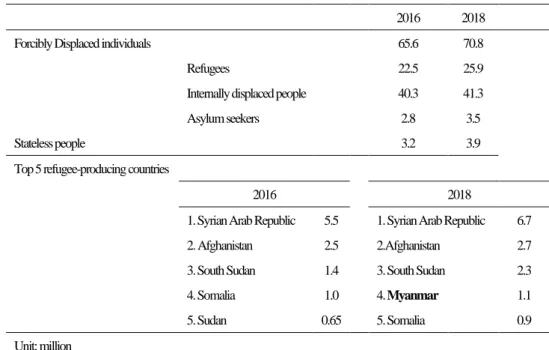
Table 1 displays figures of refugees in the world at the end of the year 2016 and 2018 (UNHCR 2017, 2019). At the end of the year 2018, almost 70.8 million individuals were forcibly displaced on the grounds of persecution, conflict, violence, or human rights violations. UNHCR has classified forcibly displaced people into 3 categories – refugees (crossed international border), internally displaced people (IDPs), and asylum seekers1.
The lower panel of Table 1 shows the change in the 5 largest reported refugee populations in the world at the end of the year 2016 and 2018. At the end of the year 2016, the top 5 refugee-producing countries were war-torn, failed and/or highly unstable states (Hansen 2018). At the end of the year 2018, Myanmar was listed as the fourth largest refugee-producing country. In 2017, due to crimes against Rohingyas in the Rakhine State of Myanmar, hundreds of thousands were forced to flee their homes and cross the border to Bangladesh, joining the existing
Rohingya refugee population.
Table 1. Global trend at the end of year 2016 and 2018.
2016 2018
Forcibly Displaced individuals 65.6 70.8
Refugees 22.5 25.9
Internally displaced people 40.3 41.3
Asylum seekers 2.8 3.5
Stateless people 3.2 3.9
Top 5 refugee-producing countries
2016 2018
1. Syrian Arab Republic 5.5 1. Syrian Arab Republic 6.7
2. Afghanistan 2.5 2.Afghanistan 2.7
3. South Sudan 1.4 3. South Sudan 2.3
4. Somalia 1.0 4. Myanmar 1.1
5. Sudan 0.65 5. Somalia 0.9
Unit: million
Source: UNHCR (2017, 2019b)
The statelessness of the Rohingyas has made the refugees vulnerable to risks. Stateless are individuals who under international law are defined as persons who are not considered to be nationals by any State under the operation of its law. In other words, they do not possess the nationality of any State. Stateless people face difficulty in acquiring fundamental human rights such as education, medical care, or legal employment. Their vulnerability makes them susceptible to experience violence inside or outside refugee camps. Table 1 shows that data reported by UNHCR for the year 2018 captures 3.9 million stateless people in the world. As shown in the table, the number has increased comparatively since the year 2016, a total of 3.2 million. A large part of this change is caused by the increased visibility of the Rohingyas from Myanmar (Institute on Statelessness and Inclusion, 2018).
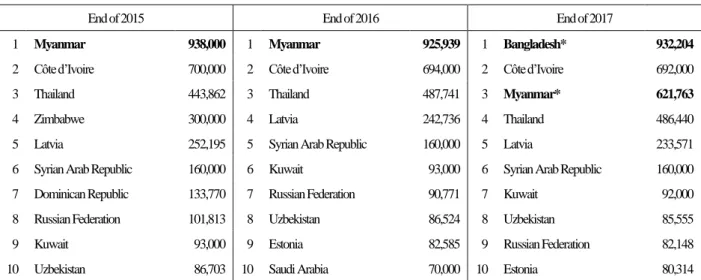
Table 2 displays figures of the ten largest reported stateless populations in the world from 2015 to 2017. At the end of 2017, Bangladesh is shown to be on top of the list due to the massive influx of stateless Rohingyas in 2017. The current total estimated stateless Rohingya refugees in Bangladesh are 932,204. According to Institute on Statelessness and Inclusion (2018), more than 125,000 Rohingyas have been internally displaced within Myanmar for several years, while the number of non-displaced stateless Rohingya in Myanmar has dropped to an estimated 470,000.
Table 2. The ten largest reported stateless populations in the world from 2015 to 2017.
End of 2015 End of 2016 End of 2017
1 Myanmar 938,000 1 Myanmar 925,939 1 Bangladesh* 932,204
2 Côte d’Ivoire 700,000 2 Côte d’Ivoire 694,000 2 Côte d’Ivoire 692,000
3 Thailand 443,862 3 Thailand 487,741 3 Myanmar* 621,763
4 Zimbabwe 300,000 4 Latvia 242,736 4 Thailand 486,440
5 Latvia 252,195 5 Syrian Arab Republic 160,000 5 Latvia 233,571
6 Syrian Arab Republic 160,000 6 Kuwait 93,000 6 Syrian Arab Republic 160,000
7 Dominican Republic 133,770 7 Russian Federation 90,771 7 Kuwait 92,000
8 Russian Federation 101,813 8 Uzbekistan 86,524 8 Uzbekistan 85,555
9 Kuwait 93,000 9 Estonia 82,585 9 Russian Federation 82,148
10 Uzbekistan 86,703 10 Saudi Arabia 70,000 10 Estonia 80,314
* In Bangladesh, the figure includes stateless Rohingya refugees; in Myanmar the figure includes stateless Rohingya IDPs.
Source: Institute on Statelessness and Inclusion (2018)
2) Analytical framework
In section 3, we summarize the history of refugee movements since the 15th century and
scholarly discussions after world war II. We confirm the cause and characteristics of significant refugee movements and how related literature have developed by sorting various refugee studies based on the type of refugee and keywords. For the literature on refugee studies, the search engine Google Scholar was used to find and sort relevant papers.
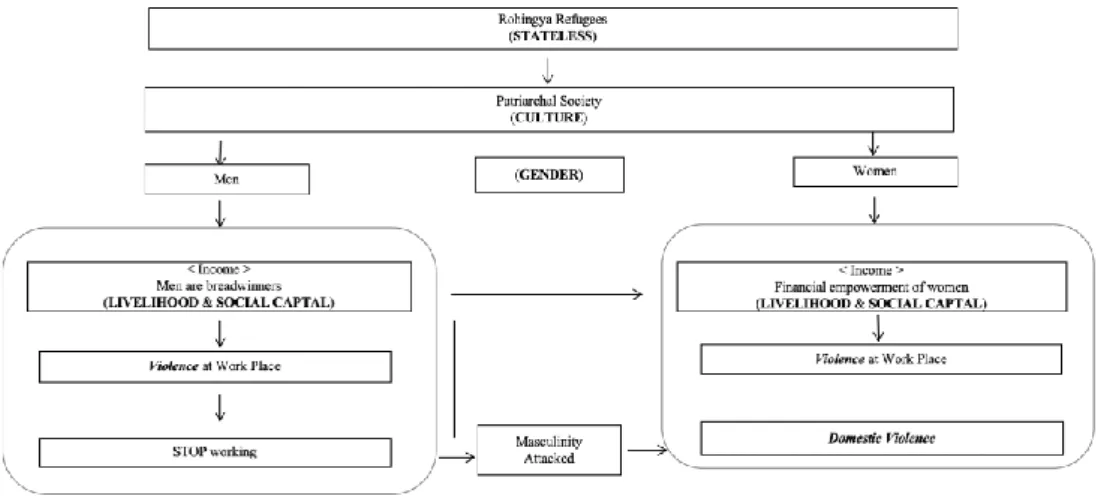
Figure 1 shows an analytical framework used for sorting relevant papers and how the following keywords were chosen. Following the discussion of Akhter and Kusakabe (2014), we used keywords such as “refugee,” “stateless,” “culture,” “gender,” “livelihood,” and “social capital” for selecting of relevant papers. As described in the previous section, statelessness is a significant characteristic of Rohingya refugees, which also makes them vulnerable to the risk of violence. The Rohingya society is inherently patriarchal in its culture and their beliefs involve men being the breadwinners and protectors of a family. However, refugees are exposed to the risk of violence at the workplace, which eventually led to male refugees stopping work. If men stopped working, it was up to the women to become providers for the family. Keeping in mind that the society is patriarchal and that women are not used to working beyond the comfort of their homes, international supporting agencies and NGOs were able to provide jobs to some women as a part of their financial empowerment within the refugee camps. Similar to the case of men’s working place, there were reports of women facing violence at work places outside the refugee camps. Further, this societal dynamic change, threatened and attacked a man’s masculinity, which later translated into an increase in domestic violence. In this viewpoint,
refugees’ culture and gender view affect the cause of violence and to provide secure income generating opportunity to refugees is required. Therefore, keywords “culture”, “gender”, “livelihood” and “social capital” are selected.
Figure 1. Analytical framework and keywords
In section 4, we look into the literature of the Rohingya refugee case using the above shown analytical framework. For this section, the search engine Web of Science was explicitly used.
3. Literature review on refugee studies
1) Timeline of refugee movement
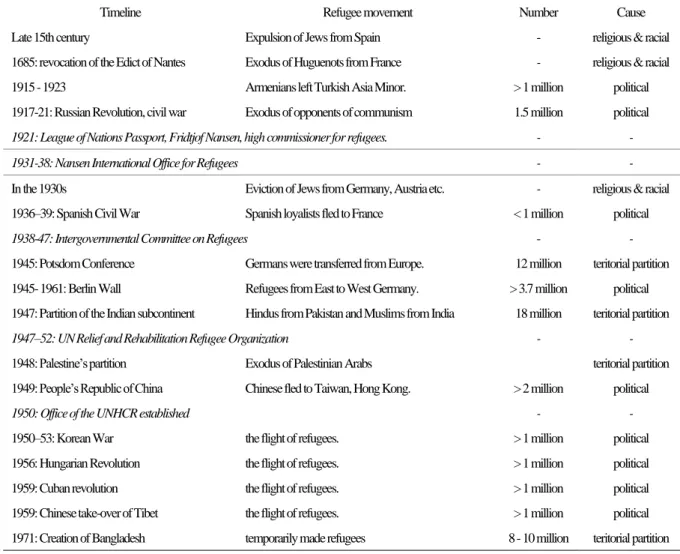
Historically, several refugees moved across countries as a result of religious and racial intolerance, political flight, and territorial partition. Table 3 displays the timeline of significant refugee movement and international agents’ protections since the 15th century. With the
emergence of state borders in the late 19th century, the refugee problem became a serious legal
issue. Before 1921, those who needed asylum could move from one country to another without passports or visas. In response to this refugee crisis, after World War II, in 1950, the United Nations established the United Nations High Commissioner for Refugees (UNHCR). UNHCR acts as the guardian of the 1951 Convention relating to the Status of Refugees, which defines the legal protections for refugees.
Table 3. Timeline of refugee movements and protection
Timeline Refugee movement Number Cause
Late 15th century Expulsion of Jews from Spain - religious & racial
1685: revocation of the Edict of Nantes Exodus of Huguenots from France - religious & racial
1915 - 1923 Armenians left Turkish Asia Minor. > 1 million political
1917-21: Russian Revolution, civil war Exodus of opponents of communism 1.5 million political
1921: League of Nations Passport, Fridtjof Nansen, high commissioner for refugees. - -
1931-38: Nansen International Office for Refugees - -
In the 1930s Eviction of Jews from Germany, Austria etc. - religious & racial
1936–39: Spanish Civil War Spanish loyalists fled to France < 1 million political
1938-47: Intergovernmental Committee on Refugees - -
1945: Potsdom Conference Germans were transferred from Europe. 12 million teritorial partition
1945- 1961: Berlin Wall Refugees from East to West Germany. > 3.7 million political
1947: Partition of the Indian subcontinent Hindus from Pakistan and Muslims from India 18 million teritorial partition
1947–52: UN Relief and Rehabilitation Refugee Organization - -
1948: Palestine’s partition Exodus of Palestinian Arabs teritorial partition
1949: People’s Republic of China Chinese fled to Taiwan, Hong Kong. > 2 million political
1950: Office of the UNHCR established - -
1950–53: Korean War the flight of refugees. > 1 million political
1956: Hungarian Revolution the flight of refugees. > 1 million political
1959: Cuban revolution the flight of refugees. > 1 million political
1959: Chinese take-over of Tibet the flight of refugees. > 1 million political
1971: Creation of Bangladesh temporarily made refugees 8 - 10 million teritorial partition
Source: Authors created
Figure 2. Number of refugees Source: UNHCR Population Statistics Reference Database
Figure 2 displays the number of refugees extracted from the UNHCR Population Statistics. In the 1950s and 1960s, relatively few asylum seekers and refugees from low-income countries made their way to the world’s wealthier states. In the early 1980s, asylum seekers from countries like Africa, Asia, the Middle East, and Central America began to arrive in significant numbers. At around the same time, a growing number of asylum seekers from communist countries of Central and Eastern Europe also began to arrive in the west. Confronted by these flows, by the middle of the 1980s, almost all of industrialized states expressed their distress towards the rising ‘asylum crisis’ (UNHCR 1997). The non-arrival refugee regime in industrialized countries sustained the number of refugees in the 1990’s.
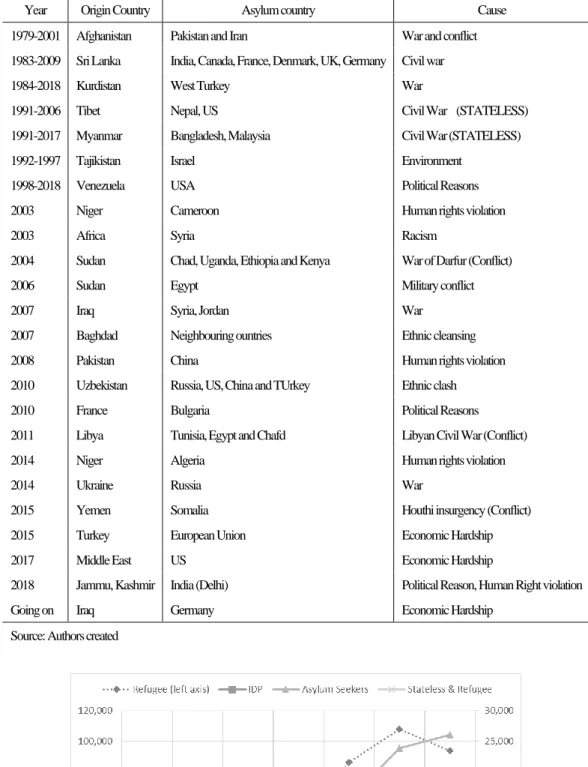
After a millennium, a massive increase in the number of refugees was seen, with many of them fleeing to neighboring Third world countries. Table 4 shows recent refugee movements. It displays the year, countries of origin, asylum countries, and the cause of movement. Form the table, it could be seen that most of the refugees originated from African, Middle Eastern, and Asian countries. Asylum countries are spread worldwide, primarily Africa and Asia. Compared to the movement before the 1970s, as shown in table 3, a large part of the refugee movement can be characterized as seeking asylum from their origin third world country to another. According to UNHCR (2019), about 80 percent of these refugees live in neighboring countries to their countries of origin.
2) Chronology of refugee study
Figure 3 shows the amount of published literature on refugees sorted based on the type of refugee. The total number of articles including the keyword “Refugee” in manuscripts has increased significantly(the figure is shown in the left axis). Reflecting on the fact that the majority of the refugees are internally displaced people, lots of research on internally displaced people were conducted since the early stages of refugee study in the 1980s. As industrialised host countries experienced mass refugee acceptance, a study on Asylum seekers became critical not only for refugees but also for accepting societies. Recently, the vulnerability of stateless people have been reported. In light of this, the UNHCR launched a global campaign aimed at ending, within a decade, the problem of statelessness in 2014. There has been a rapid growth in concerns towards stateless, which can be confirmed by the increase in the usage of the keyword ‘stateless’ in recent literature.
Table 4. Refugee Cases from 2000-2017
Year Origin Country Asylum country Cause
1979-2001 Afghanistan Pakistan and Iran War and conflict
1983-2009 Sri Lanka India, Canada, France, Denmark, UK, Germany Civil war
1984-2018 Kurdistan West Turkey War
1991-2006 Tibet Nepal, US Civil War (STATELESS)
1991-2017 Myanmar Bangladesh, Malaysia Civil War (STATELESS)
1992-1997 Tajikistan Israel Environment
1998-2018 Venezuela USA Political Reasons
2003 Niger Cameroon Human rights violation
2003 Africa Syria Racism
2004 Sudan Chad, Uganda, Ethiopia and Kenya War of Darfur (Conflict)
2006 Sudan Egypt Military conflict
2007 Iraq Syria, Jordan War
2007 Baghdad Neighbouring ountries Ethnic cleansing
2008 Pakistan China Human rights violation
2010 Uzbekistan Russia, US, China and TUrkey Ethnic clash
2010 France Bulgaria Political Reasons
2011 Libya Tunisia, Egypt and Chafd Libyan Civil War (Conflict)
2014 Niger Algeria Human rights violation
2014 Ukraine Russia War
2015 Yemen Somalia Houthi insurgency (Conflict)
2015 Turkey European Union Economic Hardship
2017 Middle East US Economic Hardship
2018 Jammu, Kashmir India (Delhi) Political Reason, Human Right violation
Going on Iraq Germany Economic Hardship
Source: Authors created
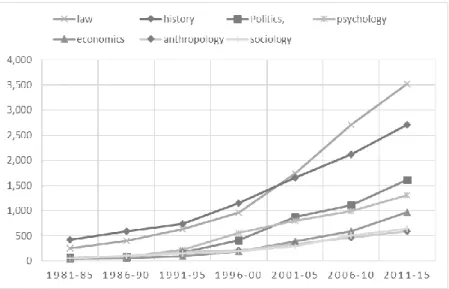
Figure 4. Literature of refugee sorted by discipline
Figure 4 shows search results of refugee studies sorted by disciplines. The number of studies conducted by the following disciplines - “law,” “history,” “politics,” “psychology,” “economics,” “anthropology,” and “sociology” on refugees is described. As we recognize the need for multidisciplinary research addressing refugee issues, many studies from different perspectives have accumulated over the decades. The volume of refugee studies in sociology, economics, and anthropology is less than desk studies addressing macro issues in law, history, and political aspects of refugees. Law and politics are practical approaches to immigration law, immigration policies and institutions, and structural analysis. History, economics, and anthropology can analyse the causes and dynamics of displacement. Psychology and anthropology are suitable for studying individual asylum, identity, affiliation, and personal and collective experiences.
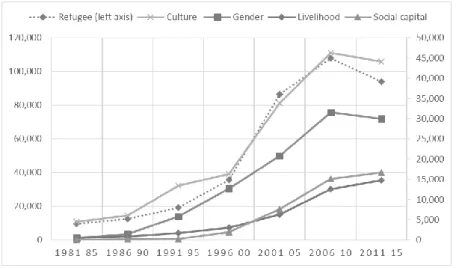
Figure 5 shows the amount of literature published from 1981 to 2015, sorted by keywords.
Similar to figure 3, the number of studies with the keyword “refugee” is shown in the left axis and studies with other keywords (culture, gender, livelihood, social capital) are denoted in the right axis. The keyword “culture” is a general term, and cultural differences can be both a cause of refugee migration as well as issues faced at refugee camp settlements in the host country. Also, from a macro or microanalytical point of view, culture is essential for the discussion of both the macrosystem (like legal acceptance system, international relations) and the micro behavior of refugees (such as network building at refugee camps, psychological recovery to new adjustments). Therefore, there is a proportionally increased use of the keyword “culture” in studies involving the keyword “refugee.” Similarly, studies with the keyword “gender” have proportionately increased to the study with “refugee” as gender differences could be an issue of both pre and post refugee migrations which closely relates to both the micro and macro
analytical views. Reflecting on the relative narrowness of the term “gender” compared to “culture, the volume of the study is around 60-75% of the study of culture.
Figure 5. Literature of refugee sorted by keywords
The number of studies with keywords “livelihood” or “social capital” is around half of those with “culture” or “gender.” One possible explanation is that “livelihood,” or “social capital” tends to be used in the post-migration and microanalytical views with specific context to refugee literature study. The figure shows that the number of studies with “livelihood” or “social capital” started to increase after the year 2001 reflecting researcher’ rising interest in detailed case studies in this period.
4. Violence experienced by Rohingyas
1) History of the Rohingyas
The Rohingya crisis arises from religious and social differentiation between the Rakhine Buddhists and Rohingya Muslims. During the World War II, the Rohingyas were allied with the British , to fight against the local Rakhine Buddhists, who were allied with the Japanese, in return for a promised Muslim state. Following their independence in 1948, the newly formed union government denied citizenship to the Rohingyas, subjecting them to extensive systematic discrimination in the country. From 1947-61, the Rohingyas formed a mujahideen, which then fought the government forces in an attempt to monopolize the most Rohingya populated region around the Mayu peninsular in northern Arakan.
Rohingya separatist movements emerged from the remnants of the mujahideen, and the fighting resulted in the Burmese government launching a massive military operation named the- “Operation Dragon King’ in 1978 to expel the so-called “foreigners’. Also, in the 1990s, the government of Myanmar launched another offensive attack against the Rohingya Solidarity Organization (RSO). Consequently, a counter-attack by unidentified insurgents on three Burmese border posts alongside Myanmar's border with Bangladesh caused the slow but gradual movement of refugees into Bangladesh. Prior to 1962, the Rohingyas were holders of Government-issued identity cards as well as British-issued ration cards, which affirmed them as citizens of Burma. Under the pretext of checking these ID cards, they were forcibly taken and torn to bits to deny them their legal identity (Lintner, 1990).
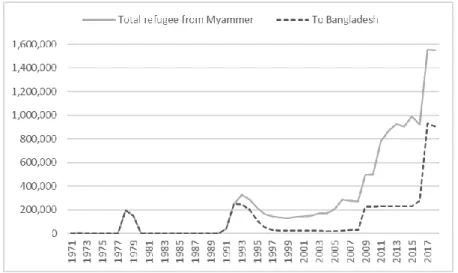
Figure 6. Refugee number from Myanmar
Social exclusion and discrimination against the Rohingyas took place in avenues of politics and education. Before independence and particularly after independence, there were several Muslim members of parliament (MP), with compulsory participation of two Muslim ministers in the cabinet till 1962. However, post the army regime from 1962 to 1995, not a single Muslim was appointed as a minister or even as a deputy minister (South, 2005). Schools got nationalized in 1963, resulting in the removal of all Muslim high schools. Muslim headmasters and senior Muslim teachers were replaced with Buddhist teachers (Parnini, Naushin, 2013). As reported by Wonterghem, the Burmese Muslims human rights advocates, based abroad, state that they were deprived of their political rights and opportunity of service in the government, ministries, directorates, departments, corporations, judiciary, education and local administrative councils diverting them into the avenue of trade and cottage industries in which they became quite successful.
The Rohingyas were then effectively rendered stateless with the passage of the 1982 nationality law that did not recognize them as one of 135 ‘national ethnic groups’ worthy of Burmese citizenship. They were viewed as ‘illegal immigrants’ from Bangladesh, their freedom of movement within Myanmar was severely restricted and were denied access to schools, hospitals, and even markets (Kingston, 2019). On 25 August 2017, the recognition of the mass atrocity crimes such as ethnic cleansing and genocide, including systematic rape of women and girls, bought the Rohingya crisis to light. Hence highlighting the term ‘statelessness.’
As shown in Figure 6, many refugees moved to Bangladesh. Bangladesh Government’s Policy of Encampment led to the total restriction of movement for camp refugees. No refugee could go out of the camp without prior approval of camp officials, which is seldom entertained in writing (Parnini, Naushin 2013). Anybody caught red-handed out visiting the camp illegally or more could face harsh treatment, which included beating from the police. The policy of Unburdening Responsibility pertains to the responsibility taken by the Bangladesh Government in terms of economic burden. Bangladesh has borne little cost towards caring for the refugees. However, the government does benefit from having the UNHCR around as it leads to an increase in employment in the country. The policy of repatriation is, however, a dilemma, with a majority of the refugees being unwilling to return home. Although in 1997, repatriation of around 7535 refugees did happen, after which it was stopped. The Government of Bangladesh then quickly declared that no refugees would be allowed to settle in Bangladesh permanently, and this position has been renewed time and again and is still the current policy of the government.
All forced migrants begin from a position of loss, including the loss of assets, family and community and often emotional and physical health. At the host country, forced migrants must try to re-establish their livelihoods in a policy context that is often weighted against them (Jacobsen, 2014). Refugees and IDPs are usually provided with humanitarian assistance and livelihood programs. However, these sometimes can have negative effects and backfire.
IDPs and Statelessness however have different implications for refugees. The main difference being that IDPs are citizens rather than ‘foreigners’ and thus are not constrained by laws and policies pertaining to non-citizens. Not all refugees arrive at their places of asylum impoverished and some nationalities do better than others.
There are, to be sure, cases of real persecution: the mass exodus of hundreds of thousands of Rohingya from Myanmar being a vital contemporary example. Nonetheless, the majority of these refugees fled generalized violence rather than individual persecution.
2) Characteristics of Rohingya literature
Figure 7 shows the amount of literature that included the keyword “Rohingya” in the article. As shown in the figure, scholarly attention toward Rohingya issues has increased rapidly since 2000. As described in the previous section, the Rohingya issue is not a new phenomenon but has existed for decades. The recent humanitarian attacks and mass migration required the immediate need for scholars to address this issue.
Figure 7. Literature of Rohingya from 1991 to 2020
Compared to the literature on refugees in general, literature on Rohingya issues tends to focus more on “culture,” “gender,” and “livelihood.” Panel (b) of figure 8 shows 39.1 to 47.0 % of refugee study included the keyword “culture,” reflecting the fact that many refugee issues involved the aspect of culture. The stronger tendency is found for the Rohingya case in panel (a), with 54.2 to 72.3 % of Rohingya studies, including the keyword “culture” due to the cultural difference being the leading cause of conflict at both the Origin and Host countries. This refers to the difficulties faced by Rohingya refugees towards adjustments into the culture of the host country.
(a) Rohingya and keywords (% of Rohingya studies) (b) Refugee and keywords (% of refugee studies)
Compared to non-specific refugee studies, Rohingya literature tends to mention about gender issues. Panel (a) shows that the share of “Gender” related literature for the Rohingya study is 33.6 to 47.4 % and slightly more than that of the general refugee study case (24.1 to 39.5 %) in panel (b).Similarly, “livelihood” is included more in Rohingya literature rather than non-specific refugee studies. Although scholarly discussions of livelihood are active, a related vital concept “social capital” is not discussed in the case of Rohingya literature. As Jacobsen (2014) describes it, theory and related empirical work on refugee livelihoods are characterized by a notable lack of quantitative data. Population-based data do not include refugee samples, and data collection in conflict and displacement areas are considered to be dangerous or logistically difficult. Therefore, the livelihoods of forced migrants in developing countries are difficult, and if the topic narrowed to “social capital,” conducting relevant research would be extremely difficult.
3) Livelihood and gender-based violence
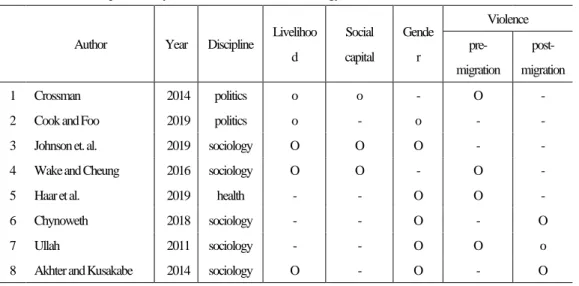
Maintaining a refugee’s livelihood and social capital is closely related to the prevention of gender-based violence. To understand the kind of research done on this matter, we selected literature related to livelihood and gender-based violence. Tables 5 and 6 show the discipline, keywords, and methodologies of selected literature on the Rohingyas. Numerous reports containing evidence regarding the situation of Rohingya refugees are much in the form of descriptive analysis on laws and policies. Some choose a different approach by conducting interviews with refugees or related personnel of humanitarian agencies.
The literature on politics describes the macro situation based on literature review and interview of humanitarian agencies. Crossman (2014) analyzes the human rights violations against the Rohingyas based on primary sources such as newspaper and international organization reports and secondary sources like scholarly articles. It describes the Rohingyas as issues of ethnic cleansing and examines the implicit government policies from 2000 to 2014. It explains how the Myanmar Government left the Rohingyas stateless and forced them to flee Myanmar for security, in neighboring states. Also, it derives suggestions on international communities’ responsibility to protect the Rohingyas and its peacebuilding plan. It mentions the importance of social capital in the peacebuilding process to facilitate cooperation and tolerance between ethnic groups but does not provide any detailed analysis.
Cook and Foo (2019) treated the Rohingya exodus as a combining issue of natural hazards and displaced populations, which can create complex humanitarian emergencies. They prepared a report to identify Bangladesh's disaster management structures which comprised of 20
interviews conducted between the 20th February and 1st March 2018 with humanitarian practitioners. Participants were based in Dhaka, Teknaf, Ukhia, and Cox's Bazar, Bangladesh. They pointed out that the beneficiaries were engaged through the Majhi system in the 2017 Rohingya Exodus response. A Majhi is a Rohingya community leader, typically in charge of 10–12 families within a camp. The Majhi system has been used in the Rohingya refugee camps since 1991 but was disbanded in 2007. Considering a Majhi is a male-appointed individual, they emphasized the need for democratic and equal gender representation in camp governance. However, the structure of the Majhi system and how it affects gender issues are not discussed in this study.
Table 5. Discipline and keywords of selected literature of Rohingya
Author Year Discipline Livelihoo
d Social capital Gende r Violence pre-migration post-migration 1 Crossman 2014 politics o o - O -
2 Cook and Foo 2019 politics o - o - -
3 Johnson et. al. 2019 sociology O O O - -
4 Wake and Cheung 2016 sociology O O - O -
5 Haar et al. 2019 health - - O O -
6 Chynoweth 2018 sociology - - O - O
7 Ullah 2011 sociology - - O O o
8 Akhter and Kusakabe 2014 sociology O - O - O
Note: "O" and "o"means the article discuss the keyword mainly and slightly.
Source: Authors created.
Table 6. Methodology of selected literature of Rohingya
Author Year Location Country Interview Other method
1 Crossman 2014 Myammer . literature review
2 Cook and Foo 2019 Bangladesh 20 practitioners literature review
3 Johnson et. al. 2019 1 camp, 2 villages Myammer 156 households .
4 Wake and Cheung 2016 Malaysia 27 refugees
5 Haar et al. 2019 Bangladesh 114 refugees .
6 Chynoweth 2018 4 camps Bangladesh 45 practitioners FGS (109 respondents)
7 Ullah 2011 2 camps Bangladesh 134 refugees .
8 Akhter and Kusakabe 2014 1 camp Bangladesh 35 households FGS (14 respondents)
Existing literature focuses on either livelihood or gender-based violence. About livelihood and vulnerability of Rohingya refugees, Johnson (2019) studied three different communities that are vulnerable to cyclones: an IDP camp, a village with a predominantly Rohingya population, and a village with a predominantly Burmese population. This study applies a quantitative analysis of 156 questionnaire data. Residents of the IDP camp were the most vulnerable compared to other communities, and the Rohingya dominant village appeared to be more vulnerable than the dominant Burmese village. This study mentions social capital by showing the villagers’ time in the community, assuming long-term residents have a higher possibility of building social capital to reduce vulnerability. The study revealed substantial differences between the communities in the number of long-term residents. Also, Wake and Cheung (2016) present the findings from the case study to improve the understanding of the livelihoods of refugees. Interviews with 27 refugees were conducted in Kuala Lumpur in June 2015 to explore their life histories from the time that they were displaced from Myanmar. They qualitatively showed how refugees’ social networks or social capital provided them with protection, livelihood support and shelter, financial support and a job by describing their life history. However, these studies do not have the research scope for gender issues.
About gender-based violence, scholarly attention is often given to violence as a cause of migration. Haar (2019) shows evidence of pre-migration violence from a clinical study point of view. They used purposive and snowball sampling to identify survivors residing in refugee camps in Bangladesh. Interviews were conducted to assess whether the clinical findings corroborate survivors’ narratives. About post-migration violence, Chynoweth (2018), as Sexual Violence Project Director of The Women's Refugee Commission (WRC), wrote a comprehensive report on sexual violence against refugee men and boys. WRC conducted interviews with 21 focus groups comprising of 109 Rohingya men, women, and adolescents in four sections of Kutupalong Camp and 45 humanitarian aid workers. This study provides informative evidence on gender-based violence but does not discuss the relationship with their livelihood.
Ullah (2011) tries to understand the dynamics and severity of the reported humiliation by the government on the Rohingya population and how they are marginalized in their refugee camps. The author conducted interviews with 134 refugees from two existing camps in Cox’s Bazar. It shows the level of abuse and persecution perpetrated on them before migration and describes the difficulties they face post-migration. This study does not treat post-migration gender-based violence, but gender issues are mentioned as reported quandary in camps, as shown in table 7.
Table 7. Reported Quandaries in Camps by Ullah (2011)
Kutupalong Noyapara
f % (n = 60) f % (n = 74)
Poor camp infrastructure 42 70 47 63.51
Limited access to education 44 73.31 51 68.92
Limited work opportunity 39 64.98 44 59.46
Limited food availability 29 48.32 41 55.41
Limited mobility 52 86.63 49 66.22
Clashes and police action 33 54.98 24 32.43
Gender issues 31 51.65 19 25.68
Insufficient sanitation and water supply 48 79.97 47 63.51
Poor health and nutrition situation 49 81.64 55 74.32
Source: Based on Ullah (2011) table 4.
Akhter and Kusakabe (2014) shed light on the relationship between livelihood and gender-based violence among Rohingya refugees living in the Kutupalong camp. Refugees are not allowed to find employment outside the camp, while state support is minimal, they have to earn from whatever work is available. They found that mobility of refugee men is highly restricted by violence and intimidation, which forces refugee women into the role of a family’s breadwinner. Though all refugees suffer violence, women face it both inside and outside their homes. Their precarious political status as refugees and a lack of community support in the camps combined, increases their vulnerability. Although their study provides valuable insight into the relationship between culture, livelihood and gender-based violence, the data is limited to 35 households in one refugee camp, and it is difficult to judge if we can generalize this framework to other Rohingya refugee cases.
5. Conclusion
To sort out issues for future studies on violence stemming from the re-establishment of livelihood in refugee camps, we examine the current situation and prior studies of refugee studies focusing on the culture, gender, livelihood, and social capital.
The literature review shows that refugee studies have increased since the 1980s. Recently, the world’s concern about statelessness is growing which, is increasing studies on statelessness. Regarding discipline and methodology, past refugee studies, any studies from different perspectives have been accumulated. The volume of refugee studies in sociology,
economics, and anthropology is less than a desk study addressing macro issues of law, history and political aspects of refugees. The number of refugee studies with keywords “livelihood” or “social capital” is around half of those with “culture” or “gender,” indicating that analysis for post migrations from the viewpoint of micro refugee behavior has been less conducted than research on macro aspects of refugee issues.
The scholarly attention to Rohingya issues has increased rapidly after 2000, reflecting visibility of the Rohingya crisis and the world’s concern. Comparison between general refugee literature and Rohingya related literature shows that literature on Rohingya issues tends to mention more on “culture,” “gender,” “livelihood.” Although scholarly discussion of livelihood is active, the related important concept “social capital” is not actively discussed for the case of Rohingya literature, probably due to lack of quantitative microdata. Data collection in conflict and displacement area is dangerous or logistically difficult.
Beyond this difficulty, a literature review on the Rohingya case studies confirmed that some field surveys were conducted on micro situations of livelihood and gender-based violence issues. Existing literature focuses on either livelihood or based violence. About gender-based violence, scholarly attention is often given to violence as a cause of migration. About post-migration violence, Chynoweth (2018) provides informative evidence on gender-based violence. Also, Ullah (2011) describes the difficulties that Rohingya refugees face in post-migration. These studies provide essential information for understanding gender violence and livelihoods in refugee camps. However, the research conducted focuses on either gender violence or livelihood issues. Therefore, it is not clear how the two elements are related. Akhter and Kusakabe (2014) shed light on the relationship between livelihood and gender-based violence in the camp. Though their study provides valuable insights into the relationship between culture, livelihood and gender-based violence, the data is limited and it is difficult to judge if we can generalize this framework to other Rohingya refugee cases.
This study aims to sort out an issue for future studies on violence stemming from the re-establishment of livelihood in refugee camps. From this viewpoint, literature surveys have highlighted the relative lack of research on the micro aspects of refugee research and the difficulty of collecting data in refugee camps. For this reason, limited data is used only to grasp the actual situation of refugee camps fragmentary. A more field-research-based analysis is needed to gain a better understanding of this issue which can then lead to more practical policy implications. To overcome data collection difficulties, it is necessary to plan a long-term approach to conducting interviews at refugee camps. As a preliminary survey, it would be useful to conduct a literature survey based on primary materials such as local newspapers and
interviews with refugee support organization staff.
Endnotes
1According to UNHCR (2019 a), definitions for refugees, internally displaced person, asylum seeker are as follows.
“Refugees” include individuals granted complementary forms of protection; or those enjoying temporary protection. “Internally displaced persons” (IDPs) are people or groups of individuals who have been forced to leave their homes or places of habitual residence, in particular as a result of, or in order to avoid the effects of armed conflict, situations of generalized violence, violations of human rights, or natural or man-made disasters, and who have not crossed an international border. The term ‘asylum seeker’ refers to a person who requests refugee status in another state, normally on the grounds that they have a well-founded fear of persecution in their country of origin, or because their life and liberty is threatened by armed conflict and violence
Reference
Akhter, S., & Kusakabe, K. (2014). Gender-based violence among documented Rohingya refugees in Bangladesh. Indian Journal of Gender Studies, 21(2), 225-246.
Alistair D. B. Cook, and Yen Ne Foo, (2019) "Towards ‘Shared’ and ‘Complex’ Disaster Governance in Bangladesh: The 2017 Rohingya Exodus" in Towards ‘shared’ and ‘complex’ disaster governance in Bangladesh: The 2017 Rohingya Exodus, International Journal of Disaster Risk Reduction, Vol. 39
Chynoweth, S. (2018) It’s Happening to Our Men as Well: Sexual Violence Against Rohingya Men and Boys, Women's Refugee Commission
Crossman, L. (2014). Myanmar's Rohingya Refugees: The Search for Human Security (Doctoral dissertation, Georgetown University).
Gorst-Unsworth, C., & Goldenberg, E. (1998). Psychological sequelae of torture and organized violence suffered by refugees from Iraq: trauma-related factors compared with social factors in exile. British Journal of Psychiatry, 172, 90–94.
Haar, R. J., Wang, K., Venters, H., Salonen, S., Patel, R., Nelson, T., ... & Parmar, P. K. (2019). Documentation of human rights abuses among Rohingya refugees from Myanmar. Conflict and health, 13(1), 42.
Institute on Statelessness and Inclusion (2018) "Statelessness in numbers: 2018, An overview and analysis of global statistics”
Jacobsen, K. (2014). Livelihoods and forced migration. The Oxford Handbook of Refugee and Forced Migration Studies. New York: Oxford University Press. http://doi. org/10.1093/oxfordhb/9780199652433.001, 1.
https://files.institutesi.org/ISI_statistics_analysis_2018.pdf (accessed 5 January 2020)
Johnson, T., von Meding, J., Gajendran, T., & Forino, G. (2019). Disaster vulnerability of displaced people in Rakhine state, Myanmar. In Resettlement Challenges for Displaced Populations and Refugees (pp. 81-91). Springer, Cham.
Kathleen, N. (1993) Ethnic conflict and refugees, Survival, 35: 1, 81-101, DOI: 10.1080/00396339308442675.
Lindsey N. K.(2019) Conceptualiszing Statelessness as a Human rights challenge: Framing, Visual Representation, and (Partial) Issue Emergence, Journal of Human Rights Practice, 11, 2019, 52-72.
Lintner, B. I. (1990) Outrage: Burma’s Struggle for Democracy, Bangkok:White Lotus.
Milton, A.H., Rahman, M., Hussain, S., Jindal, C., Choudhury, S., Akter, S., Ferdousi, S., Mouly, T.A., Hall, J., Efird, J.T. (2017). Trapped in Statelessness: 35 Rohingya Refugees in Bangladesh. International Journal of Environmental Research and Public Health, vol. 14, no. 8, pp. 942
Parnini, Syed. N. (2013). The crisis of the Rohingya as a muslim minority in Mynamar and Bilateral Relations with Bangladesh, Journal of Muslim Minority Affairs. June 2013, VIol. 33 Issue 2, p281-297, 17p.
Randall, H. (2018) The Comprehensive Refugee Response Framework: A Commentary, Journal of Refugee Studies, Volume 31, Issue 2, June 2018, Pages 131–151,
https://doi.org/10.1093/jrs/fey020 (accessed 5 January 2020)
South, A. (2005) Mon Nationalism and Civil War in Burma: The Golden Sheldrake, London: Routledge.
Ullah, A. A. (2011). Rohingya refugees to Bangladesh: Historical exclusions and contemporary marginalization. Journal of Immigrant & Refugee Studies, 9(2), 139-161.
UNHCR (1998), The State of the World's Refugees 1997-98: A Humanitarian Agenda, Chapter 5. The Asylum Dilemma, Oxford: Oxford University Press for United Nations High Commissioner for Refugees
https://www.unhcr.org/publications/sowr/3eb7ba414/ (accessed 5 January 2020)
UNHCR (2014) Special Report Ending Statelessness within 10 years
UNHCR (2017) Global Trends: Forced Displacement in 2016, https://www.unhcr.org/5943e8a34.pdf
UNHCR (2019a) Welcome to the UNHCR Population Statistics Database. http://popstats.unhcr.org/en/overview. (Retrieved on 21 December, 2019)
UNHCR (2019b) Global Trends: Forced Displacement in 2018, https://www.unhcr.org/5d08d7ee7.pdf (accessed 5 January 2020).
UNHCR (2019c) Joint Response Plan for Rohingya Humanitarian Crisis January to December 2019 http://reporting.unhcr.org/node/21843(accessed 5 January 2020)
Wake, C., & Cheung, T. (2016). Livelihood strategies of Rohingya refugees in Malaysia. We want to live in dignity”,” London, Overseas Development Institute, 1-43.