A Procedural Method for Modeling the Purkinje Fibers of the Heart
Takashi I
JIRI1, Takashi A
SHIHARA2, Takeshi Y
AMAGUCHI3, Kenshi T
AKAYAMA1,
Takeo I
GARASHI1,4, Tatsuo S
HIMADA5, Tsunetoyo N
AMBA6, Ryo H
ARAGUCHI7,
and Kazuo N
AKAZAWA71Department of Computer Science, the University of Tokyo; 2Department of Cardiovascular Medicine, Heart Rhythm Center,
Shiga University of Medical Science; 3Graduate School Medicine System Research Course, Oita University; 4JST/ERATO; 5Faculty of Medicine, School of Nursing, Oita University; 6Department of Medical Engineering, Himeji Dokkyo University;
and 7National Cardiovascular Center Research Institute
Abstract: The Purkinje fibers are located in the ventricular walls of the heart, just beneath the endocardium and conduct excitation from the right and left bundle branches to the ven-tricular myocardium. Recently, anatomists succeeded in photo-graphing the Purkinje fibers of a sheep, which clearly showed the mesh structure of the Purkinje fibers. In this study, we present a technique for modeling the mesh structure of Purkinje fibers semiautomatically using an extended system. The L-system is a formal grammar that defines the growth of a fractal structure by generating rules (or rewriting rules) and an initial structure. It was originally formulated to describe the growth of plant cells, and has subsequently been applied for various purposes in computer graphics such as modeling plants, build-ings, streets, and ornaments. For our purpose, we extended the growth process of the L-system as follows: 1) each growing
branch keeps away from existing branches as much as possible to create a uniform distribution, and 2) when branches collide, we connect the colliding branches to construct a closed mesh structure. We designed a generating rule based on observa-tions of the photograph of Purkinje fibers and manually speci-fied three terminal positions on a three-dimensional (3D) heart model: those of the right bundle branch, the anterior fascicle, and the left posterior fascicle of the left branch. Then, we grew fibers starting from each of the three positions based on the specified generating rule. We achieved to generate 3D models of Purkinje fibers of which physical appearances closely resem-bled the real photograph. The generation takes a few seconds. Variations of the Purkinje fibers could be constructed easily by modifying the generating rules and parameters.
Key words: Purkinje fibers, L-system, heart simulation.
A
three-dimensional (3D) virtual heart model is of-ten used for computer simulations and visualizations. Computer simulation is one way to understand the elec-trophysiological properties of the heart or to figure out the mechanisms of fatal arrhythmias [1–4]. Effective visualization of a 3D heart model is also a useful tool for education and communication between doctors and patients [1, 5]. However, the creation of a 3D heart model is difficult and time-consuming because the heart has intricate structures containing various tissues, such as the atrioventricular node, bundle of His, Purkinje fi bers, and contractive myocardium. Our goal was to facilitate this process by providing effective modeling tools. In this study, we focused on the construction of Purkinje fi bers.The Purkinje fi bers are part of the ventricular conduc-tion system and were originally discovered by Tawara [6]. These tissues conduct excitation (electrical activa-tion) rapidly from the bundle of His to the ventricular
myocardial tissue. The Purkinje fibers are located in the ventricular walls of the heart, just beneath the endocar-dium. Figure 1 is a PAS-stained stereomicrograph of a sheep heart provided by Shimada et al. [7], which shows the closed mesh structure of the Purkinje fi bers. Since the Purkinje fi bers play a key role in the conduction system, many simulation studies have taken them into account. In such simulation-based systems, the fibers are usually constructed manually. In [2, 8, 9], authors drew a simpli-fied two-dimensional (2D) shape of the Purkinje fibers manually on the flatten endocardium and then mapped the 2D shape onto a 3D heart model. However, it is still diffi cult to manually create detailed structures as shown in Fig. 1. It also takes time to generate various Purkinje fiber patterns which are sometimes required to perform simulations using various models.
In this report, we present a semiautomatic system for modeling the mesh structure of the Purkinje fibers by
ap-Received on Feb 28, 2008; accepted on Jun 19, 2008; released online on Oct 18, 2008; doi:10.2170/physiolsci.RP003208
Correspondence should be addressed to: Takashi Ijiri, Computer Science, the University of Tokyo, Science Bldg. 7, Room 302, 7-3-1 Hongo, Bunkyo-ku, Tokyo, 113-0033 Japan. Tel: +81-3-5841-4091, E-mail: [email protected]
plying the L-system. The user manually specifi es the endo-cardial regions that the Purkinje fibers will cover, several positions from which fibers will grow (e.g., the terminal positions of the right bundle branch, the left anterior fas-cicle, and the left posterior fascicle on the endocardium), and the parameters of the L-system. Then, the growth simulation of L-system generates 3D mesh structures that cover the specifi ed regions. This process takes only a few seconds and the user can generate various Purkinje fiber models by simply changing the generation parameters.
L-system. The L-system is a formal grammar origi-nally introduced by Lindenmayer to formalize the devel-opment of multicellular plants [10] and was subsequently expanded to represent higher plants and complex branch-ing structures [11–13]. The framework of the L-system consists of an initial structure and rewriting rules (or generating rules). The essence of development is parallel replacement using the rewriting rules. Starting from the initial structure, the L-system replaces each part of the current structure by applying the rule sequentially. Fig-ure 2 shows a simple example, the development of a com-pound leaf [12]. This includes two module types: the api-ces (thin red lines) and the internodes (thick black lines). This example has two rewriting rules (Fig. 2, top-left): one replaces an apex with an internode, two lateral api-ces, and a top apex, while the other replaces an internode with a longer one. The initial structure is a single apex. Using these simple rules, the system develops an intri-cate branching structure over several replacing steps. An interesting aspect of the system is that each replacement process corresponds to the growth of part of the plant. Therefore, the L-system is not only a heuristic technique that creates fractal-like shapes, it is also a simulation of real-world plant growth. Karch et al. presented a similar method to generate vessel tree patterns [14]. However, the L-system and the method of Karch et al. [14] are designed for open tree structures and cannot be applied directly for the closed mesh structures seen in Purkinje fi bers.
METHODS
In contrast to existing approaches that create Purkinje fibers on flattened 2D endocardium [2, 8, 9], we gener-ate them directly in 3D space to achieve the detailed 3D overlapping structures of Purkinje networks. Our system loads a 3D polygon model of the heart and generates Purkinje fi ber models just beneath the endocardium. We represent the mesh structure of the Purkinje fi bers with a number of branch segments connected to each other (Fig. 3a). Each branch is represented as a curved polyline and constructs cylindrical objects along the polyline for ef-fective visualization. We also create a volume representa-tion to compute a distance fi eld to guide the growth of the Purkinje fi bers. We prepare 128 × 128 × 128 volume data that cover the entire heart model, and activate voxels just beneath the endocardium where the Purkinje network is located (we call this the Purkinje layer; Fig. 3b).
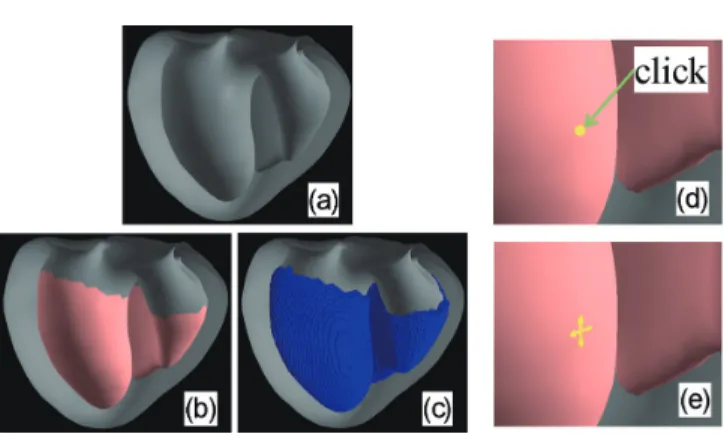
User interface. After loading a 3D heart model, the user first specifies endocardium surface regions on the heart model. We provide a sketch-based interface that al-lows the user to specify polygons by painting. The speci-fi ed surfaces are highlighted in red (Fig. 4b). The system then generates the Purkinje layer by activating voxels that are inside the 3D heart model and close to the specified Fig. 1. A photograph of the Purkinje fibers of a sheep [7].
(reprinted with permission)
Fig. 2. A simple example of the L-system (compound leaf) [12]. Beginning with the initial structure (leftmost thin red line), the system generates a complicated structure by ap-plying two generating rules (top-left) sequentially.
Fig. 3. Branch segments of the Purkinje fibers (a) and vol-ume representation of the Purkinje layer (b).
endocardium surface (we used 3r as a threshold, where r is the voxel width; Fig. 4c). Next, the user specifi es initial points from which the Purkinje fi bers will grow by click-ing on the heart model directly. The system places four initial apexes radially at each specified position (Fig. 4, d and e). Finally, the user sets the growth parameters of the generating rule by manipulating the control points directly [15] (Fig. 5). When all of the parameters are set, the user pushes the “growth button” to start the growth simulation of the L-system.
The actual photograph of Purkinje fibers (Fig. 1) shows that most of the branch segments are divided into two child branches. Based on this observation, we pro-vide a simple generating rule in Fig. 5. This generating rule contains two module types, apices (blue arrow) and internodes (orange bar), and replaces one apex with an in-ternode and two new child apices. The system allows the user to modify directions of the two child apices by ma-nipulating a handle (Fig. 5b). The user can also set branch length lbra. We introduce a randomness to the length by
using Gaussian random number: lbra' = lbra + random (µ,
σ2). We set mean value µ = 0, and standard deviation σ2 =
0.4 × lbra for generating the results in this paper.
Creation of Purkinje Network. When the growth button is pressed, our system runs a growth simulation to create a Purkinje network. The growth simulation uses an itera-tive algorithm similarly to the standard L-system. Each iteration process consists of two steps. In the fi rst step, we randomly shuffle the order of all apices and insert them into a queue (Note that there are 4 apices for each user-specified initial point at the beginning). In the second step, we grow all apices in the queue one by one. Differ-ently from the standard L-system in which all branch seg-ments have straight shapes (Fig. 2), we grow an apex to be a curved branch segment so as to obtain a uniform dis-tribution (see the next paragraph). If a growing apex steps out of Purkinje layer or collides to an existing branch, we
stop the growth of the apex. If not, we add two new ces based on the generating rule (Fig. 5). These new api-ces will grow in the next iteration. Their directions and lengths are determined by the user-specifi ed parameters. We stop the growth iteration when no new apices are gen-erated.
Extended L-system. The branch segments of Purkinje fi bers are curved and distributed uniformly, as shown in Fig. 1. To generate such mesh structures, we introduce two extensions of L-system: one is for generating uni-form distributions and the other is for constructing closed mesh structures.
To generate uniform branch distributions, we grow and bend a new branch to keep away from all existing branches. Our system approximates the curved shape of a branch with a simple polyline consisting of fi ve line segments. During the growth process, the system first constructs a distance fi eld from all existing branches and calculates the gradient of the distance fi eld (Fig. 6a). We compute only this distance field and the gradient field at the voxel grids for fast calculations. The system then grows a new branch that curves along the gradient. We defi ne the direction of each line segment of a branch as;
(1) where doriginal is the direction of the previous segment, dgradient is the gradient direction at the terminal point of
Fig. 4. Overview of the modeling process. The user speci-fies endocardial regions (b) on a 3D heart model (a) so as to create the Purkinje layer (c). The user also specifi es the initial points by clicking (d, e).
Fig. 5. A generating rule (a) and its handle (b). The user can modify the growth directions of two child apices by manipu-lating the control points.
Fig. 6. The distance fi eld of one branch (a) and the growth of a branch in a gradient fi eld (b, c).
d d d d d = + + original gradient original gradient w w 1 1 * *
the previous segment, and w1 is a user-specified weight.
Figure 6b shows a simple example: a new branch is grow-ing from bottom to top in a gradient fi eld that slants from left to right. The branch curves gradually in the direction of the gradient. We also project the direction d parallel to the endocardium surface so that the growing branch does not pop out from the thin Purkinje layer:
(2) where n is the normal vector of the nearest polygon on the endocardium surface. When a growing branch steps out of the user-specifi ed endocardial region, the system stops its growth.
To generate a closed mesh structure, we add a simple rule to the L-system. If a growing branch collides with an existing branch, the system connects the growing branch to the collided branch and stops the growth of the branch. Since thin branches rarely collide with each other in 3D space, we use a threshold k. If the distance between growing and existing branches is less than k, we detect a collision. We set k = 0.2 × lbra.
RESULTS AND DISCUSSION
Based on a photograph of actual Purkinje fi bers, we de-′ = − ⋅
(
)
d d d n n
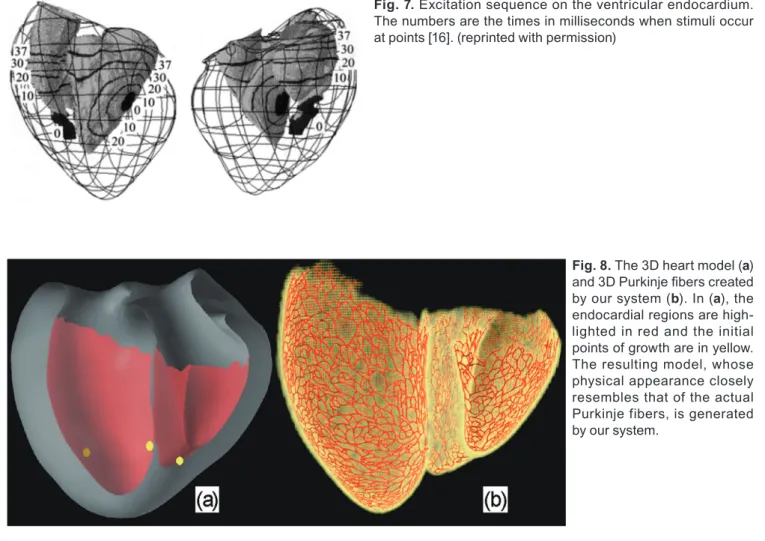
Fig. 8. The 3D heart model (a) and 3D Purkinje fi bers created by our system (b). In (a), the endocardial regions are high-lighted in red and the initial points of growth are in yellow. The resulting model, whose physical appearance closely resembles that of the actual Purkinje fibers, is generated by our system.
signed a generating rule (Fig. 5a) and set branch length lbra = 1.8 mm. The branch length is ~10-times the actual
one since the Purkinje network has self-similarity as shown in Fig. 1. The conduction velocity in the Purkinje fibers is ~2 m/s and thus the activation time along the branch is estimated as ~0.9 ms, which is markedly shorter than the action potential rising phase (several milliseconds). Therefore, we strongly believe that this degradation of the Purkinje network scale does not alter the physiological role in the simulated 3D ventricles. Next, we specified 3 initial growth points based on a map of excitation sequence on the endocardium that was modeled based on measured data (Fig. 7) [16]. These 3 initial growth points (Fig. 8a) correspond to the 3 earliest stimuli regions (0 ms regions in Fig. 7); distal ends of the right bundle branch, the left anterior fascicle, and the left posterior fascicle. Figure 8b shows a generated Purkinje model, demonstrating that our system can capture the de-tailed mesh structure. The growth simulation takes less than 10 seconds.
To evaluate the quality of Purkinje fi ber model created by our method, we compared a distribution of branch lengths of our model and that of the real photograph in Fig. 1. First, we manually binarized the photograph (Fig.
9a) and extracted mesh structures by skeletonizing the binary image (Fig. 9b). Next, we generated real-scale Purkinje fibers on a plane surface by our method (Fig. 9c). We set lbra = 0.18 mm. We then compared the
dis-tribution of branch lengths (Fig. 9d), and found that our created model has a similar length distribution to the real Purkinje fibers. In both cases (Fig. 9, b and c), the mean length of branches is ~0.13 mm. In the generation process of Fig. 9c, we observed that ~45% apices collided to ex-isting branches and stopped their growths. This causes that the number of shorter branches are more than that of longer branches. Figure 10 shows the growth iteration
processes of the extended L-system on a plane surface. We can also generate variations of Purkinje fi ber models by modifying the parameters of the L-system, as shown in Fig. 11.
We can also perform a simple simulation of excitation conduction on Purkinje fi bers. First, we activate branches connected to the initial points. Then, we iteratively ac-tivate branches connected to the acac-tivated branches in each simulation step. Figure 12 illustrates the excitation conduction along the Purkinje fi bers. We observe an exci-tation conduction pattern similar to the measured model (Fig. 7).
Fig. 9. An evaluation of the resulting model. A chart (d) compares a branch length distribution of real Purkinje fi bers in the photograph and that of our resulting model.
Fig. 10. Growth process of the extended L-system on a plane surface. These panels show the 1st, 3rd, 6th, 9th, and 12th iterations of the growth process from left to right. Starting from the center point, the Purkinje fi bers grow to fi ll the pink region.
Fig. 11. Variations of Purkinje fi ber models and their growth parameters. w1 is the weighting value for bending segments and
REFERENCES
1. Nakazawa K, Suzuki T, Ashihara T, Inagaki M, Namba T, Ikeda T, Suzuki R. Computational analysis and visualization of spiral wave reentry in a virtual heart model. In: Yamaguchi T, editor. Clinical application of computational mechanics to the cardiovascular system. New York: Springer; 2000. 2. Berenfeld O, Jalife J. Purkinje-muscle reentry as a mechanism of polymorphic
ventricular arrhythmias in a 3-dimensional model of the ventricles. Circ Res. 1998;82:1063-77.
3. Smith N, Hunter P. Giving form to the function of the heart: embedding cellular models in an anatomical framework. Jpn J Physiol. 2004;54:541-4.
4. Usyk TP, LeGrice IJ, McCulloch AD. Computational model of three-dimensional cardiac electromechanics. Comput Visual Sci. 2002;4:249-57. 5. Igarashi T, Ashihara T, Yao T, Nagata S, Takada M, Sakachi H, Suzuki T,
Nakazawa K. Examination of various pen-based input methods for electronic medical recording systems. In: Proc. of the 21st Joint Conference on Medical Informatics, 2001.
6. Tawara S. Das Reirzleirungssysrem des Saugertierherzens. Fischer, JENA, 1906.
7. Shimada T, Ushiki T, Fujita T. Purkinje fibers of the heart. Shinyaku to Chiryou. 1992;42:11-3 (in Japanese).
8. Clements CJ, Vigmond EJ. Construction of a cardiac conduction system subject to extracellular stimulation. In: Proc. of the 2005 IEEE Engineering in Medicine and Biology 27th Annual Conference Shanghai. 2005. p. 4235-8. 9. Pollard AE, Barr RC. The construction of an anatomically based model
of the human ventricular conduction system. IEEE Trans Biomed Eng. 1990;37:1173-85.
10. Lindenmayer A. Mathematical models for cellular interactions in development. I & II. J Theor Biol. 1968;18:280-315.
11. Prusinkiewicz P, Lindenmayer A. The algorithmic beauty of plants. New York: Springer-Verlag; 1990.
12. Prusinkiewicz P, Hammel M, Hanan J, Me ˇ ch R. L-systems: from the theory to visual models of plants. In: Proc. of the 2nd CSIRO Symposium on Computational Challenges in Life Sciences. 1996.
13. Me ˇ ch R, Prusinkiewicz P. Visual models of plants interacting with their environment. ACM SIGGRAPH 96. 1996. p. 397-410.
14. Karch R, Neumann F, Neumann M, Schreiner W. A three-dimensional model for arterial tree representation, generated by constrained constructive optimization. Comput Biol Med. 1999;29:19-38.
15. Ijiri T, Owada S, Igarashi T. The Sketch L-System: global control of tree modeling using free-form strokes. In: Proc. of Smart Graphics 2006. 2006. p. 138-46.
16. Nakazawa K, Ashihara T, Suzuki T, Yao T, Namba T. Cardiac model based on active membrane model: spiral wave reentry as a mechanism of lethal arrhythmia. In: Okamoto Y, editor. Physiome for the cardiovascular system. Tokyo: Morikita; 2003 (in Japanese).
In contrast to existing methods that require the user to model the detailed mesh structures manually, our system allows the user to design variants of 3D Purkinje fiber models using simple interactions. Since the growth simu-lation using the extended L-system is rapid, the user can easily examine and tune parameters by trial and error. The resulting Purkinje fiber models have detailed mesh structures and their physical appearances closely resem-ble the photograph of the Purkinje fi bers.
CONCLUSIONS
We present a semiautomatic system for creating 3D Purkinje fiber models and introduce two extensions to the L-system: collision avoidance and closed mesh structure creation. The user specifies the endocardial regions, initial points of growth, and generating rules of the L-system. Then, our extended L-system performs the growth simulation that constructs the 3D mesh structure of Purkinje fi bers in a few seconds.
One limitation is that our system requires users to tune the parameters based on their observations and experi-ments. We plan to extend this system so that rules and pa-rameters can be estimated from anatomical photographs. Another future project is to apply our method to other targets such as airways and blood vessels.
This work was supported in part by Adobe Systems Inc. and JSPS Research Fellowship.
Fig. 12. Excitation conduction along the ventricular Purkinje fi bers. The excitation conduction started from the initial points of growth, and we activated the connected branches iteratively. These panels show the 2nd, 6th, 10th, 14th, 18th, and 22nd iterations.
![Fig. 2. A simple example of the L-system (compound leaf) [12]. Beginning with the initial structure (leftmost thin red line), the system generates a complicated structure by ap-plying two generating rules (top-left) sequentially.](https://thumb-ap.123doks.com/thumbv2/123deta/6828769.1168171/2.977.514.859.150.364/compound-beginning-structure-generates-complicated-structure-generating-sequentially.webp)