
Detection and evolution analysis of code clones for
efficient management of large-scale software
systems
Submitted to
Graduate School of Information Science and Technology
Osaka University
January 2015
Abstract
In recent decades, large-scale software systems have become mainstream. Such software systems have complicated the maintenance process by increasing efforts such as inspection and understanding of the existing source code. Therefore, to maintain these systems, a great deal of work and time are necessary. To alleviate this problem, this research focus on a well-known factor hindering the software maintenance task, a code clone (i.e., a code fragment that has other code fragments identical or similar to it in the source code). It is widely believed that code clones complicate software maintenance. For example, when changes to code clones in a clone set (i.e., a set of code clones that are identical or similar to each other) are inconsistent, the developer needs to identify inconsistently changed code clones and apply consistent changes to them.
Thus far, many tools and techniques have been proposed for supporting the detection and management of code clones. However, most are insufficient for supporting code clone related tasks during the software maintenance process for large-scale software systems. To resolve this problem, this study attempts to solve two important problems that code clones face. That is, “Which type of normaliza-tion dose make code clones to detected with high speed from large-scale software systems? ” and “Which supports are necessary for more widely used tools that support clone refactoring? ”.
To solve the first problem, this research proposes six approaches for detecting code clones with preprocessing input source files using different degrees of nor-malizations (e.g., the removal of white spaces, tokenization, and the regularization of identifiers). More precisely, each type of normalization is applied to the input source files, and equivalence class partitioning of the files is then conducted during the preprocessing. Code clones are then detected from a set of files that are repre-sentatives of each equivalence class using a token-based code clone detection tool calledCCFinder. The proposed approaches can be categorized into two types, an approach with non-normalization and approaches with normalization. The former type is the detection of only identical files without normalization, whereas the latter category is the detection of identical files with different degrees of normalization
such as the removal of all lines containing macros in C program. From a case study, it was observed that the detection times of the proposed approaches are at least two-times faster than an approach that uses onlyCCFinder. It was also found that the approach with non-normalization is the fastest of the proposed approaches for many cases.
To resolve the second problem, this research presents an investigation of clone refactoring (i.e., merging code clones into a new method) carried out during the development of open source software systems for promoting the development of refactoring tools that can be more widely utilized. In this investigation, it was identified that a “Replace Method with Method Object” is the most frequently used refactoring pattern for clone refactoring. Moreover, this research discovered that merged code clone token sequences and the differences in the token sequence lengths vary for each refactoring pattern.
List of Publications
Major Publications
[1-1] Eunjong Choi, Norihiro Yoshida, Yoshiki Higo, Katsuro Inoue:
Propos-ing and EvaluatPropos-ing Clone Detection Approaches with PreprocessPropos-ing Input Source Files. IEICE Transactions on Information and Systems, Vol.E98-D,
No.2, February 2015 (to appear).
[1-2] Eunjong Choi, Kenji Fujiwara, Norihiro Yoshida, Shinpei Hayashi: A
Sur-vey of Refactoring Detection Techniques Based on Change History Analysis.
Computer Software, Vol.32, No.1, February 2015 (in Japanese) (to appear). [1-3] Eunjong Choi, Norihiro Yoshida, Katsuro Inoue: An Investigation into the
Characteristics of Merged Code Clones during Software Evolution. IEICE
Transactions on Information and Systems, Vol.E97-D, No.5, pp.1244-1253, May 2014.
[1-4] Eunjong Choi, Norihiro Yoshida, Katsuro Inoue: What Kind of and How
Clones are Refactored?: A Case Study of Three OSS Projects. in Proceedings
of the 5th Workshop on Refactoring Tools (WRT 2012), pp.1-7, Rapperswil, Switzerland, June 2012.
Related Publications
[2-1] Manamu Sano, Eunjong Choi, Norihiro Yoshida, Yuki Yamanaka, Katsuro Inoue: Supporting Clone Analysis with Tag Cloud Visualization. in Proceed-ings of the International Workshop on Innovative Software Development Methodologies and Practices (InnoSWDev 2014), pp.94-99, Hong Kong, China, November 2014.
[2-2] Yuki Yamanaka, Eunjong Choi, Norihiro Yoshida, Katsuro Inoue: A High
IPSJ Journal, Vol.55, No.10, pp.2245-2255, October 2014 (in Japanese). [2-3] Akira Goto, Norihiro Yoshida, Masakazu Ioka, Eunjong Choi, Katsuro
In-oue: Method Differentiator Using Slice-based Cohesion Metrics. in Pro-ceedings of the 12th Annual International Conference Companion on Aspect-oriented Software Development (AOSD 2013 Companion), pp.11-14, Fukuoka, Japan, March 2013.
[2-4] Yuki Yamanaka, Eunjong Choi, Norihiro Yoshida, Katsuro Inoue, Tateki Sano: Applying Clone Change Notification System into an Industrial
De-velopment Process. in Proceedings of the 21st IEEE International
Confer-ence on Program Comprehension (ICPC 2013), pp.199-206, San Francisco, California, USA, March 2013.
[2-5] Akira Goto, Norihiro Yoshida, Masakazu Ioka, Eunjong Choi, Katsuro In-oue: How to Extract Differences from Similar Programs? A Cohesion Metric
Approach. in Proceedings of the 7th International Workshop on Software
Clones (IWSC 2013), pp.23-29, San Francisco, California, USA, March 2013.
[2-6] Yuki Yamanaka, Eunjong Choi, Norihiro Yoshida, Katsuro Inoue, Tateki Sano: A Development of Clone Change Management System and Its
Appli-cation to Actual Project. IPSJ Journal, Vol.54, No.2, pp.883-893, February
2013 (in Japanese).
[2-7] Yuki Yamanaka, Eunjong Choi, Norihiro Yoshida, Katsuro Inoue, Tateki Sano: Industrial Application of Clone Change Management System. in Pro-ceedings of the 6th International Workshop on Software Clones (IWSC 2012), pp.67-71, Zurich, Switzerland, June 2012.
[2-8] Eunjong Choi, Norihiro Yoshida, Takashi Ishio, Katsuro Inoue, Tateki Sano:
Extracting Code Clones for Refactoring Using Combinations of Clone Met-rics. in Proceedings of the 5th International Workshop on Software Clones
Acknowledgement
First of all, I would like to express my most sincere gratitude to my respected super-visor Katsuro Inoue. Without his warm supports and valuable comments regarding my research, this study would not have been possible. I feel extremely happy and blessed for the opportunity to have been supervised by him and have been inspired by his enthusiasm and integral view toward research.
I would especially like to express my gratitude to Professors Toshimitsu Ma-suzawa, and Shinji Kusumoto for their valuable comments and helpful suggestions regarding this thesis. I would also like to acknowledge the guidance of Professors Kenichi Hagihara and Yasushi Yagi.
In addition, I would like to express my gratitude to the professors and staff members of Inoue laboratory. I appreciate Associate Professor Makoto Matsushita and Assistant Professor Takashi Ishio for their kind consideration. I also appreciate Specially Appointed Professor Shusuke Haruna and Specially Appointed Associate Professor Yukio Mohri for their kind support. Moreover, I would like to express my thanks to Specially Appointed Assistant Professors Kula Raula Gaikovina and Ali Ouni for their helpful comments and suggestions regarding this research. In particular, I owe many thanks to Ms. Mizuho Karube for her continual support and understanding.
I am grateful to have had the chance to conduct the research with such great people. I really appreciate Assistant Professor Yoshiki Higo at Osaka University for his insightful encouragements and comments regarding my research. I would also like to thank Assistant Professor Hayashi Shinpei at Tokyo Institute of Tech-nology for his valuable comments and gentle advices. In addition, I am grateful to Mr. Kenji Fujiwara at Nara Institute of Science and Technology for his friendly and practical support. I would also like to acknowledge my appreciation to Mr. Tateki Sano at NEC Corporation for his support. I would additionally like to thank Dr. Coen De Roover and Mr. Reinout Stevens at Vrije Universiteit Brussel, Belgium for their warm supports and advice. I also want to express my thanks to Mr. Akira Goto at NS Solutions Corporation for his diligent work and kind support and to Mr. Yuki Yamanaka at Hitachi, Ltd for his hard work and heartful kindness.
I am particularly appreciative of Assistant Professor Zhenchang Xing at Nanyang Technological University, and Dr. Yinxing Xue and Associate Professor Stan Jarz-abek at the National University of Singapore for their warm welcome and kindness during my stay in Singapore as an international exchange student. In particular, I am very grateful to have had the chance to conduct research with Professor Zhen-chang Xing.
I also would like to thank Professor Daniel German at the University of Vic-toria, Canada for his valuable comments regarding my research. I also am very grateful to Associate Professor Toshihiro Kamiya at Future University Hakodate for his great work on code clones, particularly the development of CCFinder. I would like to thank Assistant Professor Marouane Kessentini at the University of Michigan, USA for his helpful advice and comments. I would also like to express my appreciation to Assistant Professor Hideki Hata at Nara Institute of Science and Technology for his warm advice. Thanks also to the anonymous reviewers of my papers for their valuable suggestions and comments. Moreover, I would like to particularly thank the great researchers, in the software engineering community. Although I cannot name all of them here owing to a lack of space, their significan work has consistently thrilled me.
I am grateful to my ex-colleagues Mr. Masahiro Uchida and Mr. Sahichi Ya-manaka in JN System Partners Co., Ltd for their kindness and support. I would also like to express my thanks to the members of the Osaka-Yodogawa Rotary Club, particularly Ms. Toshiko Nakatsu and the Nishimura International Schol-arship Foundation for their economic support and warm kindness. In addition, I would like to express my thanks to my friends in Japan and Korea, particularly Jaejong Li, Naewook Jung, Minji Kim, Semi Kim, Sunyoung Park, Mijung Park, Minyong Jeong, Aya Suzuki, Yuko Muko, Junya Nakamura, and students of IT Spiral, 2012 class. Thanks are also due to my many friends in the Department of Computer Science, especially Mr. Yonghwan Kim in the Masuzawa laboratory and the students in the Inoue and Kusumoto laboratories.
I would also like to express my gratefulness to my loving family members and relatives for their continued support and for consistently being in my corner. In particularly, I want to thank my parents, Jaein Choi and Keumsoon Park, for their warm support and encouragement and for always being on my side. Finally, I would like to send a warm and well-deserved thank to my husband, Associate Professor Norihiro Yoshida at Nagoya University, for his years of mentoring and guidance. None of these studies described in this thesis would have been impossi-ble without his great support and continued patience. Thank you!
Contents
1 Introduction 1
1.1 Motivation . . . 1
1.2 Contributions of This Thesis . . . 2
1.3 Thesis Outline . . . 3
2 Related work 5 2.1 Code Clones . . . 5
2.1.1 Code Clone Detection . . . 6
2.1.2 Analysis of Clone Evolution . . . 10
2.2 Refactoring . . . 12
3 Proposing and Evaluating Clone Detection Approaches 19 3.1 Motivation . . . 19
3.2 Proposed Approaches . . . 21
3.2.1 Approach with Non-normalization . . . 22
3.2.2 Approaches with Normalization . . . 24
3.3 Case Study . . . 26
3.4 Results . . . 27
3.4.1 Comparison with the Approach that uses OnlyCCFinder 27 3.4.2 Comparison of Proposed Approaches . . . 28
3.5 Discussion . . . 29
3.6 Threats to Validity . . . 29
3.7 Summary . . . 30
4 Investigating Merged Code Clones during Software Evolution 33 4.1 Motivation . . . 33
4.2 Research Questions . . . 34
4.3 Steps of this Investigation . . . 35
4.3.2 Step 2 : Identifying Instances of Clone Refactoring . . . . 39
4.3.3 Step 3 : Measuring the Characteristics of Merged Code Clones . . . 41
4.4 Results of the Investigation . . . 42
4.5 Suggestions for Clone Refactoring Tools . . . 45
4.6 Threats to Validity . . . 47
4.7 Summary . . . 47
5 Conclusion and Future Work 53 5.1 Conclusion . . . 53
List of Figures
2.1 Overview of a rule-based refactoring detection technique . . . 14
3.1 An example of the result of each normalization . . . 21
3.2 Overview of an approach with non-normalization . . . 22
3.3 An example of equivalence class partition and selection . . . 23
3.4 An overview of the approaches with normalization . . . 23
4.1 Overview of the investigation . . . 35
4.2 An example of clone refactoring using the EM pattern . . . . 38
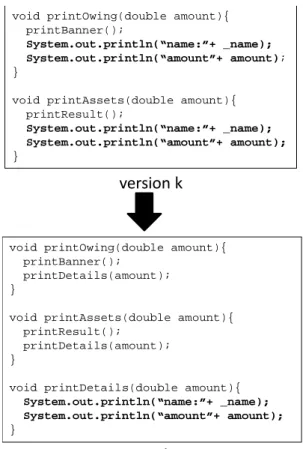
4.3 An example of clone refactoring using the RMMO pattern] . . . . 39
4.4 An example of clone refactoring using the EM pattern in Apache Ant between releases 1.6.2 and 1.6.3. . . . 49
4.5 An example of clone refactoring using the RMMO pattern in Xerces-J between releases 1.0.4 and 1.2.0 . . . . 50
4.6 Box plots of Uav for the EM, ES, FTM, and RMMO patterns (a), and of Umi, Uav, and Umxfor RMMO pattern (b) . . . 51
4.7 Bot plots of Lav for the EM, ES, FTM, and RMMO patterns (a), and Lmi, Lav, and Lmx for RMMO pattern (b) . . . 51
4.8 Overview of a tool that we suggest for supporting EM pattern based the findings . . . 52
List of Tables
3.1 Statistics of subject systems . . . 26
3.2 Detection time in seconds (Apache Ant) . . . 31
3.3 Detection time in seconds (Linux Kernel) . . . 31
3.4 Detection time in seconds (Samsung Galaxy) . . . 31
3.5 Results of Apache Ant . . . 32
3.6 Results of Linux Kernel . . . 32
3.7 Results of Samsung Galaxy . . . 32
4.1 Statistics of subject systems . . . 38
4.2 The number of sets of merged code clones, and the number of pairs of merged code clones in parentheses from overall subject systems 43 4.3 The number of pairs of code clones and percentage share catego-rized by class distance . . . 45
Chapter 1
Introduction
This chapter provides a short introduction to this thesis. First, Section 1.1 intro-duces the motivation. Section 1.2 then illustrates the contributions. Finally, Section 1.3 describes an outline of this thesis.
1.1
Motivation
In recent decades, many companies have released new models in rushed intervals to achieve superiority over their rivals [16]. To do so, they have frequently reused robust parts of existing source code for new developments. As a consequence, a significant amount of code clones (i.e., code fragments that have other code frag-ments identical or similar to them in the source code) exist within software systems and between different releases of the models/versions of software systems.
These code clones complicate the maintenance process by increasing efforts, such as inspections and an understanding of the existing source code. For example, if code clones belonging to the same clone set (i.e., a set of code clones that are identical or similar to each other) have been inconsistently-changed, generating defects in the software system, the developer will need to find the inconsistently-changed code clones and propagate the required changes to them. To alleviate this problem, code clones should be documented and properly maintained (e.g., merging code clones into a function/method).
There are a multitude of techniques and implemented tools for automatically detecting code clones and supporting their management [21, 44, 78]. Using a code clone management tool, a developer can easily apply consistent changes to code clones [21] or conduct clone refactoring (i.e., merging code clones into a sin-gle function/method) [44]. Moreover, when code clones have been inconsistently changed, the developer can readily identify inconsistently-changed code clones
us-ing a code clone detection tool [46, 62]. Such tools help developers effectively maintain their software systems.
However, most of these techniques and tools are insufficient for large-scale software systems. With respect to the detection of code clones, most of them take a long time when the size of the input source code is large. For example, a token-based code clone detection tool calledCCFindertakes about 40 days on a single PC-based workstation to detect code clones from 400 million lines of code [63]. Currently, the tools for code clone management are commonly underused. In particular, although clone refactoring is a promising approach, the tools support-ing clone refactorsupport-ing are underused compared to refactorsupport-ing tools (e.g.,Eclipse’s refactoring features) that were not intended to support clone refactoring. To facili-tate these problems, this study aims to solve the following two Research Questions (RQs).
RQ1: Which type of normalization dose make code clones to detected with high
speed from large-scale software systems?
RQ2: Which supports are necessary for more widely used tools that support clone
refactoring?
In this thesis, a new approach for detecting code clones in large-scale software systems and an investigation into clone refactoring during the software evolution are presented to answer RQ1 and RQ2, respectively.
1.2
Contributions of This Thesis
The contributions of this thesis are as follows:
• First, six approaches for detecting code clones from different release
mod-els/versions are presented and implemented using preprocessing input source files withCCFinder[49], a token-based code clone detection tool. During the preprocessing of the proposed approaches, the input source file is nor-malized to the different degrees of the program elements. For example, one of the proposed approaches normalizes each input source file by removing all lines containing only comments, and comments and white spaces before and after comments. Different degrees of normalization lead to different granularities of the source code to be detect as code clones.
• Second, for a set of different released models/versions of various software
systems, it was found that the proposed with a preprocessing of the in-put source files detect code clones faster than an approach that uses only
CCFinder. It was also found that any normalization takes significant amount of time during the preprocessing and post-processing and is unable to reduce the total detection time in many cases.
• Third, an approach using a code clone identification technique called
undi-rected similarity (usim) and a refactoring detection tool calledRef-Finder to investigate instances of clone refactoring (i.e., the merging of a set of var-ious code clone types into a single function or a method using refactoring patterns) are presented.
• Finally, it was discovered that the Extract Method (EM) and Replace Method with Method Object (RMMO) patterns are used the most when developers
conduct clone refactoring. Moreover, it was found that large token differ-ences exist between merged code clones when the RMMO and EM patterns are used on pairs of code clones.
1.3
Thesis Outline
The remainder of the thesis is structured as follows:
Chapter 2: Related works
The thesis begins with a review of studies to help deeply understand the problemns involved with this thesis. In this chapter, studies on automatic code clone detection and analyzing code clones during the software evo-lution are first reviewed. Moreover, studies on the automatic detection of refactoring instances from the source code history and analyzing the refac-toring instances during the software evolution will also be introduced.
Chapter 3: Proposing and Evaluating Clone Detection Approaches
This chapter describes six code clone detection approaches with a prepro-cessing of the input source files. These approaches extendCCFinder by adapting the preprocessing and post-processing to detect code clones effec-tively from different model/versions released. Moreover, a comparison of the proposed approaches and an “approach that uses onlyCCFinder” will be presented. The goal of this study is to investigate how the normaliza-tions impact the code clone detection for quickly detecting code clones from large-scale software systems.
Chapter 4: Investigating Merged Code Clones during Software Evolution
This chapter presents an investigation into merged code clones during the evolution of three Open Sorce Software (OSS) systems. This investigation
was conducted using a refactoring detection tool and a token similarity met-ric. The goal of this investigation was to uncover clues that can contribute to the development of more widely used tools for clone refactoring.
Chapter 5: Conclusion and FutureWork
The final chapter concludes the thesis by summarizing the main findings, and providing directions for future research.
Chapter 2
Related work
This chapter describes previous works related to code clones and refactoring to help with a deeper understanding of this thesis. Section 2.1 reviews existing studies on code clones, and Section 2.2 describes state-of-the-art studies on refactoring detection and analysis during the software evolution.
2.1
Code Clones
A code clone is a code fragment that has other code fragments identical or similar to it in the source code. A clone set is a set of code clones that are identical or similar to each other. Code clones can be categorized into the following four types based on the textual (Type-1, Type-2, and Type-3) and semantic (Type-4) similarities between the pairs of code clones [82]:
Type-1: Identical code fragments except for variations in whitespace, layout, and
comments.
Type-2: Syntactically identical fragments except for variations in the identifiers,
literals, types, whitespace, layout, and comments.
Type-3: Copied fragments with further modifications such as changed, added, or
removed statements, in addition to variations in the identifiers, literals, types, whitespace, layout, and comments.
Type-4: Two or more code fragments that conduct the same computations but are
implemented through different syntactic variants.
The dissimilarity and abstraction in the definition of code clones increase from Type-1 to Type-4.
Code clones are usually generated through the copying and pasting of existing code fragments with or without modifications. Such “copy and paste” tasks are the result of programmer’s mental macros or the inexpressiveness of the programming languages used. Meanwhile, the avoidance of a new defects, the reuse of a tem-plate/design, the programmer’s lack of knowledge of the domain/product, and the development resources also trigger such tasks [50, 81].
Details of previous code clone related studies are introduced in the following subsections. Existing studies on code clone detection and analysis are reviewed in Sections 2.1.1 and 2.1.2, respectively.
2.1.1 Code Clone Detection
Thus far, numerous code clone detection techniques and their implemented tools have been proposed, which can be roughly classified into the following categories:
• String-based techniques [24, 22]
• Token-based techniques [5, 4, 49, 62, 70, 63, 101] • Tree-based techniques [10, 47, 58, 57]
• Program dependence graph-based techniques [30, 56, 59] • Memory-based techniques [52]
• Hybrid techniques [7, 45, 80, 79]
Hereafter, techniques and tools from the abovementioned categories are intro-duced.
String-based techniques
The techniques in this category conduct string-by-string comparisons of the input source code and detect similar sequences of the strings as code clones. Ducasse et al. proposed a language-independent clone detection technique based on line similarities, and implemented a tool calledDuploc[24]. After removing comments and white spaces from the input source code,Duploc detects Type-1 and Type-2 code clones using dynamic pattern matching. It also provides a scatter plot that visualizes the results of code clones for sup-porting analysis tasks.
Ducasse et al. also presented string-matching techniques with six different degrees of code normalization (i.e., replacing certain elements of a program
with generic placeholders with the aim of removing only nonessential infor-mation), and then measured their impact on the quality of the code clone detection [22]. First, noise (e.g., white spaces, tabulations, and comments) is eliminated from the input source code, and a different degree of code nor-malization (e.g., replacing identifiers, labels, and basic numeric types with a special token) is applied to the input source code. Next, code clones are detected using line-by-line string matching. In a case study, the authors com-pared different proposed techniques and confirmed that more complicated normalization results in a decrease in the recall and precision.
Token-based techniques
These techniques tokenize the input source code through normalization, and then compare the token sequences of lines to detect any code clones. Baker developed a token-based code clone detection tool calledDup[5, 4]. First, Duptokenizes the input source code, and the tokens of the identifiers and constants are then replaced with placeholders. Next,Dupextracts the pairs of longest matches using a suffix tree algorithm [66]. It detects pairs of ex-actly the same code fragments or parameterized matched strings (i.e., a pair of code fragments in which each identifier or constant in one code fragment is consistently changed into another identifier and constant in another code fragment), with the exception of comments, blank lines, and white spaces, as code clones.
Kamiya et al. developed a tool calledCCFinder that detects Type-1 and Type-2 code clones based on token similarities [49]. The steps used to detect code clones from the input source code are as follows: First, each line of the input source files is divided into tokens corresponding to a lexical rule of the programming language. The tokens of all files are concatenated into a single token sequence. In addition, the white spaces (including ‘\n’ and ‘\t’) and comments between tokens are removed from the token sequence. The token sequence is then transformed, (i.e., tokens are added, removed, or changed based on the transformation rules) and, each identifier related to the types, variables, and constants is replaced with a special token for detecting Type-2 code clones. Next, from all of the substrings in the transformed token se-quence, equivalent code fragments are detected as code clones. A suffix-tree matching algorithm [38] is used to compute the matching, in which the clone location information is represented as a tree with sharing nodes for leading identical subsequences, and the clone detection is conducted by searching the leading nodes on the tree. Finally, each location of a code clone is con-verted into line numbers of the original input files. D-CCFinder extends CCFinderto detect code clones from large-scaled software systems [63].
To detect code cones at high speed, it partitions the code clone detection into smaller pieces for distribution in very large software systems.
CP-Miner, proposed by Li et al., detects code clones and bugs that are in-duced by code clones using a frequent subsequence mining (i.e., an asso-ciation analysis technique used to discover frequent subsequences in a col-lection of sequences) technique [62]. CP-Minertokenizes the input source code with replacement of identifier names such as variables, functions, and types with a special token. After converting a tokenized source code into hash values,CP-Minerdetects code clones using an enhanced algorithm of closed sequential pattern mining[103] from sequences of the hash values. Murakami et al. proposed a code clone detection technique using Smith-Watermanand the longest common subsequence (LCS) algorithm to detect gapped code clones [70]. This technique normalizes (i.e., user-defined iden-tifiers are replaced with specific tokens) a tokenized source code and then calculates a hash value for every statement. After identifying similar hash sequences using the tailored Smith-Waterman algorithm [86], it identifies gapped code clones using the LCS algorithm.
Yamanaka et al. presented a lightweight technique aimed at detecting func-tion clones, using informafunc-tion retrieval techniques [101]. A feature vector is generated for each function of the input source code using the Term Fre-quency Inverse Document FreFre-quency (TF-IDF) and reserved keywords, and clustering of the generated vectors is then conducted by means oflocality sensitive hashing (LSH) [31]. Finally, clones are detected based on the similarities between each pair of feature vectors.
Tree-based techniques
In these techniques, input source code is represented as a tree structure, and code clones are then detected by identifying isomorphic subtrees.CloneDR, developed by Baxter et al., detects code clones using abstract syntax tree [10]. CloneDRpartitions subtrees of abstract syntax tree using hash values, and then detects code clones by comparing subtrees that have the same hash values.
Deckard, developed by Jiang et al., computes certain characteristic vectors from the abstract syntax trees [47]. These vectors are clustered using LSH, and subtrees with vectors in a cluster are then detected as code clones. Koschke et al. proposed a technique that uses a suffix tree to identify code clones from an abstract syntax tree [58]. This approach parses the input source code and generates an abstract syntax tree. It then serializes the ab-stract syntax tree and the abab-stract syntax tree input into suffix tree. It detects
code clones of syntactic units by decomposing the identified code clones into complete syntactic units.
Koschke proposed a technique for detecting code clones between a subject system and a corpus (i.e., a set of software systems) aimed at identifying potential license violations [57]. This technique generates a suffix tree for a subject system and then compares every file in the corpus with the generated suffix tree using anMD5hash function.
Program dependence graph-based techniques
These techniques transform input source code into a program dependence graph [26], a representation of a program that represents only the control and data dependency between statements and predicates, and then identi-fies isomorphic program dependence graph subgraphs to detect code clones. Komondoor and Horwitz presented a program dependence graph-based code clone detection technique and implemented a tool calledPDG-DUP [56], which partitions all program dependence graph nodes into equivalence classes and then finds isomorphic program dependence graph subgraphs using (back-ward) program slicing. It then reports the isomorphic program dependence graph subgraphs as code clones.
Krinke proposed a code clone detection technique based on fine-grained pro-gram dependence graphs [59]. The technique detects similar syntactic struc-tures (Type-1, Type-2, and Type-3 code clones) as well as similar semantics (Type-4 code clones) by comparing the subgraphs of the program depen-dence graphs.
Gabel et al. presented a technique for detecting code clones including se-mantic code clones (i.e., sese-mantically similar code fragments) [30]. This technique maps carefully selected program dependence graph subgraphs to their related structured syntax, and then detects clones usingDeckard’s vec-tor generation and LSH-based clustering.
Memory-based techniques
Kim et al. proposed an approach for detecting code clones based on abstract memory, and implemented a tool calledMeCC[52]. MeCCcomputes the abstract memory states from input programs using a static analysis, and then detects code clones by comparing the abstract memory states. It is able to detect Type-4 clones such as pairs of statement-reordered code clones.
Hybrid-based techniques
in such techniques to detect code clones. Roy and Cordy developed a text-based hybrid clone detection tool calledNiCad[80, 79]. NiCadidentifies and normalizes potential clones using flexible pretty-printing. It then pro-ceeds to normalize the input source code and compare text lines of potential code clones using the LCS algorithm.
Basit and Jarzabek developed a tool calledClone Minerfor detecting struc-tural clones (i.e., larger granularity code clones such as similar files or di-rectories) [7]. Clone Miner detects structural clones using frequent item-set mining [37] from the repeated combinations of simple clones (i.e., frag-ments of duplicated code) detected byRepeated Tokens Finder(RTF)[8], a token-based code clone detection tool.
Finally, Hummel et al. proposed an incremental index-based code clone detection approach [45]. An index allows the lookup of all clones for a single file, and can be updated efficiently, when files are added, removed, or modified. This approach computes MD5 hash values from tokenized source code and then generates statement indices from the MD5 hash values. It detects code clones by retrieving the index from the databases.
2.1.2 Analysis of Clone Evolution
Many studies have been conducted on identifying the possible impact of code clones during the software evolution. Mandal et al. investigated the clone evo-lution history to identify candidates for clone refactoring [65, 69]. They analyzed the clone evolution from 13 subject systems using association rules [65]. Their analysis was conducted based on the idea that if code clones belonging to the same clone set are changed together, preserving their similarity during the software evo-lution, they can be important candidates for clone refactoring. Thus, the authors de-tected code clones from 13 subject systems usingNiCad, and then mined for code clones following the similarity-preserving change patterns using association rules. They found that, on average, 7.04% of the code clones follow similarity-preserving change patterns, and that more than half of them are method-level clones. How-ever, they also found code clones that have changed with non-cloned code or code clones belonging to other clone sets, which should not be removed through clone refactoring but should be tracked to consistently update them in the future. Thus, to find candidates for tracking, they also mined code clones from six subject systems, and identified candidates for tracking at an overall rate of 10.27% [69].
Thus far, several studies have investigated clone removal during the software evolution [11, 32, 105, 106]. G¨ode investigated clone removal aimed at gaining in-sight to improving clone detection and refactoring tools. In this study, Type-1 and
Type-2 code clones were detected from four subject systems, and then manually in-vestigated to determine whether such code clones were deliberately removed. This investigation revealed that method extraction is the most frequently used refactor-ing pattern to eliminate code clones, and that most of the removed code clones are contained within the same or closely related files. Bazrafshan and Koschke expanded on G¨ode’s study by analyzing not only deliberately removed but also ac-cidently removed code clones from seven subject systems. Their analysis found that code clones are accidently removed more frequently than they are deliberately removed, and that Type-2 code clones are more frequently removed than Type-1 code clones. Zibran et al. investigated the changes and removal patterns of Type-1, Type-2, and Type-3 code clones from a total of 228 releases of six OSS systems to characterize the patterns of clone change and removal during the software evo-lution. Their study was conducted based on code clones detected byNiCad and the clone evolution model constructed bygCad[85], a code clone genealogy ex-tractor. Their study found that a few early releases of software systems experience more significant clone removal than later releases. It was also found that the most of the code clones underwent changes only once, before they were removed. Fur-thermore, they investigated 329 releases of nine software systems and additionally revealed that inconsistent changes were found to have dominated over consistent changes of code clones [106].
Wei and Godfrey analyzed clone refactoring from Linux kernel to understand the ratio of intentional clone refactoring [95]. Their study found that only a small fraction of code clones are intentionally refactored.
Several studies have analyzed OSS systems to understand how code clones evolve [55, 84]. Kim et al. initially presented a model of a clone genealogy (i.e., history of how each code clone in a clone set has changed with respect to other clones in the same set) by mapping code clones across multiple consecutive re-visions from two Java OSS systems. Their study confirmed that code clones are either very volatile (i.e., disappear shortly after they are created), or hard to re-move [55]. Saha et al. investigated the evolution of clones at the release level from 17 subject systems and found that many clone sets are alive and long-lived, either without any changes or with changes only in the identifier renaming [84].
Two investigations have aimed at identifying how developers create and main-tain clones [6, 39]. Balint et al. analyzed three OSS systems to identify how devel-opers copy code [6]. Their study related detected code clones with the developer information by usingcvs annotateand found that an inconsistent rate of changes to code clones correlated with the number of developers. In addition, Harder ana-lyzed the relationship between code clones and the number of developers involved in the creation and maintenance of the clones for five OSS systems [39]. He found that several differences, such as the rationale for cloning and the changes applied
to the clones, exist between single- and multiple-author clones.
Several studies have also analyzed the stability of cloned and non-cloned code during the software evolution [33]. Krinke analyzed the code clones and changes in five OSS systems and confirmed that cloned code is more stable than non-cloned code (i.e., a non-cloned code is more often added and deleted than a cloned code) [60]. G¨ode and Harder extended Krinke’s study using a more detailed measurement and additionally found that Type-1 code clones are less stable than Type-2 and Type-3 code clones [33]. Mondal et al. also extended Krinke’s study by analyzing code clones in 12 subject systems written in three different program languages, namely Java, C, and C# [68]. This study found that Type-1 and Type-2 clones are unstable, and that code clones in Java and C systems are not as stable as those in C# systems.
Finally, other studies have investigated the relationship between code clones and defect proneness [14, 77]. Nicolas et al. studied code clones at the release level to aim at investigating the effect of inconsistent changes on software quality. The authors analyzed code clones in three subject systems and found that only a small fraction of code clones induce software defects at the release level [14]. In addition, Rahman et al. analyzed four OSS systems using code clones to verify whether code clones are the source of a really bad smell [77]. Their study revealed that clones are much less defect-prone than non-cloned code.
2.2
Refactoring
Refactoring was defined by Fowler as a disciplined technique for restructuring an existing body of source code, altering its internal structure without changing its external behavior [28]. Refactoring leads to a reduction in the number of bugs and improved software quality and readability of the source code. The term “refactor-ing” was originally introduced by Opdyke in his Ph.D. thesis [72]. Fowler pre-sented 72 refactoring patterns, including the Extract Method and Rename Method, along with the motivation and specific steps for conducting each refactoring pat-tern [28]. Hereafter, related works on refactoring detection and investigations into refactoring instances during the software evolution are summarized. In particu-lar, these works will help readers understand the study, introduced in Section 4, in which merged code clones were analyzed during the software evolution based on detected refactoring instances.
The definition of refactoring detection used in this paper is as follows: Suppose that (va, vb)(0≤ a < b ≤ n) are a pair of versions extracted from a set of succes-sive versions (v0, . . . , vn−1, vn), and C ={c0, . . . , cm−1, cm} is a set of changes occurring between versions vaand vb. If a subset (not empty) of set C subsumes
refactoring operations defined in the refactoring catalog suggested by Fowler, the subset is detected as a refactoring performed between versions vaand vb. In gen-eral, refactoring detection tools take a pair of versions (v1, v2) as input, and then
outputs a list of refactoring performed between versions v1and v2.
State-of-the-art studies for the automatic detection of refactoring instances from histories of source code changes can be categorized as follows [19]:
• Rule-based techniques [1, 2, 20, 35, 29, 54, 75, 92, 96, 97, 98, 100] • Code clone-based techniques [15, 96]
• Metrics-based techniques [18, 64] • Dynamic analysis-based techniques [89] • Graph matching-based techniques [51, 90]
• Search-based techniques [13, 41, 42, 51, 64, 73, 93]
In this paper, only rule-based detection techniques are discussed, a complete discussion can be found in [19].
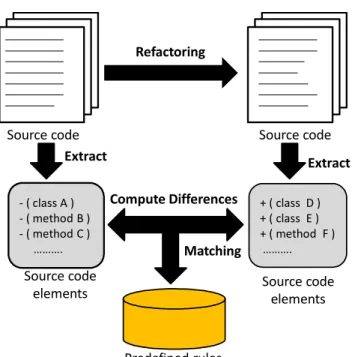
The rule used in these techniques is the criterion for determining whether refac-toring was performed based on changes (e.g., additions, deletions, and movements) of the program elements (e.g., classes, methods, and parameters) and the similarity of elements between two versions. For example, to detect refactoring instances of the Extract Method pattern, a technique proposed by Prete et al. [54, 75] extracts program elements as facts and then computes the similarities of the facts between two versions. Finally, if the computed results match a predefined rules that states the “source code of a new method is extracted from a changed method in the old version, the new method calls the old method, and source code of the new and old methods are similar to each other” then the target source code is detected as a refactoring instance of the Extract Method pattern. Figure 2.1 summarizes the process of this type of detection.
The techniques proposed by Antoniol et al. and Advani et al. detect refactoring instances based on Fowler’s definition of refactoring patterns [1, 2]. Antoniol et al. presented a technique for detecting refactoring instances at the class level (e.g.,
Class Extraction and Class Split) based on the predefined conditions to investigate
the evolution of classes in Java software systems. Their technique extracts identi-fiers from each class, and then weights the extracted identiidenti-fiers based on the TF-IDF (Term Frequency-Inverse Document Frequency) [3]. Next, it converts each class into a vector based on the weight of the class, and, finally, determines the refactoring instances according to the conditions based on changes (e.g., a newly
Extract Source code Source code Predefined rules - ( class A ) - ( method B ) - ( method C ) ………. + ( class D ) + ( class E ) + ( method F ) ………. Compute Differences Source code elements Source code elements Refactoring Matching Extract
Figure 2.1: Overview of a rule-based refactoring detection technique
added class) in each class and the cosine of the angle between two vectors rep-resenting the classes. Furthermore, this approach was applied to 40 releases of
dnsjava and identified the Class Replacement, Merge and Split, and Factor Out
refactoring. Advani et al. developed a tool for detecting refactoring instances according to the predefined criteria aimed at investigating whether certain refactor-ing patterns are related [1]. This tool reports refactorrefactor-ing instances when predefined criteria for 15 refactoring patterns are matched with changes in the class entities (e.g., methods and fields). As a result of applying the tool to seven OSS systems, this study found that the Rename Method, Rename Field, Move Method, and Move
Field patterns are frequently related with other refactoring patterns.
G¨org and Weißgerber implemented a tool called REFVIS for detecting the refactoring instances based on changes (e.g., add, remove and unchanged) in the signatures of the classes and methods between two versions [35]. REFVIS also provides a feature that visualizes the detection results at the classes and methods levels. Weißgerber and Diehl presented a technique for detecting refactoring in-stances based on added, changed, or removed classes; interfaces; methods; and fields between two versions [96]. It then ranks the refactoring instances based on similarities in the source code between the two versions using CCFinder. This
technique is able to detect similar source codes as refactoring instances, whereas REFVISonly reports two exact source code as refactoring instances.
Xing and Stroulia’s UMLDiff detects refactoring instances between two ver-sions [97, 98, 100]. UMLDiffextracts logical facts such as the types, names, and modifiers of the packages and classes from two input program versions. It then computes their similarities based on their changes, additions, movements, and dele-tions. Finally, if the computed similarities are matched with queries representing refactoring patterns, it detects the target source code as a refactoring instance.
Prete et al. developed anEclipseplug-in calledRef-Finderthat detects refac-toring instances of 63 refacrefac-toring patterns between two program versions based on the predefined rules [54, 75]. Ref-Finder extracts the code elements (e.g., packages, classes, and interfaces), structural dependencies (e.g., containment and overriding relationships), and the contents of the code elements (e.g., if-then-else control structures) as facts from two input program versions. It then computes the differences in facts between the two program versions. Finally, it determines the refactoring instances based on the predefined rules of the refactoring patterns [74]. Ref-Finderdetects both atomic refactoring and complex refactoring using other atomic refactoring as a pre-requisite. Furthermore, it can detect more instances of refactoring patterns using code information such as a conditional branch and exception handling.
A technique proposed by Fujiwara et al. detects refactoring instances from multiple revisions [29]. This technique speeds up the refactoring detection by ex-tracting code elements from each revision and matching them using Historage [40]. Rule-based techniques are also used to detect refactoring instances from the changes in histories of the components. In general, it is difficult to detect refac-toring instances from changes in histories of the components because of backward compatibility (i.e., obsolete source codes coexist with their newer counterparts un-til they are no longer supported). To address this problem, Dig et al. and Taneja et al. presented techniques for detecting refactoring instances between two ver-sions of components based on predefined rules [20][92]. Dig et al. developed an Eclipseplug-in calledRefactoringCrawler[20], which identifies similar pairs of entities (e.g., methods and classes) in two versions of components usingShingles [17] to find refactoring candidates, and then analyzes references among the source code entities in each of the two versions of the components to detect real refac-toring instances. Taneja et al. developed a tool calledRefac Lib, which extracts similar entities from the source code from two versions of an Application Program-ming Interface (API) and then reports the refactoring instances based on a syntactic analysis, the similarities and size of the entities, and information regarding obsolete entities.
soft-ware evolution for several different purposes are described. Note that only studies using automation techniques for detecting refactoring instances are introduced.
Several studies have aimed at finding the relationship between defects and refactoring [9, 36, 53]. G¨org and Weißgerber investigated jEdit and Tomcat to find refactoring instances containing bugs [36]. After preprocessing the extracted data from CVS repositories, they identified refactoring instances ofADD/Remove ParameterandRename Methodpatterns based on changes in the methods and classes between two versions [35]. They then checked whether these refactoring patterns were consistently applied to all related methods to identify incomplete refactoring instances. As a result, they found five candidate buggy methods.
Kim et al. investigated the development histories of three OSS systems, aiming at determining the relationships between API-level refactorings (i.e., Rename and
Move Package/Class/Method, and Method Signature Change) and bug fixes [53].
They analyzed revisions containing API-level refactoring, revisions containing bug fixes, and bug-introduction changes in Eclipse JDT, jEdit, and Columba. They concluded that the number of bug fixes increases after refactoring, whereas the time taken to fix the bugs decreases after refactoring. Meanwhile, Bavota et al. reported that refactoring induces a small number of defects [9]. They analyzed the refactoring instances detected by Ref-Finder from three Java OSS systems to investigate to what extent refactoring induces bugs. As a result, they found that only 15% of the refactoring instances induced bug fixes and that several refactoring patterns including the Pull Up Method and Extract Subclass induce more bug fixes than others.
Some studies have investigated the actual practice of refactoring to better un-derstand the process [87, 99]. Xing and Stroulia analyzed three pairs of released versions of Eclipse JDT using theUMLDiff algorithm to investigate the actual refactoring practice and suggested a direction for improving refactoring support tools [99]. In their study, they found that 70% of the structural changes were the result of refactoring, and that existing integrated development environments lack support for complex refactoring such as refactoring of the containment-hierarchy. Soares et al. analyzed the frequency of refactoring, program structures affected by refactoring, and the scope of refactoring from almost 41,000 software versions of five OSS systems [87]. From the identified refactoring based on behavior preser-vation between pairs of versions, they found that 27% of the changes during the software evolution were from refactoring. They also identified that most refactor-ings is low-level refactorrefactor-ings (i.e., only changing blocks of code within methods) or local refactorings (i.e., performed within a package).
Rachatasumrit and Kim investigated 14 pairs of versions of three Java OSS systems (Apache JMeter, XML Security Library, and Apache ant), aiming at deter-mining the relationship between refactoring and regression testing [76]. This
in-vestigation was conducted based on refactoring instances detected byRef-Finder and affected tests (i.e., a set of regression tests in the old version that are relevant to atomic changes) identified byFAULTTRACER[104], an automated change impact analysis tool. The results of this investigation revealed that 22% of the refactored methods and fields are covered by existing regression tests and that 38% of the affected tests involve refactoring. Furthermore, it was also found that 50% of the failed affected tests involve refactoring.
Finally, Tsantalis et al. studied Git repositories of three OSS systems, namely
JUnit, HTTPCore, and HTTPClient [94]. They analyzed the refactoring histories,
using refactoring detection rules suggested by Biegel et al. [15]. As a result, they observed that most types of the refactoring applied are conducted by specific de-velopers, who usually have a key role in the management of the project. Moreover, they found a wide variety of reasons motivating the application of refactoring; for instance, the decomposition of methods was the most dominant motivation for ap-plying Extract Method refactoring to deal with code smell.
Chapter 3
Proposing and Evaluating Clone
Detection Approaches
3.1
Motivation
Electronics companies are currently releasing new models of their products in reg-ular and rushed intervals [16, 25, 83]. To release a new model within a short time-frame, a number of companies simply reuse existing files with or without modifi-cations. This saves time and cost, and avoids the high risk entailed in creating new code logic. However, it generates many identical or similar files between different versions and models, making software systems difficult to maintain.
It is important to detect code clones from different released versions and mod-els. For example, when a defect is contained in a code clone in one version/model, all of its cloned code fragments in the other versions/models should be inspected for the same bug. This takes a significant amount of time and effort, particularly in large-scale software systems. To date, researchers have proposed code clone detection approaches using various granularities such as lines, tokens and abstract syntax trees and have evaluated them to find the most effective approach [12, 82].
Different degrees of normalizations (i.e., the transformation of program ele-ments) for detecting code clones have also been proposed. Each type of normaliza-tion makes subtly different but similar source code to be detected as code clones. For instance, a code clone detection tool calledDupnormalizes the input source files by tokenizing each file into a single token sequence [4]. This normalization leads to the detection of source code with different white spaces, layout, and com-ments as code clones. A token-based code clone detection tool calledCCFinder normalizes the input source files by replacing identifiers related to the types, vari-ables, and constants using a special token, and then concatenating all tokens in the
same file into a single token sequence [49]. This normalization leads to the detec-tion of source code with different identifiers, white spaces, layout, and comments as code clones. Different degrees of normalization cause different granularities of source code to be detected as code clones, but only little is known about how such normalization impacts the code clone detection [23].
To investigate how normalization impacts the code clone detection, this study proposes and evaluates six approaches for detecting code clones with preprocess-ing uspreprocess-ing different degrees of normalization. More precisely, each type of nor-malization is applied to the input source files, and equivalence class partitioning is then conducted on the files based on theMD5hash function during the preprocess-ing. The goal of this preprocessing is to avoid an irrelevant code clone detection caused by identical files. Identical files increase the computational complexity of the code clone detection because code clones are repeatedly detected within them. The proposed approaches can be categorized into two types, an approach with non-normalization and approaches with non-normalization. The former category is the de-tection of code clones based on identical files without normalization, whereas the latter category is the detection of clones based on different degrees of normaliza-tion, such as removing macros from the input source files. After preprocessing, code clones are detected only in a corpus (i.e., a set of files each of which is a rep-resentative of each equivalence class) byCCFinder. As a case study, the proposed approaches and an approach that uses onlyCCFinderare applied to different ver-sions of three OSS systems. The contributions of this study can be summarized as follows:
• Both of the proposed approaches with a preprocessing of the input source
files are faster than the approach using onlyCCFinder.
• Any normalization also takes a great deal of time during the preprocessing
and post-processing, and is unable to reduce the total detection time in many cases.
• We have proposed and implemented code clone detection approaches using
the preprocessing of the input source files.
The remainder of this study is organized into the following sections. Section 3.2 details the proposed code clone detection approaches. Section 3.3 describes a case study on different versions of three OSS systems, and Section 3.4 details the results. Next, Section 3.5 discusses the results of the case study, Section 3.6 then describes threats to the validity of the proposed approaches, and finally, Section 3.7 concludes this chapter.
/* say “Hello World” */ #include <stdio.h> int main() { printf("Hello World¥n“); return 0; } a
Original Source Code
intmain(){printf("HelloWorld¥n");return0;} f ISC Approach $main(){printf("HelloWorld¥n");return0;} g INSC Approach c #include <stdio.h> int main() { printf("Hello World¥n"); return 0; } IEC Approach
/* say “Hello World” */ int main() { printf("Hello World¥n"); return 0; } d IEM Approach
/* say “Hello World” */ #include <stdio.h> int main() { printf("Hello World¥n"); return 0; } b
Approach with Non-normalization
int main() { printf("Hello World¥n“); return 0; } e IEMC Approach
Figure 3.1: An example of the result of each normalization
3.2
Proposed Approaches
This study proposes and evaluates approaches for detecting code clones with a different type of preprocessing. The proposed approaches can be categorized into two categories: an approach with non-normalization (see Subsection 3.2.1) and approaches with normalization (see Subsection 3.2.2). The former is the detection
Detection of clones Mapping Selection Equivalent class partition MD5 Calculation
all clone sets Input source files Clone detection Post-processing Preprocessing
Figure 3.2: Overview of an approach with non-normalization
of code clones based on identical files without normalization, whereas the latter is the detection of code clones based on identical files with different degrees of normalization. Both approache types share the following pipeline phases:
i. Preprocessing: This is used to conduct equivalence class (i.e., a set of files that are identical to each other based on the hash values) partitioning and generate a corpus based onMD5hash values of the input source files. For this study, theMD5hash function was adopted because its probability of an accidental collision is extremely small.
ii. Clone detection: This is used to detect code clones in a corpus usingCCFinder. In this phase, code clones are detected only on a corpus because identical files are detected as equivalence class in the preprocessing phase. As a re-sult, time complexity from the repeatedly detection of code clones within the identical files can be reduced. To detect code clones, this study uses CCFinderbecause of its high accuracy in code clone detection.
iii. Post-processing: This is used to generate all clone sets by mapping the out-put ofCCFinder, the equivalence classes and other information if necessary. The all cone sets exclude clone sets existing only within each equivalence class because they are already detected as equivalence classes.
The detailes of the approach with non-normalization and approaches with nor-malization are explained in Subsection 3.2.1 and 3.2.2 respectively.
3.2.1 Approach with Non-normalization
This type of approach identifies identical files without normalization. For example, Figures 3.1(a) and 3.1(b) show identical non-normalized files used in this type of approach. Code clones are then detected based on these identical files. Figure 3.2
0cc 0cc 0cc be05 be05 175 A9 b1 b2 c1 d1 (a) a1 a2 a3 0cc 0cc 0cc be05 be05 175 A9 b1* b2 c1* (b) a1* a2 a3 d1*
Figure 3.3: An example of equivalence class partition and selection
Normali-zation Parsing Input source files MD5 Calculation Detection of clones Mapping Clone detection Selection
all clone sets Post-processing Equivalent class partition Preprocessing
Figure 3.4: An overview of the approaches with normalization
illustrates an overview of the three phases of this approach type. The details of each phase are as follows:
a. Preprocessing: For each input source file, theMD5hash value of the file is calculated. Equivalence class partitioning is then conducted based on the hash values. Namely, all files that have the sameMD5hash values are par-titioned into the same equivalence class. Figure 3.3 shows an example of a partition. In this figure, characters written on the files represent the hash val-ues, and a blue rectangle represents each equivalence class. Taking a closer look at the figure, files a1, a2, and a3, which have the same hash value ’Occ’,
are partitioned into the same equivalence class. Files b1 and b2, which have
the same hash value ’be05’, are also partitioned into an equivalence class. In addition, files c1 and d1are partitioned into their own singleton equivalence
class. After the partitioning, a file is selected from each equivalence class as a representative and then added to the corpus. Figure 3.3 shows an example of such a selection. In this figure, an asterisk indicates files contained in the
corpus. That is, files a1, b1, c1, and d1are selected and then contained in the
corpus.
b. Clone Detection: Code clones are detected in a corpus usingCCFinder. c. Post-processing: It is easy to assume that if a code clone exists in one file
within an equivalence class, code clones also exist in the same place in other files of the same equivalence class. Thus, during this phase, all clone sets are generated based on this assumption. That is, if a code clone is detected in a representative of an equivalence class during the clone detection phase, then a code fragment in the same place in the other files of the same equivalence class are also added to the same clone set as code clones.
3.2.2 Approaches with Normalization
This category contains approaches with different degrees of normalization, as fol-lows:
• Identical Except for Comments (IEC) approach • Identical Except for Macros (IEM) approach
• Identical Except for Macros and Comments (IEMC) approach • Identical Source Code (ISC) approach
• Identical Normalized Source Code (INSC) approach
These approaches require additional processes compared to the approach with non-normalization described in Section 3.2.1. That is, they parse the input source files into tokens and then save the token information during the preprocessing phase. Figure 3.4 provides an overview of three common phases of the above approaches. In the figure, additional processes are shown in red. The details of each phase are as follows:
1. Preprocessing: The input source files are parsed into tokens and the follow-ing information is then extracted from each file:
• Token list: a list of tuples (the token number, the start column number,
the end column number and the line number) of each token, with the following attributes.
– Token number: the number assigned to each token.
– End column number: the column number where the token ends. – Line number: the line number where the token exists.
One of the following normalizations is then applied to each input source file. Note that targets for normalizations are selected from the same program elements asCCFinder.
• For the IEC approach: All lines containing only comments, and
com-ments or white spaces before and after the comcom-ments are removed from each input source file. This normalization transforms Figure 3.1(a) into Figure 3.1(c).
• For the IEM approach: All lines containing only macros are removed
from each input source file. This normalization transforms Figure 3.1(a) into Figure 3.1(d).
• For the IEMC approach: All lines containing only macros or
com-ments, and comments or white spaces before and after the comments are removed from each input source file. This normalization transforms Figure 3.1(a) into Figure 3.1(e).
• For the ISC approach: Tokens in the same file are concatenated into
a single token sequence. This normalization transforms Figure 3.1(a) into Figure 3.1(f).
• For the INSC approach: Tokens of identifiers, literals, and types are
replaced by a special token, and tokens in the same file are then con-catenated into a single token sequence. This normalization transforms Figure 3.1(a) into Figure 3.1(g). In this figure, an identifier ‘int’ is replaced by $.
The rests of this phase are is same as the preprocessing used in the approach with non-normalization, as explained in Section 3.2.1-a. All files that have the same hash value are partitioned into the same equivalence class. After the partition, a file is selected from each equivalence class as a representative and then added to the corpus.
2. Clone Detection: Code clones are detected in the corpus usingCCFinder. 3. Post-processing: As a result of normalization during the preprocessing phase,
code clones may exist in different places between the files within the same equivalence class. Therefore, if a code clone is detected in a representative of an equivalence class, mapping is conducted as follows:
(a) The start token number (i.e., the first token number of the code clone) and the end token number (i.e., the last token number of the code clone) in the representative are identified.
(b) The start column number and the line number of the corresponding start token number in other files in the same equivalence class are identified based on the token list saved during the preprocessing.
(c) The end column number and the line number of the corresponding end token number in other files in the same equivalence class are also iden-tified based on the token list.
(d) The code fragments ranging from the identified start column number in the line number to the identified end column number in the line number in other files of the same equivalence class are added into the same clone set as code clones
3.3
Case Study
In the case study, the proposed approaches and the approach that uses onlyCCFinder are applied to different versions of three OSS systems. Note that the proposed approaches detect code clones by excluding identical files within the same equiva-lence class, and therefore for the case study, different versions of the same software system were selected as subject systems because they contain many identical files. In particular, the case study was designed to address the following two RQs:
• RQ1. Can the proposed approaches detect code clones faster than an
ap-proach that uses onlyCCFinder?
• RQ2. Which approach is the fastest among the proposed approaches?
In the case study, 30 tokens (the default setting) were used as the minimum length of the token sequence of a code clone forCCFinder. During the case study, each approach was executed three times to obtain reliable results. This case study
Table 3.1: Statistics of subject systems
Name #Versions #Files Line of code #Tokens
Apache Ant 29 18,708 4,862,102 8,404,790
Linux kernel 12 7,839 5,690,967 12,537,555
was conducted on a 64-bit Windows 7 Professional workstation equipped with two processors, (i.e., 2.27GHz and 2.26GHz CPUs) and 24 GB of main memory.
As the subject systems, three OSS systems of different sizes and application domains were selected: Apache Ant1, Linux kernel2, and Samsung Galaxy3. An overview of these systems is shown in Table 3.1.
Apache Ant is a Java library and command-line tool for building systems
writ-ten in Java. From this system, Java files under a directory called main were selected from 29 consecutive released versions (released versions 1.1 through 1.9.4). Linux
kernel is a clone of the UNIX operating system written in C. From this system, C
files having the file extensions .c, .cc, .cpp, and .cxx under a directory called fs were selected from 12 consecutive released versions (released versions 2.6.0 through 2.6.10). Samsung Galaxy is a Samsung mobile phone called Samsung Galaxy Y Pro, which is written in C. Two released versions of this model for different geo-graphical areas, Latin America and China, were selected. From this system, C files having the file extensions .c, .cc, .cpp, and .cxx under a directory called common were selected from each version. Note that files that are lexically incomplete were excluded.
3.4
Results
This section describes the results of the case study used to answer the above RQs.
3.4.1 Comparison with the Approach that uses OnlyCCFinder
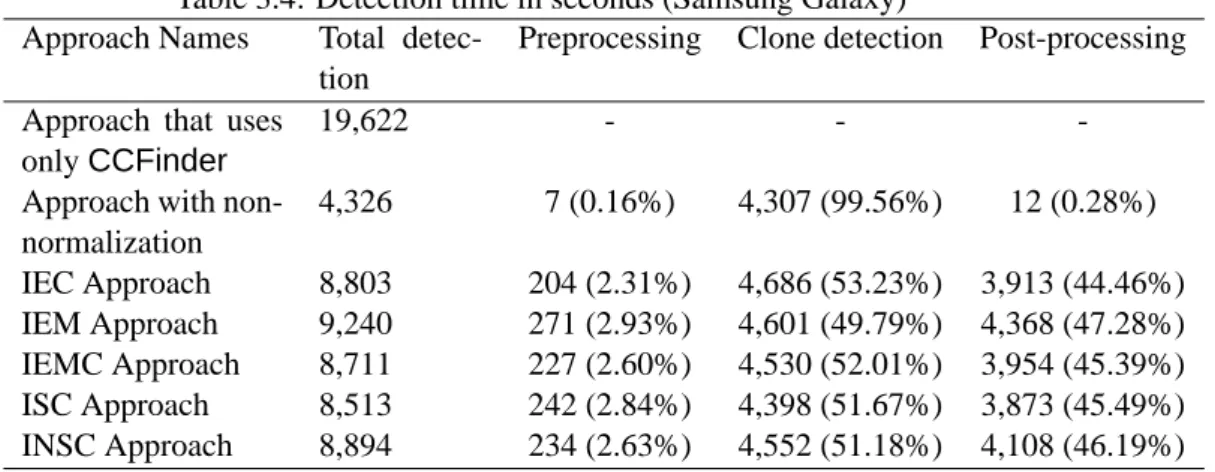
To answer RQ1, this study compared the proposed approaches with the approach that uses onlyCCFinderwith respect to the detection time. Tables 3.2, 3.3, and 3.4 list the detection times of the proposed approaches compared to the approach that uses onlyCCFinderfor Apache Ant, Linux kernel, and Samsung Galaxy, re-spectively. Note that the “IEM Approach” and “IEMC Approach” are conducted based on the macros in C program, and thus these approaches were only applied to Linux kernel and Samsung Galaxy. In these tables, the columnTotal detection timerepresents the detection time needed to complete each approach. The columns Preprocessing,Clone detection, andPost-processingshow the detection time of each phase. In these columns, the numbers in the parentheses represent their proportion of the total detection time. Note that these tables show the average detection time of the three executions.
1 http://ant.apache.org/ 2 http://www.kernel.org/ 3 http://opensource.samsung.com/index.jsp





![Figure 4.3: An example of clone refactoring using the RMMO pattern]](https://thumb-ap.123doks.com/thumbv2/123deta/8365752.1297401/53.892.294.656.180.673/figure-example-clone-refactoring-using-rmmo-pattern.webp)
