1. Introduction
In the spring of 2020, the global COVID-19 pandemic disrupted and changed the lives of people throughout the entire world. As in many parts of the world, shifting from traditional classroom teaching with face-to-face contact to online teaching with students attending classes remotely was considered to be the best option to slow the spread of the novel coronavirus. At Nagoya University of Foreign Studies (NUFS), the start of the semester was first postponed from April 10 to April 27, with the final decision to make the move to online classes decided only two weeks prior to the April 27 start date. Needless to say, feel-ings of consternation and panic were a natural response to this entire situation, from students and their parents, to instructors and university administrators. In this report, I am going to describe how the English team in the Department of Global Governance and Collaboration (“Collabo”) at NUFS collaborated more closely due to the sudden shift to online teaching. First, I will describe the Collabo English curriculum and how the design of the curriculum facilitated the transition to online teaching. Next, I will describe how the Collabo English team coordinated and collaborated together to implement the shift to online teaching
Transitioning to Online Teaching the Collaborative Way
in a very short time, and finally, I will report about how instructors and students responded to the new situation.
2. Collabo English Curriculum
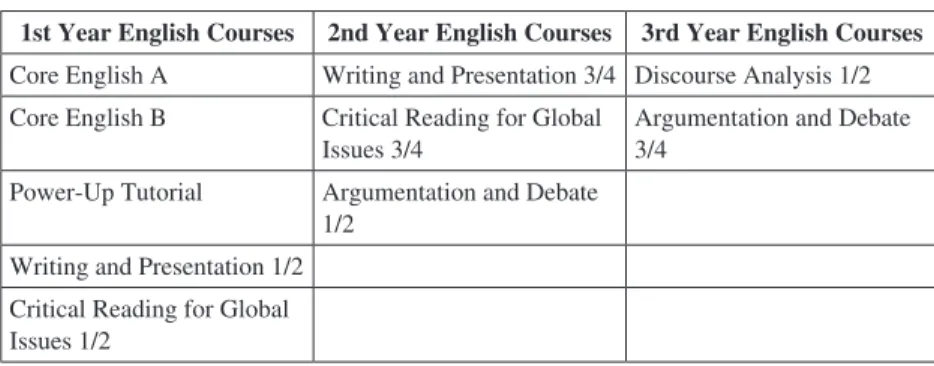
The Collabo English curriculum is unique in many ways. The entire English curriculum in Collabo is both integrated and coordinated for all three years of the required English classes. For first year students, the curriculum consists of the Core English program, the Power-up Tutorial program, academic writing (Writing and Presentation) and academic reading (Critical Reading for Global Issues). For second year students, the curriculum includes academic writing (Writing and Presentation), academic reading (Critical Reading for Global Issues), and debate (Argumentation and Debate), while in the third year, the curriculum consists of academic writing (Discourse Analysis) and debate (Argumentation and Debate). (See Figure 1).
The entire required English curriculum is integrated which means that for each course in each academic year, there are three to four thematic units per semester that all the courses share. For example, in the first year, the first thematic unit is about “Urban versus Rural Living” and for three to four weeks, the students read, write, listen and discuss this topic in all of their English Figure 1 - Collabo English Curriculum
1st Year English Courses 2nd Year English Courses 3rd Year English Courses
Core English A Writing and Presentation 3/4 Discourse Analysis 1/2 Core English B Critical Reading for Global
Issues 3/4
Argumentation and Debate 3/4
Power-Up Tutorial Argumentation and Debate 1/2
Writing and Presentation 1/2 Critical Reading for Global Issues 1/2
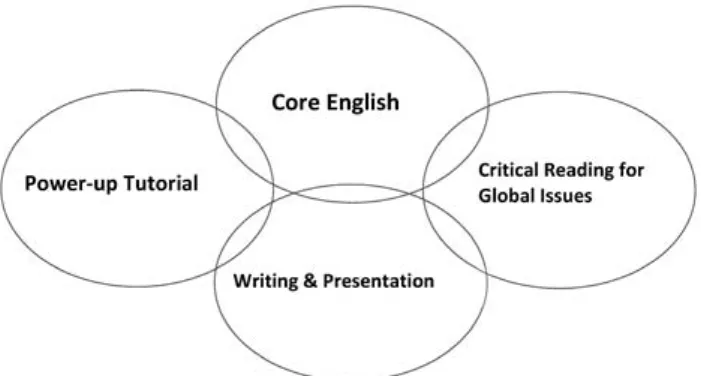
classes which includes Core English (CE), Power-up Tutorial (PUT), Writing and Presentation (WP) and Critical Reading for Global Issues (CRGI). In other words, the same thematic topic is thoroughly covered and shared by all five courses over the same period of time. (See Figures 2-3).
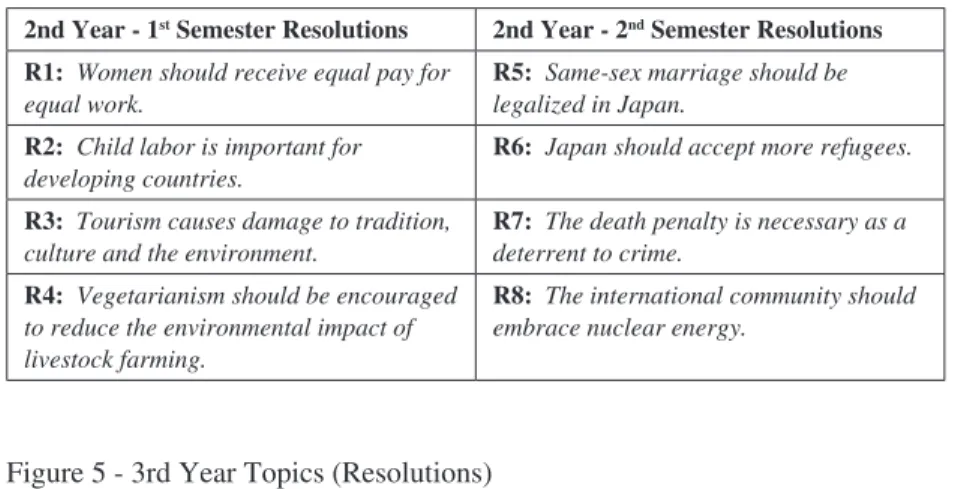
Similarly, the second and third year of the English curriculum is thematically integrated, but rather than calling them topics or themes, they are referred to as “resolutions” due to the fact that the students research and prepare to formally debate the resolutions. (See Figures 4-5).
Besides being an integrated curriculum, it is also a coordinated curriculum. Coordination in this case means several things. First, all instructors and students use the same teaching materials, whether they are commercially-published texts (Core English, PUT, and Argumentation and Debate 1/2) or original custom-produced materials for the rest of the courses. Secondly, it means that Figure 2 - Integrated English Curriculum
Figure 3 - 1st Year Topics
1st Year - 1st Semester Topics 1st year - 2nd Semester Topics
1. Urban vs Rural Living 1. Climate Change
2. Festivals Around the World 2. Effects of the Olympics
3. The Cost of Education 3. Corporate Social Responsibility
all instructors follow the same basic schedule and unified lesson plans to ensure that the students are uniformly receiving the same opportunities for both teaching input and student output. Furthermore, student assessment is also included as a part of the curriculum. Therefore, regardless of instructor, this integration and coordination ensures more uniformity and consistency across the curriculum.
There is another unique feature of the Collabo English curriculum. Each course includes elements of “blended learning” which means that regular class-room learning is combined with elements of online teaching through activities, tasks, supplementary videos, URL links, study materials, handouts, templates, and quizzes that are all available through its own separate Moodle page that is also integrated and coordinated across the entire English curriculum. This would Figure 4 - 2nd Year Topics (Resolutions)
2nd Year - 1st Semester Resolutions 2nd Year - 2nd Semester Resolutions R1: Women should receive equal pay for
equal work.
R5: Same-sex marriage should be
legalized in Japan.
R2: Child labor is important for
developing countries.
R6: Japan should accept more refugees. R3: Tourism causes damage to tradition,
culture and the environment.
R7: The death penalty is necessary as a
deterrent to crime.
R4: Vegetarianism should be encouraged
to reduce the environmental impact of livestock farming.
R8: The international community should
embrace nuclear energy.
Figure 5 - 3rd Year Topics (Resolutions)
3rd Year - 1st Semester Resolutions 3rd Year - 2nd Semester Resolutions R1: Citizens should be allowed to carry
weapons for self defense.
R4: We need religion to have a better
life.
R2: Animals have rights just the same as
humans.
R5: People living in a foreign country
must completely assimilate into the host culture.
R3: Euthanasia should be an option for
terminally ill patients.
R6: We should not be worried about the
prove to be one of the most fortunate things about the curriculum since students begin using it as first year students, so by the time they are in their second year, there are no issues.
3. Coordination of the Collabo English Team
Managing an integrated and coordinated curriculum would not be possible without course coordinators and each course has one. Each coordinator is in charge of communicating with the other course instructors throughout the aca-demic year and taking the lead for the refinement of existing teaching materials as well as the development of new materials. In addition, since communication amongst the English team members is crucial, meetings are held regularly. During the normal academic year, communication takes place in biweekly task force meetings, competently managed by Mr. Daniel Lumley. These are formal meetings with a set agenda, a meeting leader, and are followed up with recorded meeting minutes that are shared with all the team members and Collabo department members. In addition to task force meetings, there are formal “post-mortem” meetings held for each course at the end of the academic year in order to review, reflect, and make suggestions for revising teaching materials for the next academic year. Furthermore, there are many informal meetings that take place in the form of email threads, hallway conversations, and impromptu casual meetings. We are fortunate that all the members of the English team appreciate this close communication and coordination.
4. The Transition to Online Teaching
Until NUFS made the official decision to shift to online/remote learning on April 10, the English Team could not make any decisions or plans for the new semester, lest we waste time and energy. Needless to say, anxiety and stress lev-els were quite high during this period. One thing that we could do, however, was to begin researching and sharing ideas about online teaching and start thinking
about how we would shift to online teaching if and when that decision was made. It was during this time that the English team instructors began experimenting with various online meeting platforms such as Google Meet and Zoom as well as other online teaching applications and websites. By the time the university would finally make the decision to offer online / remote learning, the English team members were all familiar with Zoom and liked the various features such as polling, breakout rooms, screensharing, whiteboard, the ability to change one’s background, and the ability to see the faces of all meeting members. If we were going to have to teach online, Zoom seemed to offer the most useful features that would help us to simulate the face-to-face classroom in an online learning environment.
Once the decision to shift to online learning was made, the English team was ready to pounce into action. It had been decided and agreed upon by the team that since none of us were trained or experienced with online teaching, we would be offering “emergency” online classes. In order to reduce the burden on both the instructors and the students, we wanted to keep things as clear and simple as possible. For all the courses, we would use Zoom to simulate face-to-face teaching in the classroom, especially because of the breakout room feature that would allow instructors to make pairs or small groups of students for more active communicative interaction activities and tasks during class time.
Another simplification decision we made was to continue to use Moodle as the central location for communicating with the students about the course content and materials. Our Moodle coordinator, Mr. Daniel Lumley, was in charge of unifying each of the Moodle course pages so that they were uniformly organized and easier for the students to navigate to find what they needed for each course. (See Figure 6). This also included posting a recurring Zoom link for each instructor’s Zoom classroom. In that way, student confusion would be reduced because all they had to do was open the Moodle page for their course and click on their instructor’s name. (See Figure 7).
Regarding the student submission of homework assignments, such as work-sheets, essays, and reports, the simplification decision was to have students use either Moodle or Google Drive. In the case of Google Drive, students were instructed how to create and upload their assignments to a folder they shared with their instructor, including editing privileges. Fortunately, despite the clunky and awkward design of the Google suite of applications, students were able to overcome the somewhat steep learning curve and become proficient users of Google Drive and Google Documents.
Furthermore, we had to adjust our lesson plans, which are also a part of the integrated and coordinated curriculum. Each coordinator was in charge of adjusting their course lesson plans and syllabus, and then sharing them with the other course instructors. Since the semester started two weeks later than normal but was going to finish at the originally planned time, it meant that we faced the Figure 6 - Moodle Home Access Page for Collabo Students
decision to either move quickly through all three to four thematic units, or slow it down by reducing the lesson content by one topic, which is ultimately what we decided. It had also been suggested by the university that lessons could be reduced to 60 minutes to help alleviate student and instructor stress due to being online most of the day.
Finally, I must not forget to include the importance of close communication with our department assistants. The Collabo English team has a very good working relationship with the assistants, and they are included in many email threads so that they are aware of what we are doing. In this way, if a student calls the office with a problem or concern, the assistants are often able to help solve the problem or quickly find the proper person to direct the student to contact. Without the amazing support of the assistants, namely Ms. Kato and Figure 7 - Sample Moodle Class Page
Ms. Fujinuma, the transition to online teaching would not have been nearly as smooth.
To sum up, the transition to emergency online teaching included several sim-plification decisions: 1) Using Zoom as the online classroom meeting platform, 2) Using Moodle as the central location for all course and blended learning materials that had already been created in previous years, 3) Using Google Drive as the location for assignments that needed feedback, assessment, and comments, and 4) Slowing down the pace of the lessons by reducing one topic or resolution in the first semester, and aiming to teach a 6o minute online class rather than the usual 90 minute class. Moreover, instructors were strongly encouraged to stick to these simplification decisions in order to reduce the stress and burden of online teaching for not only the instructors, but also the students. This also meant that instructors were not supposed to introduce anything new, such as different online learning applications or platforms into their own classrooms.
5. General Response to Online Learning by Collabo Instructors and Students
In my case, when I am teaching in the regular classroom environment, I make full use of technology in the classroom such as using the overhead camera projector to project class worksheets onto the screen and using the computer projector system to show my Powerpoint slides. For the transition to online teaching, I continue to use Powerpoint slides to teach, but I have expanded what I usually include in my slides to compensate for the lack of the overhead camera projector. I have found that this adds about an extra hour of preparation for each class that I teach, so with eight koma, I spend about six to eight more hours per week for class preparation. However, by doing this extra preparation, I feel that the quality of my lessons has improved. In addition, not only me, but most of the Collabo English team instructors have fairly quickly adjusted to online teaching and many of us actually quite enjoy it.
When the semester finally began on April 27, instructors and students were full of nervous anticipation, especially the first year students whom we had not even met yet and who were going to have their first college experience in the online environment. The first day came and went, then the first week. Surprisingly and fortunately, there were few major issues!
One of the biggest issues was the weak online environment that some students faced. Another issue was students not having the proper online tools such as a computer and headphones, with students mistakenly believing that just using a smartphone was going to be acceptable. For instructors, there were reports of an increase in eye strain, headaches, and just sheer exhaustion from teaching online for several hours a day. In addition, there was additional stress about “blind teaching” meaning that it was not always possible to see the students reactions and other nonverbal cues as well as not being able to monitor what the students were seeing when the instructor was sharing their screen.
The online learning environment also has many advantages. Because students do not have to spend any time commuting to campus, they are able to sleep a bit later and they also have more time to devote to their studies. Without the commuting time, students seem to be more alert and attentive during class. Furthermore, attendance rates have skyrocketed! NUFS students in general are very good about class attendance, but with the transition to online learning, having 100% attendance became the new norm.
Now in the second semester of online teaching, some newer issues seem to be appearing. In my classes, I have noticed that some students are requesting to keep the camera turned off and I allow it if there is a good reason, like a weak WiFi connection. Another situation that has occurred is that I have had more than a few students attending class from unusual places like in a car while driving or parked in a convenience store parking lot. I even had one student who was attending class while sitting in the game arcade section of the local Aeon shop-ping mall. Also, it has been recently reported that students seem to be using the
chat function to privately chat with classmates during class. Our response will be to remind the students about online ethical behavior and caution them about using class time for private conversations.
6. Summary
In this report, I have explained the reasons why the Collabo English instruc-tors and students were able to successfully make the transition to online learning. First, having an integrated and coordinated curriculum helps ensure that the English team members are unified and consistent. Instructors are able to share ideas and support each other because they are using the same teaching materials, and there is a lot of communication and collaboration between them. In addition, we are basically able to use the same teaching materials every year after they have gone through a revision process, so familiarity with the teaching materi-als significantly reduces teacher anxiety and stress. Second, we already have elements of online teaching built into our curriculum with the blended learning environment that Moodle helps provide. The transition to online teaching was relatively easy because we did not have to create an online classroom situation from scratch. Furthermore, the learning curve needed to overcome learning Moodle technology was not required because we were already proficient with setting up and using Moodle. Third, when we had determined that our teaching was going to be “emergency” online teaching, the perceived trepidation we felt before starting online teaching was reduced significantly. We consider ourselves to be proficient and competent classroom teachers, but transitioning to online learning certainly caused us much consternation because it was not something we had ever done before. By calling it “emergency” online teaching, we could approach it more confidently since we would be just doing what we usually do, but in the online Zoom classroom environment. Finally, the other big reason why the transition to online teaching was relatively easy was because of the centralized decision to keep everything as simple as possible, both for
the instructors and for the students. This also reduces stress and anxiety for all involved because instructors are all doing the same thing. With just a couple of technologies to master, instructors were able to comfortably transition to online teaching. Although online teaching is far from ideal, the Collabo English team made the transition fairly smoothly with very few issues.