Ian Harnett
Dedicated to Berengar of Tours (0999-1088), Jan Hüs (1369-1415), John Goreway (1555), Thomas Hayward (1555), and Edward Wightman (1612)
“What is to give light must endure burning” (Viktor Frankel 1905-1997)
7.1 The Target
In the International Year of Light, the eight hundredth anniversary of the Magna Carta, the six hundredth year of the martyrdom of Jan Hüs, the arrival of NASA Dawn at Ceres, and the passage of NASA New Horizons through the Pluto system, Morphs 7 (MM 7), Time Column Two, takes up a question asked by the French philosopher Ruwen Ogien at the start of his 2013 book ’L’Etat nous rend-il meilleur’ and answers it by developing the position of the Pastorate’ and ’Shepherd King developed by the French philosopher Michel Foucault in ’Security, Territory, Population’ (1977-1978. This move is towards genre expression within the framework of the hierarchy of genres.
7.2 Clearing The Decks
Ruwen Ogien, a contemporary French philosopher and Director of Research at CNRS, at the start of his book ’L’Etat nous rend-il meilleur’ (2013) asks: ’Why has a hegemony of conservative thought arisen in the public life of prosperous, democratic societies?’
’Large-Scale Psychological Differences Within China Explained by Rice Versus Wheat Agriculture’ (Talhelm et al. 2014) suggested that large-scale psychological differences within China are best explained by the economics of rice production versus the economics of wheat production. If this is the case, then pastoralist economic activity, Court Society economic activity, and the appearance of a hegemony of conservative thought in the public life of prosperous, democratic societies might be interconnected with the mindset, psychology, and rhetoric associated with particular economic practices.
To test the legacy of behavior described by Hiroshi Sega in his ’Zetsubo no Saibansho’ (Courts Without Hope 2014) and by Joseph Sorge in his 2013 ’Divorce Corp’, MM 6 developed Time Column One and ran
the Sega-Sorge Data Package down Time Column One. This trial run suggested that the basin of attraction and the phase space of the Court economic production system resulted in a closed, isolated system with one limit cycle, i.e., black. In other words, Zoroaster, Hesiod, Plato, Aristotle, Cicero, the Goliards, Petrarch, Valla, Scaliger, Voltaire, Balzac, Spencer, Barthes, Berman, Buchanan, Chandler, and Girard were correct in their bleak assessments of the Court Society.
To take further the notion of an “Invisible Gorilla” and a “Galapagos Syndrome surviving at the core of the Modern Legislative State, ’Mimetic Morphs 7 Time Column Two’ explores the notion of Genre Expression before returning to the Jungian Archetype Judge (JAJ) travelling as a standing wave dynamic through time. Then, after making adjustments to the parameters of the JAJ Wave, MM7 extends a second long ranging Time Column down the X-axis in search of the frequencies of the Judicial Brain (JB).
7.3 Methodology
In preparing for the Age of Big Data, the Mimetic Morph series has employed the linguistic theories of Ferdinand de Saussure preserved by the notebooks of Emile Constantin edited and translated by Eisuke Komatsu and Roy Harris (1993). In particular, the Mimetic Morph series has utilized the lectures of 15 November 1910, 18 November 1910; 22 November 1910; 25 November 1910; 29 November 1910, and 2 December 1910. ’Development in Continuity’; ’Isoglossematic Bands’; Isoglossematic Waves’; Hypercube Schema, ’Linguistic Waves’; ’Time Column’; the ’Vertical Axis’; and ’Wellentheorie (Johannes Schmidt 1877) are Saussurean notions.
While building the MM 6 Saussurean Time Column to test for ’Development in Continuity’; ’Isoglossematic Bands’; Isoglossematic Waves’; ’Linguistic Waves’; and the ’Wellentheorie (Johannes Schmidt 1877) in the data cube in search of the Judicial Brain, the limitations of the Western calendar became apparent. In MM 7, Saussurean Time Column Two is built on a new calendar, i.e, the Holocene calendar.
The Holocene Calendar (HC), an invention long past its time, adds 10,000 years to the Western calendar by starting from the end of the last glacial epoch. Simplicity itself, the Holocene calendar reverses BC dates to their correct numerical sequence, whereby the year 2000 BC becomes 8000 HC, and prefixes 1 to AD dates, whereby 2000 AD becomes 12000 HC and the year 2015 becomes 12015 HC. The HC (Holocene Calendar) is grounded in geophysical reality, the end of the last Ice Age, and it can easily be expanded to incorporate millions and billions of years.
The data cube Judicial Brain; Linguistic Waves; and Time Columns do not belong to the Genre of Reason. Instead, the double bookkeeping methodology follows in the footsteps of Lorenzo Valla (1406-1457) and the discipline of Stemmatology, e.g., tabulations, tags, threads, ties, tiles, toggles, traces, tracks, traffic, trains, trails, trajectories, trawls, tuples, and types. In our augmented reality, we are not looking for a
prime mover but are focused on patterns, e.g., tints, tones, and tunes in the tapestry of the time tornado.
7.4 Genre Expression
Genre expression bypasses the gene and environment debate by focusing on the semiotic systems providing cohesion to institutions. Narrative and story provide the reification of reality. In other words, language metaphor drives mobs, mode, models, money, monopoly, morality, motivation, and molds. Semiotic microarrays of routines, sub-routines, and tags bundled up into genre, become the vehicle installing the indoctrination behind legitimization, licence, and validation. Adaptive stories, “Just So” stories, and “Let’s Pretend” stories are the pathway to ideologies of domination.
“Die, selfish gene, die” (7,100 words in Aeon magazine, by journalist David Dobbs) reports on the vast difference between grasshoppers and locusts. Grasshoppers are described as elegant, long-legged, modest, solitary, and well mannered and locusts are described as hoggish hooligans, short-legged, and swarmers. But, despite appearing to be different animals, species, and possibly genera, grasshoppers and locusts are exactly the same species and can even be the same animal morphing from one into the other at short notice. Gene expression alters appearance, behavior, form, and social world. Nothing is rewritten in the genetic blueprint or book. It is the read out of the genome that alters the phenotype from grasshopper to locust matching the species to an altered environment.
Genre Expression by analogy, explains why judges and lawyers remain human at DNA level but in their social actions, behavior, and conduct become abusive, brutal, cruel, deceptive, and evasive fraudsters. It is their semiotic read out - installed by law culture, law faculties, law habits, law institutions, law literature, law praxis, and law professors – that progressively reduce adult humans to the intelligence of a Medieval nine year old educated child, then to a one year old Modern child, then to behavior far less intelligent than that of the Drosophila melanogaster (common fly) researched by Azusa Kamikouchi, a Nagoya University professor, and, second, the maze-solving slime mould Physarum polycephalum researched by Nagagaki formerly of the Nagoya Biometic Control Research Centre; the 2nd International Workshop on Biologically Inspired Approaches to Advanced Information Technology, Osaka, Japan, 26-27 January 2006; and ’Rules for Biologically Inspired Adaptive Network Design’, Atsushi Tero et al. (Science 22 January 2010, pp. 439 - 442 DOI: 10.1126/science.1177894.
Why does the Court Society choose to downsize its IQ? Why should the Court Society decide to be scientifically illiterate? Why would the Court Society refuse to acknowledge the existence of atoms, binary logic, chemistry, geometry, gravity, measurement, molecules, motion, physics, public space, science, and verification? Is it the addictive brain food the tribe receives as a reward for causing emotional contagion? Is it that an outmoded semiotic readout from the wrong side of history preserves and provides economic and social advantages for the tribe. Or is the economic system of production that generates the
willful blindness of the Court Society? Whichever proves to be true, the semiotic readout generating the large-scale psychological differences observed in the actions, behavior, and conduct of the Court is the leftover relic of a toxic theology.
7.5 Ideologies of Domination
The ’James Lexicon Bundle’ (2010) and the ’Judicial Brain Lexicon Bundle’ (2015) take us into the heart of Genre Expression, ideologies of domination, and semiotic readouts.
’Democratic Insecurities’ (James 2010) provides a lexicon bundle by which to parameterize the Allostatic Loading Praxis (Emotional Contagion, Negative Energy) of the Court Society. Erica Caple James, an Associate Professor of Anthropology at the Massachusetts Institute of Technology, in ’Democratic Insecurities’ explored Western modes of action in Haiti after the 1991 coup in relation to the traumas of victims. This ’James Lexicon Bundle’ includes: (1) Assemblage of Actors; (2) Assemblage of Institutions; (3) Asymmetries of Power; (4) Broken Communities; (5) Coup Apparatus; (6) Covert Channeling; (7) Cultural Pathology; (8) Disenfranchisement; (9) Disorder and Disruption in Social Space; (10) Elite Spectrum; (11) Embodied Legacies of Acute Victimization; (12) Existence of Hidden Transactions; (13) Exploitive Domestic Practices; (14) Forces of Production and Reproduction; (15) Global Mental Health; (16) Global Saturation; (17) Government Actors; (18) Hidden Actors; (19) Human Authors; (20) Institutional Actors; (21) Key Levers; (22) Malevolent Bureaucracy; (23) Malevolent Perpetuators; (24) Mobile Sovereigns; (25) Modes of Social Control; (26) Necropolitics; (27) Negative Nexus of Power; (28) Negligent Patriarchs; (29) Neomodern Social Engineering; (30) New Forms of Warfare (Brownmiller 1975); (31) Occult Actors; (32) Occult Economies; (33) Occult Economies of Trauma; (34) Occult Institutions; (35) Occult Motivation; (36) Occult Powers; (37) Ontological Security; (38) Overarching Pattern of Predation; (39) Plantation Regime; (40) Political Economy of Extraction; (41) Powerful Actors; (42) Political Economy of Trauma; (43) Practices of Divination; (44) Predatory History; (45) Predatory Practices; (46) Predatory Sovereign State; (47) Privileged Position; (48) Psychosocial Wounds; (49) Puppets of Hidden Actors; (50) Ruptures in Routines of Daily Life; (51) Secular Theodicies; (52) Secular Theology; (53) State Fetishism; (54) State within a State; (55) Structural Violence; (56) Structures of Domination and Exploitation; (57) Technologies of Trauma; (58) Terror Apparatus; (59) Terror Economies; (60) Trauma of Insignificance; (61) Trauma Narratives; (62) Trauma Portfolios; (63) Traumatized Citizens; (64) Thwarting; (65) Unconstitutional Rule; (66) Virtual Sovereignty; and (67) Voodoo Economies. The Judicial Brain Lexicon Bundle (2015) is built primarily from the Gold Card British Commonwealth countries of Britain and New Zealand (MM 5.6.1; 5.6.2; 5.6.3; 5.6.4). Assembled from the horse’s mouth, so to speak, the Judicial Brain Lexicon Bundle includes (1) Absolute Sovereignty; (2) ars artium, regimen animarum; (3) Aristotelian Mechanics; (4) Divine Intervention; (5) Divine Right; (6) Dominion and Domination; (7) Disputatio; (8) Eminent Domain; (9) Exceptional Powers; (10) Exclusion; (11)
Infallibility; (12) “Inherent” Jurisdiction; (13) “Ius Maletractandi”; (14) Judge-made Law (Judicial Activism); (15) Lordship; (16) Platonic Supersensible Ideal; (17) Plenipotentiary Powers; (18) Privilegium; (19) Sacred Geometry; (20) Sanctum Sanctorum; (21) Scholastic Corporation; (22) Seigneurial Economy; (23) Social Domination Network; (24) Sophistical Opinion; (25) Scientific Illiteracy; (26) Superior Force; (27) Two-Sword System; (28) “Ultra Vires”; (29) Unlimited Jurisdiction; and (30) Voice of Heaven. To the Judicial Brain Lexicon Bundle, we can add not only the expanded lexicon of Aristotelian Mechanics, e.g., (31) Circle of Perfection; (32) Empyrean Heaven; (33) Geocentricism; (33) Great Chain of Being; (34) Natural Order; (35) Prime Mover; (36) Ranks; (37) Shells; (38) Summum Bonum; (39) Stationary Hierarchy; Sublunary Zone (Sub-Human Citizens) and (40) Teleology but also the enhanced lexicon of Capstone JIMP JOE Network-Centric Warfare (MM 4.2), i.e., the covert remilitarization of the Court, the legal industry, and the Justice Sector by the USA Department of Defence, Homeland Security, and USA military as part of Operations Afghanistan Enduring Freedom and Iraqi Enduring Freedom.
The ’James Lexicon Bundle’ (2010) and the Judicial Brain Lexicon Bundle (2015) indicate the fault line between the Age of Data and the Age of Divinity.
7.6 Michel Foucault on Pastoral Power
We will now briefly review the stages of the Jungian archetype Judge in the standing wave dynamic enhanced by the 1978 lectures termed ’Security, Territory, Population’ delivered by Michel Foucault who held the chair ’The History of Systems of Thought’ at the Collège De France. In this work, edited by Michel Senellart, Foucault developed the notion of bio-power together with an analysis of the mechanisms of power in governmentality framed by the organization of pastoral power.
To begin with, on 18 January 1978, Foucault refers to scarcity during the seventeenth and eighteenth centuries still being regarded as a punishment for man’s evil nature together with the juridical-moral concept of evil human nature (fallen nature) and the cosmological-political concept of fortune being the two general frameworks for thinking about scarcity. In the Ancien Régime, scarcity exists as corrective action and punishment by the order of Providence, not as chaos; not climate change; not disease; not lack of education, information, & knowledge; and not due to social conditions. In his conclusion, Foucault states that the thought and organization of modern political societies are based, not on God’s laws or Men’s evil nature, but the domain and reality of physics, e.g., ’economics is a physics’, and liberalism is a movement developed from the laws, principles, and mechanisms of reality itself. Foucault termed this movement to an economics based on the power of physics as normalization.
Corrective action and punishment by the order of Providence also sum up the actions, behavior, and conduct expressed by the semiotic readout of the Court Society.
In his 8 February 1978, 15 February 1978, 22 February 1978, 1 March 1978, 8 March 1978, and 15 March 1978 lectures, Foucault discussed the organization of pastoral power in the pre-Christian and Christian East; the magistrate-shepherd in Plato’s Critias, Laws, Republic, Statesman; the pastoral metaphor in the West, as a model of the government of men; the role of the pastorate in the history of governmentality; pastorate relationship to the law: institutionalization of a relationship of complete subordination of the sheep to the person who directs them; the field of the pastorate in the modes of the exercise of power; and the intensification of the religious pastorate following the Protestant Reformation and the Counter Reformation.
Pastoral power, originating from Assyria, Babylon, Egypt, and Indo European defines the fundamental religious relationship between a God and men, and, ipso facto, the subaltern shepherd who is the king and judge and the people (Foucault 1978: 169-170, 187). In Plato’s Laws the Magistrate-Shepherd is a subordinate magistrate, a watchdog, a policeman and in Book Ten of the Laws the magistrate-Shepherd is an auxiliary and functionary of the City State (Ibid: 190-191). Thrasymachus in Book One of the Republic takes a far more cynical (pragmatic) view of the Magistrate-Shepherd, who wears a sheepskin jacket, and in the Statesman Plato proposes that political constitutions only begin with the end of the divine pastoral shepherd. It is the model of the weaver that replaces the shepherd (Ibid: 196). Foucault concludes that Plato in the Statesman rejected entirely the notion of the Magistrate-Shepherd and the pastorate.
Foucault suggests pastoral power became introduced into Europe as part of the Christian Church institution of governance, “doubtless something from which have still not freed ourselves” (Ibid: 199). “The Reformation was a formidable reinforcement of the pastorate in two different types” (Ibid: 200). “There has never been an anti-pastoral revolution. The pastorate has not yet experienced the process of profound revolution that would have definitively expelled it from history” (Ibid: 201).
MM 1 at 5.5 Institutional Meiosis, at Table Two Institutional Meiosis, at Table Three ’Defensor pacis and the Twenty First century Court’, and at Table Four ’Martin Luther and the Twenty First century Court’ described the institutional meiotic separation of the secular theology of the Court from the religious theology of the Church. At that time, we were unaware of the significance of pastoral power. In other words, what we missed entirely in MM 1 was that the set of techniques and procedures of Church pastoral power carried, cloned, and crossed over to the secular theology of the Court. Now, thanks to Foucault (1978), we can identify one of the “great external blockages” (Ibid: 201) to the evolution of the Modern Legislative State, i.e., the genre expression of pastoral power surviving as habitus, mindset, praxis, and semiotic readout in the Court Society.
The pastorate (’oikonomia psuchōn’) is the conduction, economy, management, regime, and shepherding of souls (regimen animarum). Brainwashing, coercion, duplicity, intimidation, lies, subordination, terror, and tricks are part and parcel of this conducting and shepherding process, a form of economic exploitation,
by the conductors. The great age of the pastorate extended from the tenth century through to the eighteenth century (Ibid: 264), which coincides neatly with the Europe-wide involvement of magistrates with burning citizens at the stake or pulling them apart with physical torture machines.
Foucault (Ibid: 268) writes of the development of a dimorphism, a binary structure within the pastoral field, distinguishing the clergy from the laity wherein the whole of medieval Christianity from the sixteenth century is characterized by the existence of two clearly distinguished categories of individuals, clergy and laity, who do not have the same civil rights, obligations, or privileges (J. Zeiller, “L’organisation ecclésiastique aux deux premiers siècles,” in A. Fliche and V. Martin, Histoire de l’Église depuis les origines jusqu’à nos jours. I. L’Église primitive (Paris: Bloud & Gay, 1934) pp. 380-381. This dimorphism is also the source code behind the cloned dogma establishing legal apartheid.
“From the twelfth century the Church was penetrated by a judicial model that was a major reason for anti-pastoral struggles” (Ibid: 270). Wyclif, Jan Hüs, and Wesley participated in these anti- anti-pastoral struggles. Foucault (Ibid: 313) speaks of the “de-governmentalization of the cosmos” occurring precisely between 1580 and 1650 in the res publica that took place in Europe following the Protestant Reformation. 22 March 1978, Foucault suggests that the breakthrough of a “governmental reason in Europe took place due to a different way of thinking about the relations between the kingdom of heaven and the kingdom on earth. This regulatory switch was a schema of intelligibility for a whole set of already established institutions, a whole set of given realities”. At the heart of this revolution lay the principle of intelligibility. The notions of Empire and Church had become a sort of empty envelope, an empty shell, to be replaced by a new economy (5 April 1978, Chapter Thirteen), a new economy based on scientific knowledge (Ibid” 450), i.e., normalization.
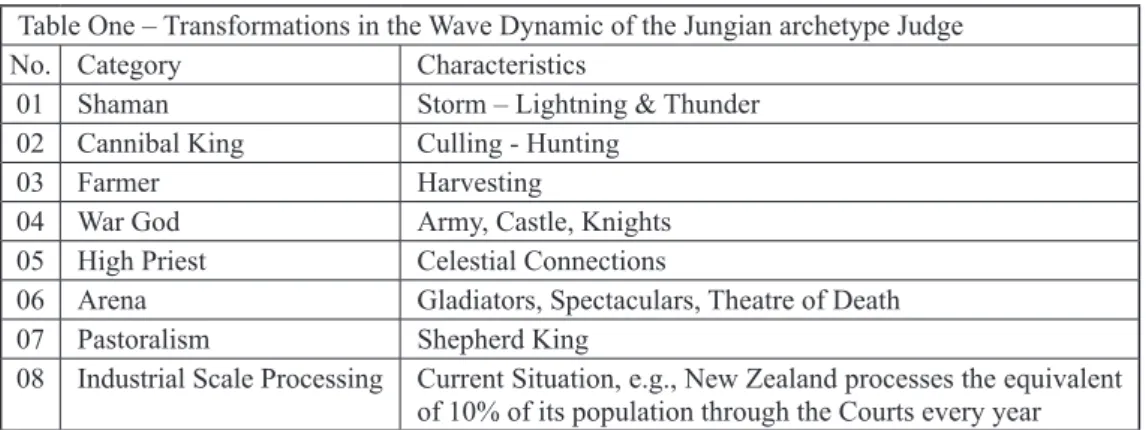
Now, after this detour through pastoral power, we are able to more accurately define stages re the ’Development in Continuity’ embedded in the standing wave dynamic of the Jungian archetype Judge.
Table One – Transformations in the Wave Dynamic
Table One – Transformations in the Wave Dynamic of the Jungian archetype Judge No. Category Characteristics
01 Shaman Storm – Lightning & Thunder 02 Cannibal King Culling - Hunting
03 Farmer Harvesting
04 War God Army, Castle, Knights 05 High Priest Celestial Connections
06 Arena Gladiators, Spectaculars, Theatre of Death 07 Pastoralism Shepherd King
08 Industrial Scale Processing Current Situation, e.g., New Zealand processes the equivalent of 10% of its population through the Courts every year
7.7 Time Column Two
Constructed within a data hypercube, Time Column Two is tied to a new calendar, i.e, the Holocene calendar. A time wipe travels in tiles tupled across the horizontal axis and a time swipe travels in tiles tupled down the vertical axis. As with Time Column One, the Time Column Two elevator begins from the current floor with tagging and tupling two court cases taken 1,2000_1,2010 HC from widely separated countries in a synchronic tile wipe across the horizontal axis, i.e., CIV2000 404/1706/SDOO in New Zealand - where judges destroy two safe, secure, well-functioning freehold properties based on Judicial Activism and Solution-Focused Courts - and Kelo v City of New London in the Supreme Court of the USA - where judges destroy an entire community in New London.
The second time swipe in Time Column Two is made up by stopping the TCT elevator 600 years down in the Holocene calendar 1,1400 (fifteenth century CE) HC and swiping New Zealand’s CIV2000 404/1706/ SDOO against two time tile wipes, i.e., the Court cases of Joan of Arc and Jan Hus.
The third time swipe in Time Column Two stops the TCT elevator another 1500 years down in the Holocene calendar at year 10,000 HC where New Zealand’s CIV2000 404/1706/SDOO is swiped against the Parable Of The Vineyard.
The fourth time swipe in Time Column Two stops the TCT elevator another 1000 years down in the Holocene calendar at year 09,000 HC where New Zealand’s CIV2000 404/1706/SDOO is swiped against two time tile wipes, i.e., the Court cases of Greek Hesiod’s Works and Days and Egypt’s special commission set up in year 16 of Ramses IX (’Amon-her-khepshef Khaemwaset’) during the 20th Dynasty to investigate tomb robbing of the royal necropolis.
The fifth time swipe in Time Column Two stops the TCT elevator another 500 years down in the Holocene calendar at year 08,500 HC where New Zealand’s Crime Act (2006) is batched, matched, tagged, tiled, tupled, and wiped against Zoroaster’s Gathas.
The final time swipe in Time Column Two stops the TCT elevator another 1000 years down in the Holocene calendar at year ~07,500 HC, our MM7 ground floor, where the public performance of a New Zealand Judge can be integrated with the public performance of the first named Judge, Gilgamesh of Uruk.
7.7.1 Annie Cameron and Susette Kelo
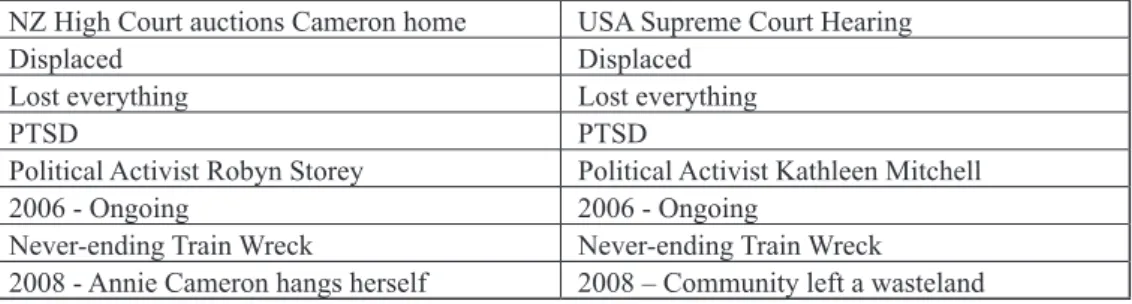
Table Two – Annie Cameron and Susette Kelo Integration
HC 1,1997 - New Zealand HC 1,1997 - New London, USA CIV2000 404/1706/SDOO Kelo v City of New London
1997-2005 1997-2005
Annie Cameron Susette Kelo
46 Blackwell Drive 8 East Street
North of the Firth of Thames Near the Thames River
Near Naval Underwater Sound Laboratory Near Naval Underwater Sound Laboratory Ordinary, quiet, unassuming person Ordinary, quiet, unassuming person Similar educational level Similar educational level
A Battler A Battler
Same age Same age
Same body weight Same body weight
Red hair colour Red hair colour
Nickname “Red” Nickname “Red”
Burned easily in the sun Burned easily in the sun
First home First home
Seaside Seaside
Breath-taking view Breath-taking view
“Strange sense of belonging” “Strange sense of belonging” “This house is calling me” “This house is calling me”
Low income area Low income area
Freehold property Freehold property Part of a community Part of a community
Did a lot of home improvement Did a lot of home improvement Tiled the floors Polyurethaned the floors Collected antiques Collected antiques Put in raised flowerbeds made of granite
alongside the cottage Put in raised flowerbeds made of granitealongside the cottage Wore wide-brim sunhats Wore wide-brim sunhats
Gardening gloves Gardening gloves
Fan of Nirvana Fan of Nirvana
Court is like a rectal examination Court is like a rectal examination Multiple lawsuits Multiple lawsuits
Start October 1997 Start October 1997
Antagonist John COX Antagonist Claire Gaudianni Funded by public money Funded by public money
Legal Services Agency New London Development Cooperation Socially connected Socially connected
Diva Diva
Dirty Tricks Program Dirty Tricks Program
Fear tactics Fear tactics
December 2000 – Judge Glazebrook finds
S129B case to answer December 2000 – Kilo v City of Londonfiled in Court 2001 – Year of Discovery 2001 – Year of Discovery
March 2002 - Judge NICHOLSON March 2002 - Judge Martin
September 2002 – More dishonesty exposed September 2002 – More dishonesty exposed December 2002 - back in Court December 2002 - back in Court
Sixty Minutes 2003 Sixty Minutes 2003 16 February 2005 22 February 2005
NZ High Court auctions Cameron home USA Supreme Court Hearing
Displaced Displaced
Lost everything Lost everything
PTSD PTSD
Political Activist Robyn Storey Political Activist Kathleen Mitchell
2006 - Ongoing 2006 - Ongoing
Never-ending Train Wreck Never-ending Train Wreck
2008 - Annie Cameron hangs herself 2008 – Community left a wasteland
The synchronic integration of the Court experiences of Annie Cameron in New Zealand (1997-2008) and Susette Kelo (1997-2008) demonstrate that neither Court case is out of the ordinary, unique, or unusual. Berman (1983) observes that the Canon Courts were set up to break communities and to transfer assets to the Church. In the New Zealand case, family and friends of the prosecuting lawyer obtained ownership of the Cameron freehold plans, possessions, and properties and in the USA case the City of New London obtained the lands of the displaced community. In both cases the Courts proved efficient at Displacement. Disorder and Disruption in Social Space; Embodied Legacies of Acute Victimization; Exploitive Domestic Practices; Key Levers; Malevolent Bureaucracy; Malevolent Perpetuators; Mobile Sovereigns; Negative Nexus of Power; Negligent Patriarchs; Overarching Pattern of Predation; Political Economy of Extraction; Powerful Actors; Political Economy of Trauma; Predatory Practices; Psychosocial Wounds; Puppets of Hidden Actors; Ruptures in Routines of Daily Life; Structural Violence; Structures of Domination and Exploitation; Technologies of Trauma; Terror Apparatus; Terror Economies; Trauma of Insignificance; Trauma Narratives; Trauma Portfolios; Traumatized Citizens; Thwarting; Unconstitutional Rule; and Virtual Sovereignty.
With more than 50 tags, ties, and tuples established on the horizontal axis between New Zealand’s CIV2000 404/1706/SDOO and the USA’s Kelo v City of New London, we can swipe New Zealand’s CIV2000 404/1706/SDOO down deeper and deeper on the vertical axis, always remembering that Kelo v City of New London is a silent travel companion.
7.7.2 Annie Cameron and Joan of Arc
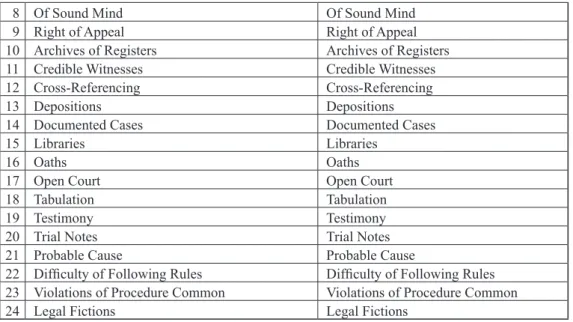
Table Three – Annie Cameron and Joan of Arc Integration
21st century New Zealand Courts Fifteenth Century Canon Courts 1
1 In NZSC70 the word “Lord” appears ~280 times Overlords
2 Removed from Secular Control Removed from Secular Control 3 Limitless Power Limitless Power
4 Teleological Intention Teleological Intention
5 Miranda Rights Miranda Rights
6 Rights to a Defence Lawyer Rights to a Defence Lawyer 7 Right to Remain Silent Right to Remain Silent
8 Of Sound Mind Of Sound Mind 9 Right of Appeal Right of Appeal 10 Archives of Registers Archives of Registers 11 Credible Witnesses Credible Witnesses 12 Cross-Referencing Cross-Referencing
13 Depositions Depositions
14 Documented Cases Documented Cases
15 Libraries Libraries
16 Oaths Oaths
17 Open Court Open Court
18 Tabulation Tabulation
19 Testimony Testimony
20 Trial Notes Trial Notes
21 Probable Cause Probable Cause
22 Difficulty of Following Rules Difficulty of Following Rules 23 Violations of Procedure Common Violations of Procedure Common
24 Legal Fictions Legal Fictions
For seven centuries the Aquinean Court system of “Credible Witnesses, Cross-Referencing, Defence by a lawyer, Depositions, Miranda Rights, Oaths, Open Court, Testimony, and Trial Notes” found humans guilty of animal transformations, flying on broomsticks, meeting with the devil, and numerous other delusions.
Kelly, in Inquisitions and Other Trial Procedures in the Medieval West (2001: 450) writes on the Joan of Arc trial: “Things had come to a sorry pass when the very substance of the inquisitional procedure was so routinely ignored that violations were no longer recognized as such….The abusive practices that came to prevail…should be identified as a perversion of the inquisitional process caused by overzealous and underscupulous judges….Trained in theology rather than law, they came by their ignorance honestly & such honest ignorance has remained to our own day”.
7.7.3 Ian Harnett and Jan Hus
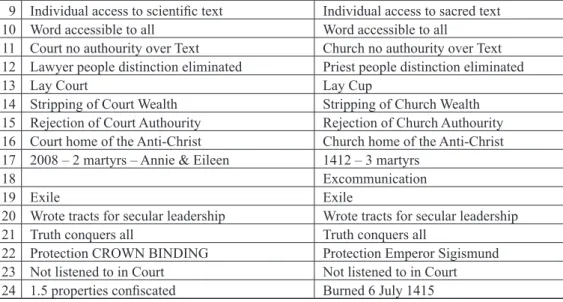
Table Four – Ian Harnett and Jan Hus Integration
21st century New Zealand Courts 1415 Canon Court
1 Ian Harnett (1947- ) Jan Hus (1372-1415)
2 Country boy Country boy
3 Master of Arts Master of Arts
4 Professor Professor
5 Court was a corrupted body Church was a corrupted body 6 Need for Court Reform Need for Church Reform 7 Anti Court Indulgences Anti Church Indulgences 8 Primacy of Science Primacy of Scripture
9 Individual access to scientific text Individual access to sacred text 10 Word accessible to all Word accessible to all
11 Court no authourity over Text Church no authourity over Text 12 Lawyer people distinction eliminated Priest people distinction eliminated
13 Lay Court Lay Cup
14 Stripping of Court Wealth Stripping of Church Wealth 15 Rejection of Court Authourity Rejection of Church Authourity 16 Court home of the Anti-Christ Church home of the Anti-Christ 17 2008 – 2 martyrs – Annie & Eileen 1412 – 3 martyrs
18 Excommunication
19 Exile Exile
20 Wrote tracts for secular leadership Wrote tracts for secular leadership 21 Truth conquers all Truth conquers all
22 Protection CROWN BINDING Protection Emperor Sigismund 23 Not listened to in Court Not listened to in Court 24 1.5 properties confiscated Burned 6 July 1415
Source examples are taken from Chapter Eight in A History of Medieval Heresy and Inquisition (Jennifer Kolpacoff Deane 2011). By tabulating, tagging, and tupling the context, life, and struggle of Ian Harnett in the first two decades of the Twenty First Century against the context, life, and struggle of Jan Hus in the first two decades of the Fifteenth Century, it becomes obvious within a functional meme structural model that very little difference exists in the experiences of Hus and Harnett. Jan and Ian faced exactly the same problems, i.e., (1) corrupt Church; (2) corrupt Court. The experiential struggles of Jan Hus and Ian Harnett, i.e., (1) Primacy of text; (2) Democratic control of text; (3) Elimination of Elites; (4) Elimination of Indulgences; (5) Secular power, indicates no change has taken place in Court processes between Hüs and Harnett.
7.7.4 Parable Of The Vineyard
The Parable of the Vineyard appears in three of the New Testament gospels (Mathew 21: 33-46; Mark 12, 1-12; Luke 20: 9-19) and tells the story of an owner of a vineyard who handed it over to tenants and departed for a far country. When the landowner sent his servants to collect his portion of the harvest his servants were cruelly rejected by the tenants; some were beaten, stoned, and even killed. Then he sent even more the second time and they too received the same treatment from the unrepentant people. The unrepentant people then kill the landowner’s son and seize the land for themselves.
Table Five – Harnett Tryphena Lands and Parable Of The Vineyard
New Zealand New Testament
CIV2000 404/1706/SDOO Mathew 21: 33-46; Mark 12, 1-12; Luke 20: 9-19
Loyal Tenant Disloyal Tenants
Handed over temporary use of access Handed over temporary use of vines Departed for a far country Departed for a far country
Workmen driven off Servants were cruelly rejected Tenant becomes displaced refugee, PTSD,
driven to suicide, lost to the world Some were beaten, stoned, and even killed CIV2001 404-0031913;
CIV 2006-404-004262: CIV-2006-404-007584;
Second time Same treatment from the
unrepentant people Same treatment from the unrepentant people Landowner’s tenant killed Landowner’s son killed Seize the land for themselves Seize the land for themselves What is the landowner to do? What is the landowner to do?
Two thousand years of Christian teachings have had zero effect and influence upon the practices of the Court. Thus, first, the practices of the Court both predate and predominate over Christian teachings and second, it would be futile for any Parliament or people to attempt to alter such an entrenched and resistant “Transactive Memory System”.
7.7.5 Annie Cameron And Hesiod
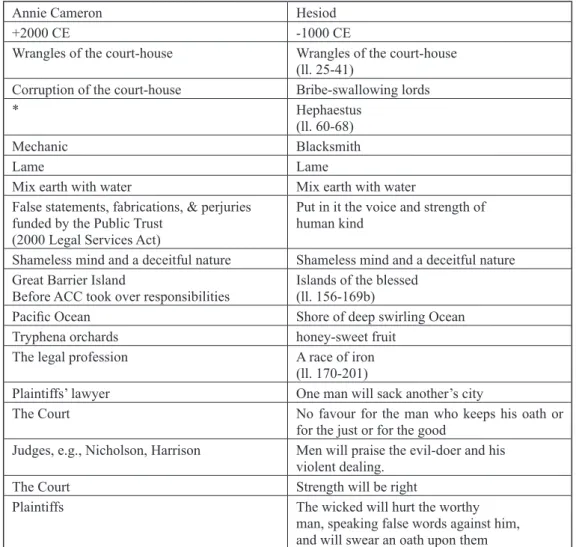
Hesiod found himself in an unwanted Court case over land and though ~3000 years and half a planet separate Annie Cameron from Hesiod, the Court experiences of Annie Cameron and Hesiod are virtually identical. More than fifty binary pairs exist between Hesiod’s Works and Days in archaic Greece 2,700 years ago and the multiple law suits against the Harnett Tryphena Lands.
Great Barrier Island, New Zealand, is very similar to the archaic Greek world of Hesiod, author of Works and Days. The agricultural worlds of archaic Greece and New Zealand are very common, e.g., craftsmen, potters, ploughman, minstrel, grain, fig trees, wine, bees, spring flowers, leaves on the topmost shoot of a fig-tree, plough in the spring, when the cuckoo first calls, sultry summers, rich in flocks, woolly sheep are laden with fleeces, shearing sheep, gelding kids and sheep, fencing in a sheep-cote, the goat’s fine hair, the foot-print that a cow makes, horned oxen in the byre, geld the boar and loud- bellowing bull, swift-footed horses, swift ships, the sparkling sea, chirping grass-hoppers, harvest season, bring home your fruits, a loaf of four quarters, drink bright wine sitting in the shade, wine party, cawing crows, barns filled with food, oak trees, look after the dog with jagged teeth and sharp-fangs, Poles of laurel, elm most free from worms, glades, fixed wages, oxen, wagons, swiftly flying hawk, prune the vines, chopping wood, fierce gales, heavy autumn rain, frost, cold winters, the season of rainy winter, white snow, wintry hard for sheep and for men, airy-swinging spider, needlework, the loom, and the opening of a wine-jar.
to the world that Hesiod lived in. Like Hesiod, Annie marked her year by the solstices and equinoxes; she lived under the same stars that Hesiod saw, e.g., Sirius, the constellation of Orion. Like Hesiod, Annie had no car, no motorbike, no phone, no TV. She was a minstrel who lived by candlelight & cooked on a woodstove. She made bread from whole meal grain and she had wine parties. She even followed the same calendar as Hesiod advised, although it was set for the Southern hemisphere. She had her bees and spring flowers, she worked her garden, she harvested her fruits, she spun her loom, she listened to the chirping grasshoppers, and she watched the airy-swinging spider. She had her dog with jagged teeth and sharp-fangs, his name was Bud, and she shipped her freight on the Nivanga, a ship owned by Neil Carter and Irene Wright. Why would anyone want to tortiously interfere with her life, displace her from her life, make her a refugee in Auckland, drive her insane, & steal her garden and home? For that matter, why should anyone want to tortiously interfere with the life of Neil Carter and Irene Wright, destroy their livelihood, drive them from their home?
Table Six – Annie Cameron And Hesiod
Annie Cameron Hesiod
+2000 CE -1000 CE
Wrangles of the court-house Wrangles of the court-house (ll. 25-41)
Corruption of the court-house Bribe-swallowing lords
* Hephaestus
(ll. 60-68)
Mechanic Blacksmith
Lame Lame
Mix earth with water Mix earth with water False statements, fabrications, & perjuries
funded by the Public Trust (2000 Legal Services Act)
Put in it the voice and strength of human kind
Shameless mind and a deceitful nature Shameless mind and a deceitful nature Great Barrier Island
Before ACC took over responsibilities Islands of the blessed(ll. 156-169b) Pacific Ocean Shore of deep swirling Ocean Tryphena orchards honey-sweet fruit
The legal profession A race of iron (ll. 170-201)
Plaintiffs’ lawyer One man will sack another’s city
The Court No favour for the man who keeps his oath or for the just or for the good
Judges, e.g., Nicholson, Harrison Men will praise the evil-doer and his violent dealing.
The Court Strength will be right
Plaintiffs The wicked will hurt the worthy man, speaking false words against him, and will swear an oath upon them
Plaintiffs Envy, foul-mouthed, delighting in evil, with scowling face,
Plaintiffs
NICHOLSON, LEE, COURTNEY Oath keeps pace with wrong judgments(ll. 212-224) 13 years of cases against the
the Cameron Tryphena Lands which end up being handed over to family & friends
of the Plaintiffs’ lawyer.
There is a noise when Justice is being dragged in the way where those who devour bribes and give sentence with crooked judgments
Auckland City Council Even a whole city suffers for a bad man who sins and devises presumptuous deeds (ll. 238-247)
TWELVE NEW ZEALAND JUDGES Those who oppress their fellows with crooked judgments
(ll. 248-264) GLAZEBROOK; HAMMOND; REGAN;
NICHOLSON; FAIRE; VENNING; SARGISSON; ROBINSON; HARRISON; LEE; COURTNEY; and STEVENS
The mad folly of their princes who, evilly minded, pervert judgment and give sentence crookedly
Death of First Plaintiff 12 December 2007
7 years after GLAZEBROOK Oral J 12 December 2000
He does mischief to himself who does mischief to another, and evil planned harms the plotter most
(ll. 265-266)
First Plaintiff Whoever deliberately lies in his witness and forswears himself, that man’s generation is left obscure thereafter (ll. 274-285)
Annie Cameron The generation of the man who swears truly is better thenceforward
Hesiod’s advice to Plaintiffs’ lawyer Turn your misguided mind away from other men’s property
(ll. 293-319)
Lawyers Waste the labour of the bees
Hesiod’s advice to Plaintiffs’ lawyer Wealth should not be seized (ll. 320-341)
Plaintiffs’ lawyer If he steal it through his tongue
Hesiod’s advice to Plaintiffs’ lawyer Gain deceives men’s sense & dishonour tramples down honour, the gods soon blot him out and make that man’s house low, wealth attends him only for a little time Hesiod’s advice to property owners A bad neighbour is as great a plague
as a good one is a great blessing (ll. 342-351)
Hesiod’s advice on bad neighbours Not even an ox would die but for a bad neighbour
Hesiod’s advice to Plaintiffs and
to Plaintiffs’ lawyer Do not get base gain: base gain is as bad as ruin (ll. 352-369)
Hesiod’s advice to property owners Get a witness; for trust and mistrust, alike ruin men
(ll. 370-372)
Hesiod’s advice to property owners Do not let a flaunting woman coax, cozen, and deceive you: she is after your barn (ll. 373-375)
Star Sirius passes over the heads of men Star Sirius passes over the heads of men (ll. 414-447
Migratory birds The voice of the crane (ll. 448-457
Judge NICHOLSON, P. 404, L. 32
“What is a mattock?” a mattock(ll. 465-478)
good management is best for mortal men Annie Cameron’s Garden
Artichoke flowers Artichoke flowers(ll. 582-596)
Orion Orion
(ll. 597-608)
New Zealand Orion and Sirius
(ll. 609-617) Great Barrier Island Sea-faring
(ll. 618-640)
The good ship Nivanga Admire a small ship, but put your freight in a large one
(ll. 641-645)
put all the freight on board (ll. 663-677)
1215 Magna Carta, Article 36 Observe due measure (ll. 678-694)
1215 Magna Carta, Article 20 Proportion is best in all things
The Court methodology against the Cameron Tryphena Lands is identical to that of archaic Greece 3000 years ago. Nearly 3000 years after Hesiod, there are still (1) Wrangles of the court-house; (2) Bad neighbours; (3) Witnesses who give False Oaths; (4) People who steal through the tongue; (5) People who use the Court to drive people to ruination; (6) Judges who drag the law sideways; (7) Crooked and perverted Judgments; & (8) no Justice for the honest. How can Hesiod’s world and Harnett’s world be identical after 3000 years of Law Faculties, Legislation, Parliaments, political parties, reform, and supervisory watchdogs? Identification of the archaic Greek court-house operating in the modern world after 3000 years is a wake-up call to the Legislature, Parliaments, political parties, and supervisory watchdogs.
7.7.6 Tryphena And Thebes
indexing the performance of the Office of the New Zealand Judicial Complaints Commissioner re the Harnett Tryphena Lands against the special commission set up in year 16 of Ramses IX (’Amon-her-khepshef Khaemwaset’) during the 20th Dynasty, i.e., 3000 years ago, to investigate tomb robbing of the royal necropolis. In calibrating Tryphena and Thebes separated by 3000 years, the Abbott Papyrus; the Leopold II and Amherst Papyrus; and the Mayer Papyrus provide an accountable, credible, and transparent backdrop for the robbing of the Cameron Tryphena Lands.
The tombs of the royal necropolis were protected by grave warnings carved into tomb hieroglyphics and by elaborate security measures. Only organized teams of professionals could rob them. The Commission arrested 45 people and brought them to trial. It turned out that the loot stolen from the tombs found its way into the Theban economy, therefore, everyone in the local area had benefited financially at some time from the tomb robbing. 3000 years later, the characters in the story are quite well known. The tombs in the necropolis of Thebes were under the supervision of the mayor of west Thebes, who was named Paweraa (Pewero). He was also the Chief of Police. The mayor of East Thebes, Paser (Peser), was the whistleblower who accused Paweraa of either being involved in the series of Tomb robberies or being negligent in protecting the royal tombs. The Vizier Khaemwaset ordered an investigation by a commission but he appointed Paweraa to head the vizierial commission. In the official report, the inspectors found that the majority of tombs were uninjured. In the ensuing trial seventeen workmen from near-by temples were convicted and executed. However, not surprisingly, it proved impossible for Paweraa to be officially charged with any crime due to the circumstantiality of the evidence. The people of Deir el Medina considered the investigation corrupt; the investigations concluded that Paser had delivered himself of slanders; Paser disappeared from the historical record soon after the report was filed; and the tomb robbing continued unabated. It is thought that the documents are a whitewash written from the perspective Paser’s rival, Paweraa.
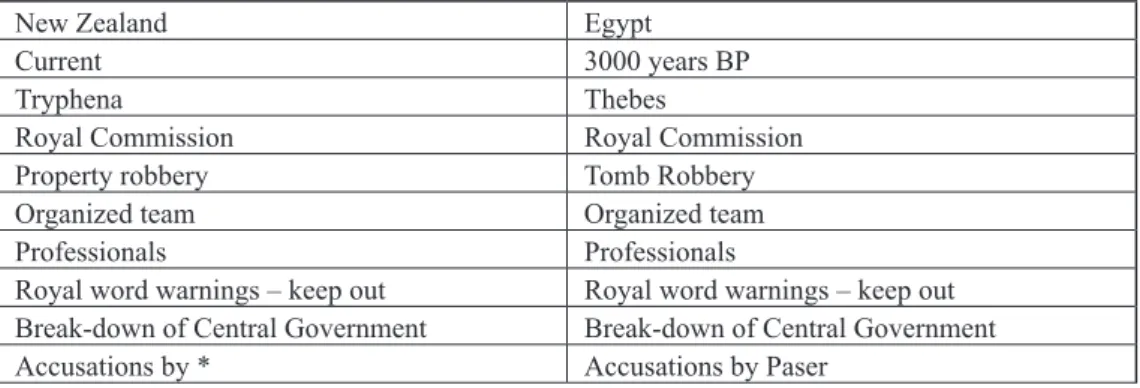
In calibrating Tryphena and Thebes by tupling the New Zealand CROWN against the royal necropolis, fundamental structural similarities emerge.
Table Seven – Tryphena versus Thebes
New Zealand Egypt
Current 3000 years BP
Tryphena Thebes
Royal Commission Royal Commission
Property robbery Tomb Robbery
Organized team Organized team
Professionals Professionals
Royal word warnings – keep out Royal word warnings – keep out Break-down of Central Government Break-down of Central Government Accusations by * Accusations by Paser
Whistle blower Whistle blower
Negligence in official duties Negligence in official duties
Twelve Judges Paweraa
? Put in charge of the investigation
On site investigation On site investigation
No Forensics Forensics
No Material witnesses interviewed Material witnesses interviewed
Whitewash Whitewash
No Convictions Conviction only for low operatives * disappears from history Paser disappears from history Found to have made false accusations Found to have made false accusations Land-robbing continued Tomb-robbing continued
Land-robbing was a local industry Tomb-robbing was a local industry Carried out by those paid to protect
the CROWN Carried out by those paid to protectthe royal necropolis Sustained the local economy Sustained the local economy Not a secret in the local area Not a secret in the local area
The Tryphena and Thebes Tabulation does not indicate any hope for the judicial system. First, the royal process at Thebes for investigation was an accountable, credible, and transparent process. However, second, the royal process at Thebes was corrupted by putting the accused in charge of the investigation, i.e., the fox guards the henhouse. Third, therefore, the investigation only finds what it wants to find and only the low level operatives are identified and punished, which conveniently eliminates the witnesses to the conspiracy. Fourth, at Thebes it is the whistleblower doing his official duty that ends up being found to be a guilty party. Fifth, the tomb robbing continues unabated. Sixth, the tomb robbing is carried out by those whose job it is to defend the tombs. Seventh, the tomb robbing sustained the local Theban economy. And eighth, the Thebes Template has been in operation throughout 3000 years of official commissions. The Tryphena and Thebes Template teaches us that while the CROWN may be honest, reliable, and true, its agents certainly are not. Instead, the agents of the CROWN protect each other and their own private interests and use the power of the CROWN to advance and benefit themselves. This conclusion was proven correct by Edward III’s 1341 broad inquiry into Court abuse; Edward I’s 1298 Judicial Inquiry; his 1289 CE Commission into Complaints against the King’s Bench; and his 1275 Commission into Judicial Abuse, all of which produced no change in the actions, behavior, or conduct of the Court.
Despite being separated by 3000 years the targeting of property in Tryphena and the targeting of tombs in Thebes share the same modus operandi. In both cases we observe professional teams robbing that which they are supposed to protect; the whistle blowers being denigrated; and the robbers being put in charge of the investigation (Also see Russia and the death of Sergei Magnitsky). From Thebes to Tryphena, the complaints process of the CROWN is a charade, a hollowed out process. Nothing has changed in the 3000 years between Thebes and Tryphena.
7.7.7 New Zealand Crimes Act 2006 And Zoroaster
New Zealand and Zoroastrian Persia not only share the same agricultural culture with the cows, goats, horses, and sheep of the New Zealand world being the cows, goats, horses, and sheep of the Zoroastrian world and butter, cheese, hides, leather, meat, saddles, and yoghurt being commonalities between the New Zealand and Zoroastrian worlds but they also the share the same legal culture, with the core of the New Zealand Crimes Act (2006) being Zoroastrian. We begin first by calibrating Part 6 of THE CRIMES ACT (2006), Misleading Justice, against the Yashna.
Table Eight – New Zealand and Zoroaster One
New Zealand 1 Zoroaster 1
HC 1,2000 HC 0,8500
THE CRIMES ACT (2006) Avestan Gathas
108 Perjury defined Conquering lies (YASNA 9)
109 Punishment of Perjury What penalty is for him who seeks to achieve kingdom for a lie, for a man of ill deeds who makes his living by injuring the innocent? (YASNA 31) 110 False Oaths The profane apostate biped (YASNA 9) 111 False Statements The sanctity-destroyers (YASNA 9) 112 Evidence of Perjury, False Oath,
or False Statement Not to listen to those who by lies bring house, family, community and land into misery and destruction (YASNA 31) 113 Fabricating Evidence The wicked human tyrant, righteousness
-disturber, & the unholy life-destroyer (YASNA 9)
114 Use of Purported Affidavit The sanctity-destroyers (YASNA 9) 115 Conspiring to bring False Accusation The teacher of evil who destroys the
design of life (YASNA 32)
116 Conspiring to defeat Justice Those who by Bad Spirit, Bad Thought, and Bad Word defraud mankind of happy life and bring mankind to ruination (YASNA 32)
117 Corrupting Witnesses The wicked, no-good, lawless, evil-knowing (YASNA 12)
Calibrating THE NEW ZEALAND CRIMES ACT (2006) against Zoroaster first demonstrates that despite ~3500 years New Zealand and Zoroaster share the same indexicality when it comes to the definition and parameters of Misleading Justice. In fact, it is self-evident from precedent that New Zealand Law on Misleading Justice is Zoroastrian Law. Indexicality is, of course, double keeping, and double book-keeping is, of course, tabulation, and tabulation was, of course, invented as formal system by the Sumerians 5000 years ago. Copernicus made great use of tables in his De revolutionibus orbium coelestium, a process he called computation. Truth Tables are at the heart of modern computation. One does not find Truth Tables in the Court.
Table Nine – New Zealand and Zoroaster Two
New Zealand 2 Zoroaster 2
HC 1,2000 HC 0,8500
THE CRIMES ACT (2006) Avestan Gathas
81 Seditious offences defined (d) Those who by lies bring house, family, community and land into misery and destruction
98B Harming the Person Damaging, and plundering (YASNA 12)
Injuring the innocent (YASNA 31)
145 Criminal Nuisance Those who by Bad Spirit, Bad Thought and Bad Word defraud mankind of happy life and bring mankind to ruination (YASNA 31)
assault the happy villagers (YASNA 53)
218 Ownership the need to get good warning of the thief; (YASNA 9)
219 Theft or Stealing Renounce theft (YASNA 12) 269 Intentional Damage Those who injure possessions
(YASNA 46)
With sixteen binary pairs, or double book-keeping entries, tupled between THE NEW ZEALAND CRIMES ACT (2006) and Zoroastrian Law on the correct actions, behavior, and conduct for a safe, secure, and stable society, we can continue by checking if Zoroastrian Law provides any advice on how communities become broken, destroyed.
Table Ten – New Zealand and Zoroaster Three
New Zealand 3 Zoroaster 3
+2000 CE -HC 0,8500
Justice Ministry Avestan Gathas The House of the Lie
Evil dominion of evil deeds, evil words, evil self, evil thought, and evil food (YASNA 49)
The place of corruption (YASNA 53)
Lords of the Land who plunder the people through deception and fell purpose (YASNA 48)
So fond of power that they refused to be regulated or watched
(YASNA 9)
Lords of the Land who do not obey the statutes and ordinances YASNA 51
A man of ill deeds who makes his living by injuring the innocent
(YASNA 31)
Those who by lies bring house, family, community & land into misery &destruction (YASNA 31)
men of evil action, Wild beasts of prey (YASNA 34)
Men of evil creed (YASNA 34)
Those who by Bad Spirit, Bad Thought and Bad Word defraud mankind of happy life and bring mankind to ruination (YASNA 32)
Teacher of evil who destroys the design of life
(YASNA 32) The happy villagers (YASNA 53)
Scholar who studies books (YASNA 9)
What land must he flee to escape the Liar rulers of the land?
(YASNA 46)
7.7.8 New Zealand and Gilgamesh
The performance of New Zealand Judge Colin Nicholson in CIV2000 404/1706/SDOO can be calibrated against the performance of Uruk Judge Gilgamesh (Bilgamesh, Izdubar, Gilgamos), a demigod who lived between 07500 and 07800 HC (2800 and 2500 BC), four generations after the great Deluge. This tag and tuple interleave between a modern Gold Card Nation Judge and a Sumerian Judge, son of a Goddess and a Vampire, separated by ~5000 years should indicate whether judiciary is evolving or devolving.
N New Zealand Judge Nicholson Sumerian Judge Gilgamesh 01 Power to Bind and Unbind Power to Bind and Unbind 02 Do not abuse this Power Do not abuse this Power
03 Clay Clay
04 Forest of podocarp in the hills
of Tryphena Forest of Cedars in the mountains of Amanus 05 Green Hillside Green Hillside
06 Unknown Road Unknown Road
07 Way broad & the going good Way broad & the going good
08 Island Island
09 Sweet Water Sweet Water
11 Deepest Channel Deepest Channel
12 Heavy Stones Heavy Stones
One chief complaint that Citizens of Uruk had against Judge Gilgamesh was that he could not follow a straight line. This is also one of the chief complaints lodged against the public performance in CIV2000 404/1706/SDOO of New Zealand Judge Colin Nicholson. Here we observe the time column clash between sacred and scientific geometry with judges following the semiotic readout of sacred geometry and citizens following the semiotic readout of scientific geometry. Interestingly, in the tupled time columns, Gilgamesh is able to find and follow an unknown road through green hillsides, a mission task New Zealand Judge Nicholson failed at, despite the “way being broad & the going good, and Gilgamesh is also able to go to an island and descend to the Deepest Channel in the water bed using Heavy Stones, another mission task the New Zealand Judge failed at. Most spectacularly, Gilgamesh recognized that clay and water were the foundation of Natural Man, a recognition the New Zealand Judge was unable to make. Factoring in the damage done to the freehold landholder and the tenant and to their plans, possessions, and properties by the New Zealand Judge, it impartially appears that the New Zealand Judge is more Godlike and vampirish than Judge Gilgamesh. This devolution from the human semiotic readout we attribute to the genre expression of Pastorate Power coupled with the basin of one limit cycle phase space of the Court economic system, i.e., black.
’Litigation is not susceptible to scientific laws and measurements’ (ELIAS CJ, GAULT & KEITH JJ); ’Judges make law. They always have done: hence the expression ’judge-made law’ (TIPPING J) in NZSC 70, 11 September 2006, (51, 135).
7.7.9 Quick Review of Time Column Two
In Time Column Two, the vertical Court Conglomerate and Judicial Junta displays all the signatures listed in the ’James Lexicon Bundle’ (1,2010). From Uruk to Zoroaster to Egypt to Hesiod to Jesus to Jan Hus to Joan of Arc to Haiti to New London to New Zealand, the message remains constant: law management requires new management structures that promote and protect social safety, security, stability, and surety.
7.7.10 Judicial Brain Wave Twenty-Five Common Frequencies
Modern neurological science and our two Saussurean Stacks extracted from the DeepCore Corpus allow us to Fourier transform the travelling wave of the Judicial brain, thereby, reducing all judges from across all cultures, epochs and regions to one data packet. In this power-induced hubris (Robertson 2012: 266) with unchecked, unfettered power (Ibid 282), believing in the Divine Right of Kings, God-given, Heaven-sent powers, and the Natural Order of Domination matched with a steep ’Power-Distance Index’ (Ibid 100), neurological derangement is inevitable. Fueled by overdoses of adrenalin, dopamine, and
testosterone, twenty-five common frequencies define the parameters of the Judicial brain wave.
Table Eleven – Judicial Brain Wave Twenty-Five Common Frequencies
Table Eleven – Judicial Brain Wave Twenty-Five Common Frequencies 01 Aloof
02 Care less about what others think 03 Certain, confident, positive 04 Contempt 05 Culling of people 06 Domineering 07 Egocentric 08 Entitlement 09 Filtering of facts 10 Greater risk taker 11 Insular
12 Lack of compassion and empathy 13 Less ethics
14 Lowered inhibitions 15 Magnified self-interest 16 Narrow goals
17 People as instruments to an end 18 People as means to an end 19 People as objects
20 Outcomes-based (not Rule-based) 21 Over optimistic
22 Sense of Invincibility 23 Snap decision-making 24 Special case exceptionalism 25 Recklessness
To this list we can add Judges display (26) Amnesia; (27) scientific illiteracy; (28) spatial disorientation; (29) temporal disorientation; and (30 visual impairment. The personality type psychologists like to call ’P-Power’ leaps out of this Alice in Wonderland Groupthink held together by dogmatic Genre Expression. The relic office of Judge is a deranged neurology, the Court a place for igniting emotional contagion (Hatfield et al. 1994) through altering the citizen’s chemical thermostat, first, by treating them as a sub-human; second, by allostatic loading delivered by abusive linguistic systems; and third, by driving the ’patsy rabbit’ into ’passive coping’ and TPR (Total Peripheral Resistance) (Cacioppo & Patrick: 2008). Court strategy is driven by the political economy of a Stovepiped Society generating citizen trauma for profit by causing Cortisol overload. The indirect death rate, indirect divorce rate, indirect economic costs, indirect health costs, and indirect social costs set in motion by this medieval system of world governance – genre expression from an abandoned historical constellation - must be enormous.
7.8 Where to From Here?
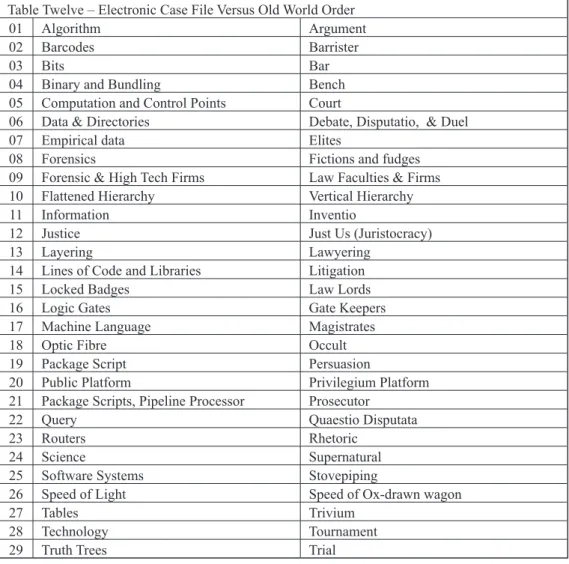
Table Twelve – Electronic Case File Versus Old World Order
Table Twelve – Electronic Case File Versus Old World Order
01 Algorithm Argument
02 Barcodes Barrister
03 Bits Bar
04 Binary and Bundling Bench 05 Computation and Control Points Court
06 Data & Directories Debate, Disputatio, & Duel
07 Empirical data Elites
08 Forensics Fictions and fudges
09 Forensic & High Tech Firms Law Faculties & Firms 10 Flattened Hierarchy Vertical Hierarchy
11 Information Inventio
12 Justice Just Us (Juristocracy)
13 Layering Lawyering
14 Lines of Code and Libraries Litigation
15 Locked Badges Law Lords
16 Logic Gates Gate Keepers
17 Machine Language Magistrates
18 Optic Fibre Occult
19 Package Script Persuasion
20 Public Platform Privilegium Platform 21 Package Scripts, Pipeline Processor Prosecutor
22 Query Quaestio Disputata
23 Routers Rhetoric
24 Science Supernatural
25 Software Systems Stovepiping
26 Speed of Light Speed of Ox-drawn wagon
27 Tables Trivium
28 Technology Tournament
29 Truth Trees Trial
7.9 Review
The initial answer to the Ruwen Ogien question of 2013 is four fold: (1) Resurgent Past driven by (2) the Genre Expression of Pastoral Power through (3) the Global Expansion of Judicial Power, and (4) the covert remilitarization of the Court, the legal industry, and the Justice Sector by Capstone JIMP JOE Network-Centric Warfare practices promoted by the USA Department of Defence, Homeland Security, and USA military as part of Operations Afghanistan Enduring Freedom and Iraqi Enduring Freedom. Genre Expression with its semiotic readout explains how humans become hoggish hooligans,
short-legged, and swarming locusts with IQs lower than the common fly and slime mould rather than intelligent grasshoppers. As Roland Barthes wrote in The Semiotic Challenge, ’The world is incredibly full of old rhetoric”. Or, as Michel Foucault put it in 1978: “There has never been an anti-pastoral revolution. The pastorate has not yet experienced the process of profound revolution that would have definitively expelled it from history” (Ibid: 200-201). Equally, the modes of economic production associated with the Genre Expression of the Court Society produce the large-scale psychological characteristics observed across the millennium. It is surprising how far and how well the ’James Lexicon Bundle’ (2010) travels in Time Columns One and Two through the Saussurean Stacks. Either the James Lexicon Bundle is more universal than Haiti or the Haiti experience is more universal than supposed.
7.10 Summary
The broader answer to the great 2013 question of Ruwen Ogien is the return or resurgence of the “Hierarchy of Genres”. In this Neo-Genre Expression, the Court Society is recycling their entitlement to be at the top of the food chain. In other words, Judicial Activism and Solution-Focused Courts have usurped Modern Governance with the Old World Order. It is perhaps not coincidental that James (2010) should have called her book on Haiti ’Democratic Insecurities : Violence, Trauma, and Intervention....’
Major mechanistic insights are gleaned from functional and structural time swipe studies obtained by Saussurean Stacks within the Saussurean hypercube. Binary and ternary complexes of tabs, tags, tiles, threads, and tuples indicate that the Court Society is a malware meme. The entire assemblage of premises behind their claim to governability rests not upon a scientific geometry but a sacred geometry and its Hierarchy of Genres. However, being astrological hallucinations leftover from a lost cosmos, the Court Society is flotsam and jetsam from an ecclesiastic, feudal, medieval, theological epoch cast up on the beach of tomorrow. Here is the crisis in the legal industry, birds put back in yesterdays’ nests, shepherds with crooks ruling modern states. The notion of a cadre of dimorphic (elite) gatekeepers is obsolete. Their malware meme and its legal apartheid can be neutralized by replacing its stovepiped structure with flattened hierarchy.
8 Brief List of Sources
Ames, C. Righteous Persecution : Inquisition, Dominicans, and Christianity in the Middle Ages. Penn: University of Pennsylvania Press.
Barthes, R. 1980. The Semiotic Challenge. Oxford: Basil Blackwell Press.
Benedict, J. 2009. Little Pink House: A True Story of Defiance and Courage. New York: Hachette Book Group.
Berman, H. 1983. Law and Revolution: The Formation of the Western Legal Tradition. Cambridge (Ma): Harvard University Press.
Berman, H. 2003. Law and Revolution II: The Impact of the Protestant Reformations on the Western Legal Tradition. Cambridge (Ma): Harvard University Press.
Bisson, T. (Ed.). 1995. Cultures of Power : Lordship, Status, and Process in Twelfth-Century Europe. Penn: University of Pennsylvania Press.
Bollobás, B. 1998. Modern Graph Theory. New York: Springer.
Broedel, H. 2003. The Malleus Maleficarum and the Construction of Witchcraft : Theology and Popular Belief. Manchester: Manchester University Press.
Brundage, J. 2008. The Medieval Origins of the Legal Profession. Chicago: CUP.
Carrese, P. 2003. The Cloaking of Power : Montesquieu, Blackstone, and the Rise of Judicial Activism. Chicago: Chicago University Press.
Chabris, C., & D. Simons. 2009. The Invisible Gorilla : How Our Intuitions Deceive Us. New York: Broadway Paperbacks.
Coglianese, C. (Ed.). 2012. Regulatory Breakdown : The Crisis of Confidence in U. S. Regulation. Penn: University of Pennsylvania Press.
Dobbs, D. 2013. “Die, selfish gene, die”. Aeon magazine. http://aeon.co/magazine/ nature-and-cosmos/ why-its-time-to-lay-the-selfish-gene-to-rest/
Duhem, P. 1985. Medieval Cosmology : Theories of Infinity, Place, Time, Void, and the Plurality of Worlds. Translator, Ariew, R. Chicago: Chicago University Press.
Forrest, I. 2005. The Detection of Heresy in Late Medieval England. Oxford: Oxford University Press. Foucault, M. 1978. ’Security, Territory, Population’: Lectures at the Collège De France. Edited by M. Senellart. Translated by G. Burchell. New York: Picador.
Fukuyama, F. 1999. The Great Disruption: Human Nature and the Reconstitution of Social Order. New York: The Free Press.
Given, J. 1997. Inquisition and Medieval Society. Ithaca: Cornel University Press. Harnett, I. 2014. ’Mimetic Morphs 6 : Time Column One.’ Kinjo Gakuin Daigaku Ronshu. Studies in Humanities, Vol. 11, No. 1, September 2014.
Hefferman, M. 2011. Willful Blindness : Why We Ignore the Obvious at Our Peril. New York: Walker Publishing House.
Hirschel, R. 2004. Towards Juristocracy : The Origins and Consequences of the New Constitutionalism. Harvard: Harvard University Press.
Grant, E. 1996. Planets, Stars, and Orbs : The Medieval Cosmos 1200 – 1687. Cambridge: Cambridge University Press.
Iogna-Prat, D. 2002. Order and Exclusion : Cluny and Christendom face Heresy, Judaism, and Islam (1000-1150). Translator, Edwards, G. Cornell: Cornell University Press.
James, E. 2010. Democratic Insecurities : Violence, Trauma, and Intervention in Haiti. Berkeley: University of California Press.
Kelly, H., 2001. Inquisitions and Other Trial Procedures in the Medieval West. Aldershot: Ashgate Variorum.
Kolpacoff Deane, J. 2011. A History of Medieval Heresy and Inquisition. Lanham: Rowman & Littlefield. Komatsu E. & R. Harris. 1993. Saussure’s Third Course of Lectures on General Linguistics (1910-1911). Oxford: Pergamon Press.
Kramer, A., Guillory, J., & Hancock, J. 2014. ’Experimental evidence of massive-scale emotional contagion through social networks.’ PNAS. Vol. 111. Number 24. 8788-8790. doi: 10.1073/ pnas.1320040111
Lewontin, R. Rose, S., & L. Kamin. 1984. Not In Our Genes : Biology, Ideology, and Human Nature. New York: Random House.
Malleson, K., & P. Russell (Eds.). Appointing Judges in An Age of Judicial Power : Critical Perspectives from Around the World. Toronto: Toronto University Press.
Moore. R. 1987. The Formation of a Persecuting Society. Oxford: Blackwell. Moore, R. The First European Revolution (c. 970-1215). Oxford: Blackwell.
Nirenberg, D. 1996. Communities of Violence : Persecution of Minorities in the Middle Ages. Princeton. Princeton University Press.
Ogien, J. 2013. L’État Nous Rend-il Meilleurs. Barcelona: Éditions Gallimard.
Patel, D. 2014. ’Complete pairing not needed’. Science 31 October 2014: Vol. 346 no. 6209 pp. 542-543 DOI: 10.1126/science.1262123
Reinhard, W. (Ed.). 1996. Power Elites and State Building. New York: Oxford University Press. Russell, J., & R. Cohn. 2012. Regulatory Capture. Edinburgh: Bookvika.
Robertson, I. 2012. The Winner Effect : The Neuroscience of Success and Failure. New York: St Martin’s Press.
Sega, H. 2014. Zetsubo no Saibansho (Courts Without Hope). Tōkyō : Kōdansha.
Shleifer, A., & R. Vishny. 1998. The Grabbing Hand : Government Pathologies and Their Cures. Harvard: Harvard University Press.
Sorge, J. 2013. ’Divorce Corp’ (Film).
Stone Sweet, A. 2000. Governing with Judges: Constitutional Politics in Europe. Oxford: Oxford University Press.
Talhelm, T., X. Zhang, S. Oishi, C. Shimin, D. Duan, X. Lan, and S. Kitayama. 2014. ’Large-Scale Psychological Differences Within China Explained by Rice Versus Wheat Agriculture.’ Science. Vol. 344, 9 May, pp 603 – 608.
Tate, N., & Vallindar T. (Eds.). 1995. The Global Expansion of Judicial Power. New York: University of New York Press.
Van Nouhuys, T. 1998. The Age of the Two-Faced Janus : The Comets of 1577 and 1618 and the Decline of the Aristotelian World Vie win the Netherlands. Leiden: Brill.
Wedel, J. 2009. Shadow Elite: How the World’s New Power Brokers Undermine Democracy, Government, and the Free Market. New York: Basic Books.
Westra, L. 2012. Faces of State Terrorism. Leiden: Brill.
Cambridge University Press.
Zambelli, P. (Ed.). 1986. Astrologi Hallucinati : Stars and the End of the World in Luther’s Time. Berlin: Walter de Gruyter.
Zerubavel, E. 2006. The Elephant in the Room: Silence and Denial in Everyday Life. Oxford: Oxford University Press.