
多特徴CRFに基づくオンラインレビューからの料理名データベースの構築
2
0
0
全文
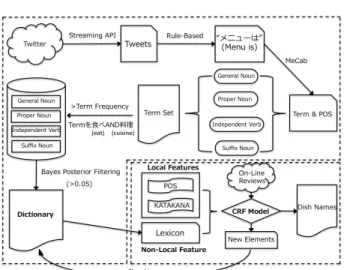
(2) 情報処理学会第 76 回全国大会. 4.Evaluation experiment For constructing dictionary of dish elements, we use tweets as the data source in which 37443 cuisines related messages are collected within 24days by twitter authority API. Meanwhile we utilize web crawler to snatch reviews from Tabelog as training set and testing set for CRF learning proceeding. The data set includes 27997 on-line registered restaurants where 185494 reviews are written. We randomly select 500 reviews as experimental sample that is annotated by one person within 3 days. We adopt 10fold cross validation to evaluate the experimental results with 90% for training and 10% for testing. We can see the statistics in table 1. Table 1: Statistics of data set Data Set Statistics Tabelog #(reviews): 185494 #(Restaurants): 27997 Experiment Data #(reviews): 500 Training Set: 90% Testing Set: 10% Dictionary #(Tweets): 37443 In the experiment, we consider two baselines. One is dictionary looking up, and another is CRF+Term. In table 2, 3, 4, symbol T, P, D, K, B and I denote term, part-of-speech, dictionary, KATAKANA and iteration respectively. The forth column F1 score is calculated by the second and the third columns. The fifth column is standard deviation of F1 score. The proceeding of experiment is completed through adding each local feature and non-local feature into system step by step. Following, we will evaluate the results of baseline and our method. Table 2 shows low precision and recall of only using dictionary. The reason is many terms in the dictionary cannot be as dish name independently, and many dish name elements are not collected into the dictionary. So, it is not available for only using the dictionary as NER method. For using CRF and T, although high precision (91.14%) can be acquired, a low recall (54.39%) also appears simultaneously. That is a common problem of the NER systems that often achieve high precision accompanied with low recall. Following, we add the other features into CRF progressively. In the first step, term as unique feature is used to test second baseline that can acquire high precision. Next, we add the POS into the proceeding, and it brings huge increase on recall and F1 score. As mentioned above, most of elements consisting of Japanese dish name belong to these four types of partof-speech. Therefore, they could be considered as powerful observations for sequence recognition. As rows 5 and 6 in table 2, KATAKANA hardly contributes anything to final results. By observation on training data, we find KATAKANA accounts for a small proportion in data set. But we cannot ignore it.. 2-32. There exist large mount foreign dish names in Japanese, especially in ethnic cuisine. So, we experiment on another data set that is extracted with a large number of foreign dish names by handicraft. In table 4, we can see that KATAKANA plays an important role in elevating recall. Table 2: Results for CRF+Features Pre.% Re.% F1% DICTIONARY 70.7 42.7 53.25 CRF+T 91.14 54.39 68.06 CRF+T+P 88.66 71.47 79.08 CRF+T+P+D 88.37 74.39 80.68 CRF+T+P+D+K 88.19 74.44 80.65 CRF+T+P+D+K+I 88.76 75.52 81.11. SD% 3.32 2.11 2.75 2.43 2.42. Table 3: Results for Combining with Bayes Posterior Pre. % Re.% F1% SD% CRF+T+P+D+B 88.25 79.41 83.54 2.94 CRF+T+P+D+K+B 88.41 78.99 83.37 2.89 CRF+T+P+D+K+B+I 87.49 81.61 84.38 2.48 Table 4: Results for adding KATAKANA Pre. % Re.% F1% CRF+T+P+D+B+I 87.12 73.72 79.86 CRF+T+P+D+B+K+I 87.23 78.84 82.82 According to the non-local dictionary feature, we divide the experiment into two parts - the first part uses whole dictionary without dealing with Bayes posterior and another uses the dictionary processed by Bayes posterior. From row 4 to 6 in table 2, a small increase can be observed in proceeding of adding D, K, and I without Bayes posterior. In table 3, an evident increase can be achieved by the dictionary filtered with Bayes posterior compared with table 2, and there is a little loss of precision as the compensation. High recall is beneficial for getting enough information in cuisine documents.. 5.Future work In the future, we will build Japanese cuisine database using probabilistic graphical model and extract sentiment from on-line reviews for judging users’ opinion. Finally we will provide location and time based cuisine recommender service for users.. Reference [1] R. Tsai and C. Chou. Extracting dish names from Chinese blog reviews using suffix arrays and a multi-modal CRF model. In First International Workshop on Entity-Oriented Search. ACM SIGIR, 2011. [2] X. Liu, S. Zhang, F. Wei, and M. Zhou. Recognizing named entities in tweets. In Proceedings of the 49th Annual Meeting of the Association for Computational Linguistics: Human Language Technologies, Portland, Oregon, June 19-24 2011.. . Copyright 2014 Information Processing Society of Japan. All Rights Reserved..
(3)
図
関連したドキュメント
The proof uses a set up of Seiberg Witten theory that replaces generic metrics by the construction of a localised Euler class of an infinite dimensional bundle with a Fredholm
In this paper, we employ the homotopy analysis method to obtain the solutions of the Korteweg-de Vries KdV and Burgers equations so as to provide us a new analytic approach
For computing Pad´ e approximants, we present presumably stable recursive algorithms that follow two adjacent rows of the Pad´ e table and generalize the well-known classical
Using the batch Markovian arrival process, the formulas for the average number of losses in a finite time interval and the stationary loss ratio are shown.. In addition,
In this work, we proposed variational method and compared with homotopy perturbation method to solve ordinary Sturm-Liouville differential equation.. The variational iteration
We also show that the Euler class of C ∞ diffeomorphisms of the plane is an unbounded class, and that any closed surface group of genus > 1 admits a C ∞ action with arbitrary
Keywords: Artin’s conjecture, Galois representations, L -functions, Turing’s method, Riemann hypothesis.. We present a group-theoretic criterion under which one may verify the
Hence, for these classes of orthogonal polynomials analogous results to those reported above hold, namely an additional three-term recursion relation involving shifts in the
